VIR MDF vs Rushil MDF: Neutral Comparison Checklist (Grade, Finish, Availability)
Comparing MDF brands? Use this neutral checklist—grade options, calibration, finishes, supply consistency, and service—to choose confidently.
Note: This is independent informational content and is not affiliated with any manufacturer.
Quick Decision Summary
Both VIR MDF and Rushil MDF typically offer interior, exterior, and water-resistant grades in standard sizes; select based on verified local stock, thickness tolerance, and finish matching your site's humidity levels.
If you’re in a hurry: Use the checklist below to compare samples side-by-side. Prioritize exterior or HDFWR grades for monsoon-prone or coastal areas in India. Check edge straightness and surface smoothness on-site, as batch variations affect real-world performance in kitchens or wardrobes. Availability often favors larger cities, so confirm lead times for remote sites. Trade-offs include higher density for better screw hold but added weight for handling.
- Choose VIR MDF if pre-laminated finishes in matte or textured options suit your modular workflow and local dealers stock 8x4 sheets readily.
- Choose Rushil MDF if plain boards for custom lamination are needed with consistent calibration across thicker slabs.
- Avoid either if unverified samples show warping after 24-hour humidity test; opt for on-site trials first.
What This Material/Option Actually Is
MDF, or medium-density fiberboard, is an engineered panel made by compressing wood fibers with resins under heat and pressure. VIR MDF and Rushil MDF represent market options in interior-grade (standard dry-use), exterior-grade (moisture-tolerant), and HDFWR (high-density water-resistant) variants. These come as plain boards for post-lamination or pre-laminated with melamine faces.
Standard sizes include 8 ft x 4 ft, 8 ft x 6 ft, and 6 ft x 4 ft, with thicknesses from 3 mm to 25 mm. They fit modular interiors like wardrobes, kitchen shutters, and partitions, offering smoother surfaces than plywood for CNC routing and painting.
Is VIR MDF different from regular MDF?
VIR MDF typically features branded grades like PRO for interiors and PROPLUS for exteriors, with options for pre-lamination. It matches standard MDF in composition but emphasizes consistent density for Indian workflows. Nuance: Batch calibration varies, so measure thickness at edges and center. Next step: Request samples and tap for uniform sound—hollow tones signal low density.
What grades does Rushil MDF offer?
Rushil MDF provides similar interior, exterior, and HDFWR boards, often in plain or pre-finished forms. Key for India: Exterior grades handle 70-80% humidity better. Conditions: Thicker options (16-18 mm) suit load-bearing shelves. Check: Weigh a sample square; higher weight indicates better compaction for screw holding in humid sites.
Why It Matters in Indian Homes and Sites
In India, monsoon humidity (up to 90%) and coastal salt air accelerate MDF swelling if not moisture-resistant. Poor storage during transport from Gujarat hubs leads to edge delamination. Site realities like open-site exposure before installation cause 10-20% wastage from warping.
Practical impacts: Weak screw hold in wardrobes fails under heavy loads; scratched finishes in TV units show dirt faster. Choosing grades wisely cuts callbacks by ensuring stability in wet zones like kitchens.
Two-Minute Comparison (What Changes in Real Life)
Side-by-side evaluation reveals overlaps in offerings, with differences in local stock and finish variety. Focus on verifiable traits like calibration (thickness variance under 0.2 mm) and surface scratch resistance.
| Aspect | VIR MDF | Rushil MDF | Key Decision Check |
|---|---|---|---|
| Grade Options | Interior (PRO), Exterior (PROPLUS), HDFWR (MAXPRO) | Interior, Exterior, Moisture-Resistant variants | Match to humidity: HDFWR for kitchens |
| Thickness Range | 3.3-25 mm (e.g., 5.5, 16, 18 mm common) | 3-25 mm, focused on standard slabs | Measure ±0.1 mm tolerance |
| Finishes | Pre-lam matte, textured, plain | Plain boards, some pre-finishes | Test rub resistance on sample |
| Availability | Pan-India via distributors, strong in West/South | Widespread in North/Central, bulk focus | Confirm 48-hr delivery |
| Calibration | Typically uniform for CNC | Consistent density reported | Check edge straightness with level |
Choose based on conditions: VIR for ready finishes in fast projects; Rushil for custom lamination in dry interiors.
Grade Options: What to Evaluate
Grades define moisture tolerance: Interior for bedrooms (under 65% RH), exterior for bathrooms, HDFWR for coastal kitchens. VIR and Rushil both cover these, but verify density (650-750 kg/m³ standard). Thicker grades (18 mm+) handle sagging better in humid wardrobes.
Which grade for monsoon-heavy areas?
HDFWR or exterior grades work best, resisting swelling up to 24 hours in 90% humidity. Nuance: Interior grades fail faster in un-AC sites. Check: Expose sample to damp cloth overnight; no buckling means suitable.
Finish and Surface Quality Breakdown
Pre-laminated finishes (melamine) offer matte or gloss; plain boards need separate lamination. Evaluate scratch resistance by fingernail test—gloss shows marks easier. In India, matte suits dusty sites to hide fingerprints.
How to compare finishes between brands?
Inspect under light for orange-peel texture; smoother means better CNC paint adhesion. Conditions: Textured for high-touch areas. Next: Rub with dry cloth 50 times; no fading passes.
Availability and Supply Consistency
Both options distribute pan-India from Gujarat bases, but stock varies: metros have 8x4 ready, Tier-2 needs 3-7 days. Bulk orders ensure matching batches to avoid shade mismatch in large wardrobes.
Where is VIR MDF most available?
Strong in South/West India; check local yards for 16 mm stock. Nuance: Seasonal demand spikes pre-monsoon. Verify: Call for batch numbers matching your order.
Price Range and Cost Drivers
Plain interior MDF ranges ₹40-₹80 per sq ft; exterior/HDFWR ₹60-₹120; pre-lam adds ₹15-₹30. Drivers: Thickness (18 mm doubles cost), density, finish (textured higher), logistics (North adds 10-15%), city (metros 20% premium), wastage (5-10% from cuts).
Example: Wardrobe (50 sq ft, 18 mm exterior) totals ₹4,000-₹7,000 excluding edges. Quote checklist: Specify size/thickness/grade/quantity/location; ask for batch sample.
Decision Framework Table
| Site Condition | Recommended Grade/Finish | What to Verify |
|---|---|---|
| Wet zone (kitchen) | HDFWR, matte pre-lam | Swelling test, density >700 kg/m³ |
| Coastal humidity | Exterior, sealed edges | Salt spray sample test |
| Heavy use (kids' room) | 18 mm thick, textured | Screw hold (10 pulls) |
| Tight budget | Interior plain, 12 mm | Calibration under 0.2 mm |
| Fast delivery | Stock 8x4 pre-lam | Lead time <48 hrs |
| High scratch risk | HDFWR matte | Finger rub test |
Quality Checks You Can Do Without Lab Tests
Before buying: Tap board—uniform thud means even density; check edges for fuzziness. Ask: Batch date, density kg/m³, moisture content (<10%). Red flags: Bowed sheets, color variance.
After cutting: Edges should not crumble; sand lightly for smoothness. Installation: Seal all cuts with primer; align hinges on 30 mm zones.
Quick field test for calibration?
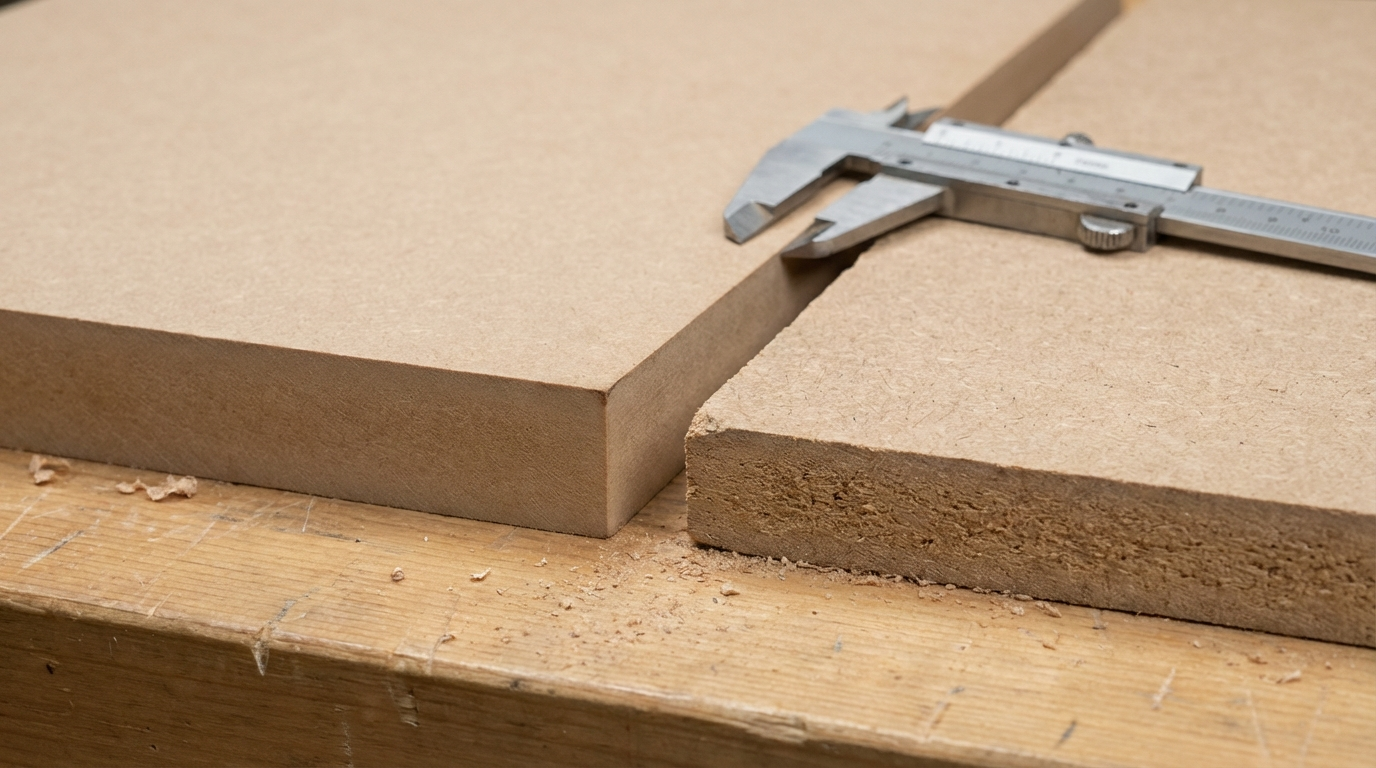
Use calipers on four corners and center; variance over 0.3 mm signals poor pressing. Nuance: Thicker boards tolerate more. Next: Reject if uneven for CNC.
Common Buyer Mistakes (and How to Avoid)
- Mistake: Ignoring grade—using interior in kitchen. Avoid: Map rooms to RH levels.
- Mistake: No sample test. Avoid: Buy one sheet first.
- Mistake: Skipping edge sealing. Avoid: Prime all cuts pre-install.
- Mistake: Overlooking thickness tolerance. Avoid: Measure multiples.
- Mistake: Bulk buy without batch match. Avoid: Note numbers.
- Mistake: Dry storage ignored. Avoid: Stack horizontally, elevate.
- Mistake: Wrong screws—loose hold. Avoid: 4-5 mm pilot holes.
- Mistake: Finish mismatch to site. Avoid: Rub test in light.
- Mistake: No wastage buffer. Avoid: Add 10% extra.
Failure Modes and Fixes
1. Edge swelling: Symptom: Bulging after rain. Cause: Unsealed cuts in humidity. Prevention: Apply edge tape/primer. Fix: Sand and reseal if minor.
2. Screw pull-out: Symptom: Hinges loosen. Cause: Low density. Prevention: Thicker boards, pilot holes. Fix: Reinforce with inserts.
3. Surface scratches: Symptom: White marks. Cause: Gloss finish, abrasion. Prevention: Matte/textured. Fix: Buff lightly.
4. Delamination: Symptom: Peeling layers. Cause: Moisture ingress. Prevention: HDFWR grade. Fix: Replace affected panel.
5. Warping: Symptom: Bowed shelves. Cause: Uneven moisture. Prevention: Acclimatize 48 hrs. Fix: Shim and brace.
6. Chipping on cuts: Symptom: Frayed edges. Cause: Dull blade. Prevention: Use 60-tooth blade. Fix: Sand and band.
Advice for Homeowners
Durability do: Wipe with microfiber damp cloth; avoid harsh cleaners. Don’t: Drag heavy items. Focus on sealed kitchens for 5+ year life.
Advice for Carpenters
Cutting: Zero-clearance insert for clean edges. Fastening: Space screws 100 mm, predrill. Handling: Gloves to prevent oils.
Advice for Architects/Designers
Specs: Detail HDFWR for wet zones, 18 mm min shelves. Finishes: Match to traffic. Precautions: Ventilation drawings.
Advice for OEM/Modular Makers
Repeatability: Batch-test density. QC: 5% sample checks. Reduce returns: Pre-seal edges in factory.
Best for wardrobes in humid cities?
Exterior 18 mm with PVC edge band resists sagging. Nuance: Add back vents. Check: Load test sample shelf.
FAQs
How do VIR and Rushil compare in water resistance?
Both provide exterior and HDFWR grades suited for moderate humidity, but performance depends on batch density and sealing. In Indian monsoons, HDFWR variants typically hold up better in unventilated spaces like utility areas. Always acclimatize sheets indoors for 48 hours before cutting to minimize risks. Verify by pressing a damp cloth on the edge for 12 hours—no visible swelling indicates good tolerance for coastal projects.
Which has better thickness options for shelves?
Options overlap in 16-18 mm ranges ideal for spanning 600 mm without sag. Thicker suits loaded wardrobes; thinner for partitions. Factors like density affect real strength—test by loading sample progressively. In practice, pair with brackets every 400 mm for safety in home setups.
Are pre-lam finishes durable enough for kitchens?
Matte pre-lams from either option withstand daily wipes if sealed properly, but avoid prolonged water contact. Trade-off: Glossier shows scratches faster in high-use. Clean with mild soap; lasts 3-5 years with care. For steam-heavy counters, overlay with quartz.
What about availability in Tier-2 cities?
Stock is reliable in metros but may require 3-5 days in smaller towns; bulk ensures consistency. Check distributor networks for 8x4 standards. Tip: Order early for peak seasons to avoid delays impacting site timelines.
How to check screw holding without tools?
Insert a screw by hand, twist 10 times; resistance without stripping signals good density. Predrill always for hinges. In humid sites, use coated screws to prevent corrosion loosening.
Can I use interior grade in bathrooms?
Not recommended—swells under shower steam. Switch to exterior with ventilation. If must, seal all six sides thickly and monitor first monsoon. Better: PVC alternatives for longevity.
Differences in CNC routing?
Both route smoothly if calibrated; watch for chip-out on pre-lams. Use upcut bits, low feed speed. Post-rout: Vacuum dust to prevent resin gumming tools.
Storage tips during Indian summers?
Stack flat, cover with tarp, elevate off ground. Avoid direct sun—heat warps thin sheets. Ideal: 20-25°C, 40-50% RH for 7 days pre-use.
Edge banding compatibility?
Standard PVC bands (0.45 mm) fit both; heat-activated glue works best. Clean edges first. For curves, thinner boards flex easier without cracking.
Cost savings tips for bulk buys?
Negotiate on plain boards, add 10% buffer for cuts. Compare per sq ft landed cost including transport. Thinner for non-structural saves 20-30%.
Disclaimer: This content is provided for general informational purposes based on industry practices and publicly available information. Product specifications, standards, prices, and availability may vary by manufacturer, region, and time. Readers should independently verify details with manufacturers, dealers, or qualified professionals before making purchase or construction decisions.Want Plywood Suggestions?
Share a few details and a VIR MDF specialist will suggest suitable brands and connect you to responsive dealers.