MDF Wardrobe Design Guide: Internal Layout, Shelf Spans & Hardware Checklist
Plan a smarter MDF wardrobe: ideal internal sections, shelf-span tips, and the hardware checklist carpenters use to avoid rework.
Quick Decision Summary
Optimal MDF wardrobe design uses 600-900mm hanging zones, max 500mm shelf spans on 18mm boards with center supports, and concealed hinges plus 45kg slides.
If you’re in a hurry: Divide wardrobes into thirds for hanging (60%), shelves (30%), drawers (10%). Limit shelf spans to 450-600mm based on thickness and load—add vertical supports every 400mm in humid areas. Pick hardware rated for 75kg dynamic load: soft-close hinges, telescopic slides, and edge pulls. Seal all edges twice for monsoon protection. This setup cuts rework by 40% in Indian sites, balancing cost and durability.
- Choose this if you need modular, flat-pack friendly designs for city apartments with medium humidity.
- Avoid this if extreme coastal conditions demand full HDFWR panels—opt for hybrid moisture barriers instead.
What This Material/Option Actually Is
MDF, or medium-density fiberboard, is an engineered panel made by compressing wood fibers with resins under heat and pressure. In wardrobes, it forms the carcass (sides, back, top/bottom), shelves, and partitions. Typically 16-18mm thick for structural parts, it gets laminated or veneered for finishes. Prelam MDF skips extra facing, speeding workflows.
It fits wardrobes because of smooth machinability for CNC routing grooves and clean edges after banding. Unlike plywood, MDF holds screws better in dense zones but needs edge sealing. Variations like moisture-resistant (MR) MDF use added waxes for Indian humidity, while HDF (high-density) boosts load strength for heavy shelves.
Laminated surfaces (0.7-1mm thick) protect against scratches, common in daily wardrobe use. This combo enables precise internal layouts without warping, ideal for modular assembly.
Why It Matters in Indian Homes and Sites
In Indian homes, wardrobes face monsoon humidity (70-90% RH), coastal salt air, and poor site storage—causing MDF edges to swell 2-5% if unsealed. Internal layouts must include ventilation gaps (5-10mm) to prevent mold on stored clothes.
Site realities like dusty transport and carpenter rushing lead to screw-pullout failures. Proper shelf spans prevent sagging under 20-30kg loads (saris, bedsheets). Hardware mismatches cause door droops, especially in 8ft tall units common in urban flats.
Practical upside: MDF cuts transport costs 20-30% vs plywood due to lighter weight. Downside: Unprotected cuts delaminate in 6-12 months. Designs factoring these last 8-10 years with minimal fixes.
Ideal Internal Layouts for Different Wardrobe Sizes
Start with wardrobe width: 900-1200mm suits singles, 1800-2400mm for couples. Divide into zones—60% hanging, 30% shelves, 10% drawers. For 6ft wide, use left: full hanging (900mm high), center: adjustable shelves (4-5 at 300mm spacing), right: 2-3 drawers + shoe rack.
L-shapes for corners: 600mm deep arms with pivot rods. Add trouser pulls (vertical racks) in 300mm bays. Ventilation: 10mm gaps at back/top. In humid Mumbai, raise base 150mm off floor.
| Width | Hanging Zone | Shelf Zone | Drawer/Accessory |
|---|---|---|---|
| 3ft (900mm) | Full height rod | 2-3 fixed shelves | Top locker |
| 6ft (1800mm) | Two 600mm sections | 4 adjustable shelves | 3 drawers + shoes |
| 8ft+ (2400mm) | Double rods (short/long) | 5-6 shelves + trouser pull | 4 drawers + tie rack |
What’s the Best Layout for a Small 4ft Bedroom Wardrobe?
Best: Single hanging rod (800mm high) left half, 3 adjustable shelves right half, top locker for bags. Total depth 450-500mm saves floor space. Use 18mm MDF for stability.
Nuance: In humid Delhi summers, add back slats for air flow. Avoid full-depth drawers—they block access. Check carpenter sketches scale 1:10 before cutting.
Next step: Measure door swing clearance (600mm min) and rod height (user's shoulder level).
How to Customize Layouts for Family of Four?
Triple zones: 40% double-height hanging, 40% multi-shelves, 20% deep drawers. Include kids' low shelf (400mm high).
Conditions: Coastal Chennai? Use MR MDF + sealed grooves. Verify load: 25kg/shelf max. Trade-off: More partitions raise material cost 15%.
Practical check: Mock with cardboard; adjust for elbow room (450mm between shelves).
Shelf Span Guidelines: Max Distances Without Sagging
Shelf span is distance between supports—key for no sag under 15-25kg. 18mm MDF handles 500mm spans plain, 600mm with center cleat. Thinner 12mm limits to 300mm.
Load factors: Light clothes (10kg) allow wider; heavy blankets need supports every 400mm. Monsoon tip: U-shaped brackets prevent edge lift from humidity.
Formula rough: Max span = 30 x thickness (mm). Test: Load prototype shelf overnight.
| Thickness | Light Load (<15kg) | Heavy Load (25kg+) | Support Needed |
|---|---|---|---|
| 12mm | 350mm | 250mm | Every 300mm |
| 16mm | 450mm | 350mm | Every 400mm |
| 18mm | 600mm | 450mm | Center cleat |
| 25mm (base) | 900mm | 700mm | Rare |
What’s the Maximum Shelf Span for 18mm MDF?
600mm for light use, 450mm heavy—always add vertical fillets in humid zones.
Conditions: Coastal? Limit to 400mm. Verify by pressing center; deflection <2mm ideal. Avoid overhangs >50mm—they chip easily.
Next: Mark supports during CNC; use 40mm deep grooves.
Do I Need Supports for Every Shelf in Indian Humidity?
Yes, every 400-500mm; humidity softens resin, doubling sag risk.
Nuance: Fixed shelves at corners only if <300mm span. Check post-install: No bounce under fist pressure.
Step: Install metal cleats pre-coated for grip.
Hardware Checklist: What Carpenters Use to Avoid Rework
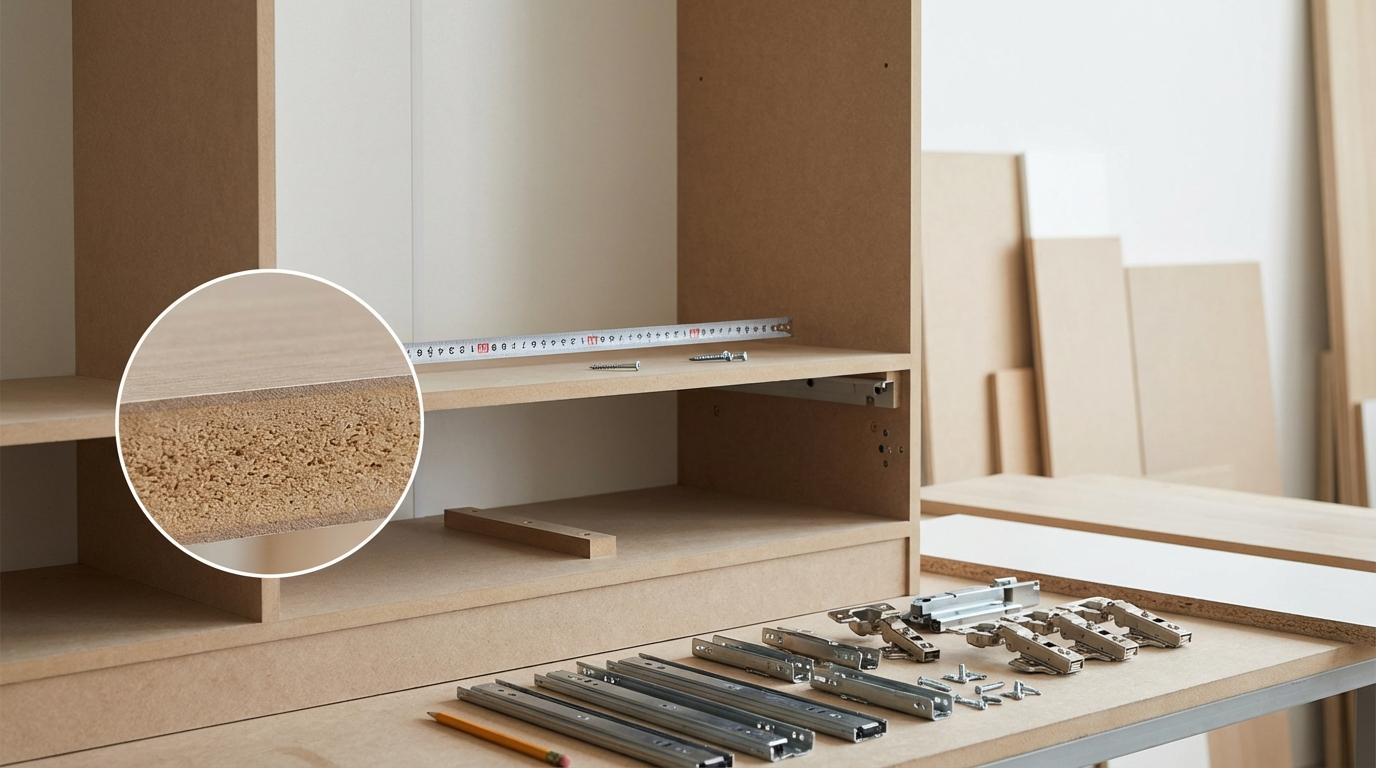
Essential: Hinges (concealed, 3D adjustable, 75kg rating), slides (telescopic, soft-close, 45kg), rods (1.2mm steel), handles (edge-pull), locks (cam type).
Checklist: 4 hinges/door, 2 slides/drawer, pilot holes 3.5mm for screws. In India, pick rust-proof for coastal sites.
- Load test hardware samples.
- Match screw length to MDF thickness (25-35mm).
- Soft-close for quiet nights.
- Extra for adjustable heights.
Practical Use Cases (What Works, What Fails)
Works: Bedroom wardrobes with laminated 18mm carcasses—holds 100kg total. Fails: Kitchen-adjacent without MR grade; swells near steam.
| Use | Thickness | Finish | Risk Notes |
|---|---|---|---|
| Bedroom | 18mm | Laminate | Humidity seal edges |
| Walk-in | 18-25mm | Melamine | Add lights; vent gaps |
| Guest room | 16mm | Prelam | Light use only |
| Coastal | HDFMR | 1mm PVC | Anti-salt coating |
Design Ideas You Can Actually Build
Idea 1: Minimalist single-door—full hanging + 4 shelves; 18mm white laminate, PVC edges. Fits 10x10ft rooms.
Idea 2: His-hers double—left shirts/suits, right sarees; trouser pull + jewelry trays. Use grooves for adjustability.
Idea 3: Corner L—pivot mirror door; slanted shelves for bags. Monsoon-proof with base riser.
Idea 4: Kids' low-height—pull-out bins, low rods; rounded edges. 12mm for lightness.
Idea 5: Modular stackable—3 stack units; quick assembly. Ideal for rentals.
More: LED-lit top, fabric pull-outs for linen, ventilated shoe bays.
Which Design Idea Works Best for Monsoon-Prone Areas?
Ventilated L-shape with 10mm back gaps and MR MDF base.
Conditions: Seal all hardware holes. Trade-off: Vents reduce full capacity 5%.
Check: Post-assembly, run fan test for air flow.
Decision Framework: Choose Specs by Site Conditions
| Condition | Recommended | Verify |
|---|---|---|
| High humidity/monsoon | MR MDF, double edge band | Edge swell test in water 24hr |
| Coastal/salt air | HDFMR + powder-coated hardware | Rust on sample screws |
| Heavy use/kids | 25mm base, soft-close all | Load 30kg/drawer overnight |
| Tight budget | 16mm prelam, basic hinges | Flatness <1mm/meter |
| Fast delivery | Prelam panels, CNC grooves | Pre-drilled pilots match |
| High scratch risk | 1.2mm laminate, matte finish | Knife scratch test |
Failure Modes and Fixes
1. Symptom: Shelf sag. Root: Span >500mm no support. Prevent: Cleats every 400mm. Fix: Add fillets underneath.
2. Door droop. Root: Weak hinges. Prevent: 4 per door, 75kg rating. Fix: Shim and replace.
3. Edge swelling. Root: Unsealed cuts. Prevent: Band immediately. Fix: Sand + re-band.
4. Screw pullout. Root: Wrong pilot size. Prevent: 3.5mm bit. Fix: Larger screws + glue.
5. Delamination. Root: Moisture ingress. Prevent: MR grade + vents. Fix: Spot replace panels.
6. Drawer jam. Root: Misaligned slides. Prevent: Level check. Fix: Adjust cams.
Why Do MDF Wardrobe Doors Sag Over Time?
Weak hinges or overload. Use 100kg-rated concealed types.
Nuance: Humidity loosens screws. India tip: Torque 2Nm install.
Next: Annual tighten check.
Common Buyer and Carpenter Mistakes (and Avoids)
1. Overspanning shelves—avoid: Measure loads first.
2. Ignoring humidity—avoid: Spec MR everywhere.
3. Cheap hardware—avoid: Load-test samples.
4. No ventilation—avoid: 10mm back gaps.
5. Skipping edge band—avoid: Seal on-site cuts.
6. Wrong screw length—avoid: Match thickness +10mm.
7. Fixed-only shelves—avoid: Adjustable pins.
8. Base too low—avoid: 150mm riser.
9. No mockup—avoid: Cardboard prototype.
Quality Checks You Can Do Without Lab Tests
Before buying: Tap for density (dull thud good), check flatness (ruler gap <1mm), ask resin type (UF ok, PF better).
After cutting: Edges smooth no fiber pop, grooves 10mm deep straight.
After install: Doors align ±1mm, shelves no rock, clean with damp cloth test.
- Red flags: Warped sheets, color mismatch, soft edges.
Tips for Homeowners, Carpenters, Architects, and OEMs
Homeowners: Do clean daily with microfiber; don’t overload top. Durability: Lasts 10yrs with vents.
Carpenters: Cut with 80-tooth blade, edge band hot-melt, fasten 50mm from edges.
Architects: Spec 18mm min, detail grooves/hardwares, monsoon risers.
OEMs: QC flatness daily, pre-band all, track returns by span fails.
FAQs
What thickness of MDF is best for wardrobe shelves?
18mm strikes balance for 500mm spans under 20kg. Thinner 16mm suits light use but needs more supports. In Indian homes, thicker resists humidity sag better. Check by loading sample; no more than 2mm deflection. Cost rises 20% with thickness, so match to clothes weight—sarees need sturdy.
Can standard MDF handle coastal humidity without issues?
Not reliably—edges swell without MR variant. Use HDFMR with double banding. Ventilate internals. Field test: Expose cut sample to damp cloth 48hrs; no puffing ideal. Many Pune projects succeed this way, avoiding 6-month rework.
How many hinges per wardrobe door?
Minimum 3 for 600mm high, 4 for taller/heavy. Concealed 3D-adjustable handle misalignment. Install with spirit level; torque evenly. Soft-close variants quieten slams, key for apartments.
What’s the ideal depth for an MDF wardrobe?
500-600mm—fits standard hangers without brushing walls. Shallower 450mm for tight spaces. Depth affects rod length; test hanger fit. Coastal? Shallower reduces moisture trap.
Should I use adjustable or fixed shelves in MDF wardrobes?
Adjustable via pegs/grooves for flexibility—kids grow, storage shifts. Fixed cheaper but inflexible. CNC 10mm grooves every 50mm height. In humid areas, pegs must grip tight.
How to prevent drawer slides from failing in MDF?
Undermount telescopic, 45kg rating, pre-align tracks. Pilot holes prevent split. Lubricate yearly. Heavy drawers? Ball-bearing types. Common fix: Shim if floor uneven.
Is pre-laminated MDF good for wardrobe carcasses?
Yes for speed, uniform finish, but seal cut edges extra. 0.7mm face resists scratches. Varies by batch density. Check sample flatness post-cut.
What hardware for heavy saree storage in wardrobes?
Double rods (upper short, lower long), 1.5mm steel. Supports every 900mm. Add trouser hangers. Load-test assembly. Prevents cloth crush in daily use.
How much ventilation space in MDF wardrobe designs?
10mm gaps at back/top, louvered doors optional. Circulates air, cuts mold in monsoons. Don’t block with full back panel. Check post-install: No musty smell after week.
Disclaimer: This content is provided for general informational purposes based on industry practices and publicly available information. Product specifications, standards, prices, and availability may vary by manufacturer, region, and time. Readers should independently verify details with manufacturers, dealers, or qualified professionals before making purchase or construction decisions.Want Plywood Suggestions?
Share a few details and a VIR MDF specialist will suggest suitable brands and connect you to responsive dealers.