Calibrated MDF vs Non-Calibrated: Differences, Price Impact & Best Uses
Understand calibrated MDF: what calibration means, when it matters for lamination/painting, and whether the price premium is worth it.
Quick Decision Summary
Calibrated MDF offers uniform thickness and smooth surfaces for superior finishing, worth the premium for visible laminated or painted projects; non-calibrated suffices for hidden or rough uses.
If you’re in a hurry: Opt for calibrated MDF in kitchens, wardrobes, or any laminated/painted application where flatness prevents delamination or uneven paint during monsoons. It cuts post-processing time and boosts finish durability. Non-calibrated works for internal frames or partitions under laminates where surface imperfections get covered. The price gap typically runs 15-30%, driven by sanding precision—verify thickness tolerance on-site to confirm value.
- Choose calibrated if: high-end finishes, CNC routing, wet zones like coastal areas, or pro workmanship expected.
- Avoid calibrated if: tight budgets, hidden structures, bulk rough carpentry, or dry inland sites with low humidity risks.
What Calibrated MDF Actually Is
Calibrated MDF refers to medium-density fiberboard processed through precision sanding machines to achieve uniform thickness across the entire 8x4-foot sheet. This step ensures tight tolerances, often within 0.2-0.3mm variation, compared to non-calibrated sheets that may vary by 0.5mm or more.
It fits into standard MDF categories like MR (moisture-resistant) or plain varieties, used in wardrobes, cabinets, and panels. Non-calibrated MDF skips this final sanding, leaving a rougher surface straight from pressing.
In Indian workflows, calibration bridges raw board to finished products, especially before lamination or painting. It reduces carpenter sanding time and minimizes defects in modular setups.
Why Calibration Matters in Indian Homes and Sites
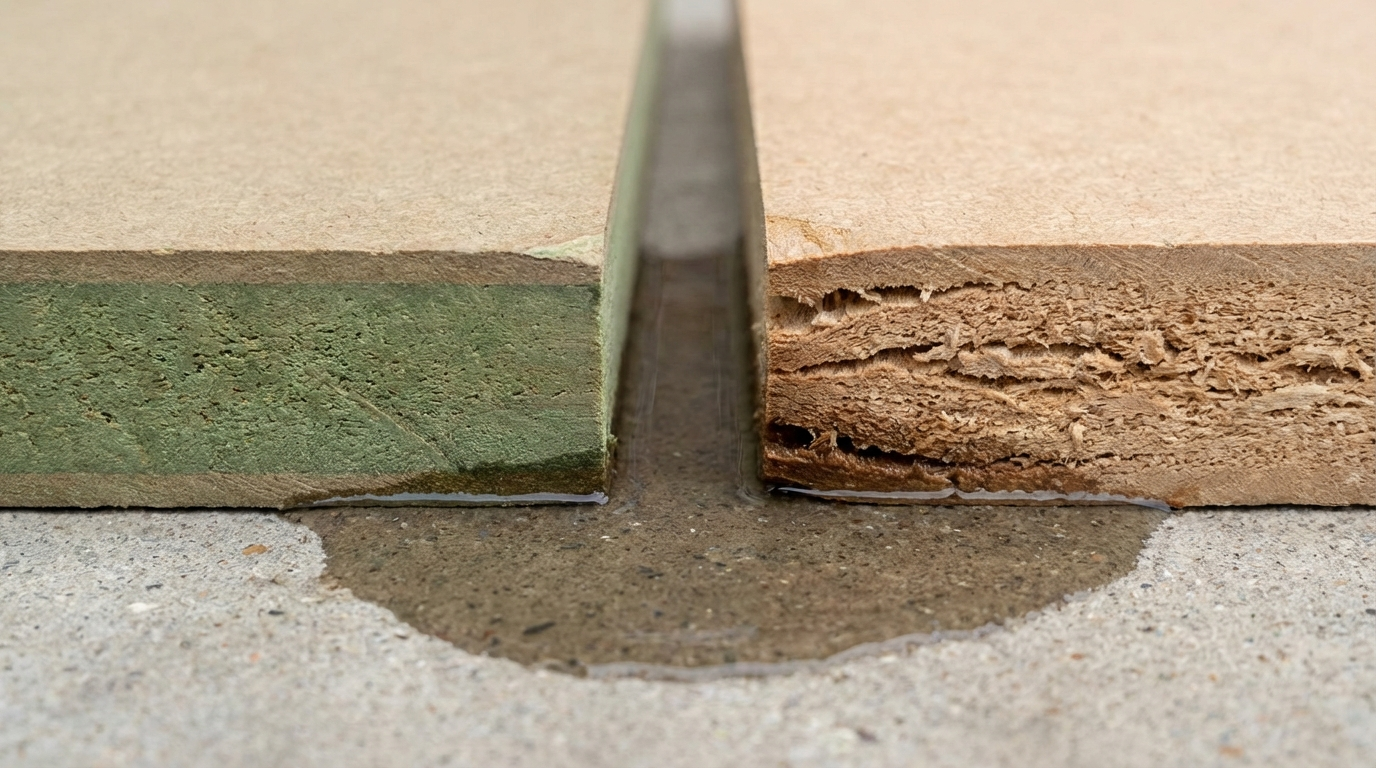
India’s monsoon humidity (70-90% RH) and coastal salt air amplify swelling risks in MDF. Uneven thickness in non-calibrated boards leads to warping or edge lifting under moisture, common in Mumbai or Chennai sites.
Poor storage during transport from northern factories to southern markets causes surface inconsistencies to worsen. Calibrated boards resist this better, holding screws tighter in humid kitchens and maintaining flatness for TV units.
Site realities like inconsistent AC drying or wet polishing exacerbate issues—calibrated MDF ensures even resin absorption for paints, preventing bubbles in Bangalore apartments.
Meaning, Types, and Where People Get Confused
Calibration means industrial sanding for exact thickness and smoothness post-pressing. Types include fully calibrated (both faces) or single-side for overlays. It’s not about density (700-850 kg/m³ typically) but surface prep.
- Confusion 1: Thinking calibration adds moisture resistance—it doesn’t; pair with MR-grade for that.
- Confusion 2: Assuming all “sanded” MDF is calibrated—rough sanding isn’t precision.
- Confusion 3: Believing thickness labels guarantee uniformity—always measure multiple spots.
- Confusion 4: Mixing with pre-laminated—calibration precedes lamination.
- Confusion 5: Overlooking batch variations—calibration quality differs by factory process.
- Confusion 6: Expecting calibration fixes low-density boards—it highlights poor fiber quality.
What does "calibrated" exactly mean for MDF boards?
Calibrated MDF has been sanded to precise, uniform thickness (e.g., 18mm ±0.2mm across the sheet) and smooth surface finish. This prevents waves or dips that cause lamination peel-off or paint drips.
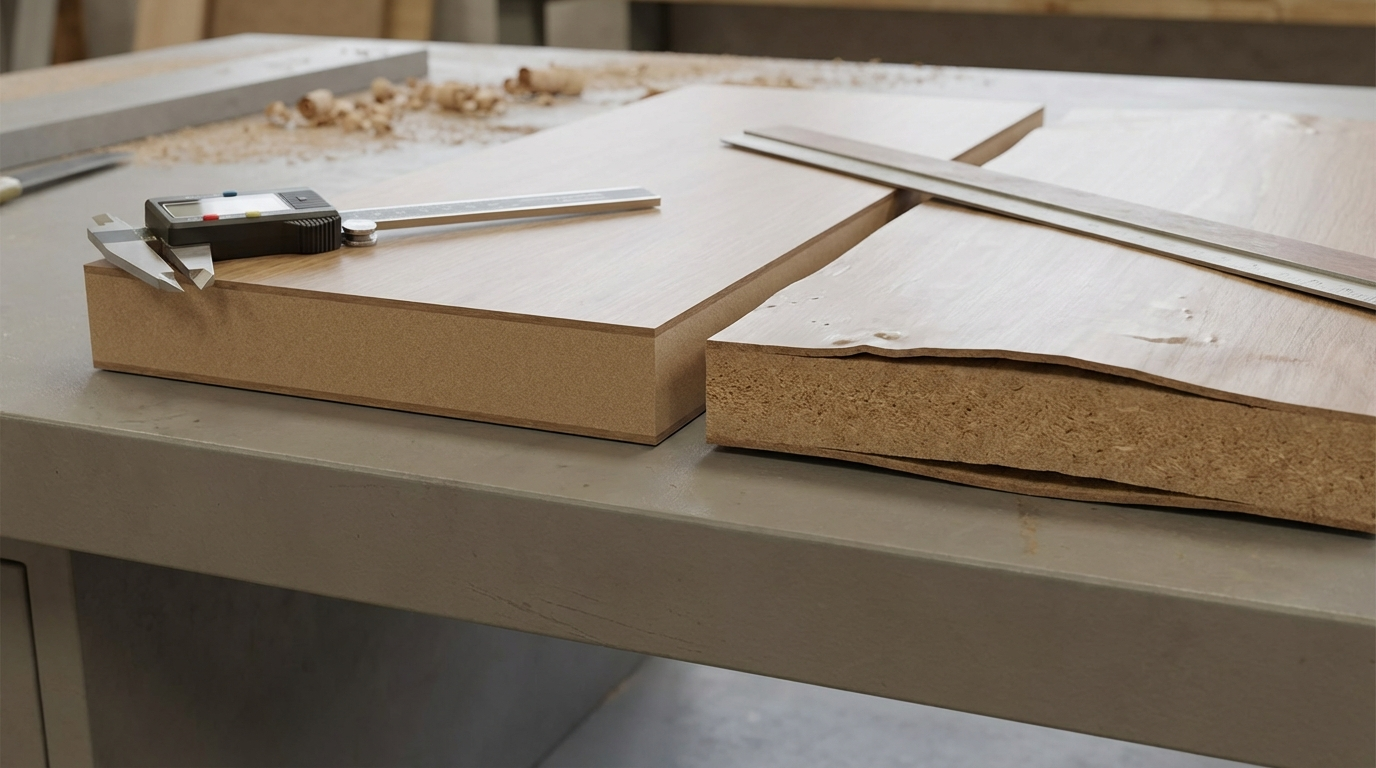
In practice, it shines for CNC-cut wardrobes where flatness ensures tight joints. During monsoons, uniform boards swell evenly, avoiding cracks. Check by placing a straight edge across the sheet—gaps over 0.3mm signal non-calibrated. Next step: measure four corners and center with calipers for verification before loading.
Is calibrated MDF the same as sanded MDF?
No—sanded MDF gets basic rough sanding to remove press marks, while calibrated undergoes multi-stage precision grinding for mirror-like flatness and exact tolerance.
This matters for painting in humid Kochi homes, where rough surfaces trap moisture under paint. Calibrated saves 20-30% finishing time for carpenters. Test: rub a finger—calibrated feels glass-smooth, no grit. If buying, ask for tolerance specs and demo a sample under light for shadows indicating unevenness.
Price Range and Cost Drivers
Non-calibrated MDF typically ranges Rs 700-1,200 per 8x4 sheet for 18mm thickness, while calibrated adds 15-30% (Rs 900-1,600). Thinner 12mm drops 20-25%, thicker 25mm rises 30-40%.
Cost drivers: calibration’s extra sanding machinery, higher energy, skilled QC; density (800+ kg/m³ pricier); sheet size; city logistics (Delhi cheaper than Kerala due to transport); wastage from precise cutting.
For a 10x6 wardrobe (about 25 sheets): non-calibrated ~Rs 20,000-30,000 base; calibrated ~Rs 25,000-40,000. Factor 10% extra for edge banding.
How to ask for a quote—checklist:
- Specify thickness, grade (MR/HR), calibration tolerance.
- Mention quantity, delivery city, sheet size.
- Ask for density test method and surface smoothness sample.
- Include edge sealing if laminated.
How much extra does calibrated MDF cost per square foot?
Expect 15-30% premium, or Rs 20-50 more per sq ft for 18mm, varying by region—lower in production hubs like Gujarat, higher in Northeast.
Driven by processing, it pays off in saved labor for lamination. In monsoon-prone areas, it cuts rework from swelling. Quote tip: compare total project cost including finishing; request sheet weight verification for density value.
Calibrated vs Non-Calibrated: Side-by-Side Comparison
Real-life differences emerge in finishing and durability, not raw strength. Calibrated excels in visible, high-finish projects; non-calibrated for concealed bulk.
| Aspect | Calibrated MDF | Non-Calibrated MDF |
|---|---|---|
| Surface Finish | Smooth, ready for lamination/paint | Rough, needs heavy sanding |
| Thickness Tolerance | ±0.2-0.3mm | ±0.5mm or more |
| Lamination Adhesion | Excellent, no bubbles | Risk of peel in humidity |
| CNC Suitability | Precise cuts, no chatter | More tool wear, uneven edges |
| Price Premium | 15-30% higher | Budget-friendly |
| Best For | Kitchens, wardrobes | Frames, partitions |
Choose based on exposure: wet zones favor calibrated; dry, hidden areas take non-calibrated to save costs.
Which is better for lamination—calibrated or non-calibrated?
Calibrated is superior for lamination due to flatness ensuring full contact and no air pockets, critical in humid Indian sites.
Non-calibrated risks delamination after 6-12 months in monsoons. Trade-off: extra cost vs rework savings. Press test: apply sample laminate—calibrated bonds tighter. Verify by tapping post-lamination for hollow sounds.
Quality Checks You Can Do Without Lab Tests
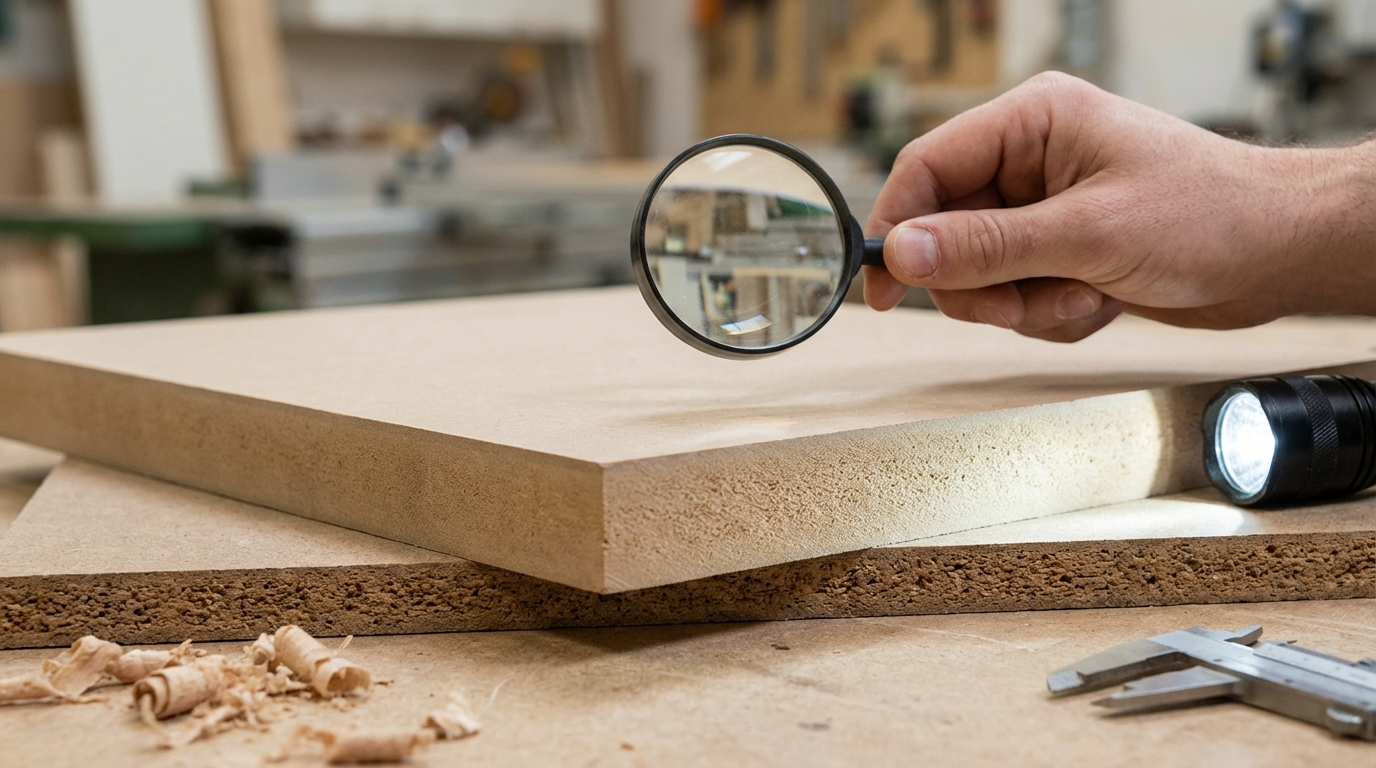
Before buying: Stack sheets—uniform height signals calibration. Shine a light at angle for surface waves. Weigh a sheet (heavier often denser). Ask: “What’s your thickness tolerance guarantee?” Red flag: vague answers.
After cutting: Edges should be straight, no feathering. Test screw hold—drill pilot, insert; calibrated grips 20% tighter typically.
After installation: Check flatness with level; seal edges fully. Clean with microfiber—calibrated resists scratches better.
How can I check if MDF is truly calibrated on-site?
Use a straight edge (steel ruler) across diagonals and center—max gap 0.3mm for calibrated. Measure thickness at 5 points with digital caliper.
In humid depots, tap for dull thud (uniform density). Avoid shiny “waxed” surfaces hiding roughness. Next: cut a small sample, sand lightly—calibrated needs minimal work.
Failure Modes and Fixes
- Symptom: Edge swelling post-monsoon. Root: Uneven thickness absorbs moisture variably. Prevention: Calibrated + edge paint/seal. Fix: Sand, re-seal; replace if warped.
- Symptom: Lamination bubbles/peel. Root: Rough surface traps air. Prevention: Calibrated boards only. Fix: Re-laminate after sanding flat.
- Symptom: Uneven paint finish. Root: Surface waves. Prevention: Calibrate + primer. Fix: Heavy sanding, repaint.
- Symptom: Screw pull-out in hinges. Root: Poor density uniformity. Prevention: Pre-drill, use calibrated MR. Fix: Epoxy anchors.
- Symptom: CNC chipping on curves. Root: Variable hardness. Prevention: Calibrated for tooling. Fix: Slower feeds, sharp bits.
- Symptom: Warping in TV units. Root: Humidity on non-uniform sheets. Prevention: Acclimatize calibrated 48hrs. Fix: Brace internals.
5-Step Decision Process for Your Project
- Assess exposure: Wet/coastal? Calibrated mandatory.
- Finish type: Laminate/paint? Calibrated. Hidden? Non-ok.
- Budget check: Premium ok for visible? Yes—calibrated.
- Verify supplier: Measure tolerance, surface test.
- Workflow fit: CNC/fast finish? Calibrated speeds up.
Failure point: Skipping step 4 leads to batch rejects. Always acclimatize 2 days pre-cut.
Should I use calibrated MDF for kitchen cabinets?
Yes, especially in humid regions—uniformity prevents delamination from steam and spills.
Non-calibrated risks in grease-prone areas. Pair with HR grade, PVC edge bands. Check: post-install, wipe daily; monitor for lifting after first monsoon. Architects spec 18mm calibrated for shaker-style doors.
Practical Decision Framework
| Project Condition | Recommended Choice | What to Verify |
|---|---|---|
| Wet zone (kitchen, bathroom) | Calibrated MR/HDF | Edge sealing, ±0.2mm tolerance |
| Coastal high humidity | Calibrated HDFWR | Surface smoothness, screw hold test |
| Heavy use (kids/pets) | Calibrated high-density | Impact resistance via drop test |
| Tight budget | Non-calibrated for internals | Plan extra sanding labor |
| Fast delivery needed | Calibrated stock grades | Batch uniformity |
| High scratch risk (TV unit) | Calibrated + melamine | Gloss level match |
Practical Use Cases (What Works, What Fails)
| Application | Thickness | Finish Notes | Risk Notes |
|---|---|---|---|
| Wardrobe shutters | 18mm calibrated | Laminate both sides | Non-calib swells doors |
| Kitchen base cabinets | 18-25mm calib | HR laminate | Steam delam on rough |
| TV wall panels | 12mm calib | Paint + edge band | Uneven paint on non |
| Office partitions | 12mm non-calib | Overlay fabric | Low risk if covered |
Can non-calibrated MDF be used for wardrobes?
Yes for internal shelves if laminated thickly, but shutters need calibrated to avoid sagging in humid cupboards.
Fails in coastal homes without AC. Use 18mm, double-side laminate. Check post-assembly: level doors; adjust hinges if binding from unevenness.
Buyer Personas: Tailored Advice
For Homeowners
Prioritize calibrated for kitchens/wardrobes—lasts 8-10 years without peel. Do: Seal edges yourself, use coasters. Don’t: Expose to direct water, skip acclimatization. Clean with damp cloth weekly; coastal? Ventilate cabinets.
For Carpenters
Cut calibrated with 6000rpm blade for clean edges; pre-drill 70% depth for screws. Handle by edges to avoid dents. In monsoons, cover stacks. Edge band immediately post-cut to block moisture.
For Architects/Designers
Spec “calibrated ±0.3mm, 800kg/m³ min” in drawings. Detail 2mm PVC edges for wet zones. For modulars, insist on factory QC sheets. Avoid thin non-calib in high-rise vibrations.
For OEM/Modular Makers
Calibrated reduces returns 30% via consistent CNC nests. QC: Auto-measure 10% sheets. Batch-code for traceability. Coastal factories: Use dehumidifiers pre-press.
Top 10 Buyer Mistakes and Fixes
- Mistake 1: Buying by price alone. Fix: Calculate total finishing cost.
- Mistake 2: Ignoring storage humidity. Fix: Acclimatize 48hrs.
- Mistake 3: No thickness checks. Fix: Caliper multiple points.
- Mistake 4: Skipping edge sealing. Fix: Band all exposed edges.
- Mistake 5: Using non-calib for paint. Fix: Calib + 2 primer coats.
- Mistake 6: Overlooking density. Fix: Weigh vs spec.
- Mistake 7: Poor transport cover. Fix: Tarpaulin stacks.
- Mistake 8: Wrong blade for cutting. Fix: Triple-chip for calib.
- Mistake 9: No pilot holes. Fix: Always drill.
- Mistake 10: Monsoon install. Fix: Dry site min 24hrs.
FAQs
Does calibration improve MDF strength?
Calibration focuses on uniformity, not core strength—it enhances screw holding indirectly via even density distribution. In Indian sites, this prevents hinge failures in heavy wardrobes. Non-calibrated may have weak spots swelling first in humidity. Always pair with appropriate density grade; test by loading sample shelves before full project.
Is the price difference worth it for painting?
Yes for visible panels—calibrated ensures even coats without runs, saving repaint costs. Premium covers reduced sanding labor, vital in dusty sites. For hidden frames, skip to save 20%. Verify smoothness pre-paint; coastal users add anti-fungal primer.
Can I calibrate non-calibrated MDF myself?
Carpenters can sand it flat with orbital sanders, but it’s labor-intensive and rarely achieves factory tolerance. Better for small fixes; full sheets waste time. In bulk projects, buy calibrated to hit deadlines. Use 220-grit progressing to 400 for best results.
What thickness needs calibration most?
Thinner boards (6-12mm) benefit hugely for wall panels, as variations amplify warping. 18-25mm for cabinets still needs it for lamination. Monsoon logic: Uniformity fights humidity regardless. Check supplier’s thinnest stock first.
Does calibrated MDF work with PVC laminates?
Perfectly—flat surface boosts adhesion in heat-press, common for modular kitchens. Avoid non-calib to prevent bubbles from air pockets. Edge band overlaps 1mm. Test adhesion pull on samples before run.
How to store calibrated MDF during monsoons?
Vertical racks, covered tarps, dehumidifier if possible—aim <60% RH. Acclimatize 3 days pre-cut in site conditions. Prevents surface checks. Coastal tip: Elevate off floors.
Is calibration standard in HDF?
Often yes, as HDF targets premium uses, but verify—some budget HDF skips it. Calibrated HDF excels in termite-prone areas with better overlays. Measure to confirm.
Can non-calibrated be used under melamine?
Yes if sanded well, as melamine hides minor roughness. But for high-gloss, calibrated prevents telegraphing. Budget trade-off: Sanding vs premium. Pre-sand 180-grit.
What if my calibrated MDF arrives uneven?
Reject batch—measure 20% sheets. Supplier swap or credit. Document with photos. Prevents project delays in tight schedules.
Calibration for CNC routing—necessary?
Highly recommended—uniformity cuts vibration, extends bit life 2x. Curves on non-calib chip easily. Slow feeds as backup. Spec in OEM contracts.
Disclaimer: This content is provided for general informational purposes based on industry practices and publicly available information. Product specifications, standards, prices, and availability may vary by manufacturer, region, and time. Readers should independently verify details with manufacturers, dealers, or qualified professionals before making purchase or construction decisions.Want Plywood Suggestions?
Share a few details and a VIR MDF specialist will suggest suitable brands and connect you to responsive dealers.