How to Check MDF Quality Before You Buy: 12 Simple Tests (No Lab Needed)
Avoid low-grade boards. Learn 12 quick MDF quality checks—surface, core, density feel, edge integrity, and moisture behavior—before payment.
Quick Decision Summary
Perform these 12 hands-on tests at the supplier yard to spot low-grade MDF: check surface flatness, edge squareness, density by weight and knock, moisture resistance, and screw hold.
If you’re in a hurry, grab a sample sheet (at least 2x2 feet), weigh it against expectations for thickness, knock for solid thud (not hollow), drop water on edges to check swelling speed, and try screwing into a predrilled hole—good MDF grips without crumbling. Skip if edges chip easily or core looks fibrous/loose. In monsoon-prone India, prioritize moisture tests and uniform density to avoid site failures like warping or delamination during humid storage.
- Choose high-density (750+ kg/m³ feel) with smooth edges if installing in kitchens or coastal homes.
- Avoid lightweight, rough-edged boards if budget allows—settle only after passing screw and water tests.
What MDF Actually Is
MDF stands for Medium Density Fiberboard, an engineered panel made by compressing wood fibers with resins under heat and pressure. It creates a uniform, smooth sheet ideal for furniture, cabinets, and interiors. Standard MDF suits dry areas, while moisture-resistant variants use added waxes or special resins for humid conditions.
Thickness ranges from 3mm to 25mm typically, with 18mm common for shutters. Densities vary: around 700-850 kg/m³ marks good quality. It accepts laminates, veneers, or paint well due to its flat surface, but edges need sealing to prevent moisture ingress. In India, it's widely used for wardrobes, TV units, and modular kitchens as a plywood alternative.
Why MDF Quality Matters in Indian Homes and Sites
India's monsoon humidity (70-90% RH) and coastal salt air accelerate MDF failures like edge swelling or core breakdown if quality is poor. Low-grade boards absorb moisture fast during transport or yard storage, leading to warping on-site. In urban sites with poor ventilation, weak screw hold causes sagging shelves or loose hinges over time.
Good quality ensures durability in kitchens (steam exposure) or wardrobes (daily use). Poor ones chip during CNC routing, increasing carpenter rework. Site realities like dust, heat, and rough handling amplify risks—always test before bulk buy to cut returns and delays.
How to Check MDF Quality: Overall 5-Step Process
- Inspect visually at yard: Look for flatness, uniform color, no blisters on full sheets.
- Handle and weigh samples: Feel density, check edges for chipping.
- Run quick physical tests: Knock, screw, water drop on cut pieces.
- Verify uniformity: Measure thickness across sheet, sand edges.
- Decide based on passes: Buy only if 10+ of 12 tests clear; negotiate if borderline.
Common pitfalls: Testing only laminated faces (ignore core), skipping monsoon simulation, or trusting supplier claims without hands-on. In India, insist on fresh stock—stacked sheets over 2 weeks often warp from ground moisture.
Price Range and Cost Drivers for Quality MDF
Expect ₹40-₹120 per sq ft for plain MDF, varying by city (higher in metros like Mumbai/Delhi due to logistics). Thicker boards (18-25mm) cost more; high-density or moisture-resistant add 20-30%. Resins, edge sealing, and pre-lamination push prices up.
Cost drivers include density (heavier = pricier but durable), sheet size (8x4 ft standard), finish type, and transport (coastal areas add for weatherproofing). Wastage from poor cuts adds 10-15%. For a 10x6 ft wardrobe, budget ₹8,000-₹15,000 raw panels.
How to ask for a quote checklist:
- Specify thickness, density range, moisture grade.
- Mention project (kitchen=MR grade), quantity, delivery site.
- Ask for sample test allowances, cut-to-size options.
12 Simple Quality Tests (No Lab Needed)
These field tests take 15-30 minutes per sheet. Use a full 8x4 ft sheet and cut samples (ask supplier). Pass if 10+ clear; good MDF feels heavy, cuts clean, holds screws tight.
What Are the First 4 Surface Checks?
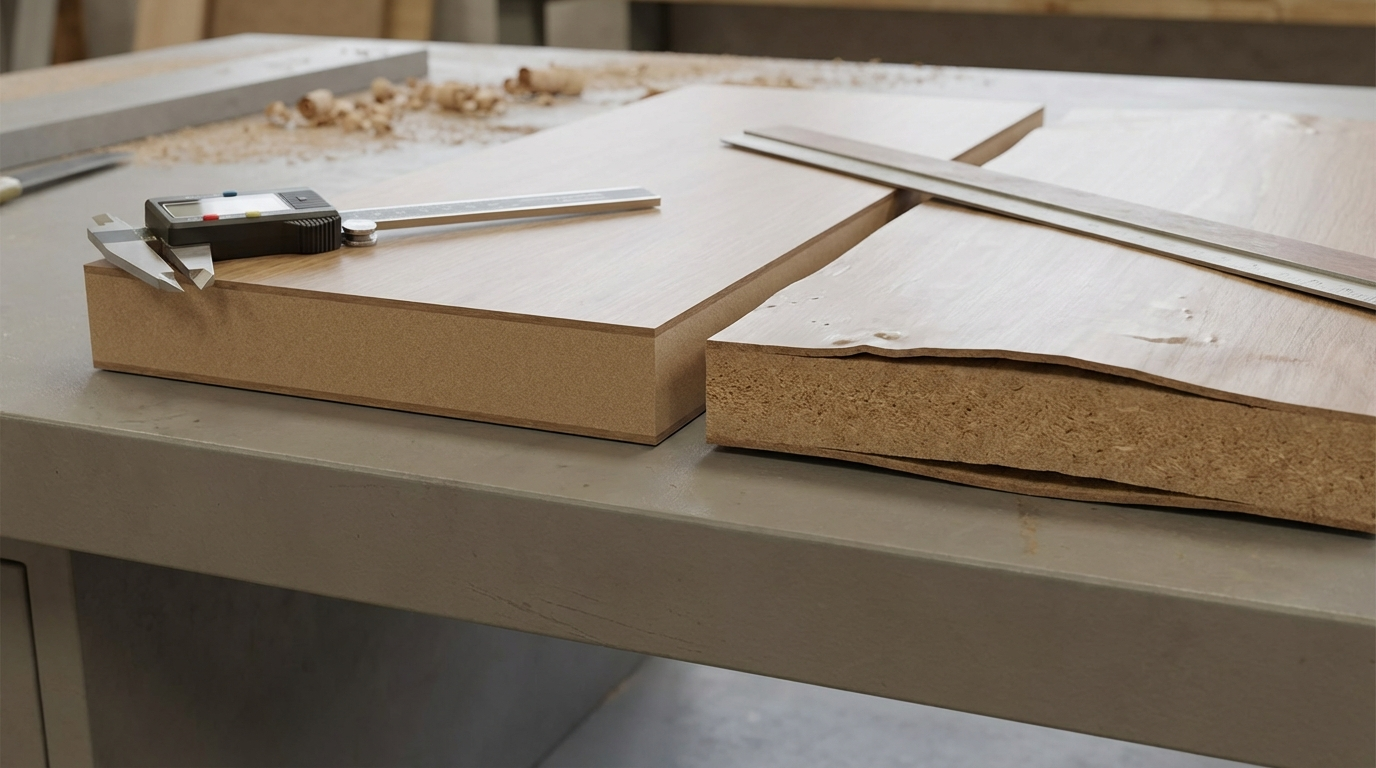
Start with visuals: (1) Flatness—place straight edge (ruler/aluminum profile) across; max sag 1-2mm allowed. (2) Smoothness—run palm/nails; no grit or pits. (3) Color uniformity—no dark streaks or yellowing (resin issues). (4) Blister-free—press face; no air pockets bubble up.
Nuance: Laminated MDF hides core flaws, so flip and check plain side. In humid yards, warped sheets fail fast. Next: Cut a 6x6 inch sample, inspect exposed edges for clues. Red flag if surface scratches with fingernail easily—poor top layer.
How to Test Density by Weight and Knock?
(5) Weight test: Lift 18mm 2x2 ft sample; should feel heavy (around 12-15kg). Light=low density, prone to sagging. (6) Knock test: Tap center/edge with knuckle; solid 'thud' not 'hollow drum'.
Conditions: Thicker needs more heft. India tip: Coastal suppliers often stock lighter imports—compare two sheets. Verify by cutting; dense core looks tight-grained. Failure mode: Hollow sound predicts screw pullout in cabinets.
Edge Integrity: What to Check?
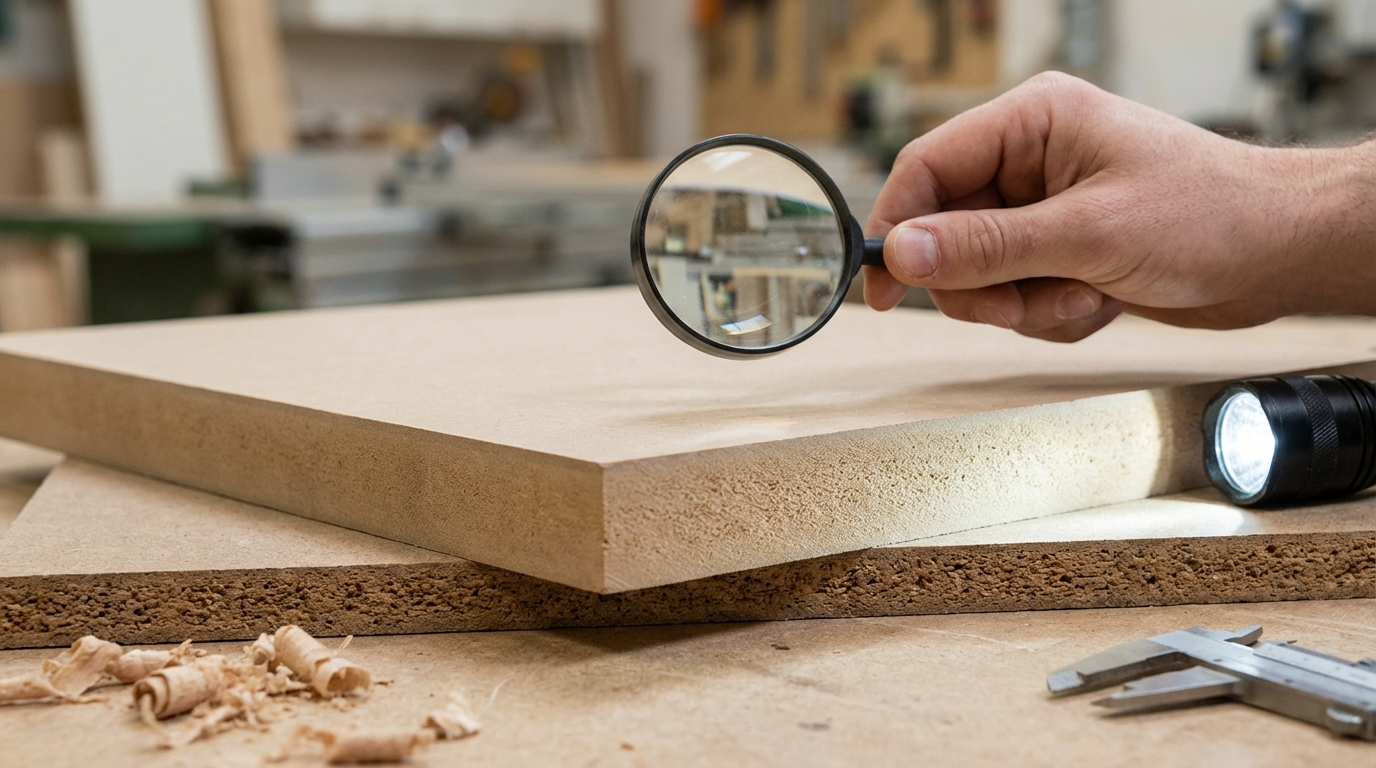
(7) Squareness: Measure corners with try-square; 90° exact. (8) Chip test: Rub edge with file/knife; minimal crumbling. (9) Particle reveal: Good shows fine, uniform fibers; coarse/big chunks=recycled waste.
Trade-off: Perfect edges cost more but save banding time. Monsoon risk: Rough edges swell first. Check post-cut: CNC routers chip low-grade fast. Seal immediately with PVA.
Moisture and Screw Tests: Critical for India
(10) Water drop: Place drops on edge/face, wait 10min; no darkening/swelling. (11) Screw hold: Drill 4mm hole, insert 12mm screw, pull; resists over 50kg feel. (12) Smell: Mild wood/resin; strong chemical=high formaldehyde.
Coastal must: Simulate rain by soaking edge 30min. Nuance: MR grades slow absorption but check labels yourself. If fails, opt HDF. Carpenter tip: Test multiple spots—center weaker.
Decision Framework: Match Conditions to Checks
| Site/Home Condition | Key Tests to Prioritize | Recommended Density/Finish | Verify By |
|---|---|---|---|
| Monsoon humidity (70%+ RH) | Water drop, edge chip, knock | MR grade, 800+ kg/m³, edge banded | Soak test 30min, no swell |
| Coastal/salty air | Water drop, screw hold, smell | HDFMR, wax-coated edges | Salt spray sim (mist water+salt), tight screw grip |
| Kitchen (steam/abuse) | Screw hold, density weight, surface grit | 18mm+, laminated, sealed edges | Drill/test 5 holes, flat ruler check |
| Wardrobe (daily use) | Knock, chip, flatness | 16-18mm, prelam, PVC edges | Heavy lift feel, no hollow tap |
| Tight budget/fast site | Visuals, weight, squareness | Standard 700kg/m³, plain for laminate | Compare 2 suppliers, negotiate samples |
| CNC heavy workflow | Chip test, particle, screw | High density, balanced moisture | Cut sample route, clean chips |
Common Buyer Mistakes and How to Avoid Them
India-specific pitfalls rack up costs—here's 10 to dodge:
- Buying cheapest without tests: Low density sags in humid godowns; always weigh/knock.
- Ignoring storage history: Ground-contact stacks warp; check bottom sheets last.
- Testing only face, not core: Lami hides flaws; cut edge mandatory.
- Skipping moisture sim: Dry yard fools; water drop essential pre-monsoon.
- No screw hold check: Hinges fail fast; drill/test every batch.
- Overlooking edge chips: CNC waste soars; file test before buy.
- Trusting thickness labels: Varies ±1mm; measure 4 corners.
- Bulk buy sans samples: Batch variance common; test 1% first.
- Forgetting smell test: VOC offgassing irritates; sniff fresh cut.
- Poor transport plan: Open trucks wet boards; cover/vertical stack.
Failure Modes and Fixes
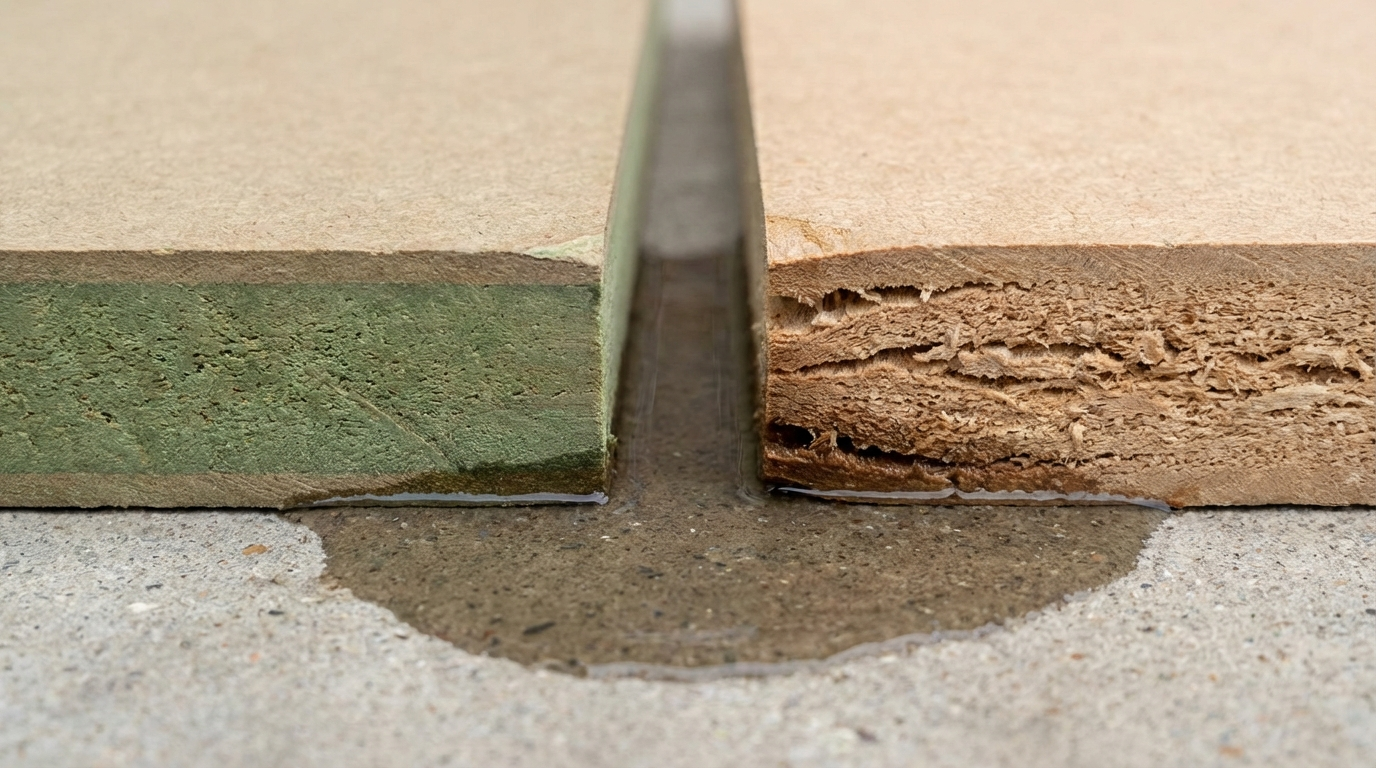
- Edge swelling: Symptom: Bulging after humidity. Cause: Low resin/porous core. Prevent: MR grade + immediate banding. Fix: Sand, reseal—but replace if severe.
- Screw pullout: Loose fittings. Cause: Low density. Prevent: Predrill right size, use anchors. Fix: Refasten with plugs.
- Delamination: Layers separate. Cause: Moisture + heat. Prevent: Dry storage, sealed edges. Fix: Clamp/epoxy minor; discard major.
- Surface chipping: Scratches flake. Cause: Brittle top fibers. Prevent: Dense board, careful handling. Fix: Fill/sand repaint.
- Warping/sag: Bent under load. Cause: Uneven density. Prevent: Flat storage, right thickness. Fix: Reinforce or replace.
- Poor laminate adhesion: Peeling finish. Cause: Greasy surface/oily resins. Prevent: Clean pre-press. Fix: Strip/redo.
Practical Use Cases: What Works Where
| Use Case | Thickness | Finish Notes | India Risk & Check |
|---|---|---|---|
| Kitchen shutters | 18mm | Laminate/PVC, full edge band | Steam test; water drop pass |
| Wardrobe carcass | 16-18mm | Prelam, ABS edges | Screw hold; no hollow knock |
| TV unit shelves | 12-15mm | Painted, T-edge | Density weight; chip-free |
| Wall panels | 8-12mm | Veneer, clip-on | Flatness; humidity sim |
Tips by Buyer Persona
What Should Homeowners Focus On?
Durability first: Pick boards passing water/screw tests for kitchens. Clean with damp cloth only—avoid soak. Do: Seal exposed edges yourself. Don't: Drag heavy items (chips surface). Check post-install: No gaps at hinges. In apartments, store vertically to beat humidity. Longevity tip: Annual edge recoat in coastal areas.
Carpenter Workflow Tips?
Cut with 60-tooth blade for clean edges; predrill screws 3/4 depth. Band edges same day to block moisture. Handling: Use suction lifts for heavy sheets. QC: Knock each panel pre-assembly. Monsoon hack: Work in shaded area, cover cuts immediately. Fasten in 50mm zones from edges for hold.
Architect Specs and Detailing?
Specify density 750kg/m³ min, MR for wet zones. Detail: Full edge returns, 2mm PVC band. Drawings: Note storage & acclimation (48hrs site). Verify supplier samples match specs. Trade-off: Dense cuts slower but CNC precise. Coastal: Wax additives in drawings.
OEM/Modular Factory QC?
Batch test 5% sheets: Automate knock/weight if possible. Reduce complaints: Log failure rates per supplier. Repeatability: Calibrate CNC for density variance. Returns drop 30% with edge seal mandate. Scale tip: Vertical racking in humid factories.
FAQs
Can I check MDF quality at home after delivery?
Yes, but yard testing is best—post-delivery, cut corners for edge/knock tests, drill scrap for screw hold. Water drop on underside simulates monsoon. If fails, document for supplier return (within 7 days typical). Home check limits: Can't weigh full sheet easily. Acclimate 48hrs first to spot latent warp. Always photo fails with date.
What's the difference between good and poor MDF visually?
Good: Uniform beige, dead flat, razor-smooth touch. Poor: Streaks, minor bows, gritty feel. Edge-wise, good is straight/tight-grained; poor crumbles/chips. In stacks, good stays square; poor top sheets blister from pressure. India yard reality: Dust hides grit—wipe clean before judge. Combine with weight for sure call.
Does thickness affect quality tests?
Yes—thicker (18mm+) hides low density better, so weight/knock crucial. Thin (6-9mm) chips easier, test edges rigorously. Uniformity matters more in thick: Measure 9 points. Screw hold weaker in thin, use smaller fasteners. Monsoon: Thick MR slows swell but core still key. Always match thickness to load.
How do I know if MDF is moisture-resistant without labels?
Water drop test: Good MR darkens slow (no swell 10min); standard soaks fast. Edge focus—faces often treated extra. Smell milder in MR. India coastal: Soak scrap 1hr, dry/weigh for % gain (<10% good). Carpenter verify: Post-cut, no fuzz expansion. Varies by batch—test fresh cuts.
Why does some MDF smell strong?
High urea-formaldehyde resins offgas VOCs—fresh cut smells sharp/chemical. Good quality uses low-emission (E1/E0 equiv), mild wood scent. Health risk in kids' rooms. Prevent: Air out 72hrs pre-install. India humid slows cure—ventilate godown. Red flag for buy: Strong odor predicts poor durability too.
Is heavy MDF always better?
Often yes—800kg/m³ resists sag/screws better—but over 850kg cuts dusty/hard. Balance: Kitchen heavy; walls medium. Test combo: Weight + knock + screw. India logistics: Heavy adds freight cost. Feel guideline: 18mm 2x2ft ~14kg good. Light variants fail humid loads fast.
Can I test for termite resistance on-site?
No direct simple test—quality boards use resins repelling mildly, but add treatment. Check: Dense core resists entry; loose fibers invite. India termite belts: Visual frass on stored sheets. Prevent: Elevate stacks, fumigate site. Spec borate-treated if high risk. Quality ties: Dense lasts longer untreated.
What if supplier refuses cut samples?
Red flag—walk or insist (pay small fee). Buy small sheet first. Alternatives: Buy from yards allowing tests. India norm: Reputable allow scraps. Document refusal if later fails. Bulk risk high sans tests—start with 10 sheets QC.
How often do quality issues show post-install?
3-6 months in humid India: Swell first, then screws. Dry AC rooms last 2+ years. Prevent: Acclimate panels site 7 days, seal all edges. Monitor hinges/shelves monthly. Early sign: Softening touch. Fix cheap if caught: Reseal vs full redo.
Disclaimer: This content is provided for general informational purposes based on industry practices and publicly available information. Product specifications, standards, prices, and availability may vary by manufacturer, region, and time. Readers should independently verify details with manufacturers, dealers, or qualified professionals before making purchase or construction decisions.Want Plywood Suggestions?
Share a few details and a VIR MDF specialist will suggest suitable brands and connect you to responsive dealers.