Moisture Resistant MDF: What “MR” Really Means and 7 Myths to Ignore
MR MDF is moisture resistant—not waterproof. Learn what MR means, typical use cases, and myths that lead to swelling and failure.
Quick Decision Summary
MR MDF handles humidity and minor splashes but fails under prolonged water exposure without edge sealing and good ventilation.
If you’re in a hurry: MR stands for Moisture Resistant, meaning it uses higher resin content and tighter fibers to slow water absorption compared to standard MDF. In Indian homes, it suits kitchens, wardrobes, and TV units in moderate humidity zones but needs full edge banding, no direct water contact, and dry storage. Avoid in bathrooms or coastal areas without extra precautions. Check density (750+ kg/m³), edge sealing post-cut, and screw-hold strength before buying. Expect swelling if myths like "it's waterproof" mislead you.
- Choose MR MDF if: semi-exposed areas like kitchen shutters or wardrobe backs in inland cities with monsoon prep (proper sealing).
- Avoid MR MDF if: direct water zones like sinks, outdoors, or high-humidity coastal sites without hybrid upgrades.
What This Material/Option Actually Is
Moisture Resistant (MR) MDF is standard Medium Density Fiberboard treated with extra moisture-repelling resins and denser fiber bonding. It starts as wood fibers mixed with urea-formaldehyde or similar resins, pressed at high pressure. The "MR" grade typically has 10-15% higher resin content than plain MDF, making fibers less prone to swelling when briefly wet.
It fits between regular MDF (for dry interiors) and Boiling Water Resistant (BWR) grades. MR MDF comes in thicknesses from 3mm to 25mm, often pre-laminated or raw for CNC work. Laminates or melamine faces add surface protection, but edges remain vulnerable without banding.
In workflows, it machines like regular MDF but demands immediate edge treatment post-cut to lock out humidity.
Why It Matters in Indian Homes and Sites
India's monsoon season (June-September) brings 80-100% humidity, causing unprotected MDF to swell 20-30% in edges within days. Coastal areas like Mumbai or Chennai add salt-laden air, accelerating delamination. Site realities—poor storage under tarps, delayed installations, or carpenter shortcuts—amplify risks.
Consequences include warped shutters, loose hinges from poor screw hold, and peeling laminates. In wardrobes, bottom panels sag under clothes if moisture creeps in. Kitchens see edge blackening from steam. Using MR MDF right cuts callbacks by focusing on sealing and ventilation, saving 15-20% on rework in humid projects.
Meaning, Types, and Where People Get Confused
MR in MDF means Moisture Resistant: engineered to withstand temporary humidity (up to 70-80% RH) and brief splashes without major swelling. It absorbs less than 10-15% water by weight in short tests, versus 25%+ for standard MDF. Types include raw MR, pre-laminated MR, and MR with MR-grade HDF cores for extra density.
What Does “MR” Exactly Stand For in MDF?
“MR” stands for Moisture Resistant, indicating resin modifications that reduce water ingress speed. Direct answer: it resists vapor and light moisture for 24-48 hours but not immersion. Nuance: performance varies by density (aim for 750-850 kg/m³) and resin type (PF resins better than UF). In India, check for even pressing—no soft spots. Next step: tap edges post-cut; solid thud means good resistance. Ignore grade if no edge seal—real test is field handling during monsoons.
Is MR MDF the Same as Waterproof MDF?
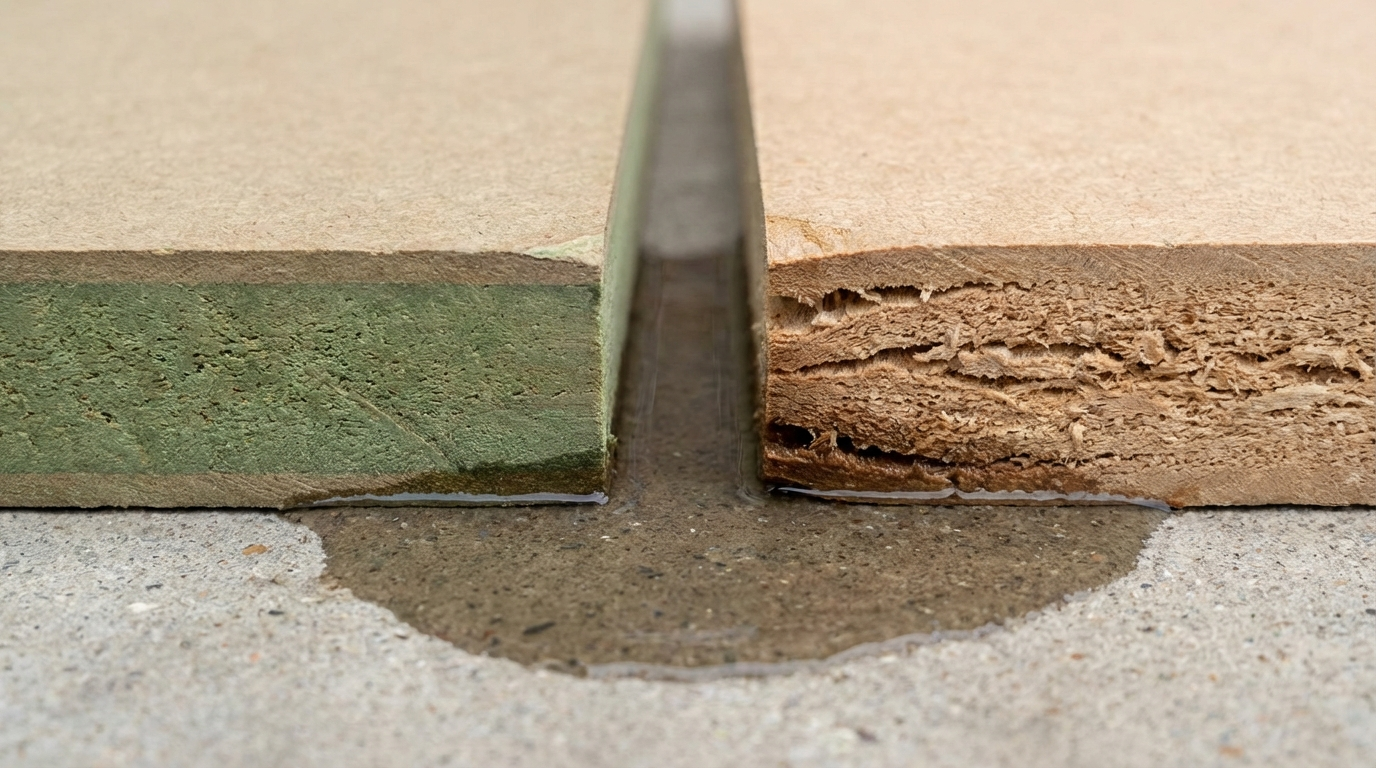
No, MR MDF is not waterproof; it delays swelling but delaminates under running water. Direct answer: waterproof grades like BWR handle boiling for hours. Nuance: MR suits indirect exposure (e.g., above stove), but coastal humidity overwhelms it without PVC edges. Check: drop water on sample edge—beading up is good, soaking in is fail. Next: pair with melamine or laminate + 2mm PVC banding for semi-wet zones.
7 Myths About MR MDF to Ignore
Myths spread via carpenter talk or quick sales pitches lead to failures. Here's each busted with real mechanics.
- Myth: MR MDF is fully waterproof. Reality: It resists splashes 2-3x longer than standard but swells if soaked. Trade-off: cheaper than BWR but needs sealing.
- Myth: No edge banding needed. Reality: Raw edges drink humidity fastest—band immediately post-CNC.
- Myth: Fine for bathrooms/showers. Reality: Steam causes 15-20% expansion; use PVC/WPC there.
- Myth: Same strength as regular MDF everywhere. Reality: Slightly denser but screw hold drops 10-15% when damp.
- Myth: Pre-laminated MR needs no extra care. Reality: Face resists, edges don't—delam from sides in humid storage.
- Myth: Costs same as plain MDF. Reality: 20-40% more due to resins; worth it only with proper install.
- Myth: Handles monsoons without site prep. Reality: Store flat, elevated; ventilate rooms or warp guaranteed.
Failure Modes and Fixes
- Symptom: Edge swelling/blackening. Cause: Unsealed cuts absorb monsoon vapor. Prevention: PVC/ABS banding within hours. Fix: Sand, re-band; replace if >5mm swell.
- Symptom: Delamination bubbles. Cause: Steam penetrates laminate edges. Prevention: Full-perimeter seal + ventilation gaps. Fix: Spot-repair epoxy; full panel swap if structural.
- Symptom: Screw pullout in hinges. Cause: Damp fibers lose grip. Prevention: Pilot holes + MR-grade inserts. Fix: Redrill wider or reinforce with blocks.
- Symptom: Surface scratches showing core. Cause: Soft top under humidity. Prevention: 0.8mm+ laminate. Fix: Buff + polish; avoid if deep.
- Symptom: Warped panels in wardrobes. Cause: Poor storage + load. Prevention: Acclimatize 48hrs. Fix: Straighten clamps or replace.
- Symptom: Chipping during CNC. Cause: Lower density edges. Prevention: Sharp tools + slow feeds. Fix: Fill + sand before banding.
Quality Checks You Can Do Without Lab Tests
How Can You Spot Good MR MDF at the Dealer?
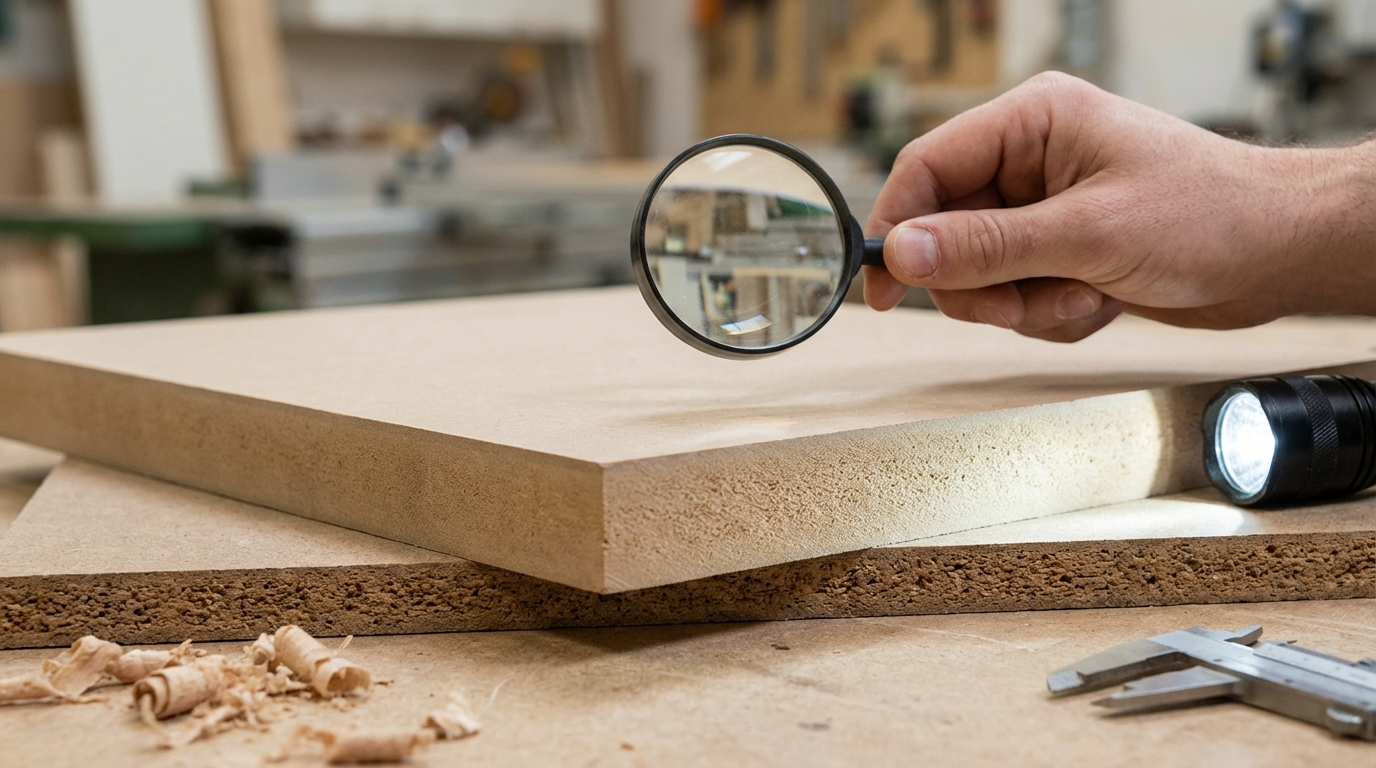
Direct answer: Weigh a known-size piece (heavier = denser fibers). Nuance: Tap edges—dull thud signals voids; crisp means tight bond. Check uniformity—no waves on surface. Red flags: musty smell (poor resin), soft flex under thumb. In India, ask for monsoon-stored samples. Next: Water-drop test on edge—should bead, not soak in 5 mins.
- Before buying: Visual (no cracks), weight test, smell check, ask resin % and density.
- After cutting: Edges smooth? No fuzz? Water beads?
- After install: Gaps sealed? No direct steam? Clean dry only.
Decision Framework: Matching MR MDF to Your Conditions
| Site Conditions | Recommended Specs | What to Verify/Trade-offs |
|---|---|---|
| Monsoon inland (70% RH) | MR MDF 18mm + full PVC edge + melamine | Density 750kg/m³; trade: cost up 25% vs plain |
| Coastal high humidity | MR HDF 16mm + WPC hybrid edges | Screw hold test; avoid if no ventilation |
| Kitchen semi-wet | Pre-lam MR 12mm + sealed backs | Edge seal immediate; steam gap 5cm |
| Wardrobe dry-ish | Raw MR 9mm + banding | Acclimatize; budget saver |
| Heavy use/abuse | MR + 1.2mm laminate | Scratch test; higher upfront cost |
| Tight budget/fast job | MR only if sealed well | Skip if site wet; rework risk high |
Two-Minute Comparison: MR vs Standard vs BWR MDF
| Aspect | Standard MDF | MR MDF | BWR MDF |
|---|---|---|---|
| Moisture Tolerance | Low (swells fast) | Medium (24-48hr splash) | High (boiling ok) |
| Cost Premium | Base | +20-40% | +50-80% |
| Best For | Dry cabinets | Kitchens/wardrobes | Wet zones |
| Edge Risk | High | Medium (seal needed) | Low |
| India Monsoon Fit | Poor | Good w/prep | Excellent |
Choose MR for balanced cost in semi-humid setups; verify by conditions over grades.
Practical Use Cases (What Works, What Fails)
| Application | Thickness | Finish/Edge | Risk Notes (India) |
|---|---|---|---|
| Kitchen shutters | 18mm | Melamine + PVC | Steam ok if gapped; seal bottoms |
| Wardrobe sides | 12mm | Laminate + ABS | Monsoon storage key; ventilate |
| TV unit shelves | 9mm | Pre-lam + tape | Low risk; load <20kg |
| Wall panels | 6mm | Veneer + edge seal | Coastal: avoid direct AC drip |
Common Buyer Mistakes and How to Avoid Them
- Mistake: Skipping edge banding. Avoid: Band all cuts same day; use 2mm PVC.
- Mistake: Bathroom use. Avoid: Switch to WPC; MR for vanity tops only.
- Mistake: Wet storage. Avoid: Elevate stacks, tarp loosely in monsoon.
- Mistake: Ignoring density. Avoid: Weigh/test tap; reject <700kg/m³.
- Mistake: Overloading damp panels. Avoid: Acclimatize 2 days; light load first.
- Mistake: Cheap laminates. Avoid: 0.7mm+ thick; check adhesion.
- Mistake: No pilot holes. Avoid: 70% screw dia; test hold.
- Mistake: Coastal no-prep. Avoid: Extra resin query + dehumidifier site.
Tips by User Type
What Should Homeowners Know About MR MDF Care?
Direct answer: Wipe spills instantly, avoid standing water, use dry cloth only. Nuance: In humid homes, ensure wardrobe vents; no wet mops near. Durability lasts 5-7 years with habits. Check: Monthly edge inspection for swelling. Next: Ventilate post-monsoon.
Carpenters: Cut with sharp 60-tooth blade, band edges machine-hot, pilot screws 3mm deep in hinge zones, handle with gloves to avoid oils.
Architects/Designers: Spec "MR grade, 800kg/m³ density, full perimeter PVC 2mm"; detail 5cm steam gaps in kitchens; coastal add back vents.
OEM/Modular Makers: QC: Batch water-drop test; standardize CNC feeds 15m/min; track returns by sealing QC—cuts complaints 30%.
FAQs
Can MR MDF be used outdoors?
No, MR MDF degrades fast outdoors from rain and UV. It lacks exterior resins, leading to swelling and fiber rot in weeks. In Indian verandas, use only under overhangs with sealed edges and paint, but prefer WPC or marine plywood. Trade-off: MR saves cost indoors; outdoors adds 50% rework risk. Verify by exposing sample to hose—replace if warps.
Does MR MDF need special tools for cutting?
Standard CNC or panel saws work, but use sharp carbide blades to avoid chipping denser edges. Slow feeds (12-18m/min) prevent tear-out in humid shops. Post-cut, vacuum dust immediately to block moisture paths. In coastal areas, oil tools to fight rust. Check: Clean cuts mean good machinability; fuzzy edges signal low quality.
How long does MR MDF last in kitchens?
Typically 4-8 years with proper sealing and no direct splashes. Monsoon humidity shortens to 3 years without vents. Factors: thickness (18mm better), edge treatment, cleaning habits. Failures from steam rise if no hood. Inspect yearly; reseal edges proactively.
Is MR MDF termite resistant?
MR grade focuses on moisture, not termites—add anti-termite treatment separately. In India, pair with borate preservatives for wardrobes. Untreated swells first, inviting pests. Check: No tunnels on sample; query treatment certs visually.
What thickness for wardrobe doors with MR MDF?
18mm for stability, 12mm sides to save weight. Thinner risks sag under handles. In humid zones, reinforce with aluminum channels. Cost driver: thicker adds 30%. Verify hang—level test post-install.
Can you paint MR MDF directly?
Yes, after sanding and primer, but edges need sealant first. Paints hide minor swelling but not fix it. Melamine better for kitchens. In monsoons, two primer coats block vapor. Test adhesion on scrap.
What's the difference between MR and MRWR MDF?
MRWR (Moisture Resistant Water Resistant) has advanced resins for longer exposure. MR suits indirect humidity; MRWR for frequent splashes. Varies by maker—check density. India projects: MR for most, MRWR coastal.
How to store MR MDF sheets on site?
Vertical racks, elevated 15cm off ground, loose cover for air flow. Avoid stacking flat in rain. Acclimatize indoors 48hrs pre-cut. Monsoon tip: Silica packs between sheets. Prevents 80% warp issues.
Will MR MDF hold heavy shelves?
Yes, up to 25kg/m linear with L-brackets and pilot screws. Dampness halves hold—seal well. 18mm best; test load gradually. Wardrobe shelves: center supports every 60cm.
Disclaimer: This content is provided for general informational purposes based on industry practices and publicly available information. Product specifications, standards, prices, and availability may vary by manufacturer, region, and time. Readers should independently verify details with manufacturers, dealers, or qualified professionals before making purchase or construction decisions.Want Plywood Suggestions?
Share a few details and a VIR MDF specialist will suggest suitable brands and connect you to responsive dealers.