How MDF Is Made: Step-by-Step Manufacturing Process (From Wood Fiber to Sheet)
A clear, step-by-step explanation of the MDF manufacturing process—fiber preparation, pressing, sanding, and quality checks—without jargon.
Quick Decision Summary
MDF starts as wood chips, defibered into fine strands, resined, matted, hot-pressed into dense sheets, cooled, trimmed, and sanded.
If you’re in a hurry: Indian MDF plants typically use eucalyptus chips for fast growth. Key steps include steam-defibering for uniform fibers, urea-resin blending for bonding (8-10% by weight), air-forming loose mats, pre-pressing to compact, multi-platen hot pressing at 180-220°C under 30-50 bar pressure for 5-15 minutes per cycle, cooling to lock dimensions, edge trimming to size, and double-sided sanding for smoothness. This creates uniform panels ideal for CNC routing in wardrobes and kitchens, but poor steps lead to swelling in monsoons.
- Grasp this process if evaluating board density for screw-holding in humid coastal sites.
- Avoid deep dive if only laminating surfaces—focus on post-production checks instead.
What This Material/Option Actually Is
Medium Density Fiberboard (MDF) is an engineered wood panel formed by bonding fine wood fibers with synthetic resin under heat and pressure. It achieves a uniform density of 650-800 kg/m³, smoother and denser than particleboard but less than HDF. No natural grain means paintable or laminatable surfaces for modular interiors.
In workflows, raw MDF serves as substrate for melamine, laminates, or veneers. Thicknesses range 3-25 mm, with 18 mm common for shutters. Indian production favors moisture-resistant variants using extra wax, suiting kitchens amid 70-90% monsoon humidity.
What raw wood goes into standard MDF?
Typically softwoods like eucalyptus or pine, plus hardwood residues and sawdust. These yield long, uniform fibers for strength. In India, eucalyptus plantations provide quick-renewable supply, reducing costs but requiring clean defibering to avoid grit. Check boards for grit-free cut edges—scratch a sample; smooth means good fiber prep. Next, verify density uniformity by weighing cut pieces.[[1]](https://materialsmarket.com/articles/how-is-mdf-made/)[[2]](https://pioneerpanelproducts.com/mdf-board-manufacturing-process/)
Why It Matters in Indian Homes and Sites
Monsoon humidity (up to 95%) and coastal salt air test MDF's resin cure and wax coating from manufacturing. Uniform fibers prevent screw-pull failures in wardrobe hinges; uneven density causes sagging TV units. Site storage without cover leads to pre-swell, mimicking poor production.
Carpenters note: Process uniformity aids CNC—warped fibers chip during routing. Architects spec MR grades for wet zones; poor pressing delaminates under AC drips. Trade-off: Smoother than plywood but swells if unsealed edges exposed.
Step 1: Debarking and Chipping the Wood
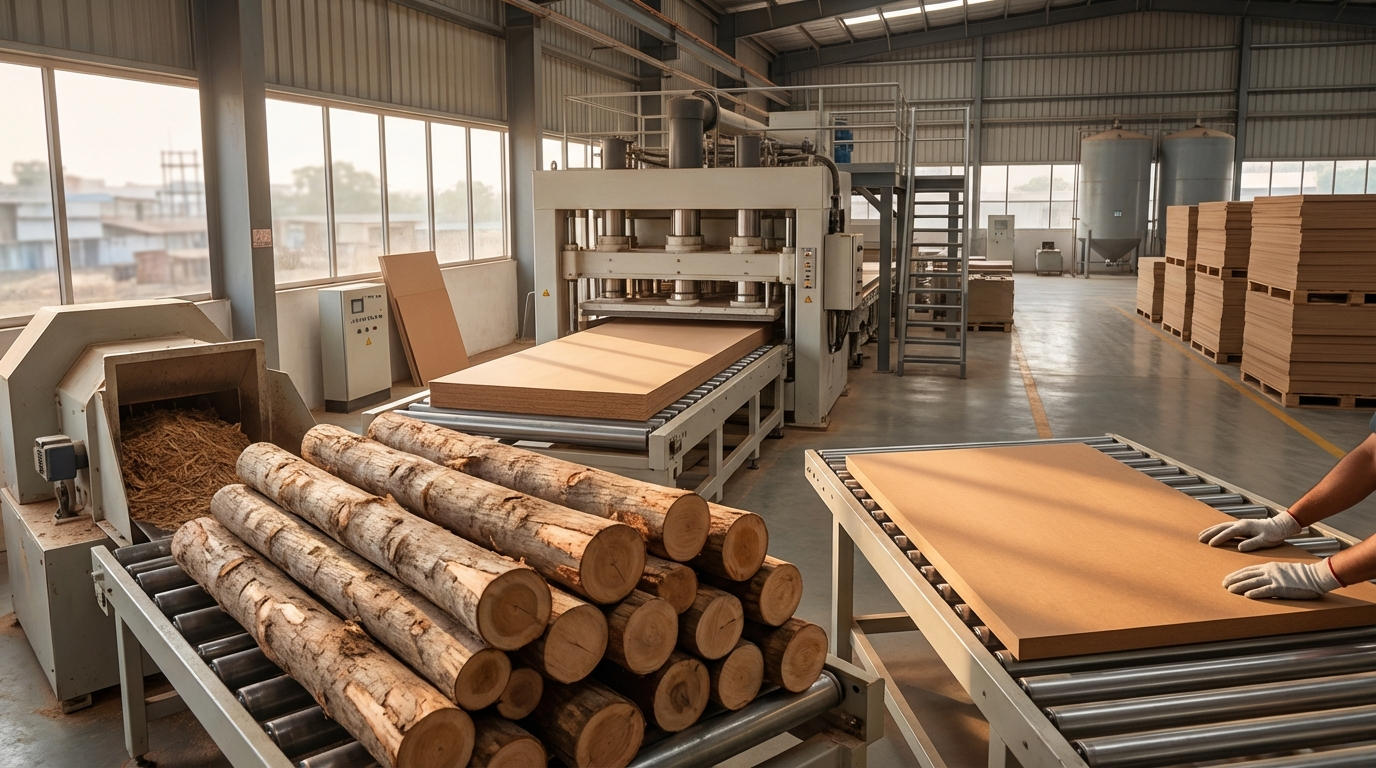
Logs arrive at plants, debarked to strip outer bark (grit source). Clean logs feed chippers, slicing into 20-30 mm uniform chips. Washing removes dirt, bark bits. In India, eucalyptus bark often kept for volume but washed rigorously.
Why critical: Uneven chips yield lumpy fibers, causing density variation. Plants re-chip oversize, recycle fines. Expect 1-2% waste here. Poor step shows as visible grit post-cut.
Why use eucalyptus in Indian MDF?
Fast-growing (7-10 years), abundant in Haryana/Tamil Nadu plantations. Yields fine fibers for smooth surfaces but needs wax for humidity. Buyers check: Cut edge should not powder. If gritty, skip—indicates dirty chipping. Verify by rubbing; clean plants minimize rejects in humid storage.[[2]](https://pioneerpanelproducts.com/mdf-board-manufacturing-process/)
Step 2: Defibering—Turning Chips to Fibers
Chips soften in steam digester (130-160°C, 4-7 bar, 5-10 mins), then enter refiner: steam explosion + mechanical plates shred to 2-4 mm fibers. Pulp-like mass exits, screened for lumps.
India twist: High steam controls lignin for bondable fibers. Faulty defibering creates clumps, weakening boards. Uniformity here ensures flat CNC cuts.
Step 3: Resin Blending and Fiber Drying
Wet fibers (80% moisture) enter blowline: spray urea-formaldehyde resin (8-12%), paraffin wax (1-2% for MR), hardeners. Mix dries in tubes (150-200°C air) to 10-12% moisture, preventing clumps.
Resin type drives grade: UF standard, PF for BWR. Over-resin yellows edges; under-resin delams. Indian plants tweak wax for monsoons.
How much resin in typical MDF?
Around 9-11% dry weight, mostly UF for cost. More in HDF (12-15%). Check post-install: No fishy smell means low emission. If buying, ask resin % and wax—higher aids coastal use. Test: Boil scrap 30 mins; minimal swell good.[[1]](https://materialsmarket.com/articles/how-is-mdf-made/)
Step 4: Mat Forming and Pre-Pressing
Dry fibers air-blown onto 20-30m perforated belt, forming 300-600 kg/m³ loose mat (target thickness x20 final). Distribution heads ensure evenness; pre-press rollers compact to 150-200 kg/m³, trim edges (recycle trims).
Uneven mat causes wavy boards. India: Belt speed matches production (200-500 m³/hr).
Step 5: Hot Pressing and Densification
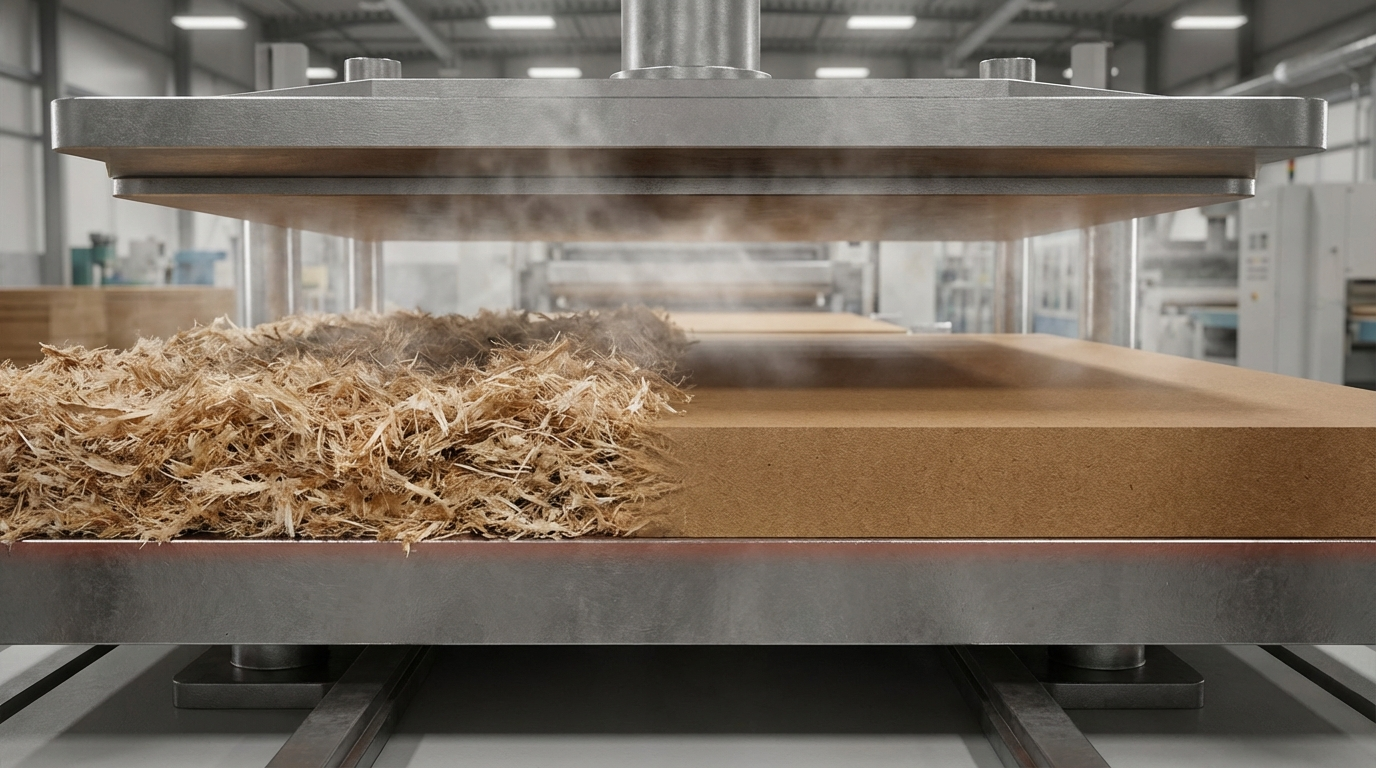
Compacted mats (10-20 high) enter multi-platen press: 180-220°C, 30-50 bar, 5-15 mins/cycle. Heat cures resin, evaporates water, densifies to 700 kg/m³ core, denser faces/surfaces.
Critical for flatness: Overheat chars; underpressure voids. Emerges hot (100°C+), enters cooling press (40-60°C, pressure) to fix size, prevent springback.
What temperature presses MDF?
Typically 190-210°C surface, gradient to core. Ensures resin thermoset without degrade. Indian coastal plants monitor closely vs humidity. Check quality: Flat panel, no steam blisters. If bowed post-cool, poor cycle—avoid for partitions.[[3]](https://www.chantawood.com/the-manufacturing-process-of-mdf/)
Step 6: Trimming, Sanding, and Initial Quality Checks
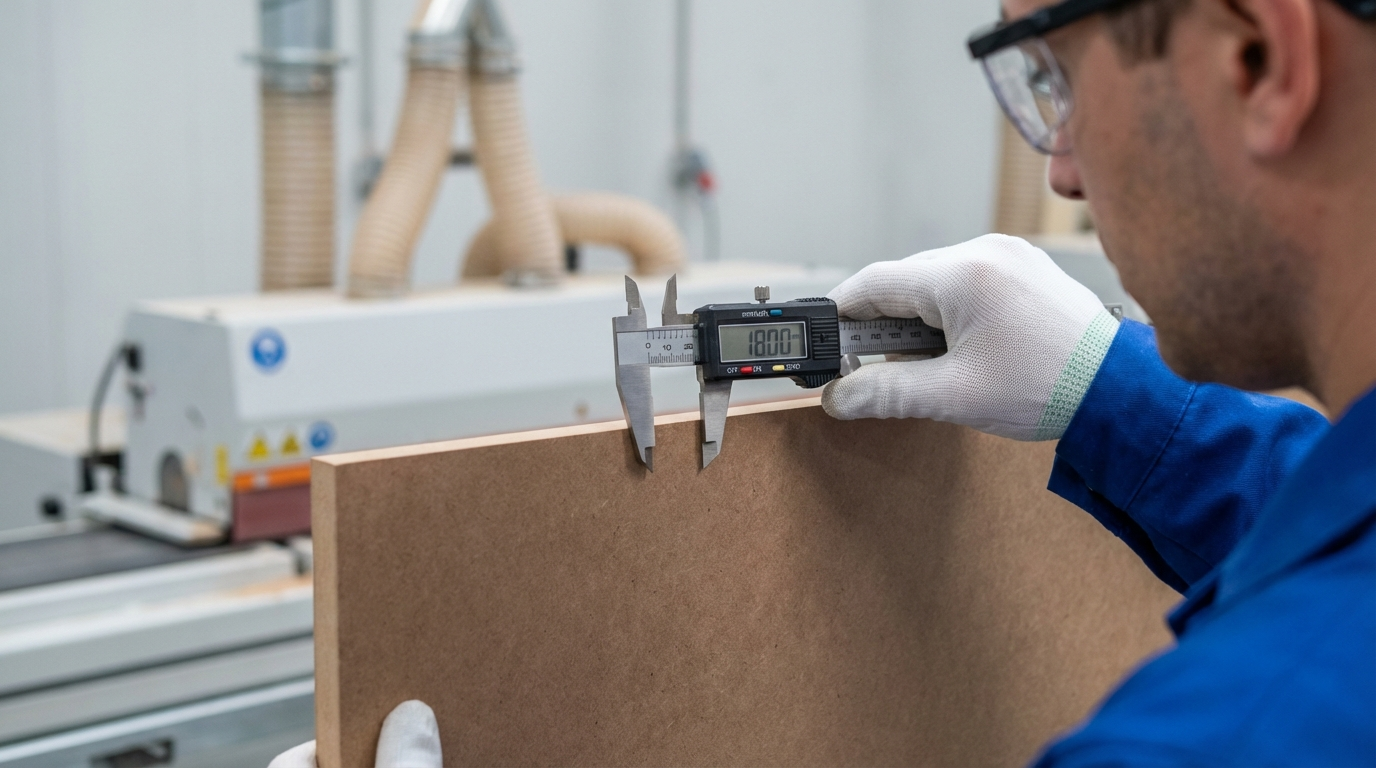
Cooled boards trimmed to width/length via saws. Double-calender sanders (80-220 grit) smooth both sides to 0.2-0.5 mm tolerance. Stacked, acclimatized.
QC: Thickness gauge (±0.2 mm), density probe, moisture meter (6-10%), visual for blows/delam. Graded A/B/C.
Variations in Indian MDF Manufacturing
MR/BWR grades add wax/paraffin in blowline, PF resin for wet zones. HDF ramps density (850+ kg/m³) via finer fibers/higher pressure. Plants near plantations cut logistics; computerized lines ensure repeatability.
Trade-off: Standard cheaper but swells; MR costlier (20-30% more) but holds in kitchens.
Failure Modes and Fixes
| Symptom | Manufacturing Root | Prevention | Fix If Happening |
|---|---|---|---|
| Edge swelling | Low wax/resin, poor drying | Ask wax %, acclimatize 48 hrs | Seal edges with putty/PVC band |
| Delamination | Under-cured resin, moisture ingress | Check flatness pre-buy | Clamp/press, epoxy inject |
| Blowholes/blisters | Trapped steam in press | Visual surface check | Sand/fill, relaminate |
| Uneven density | Poor defibering/mat form | Tap test uniform thud | Scrap heavy-use areas |
| Screw hold failure | Low core density | Pilot hole test | Wall anchors, thicker board |
| Surface scratches easy | Soft sanding/resin | Laminate immediately | Polish or overlay |
Monsoon accelerates all; store vertical, covered.
Quality Checks You Can Do Without Lab Tests
Before buying: Weigh 300x300 mm sample (target 5-6 kg for 18 mm). Visual: No lumps, uniform color. Tap: Solid thud, no hollows. Drop test: No crack.
After cutting: Edges clean, no fuzz—good fibers. Screw 4 nos, pull: >50 kg hold.
Post-install: Wipe damp; no halo. Heat iron corner: No char/discolor.
Can I test MDF moisture at home?
Use ₹200 meter or plastic bag seal 24 hrs—condensation bad. Aim <12%. India humidity warps >15%; acclimatize site-matched. Next: Compare weights pre/post bag.[[4]](https://www.woodproductsqualityfocus.com/what-are-the-most-common-quality-issues-in-mdf-production.html)
Decision Framework for MDF Selection
| Condition | Recommended Spec | Process Check/Verify |
|---|---|---|
| Monsoon kitchen | MR grade, 18 mm, waxed | Boil test minimal swell; wax % query |
| Coastal bedroom wardrobe | BWR, 16-19 mm | Edge seal test; PF resin ask |
| Heavy-use office partition | HDF 850+ kg/m³ | Density probe/thud test |
| Tight budget dry hall | Standard 12-15 mm | Uniform sand, no blows |
| CNC modular fast project | Plain raw 18 mm A-grade | Flatness ruler check |
| Scratch-prone kids room | Prelam, dense face | Nail scratch resistance |
Price Range and Cost Drivers
Raw MDF ₹1200-2200/sheet (8x4 ft, 18 mm), varies by city (Delhi +10%, coastal +15% logistics). Drivers: Thickness (+₹200/mm), density/MR grade (+30%), resin/wax type, eucalyptus batch, plant automation. Wastage 5-10% cutting adds 15%.
Budget example: Wardrobe 20 sheets @ ₹1800 avg = ₹36,000 + 20% edges/lam. Quote checklist: Specify thickness, grade, sheet size, delivery covered.
Common Buyer Mistakes and Avoidances
- Mistake 1: Ignore acclimatization—boards warp in site humidity. Avoid: Stack 7 days room-cond.
- 2: Buy thin 12 mm for shutters—sags. Use 18 mm min.
- 3: No edge sealing—swells fast. Band all cuts Day 1.
- 4: Skip density check—poor hold. Weigh/test screw.
- 5: Coastal no MR—delams. Spec BWR.
- 6: Over-sand CNC—chips. Use sharp bits.
- 7: Store flat uncovered—mold. Vertical racks.
- 8: Wet wipe raw—swells. Dry cloth only.
- 9: Ignore grit—dulls tools. Rub test buy-time.
- 10: Assume uniform—check ends vs core.
Tips by User Persona
Homeowners: Clean dry microfiber; avoid spills pooling. Durability: Laminate protects, lasts 10+ years dry zones.
Carpenters: Acclimatize, pilot drill 3 mm hinges, zone screws 40 mm inset. Edge prep: 2 mm chamfer pre-band.
Architects: Spec density/moisture in drawings, wet-zone MR min. Detail edge returns 10 mm.
OEM Makers: QC batch samples, track returns for density. Automate sanding check for repeatability.
FAQs
Does MDF manufacturing use recycled wood?
Yes, many plants blend 20-50% sawdust/residues with virgin chips for sustainability. This cuts costs but demands clean washing to avoid contaminants. In India, eucalyptus residues dominate, ensuring supply. Uniform recycling maintains quality; check for consistent density. Buyers benefit from lower prices but verify no grit—poor mix leads to tool wear in CNC jobs. Always test screw hold on samples.
What makes MR MDF different in process?
Extra paraffin wax (2-3%) sprayed in blowline before drying, plus sometimes PF resin. Wax repels moisture during humid storage/transport common in India. Process same otherwise, but higher cost 20-30%. Ideal for kitchens; standard fails monsoons. Verify by water bead test on surface.
How long does full MDF production cycle take?
Continuous line: 4-8 hours chip-to-sheet, press cycle 10 mins. Batch cooling/stacking adds day. Indian plants run 24/7 for volume. Buyers: Lead time 1-2 weeks; stock grades faster. Rushed jobs risk QC skips—insist samples.
Is the pressing step dangerous for workers?
High heat/pressure requires enclosed automated presses, steam traps. Modern Indian plants use sensors for safety. End-user irrelevant, but signals investment in quality control. Poor safety often correlates low uniformity.
Can MDF be 100% formaldehyde-free?
No, resin needed for bond; low-E1 variants use 50% less. Process adds hardeners to minimize. India pushes greener, but verify smell test. Ventilate install week.
Why do some MDF boards warp post-production?
Cooling uneven or moisture regain in humid yards. Proper star-cooler + wrapping prevents. India coastal: Insist packed delivery. Fix: Re-flatten under weights.
How to spot manufacturing defects visually?
Blows (pinholes), dark streaks (char), wavy surface (poor mat). Tap for hollows. Good: Uniform beige, mirror sand. Reject >2% defects.
Does process differ for pre-laminated MDF?
Core same; post-sand, melamine paper hot-pressed (150-180°C). Inline for efficiency. Check: No bubbles under lam, good adhesion peel test.
What density for heavy cabinets?
750+ kg/m³; test by heft. Low sags drawers. India: Spec in quotes.
Environmental impact of MDF process?
Steam recycle cuts energy; residues use lowers logging. Resins emit VOCs, but scrubbers standard. Eucalyptus plantations sustainable alternative to teak.
Disclaimer: This content is provided for general informational purposes based on industry practices and publicly available information. Product specifications, standards, prices, and availability may vary by manufacturer, region, and time. Readers should independently verify details with manufacturers, dealers, or qualified professionals before making purchase or construction decisions.Want Plywood Suggestions?
Share a few details and a VIR MDF specialist will suggest suitable brands and connect you to responsive dealers.