VIR MDF Manufacturing: Quality Process & Plant Tour
Inside VIR MDF manufacturing: from raw wood to finished boards. Discover our quality processes, certifications & what makes VIR India's best MDF.
Note: This is independent informational content and is not affiliated with any manufacturer.
Quick Decision Summary
Quick Answer: VIR MDF manufacturing involves converting plantation-based eucalyptus and silver oak wood into engineered fibreboard through defibration, resin bonding, and high-pressure compression at state-of-the-art facilities in Gujarat, India. The process yields dimensionally stable boards suitable for furniture, interiors, and commercial applications.
If you're in a hurry: MDF manufacturing transforms raw wood into uniform panels through a controlled process of fibre extraction, resin mixing, mat formation, hot pressing, and finishing. Understanding this process helps you evaluate board quality, identify genuine products, and make informed purchasing decisions for your furniture and interior projects.
- This guide helps you if: You want to understand how MDF boards are made
- Useful for buyers who: Need to verify quality claims before purchasing
- Valuable for professionals who: Specify materials for projects and need process knowledge
- Important for carpenters who: Want to understand why certain boards perform better
What MDF Manufacturing Actually Involves
MDF (Medium Density Fibreboard) manufacturing is an engineered wood production process that transforms raw timber into uniform, dense panels through controlled fibre extraction, chemical bonding, and compression. Unlike solid wood or plywood, MDF production breaks down wood completely into individual fibres before reconstituting them into a homogeneous board.
The manufacturing process typically involves several key stages: raw material preparation, defibration (fibre separation), resin and wax application, mat formation, hot pressing, cooling, and finishing. Each stage requires precise control of temperature, pressure, moisture content, and chemical ratios to achieve consistent board properties.
Modern MDF plants in India, including facilities operated by established manufacturers, use continuous production lines capable of producing boards ranging from 2mm to 30mm thickness. The process converts plantation timber—primarily fast-growing species like eucalyptus and silver oak—into value-added products with superior machining characteristics compared to natural wood.
Why Manufacturing Process Matters for Indian Buyers
Understanding MDF manufacturing directly impacts your purchasing decisions and project outcomes. In India's diverse climate conditions—from coastal humidity in Mumbai to dry heat in Rajasthan—board quality becomes critical for long-term performance.
Climate and Quality Connection
The manufacturing process determines how well an MDF board handles moisture cycling during monsoon seasons. Boards manufactured with proper resin distribution and compression profiles resist swelling better than poorly made alternatives. During June-September monsoons, humidity levels in many Indian cities exceed 80%, testing the moisture resistance of every installed board.
Site Handling Realities
Indian construction sites often expose materials to dust, moisture, and rough handling before installation. Well-manufactured boards with consistent density distribution tolerate this abuse better than boards with weak core sections. Understanding manufacturing helps you specify appropriate storage and handling requirements.
Carpenter Skill Variations
Manufacturing quality affects how boards behave during cutting, routing, and edge work. Boards with uniform fibre distribution and proper resin bonding produce cleaner edges and hold screws better—critical factors when working with carpenters of varying skill levels across different Indian markets.
Raw Material Selection and Preparation
The MDF manufacturing process begins long before the factory floor—with raw material selection and preparation. This stage fundamentally influences final board properties.
Wood Species Used in Indian MDF Production
Indian MDF manufacturers typically use plantation-based timber to ensure sustainable sourcing. The common species include:
| Wood Species | Characteristics | Impact on Final Board |
|---|---|---|
| Eucalyptus | Fast-growing, consistent fibre length | Good strength, uniform density |
| Silver Oak | Medium density, fine fibres | Smooth surface finish |
| Poplar | Light colour, soft fibres | Excellent paintability |
| Rubber Wood | Sustainable source, medium hardness | Good machining properties |
Debarking and Chipping
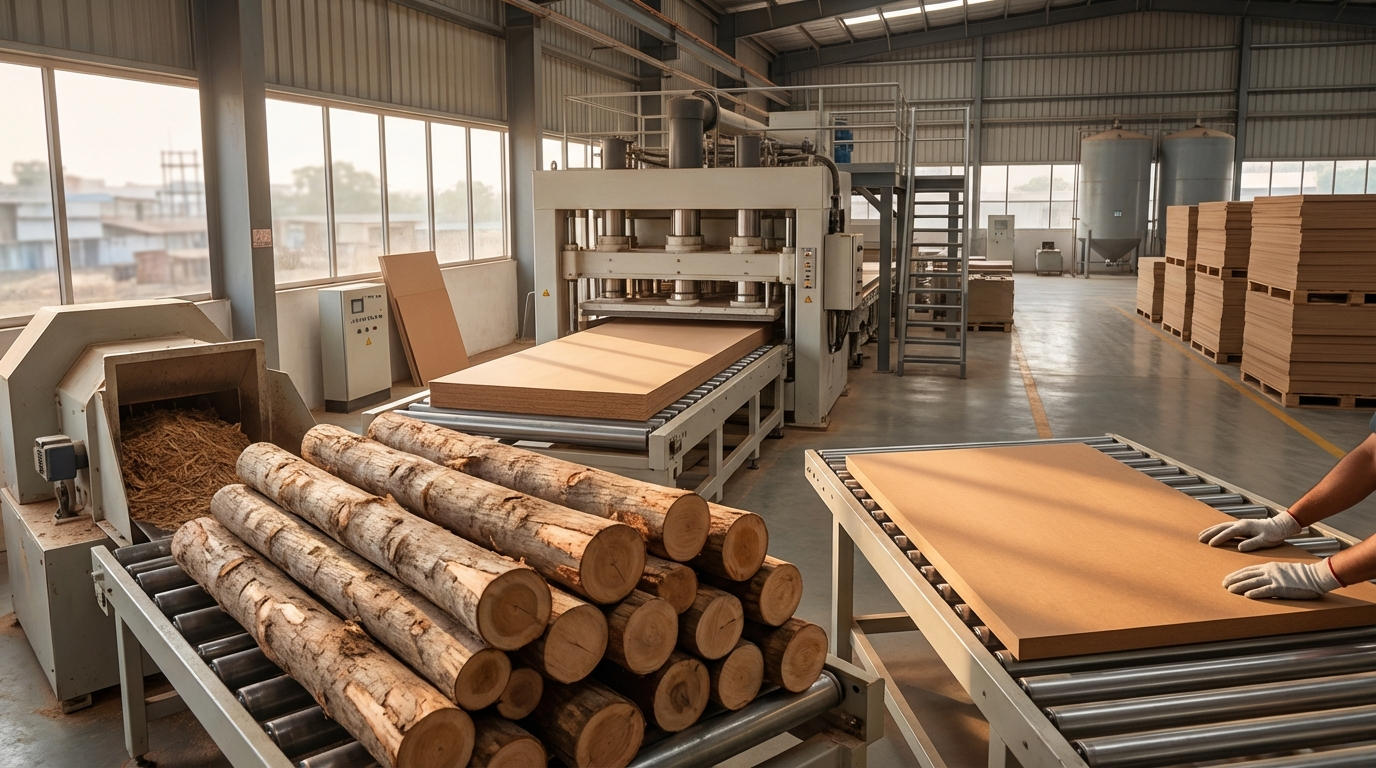
Raw logs undergo debarking to remove outer bark that could contaminate the final product. The debarked logs then pass through industrial chippers that reduce them to small, uniform wood chips typically 15-25mm in size. Chip consistency matters—irregular chips lead to uneven fibre extraction and density variations in the final board.
Chip Washing and Screening
Wood chips are washed to remove sand, dirt, and foreign particles that could damage equipment or appear as defects in finished boards. Screening separates oversized and undersized chips, ensuring only properly sized material enters the defibration stage.
The Defibration Process: Heart of MDF Manufacturing
Defibration—the process of separating wood chips into individual fibres—is the most critical manufacturing stage. This is where wood transforms from solid material into the raw ingredient for engineered boards.
How Defibrators Work
Modern MDF plants use pressurized refiners called defibrators. Wood chips enter a pre-steaming vessel where they're softened under pressure (typically 7-8 bar) and temperature (170-180°C). The softened chips then pass between rotating metal discs that mechanically separate the wood fibres.
The quality of fibre separation directly affects final board properties. Properly defibrated fibres are long, flexible, and undamaged. Over-refined fibres become too short, reducing board strength. Under-refined fibres remain as bundles, creating density variations and surface defects.
Fibre Quality Control Points
Quality-conscious manufacturers monitor several parameters during defibration:
- Fibre length distribution: Optimal range typically 1.5-3.5mm
- Fibre flexibility: Affects mat formation and pressing behaviour
- Moisture content: Usually controlled to 8-12% post-defibration
- Shive content: Underfibrated bundles should be below 0.5%
Resin Application and Blending
After defibration, wood fibres must be bonded together using synthetic resins. This stage determines the board's moisture resistance, strength, and formaldehyde emission characteristics.
Types of Resins Used
Different resin systems create different board grades:
| Resin Type | Board Grade | Moisture Resistance | Typical Applications |
|---|---|---|---|
| Urea Formaldehyde (UF) | Interior Grade (MR) | Moderate | Furniture, panelling |
| Melamine Urea Formaldehyde (MUF) | Enhanced Interior | Good | Kitchens, humid areas |
| Phenol Formaldehyde (PF) | Exterior Grade | Excellent | Outdoor, high humidity |
| MDI (Isocyanate) | Low Emission | Very Good | Healthcare, childcare |
Blending Process
Resin application happens in a blowline blender where fibres travel through a tube and resin is sprayed uniformly onto them. The typical resin content ranges from 8-12% of dry fibre weight. Wax (usually 0.5-1%) is added simultaneously to improve moisture resistance and reduce pressing time.
Uniform resin distribution is critical. Areas with insufficient resin become weak points prone to delamination. Areas with excess resin may show surface defects or increased formaldehyde emissions.
Mat Formation and Pre-Compression
Resinated fibres must be formed into a uniform mat before pressing. This stage creates the foundation for consistent board density and thickness.
Forming Station Operation
Modern forming stations use mechanical or air-lay systems to deposit fibres onto a moving conveyor belt. The fibres fall in a controlled pattern, building up layer by layer to create a loose mat typically 100-300mm thick (which will compress to final thickness of 2-30mm).
Mat uniformity directly affects final board properties. Variations in mat weight across the width or length translate into density variations in the pressed board. Quality manufacturers use weight sensors and automated adjustment systems to maintain consistent mat formation.
Pre-Compression
Before entering the hot press, the loose mat passes through pre-compression rolls that reduce its thickness and remove air. This step is essential for efficient pressing and prevents mat damage during handling. Pre-compressed mats typically reduce to 50-70% of their original thickness.
Hot Pressing: Where Board Properties Are Set
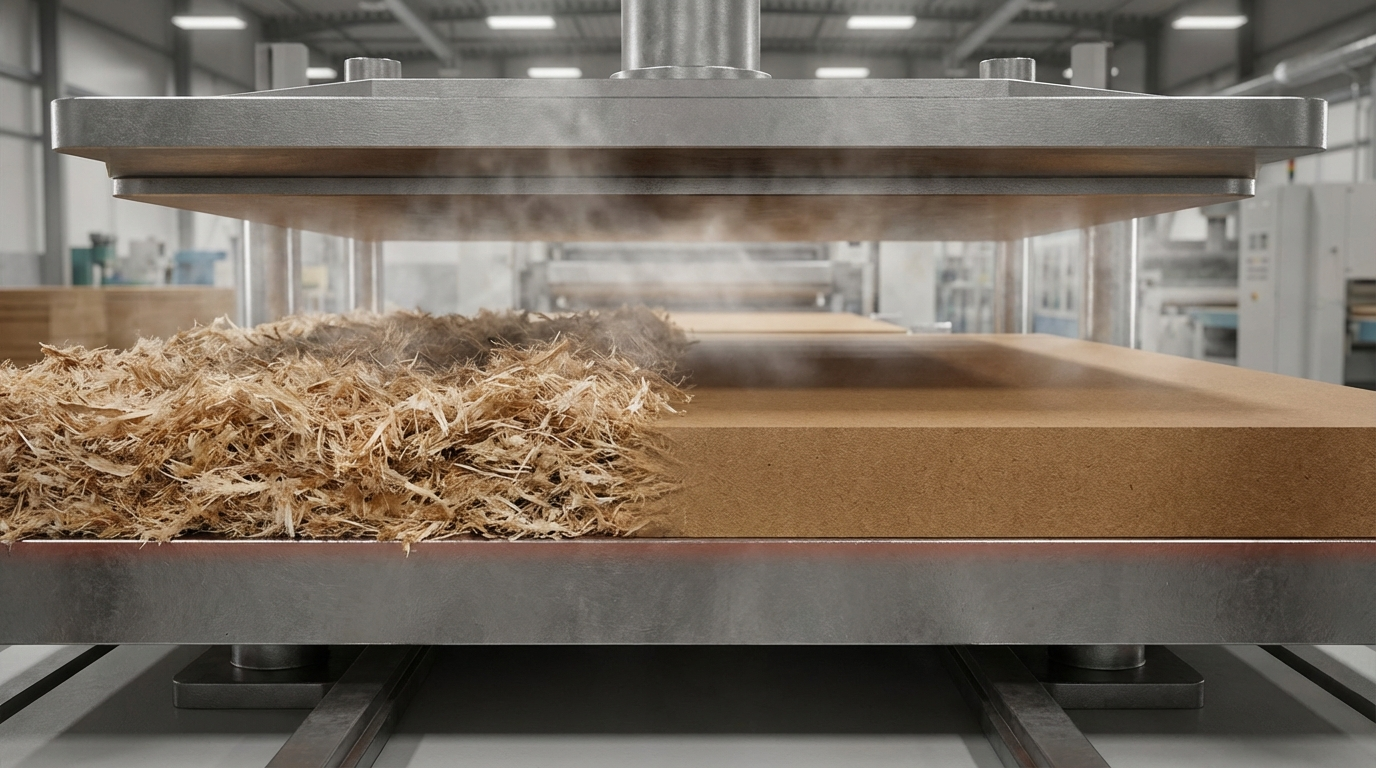
Hot pressing is where the loose fibre mat transforms into a solid, dense board. This stage permanently sets the board's density, strength, and surface characteristics through controlled application of heat and pressure.
Continuous vs. Multi-Opening Presses
Modern MDF plants use two main pressing technologies:
Continuous Presses: The mat travels between heated steel belts, allowing uninterrupted production. These systems offer better thickness control and higher production speeds. Most new facilities use continuous press technology.
Multi-Opening Presses: Individual mat sections are loaded between heated platens that close simultaneously. While offering flexibility for different thicknesses, these systems have lower productivity and more thickness variation.
The Pressing Cycle
A typical pressing cycle involves multiple stages:
- Initial Compression: Mat compressed to approximately 1.5 times final thickness
- First Holding Stage: Maintains pressure while surface layers cure
- Degassing: Pressure slightly reduced to allow steam escape
- Final Compression: Board reaches target thickness
- Curing: Heat penetrates core, completing resin polymerization
Press temperatures typically range from 180-220°C, with total pressing time varying from 3-8 seconds per millimetre of board thickness. The staged compression creates a characteristic density profile: higher density near surfaces (for strength and smooth finish) and lower density in the core (for reduced weight and cost).
Cooling, Conditioning, and Finishing
Boards exit the press at high temperatures and must be carefully cooled and conditioned before further processing. This stage prevents warping and ensures dimensional stability.
Star Dryer Cooling
Hot boards enter a star dryer or cooling carousel where they rotate slowly while ambient air removes heat. Rapid cooling can cause internal stress and warping, so this process typically takes 30-60 minutes depending on board thickness.
Conditioning and Stacking
After cooling, boards are stacked and allowed to equilibrate with ambient humidity for 24-48 hours. This conditioning period allows internal moisture gradients to equalize, preventing delayed warping after the boards leave the factory.
Sanding and Sizing
The final finishing steps include:
- Sanding: Wide-belt sanders remove the thin, dense surface layer to expose fresh fibre and create a smooth, uniform surface. Typical sanding removes 0.3-0.5mm from each face.
- Trimming: Edges are trimmed to final dimensions, removing any irregular material from the mat formation edges.
- Grading: Visual and automated inspection sorts boards by quality grade based on surface defects, thickness tolerance, and density consistency.
Quality Control Throughout Manufacturing
Consistent MDF quality requires quality control at every manufacturing stage, not just final inspection. Understanding these checkpoints helps buyers evaluate manufacturer credibility.
In-Process Quality Checks
| Stage | Parameter Checked | Acceptable Range | Test Method |
|---|---|---|---|
| Chip Preparation | Chip size distribution | 15-25mm (90% within range) | Screen analysis |
| Defibration | Fibre moisture content | 8-12% | Moisture meter |
| Blending | Resin content | 8-12% of dry fibre | Weight measurement |
| Mat Formation | Mat weight uniformity | ±3% across width | Weight sensors |
| Pressing | Temperature profile | 180-220°C | Thermocouples |
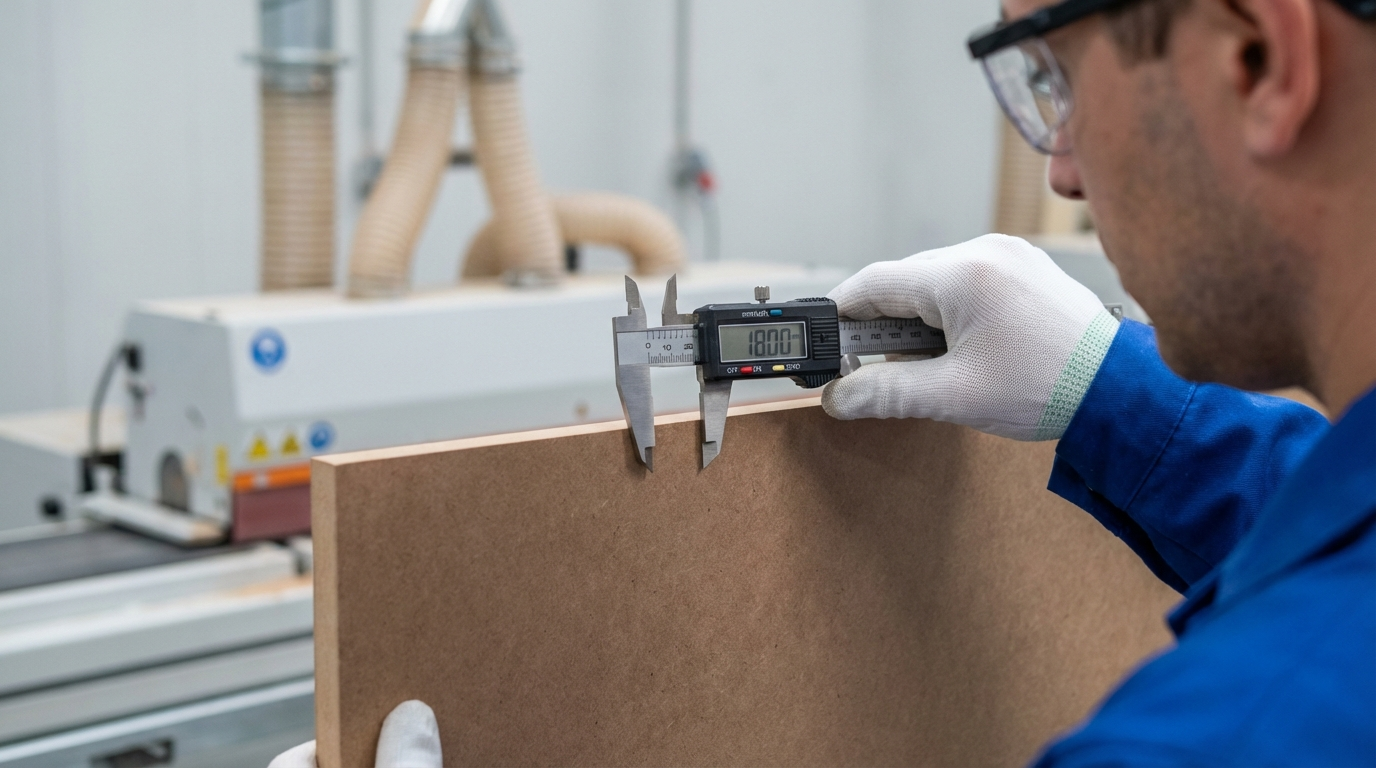
| Finishing | Thickness tolerance | ±0.2mm | Calliper measurement |
Final Board Testing
Finished boards undergo testing according to Indian and international standards. Key tests include:
- Density: Weight per unit volume, typically 650-850 kg/m³ for standard MDF
- Internal Bond: Tensile strength perpendicular to surface, indicating core cohesion
- Modulus of Rupture: Bending strength, critical for load-bearing applications
- Thickness Swelling: Percentage increase after water immersion, indicating moisture resistance
- Formaldehyde Emission: Must comply with E1 or E0 standards for indoor use
Decision Framework: Evaluating MDF Manufacturing Quality
| Quality Indicator | What to Look For | How to Verify |
|---|---|---|
| Consistent Density | Uniform weight across sheet | Check weight of multiple sheets from same batch |
| Good Internal Bond | Clean break in cross-section, no voids | Request test certificates or break sample piece |
| Proper Resin Distribution | No soft spots, uniform hardness | Tap across surface, listen for hollow sounds |
| Moisture Resistance | Minimal edge swelling | Request thickness swelling test data |
| Surface Quality | Smooth, defect-free surface | Visual inspection under raking light |
| Dimensional Accuracy | Correct thickness, square edges | Measure multiple points with calliper |
Common Manufacturing Defects and Their Causes
Understanding manufacturing defects helps buyers identify quality issues and trace them to their root causes.
Surface Defects
- Blisters: Raised areas caused by trapped steam or insufficient press time. Indicate inadequate venting or excessive moisture in mat.
- Rough spots: Areas of exposed fibre bundles from incomplete defibration. Affect painting and laminating quality.
- Resin spots: Darker areas where excess resin accumulated. May cause finishing problems.
Internal Defects
- Low internal bond: Weak core that separates easily. Caused by insufficient resin or improper pressing.
- Density variations: Inconsistent weight across the board. Results from uneven mat formation.
- Pre-cure: Resin hardens before pressing completes. Leads to weak bonding and delamination.
Dimensional Defects
- Thickness variation: Boards thicker or thinner than specified. Caused by press calibration issues.
- Warping: Curved or twisted boards. Results from improper cooling or moisture imbalance.
- Edge damage: Chipped or irregular edges. Often from handling or trimming problems.
Failure Modes and How to Prevent Them
Understanding how manufactured MDF can fail helps specify appropriate grades and installation methods.
Moisture-Related Failures
Symptom: Edge swelling, surface bubbling, board expansion
Root Cause: Inadequate resin system for application humidity, exposed edges in wet environments
Prevention: Specify exterior grade (MR or BWR) for humid applications, seal all edges before installation
Fix if Occurring: Remove affected boards, improve ventilation, replace with appropriate grade
Delamination Failures
Symptom: Surface layer separating from core, peeling laminate
Root Cause: Low internal bond strength from manufacturing defects or excessive moisture cycling
Prevention: Source from quality manufacturers, request internal bond test certificates
Fix if Occurring: Replacement is usually necessary; repair adhesives rarely restore full strength
Screw Holding Failures
Symptom: Screws pulling out, hinges loosening
Root Cause: Low-density core, improper screw selection, over-driving screws
Prevention: Use correct screw length and type for MDF, pre-drill pilot holes, don't overtighten
Fix if Occurring: Fill old holes with epoxy filler, relocate hardware slightly
Surface Finish Failures
Symptom: Paint peeling, veneer lifting, laminate bubbling
Root Cause: Surface contamination, moisture in board, incorrect adhesive or primer
Prevention: Allow boards to acclimatize, use appropriate primers, ensure proper surface preparation
Fix if Occurring: Strip existing finish, address underlying cause, refinish with correct products
Warping Failures
Symptom: Doors not closing, panels bowing, visible curvature
Root Cause: Unequal moisture exposure on opposite faces, improper storage, manufacturing defects
Prevention: Apply finish equally to all surfaces, store flat with proper support
Fix if Occurring: Minor warping may reverse with moisture balancing; severe warping requires replacement
Edge Damage Failures
Symptom: Chipped edges, crumbling corners, rough cuts
Root Cause: Dull cutting tools, improper feed rate, low-density boards
Prevention: Use sharp carbide-tipped tools, support board properly during cutting
Fix if Occurring: Apply edge banding, fill with MDF-specific filler, or trim to clean edge
Common Buyer Mistakes (And How to Avoid Them)
- Assuming all MDF is the same: Manufacturing quality varies significantly. Different plants produce different quality levels. Always request test certificates and inspect samples.
- Ignoring grade specifications: Interior grade MDF in bathrooms will fail. Match board grade to application humidity—exterior grade for wet areas, interior grade for conditioned spaces only.
- Skipping edge sealing: MDF absorbs moisture primarily through edges. Always seal cut edges with primer, edge banding, or sealant before installation in any area with humidity exposure.
- Storing improperly on site: Leaving MDF stacks exposed to construction dust and moisture damages boards before installation. Store flat, covered, and elevated off ground.
- Over-driving screws: MDF has less screw-holding capacity than solid wood. Over-tightening strips threads and weakens joints. Use pilot holes and stop when screw is snug.
- Choosing by price alone: The cheapest MDF often has the lowest density and poorest resin distribution. Failures cost more than the initial savings. Evaluate quality along with price.
- Not acclimatizing boards: Boards straight from delivery may have different moisture content than installation environment. Allow 48-72 hours in the installation space before cutting.
- Using wrong adhesives: PVA (white) glue fails in humid conditions. Use moisture-resistant adhesives for kitchen and bathroom applications.
Quality Checks Without Lab Tests
Before Buying
- Weight check: Heavier boards (for same thickness) generally indicate higher density and better quality. Compare weight of sheets from different suppliers.
- Visual inspection: Look for surface smoothness, absence of rough patches, consistent colour across the sheet.
- Edge inspection: Cut edge should show uniform fibre distribution without visible layers or voids.
- Tap test: Tap across the surface—uniform sound indicates consistent density; hollow sounds suggest voids or density variations.
- Request certificates: Ask for test reports showing internal bond, thickness swelling, and formaldehyde emission values.
After Cutting
- Edge quality: Clean cuts with minimal fuzzing indicate good fibre bonding. Excessive crumbling suggests low resin content.
- Core inspection: Cross-section should show uniform density without visible layers or colour variations.
- Routing test: Well-manufactured MDF routes cleanly without chip-out. Poor boards crumble or have irregular routing edges.
After Installation
- Monitor for swelling: Check edges near moisture sources after first monsoon season.
- Check screw tightness: Re-check hinge and hardware screws after 30 days of use.
- Inspect finish adhesion: Look for any bubbling, peeling, or lifting of applied finishes.
Tips by User Type
For Homeowners
Focus on durability expectations based on your local climate. In coastal cities like Mumbai or Chennai, specify higher moisture resistance grades even for bedroom furniture. Allow any new furniture to off-gas for 2-3 days in well-ventilated conditions before use. For cleaning, use damp (not wet) cloths and avoid soaking edges. Watch for early warning signs: doors sticking, drawer fronts warping, or edges feeling soft—these indicate moisture problems requiring attention.
For Carpenters
Invest in quality carbide-tipped cutting tools specifically rated for MDF—they stay sharp longer and produce cleaner cuts. Always cut with the good face up when using circular saws (blade exits downward) and face down for table saws (blade exits upward). Pre-drill all screw holes, especially within 20mm of edges. For CNC routing, use down-cut spirals for top surface finish and up-cut for bottom. Seal all cut edges immediately with shellac-based primer to prevent moisture absorption during project assembly.
For Architects and Designers
Specify MDF grades precisely in tender documents: "Interior Grade MDF conforming to IS 12406, minimum density 720 kg/m³, thickness swelling not exceeding 12% (24-hour water immersion)." Include edge sealing requirements in specifications. For wet zones, specify exterior grade (BWR/HDFWR) with written moisture resistance guarantees. Consider specifying pre-laminated boards for consistent quality and reduced on-site finishing variables. Include storage and handling requirements in site instructions.
For Modular/OEM Manufacturers
Establish incoming quality control procedures: check density, thickness tolerance, and surface quality of each batch. Maintain consistent supplier relationships—switching frequently introduces quality variation. Control workshop humidity between 45-65% RH to prevent pre-installation moisture absorption. Implement edge-sealing stations in production flow. Track customer complaints by board supplier to identify quality patterns. Consider specifying minimum manufacturing standards in supplier contracts.
Frequently Asked Questions
How is MDF manufactured in Indian factories?
MDF manufacturing in Indian factories follows a standardized process: plantation timber (typically eucalyptus or silver oak) is debarked, chipped, and steamed under pressure before being refined into individual fibres in a defibrator. These fibres are blended with urea-formaldehyde or melamine-fortified resins and wax, formed into a loose mat, and then compressed under high heat (180-220°C) and pressure. The resulting boards are cooled, conditioned for 24-48 hours, sanded to final smoothness, and cut to standard sizes of 8x4 feet. Quality varies by manufacturer based on equipment quality, process control, and raw material selection.
What raw materials are used in MDF board production?
MDF production uses three primary raw materials: wood fibres (from plantation species like eucalyptus, silver oak, poplar, or rubber wood), synthetic resins (urea-formaldehyde for interior grade, melamine-fortified or phenolic resins for moisture-resistant grades), and paraffin wax (for water repellency). The wood fibre constitutes approximately 82-85% of the board by weight, resin 10-14%, and wax 0.5-1%. Quality manufacturers use consistent wood species and carefully controlled resin formulations to ensure uniform board properties across production batches.
What makes moisture-resistant MDF different from regular MDF?
Moisture-resistant MDF differs from regular MDF primarily in resin formulation and manufacturing parameters. Standard MDF uses urea-formaldehyde (UF) resin, while moisture-resistant variants use melamine-urea-formaldehyde (MUF) or melamine-fortified resins that maintain bond strength in humid conditions. Higher wax content (up to 1.5% vs 0.5%) improves water repellency. The pressing cycle may also differ, with longer cure times ensuring complete resin polymerization. These changes result in lower thickness swelling (typically 8-10% vs 12-15% in 24-hour water immersion tests) and better performance in kitchens, bathrooms, and coastal environments.
How can I identify well-manufactured MDF without laboratory testing?
Several practical checks indicate MDF manufacturing quality without lab equipment. First, compare weight—heavier boards (same thickness) typically have higher density and better quality. Second, examine cut edges under good light; uniform fibre distribution without visible voids or layers indicates proper defibration and pressing. Third, tap across the surface listening for consistent sound; hollow spots suggest density variations. Fourth, check thickness at multiple points—variations exceeding 0.3mm indicate poor process control. Finally, request manufacturer test certificates showing internal bond strength, thickness swelling, and formaldehyde emissions.
Why does MDF quality vary between different manufacturers?
MDF quality variation stems from differences in equipment, raw materials, and process control. Older facilities may have less precise pressing systems, creating thickness variations and density inconsistencies. Raw material quality affects fibre characteristics—consistent plantation timber produces better results than mixed-species waste wood. Resin formulation and application uniformity impact bonding strength and moisture resistance. Finally, quality control rigor varies: some manufacturers test every batch extensively while others rely on periodic sampling. These cumulative differences explain why boards from different sources perform differently despite similar specifications on paper.
What certifications should quality MDF manufacturers have?
Quality MDF manufacturers typically hold multiple certifications. IS 12406 compliance confirms the board meets Indian standards for density, strength, and dimensional stability. ISO 9001 indicates quality management systems are in place. For exports or premium positioning, E1 or E0 formaldehyde emission certifications (or CARB compliance) demonstrate low chemical emissions suitable for indoor use. FSC or PEFC certification indicates sustainably sourced wood fibres. GREENGUARD certification verifies low VOC emissions. When evaluating manufacturers, request copies of current certificates and verify their validity with issuing bodies.
How long does the MDF manufacturing process take from wood to finished board?
The complete MDF manufacturing cycle from raw logs to finished boards typically takes 72-96 hours. Chipping and preparation requires 4-8 hours depending on volume. Defibration and blending occur rapidly, within 1-2 hours. Pressing itself takes only minutes (typically 3-8 seconds per millimetre of thickness), but mat formation, pressing, and cooling form a continuous flow taking 2-4 hours per batch. The critical conditioning period—where boards stabilize and internal moisture equalizes—requires 24-48 hours. Final sanding, cutting, and quality inspection add another 4-8 hours. Rush orders skipping conditioning often result in warping issues after delivery.
Does the wood species used affect final MDF board properties?
Wood species moderately influences MDF properties, though the manufacturing process is designed to minimize natural wood variations. Eucalyptus fibres, commonly used in Indian production, produce boards with good strength and consistent density. Poplar creates lighter boards with excellent surface smoothness for painting. Rubber wood offers moderate properties with sustainability advantages. However, well-controlled manufacturing can produce consistent boards from various species. The larger impact comes from fibre quality (length, flexibility) achieved during defibration rather than the original species. Mixed-species inputs create more variation than single-species production runs.
What happens if MDF is manufactured with incorrect pressing parameters?
Incorrect pressing parameters cause several defects. Insufficient temperature or time leaves the core under-cured, resulting in low internal bond strength—boards that delaminate easily and have poor screw-holding capacity. Excessive temperature creates surface pre-cure where outer layers harden before core compression completes, trapping steam and causing blisters or internal voids. Inadequate pressure produces low-density boards prone to moisture damage and mechanical weakness. Excessive pressure can crush surface fibres, creating a dense skin that resists finishing adhesion. These defects may not be visible initially but manifest during fabrication or after installation.
How do Indian climate conditions affect MDF manufacturing requirements?
India's varied climate—coastal humidity, monsoon seasons, and extreme regional temperature differences—demands specific manufacturing adaptations. Boards destined for coastal markets (Mumbai, Chennai, Kolkata) benefit from enhanced moisture-resistant formulations with higher melamine content. Monsoon-season production may require additional drying steps to manage ambient humidity affecting mat formation. Factory climate control becomes critical during the conditioning phase, where ambient humidity influences final board moisture content. Reputable Indian manufacturers adjust formulations and process parameters based on intended market regions, producing different grades for interior versus coastal applications.
What is the density profile of properly manufactured MDF?
Properly manufactured MDF has a characteristic U-shaped density profile when measured from face to face. Surface layers are denser (typically 900-1000 kg/m³) due to initial press contact with hot platens, providing a hard, smooth surface ideal for finishing. The core has lower density (typically 650-750 kg/m³), reducing overall weight and cost while maintaining adequate strength. This density gradient is intentional—the staged pressing cycle creates it deliberately. Boards with uniform density throughout (no gradient) typically have lower surface hardness, while boards with excessive density variation indicate poor process control during pressing.
Can manufacturing defects in MDF be repaired after purchase?
Most manufacturing defects cannot be effectively repaired post-purchase. Surface blisters can sometimes be injected with adhesive and clamped flat, but success is inconsistent. Low internal bond cannot be fixed—these boards should be rejected or used only for non-structural applications. Thickness variations cannot be corrected; specify tolerances and measure before accepting delivery. Minor surface roughness can be addressed with additional sanding, but this reduces thickness. Warped boards may flatten with proper conditioning and weighted storage, but severe warping is permanent. The best approach is rigorous incoming inspection and immediate rejection of defective material rather than attempted repair.
Disclaimer: This content is provided for general informational purposes based on industry practices and publicly available information. Product specifications, standards, prices, and availability may vary by manufacturer, region, and time. Readers should independently verify details with manufacturers, dealers, or qualified professionals before making purchase or construction decisions.
Want Plywood Suggestions?
Share a few details and a VIR MDF specialist will suggest suitable brands and connect you to responsive dealers.