Inside an MDF Plant: Quality Checks That Separate Premium Boards from Cheap Ones
Learn what happens inside an MDF plant—from density control to sanding and testing—and the quality checks that affect your furniture’s lifespan.
Quick Decision Summary
Premium MDF excels via tight density control, uniform resin distribution, and rigorous sanding, ensuring better screw hold and moisture resistance over cheap boards with voids and swelling.
If you’re in a hurry: Focus on boards with consistent thickness (check edges), smooth sanded surfaces without telegraphing fibers, and no visible particle clumps. Tap test for solid sound, weigh a sample for density feel (heavier often means tighter fibers). In India, prioritize moisture-resistant variants for monsoon-prone areas—avoid warped storage stacks. These checks spot premium quality that lasts 10+ years in kitchens or wardrobes versus cheap ones failing in 2-3 years from delamination.
- Choose premium MDF if building load-bearing furniture like wardrobes in humid coastal cities, needing strong screw holds for hinges.
- Avoid cheap boards if your site has poor ventilation or direct water exposure; they swell and chip easily during CNC routing.
What MDF Actually Is
MDF, or Medium Density Fiberboard, is an engineered wood panel made by breaking down wood into fibers, mixing with resins, and compressing under heat and pressure into dense sheets. Unlike plywood with visible layers, MDF offers a smooth, uniform surface ideal for laminates, painting, or carving. Standard thicknesses range from 3mm to 25mm, with densities typically 650-850 kg/m³.
It fits modular interiors like wardrobes, kitchen cabinets, and TV units, where flatness and machinability matter. Premium versions use refined fibers and advanced resins for consistency, while basic ones rely on coarser chips leading to weak spots. In workflows, it pairs with edge banding to mimic solid wood edges.
Why It Matters in Indian Homes and Sites
In India’s diverse climates, from Mumbai’s coastal humidity to Delhi’s dry heat, MDF quality dictates lifespan. Monsoon moisture causes cheap boards to swell at edges, loosening screws in wardrobe doors. Coastal sites amplify this with salt-laden air corroding unprotected surfaces.
Site realities like unventilated godowns during transport lead to fungal growth on low-grade boards. Premium quality ensures better dimensional stability, resisting 20-30% thickness swell in wet tests versus 50%+ for cheap ones. This translates to fewer callbacks for carpenters and durable finishes for homeowners.
Practical impact: Strong internal bonds hold screws in hinge areas without crumbling, vital for heavy-use kitchens. Poor quality fails here, causing sagging shelves after one rainy season.
Inside an MDF Plant: Key Production Stages
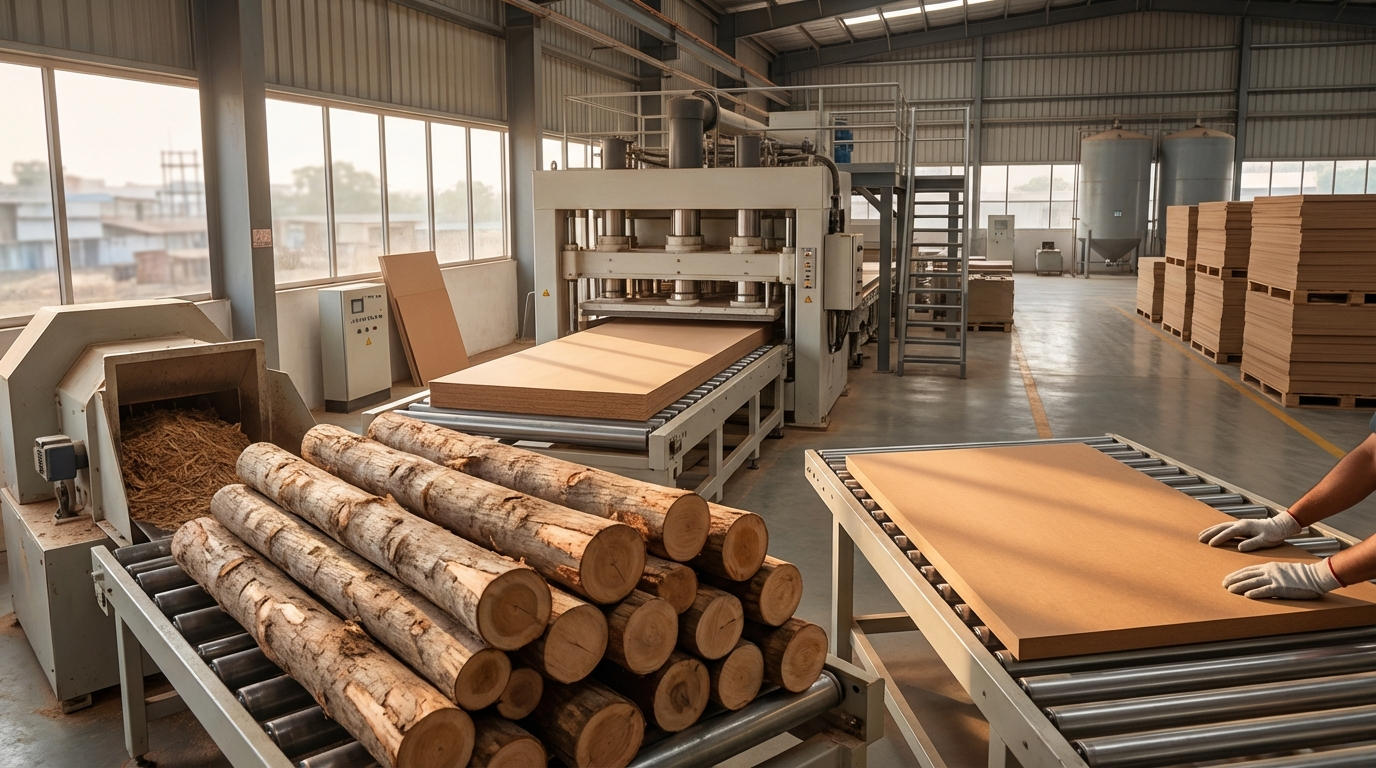
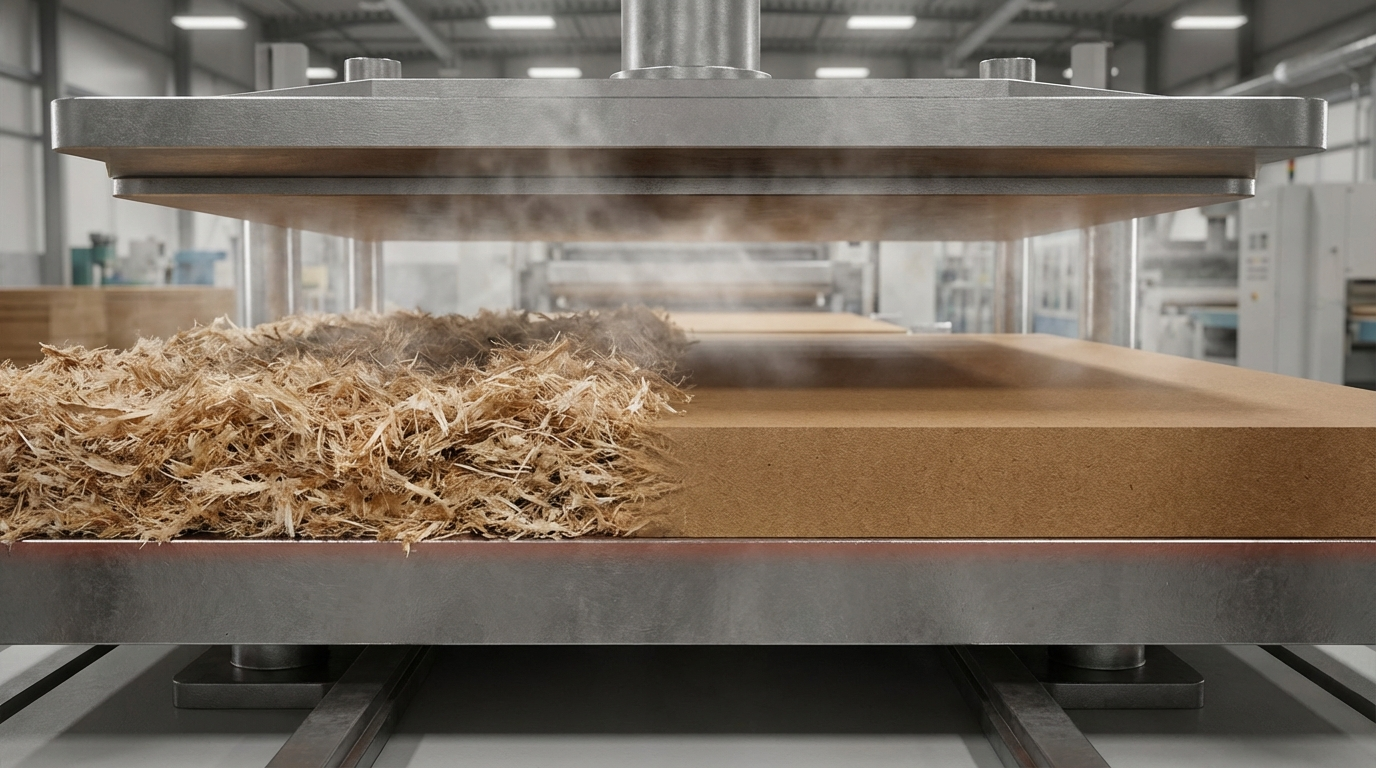
MDF production starts with wood chipping and ends at finished boards, with quality gates at each step. Logs enter debarkers, then chippers produce uniform fibers via steam refiners. Fibers dry to 8-12% moisture, blend with 8-12% urea-formaldehyde resin, form a mat, and press at 180-220°C under 40-50 kg/cm² pressure.
Post-pressing, boards cool, trim, and sand for smoothness. Premium plants monitor variables tightly—fiber length, resin spread, press time—to avoid defects. Cheap setups skip inline checks, yielding inconsistent boards prone to warping.
What separates premium MDF production from basic ones?
Premium plants use multi-stage refiners for longer, uniform fibers (2-4mm), enabling higher density without voids. They employ closed-loop resin systems for even 10% distribution, tested via grammage uniformity. Basic lines use single refiners and manual blending, leading to resin-poor zones that delaminate in humidity.
In India, premium controls suit monsoon storage; verify by checking board weight uniformity. Next step: Ask suppliers for density profile graphs during site visits—flat curves indicate quality.
Why is fiber preparation the first quality checkpoint?
Fiber prep breaks wood into fine, defect-free strands; poor chipping leaves knots causing weak spots. Premium checks reject contaminated chips (bark, metal), ensuring clean fibers. This prevents surface pinholes post-sanding.
India-specific: Cleaner fibers resist termite attack better in humid zones. Check: Rub board surface—if gritty, fibers are coarse. Test by scratching lightly; smooth resistance signals quality.
Resin Blending and Forming: Binding for Durability
Resin—usually urea-formaldehyde with hardeners—glues fibers. Premium plants use automated blenders for even coating, targeting 9-11% resin content. Forming mats via air-formed lines ensures uniform weight per area.
Weak blending causes low internal bond (IB), failing screw holds. In presses, multi-opening setups control thickness precisely. Trade-off: Higher resin boosts strength but raises cost 10-15%.
How does resin quality affect board lifespan?
Better resins (low formaldehyde, high solids) cure fully, resisting hydrolysis in humid Indian monsoons. Cheap resins emit more, yellow surfaces over time. Premium boards maintain IB above 0.8 N/mm².
Nuance: Coastal areas need MR-grade resins. Check: Smell fresh boards—mild odor good, strong chemical bad. Press nail into edge; firm withdrawal indicates solid bond.
Pressing, Cooling, and Finishing: Density and Surface Secrets
Pressing densifies the mat; premium targets zoned density (higher core/surface). Cooling tunnels prevent warping. Trimming removes ragged edges, sanding achieves <0.1mm tolerance.
Cheap boards show press marks or uneven sanding, telegraphing during lamination. In India, precise finishing ensures edge banding adhesion amid dusty sites.
What density profile makes MDF premium?
Uniform 720-780 kg/m³ across thickness, with face/core variation <10%. This resists sagging in humid cabinets. Cheap boards vary 20%+, swelling unevenly.
Conditions: Wardrobes need higher core density. Verify: Cut sample, measure weight/volume; consistent heft signals quality. Avoid if core feels spongy.
Quality Checks You Can Do Without Lab Tests
Before buying: Inspect stacks for flatness—no warping. Check surfaces for smoothness, no pits or clumps. Tap edges—solid thud, not hollow.
Weigh equal sizes; premium feels denser. After cutting: Edges should be clean, no fiber pull-out. Screw test: Drive 4mm screw, twist out—minimal crumble good.
Post-install: Wipe with damp cloth; no swelling after 24 hours. Red flags: Visible glue lines, rough sand, inconsistent thickness (>0.3mm variation).
Can you tell premium MDF by weight alone?
Partly—premium often 750+ kg/m³ for 18mm boards (around 20-22kg/sheet). Lighter signals loose fibers. But confirm with tap test.
India tip: Heavier suits humid zones. Next: Compare two sheets; uniform weight across stack best.
How to Spot Premium vs Cheap MDF in 5 Steps
- Visual scan: Smooth, uniform color—no dark streaks or voids.
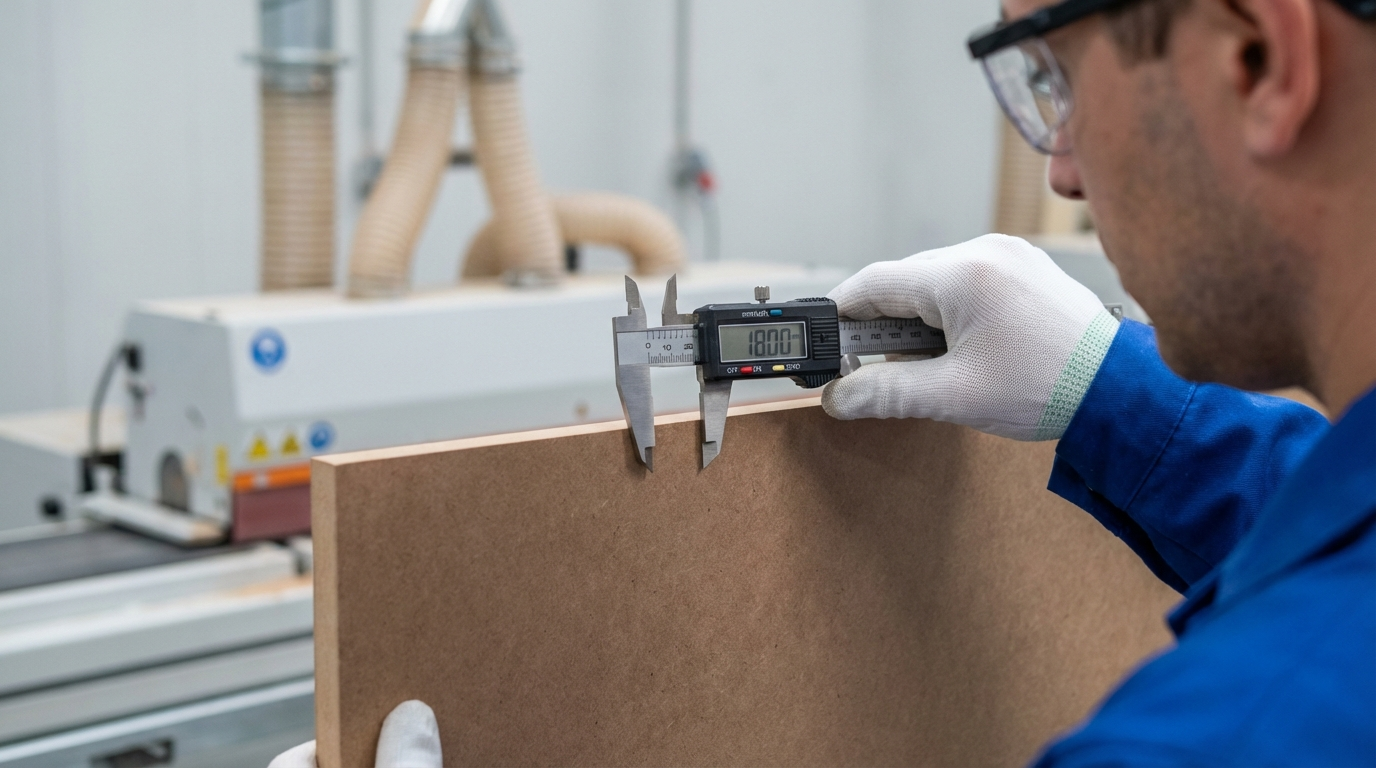
- Thickness gauge: Variation <0.2mm across sheet.
- Density feel: Weigh and tap—consistent, solid.
- Scratch/screw test: Minimal damage, strong hold.
- Moisture challenge: Expose edge to water 1 hour—no swell.
Failure point: Skipping step 3 leads to weak cores crumbling in hinges. Prevention: Always sample test.
Premium vs Cheap: Comparison Table
| Aspect | Premium Boards | Cheap Boards | Real-Life Impact (India) |
|---|---|---|---|
| Density Uniformity | <5% variation | 15-25% variation | Premium resists monsoon swell; cheap warps shelves |
| Resin Distribution | Even, automated | Clumpy, manual | Strong screw hold vs loosening doors |
| Surface Finish | <80 grit sand | Rough, pits | Laminate adhesion vs bubbling |
| Edge Quality | Clean post-trim | Ragged, chips | CNC routing ease vs breakage |
| Internal Bond | High, uniform | Low zones | Durability in humid sites vs delam |
Decision Framework: Choose Based on Your Conditions
| Site Condition | Recommended MDF Type | Verify These Checks |
|---|---|---|
| Monsoon humidity | MR-grade, 750+ kg/m³ | Thickness swell test, edge seal |
| Coastal salt air | HDFMR, zoned density | Surface wipe test, resin smell |
| Heavy use kitchen | 18-25mm, high IB | Screw hold, tap solidity |
| Tight budget | Standard 700 kg/m³ | Visual uniformity, no voids |
| CNC workflow | Consistent thickness | Sanding smoothness, cut edge |
| High scratch risk | Pre-lam face, dense surface | Scratch resistance, fiber fineness |
Failure Modes and Fixes
Symptom: Edge swelling. Root: Poor density, high moisture absorption. Prevention: MR boards, sealed edges. Fix: Sand, re-band; replace if core wet.
Symptom: Screw pull-out. Root: Low IB from resin skimps. Prevention: Premium density. Fix: Use inserts; avoid overloading.
Symptom: Surface delam. Root: Uneven resin. Prevention: Tap test pre-buy. Fix: Refinish if early; replace panels.
Symptom: Warping post-install. Root: Improper storage. Prevention: Acclimatize 48hrs. Fix: Shim alignment.
Symptom: Pinholes in laminate. Root: Coarse fibers. Prevention: Smooth sand check. Fix: Filler + repaint.
Symptom: Chipping on cuts. Root: Brittle edges. Prevention: Sharp CNC bits. Fix: Re-cut, band immediately.
Why do MDF edges swell fastest in monsoons?
Exposed lignocellulose absorbs water rapidly without MR resins. Premium boards cap at 8% swell. Nuance: Coastal worse due to salt.
Check: Dampen edge overnight. Next: Seal all cuts with wax before banding.
Common Buyer Mistakes and How to Avoid Them
- Mistake 1: Buying by price alone. Avoid: Balance with density checks; cheap often 20% weaker.
- Mistake 2: Ignoring storage. Avoid: Inspect stacks on-site, flat and covered.
- Mistake 3: No sample testing. Avoid: Cut/test screws on scrap first.
- Mistake 4: Skipping MR in wet zones. Avoid: Specify for kitchens/bathrooms.
- Mistake 5: Poor edge prep. Avoid: Band within hours of cutting.
- Mistake 6: Overloading thin boards. Avoid: 18mm min for shelves.
- Mistake 7: Dust site handling. Avoid: Cover during transport.
- Mistake 8: No acclimatization. Avoid: 2 days in room conditions.
Tips for Homeowners, Carpenters, Architects, and OEMs
Homeowners: Clean with microfiber, avoid excess water. Do: Wipe spills immediately. Don’t: Use abrasives on laminates.
Carpenters: Cut with fine blades (80 teeth), pre-drill hinges. Focus fastening zones 40mm from edge. Handle stacked to avoid dents.
Architects/Designers: Spec density >720 kg/m³, detail edge returns for humidity. Use MR in wet zones, zone thickness by load.
OEM/Modular Makers: QC each batch: 5% sample tests. Standardize CNC feeds to reduce chipping returns by 30%.
How should carpenters handle MDF on humid sites?
Acclimatize 72 hours, seal cuts instantly. Use MR boards. Nuance: Coastal needs extra wax coat.
Step: Stack vertically, fan-dry if damp.
FAQs
What makes MDF premium inside the plant?
Consistent fiber refining, precise resin metering (9-11%), and zoned pressing create uniform density without weak cores. Sanding to fine grit ensures laminate-ready surfaces. In Indian plants, premium lines often include inline density scanners, catching variations early. This results in boards holding shape through monsoons, unlike patchy cheap ones that bulge at edges after first rains. Homeowners see this in lasting wardrobe doors without sagging.
How do you check MDF density without tools?
Weigh a known-size piece against standards—18mm premium feels 20-22kg. Tap for solid resonance across surface. Compare edges to center; even heft good. In India’s variable supplier quality, this spots airy cheap boards prone to screw failures. Always test multiple sheets from stack for batch consistency, avoiding surprises during kitchen installs.
Why do cheap MDF boards fail faster in India?
Coarse fibers and skimpy resin lead to high swell (40%+) in humid monsoons, crumbling under screws. Coastal salt accelerates surface breakdown. Premium controls limit this to 10-15%, extending life. Buyers notice in peeling laminates or wobbly cabinets after one season. Prevention starts with visual uniformity checks pre-purchase.
Can you use standard MDF in kitchens?
Possible in well-ventilated dry kitchens, but MR variants better for steam exposure. Standard swells at edges from spills, loosening fittings. India’s cooking humidity demands sealed edges and 18mm+ thickness. Architects spec MR for longevity, reducing callbacks. Test by simulating steam—minimal change ideal.
What’s the role of sanding in MDF quality?
Final sanding removes press marks, achieving flatness for finishes. Premium uses progressive grits (100-220), preventing fiber telegraphing under laminates. Cheap rough sanding causes bubbles or poor adhesion in dusty Indian sites. Check by running palm—no drag. This step boosts paint hold by 50% in wardrobes.
How does plant pressing affect screw holding?
High-pressure multi-stage pressing densifies core for strong IB. Premium achieves better withdrawal force in hinges. Cheap under-press leads to crumble. In heavy wardrobes, this means no door droop. Carpenters verify by test screws—clean pull-out good.
Is thicker MDF always better quality?
No—quality is density and uniformity, not just thickness. 18mm cheap with voids underperforms 12mm premium. India projects favor balanced specs for CNC. Check profile: Solid core over thin dense face. Avoid assuming bulk equals strength.
What storage mistakes ruin MDF quality?
Stacking flat in humid godowns causes warping from trapped moisture. Vertical racking with spacers prevents this. Monsoon exposure leads to 10% swell pre-install. Cover during transport, acclimatize on-site. This preserves plant-fresh flatness for precise modular fits.
Do all MDF plants have the same quality controls?
Varies widely—premium feature automated monitoring, reject rates <2%. Basic rely on end-line checks, higher defects. In India, coastal plants often upgrade for MR. Buyers differentiate via sample tests, not claims. Consistent performance across batches signals tight controls.
Disclaimer: This content is provided for general informational purposes based on industry practices and publicly available information. Product specifications, standards, prices, and availability may vary by manufacturer, region, and time. Readers should independently verify details with manufacturers, dealers, or qualified professionals before making purchase or construction decisions.Want Plywood Suggestions?
Share a few details and a VIR MDF specialist will suggest suitable brands and connect you to responsive dealers.