Laminated MDF Board: Colors, Finishes & Application Guide
Laminated MDF board guide: 100+ color options, finishes & applications. Explore VIR laminated MDF catalog for wardrobes & kitchen cabinets.
Quick Decision Summary
Quick Answer: Laminated MDF board is medium-density fiberboard factory-bonded with decorative melamine paper, available in 100+ colors and 50+ textures including wood grains, solid colors, stone patterns, and high-gloss finishes—ideal for Indian wardrobes, kitchen cabinets, and modular furniture where consistent appearance and moisture resistance matter.
If you're in a hurry: For Indian homes in 2026, choose wood grain laminated MDF (oak, walnut, ash tones) for wardrobes and living areas, solid white or grey for modern kitchens, and textured matte finishes for high-traffic furniture that needs fingerprint resistance. Expect prices between ₹45-120 per square foot depending on thickness and finish quality. Always verify the laminate is bonded on both sides for warp resistance in humid conditions.
Choose laminated MDF board if:
- You want factory-finished boards ready for cutting without additional lamination
- Your project requires consistent color matching across multiple furniture pieces
- Budget constraints prevent using solid wood or high-end veneers
- The application is indoor-only in climate-controlled or semi-controlled spaces
Avoid laminated MDF board if:
- The furniture will be in direct contact with water (sink bases, outdoor use)
- You need to create complex curved shapes requiring post-forming
- Edge exposure is unavoidable and edge-banding resources are limited
- Coastal humidity exceeds 80% consistently without air conditioning
What Laminated MDF Board Actually Means
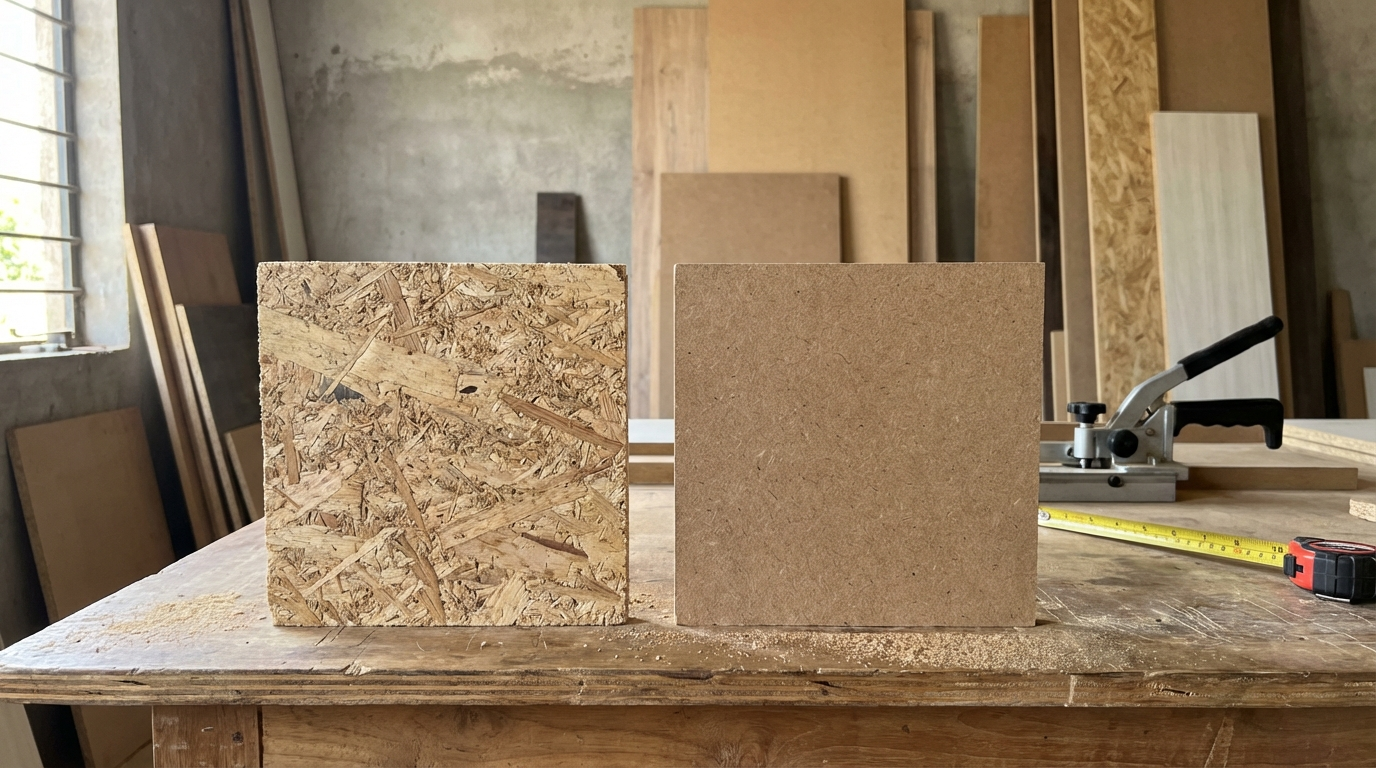
Laminated MDF board refers to medium-density fiberboard that has been factory-bonded with decorative melamine-impregnated paper under controlled heat and pressure. Unlike raw MDF that requires separate laminate application, pre-laminated boards arrive ready for fabrication with the decorative surface already permanently fused to the substrate.
The manufacturing process involves compressing wood fibers with resin and wax to form the MDF core, then applying decorative paper saturated with melamine resin onto one or both surfaces. This bonding happens at temperatures between 150-200°C under pressures of 20-30 kg/cm², creating a surface that resists scratches, stains, and moderate moisture exposure.
Where it fits in the material hierarchy:
- Above: Solid wood, natural veneers, high-pressure laminates (HPL)
- Same level: Pre-laminated particle board, melamine-faced chipboard
- Below: PVC film-wrapped boards, paper-foil finished boards
Common confusions clarified:
- Laminated MDF vs. HPL on MDF: Laminated MDF has a thinner melamine layer (0.1-0.2mm) bonded during manufacturing, while HPL (0.8-1.25mm thick) is a separate sheet glued to MDF at the fabrication stage
- Pre-laminated vs. post-laminated: Pre-laminated is factory-finished; post-laminated means raw MDF with laminate applied later by carpenters or fabricators
- Melamine MDF vs. laminated MDF: These terms are used interchangeably in Indian markets—both refer to melamine-paper-faced MDF boards
Why Laminated MDF Colors Matter for Indian Homes
Color selection in laminated MDF directly impacts furniture longevity and maintenance burden in Indian conditions. The humid monsoon season (June-September) causes moisture absorption through exposed edges, which manifests differently across finish types. Dark matte finishes hide edge swelling better than high-gloss whites, which show every imperfection.
Monsoon and coastal humidity impact:
- Light-colored boards show water staining more prominently if edges are compromised
- Glossy surfaces reveal moisture-induced warping immediately through light reflection distortion
- Wood grain patterns camouflage minor surface damage better than solid colors
- Coastal areas (Mumbai, Chennai, Kochi) require boards with moisture-resistant (MR) or boiling water resistant (BWR) cores regardless of surface finish
Real consequences of wrong color/finish selection:
- Swelling visibility: White glossy wardrobe shutters show 2-3mm edge swelling prominently; textured oak hides the same damage
- Fingerprint accumulation: High-gloss dark colors (black, navy) require daily cleaning in kitchens; matte finishes need weekly attention
- Heat damage: Dark laminated surfaces near cooking areas absorb more heat, accelerating delamination near stove zones
- UV fading: Vibrant colors (red, yellow, cobalt) fade faster near windows; earth tones and neutrals maintain consistency
Site handling realities affecting color choice:
- Construction dust settles into textured surfaces and is harder to clean than smooth finishes
- Transport scratches are more visible on solid dark colors than on patterned surfaces
- Edge chipping during carpenter handling shows white MDF core against dark laminates starkly
Complete Color Categories Available in India (2026)
The Indian laminated MDF market in 2026 offers over 300 distinct color-pattern combinations across major manufacturers. Understanding these categories helps in matching furniture to interior schemes and maintenance capabilities.
Solid Colors (Unicolors)
Solid color laminated MDF provides uniform, single-tone surfaces without patterns or textures. These boards are preferred for contemporary minimalist designs and modular furniture where clean lines matter.
| Color Family | Popular Shades | Best Applications | Maintenance Level |
|---|---|---|---|
| Whites | Pure white, off-white, ivory, cream | Kitchen cabinets, wardrobes, study tables | High (shows dirt easily) |
| Greys | Light grey, charcoal, slate, cement grey | TV units, office furniture, modern bedrooms | Medium |
| Blacks | Matte black, glossy black, graphite | Accent panels, handles, contemporary kitchens | High (fingerprints visible) |
| Beiges/Browns | Sand, mocha, coffee, chocolate | Living room furniture, traditional interiors | Low |
| Vibrants | Red, blue, green, yellow, orange | Children's furniture, accent pieces, commercial | Medium (fading risk) |
Wood Grain Patterns
Wood grain laminated MDF replicates natural timber appearance at a fraction of solid wood costs. Modern printing technology creates realistic grain patterns with tactile textures that mimic actual wood feel.
| Wood Type Replicated | Tone Range | Grain Character | Popularity in India |
|---|---|---|---|
| Oak | Light to medium brown | Pronounced, linear | Very high |
| Walnut | Dark brown to chocolate | Swirled, dramatic | High |
| Teak | Golden to reddish-brown | Medium, traditional | Very high (regional preference) |
| Maple | Pale cream to light tan | Subtle, fine | Medium |
| Ash | Light grey-brown | Strong, open | Growing |
| Cherry | Reddish-pink to brown | Fine, elegant | Medium |
| Wenge | Very dark brown/black | Linear, bold | Medium (modern interiors) |
Stone and Concrete Patterns
Stone-effect laminated MDF has gained significant traction in Indian urban markets for industrial and contemporary aesthetics. These patterns work particularly well for TV unit backdrops, feature walls, and modern kitchen countertop surrounds.
- Marble effects: White Carrara, grey Statuario, beige Botticino, black Marquina
- Concrete/cement: Light grey, dark grey, textured concrete, polished concrete
- Terrazzo: Multi-colored chip patterns on neutral bases
- Slate: Dark grey with natural cleft texture simulation
Abstract and Geometric Patterns
Contemporary Indian interiors increasingly feature abstract laminated MDF for statement furniture pieces. These patterns suit commercial spaces, children's rooms, and accent furniture.
- Geometric: Hexagons, chevrons, herringbone, diagonal lines
- Abstract: Fluid patterns, watercolor effects, brush strokes
- Metallic: Brushed aluminum, copper, gold, bronze effects
- Textile: Linen, canvas, leather texture simulations
Finish Types: Matte, Gloss, and Textured Options
The finish on laminated MDF determines its visual impact, maintenance requirements, and suitability for specific applications. Understanding finish characteristics helps avoid costly mismatches between surface type and usage conditions.
Matte Finish
Matte finishes absorb light rather than reflecting it, creating a sophisticated, non-reflective surface. This finish has become the dominant choice for premium Indian interiors in 2026 due to its practical benefits.
Characteristics:
- Light reflection: Less than 10%
- Fingerprint visibility: Low to moderate
- Scratch visibility: Lower than gloss
- Cleaning frequency: Weekly for high-touch areas
Best applications: Wardrobe exteriors, TV units, study tables, bedroom furniture, office partitions
Indian market trend: Anti-fingerprint (AFP) matte technology is increasingly available, marketed as "Traceless" or "Suede Touch" finishes that resist smudges and fingerprints even on dark colors.
High-Gloss Finish
High-gloss laminated MDF provides mirror-like reflectivity that makes spaces appear larger and brighter. However, it demands higher maintenance commitment and careful application selection.
Characteristics:
- Light reflection: 70-90%
- Fingerprint visibility: Very high
- Scratch visibility: High (any surface damage is immediately apparent)
- Cleaning frequency: Daily for kitchen applications
Best applications: Modern kitchen cabinet fronts, bathroom vanities (with proper ventilation), retail displays, commercial reception desks
Caution for Indian conditions: High-gloss surfaces in non-AC kitchens accumulate oil films rapidly, requiring specialized cleaners. Avoid for homes without regular housekeeping support.
Textured Finishes
Textured laminated MDF incorporates physical surface relief that can be felt by touch. These finishes add depth and character while providing practical benefits for daily use.
| Texture Type | Surface Feel | Maintenance | Best For |
|---|---|---|---|
| Woodgrain embossed | Linear grooves matching print | Low | Wardrobes, doors |
| Linen/Canvas | Fine cross-hatch pattern | Medium | Cabinet exteriors |
| Leather pore | Irregular small indentations | Medium | Premium furniture |
| Stone texture | Rough, natural feel | Low | Feature walls, TV backdrops |
| Soft-touch/Velvet | Smooth, suede-like | Medium-High | High-end wardrobes |
Synchronized Texture (EIR - Embossed in Register)
The most advanced laminated MDF finish available in India features synchronized texture where the physical embossing exactly matches the printed wood grain pattern. When you run your fingers across the surface, you feel grooves where the printed grain lines appear.
Premium pricing: EIR finishes typically cost 30-50% more than standard textured options but provide the most realistic wood simulation available in laminated boards.
Application-Wise Color and Finish Recommendations
Different furniture applications in Indian homes demand specific color-finish combinations optimized for their usage patterns, exposure conditions, and aesthetic requirements.
Kitchen Cabinets
| Cabinet Location | Recommended Colors | Recommended Finish | Why |
|---|---|---|---|
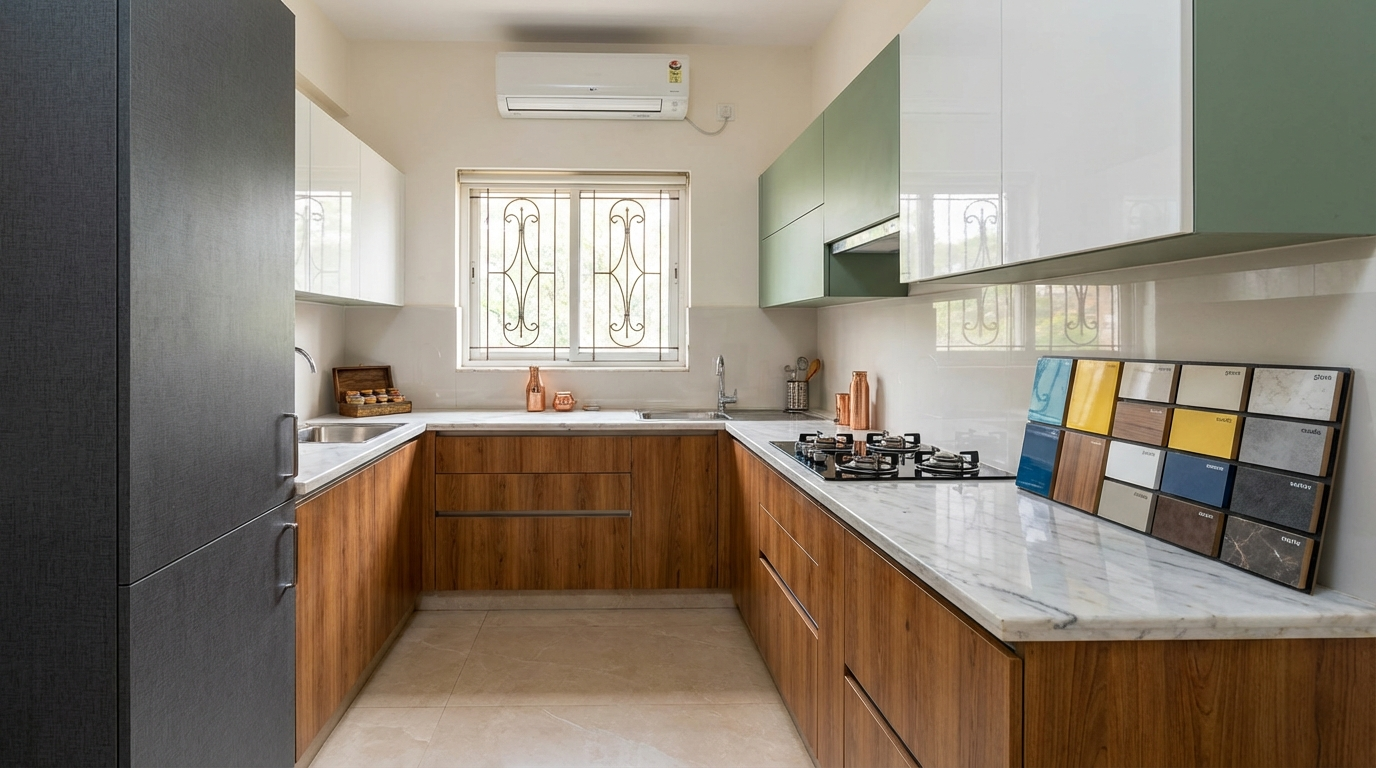
| Upper cabinets | Light colors (white, cream, light wood) | Matte or satin | Less fingerprint exposure, brightens space |
| Lower cabinets | Medium tones (grey, wood grain, beige) | Textured matte | Hides scuffs from foot traffic and cleaning |
| Island/Peninsula | Contrast color to wall cabinets | Depends on use pattern | Creates visual interest |
| Near cooktop | Avoid dark glossy surfaces | Matte only | Oil splatter and heat damage visibility |
Indian kitchen specifics: Due to oil-heavy cooking, avoid high-gloss finishes within 60cm of the cooking zone. Use HDFWR (High-Density Fiberboard Water Resistant) grade laminated boards near sinks and wet zones.
Wardrobes and Closets
Wardrobe exteriors form large visual surfaces that significantly impact bedroom aesthetics. Color and finish selection should balance visual appeal with practical maintenance.
- Master bedroom: Wood grains (walnut, oak, teak) in matte or textured finishes; neutral solid colors for contemporary looks
- Children's rooms: Light colors (white, pastels) with scratch-resistant matte finishes; avoid high-gloss due to fingerprint accumulation
- Guest bedroom: Neutral tones (grey, beige, light wood) that complement varied bedding and decor changes
- Walk-in closets: Light interiors improve visibility; exterior colors can match room theme
Wardrobe interior recommendation: Use light-colored laminated MDF (white, cream, light grey) for wardrobe interiors regardless of exterior color—improves clothing visibility and makes the space appear larger.
TV Units and Entertainment Centers
TV unit laminated MDF needs to balance screen visibility (avoiding reflective surfaces near the display) with contemporary aesthetics.
- Behind TV: Dark matte colors (charcoal, walnut, wenge) reduce eye strain and make screens appear larger
- Storage sections: Wood grains or textured neutrals hide cable management dust
- Open shelves: Light colors display decorative items better
- High-gloss accent panels: Acceptable on sections not directly adjacent to the screen
Study Tables and Home Office Furniture
Work surfaces require colors and finishes that reduce eye fatigue during extended use while hiding everyday wear.
- Desktop surfaces: Light matte colors (white, light oak, light grey) reduce eye strain; avoid dark glossy surfaces
- Storage/shelving: Wood grains or neutrals complement most monitor/laptop colors
- Avoid: Pure white glossy surfaces that cause glare under task lighting
Commercial Applications
Office and retail environments have different priorities—durability, professional appearance, and brand alignment often matter more than residential aesthetics.
| Application | Recommended Colors | Finish | Special Considerations |
|---|---|---|---|
| Office workstations | Light wood, light grey, white | Matte, textured | Anti-bacterial options available |
| Reception desks | Brand colors, premium wood grains | High-gloss or premium matte | High-traffic durability needed |
| Retail displays | White, neutral backgrounds | Various | Product visibility priority |
| Partitions | Corporate neutrals | Matte, acoustic options | Sound absorption features available |
Decision Framework: Which Color and Finish for Which Condition
Use this framework to match your specific conditions with appropriate laminated MDF color and finish selections.
| Condition | Recommended Choice | What to Verify |
|---|---|---|
| High humidity (coastal areas, monsoon exposure) | HDFWR grade board; medium tones; textured finish | Board grade stamped on edge; edge sealing quality |
| Heavy daily use (children's furniture, kitchen) | Textured matte finish; medium colors hiding wear | Scratch resistance rating; surface hardness |
| Tight budget | Standard wood grains; simple matte finish | Both-side lamination for warp resistance |
| Premium appearance priority | EIR synchronized texture; anti-fingerprint matte | Texture-print alignment across boards |
| Commercial high-traffic | Solid colors; high-durability matte or textured | Commercial grade rating; warranty terms |
| Near cooking zone | Light to medium matte colors; heat-resistant grade | Heat resistance specification; distance from flame |
| Direct sunlight exposure | UV-resistant grades; earth tones over vibrants | Lightfastness rating; warranty against fading |
| Matching existing furniture | Request samples; photograph matching | Same batch number for multiple boards |
Common Buyer Mistakes (And How to Avoid Them)
These mistakes consistently lead to dissatisfaction, premature failure, or costly replacements of laminated MDF furniture in Indian conditions.
Mistake 1: Choosing high-gloss for entire kitchen
Consequence: Daily visible fingerprints, oil film accumulation, cleaning fatigue within months. Prevention: Limit high-gloss to upper cabinets or accent areas only; use matte for lower cabinets and near cooking zones.
Mistake 2: Selecting dark solid colors for children's furniture
Consequence: Every scratch, fingerprint, and sticker residue shows prominently. Prevention: Choose light or medium wood grains with textured finishes for children's rooms.
Mistake 3: Not verifying both-side lamination
Consequence: Warping within 6-12 months as unbalanced moisture absorption causes boards to bow. Prevention: Always confirm decorative laminate on both faces, or at minimum, balancing laminate on the back.
Mistake 4: Ordering based on digital images alone
Consequence: Actual board color differs from screen representation; clashes with existing interiors. Prevention: Request physical samples; view in actual installation lighting before confirming.
Mistake 5: Ignoring batch number matching for large projects
Consequence: Visible color variation between wardrobe panels from different production batches. Prevention: Order all boards from same batch; verify batch numbers match on delivery.
Mistake 6: Using standard grade in wet zones
Consequence: Edge swelling and delamination within 1-2 monsoon seasons. Prevention: Specify MR (Moisture Resistant) or HDFWR grade for kitchen, bathroom-adjacent, and coastal applications.
Mistake 7: Selecting trendy colors without longevity consideration
Consequence: Vibrant accent colors that feel dated within 2-3 years. Prevention: Use trendy colors on easily replaceable elements (handles, back panels); keep carcass in timeless neutrals.
Mistake 8: Forgetting edge-banding color matching
Consequence: Visible mismatch between face laminate and edge-banding tape. Prevention: Order matching edge-banding from same manufacturer; verify shade match before carpenter starts.
Failure Modes and How to Prevent Them
Understanding how laminated MDF fails helps in specification, installation, and maintenance decisions that extend furniture lifespan.
Failure Mode 1: Surface Delamination
Symptom: Melamine paper lifts or bubbles away from MDF core, often starting at edges or corners.
Root cause: Moisture penetration through unsealed edges; heat damage; manufacturing defect in bonding.
Prevention: Ensure all edges are properly sealed with edge-banding or PVC lipping; maintain 50cm minimum distance from direct heat sources; inspect bonding quality before installation.
Fix if happening: Minor bubbles can be re-adhered using heat gun and pressure; extensive delamination requires panel replacement.
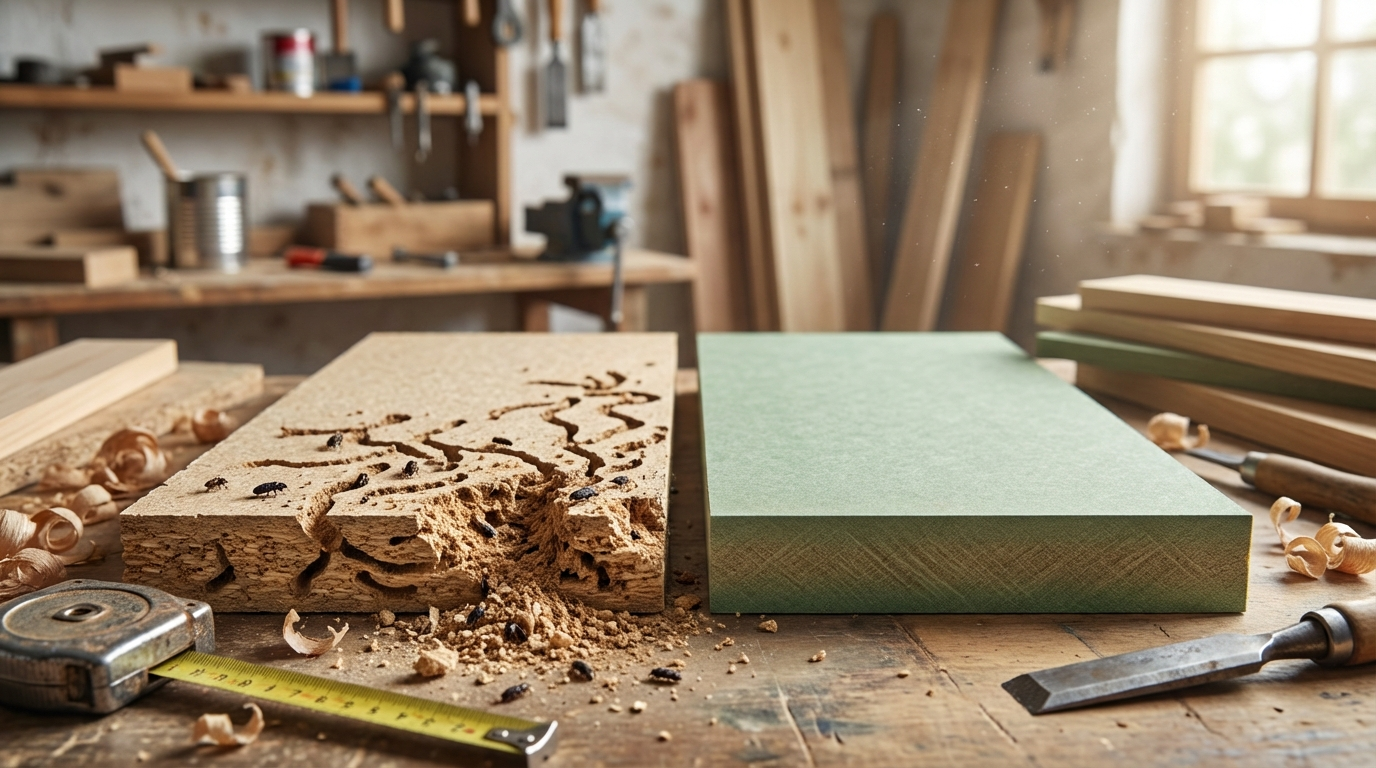
Failure Mode 2: Edge Swelling
Symptom: Visible thickening at board edges; edge-banding popping off; difficulty in door alignment.
Root cause: Water/moisture ingress through exposed edges; using standard grade in humid conditions.
Prevention: Use appropriate moisture-resistant grade; ensure complete edge sealing; address water leaks immediately.
Fix if happening: Minor swelling can be sanded down but exposes core; severe swelling requires panel replacement.
Failure Mode 3: Warping and Bowing
Symptom: Flat panels develop curves; doors don't close flush; gaps appear in carcass joints.
Root cause: Single-side lamination creating moisture absorption imbalance; improper storage before installation; temperature-humidity cycling.
Prevention: Specify double-side lamination; store boards flat in climate-controlled areas; allow acclimatization before installation.
Fix if happening: Minor warping may settle if conditions stabilize; severe warping is permanent and requires replacement.
Failure Mode 4: Surface Scratching
Symptom: White lines appearing on dark surfaces; general dullness; loss of original finish appearance.
Root cause: Abrasive cleaning materials; dragging objects across surface; inadequate scratch-resistance specification.
Prevention: Use appropriate cleaning methods (soft cloth, mild cleaners); choose scratch-resistant grades for high-use areas; apply felt pads under objects.
Fix if happening: Minor scratches can be reduced with appropriate polishes; deep scratches are permanent.
Failure Mode 5: Color Fading
Symptom: Uneven coloration between sun-exposed and shaded areas; overall color appears washed out.
Root cause: UV exposure without UV-resistant laminate; selecting non-lightfast colors for window-adjacent furniture.
Prevention: Specify UV-resistant grades for sun-exposed applications; choose lightfast colors; use window films to reduce UV penetration.
Fix if happening: Fading is irreversible; panel replacement required for aesthetic restoration.
Failure Mode 6: Hinge and Hardware Pull-Out
Symptom: Screws loosening repeatedly; hinges wobbling; hardware falling out of board.
Root cause: Screws placed too close to edge; using screws inappropriate for MDF density; moisture-weakened core.
Prevention: Use proper MDF-specific screws; maintain minimum 25mm edge distance for hardware; ensure core is not moisture-compromised.
Fix if happening: Fill existing holes with wood filler and resin; drill fresh pilot holes in new locations; consider adding backing plates.
Quality Checks Without Lab Tests
These practical verification methods help assess laminated MDF quality in showrooms, warehouses, and after cutting—without specialized equipment.
Before Buying: Visual and Physical Checks
- Surface uniformity: Look across the board surface at a low angle under bright light—quality lamination shows no bubbles, waves, or texture inconsistencies
- Edge inspection: Factory-cut edges should show uniform density without voids or density variations; the laminate-to-core bond should be tight without visible gaps
- Thickness consistency: Measure thickness at multiple points using calipers; variation should be under 0.3mm across the board
- Flatness test: Place board on a known-flat surface; check for rocking indicating warp; gaps should not exceed 2-3mm
- Back side verification: Confirm balancing laminate or decorative laminate exists on the back surface
Questions to Ask the Seller
- What grade is this board? (E0/E1/E2 for formaldehyde; MR/BWR for moisture resistance)
- Is this both-side laminated or single-side with balancing?
- What is the core density? (Higher density = better screw holding, typically 700-850 kg/m³)
- Can you provide batch matching for my complete order quantity?
- What is the warranty coverage and exclusions?
- Is matching edge-banding available for this exact shade?
Red Flags to Watch For
- Boards stored vertically without support (risk of warping)
- Boards stored in open, humid environments without covering
- Significant price below market range (typically indicates quality compromise)
- Inability to provide grade documentation or batch information
- Visible damage being dismissed as "normal" or "will disappear"
After Cutting: Quality Verification
- Edge quality: Clean-cut edges without chipping or delamination; core should appear uniform without voids
- Core consistency: Cross-section should show homogeneous density throughout; no visible layers or gaps
- Laminate adhesion: Try peeling at cut edge with fingernail—quality lamination will not lift
- Off-gassing: Strong chemical smell at fresh cuts may indicate higher formaldehyde (E2 grade); E0/E1 grades have minimal odor
After Installation: Maintenance Indicators
- Check door alignment within first week—settling is normal; continued shifting indicates installation or board issues
- Verify edge-banding adhesion by gentle pull test after 24 hours
- Monitor edges near sinks/wet areas for first monsoon season
- Document any issues immediately for warranty claims
Tips by User Type
For Homeowners
Durability expectations: Quality laminated MDF furniture should last 10-15 years with proper care in normal Indian conditions. Expect 5-8 years in high-humidity areas without air conditioning. Plan replacement budgets accordingly.
Cleaning do's and don'ts:
- Do: Use soft microfiber cloth; mild soap solution; dry immediately after wet cleaning
- Don't: Use abrasive scrubbers; bleach or harsh chemicals; excess water left standing; furniture polish with silicone (builds up film)
When to worry:
- Edges feeling soft or spongy (moisture absorption beginning)
- Visible swelling at any edge (requires immediate sealing or replacement)
- Doors not closing properly when they previously did (warping)
- Laminate lifting at corners (delamination beginning)
For Carpenters and Fabricators
Cutting tips:
- Use TCT (Tungsten Carbide Tipped) blades with 60+ teeth for clean cuts
- Score laminate surface with knife before cutting to prevent chipping
- Cut with laminate face up on table saws; face down on circular saws
- Support full board during cutting to prevent breakage
Edge preparation:
- Sand edges lightly before edge-banding to ensure adhesion
- Apply edge-banding within 24 hours of cutting to minimize moisture ingress
- Trim edge-banding flush using appropriate tools to avoid laminate damage
Screw zones and hinge areas:
- Pre-drill pilot holes to prevent splitting; use 2mm smaller diameter than screw
- Maintain minimum 25mm from edges for all hardware
- Use confirmat screws for structural joints in MDF
- Consider metal inserts for hardware subject to repeated adjustment
Storage and handling:
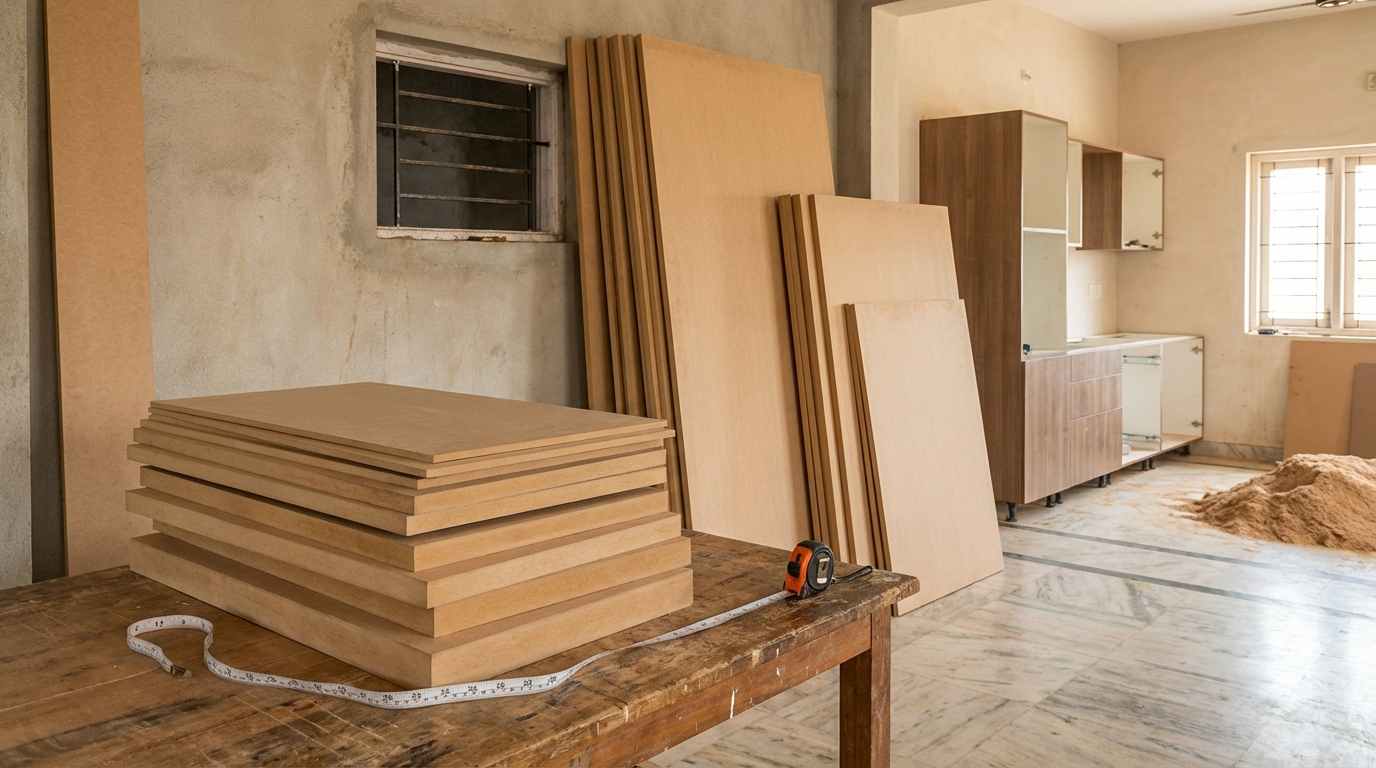
- Store flat on level supports at 300mm intervals
- Keep away from direct sunlight and moisture sources
- Allow 24-48 hours acclimatization in installation environment before cutting
- Handle with care—corner damage is irreversible
For Architects and Interior Designers
Specification language:
- Specify: "Pre-laminated MDF, [thickness]mm, [grade] core, [finish type], both-side laminated, BIS-certified"
- Include edge-banding specification: "2mm PVC edge-banding, color-matched to face laminate"
- For wet zones: "HDFWR grade mandatory with factory-applied PUR edge sealing"
Wet-zone detailing:
- Specify minimum 100mm plinth gap from floor in kitchens and bathrooms
- Require waterproof backing board between wall and MDF furniture
- Detail drip grooves on horizontal surfaces near sinks
- Specify stainless steel or plastic shelf supports, not MDF strips
Color selection process:
- Request A4-size physical samples for client approval
- View samples in actual room lighting at different times of day
- Obtain manufacturer's batch commitment in writing for large projects
- Include 5-10% excess in specification for damage replacement matching
For Modular Furniture and OEM Manufacturers
QC checkpoints:
- Incoming inspection: thickness tolerance, color consistency, surface defects, laminate adhesion
- In-process: cutting accuracy, edge quality, hardware placement precision
- Final: assembly alignment, door operation, finish inspection under standardized lighting
Reducing complaints:
- Maintain controlled storage environment (temperature 20-30°C, humidity 50-70%)
- Use same-batch boards for visible surfaces in single units
- Apply edge-banding before components leave controlled environment
- Include care and maintenance instructions with every delivery
Batch consistency:
- Establish relationships with manufacturers for reserved batch allocation
- Maintain sample library of each batch for post-delivery matching
- Document batch numbers in production records for warranty tracing
- Order project quantities in single shipment wherever possible
Thickness and Size Options Available in India
Understanding available dimensions helps in efficient material planning and cost optimization.
| Thickness (mm) | Common Applications | Typical Price Range (₹/sq ft) | Availability |
|---|---|---|---|
| 6mm | Back panels, drawer bottoms, partition infills | ₹30-50 | Widely available |
| 8mm | Back panels, light shelving | ₹35-55 | Available |
| 12mm | Shelving, light furniture, wall panels | ₹45-70 | Widely available |
| 15mm | Cabinet sides, internal shelving | ₹55-80 | Available |
| 18mm | Carcass, doors, heavy shelving, worktops | ₹65-100 | Most common |
| 25mm | Heavy-duty tops, counters, commercial furniture | ₹85-130 | Available on order |
Standard sheet sizes in Indian market:
- 8 ft × 4 ft (2440mm × 1220mm): Most common, widely available
- 9 ft × 4.25 ft (2800mm × 1300mm): Available for larger applications
- 10 ft × 4.25 ft (3050mm × 1300mm): Available on order for floor-to-ceiling wardrobes
Planning tip: Calculate material requirements to maximize sheet utilization. An 8×4 sheet yields 32 square feet; a 9×4.25 sheet yields approximately 38 square feet. Factor 10-15% wastage for standard projects.
Price Factors and Budget Planning (2026)
Laminated MDF pricing in India varies significantly based on multiple factors. Understanding these helps in realistic budgeting.
Price drivers (in order of impact):
- Board grade: HDFWR costs 30-50% more than standard MDF
- Thickness: Linear relationship—thicker boards cost more per square foot
- Finish type: High-gloss and EIR textures command 20-40% premium over standard matte
- Color complexity: Specialty patterns (marble, metallic) cost more than solid colors
- Brand: Premium manufacturers typically charge 15-25% over economy brands
- Quantity: Bulk orders may negotiate 5-10% discounts
Budget estimation example (18mm standard wardrobe):
- 8×4 ft wardrobe carcass: approximately 80-100 sq ft of laminated MDF
- At ₹70-90 per sq ft for 18mm standard grade: ₹5,600-9,000 for board cost alone
- Add 20-30% for edge-banding, hardware, and fabrication
- Total material cost estimate: ₹7,000-12,000 for basic wardrobe carcass
Cost-saving strategies:
- Use thinner boards (12mm) for internal components; reserve 18mm for visible elements
- Choose standard wood grains over specialty patterns for large surface areas
- Use premium finishes only on high-visibility surfaces (doors, front panels)
- Optimize cutting to minimize wastage; plan layouts before ordering
Frequently Asked Questions
What is the difference between laminated MDF and pre-laminated MDF board?
There is no functional difference—both terms refer to MDF boards with factory-applied melamine paper lamination. "Pre-laminated" emphasizes that the lamination happens during manufacturing, before the board reaches fabricators, distinguishing it from post-lamination where raw MDF receives laminate application at the workshop. In Indian markets, these terms are used interchangeably. When purchasing, focus on verifying the board grade, thickness, and finish type rather than this terminology difference.
Can laminated MDF be used in Indian kitchens with heavy cooking?
Laminated MDF works well in Indian kitchens with proper specification and installation. Use HDFWR (High-Density Fiberboard Water Resistant) grade near sinks and wet areas. Maintain minimum 50-60cm distance between laminated surfaces and gas burner edges to prevent heat damage. Choose matte finishes over high-gloss in cooking zones to minimize oil film visibility and cleaning burden. Ensure all edges are properly sealed with PVC edge-banding, and consider stainless steel kickboards at floor level. Standard laminated MDF is not suitable for direct water contact—avoid using it as sink bases without additional waterproofing.
How long does laminated MDF furniture last in coastal areas?
In coastal Indian cities (Mumbai, Chennai, Kochi, Visakhapatnam), laminated MDF furniture typically lasts 5-8 years compared to 10-15 years in drier climates. The higher salt content in coastal air accelerates hardware corrosion, while humidity averaging 70-85% stresses moisture-resistant grades. To maximize lifespan: use HDFWR or marine-grade boards; ensure complete edge sealing; maintain air conditioning in furniture rooms during monsoon; inspect edges annually for early swelling signs; and use stainless steel or plastic hardware instead of standard zinc-coated options.
Which laminated MDF color is best for small Indian apartments?
Light colors—particularly white, cream, light grey, and light oak—work best for small Indian apartments by visually expanding space and maximizing natural light reflection. However, pure white requires higher maintenance in dusty urban environments. The optimal choice for most small apartments is light wood grains (maple, ash, light oak) in matte or satin finish. These colors hide dust better than solid whites while maintaining the space-expanding benefit. For furniture receiving daily touch (wardrobe handles, kitchen cabinets), consider anti-fingerprint matte finishes that combine light colors with practical maintenance levels.
Is laminated MDF waterproof or only water-resistant?
No laminated MDF is truly waterproof—all grades are water-resistant to varying degrees. The melamine surface layer resists water penetration for short periods, but the MDF core absorbs moisture readily through exposed edges or prolonged surface contact. HDFWR (High-Density Fiberboard Water Resistant) and MR (Moisture Resistant) grades withstand humidity and occasional splashes but will fail if submerged or consistently exposed to standing water. For areas with water immersion risk (outdoor, shower-adjacent, below-sink), consider marine plywood or solid surface alternatives instead of laminated MDF.
How do I match laminated MDF color across multiple furniture pieces?
Achieving consistent color matching across furniture pieces requires several steps. Order all required boards from the same manufacturer batch—request batch number confirmation and include 10% extra material for potential replacements. Request physical samples before finalizing and view them in your actual room lighting. When working with different fabricators, provide boards from the same lot rather than relying on color name matching. For projects spanning multiple deliveries, maintain sample pieces from each batch for future matching. Digital color catalogs are reference only—actual boards may vary by 5-15% from screen representations.
What finish is best for wardrobe doors that get touched frequently?
Anti-fingerprint (AFP) matte finishes are ideal for frequently touched wardrobe doors. These specialized surfaces resist fingerprint accumulation while maintaining a sophisticated appearance. Traditional matte finishes in medium tones (grey, medium wood) are second-best, hiding fingerprints better than dark or light solid colors. High-gloss finishes are not recommended for wardrobe doors regardless of color—they show every touch and require daily cleaning to maintain appearance. Textured finishes also perform well, with the physical relief disguising fingerprints. Budget for AFP finishes if daily appearance matters; expect 20-30% premium over standard matte.
Can laminated MDF be painted if I want to change colors later?
Laminated MDF can be painted, but the process requires proper preparation and yields different results than painting raw wood. The melamine surface is non-porous, requiring light sanding (220-grit) and primer application (bonding primer specifically) before paint adheres properly. Even with proper preparation, painted laminated MDF is more prone to chipping and peeling than factory lamination. The practical approach is to choose timeless colors initially rather than planning for later painting. If color change becomes necessary, consider replacing front panels (doors, drawer fronts) rather than painting existing laminated surfaces.
What is the environmental impact of laminated MDF boards?
Laminated MDF environmental impact involves multiple factors. On the positive side: MDF uses wood fibers from fast-growing plantation species and wood processing waste, reducing old-growth forest pressure; pre-lamination eliminates volatile organic compound (VOC) emissions from on-site lamination. Concerns include: formaldehyde-based resins in manufacturing (E0/E1 grades minimize this); limited recyclability due to resin content; and energy-intensive manufacturing. Look for boards certified by Singapore Green Label, FSC, or BIS environmental standards. E0 grade boards emit negligible formaldehyde and are recommended for homes with children or allergy sensitivity. In 2026, several manufacturers offer boards with bio-based resins as premium alternatives.
How do I clean and maintain laminated MDF furniture properly?
Daily maintenance involves wiping with a dry or slightly damp microfiber cloth to remove dust and light marks. Weekly cleaning uses mild soap solution (dishwashing liquid diluted in water) applied with a soft cloth, followed immediately by drying with a clean cloth. For stubborn marks: apply rubbing alcohol on a cloth for adhesive residue; use non-abrasive cream cleaner for food stains; avoid scrubbing with rough materials. Never use bleach, ammonia-based cleaners, or abrasive powders. Prevent damage by using coasters under glasses, felt pads under decorative objects, and avoiding placement of hot items directly on surfaces. Annual inspection of edges and hardware allows early detection of moisture damage or hardware loosening.
Why does my laminated MDF furniture have a chemical smell?
New laminated MDF furniture may emit a chemical odor from residual formaldehyde in the adhesive resins and volatile compounds from the laminate material itself. The intensity depends on the formaldehyde grade: E2 boards have noticeable odor; E1 boards have mild odor; E0 boards have minimal to no perceptible smell. The odor typically dissipates within 2-4 weeks in well-ventilated spaces. To accelerate off-gassing: maximize ventilation in the first weeks; avoid placing furniture in closed, unventilated rooms initially; and consider running an air purifier. For sensitive individuals (children, allergies, respiratory conditions), specify E0 grade boards only and allow furniture to off-gas in a ventilated space before moving to bedrooms.
What thickness of laminated MDF should I use for wardrobe carcass?
For wardrobe carcass (sides, top, bottom, and fixed shelves), 18mm laminated MDF is the standard choice providing adequate strength for spans up to 800mm without sagging. Use 25mm for shelves exceeding 800mm span or supporting heavy loads (books, electronics). Back panels can use 6mm or 8mm boards to reduce weight and cost. Adjustable shelving in deep wardrobes may require 18mm with metal support strips for long-term sag prevention. Internal drawer components can use 12mm or 15mm boards. For doors, 18mm is standard; going thinner saves weight but may warp more easily, especially with tall doors exceeding 2000mm height.
Note: This is independent informational content and is not affiliated with any manufacturer. Always verify specifications with suppliers before purchase.
Disclaimer: This content is provided for general informational purposes based on industry practices and publicly available information. Product specifications, standards, prices, and availability may vary by manufacturer, region, and time. Readers should independently verify details with manufacturers, dealers, or qualified professionals before making purchase or construction decisions.Want Plywood Suggestions?
Share a few details and a VIR MDF specialist will suggest suitable brands and connect you to responsive dealers.