What is Particle Board? Composition, Uses & MDF Comparison
What is particle board? Learn composition, manufacturing, uses & how it compares to MDF. Expert guide from VIR helps you choose the right board.
Quick Decision Summary
Quick Answer: Particle board is an engineered wood panel made from wood chips, sawdust, and shavings bonded with synthetic resin under heat and pressure. It offers an affordable alternative to solid wood and plywood for interior furniture applications where cost matters more than moisture resistance or heavy load-bearing capacity.
If you're in a hurry: Particle board works best for dry indoor applications like wardrobe carcasses, TV unit interiors, office furniture, and shelf panels. It costs 30-50% less than MDF and 60-70% less than plywood. However, it swells irreversibly when exposed to water and holds screws poorly at edges. For kitchens, bathrooms, or coastal areas in India, choose moisture-resistant alternatives instead.
Choose particle board if:
- Your application is strictly dry and indoor (bedrooms, living rooms, offices)
- Budget is your primary constraint
- The board will be laminated or veneered (hiding the rough surface)
- Load-bearing requirements are moderate
Avoid particle board if:
- Any water exposure is possible (kitchens, bathrooms, balconies)
- You live in high-humidity coastal regions
- Heavy items will be stored (books, crockery, appliances)
- Frequent disassembly and reassembly is expected
What Particle Board Actually Means
Particle board, also called chipboard or pressboard, is a non-structural engineered wood panel manufactured from wood particles—small chips, sawdust, shavings, and mill residues—bound together using synthetic resin adhesives under high temperature and pressure. Unlike solid wood or plywood which use continuous wood fibres, particle board reconstitutes waste wood into uniform sheets.
The material originated during World War II in Germany when solid wood became scarce. Manufacturers developed methods to efficiently use wood waste, creating an affordable building material that gained commercial traction globally by the 1950s. Today, particle board represents one of the highest-volume engineered wood products worldwide.
Where particle board fits in the material hierarchy:
- Below plywood: Less strong, less moisture resistant, but significantly cheaper
- Below MDF: Rougher surface, lower density, weaker edges, but lighter and more affordable
- Above raw wood waste: Transforms otherwise landfilled materials into usable panels
Common confusions clarified:
- Particle board vs chipboard: Same product, different regional names (chipboard common in UK/Europe)
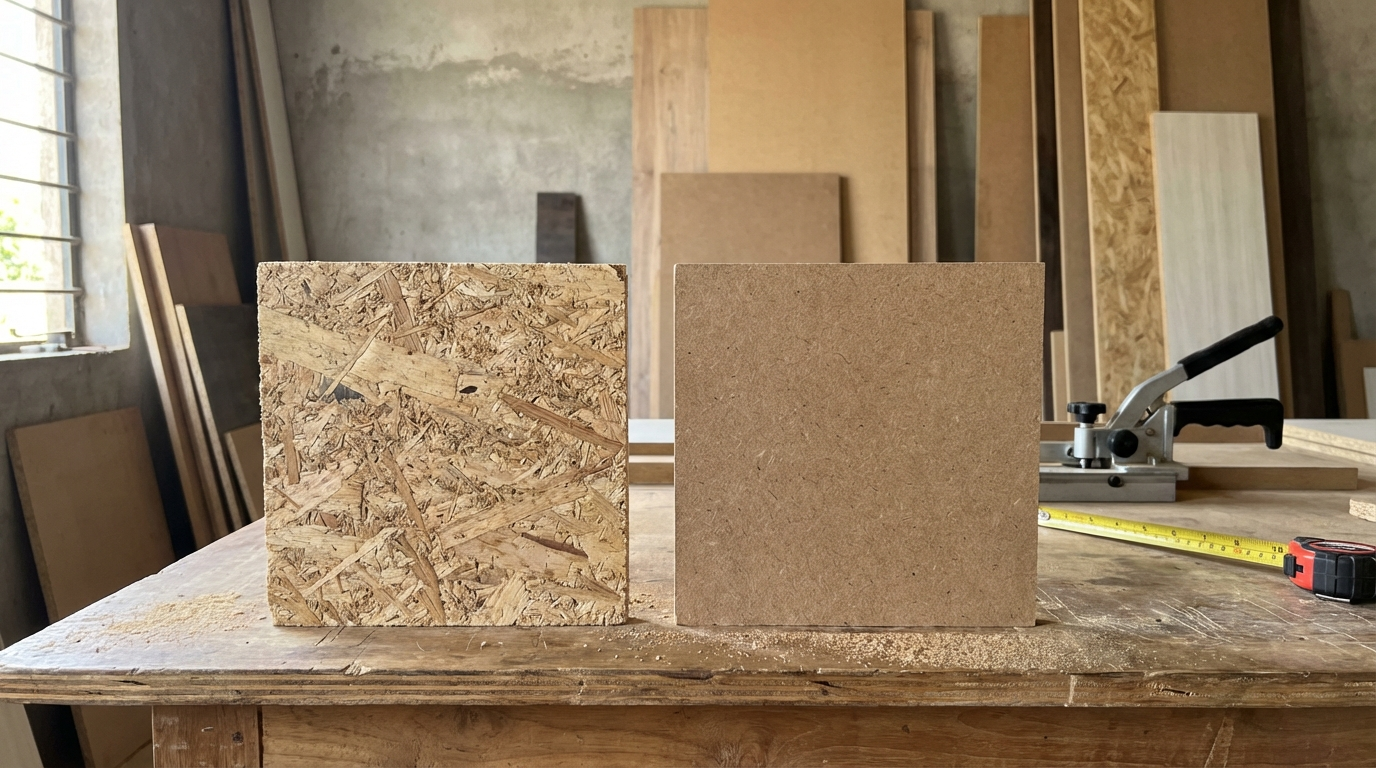
- Particle board vs MDF: Different raw materials—particles vs fibres—resulting in different properties
- Particle board vs HDF: HDF (High-Density Fibreboard) is much denser and stronger than particle board
- Particle board vs blockboard: Blockboard has solid wood strips in the core, making it stronger
Why This Matters for Indian Homes
India's climate presents unique challenges that directly impact particle board performance. Understanding these factors prevents costly furniture failures and replacement cycles.
Monsoon and Humidity Impact
During June-September, relative humidity in many Indian cities exceeds 80-90%. Particle board absorbs atmospheric moisture even without direct water contact. This causes:
- Gradual swelling of panels (1-3mm thickness increase)
- Warping of doors and shutters that no longer close properly
- Delamination of surface laminates
- Musty odour from moisture trapped in the core
Coastal Area Considerations
Cities like Mumbai, Chennai, Kochi, Visakhapatnam, and Goa face salt-laden humid air year-round. Standard particle board in these regions typically shows degradation within 2-3 years, compared to 5-7 years in drier inland areas. The salt accelerates moisture absorption and weakens resin bonds.
Real Consequences of Wrong Material Choice
Indian carpenters and homeowners frequently report these particle board failures:
- Kitchen cabinet collapse: Sink area cabinets sagging within 18 months due to steam and splash exposure
- Wardrobe bottom panel bulging: Floor moisture wicking up through unlaminated undersides
- Screw pullout: Hinges and handles loosening as particle board loses grip over humid cycles
- Edge crumbling: Exposed edges absorbing moisture and disintegrating
Site Handling Realities
Indian construction sites often expose materials to harsh conditions:
- Boards stored in open areas during monsoon waiting for installation
- Dust and cement particles settling on surfaces before lamination
- Rough handling during transport damaging edges and corners
- Delayed installation allowing moisture absorption
Practical advice: Always inspect particle board upon delivery, store in covered dry areas, and insist on immediate edge sealing after cutting.
Composition and Manufacturing Process
Understanding how particle board is made helps you evaluate quality and anticipate performance in different conditions.
Raw Materials
Particle board composition typically includes:
- Wood particles (85-92%): Sawdust, wood chips, shavings, planer waste, plywood trimmings
- Resin binder (6-10%): Usually urea-formaldehyde (UF) or melamine-urea-formaldehyde (MUF)
- Wax (0.5-1%): Paraffin wax for basic moisture resistance
- Additives (1-2%): Fire retardants, fungicides, or moisture-resistant chemicals as needed
Step-by-Step Manufacturing
- Wood preparation: Logs debarked, cut into chips using industrial chippers
- Particle sizing: Chips reduced to uniform sizes via hammer mills or knife systems
- Drying: Particles dried to 2-8% moisture content in rotating drum dryers
- Resin blending: Dried particles sprayed with resin in rotating blenders (6-12% resin content)
- Mat formation: Blended particles spread onto conveyor belts in layered formation
- Pre-pressing: Initial compression at room temperature (145-200 psi)
- Hot pressing: Final compression at 160-220°C and 290-590 psi for 3-7 minutes
- Cooling and conditioning: Boards cooled gradually to prevent internal stress
- Finishing: Sanding to thickness tolerance, cutting to standard sizes
Layer Structure
Quality particle boards use a three-layer or graduated density structure:
- Surface layers: Fine particles creating smoother finish for lamination
- Core layer: Coarser particles reducing weight and saving material
This construction improves surface quality while maintaining reasonable panel weight and cost efficiency.
Types and Variations Explained
| Type | Resin Used | Moisture Resistance | Typical Applications | Price Range (₹/sqft) |
|---|---|---|---|---|
| Standard/Commercial Grade | Urea-Formaldehyde | Poor | Dry area furniture, office partitions | 18-28 |
| Moisture Resistant (MR) | Melamine-UF | Moderate | Semi-dry areas, AC rooms | 25-38 |
| Fire Retardant (FR) | UF + FR additives | Poor-Moderate | Commercial spaces, public buildings | 35-50 |
| Pre-laminated | Varies | Varies by base | Ready-to-use furniture, quick installations | 45-75 |
| Veneered | Varies | Varies by base | Decorative applications, visible surfaces | 55-120 |
Common Misunderstandings About Particle Board Types
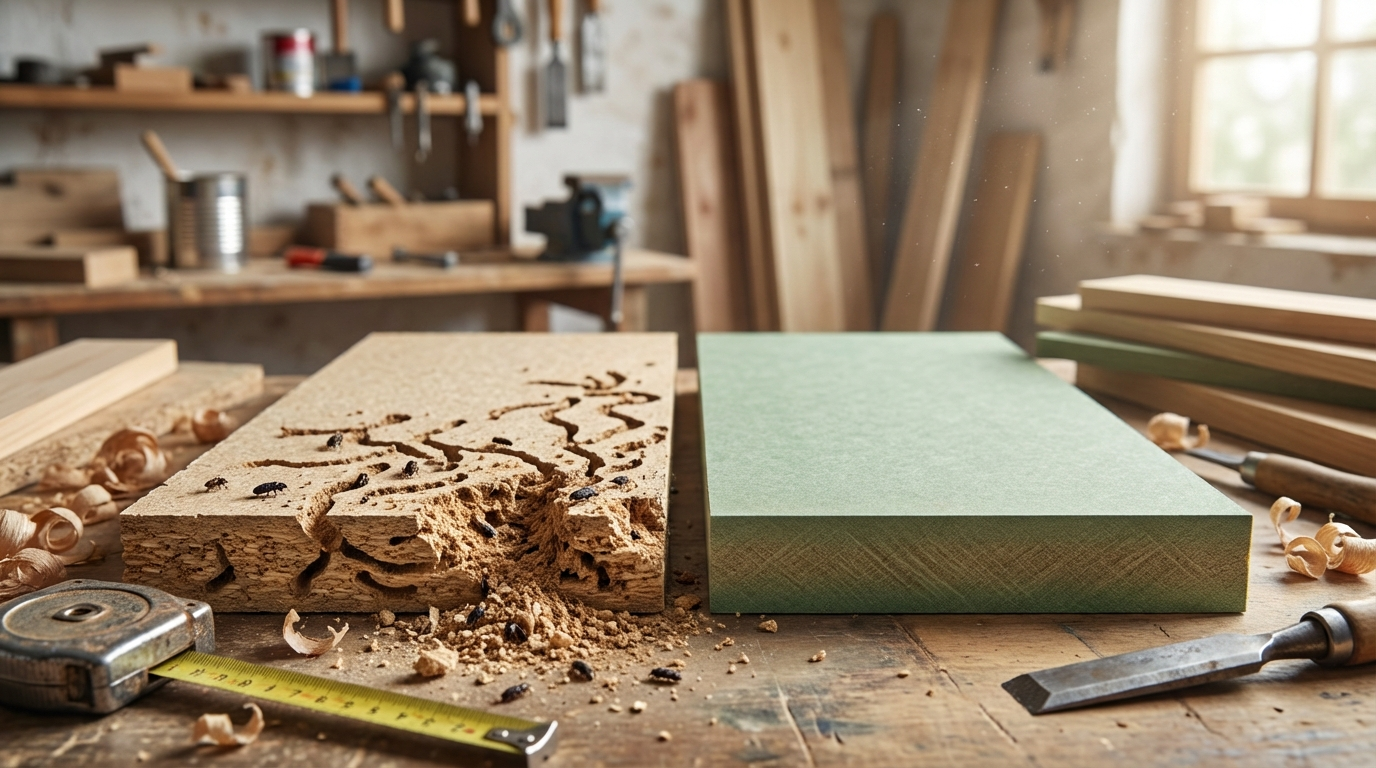
- "All green-coloured particle board is waterproof": Green dye indicates moisture-resistant grade, not waterproof. It still absorbs water over time.
- "Higher density always means better quality": Density affects weight and screw-holding, but resin type matters more for durability.
- "Pre-laminated boards don't need edge banding": Only the faces are protected; edges remain vulnerable and must be sealed.
- "Particle board and compressed wood are different": Compressed wood is a colloquial term often referring to particle board or MDF.
- "MR-grade particle board can be used in kitchens": MR grade handles humidity, not direct water. Kitchen sink areas still need better alternatives.
Head-to-Head Comparison: Particle Board vs MDF
This comparison addresses one of the most common buyer questions in India—choosing between these two affordable engineered wood options.
| Parameter | Particle Board | MDF | Better Choice |
|---|---|---|---|
| Raw material | Wood chips/particles | Wood fibres (refined) | MDF (finer, more uniform) |
| Density | 500-800 kg/m³ | 600-850 kg/m³ | MDF (denser) |
| Surface smoothness | Rough, porous | Smooth, uniform | MDF (paintable without primer) |
| Weight (18mm sheet) | 35-42 kg | 42-50 kg | Particle board (lighter) |
| Screw-holding (face) | Moderate | Good | MDF |
| Screw-holding (edge) | Poor | Moderate | MDF |
| Machining/CNC routing | Limited precision | Excellent detail | MDF (intricate work) |
| Moisture resistance | Poor | Poor (both need MR grades) | Tie (both vulnerable) |
| Price (per sqft, 18mm) | ₹22-35 | ₹35-55 | Particle board (30-40% cheaper) |
| Painting suitability | Requires laminate/veneer | Direct painting possible | MDF |
Choose Particle Board When:
- Budget is the primary constraint
- Surfaces will be laminated (hiding texture)
- Application is strictly dry and indoor
- Weight needs to be minimized
- Hidden structural components (carcass backs, shelf bottoms)
Choose MDF When:
- Surfaces require painting or detailed finishing
- CNC routing or intricate designs are planned
- Better edge quality matters (visible edges)
- Screw-holding reliability is critical
- Speaker cabinets or acoustic applications
Practical Applications of Particle Board
| Application | Recommended Thickness | Grade Needed | Risk Factors |
|---|---|---|---|
| Wardrobe carcass | 18mm | Standard/MR | Bottom panel moisture, hinge screw loosening |
| TV unit shelves | 18mm | Standard | Sagging under heavy equipment |
| Office workstations | 25mm | Standard | Edge damage from chairs/trolleys |
| Bookshelf internal | 18-25mm | Standard | Sagging over time with heavy books |
| False ceiling grid | 12mm | Standard | Roof leakage damage |
| Floor underlayment | 12-18mm | MR | Subfloor moisture wicking |
| Partition backing | 8-12mm | Standard | Impact damage, no structural load |
| Drawer bottoms | 6-8mm | Standard | Heavy item storage stress |
Applications to Absolutely Avoid
- Kitchen sink cabinets: Guaranteed failure from splash and steam
- Bathroom vanities: Constant humidity destroys within months
- Outdoor furniture: No particle board survives outdoor exposure
- Flooring in wet areas: Balconies, utility areas, wash spaces
- Structural elements: Never use for load-bearing applications
Decision Framework: Which Option for Which Condition
| Condition | Recommended Choice | What to Verify |
|---|---|---|
| Dry bedroom furniture, tight budget | Standard particle board with laminate | Edge banding quality, laminate adhesion |
| AC office space, moderate budget | Standard or MR particle board | Thickness for span, edge protection |
| Non-AC room in humid city | MR particle board or MDF | Green core colour, manufacturer certification |
| Coastal area home | MR-MDF or BWR plywood | Avoid standard particle board entirely |
| Kitchen (away from sink) | MR particle board with HPL | All edges sealed, no exposed surfaces |
| Kitchen sink area | BWR plywood or marine plywood | Particle board not recommended |
| Heavy storage (books, crockery) | Plywood or blockboard | Particle board will sag over time |
| Modular furniture (flat-pack) | Standard particle board | Cam lock fittings, proper hardware |
| Painted finish required | MDF (not particle board) | Particle board cannot be painted directly |
| CNC-routed designs | MDF (not particle board) | Particle board chips during intricate routing |
Common Buyer Mistakes (And How to Avoid Them)
Mistake 1: Choosing Based on Price Alone
Consequence: Furniture replacement within 2-3 years costs more than initial savings.
Prevention: Factor in lifespan—₹10,000 furniture lasting 3 years costs more per year than ₹18,000 furniture lasting 8 years.
Mistake 2: Using Standard Grade in Humid Rooms
Consequence: Swelling, warping, delamination during monsoon.
Prevention: Specify MR grade for any room without continuous AC in humid regions.
Mistake 3: Ignoring Edge Sealing
Consequence: Moisture enters through cut edges causing internal swelling.
Prevention: Insist on PVC edge banding on ALL cut edges, including hidden ones.
Mistake 4: Expecting Screw Reliability at Edges
Consequence: Hinges and handles loosen within 12-18 months.
Prevention: Use cam-lock fittings, dowels, or insert screw anchors rather than direct screws in edges.
Mistake 5: Using Particle Board for Adjustable Shelves
Consequence: Shelf pin holes wallow out, shelves slip or fall.
Prevention: Use MDF or plywood for adjustable shelving systems.
Mistake 6: Storing Boards Improperly Before Installation
Consequence: Moisture absorption before installation causes immediate problems.
Prevention: Store flat, covered, in dry area. Install within 48-72 hours of delivery during monsoon.
Mistake 7: Assuming Pre-Laminated Means Fully Protected
Consequence: Cut edges and drill holes remain vulnerable.
Prevention: Seal all cuts and holes immediately after machining.
Mistake 8: Overloading Shelves Beyond Capacity
Consequence: Permanent sagging, eventual shelf failure.
Prevention: For 18mm particle board, maximum span without support: 600mm. Add vertical supports for longer spans.
Failure Modes and How to Prevent Them
Failure 1: Surface Swelling and Bubbling
Symptom: Laminate lifting, bumpy surface texture appearing
Root cause: Moisture penetration through edges or unsealed areas
Prevention: Complete edge sealing, avoid water contact, maintain room ventilation
Fix if happening: Cannot be reversed. Replace affected panels.
Failure 2: Edge Crumbling
Symptom: Edges becoming soft, particles falling away
Root cause: Unprotected edges absorbing moisture, physical impact damage
Prevention: PVC edge banding, aluminium edge profiles for high-traffic areas
Fix if happening: Apply wood filler, sand smooth, apply new edge band.
Failure 3: Screw Pullout
Symptom: Screws spinning freely, not gripping, handles/hinges loosening
Root cause: Screws placed too close to edge, repeated opening/closing stress
Prevention: Use appropriate screw lengths, pilot holes, edge distance minimum 25mm
Fix if happening: Use larger screws, apply wood glue with toothpicks in hole, or relocate hardware.
Failure 4: Shelf Sagging
Symptom: Visible downward curve in middle of shelf
Root cause: Excessive span, overloading, insufficient thickness
Prevention: Follow span limits, add centre support for spans over 600mm
Fix if happening: Add vertical support divider, or replace with thicker/stronger material.
Failure 5: Hinge Area Failure
Symptom: Door drooping, uneven gaps, difficulty closing
Root cause: Particle board around hinges breaking down from repeated stress
Prevention: Use three hinges for tall doors, soft-close mechanisms to reduce impact
Fix if happening: Relocate hinges to fresh area, use larger hinge plates to spread load.
Failure 6: Internal Delamination
Symptom: Hollow sound when tapped, surface feels spongy
Root cause: Manufacturing defect, moisture cycling causing internal bond failure
Prevention: Buy from reputable suppliers, check board density at purchase
Fix if happening: Cannot be repaired. Replace entire panel.
Quality Checks Without Lab Tests
Before Buying: What to Check at the Shop
- Weight test: Lift one corner of the sheet. It should feel solid, not unusually light for its size.
- Edge inspection: Look at cut edges—particles should be evenly distributed, not clumped or with large voids.
- Surface flatness: Sight along the surface at eye level. Reject boards with visible waves or dips.
- Thickness consistency: Measure at 4-5 points across the board. Variation should be under 0.5mm.
- Moisture content: Ask for moisture meter reading. Should be 8-12% for Indian conditions.
- Grade marking: Look for manufacturer stamps indicating E1/E2 formaldehyde class and moisture grade.
Questions to Ask the Dealer
- What is the resin type used (UF, MUF, or MDI)?
- What is the formaldehyde emission class (E0, E1, or E2)?
- How old is this stock? (Older stock may have absorbed moisture)
- Is this BIS-certified or from which factory?
- What warranty do you offer against manufacturing defects?
Red Flags to Walk Away From
- Strong chemical smell (indicates high formaldehyde emission)
- Visible mould spots or water stains
- Significantly lower price than market average (likely inferior resin content)
- No manufacturer marking or batch identification
- Crumbling or soft edges even before cutting
After Cutting: What to Verify
- Core colour: Should be uniform. Dark spots indicate moisture damage or contamination.
- Cut edge quality: Clean cut without excessive tear-out or crumbling.
- Dust colour: Should be light tan/brown. Dark or black particles indicate contaminated raw material.
- Screw test: Drive a test screw 25mm from edge. Should grip firmly without spinning.
After Installation: Ongoing Checks
- Check door alignment monthly for first 3 months (catches moisture issues early)
- Inspect bottom panels near floor for any swelling signs
- Tighten all hardware after first monsoon season
- Look for laminate edge lifting—indicates moisture ingress
Tips by User Type
For Homeowners
Durability expectations: Standard particle board furniture in dry Indian homes typically lasts 5-8 years with proper care. Expect shorter lifespan (3-5 years) in humid conditions without AC. Budget for potential replacement rather than expecting lifetime use.
Cleaning do's and don'ts:
- DO: Wipe with dry or slightly damp cloth, dry immediately
- DO: Use coasters under water glasses, plant pots
- DON'T: Use wet mopping near furniture bases
- DON'T: Apply water-based cleaners directly—spray on cloth first
- DON'T: Leave spills unattended even for minutes
When to worry: If doors won't close properly after monsoon, laminate feels bumpy, or musty smell develops—these indicate moisture damage requiring attention before it spreads.
For Carpenters and Fabricators
Cutting tips:
- Use 60-80 tooth TCT blades for clean cuts
- Cut with laminate face up on table saw to prevent chipping
- Score laminate with utility knife before cutting for chip-free edges
- Support boards fully to prevent breakage
Edge preparation:
- Sand cut edges with 120-grit before edge banding
- Apply edge band within 24 hours of cutting
- Use hot-melt edge bander for best adhesion
- Trim edge band flush with sharp blade, not sanding
Screw zones:
- Minimum 25mm from any edge for screw placement
- Pre-drill pilot holes 70% of screw diameter
- Use coarse-thread screws, not fine-thread
- For hinges, use cup hinges with larger mounting plates
Handling:
- Store flat, never on edge
- Keep minimum 150mm off floor on battens
- Cover with plastic during monsoon storage
- Handle with gloves to prevent surface damage
For Architects and Interior Designers
Specification language: When specifying particle board, include: grade (standard/MR/FR), thickness, density class, formaldehyde emission class (E1 minimum recommended), and surface finish requirements.
Wet-zone detailing:
- Specify BWR plywood or marine-grade alternatives for sink cabinets
- Include skirting detail lifting carcass 50mm off floor
- Call out sealed kickboard joints to prevent splash ingress
- Specify stainless steel sink cabinet bottoms where budget permits
Finish selection guidelines:
- HPL (High-Pressure Laminate) for horizontal surfaces—better scratch resistance
- LPL (Low-Pressure Laminate) acceptable for vertical surfaces
- Specify 0.8mm laminate minimum for durability
- Include laminate edge band colour matching in specifications
For Modular Furniture and OEM Manufacturers
QC checkpoints:
- Incoming inspection: moisture content, thickness tolerance, surface defects
- After cutting: edge quality, dimensional accuracy
- After edge banding: adhesion test (try peeling at corners)
- Assembly stage: hardware grip, joint tightness
- Final inspection: door alignment, drawer operation, surface finish
Reducing customer complaints:
- Use MR grade as standard for all humid regions
- Include installation guidelines with every delivery
- Train installation teams on edge sealing importance
- Offer monsoon-specific installation precautions
Batch consistency:
- Source from single manufacturer per project
- Request same batch boards for visible components
- Maintain controlled storage (below 65% RH)
- Rotate stock to prevent extended storage periods
Price Ranges and Cost Factors
Note: Prices vary by region, brand, and market conditions. These ranges are indicative for planning purposes only.
| Thickness | Standard Grade (₹/sqft) | MR Grade (₹/sqft) | Pre-laminated (₹/sqft) |
|---|---|---|---|
| 6mm | 12-18 | 16-22 | 28-40 |
| 8mm | 14-20 | 18-26 | 32-45 |
| 12mm | 18-26 | 24-32 | 40-55 |
| 18mm | 24-35 | 32-45 | 52-72 |
| 25mm | 32-45 | 42-55 | 65-90 |
Cost Drivers
- Resin content: Higher resin = better binding = higher cost
- Density: Higher density boards cost more but perform better
- Surface quality: Finer surface particles add to cost
- Certifications: BIS-marked, E1-rated boards command premium
- Brand: Established brands typically 15-25% higher than unbranded
- Location: Prices higher in metros, lower near manufacturing hubs
Budget Estimation Example
For a standard 3-door wardrobe (8ft × 7ft):
- Particle board requirement: approximately 120-140 sqft
- Standard grade (₹28/sqft): ₹3,360-3,920
- MR grade (₹38/sqft): ₹4,560-5,320
- Add laminate: ₹3,000-5,000
- Add hardware, edge band, labour: ₹8,000-15,000
- Total estimate range: ₹15,000-25,000
Frequently Asked Questions
What is the difference between particle board and MDF?
Particle board is made from larger wood chips and particles, while MDF (Medium-Density Fibreboard) uses finely refined wood fibres. This fundamental difference creates distinct properties: MDF has a smoother, denser surface ideal for painting and CNC routing, while particle board has a rougher texture requiring laminate covering. MDF typically costs 30-40% more than particle board but offers better screw-holding at edges and superior machining quality. For budget furniture with laminate finish, particle board works well; for painted or detailed work, choose MDF.
Is particle board waterproof or water-resistant?
Standard particle board is neither waterproof nor water-resistant—it absorbs water readily and swells irreversibly. Even MR (Moisture Resistant) grade particle board only handles humid air better; it still damages when exposed to direct water contact. The green-coloured core in MR boards indicates added wax and modified resin for humidity tolerance, not waterproofing. For areas with potential water exposure (kitchens, bathrooms), choose BWR plywood or marine-grade alternatives. Particle board should only be used in confirmed dry interior applications.
How long does particle board furniture last in India?
In properly air-conditioned dry environments, quality particle board furniture typically lasts 6-10 years with proper care. In non-AC rooms in humid cities like Mumbai, Chennai, or Kolkata, expect 3-5 years before moisture-related issues appear. Coastal areas see even shorter lifespans of 2-4 years for standard grades. The biggest factors affecting longevity are edge sealing quality, room humidity levels, and avoiding water contact. Using MR-grade boards in humid regions can extend lifespan by 2-3 years compared to standard grades.
Can particle board be used in kitchen cabinets?
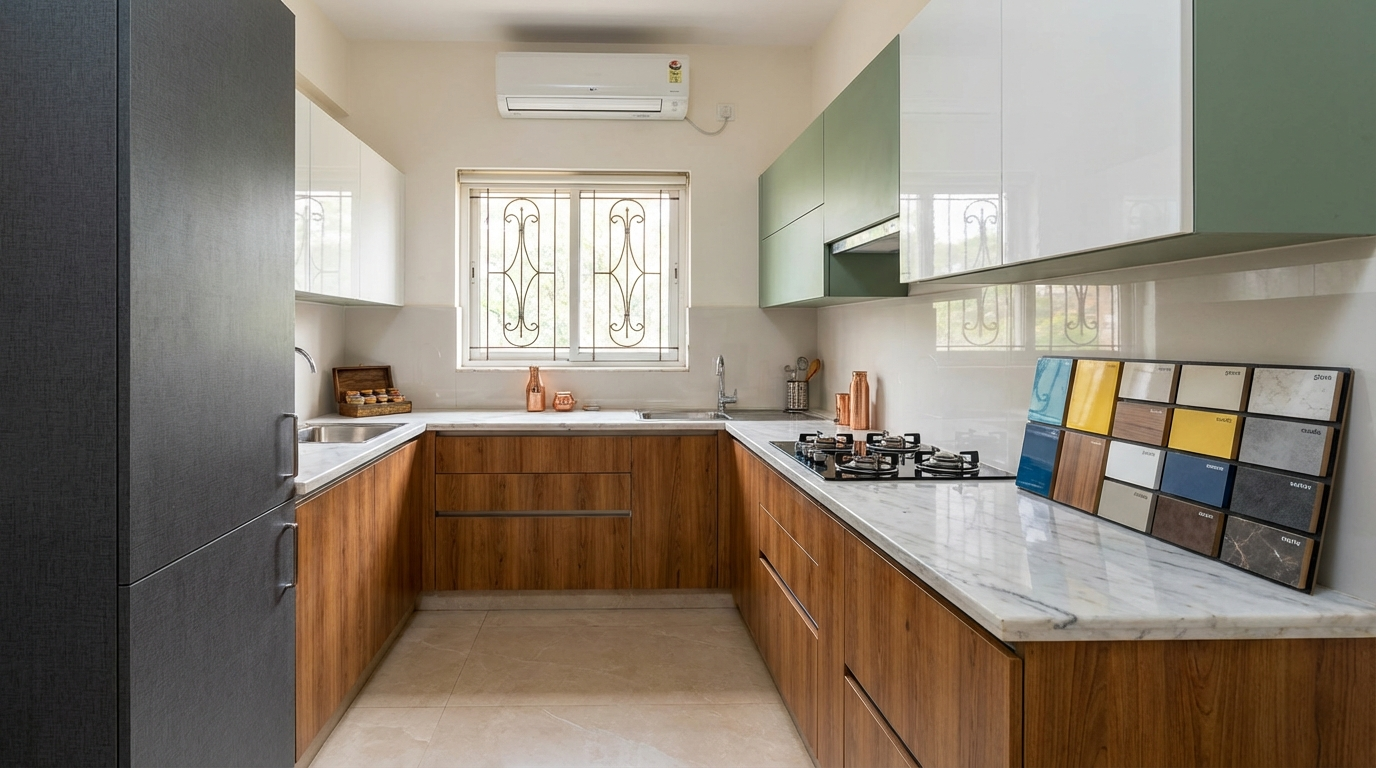
Particle board can be used for kitchen cabinet carcasses in dry zones away from the sink, cooktop steam, and dishwasher moisture—but only MR grade with complete edge sealing. However, cabinets directly under sinks, near water sources, or in high-steam areas should never use particle board; choose BWR plywood instead. Even with precautions, kitchen particle board cabinets in Indian homes typically need replacement within 5-7 years due to accumulated moisture exposure from cooking and monsoon humidity.
Why does particle board swell and how can I prevent it?
Particle board swells because the wood particles inside absorb moisture and expand—unlike solid wood, this expansion doesn't reverse when dried. Once swollen, the internal structure is permanently damaged. Prevention requires three strategies: first, use MR-grade boards in any humidity-prone area; second, seal all edges with PVC edge banding (including hidden edges); third, avoid placing particle board furniture directly on floors where mopping water can wick up. In existing furniture, address any laminate lifting immediately to prevent moisture entry.
Is particle board safe for indoor use? What about formaldehyde?
Modern particle boards manufactured to E1 or E0 emission standards are safe for indoor use in well-ventilated spaces. The concern relates to formaldehyde released from urea-formaldehyde resin binders. E1-rated boards emit less than 0.1 ppm formaldehyde—below WHO safety thresholds. When buying, look for BIS certification or E1 marking. Avoid unbranded boards without emission ratings, especially for bedrooms and children's rooms. If you smell strong chemical odours from new furniture, increase ventilation for the first 2-4 weeks until off-gassing reduces.
Can I paint directly on particle board?
No, particle board's rough, porous surface cannot be painted directly with good results. The texture shows through paint, and the surface absorbs paint unevenly creating a blotchy appearance. For painted finishes, choose MDF instead. If you must paint particle board, it requires extensive preparation: sand thoroughly, apply wood primer, sand again, apply filler to any voids, sand once more, then apply multiple paint coats. Even then, results won't match MDF quality. Lamination remains the practical choice for particle board finishing.
What screws work best with particle board?
Use coarse-threaded screws specifically designed for particle board—these have wider thread spacing that grips the loose particle structure better than fine-threaded screws. Recommended: 3.5mm × 30mm for 18mm boards into face, 4mm × 40mm for edge connections through pilot holes. Always pre-drill pilot holes at 70% of screw diameter. For heavy-duty connections, use confirmat screws (furniture screws with special thread design) or insert threaded metal bushings. Never place screws closer than 25mm from any edge to prevent cracking.
How do I identify good quality particle board at the shop?
Quality indicators include: uniform particle distribution visible at cut edges (no large voids or clumps), consistent colour throughout the core (dark spots indicate contamination), manufacturer markings showing grade and batch, weight appropriate for density class, and smooth flat surfaces without visible waves. Request the moisture content reading—it should be 8-12%. Avoid boards stored outdoors, those with musty smell, or significantly cheaper than market rate (often indicates inferior resin content). Reputable brands maintain more consistent quality than unbranded options.
What is the weight of particle board per square foot?
Weight varies by thickness and density grade. Typical weights for standard 8×4 feet sheets: 6mm weighs approximately 18-22 kg, 12mm weighs 32-38 kg, 18mm weighs 45-55 kg, and 25mm weighs 60-72 kg. This translates to roughly 0.65-0.85 kg per square foot for 18mm thickness. Particle board is generally 15-20% lighter than equivalent MDF, making it easier to handle but sometimes indicating lower density (and potentially weaker bonding). Higher-quality particle boards tend toward the upper weight ranges.
Can particle board be recycled or is it eco-friendly?
Particle board starts as recycled material—made from sawdust, wood chips, and manufacturing waste that would otherwise be landfilled or burned. In this sense, it's an efficient use of wood resources. However, end-of-life recycling is limited because the resin binders contaminate the wood fibres, making them unsuitable for many recycling processes. Some manufacturers accept old particle board for energy recovery (burning for heat in manufacturing). For environmental considerations, choose boards with E1 or lower formaldehyde ratings and from FSC-certified sources when available.
Is particle board furniture good for rental properties?
Particle board furniture offers a practical balance for rental properties: affordable upfront cost, adequate durability for tenant use cycles, and easy replacement when worn. For rental investments, use MR-grade particle board with HPL laminate (not LPL) for better scratch and wear resistance. Avoid particle board in kitchens and bathrooms even in rentals—the repair costs from water damage exceed initial savings. Budget for furniture replacement every 6-8 years as part of rental property maintenance planning.
Disclaimer: This content is provided for general informational purposes based on industry practices and publicly available information. Product specifications, standards, prices, and availability may vary by manufacturer, region, and time. Readers should independently verify details with manufacturers, dealers, or qualified professionals before making purchase or construction decisions.Want Plywood Suggestions?
Share a few details and a VIR MDF specialist will suggest suitable brands and connect you to responsive dealers.