MDF Board Sizes: 8x4, 9x6 & Custom Cutting — What’s Common in the Market?
Understand common MDF board sizes (like 8x4) and how custom cutting works. Includes planning tips to reduce waste and save cost.
Quick Decision Summary
Standard MDF board sizes in India are typically 8x4 feet and 9x6 feet, with custom cutting helping to cut waste by 10-20% in modular projects.
If you’re in a hurry: Go for 8x4 feet sheets for most wardrobe and kitchen shutters as they fit standard transport and reduce handling risks during monsoons. Use 9x6 for larger wall panels or partitions where fewer joints mean better strength. Always plan layouts on paper first to optimize cuts—aim for under 5% waste. Custom cutting suits CNC workflows but adds 10-15% to costs; verify supplier kerf loss (saw blade width) before ordering. Check sheet flatness on-site to avoid warping surprises.
- Choose 8x4 if: small-to-medium projects, tight spaces, standard carpenter tools, coastal transport ease.
- Choose 9x6 if: large uninterrupted surfaces, fewer seams needed, factory-style cutting.
- Avoid custom-only if: budget tight or small volumes—stick to stock sizes.
- Avoid oversized if: poor storage ventilation risks edge swelling in humid Indian sites.
What This Material/Option Actually Is
MDF board sizes refer to the standard dimensions of medium-density fiberboard sheets available from manufacturers. These are pre-manufactured full sheets sold in feet by feet measurements, like 8 feet long by 4 feet wide, or larger 9x6 variants. Thicknesses range from 3mm to 25mm typically, with sizes chosen based on project scale and cutting efficiency.
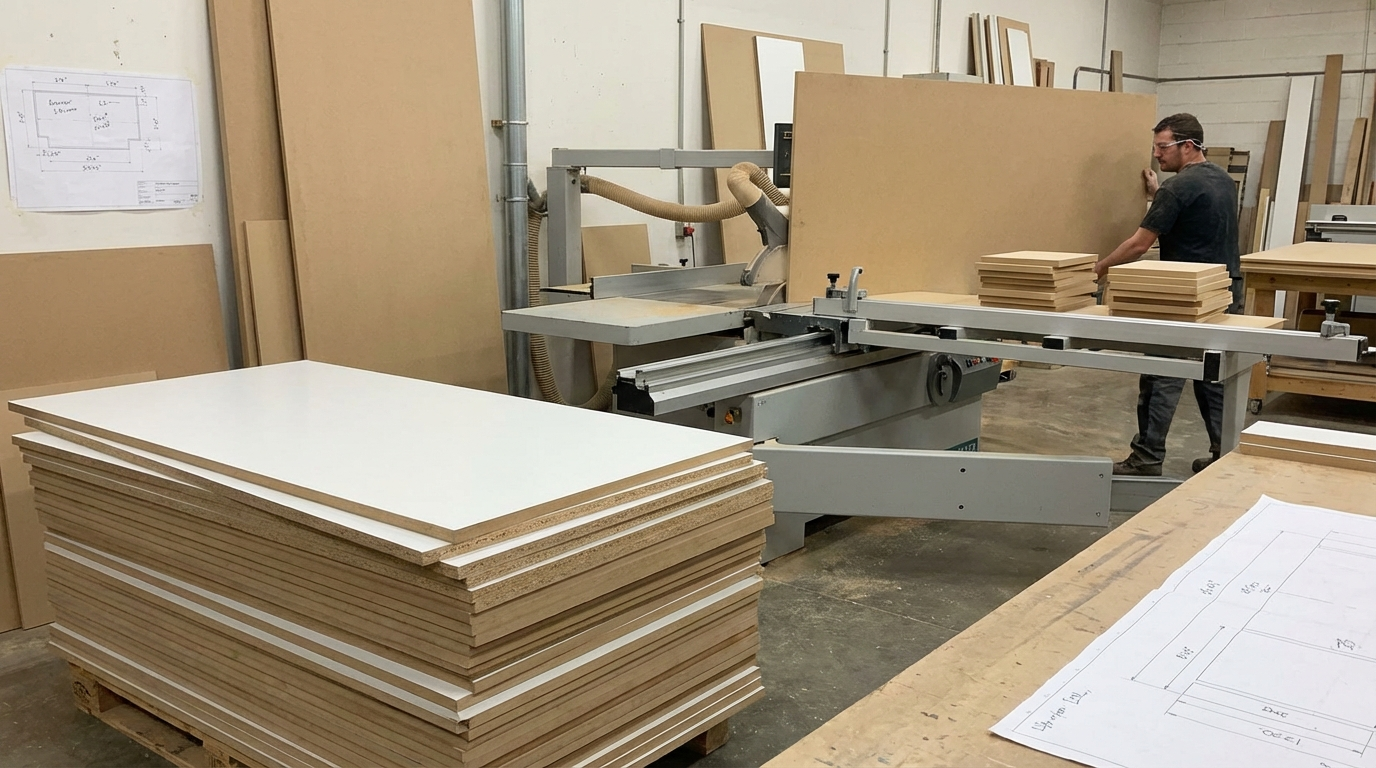
In the supply chain, full sheets come wrapped in plastic for protection, stacked flat on pallets. Custom cutting means suppliers slice these into smaller panels per your layout, often with CNC precision. This fits into broader engineered wood workflows, from raw MDF to laminated or pre-finished boards used in interiors.
Sizes aren't random—they align with transport trucks (8-foot lengths match common van sizes) and building door widths for easy site entry. In India, 8x4 dominates due to plywood legacy, while 9x6 gains traction for modern modular furniture.
Why It Matters in Indian Homes and Sites
Board size directly impacts waste, joints, and durability in humid Indian conditions. Larger 9x6 sheets mean fewer seams, reducing moisture entry points during monsoons—critical for coastal areas like Mumbai or Chennai where humidity hits 90%. Smaller 8x4 suits urban apartments with narrow lifts, easing transport without bending sheets that could cause internal stresses.
Site realities amplify this: poor storage on open godowns leads to surface absorption, making oversized sheets harder to keep flat. More joints from small sheets weaken screw-holding in high-use zones like wardrobe doors. Optimized sizing cuts logistics costs by 15-20% and speeds carpenter workflows, vital for monsoon-delayed projects.
Practical fallout: mismatched sizes lead to 20-30% waste, hiking effective sq ft costs. In wet kitchens, unsealed joint edges swell first, delaminating finishes faster.
What is the most common MDF board size in India?
The 8x4 feet size is most common, used in over 70% of residential projects for its versatility. It fits standard cutting tables, transport vehicles, and door frames easily.
Nuance: In North India dry zones, it's ideal for wardrobes; South/Coastal prefers it too for handling. Larger 9x6 suits commercial panels but needs wider access. Always measure site entry first—8x4 avoids lift issues in high-rises. Next step: Sketch your layout to see how many full sheets fit without excess trims.
Is 9x6 MDF better than 8x4 for large projects?
Not always better—9x6 reduces joints for stronger panels in walls/TV units, but only if site access allows. It cuts waste in big layouts by 10-15%.
Conditions: Great for ground-floor villas, but risky in apartments due to maneuvering. Trade-off: higher upfront sheet cost vs fewer seams in humid sites. Verify: Ask supplier for diagonal flatness check; warped 9x6 amplifies issues. Plan: Use nesting software or paper mockup for yield.
Common MDF Sizes in the Indian Market
Typically, suppliers stock 8x4 feet (2440x1220mm) across 3-18mm thicknesses for everyday use. This size mirrors plywood standards, making it carpenter-friendly with manual saws or panel saws.
9x6 feet (2745x1830mm) is growing popular for expansive surfaces like office partitions or bed headboards, available in 12-18mm often. Other variants include 8x3 or 6x4 for specialty, but these add costs due to low volume.
Custom cutting turns full sheets into exact panels—e.g., 18x36 inches shutters from 8x4. Suppliers charge per cut line, factoring kerf (2-3mm loss per cut). In many Indian projects, mixing sizes optimizes: 8x4 for cabinets, 9x6 for backs.
Are there standard thicknesses for 8x4 and 9x6 MDF?
Yes, 3mm, 5mm, 6mm, 8mm, 12mm, 16mm, 18mm, and 25mm are standard for both sizes. 12mm suits shutters, 18mm for carcasses.
Variations: Thinner for laminates, thicker for shelves. India-specific: Opt 16-18mm for monsoon zones to resist sagging. Check: Tap edges for density uniformity; hollow sounds signal rejects. Next: Match thickness to load—e.g., 12mm max for wall panels under 4x8 feet.
Price Range and Cost Drivers
MDF full sheets range from 1500-5000 rupees for 8x4 (3-18mm), varying by city (higher in islands like Andamans due to logistics). 9x6 adds 30-50% premium. Custom cutting bumps 200-500 rupees per sheet, plus 10-20 rupees per linear foot for edges.
Drivers: Thickness (doubles every 6mm jump), density (700-850 kg/m3, higher resists screws better), finish (raw cheapest, prelam +20%), resin (MR grade +15% for humidity), transport (Tier-2 cities +10%), wastage (poor planning adds 25% effective cost).
Budget example: Wardrobe (20 sqm, 18mm) needs 6x 8x4 sheets at 3500 each = 21,000 base; optimized cuts save 1 sheet (3500 saved). Quote checklist: Specify size/thickness/quantity/cuts/edges/MR grade/site delivery.
How to Plan MDF Sizes and Custom Cutting in 5 Steps
- Measure project precisely: Account for hinges (2mm gaps), elevations (10-15mm legs), site irregularities. Use laser for accuracy.
- Sketch nesting layout: Draw full sheets, fit panels tight—aim <10% waste. Free graph paper works; apps for pros.
- Choose size mix: 8x4 for modular, 9x6 for spans >8 feet. Factor access (stairs/lift width).
- Specify cuts: List dimensions, grain direction (if textured), edge profiles. Note kerf allowance.
- Verify with supplier: Send layout, get yield quote. Inspect sample cut for accuracy, edge quality.
Failure points: Ignoring grain leads to telegraphing; monsoon delays mean cover stacks. Prevention: Order 5% extra, seal edges on-site.
How much waste is normal when cutting 8x4 MDF?
5-15% waste is typical with good planning; over 20% signals poor layout.
Conditions: CNC yields better (5%) than manual (15%). India tip: Monsoon humidity warps offcuts—use immediately. Check: Weigh scraps post-cut; calculate % vs total area. Next: Practice on paper for kitchen islands—fit doors/shelves first.
Decision Framework: Sizes Based on Project Conditions
| Project Condition | Recommended Size/Mix | Verify/Notes |
|---|---|---|
| Wet kitchen (monsoon exposure) | 8x4, 16-18mm MR grade | Flat storage; seal joints extra; fewer seams. |
| Coastal humidity (Chennai/Mumbai) | 8x4 dominant, custom small panels | Plastic wrap intact; tap for moisture sound. |
| Heavy use wardrobe (kids room) | 9x6 for carcass, 8x4 doors | 18mm min; screw zones reinforced. |
| Tight budget (<50 sqm) | All 8x4, minimal custom | Nest tightly; raw finish to save. |
| Fast delivery needed | Stock 8x4 only | Local supplier; no customs. |
| High scratch risk (office/TV unit) | 9x6 prelam, 12mm | Lam quality; edge band thick. |
| Apartment high-rise | 8x4 max | Lift width test; diagonal carry. |
| CNC modular factory | Mix 8x4/9x6 custom | Kerf 2.5mm spec; batch flatness. |
Practical Use Cases (What Works, What Fails)
| Use Case | Recommended Size/Thickness | Finish Notes | Risk Notes (India-Specific) |
|---|---|---|---|
| Kitchen shutters | 8x4, 18mm | PVC membrane | Swelling at sinks; seal edges double. |
| Wardrobe carcass | 9x6, 16mm | Plain laminate | Sag under clothes; ventilate storage. |
| TV unit shelves | 8x4, 12mm | Pre-lam | Scratch from remotes; 3mm PVC over. |
| Wall panels | 9x6, 8mm | Digital print | Monsoon warp; MR grade only. |
| Office partitions | 8x4 mix, 12mm | Melamine | Joint cracks; band all edges. |
Common Buyer Mistakes with MDF Sizes and Cutting
- Mistake 1: Ordering without layout—leads to 30% waste. Avoid: Mockup first.
- Mistake 2: Ignoring site access—9x6 stuck at stairs. Avoid: Measure doors/lifts.
- Mistake 3: Cheap thin sheets for spans—sag in humidity. Avoid: 16mm min for shelves.
- Mistake 4: No edge sealing post-cut—monsoon swelling. Avoid: Apply band same day.
- Mistake 5: Mixing thicknesses randomly—inconsistent finish. Avoid: Spec uniform.
- Mistake 6: Forgetting kerf—panels 3mm off. Avoid: Supplier quote includes it.
- Mistake 7: Storing vertical—warps large sheets. Avoid: Flat, covered stacks.
- Mistake 8: Over-customizing small jobs—costs spike. Avoid: Stock sizes for <10 sqm.
- Mistake 9: No extras for errors—shortages delay. Avoid: +5% buffer.
Can I cut MDF myself or always use custom service?
You can cut yourself with circular saw/jig, but custom service ensures precision for laminates. DIY suits raw MDF blanks.
Nuance: Manual cuts chip edges in humid wood; CNC better for repeats. India carpenter tip: Use zero-clearance insert. Check: Test scrap for tear-out. Next: For wardrobes, custom if >20 panels.
Failure Modes and Fixes
- Symptom: Edge swelling post-monsoon. Cause: Unsealed cut edges absorb moisture. Prevention: Band within 24hrs. Fix: Sand, re-band; replace if delam.
- Symptom: Panel warp/bow. Cause: Uneven storage humidity. Prevention: Flat pallets, ventilation. Fix: Clamp flat 48hrs before use.
- Symptom: Screw holes loose. Cause: Undersized for load/large sheets flex. Prevention: 18mm + inserts. Fix: Plug and redrill.
- Symptom: Finish telegraphing. Cause: Poor nesting/grain mismatch. Prevention: Plan direction. Fix: Overlay veneer.
- Symptom: Chipping on cuts. Cause: Dull blade/high speed. Prevention: Carbide blade, slow feed. Fix: Edge band covers minor.
- Symptom: Joint gaps misalign. Cause: Kerf ignored. Prevention: Layout accounts 2.5mm. Fix: Filler + sand.
Quality Checks You Can Do Without Lab Tests
Before buying: Stack sheets—check flatness by sighting edges; tap center vs edge for uniform thud (hollow = low density). Ask: Batch date, MR grade proof via feel (heavier resists water). Red flags: Plastic tears, discoloration, bows.
After cutting: Inspect edges—smooth, no burns/chips; measure dimensions (+/-1mm tolerance). Cues: Dust-free cuts signal good blade; consistent thickness drop signals quality.
After install: Press joints— no give; wet cloth test edges (no darkening in 30min). Alignment: Level check; clean with microfiber only.
What thickness MDF for wardrobe doors?
16-18mm for stability, especially shaker styles.
Conditions: 12mm ok for flats but flexes in humid homes. Coastal: MR 18mm. Check: Load test sample with 10kg. Next: Pair with soft-close hinges.
Tips for Homeowners, Carpenters, Architects, and OEMs
Homeowners: Durability—avoid water wipes near edges; dust weekly. Don’t overload shelves >15kg/sqft. Clean: Mild soap, no abrasives.
Carpenters: Cutting—sharp blade, score first; edge prep: Sand 180-grit. Fastening: Pre-drill 3.5mm for 4mm screws; hinge zones double screws. Handle: Two-person lift for 9x6.
Architects/Designers: Specs—detail sizes in drawings; wet zones: MR + PVC. Detailing: 2mm reveals hide joints. Finish logic: Prelam for speed, custom for unique.
OEM/Modular makers: Repeatability—template jigs; QC: Random flatness, cut accuracy. Reduce complaints: Pre-band all, humidity-controlled storage.
Does board size affect MDF strength?
Larger sizes like 9x6 offer better span strength due to fewer joints, but sheet quality matters more.
Nuance: 8x4 flexes if thin; reinforce mid-supports. India: Humidity weakens joints first. Check: Cantilever test 300mm overhang. Next: Spec 18mm for TV shelves.
FAQs
What’s the difference between 8x4 and 9x6 MDF in handling?
8x4 is lighter and easier for two-person carry through standard doors, ideal for urban sites. 9x6 demands wider access and forklift/pulley for stairs, but covers more area per sheet. In practice, 8x4 reduces damage risk during monsoons when sheets stay drier shorter times. Plan handling routes first—measure lift doors at 1220mm min. For apartments, split 9x6 orders into halves if possible.
Is custom cutting MDF worth the extra cost?
Yes for projects over 15 sqm, as it drops waste below 10%, saving 15-20% overall. Manual cutting adds labor errors. Suppliers use CNC for precision, but specify tolerances. In Tier-2 cities, turnaround is 2-3 days. Always share CAD layout; reject if kerf exceeds 3mm. Small jobs stick to stock for speed.
How to store MDF sheets before cutting?
Store flat on pallets, elevated 150mm off ground, under cover with airflow on sides. Avoid vertical leans that bow sheets. In humid zones, use dehumidifiers or silica packs. Check weekly for moisture spots. Monsoon tip: Double plastic if outdoors max 48hrs. Improper storage causes 20% rejection rate in sites.
Can I use 8x4 MDF for full wall panels?
Possible with joints, but 9x6 preferred for seamless look and strength. Joints need precise banding to prevent cracking. For 10-foot walls, mix sizes with vertical seams hidden by profiles. Coastal areas demand MR grade joints sealed silicone. Test mockup for alignment before full commit.
What’s the ideal waste percentage for MDF cutting?
Aim 5-10% with software nesting; 15% manual max. Exceeding signals redesign needed. Track by sqm: e.g., 32 sqm project from 4x 8x4 yields 28 sqm usable. India workflows: Carpenters hit 20% often—use graph templates. Buffer 1 extra sheet always.
Does thickness change with board size?
No, thicknesses are uniform across sizes, but availability thins for 9x6 extremes like 3mm. Stock common 12/18mm both. Larger sheets amplify sag if under-thick. Verify caliper measure on multiple spots. For shelves, 18mm 9x6 holds 25kg/m better than 12mm 8x4.
How to transport MDF sheets safely?
Flat in covered trucks, strapped secure, avoid overhangs. Use trolleys site-side; two-man lift max 30kg. Monsoon: Tarpaulin full cover. Urban: Roof racks for sedans only short distances. Damage cue: Dents cause internal cracks—inspect unwrap immediately.
Are there eco-friendly size options for MDF?
Sizes same, but choose low-formaldehyde resins and FSC-like verified sources. Larger sheets cut transport emissions via fewer trips. Recycling offcuts into particle fillers common. India: Ask density over 750kg/m3 for efficiency. Waste under 10% boosts green claims.
What if my MDF sheet arrives warped?
Reject if bow >5mm over 8 feet; clamp flat 72hrs may salvage minor. Cause: Factory moisture or transit heat. Prevention: Acclimatize site 48hrs pre-cut. Replacement policy: Inspect delivery same day with diagonal measure.
Disclaimer: This content is provided for general informational purposes based on industry practices and publicly available information. Product specifications, standards, prices, and availability may vary by manufacturer, region, and time. Readers should independently verify details with manufacturers, dealers, or qualified professionals before making purchase or construction decisions.Want Plywood Suggestions?
Share a few details and a VIR MDF specialist will suggest suitable brands and connect you to responsive dealers.