MDF Full Form + Quick Facts: The 60‑Second Guide (with examples)
MDF full form explained in plain language with quick facts on thickness, density, and where MDF is a smarter choice than plywood.
Quick Decision Summary
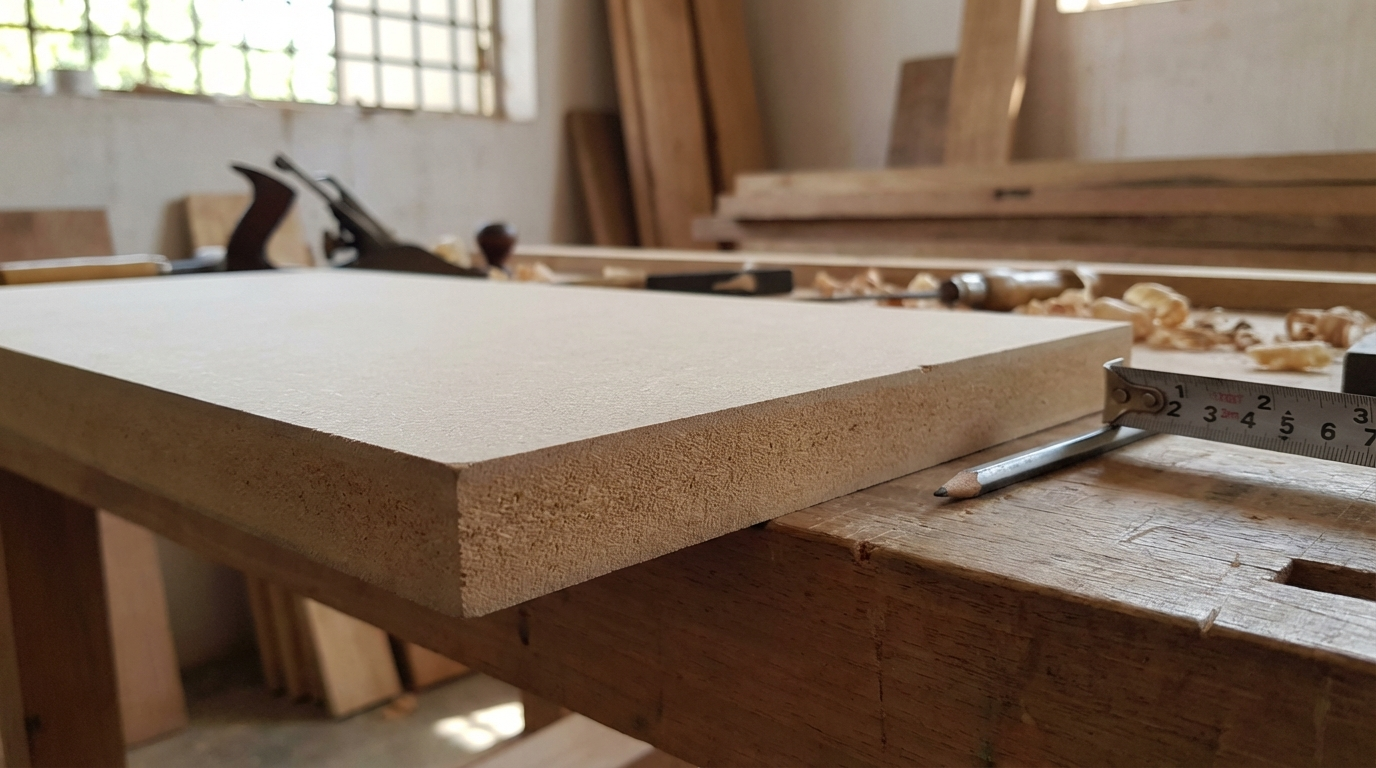
MDF stands for Medium Density Fiberboard, an engineered wood panel pressed from wood fibers for smooth, uniform surfaces ideal for painted or laminated finishes.
If you’re in a hurry: MDF offers consistent density (typically 700-850 kg/m³) across sheets, making it easier for CNC routing and modular furniture than plywood's knots or voids. Common thicknesses run 3-25 mm; pick 18 mm for wardrobes or 6-12 mm for shelves. In dry Indian interiors, it beats plywood for finish quality, but seal edges tightly against monsoon humidity to prevent swelling. Verify density by weight feel and edge smoothness before buying.
- Choose this if: you need flat panels for laminates, paint, or carving, with budget-friendly uniformity in low-moisture zones.
- Avoid this if: exposed to constant water splashes without moisture-resistant variants, or needing superior screw-holding in load-bearing frames.
What This Material/Option Actually Is
MDF is an engineered panel made by breaking down wood into fibers, mixing with resins and wax, then compressing under heat and pressure into dense sheets. Unlike solid wood or plywood's layered veneers, MDF has no grain direction, grain, or voids, giving uniform structure.
It fits as a base for interiors: laminate it for kitchens, paint for walls, or route for designs. In India, standard MR (moisture-resistant) grades handle typical humidity, while plain MDF suits controlled dry spaces.
Quick facts: Density around 700-850 kg/m³ (heavier feel than particleboard). Thicknesses from 3 mm (carcassing) to 25 mm (doors). Sheet size often 8x4 feet, cuttable to custom.
Why It Matters in Indian Homes and Sites
Monsoon humidity (70-90% RH) and coastal salt air swell unprotected MDF edges, causing delamination or sagging. Poor site storage—stacked on damp floors—leads to warping before installation.
Carpenters note: MDF's smoothness speeds painting but chips during rough handling. In urban sites like Mumbai or Chennai, quick assembly favors MDF over plywood's variable quality. Screw holding drops near edges, so reinforce hinges.
Practical upside: Uniform density prevents telegraphing (surface bumps from core defects) in laminated cabinets, common plywood issue in humid storage.
Meaning, Types, and Where People Get Confused
MDF means Medium Density Fiberboard. It's not "medium-density furniture board" or a plywood type—pure fiber composite.
What does MDF full form stand for exactly?
MDF full form is Medium Density Fiberboard. This engineered panel uses wood fibers (from hardwoods/softwoods), urea-formaldehyde resins, and paraffin wax, hot-pressed to 700-850 kg/m³ density. Unlike high-density HDF (above 850 kg/m³) or low-density particleboard, MDF balances machinability and strength. In India, check labels for MR grade (moisture-resistant with extra wax/resins). Direct answer: it's a non-directional sheet for flatwork. Nuance: density varies by batch; heavier sheets resist sag better. Next step: tap a sample—solid thud means good compression, hollow means low quality. (112 words)
Is MDF the same as particleboard?
No, MDF uses finer fibers for smoother, denser surface than particleboard's chunky chips. MDF machines cleanly for edges; particleboard crumbles. Both use resins, but MDF's uniformity suits laminates. In humid India, MR MDF outperforms basic particleboard. Check: rub sandpaper—smooth MDF vs gritty particleboard. (98 words)
Types:
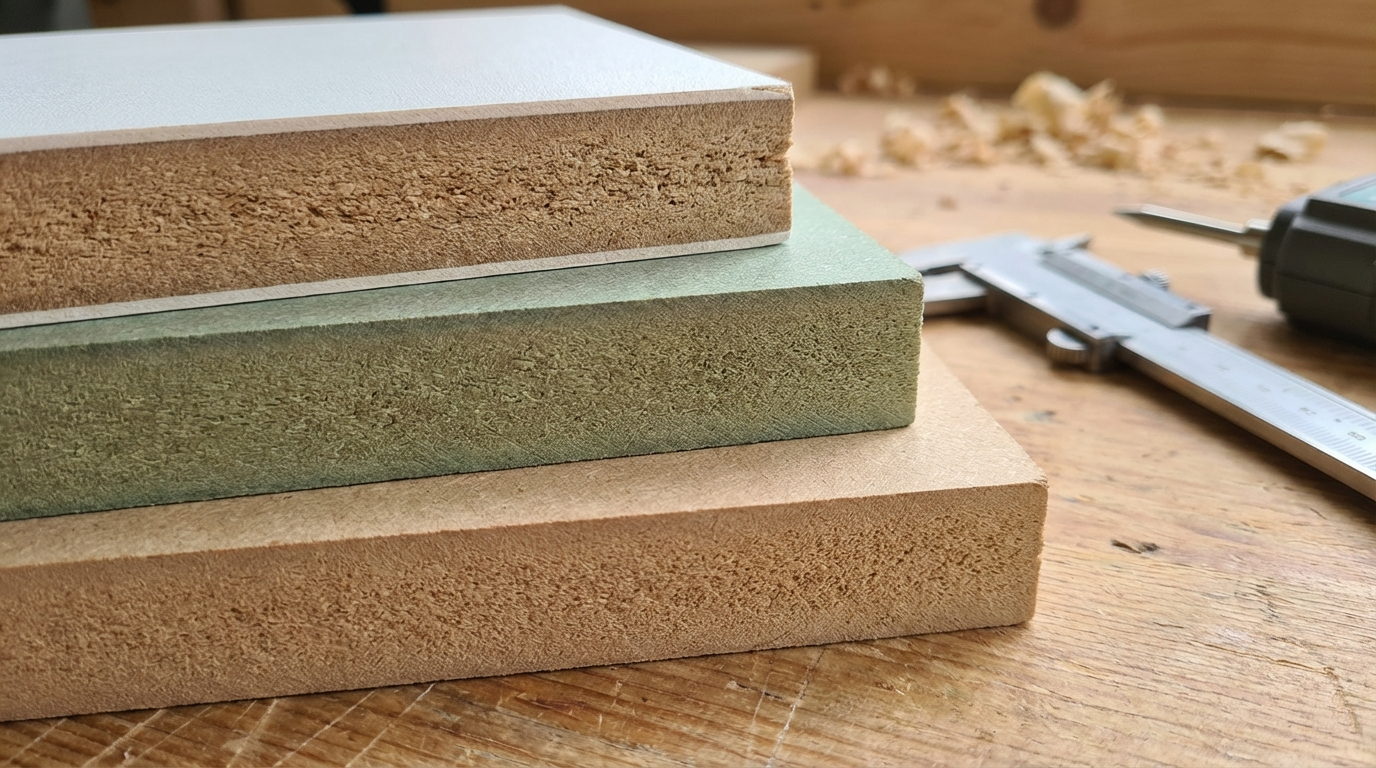
- Standard MDF: Dry interiors, paint/laminate base.
- MR MDF: Monsoon areas, extra moisture repellents.
- HDF: Thicker doors, higher density.
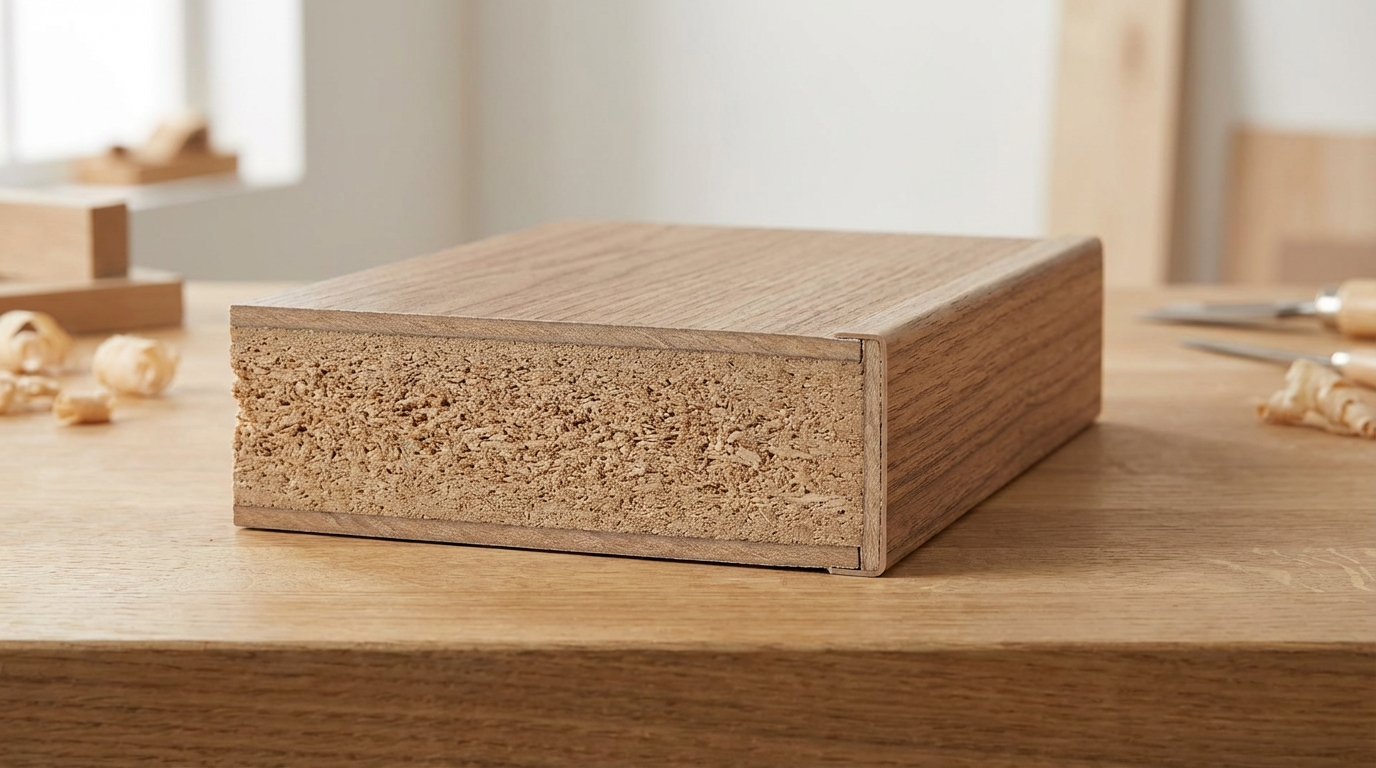
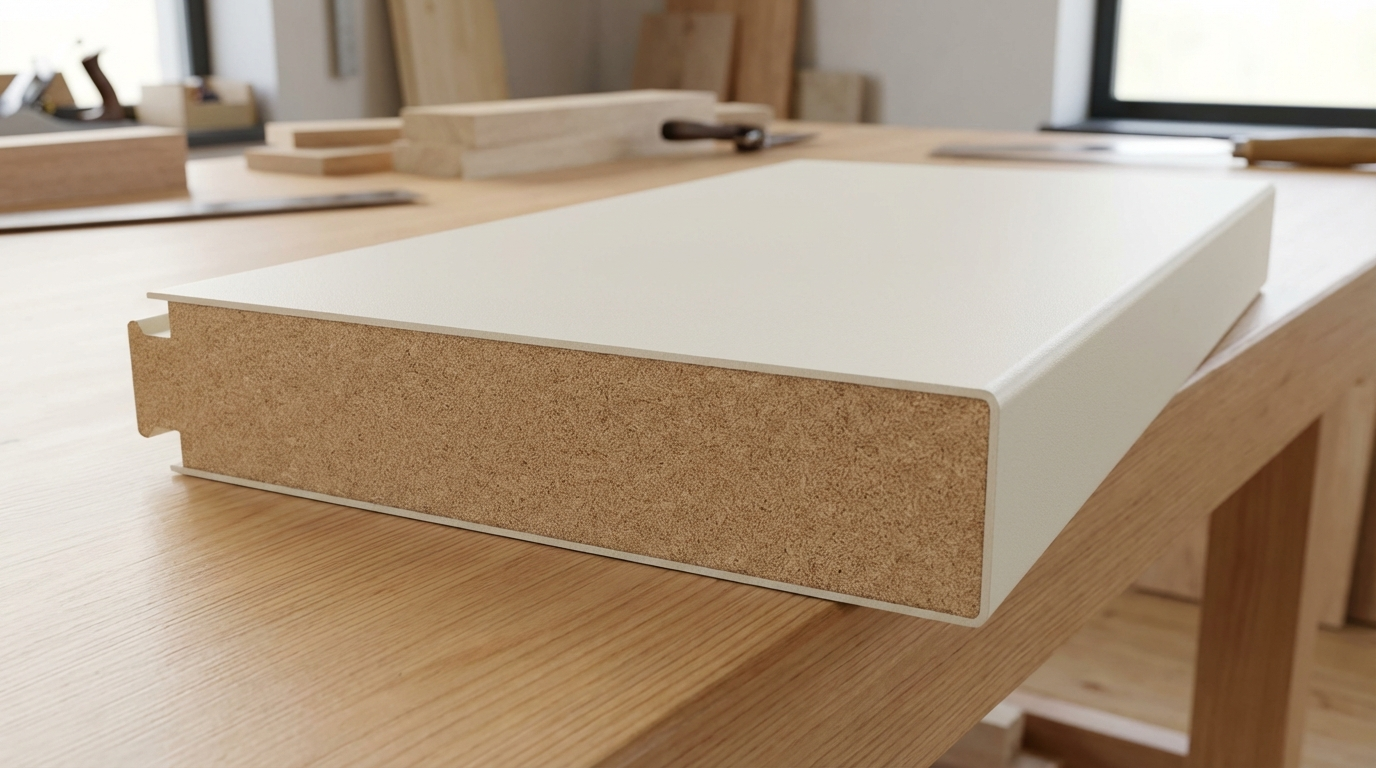
- Pre-laminated: Factory finish, less site work.
Confusions:
- Assuming all MDF is waterproof—no, only WR grades.
- Thinking it's stronger than plywood axially—it's isotropic but weaker in tension.
- Overlooking edge fragility—always band edges.
- Confusing density with hardness—test by scratching.
- Ignoring thickness for load: 12 mm shelves sag under books.
Two-Minute Comparison (What Changes in Real Life)
MDF shines in finish quality and uniformity vs plywood's natural variations. Plywood edges splinter; MDF routes smooth.
| Factor | MDF | Plywood |
|---|---|---|
| Surface Finish | Smooth, paint-ready; no knots | Grainy, needs filler for paint |
| Moisture (unprotected) | Swells edges in humidity | Better core but delams veneers |
| CNC Routing | Uniform, no tear-out | Voids cause chipping |
| Screw Holding | Good center, poor edges | Better throughout |
| Cost per Sheet (18mm) | Typically lower | Higher due to veneers |
| Indian Monsoon Fit | MR grade + sealing | BRW grade preferred |
Choose MDF for modular speed in dry zones; plywood for frames/high load.
Quick Facts on Thickness, Density, and Smarter Choices
Thickness: 3-6 mm for backs/laminates, 12-18 mm for shutters, 25 mm for tabletops. Density: 700+ kg/m³ standard; feel weight for quality.
What are standard MDF thicknesses available?
Common: 3, 5.5, 6, 9, 12, 16, 18, 25 mm. Pick 18 mm for wardrobe sides (load-bearing), 6 mm for shelves. Thinner saves cost but sags; thicker resists flex. In India, 8x4 ft sheets common—calculate cuts to minimize waste. Check: stack samples; uniform thickness means precision pressing. (102 words)
How to tell good density without scales?
Lift corner: heavier sinks faster. Tap edge: solid tone, not hollow. Scratch surface: resists light nail. Low density crumbles in cuts. Varies by maker; aim 750+ kg/m³ for furniture. (92 words)
Failure Modes and Fixes
- Symptom: Edge swelling. Root: Humidity absorption. Prevent: Edge-band immediately, use MR grade. Fix: Sand, reseal with PU polish.
- Symptom: Screw pull-out. Root: Edge screwing. Prevent: Insert plugs/blocks. Fix: Redrill with anchors.
- Symptom: Surface scratches. Root: Abrasive cleaning. Prevent: Microfiber only. Fix: Light sand + repaint.
- Symptom: Core crumbling post-cut. Root: Low density. Prevent: Buy heavier sheets. Fix: Discard, reinforce.
- Symptom: Delamination in heat. Root: Poor resin. Prevent: Ventilate site. Fix: Clamp, epoxy reglue.
- Symptom: Sag in shelves. Root: Thin span. Prevent: 12 mm min + ribs. Fix: Add supports.
- Symptom: Chipping on routes. Root: Dull tools. Prevent: Upcut bits, tape edges. Fix: Sand, fill.
Quality Checks You Can Do Without Lab Tests
Before buying:
- Visual: No dark core spots, uniform color.
- Weight: Heavier per sheet = better density.
- Edge: Smooth cut, no fuzz.
- Ask: "MR grade? Resin type?" Red flag: Vague answers.
After cutting: Clean edges mean good fibers; crumbly = reject.
Post-install: Press edges—no give. Clean with damp cloth; dry immediately.
Common Buyer Mistakes and How to Avoid Them
- Mistake: Skipping edge banding. Avoid: Band all exposed edges Day 1.
- Mistake: Using in wet kitchens untreated. Avoid: HDFWR or tiles over.
- Mistake: Overloading thin shelves. Avoid: Deflect test with weights.
- Mistake: Storing flat on ground. Avoid: Vertical racks, cover.
- Mistake: Screwing too close to edge. Avoid: 25 mm inset.
- Mistake: Painting without primer. Avoid: MDF sealer first.
- Mistake: Ignoring density feel. Avoid: Compare samples.
- Mistake: Coastal use without sealing. Avoid: Extra PU coats.
- Mistake: CNC without dust extraction. Avoid: Vacuum setup.
Decision Framework: Matching Conditions to Choices
| Site Condition | Recommended MDF Type/Finish | Verify Checklist |
|---|---|---|
| Wet zone (kitchen sink) | MR/HDFWR + PVC laminate + thick edge band | Water bead test on sample; density >750 kg/m³ |
| Coastal humidity | MR grade + melamine + PU seal | No swelling after 24h damp cloth; uniform weight |
| Heavy use (kids' room) | 18 mm + HPL laminate | Scratch resistance; screw hold test |
| Tight budget | 12 mm standard + paint | Waste calc; bulk buy |
| Fast delivery | Pre-lam sheets | |
| High scratch risk | HDF + acrylic finish | Finger rub test; hardness feel |
Persona Tips: Tailored Advice
Homeowners: Clean with soft cloth, no abrasives. Avoid water pooling. Check hinges yearly for looseness.
Carpenters: Use 180-grit for sanding, pilot holes for screws. Carbide bits for clean cuts. Store vertical.
Architects/Designers: Spec 18 mm min for spans >60 cm. Detail edge returns. Factor 10% wastage.
OEM/Modular Makers: QC density batch-wise. Standardize CNC feeds. Track returns for swelling patterns.
Practical Use Cases (What Works, What Fails)
| Use Case | Thickness | Finish Notes | Risk Notes (India) |
|---|---|---|---|
| Wardrobe shutters | 18 mm | Laminate + PVC edge | Humidity seal; hinge reinforce |
| TV unit shelves | 12 mm | Paint + ABS band | Load limit 20 kg; rib if span long |
| Kitchen cabinets | MR 18 mm | HPL + full wrap | Splash guard; no direct water |
| Wall panels | 6 mm | Membrane foil | Ventilate; AC zones only |
Where is MDF smarter than plywood?
MDF for painted/modular where uniformity trumps strength—saves filler time. Plywood for frames. In India, MDF cuts CNC waste. Check: route sample both. (94 words)
FAQs
Can MDF be used outdoors?
No, standard MDF absorbs moisture and degrades quickly in rain or sun. Even MR grades suit covered balconies only with heavy sealing. Opt for treated alternatives like HMR or metal cladding for true exteriors. In Indian monsoons, unprotected MDF warps in weeks—test by soaking edge sample overnight. Always prioritize ventilation and overhangs if semi-exposed. (102 words)
Is MDF termite resistant?
Plain MDF resists termites better than solid wood due to resins, but not fully—treat with borate sprays for infested sites. Coastal India needs extra caution; check supplier pretreatment. Inspect annually for frass. Combine with metal brackets for legs. (92 words)
How much weight can MDF shelves hold?
Typically 15-25 kg per running foot for 12 mm at 60 cm span, less near edges. Reinforce with battens for bookshelves. Test: load sample progressively. Varies by density; heavier holds more without sag. In humid rooms, derate 20%. (88 words)
Does MDF need special tools for cutting?
Use carbide-tipped blades, zero-clearance for tablesaw, or CNC for precision. Hand saws chip edges—tape first. Dust extraction prevents resin gumming. Indian carpenters: fine-tooth blade (60T) for clean finish. (85 words)
What's the difference between MDF and HDF?
HDF is higher density (850+ kg/m³), harder for doors/floors; MDF more machinable for cabinets. HDF costs more but thinner strength. Pick HDF for high-wear; MDF for routes. Feel: HDF scratches less. (82 words)
Can you paint MDF directly?
Yes, but prime with MDF sealer first to block moisture and seal pores. Two coats filler primer, then enamel. Sand between. In humid India, PU topcoat for durability. Avoid latex alone—blushes. (78 words)
Is MR MDF truly moisture resistant?
MR MDF handles 90% RH better with waxes, but not waterproof—edges swell if unsealed. Ideal for bathrooms with grout lines. Test: damp cloth 48 hours, no warp. Seal liberally for monsoons. (72 words)
How to store MDF sheets on site?
Vertical in A-frames, covered, off ground. Avoid direct sun/rain. In India, use tarps during transport; acclimate 48 hours indoors before cutting. Stack flat only short-term on pallets. (68 words)
Why does MDF edge crumble?
Low density or wrong blade speed. Use slow feed, sharp tools. Prevention: score line first. Fix: PVA glue, sand. Buy 750+ kg/m³ grades. (62 words)
Is MDF eco-friendly?
Uses waste fibers, but resins emit formaldehyde—opt low-E1 grades. Recyclable scraps. In India, check for sustainable sourcing. Better than tropical plywood for forests. (58 words)
Disclaimer: This content is provided for general informational purposes based on industry practices and publicly available information. Product specifications, standards, prices, and availability may vary by manufacturer, region, and time. Readers should independently verify details with manufacturers, dealers, or qualified professionals before making purchase or construction decisions.Want Plywood Suggestions?
Share a few details and a VIR MDF specialist will suggest suitable brands and connect you to responsive dealers.