MDF Full Form: What Does MDF Stand For? Complete Guide 2026
MDF full form is Medium Density Fibreboard. Learn what MDF means, types, uses, benefits & why VIR MDF is India's trusted choice. Complete guide inside.

Quick Decision Summary
Quick Answer: MDF full form is Medium Density Fibreboard — an engineered wood panel made by compressing wood fibres with resin binders under high heat and pressure. It offers a smooth, uniform surface ideal for furniture, cabinetry, and interior finishing across Indian homes and commercial spaces.
If you're in a hurry: MDF stands for Medium Density Fibreboard, a cost-effective alternative to solid wood with density ranging from 600-800 kg/m³. It's widely used in Indian construction for wardrobes, modular kitchens, TV units, and decorative wall panels due to its smooth paintable surface and consistent quality without natural wood defects like knots or grain variations.
- Choose MDF if: You need smooth painted finishes, cost-effective furniture solutions, intricate CNC-cut designs, or uniform panels without natural wood defects
- Choose MDF if: Your application is in dry interior spaces with controlled humidity
- Choose MDF if: You want laminate or veneer overlays with perfect adhesion
- Avoid MDF if: The installation area has direct water exposure or prolonged high humidity
- Avoid MDF if: You need structural load-bearing applications
- Avoid MDF if: Edge screw-holding strength is critical without proper reinforcement
What MDF Full Form Actually Means
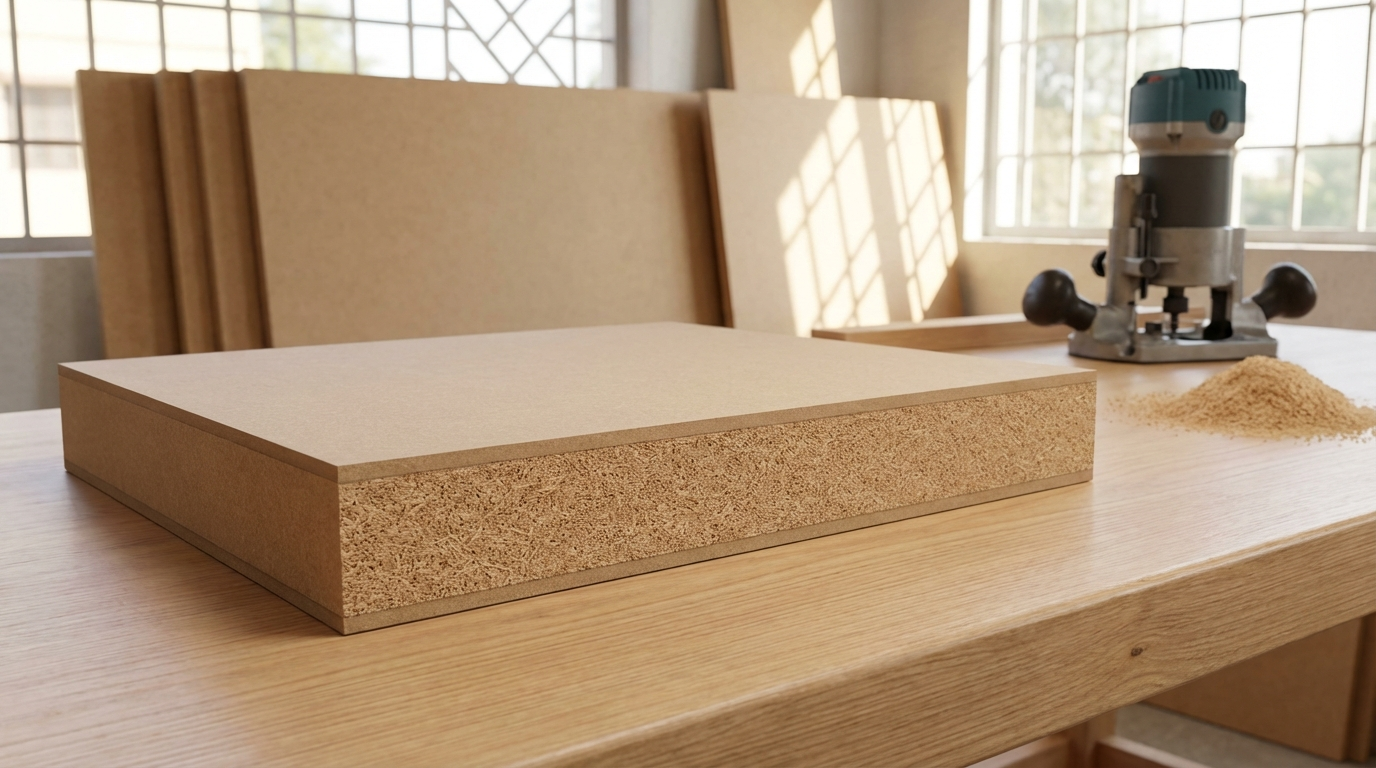
The MDF full form is Medium Density Fibreboard. This engineered wood product is manufactured by breaking down hardwood or softwood residuals into fine wood fibres, combining them with wax and resin binders, and forming panels under high temperature and pressure. The "medium density" in the name refers to its density range of typically 600-800 kg/m³, positioning it between particleboard (lower density) and High Density Fibreboard or HDF (higher density).
Understanding where MDF fits in the engineered wood hierarchy helps clarify its applications:
- Particleboard: Made from larger wood chips, lower density (450-600 kg/m³), more affordable but weaker
- MDF (Medium Density Fibreboard): Fine wood fibres, medium density (600-800 kg/m³), smooth surface, excellent machinability
- HDF (High Density Fibreboard): Very fine fibres, higher density (800-1040+ kg/m³), superior strength and hardness
Common Confusions About MDF Meaning Clarified
Many buyers in India confuse MDF with plywood or assume it's a type of plastic. Here's what MDF is not:
- MDF is not plywood — plywood uses cross-laminated wood veneers, while MDF uses compressed wood fibres
- MDF is not particleboard — MDF uses finer fibres resulting in a smoother, denser surface
- MDF is not plastic or synthetic — it's made from actual wood fibres (typically 80% wood content)
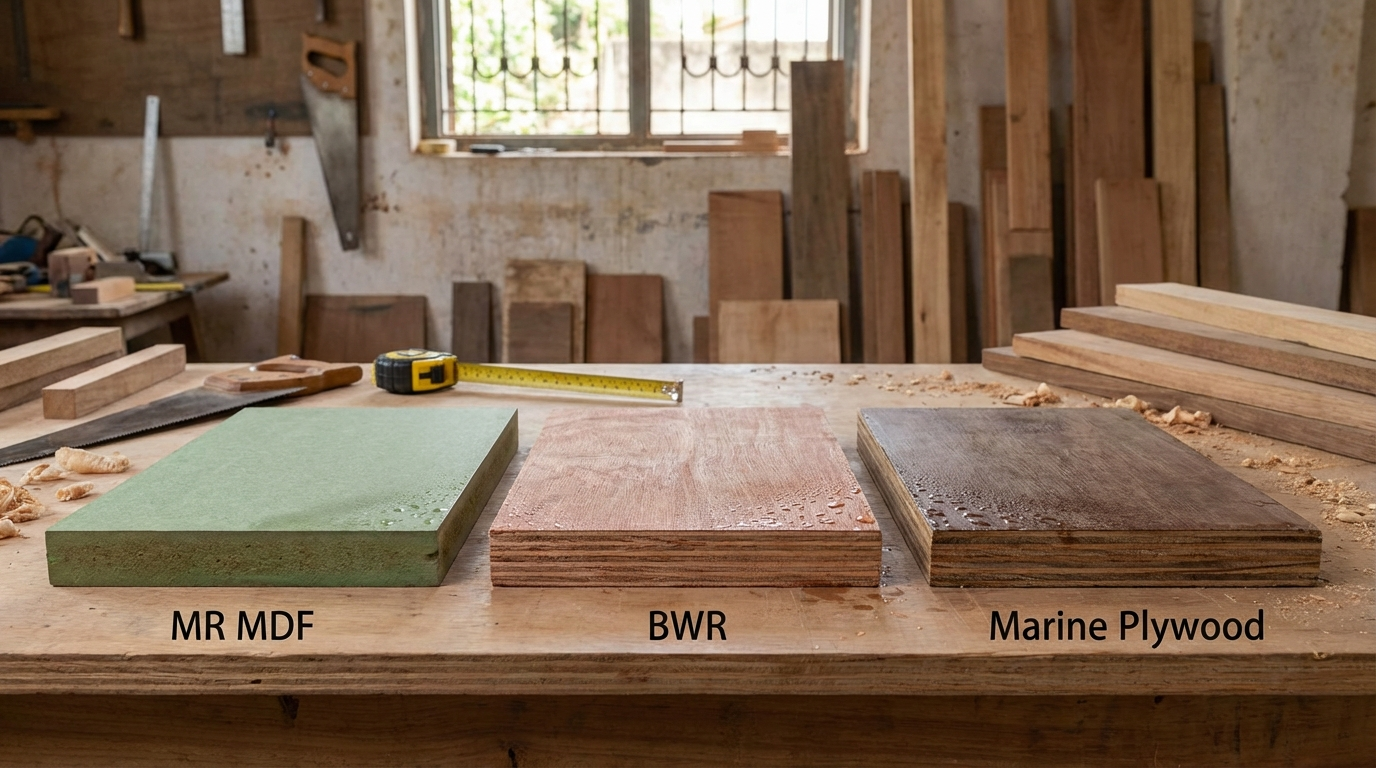
- MDF is not waterproof by default — standard MDF absorbs moisture; special grades like MR-MDF or HDFWR offer moisture resistance
- MDF is not suitable for outdoor use — unless specifically rated as exterior grade with proper sealing
Why MDF Full Form Matters for Indian Homes
Understanding what MDF stands for becomes practically important when dealing with India's unique climate challenges. The medium density composition means MDF reacts predictably to humidity changes — a critical consideration given India's diverse climate zones from humid coastal areas to dry northern plains.
Monsoon and Humidity Impact on MDF
During the June-September monsoon season, indoor humidity in many Indian cities can exceed 80%. Standard MDF boards can experience thickness swelling of 10-15% when exposed to prolonged moisture. This manifests as:
- Warped cabinet doors that no longer close properly
- Swollen edges where laminate starts peeling
- Soft spots developing on surfaces exposed to steam (near stoves, in bathrooms)
Coastal Area Considerations
In cities like Mumbai, Chennai, Kochi, and Visakhapatnam, salt-laden air accelerates moisture-related degradation. For coastal installations, using MR-MDF (Moisture Resistant) or HDFWR (High Density Fibreboard Water Resistant) becomes essential rather than optional. The additional cost of moisture-resistant grades typically adds ₹15-40 per square foot but prevents premature replacement.
Real Consequences of Wrong MDF Selection
Common failures observed in Indian installations include:
- Delamination: Laminate sheets separating from swollen MDF substrate within 2-3 monsoon seasons
- Screw pull-out: Hinges and handles loosening as MDF edges soften from moisture absorption
- Surface bubbling: Trapped moisture causing paint or laminate to bubble on exposed surfaces
- Sagging shelves: Long unsupported spans deflecting under load, especially in humid conditions
Types of MDF Boards Available in India
The Indian market offers several MDF variants, each designed for specific applications and environmental conditions. Knowing these types helps match the right board to your project requirements.
| MDF Type | Density Range | Key Feature | Best Applications | Price Range (₹/sq ft) |
|---|---|---|---|---|
| Standard MDF | 600-750 kg/m³ | Smooth surface, cost-effective | Dry interior furniture, wall panels | 25-55 |
| MR-MDF (Moisture Resistant) | 650-780 kg/m³ | Enhanced moisture resistance | Kitchens, bathrooms (not wet zones) | 40-75 |
| HDF/HDFWR | 800-1000 kg/m³ | High density, water resistant | High-humidity areas, premium furniture | 55-100 |
| FR-MDF (Fire Retardant) | 650-800 kg/m³ | Fire-retardant chemicals added | Commercial spaces, public buildings | 70-120 |
| Pre-laminated MDF | 600-800 kg/m³ | Factory-applied decorative surface | Ready-to-use furniture, quick installations | 60-150 |
| Exterior Grade MDF | 700-850 kg/m³ | Weather-resistant formulation | Covered outdoor applications, exterior cladding | 80-140 |
Understanding MDF Thickness Options in India
Indian manufacturers typically offer MDF in standardized thicknesses measured in millimetres:
- 3-6mm: Backing panels, drawer bottoms, decorative overlays
- 8-9mm: Cabinet backs, partition infills, light decorative applications
- 12mm: Shelving, cabinet sides, moderate-load applications
- 16-18mm: Standard furniture thickness — wardrobe shutters, kitchen cabinets, table tops
- 25mm: Heavy-duty applications, thick table tops, acoustic panels
The standard sheet size available across India is 8 feet × 4 feet (2440mm × 1220mm), though some manufacturers offer custom cutting services.
How MDF is Manufactured: The Process Behind the Full Form
Understanding MDF's manufacturing process explains why it behaves the way it does and helps set realistic expectations for its performance.
Step-by-Step MDF Production
- Raw Material Sourcing: Wood residues from sawmills (chips, sawdust, shavings) or plantation wood like eucalyptus are collected. Reputable manufacturers use plantation-grown species, ensuring no natural forests are cleared.
- Fibre Production: Wood chips are washed, steamed to soften lignin, then mechanically separated into fine individual fibres using a defibrator machine.
- Fibre Treatment: Dried fibres are blended with resin binders (typically urea-formaldehyde) and paraffin wax for moisture resistance.
- Mat Forming: The treated fibres are laid out in uniform mats on a continuous belt, with finer fibres directed to outer layers for smoother surfaces.
- Hot Pressing: The fibre mat is compressed under high temperature (150-200°C) and pressure, curing the resin and bonding fibres into a solid panel.
- Finishing: Panels are cooled, sanded to achieve the characteristic smooth surface, cut to standard sizes, and quality-checked.
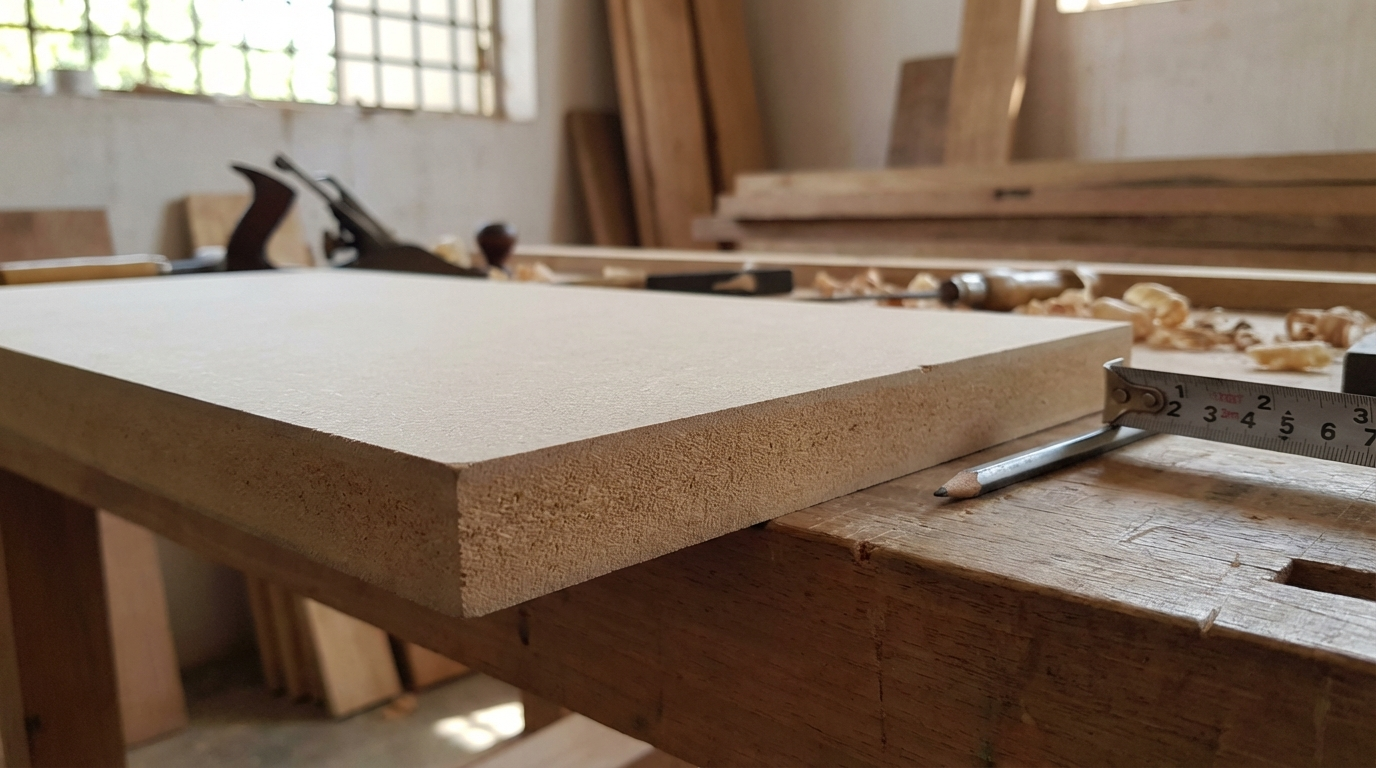
This manufacturing process is why MDF has no grain direction, no knots, and consistent density throughout — properties that natural wood cannot match.
MDF vs Alternative Materials: Detailed Comparison
Choosing between MDF and alternatives requires understanding specific trade-offs for Indian conditions and applications.
| Parameter | MDF | Plywood | Particleboard | Solid Wood |
|---|---|---|---|---|
| Surface Smoothness | Excellent (no grain) | Moderate (visible grain) | Coarse (requires laminate) | Natural grain (variable) |
| Paint Finish Quality | Superior | Good | Poor without primer | Good with prep |
| Moisture Resistance | Poor (Standard), Better (MR grade) | Fair to Good (BWR grades) | Very Poor | Variable by species |
| Screw Holding (Face) | Good | Excellent | Poor | Excellent |
| Screw Holding (Edge) | Poor to Moderate | Good | Very Poor | Excellent |
| CNC Machinability | Excellent | Moderate | Poor (chips easily) | Good |
| Weight | Heavy | Medium | Light | Variable |
| Cost (₹/sq ft) | 25-100 | 45-180 | 15-40 | 100-500+ |
| Termite Resistance | Good (treated) | Requires treatment | Moderate | Poor without treatment |
When to Choose MDF Over Alternatives
- Choose MDF when: Smooth painted finishes are priority, intricate router or CNC work is needed, cost efficiency matters, consistent appearance without natural defects is required
- Choose Plywood when: Structural strength is needed, moisture exposure is higher, edge screw holding is critical, weight savings matter
- Choose Particleboard when: Budget is extremely tight, application is fully concealed, load-bearing is minimal
- Choose Solid Wood when: Natural aesthetics are desired, longevity exceeds 20+ years, budget allows, traditional craftsmanship is valued
Decision Framework: Which MDF Type for Which Condition
| Condition/Location | Recommended MDF Type | What to Verify Before Purchase |
|---|---|---|
| Bedroom wardrobes (AC room) | Standard MDF 18mm | Smooth surface finish, proper edge sealing planned |
| Bedroom wardrobes (non-AC room) | MR-MDF 18mm | Green core colour (indicates MR grade), density check |
| Kitchen cabinets (below counter) | HDFWR or BWR Plywood | Water resistance certification, edge banding quality |
| Kitchen wall units | MR-MDF 18mm | Moisture resistance rating, hinge zone reinforcement |
| Bathroom vanity | HDFWR or Marine Plywood | Water resistance test results, proper sealing provisions |
| Living room TV unit | Standard MDF or MR-MDF | Surface smoothness, laminate compatibility |
| Coastal area furniture | HDFWR minimum | Enhanced moisture resistance, salt-air durability |
| Commercial office partitions | FR-MDF (if fire codes apply) | Fire rating certification, compliance with local codes |
| Decorative CNC panels | Standard MDF 12-18mm | Uniform density, dust-free storage before cutting |
| Children's room furniture | E0 or CARB P2 certified MDF | Low formaldehyde emission certification |
Practical Applications of MDF in Indian Construction
MDF's versatility makes it suitable for numerous applications across residential and commercial projects. Here's how MDF is commonly used in India:
Furniture Applications
- Modular Kitchen Shutters: Pre-laminated or painted MDF with proper edge banding for cabinet doors
- Wardrobe Panels: 18mm MDF for shutters, 8-9mm for back panels and drawer bottoms
- Study Tables: 25mm MDF for table tops with laminate overlay
- Shoe Racks: 12-18mm MDF with adequate ventilation provisions
- TV Units: Combination of thicknesses for shelves, back panels, and decorative elements
Interior Finishing Applications
- Wall Panelling: 8-12mm MDF for wainscoting, accent walls, geometric patterns
- False Ceiling Elements: Lightweight MDF variants for decorative ceiling borders and coffers
- Door Frames and Mouldings: MDF profiles for consistent painted trim work
- Partition Walls: MDF cladding over metal frames for office partitions
- Acoustic Panels: Perforated MDF with absorptive backing for sound management
Decorative Applications
- CNC-Cut Screens: Intricate jali patterns for room dividers and ventilation covers
- 3D Wall Textures: Routed MDF panels creating dimensional wall effects
- Display Units: Retail fixtures, exhibition stands, showroom displays
- Temple/Mandir Units: Carved and painted MDF for home prayer spaces
Common Buyer Mistakes When Purchasing MDF
Avoiding these frequent errors can save significant cost and frustration:
- Ignoring the grade specification: Assuming all MDF is the same and buying standard grade for kitchen use. Prevention: Always verify MR or HDFWR grade for humid areas.
- Skipping edge sealing: Leaving cut edges exposed, allowing moisture entry. Prevention: Budget for proper edge banding or sealing on all exposed edges.
- Underestimating thickness requirements: Using 12mm where 18mm is needed, leading to sagging shelves. Prevention: Follow span tables — maximum 600mm unsupported span for 18mm MDF shelving.
- Storing improperly at site: Keeping MDF sheets on damp floors or exposing to rain during construction. Prevention: Store flat, elevated, covered, in dry area until installation.
- Using wrong screws: Standard wood screws that don't grip MDF's fibre structure. Prevention: Use MDF-specific screws with coarse threads or confirmat screws with pre-drilling.
- Painting without primer: Direct paint application leading to uneven absorption and poor finish. Prevention: Always apply MDF-specific primer, especially on edges.
- Ignoring formaldehyde ratings: Using high-emission MDF in bedrooms and children's rooms. Prevention: Verify E1 or E0 emission certification for living spaces.
- Overloading shelves: Exceeding weight capacity based on span and thickness. Prevention: Add intermediate supports or use thicker boards for heavy storage.
- Choosing based on price alone: Selecting the cheapest option without checking density and quality. Prevention: Compare weight of same-size sheets — heavier typically indicates better quality.
- Not accounting for humidity cycles: Installing during dry season without expansion gaps. Prevention: Leave 2-3mm gaps at edges for seasonal movement, especially in non-AC spaces.
Failure Modes and How to Prevent Them
1. Edge Swelling
Symptom: Edges becoming soft, puffy, or crumbly, especially where laminate meets edge
Root Cause: Moisture penetration through unsealed edges or damaged edge banding
Prevention: Apply PVA-based edge sealer before edge banding; use quality ABS or PVC edge bands properly heat-sealed
Fix if occurring: Cut back affected area, apply wood hardener, re-seal and re-band; severe cases require panel replacement
2. Surface Delamination
Symptom: Laminate or veneer bubbling, lifting, or separating from MDF surface
Root Cause: Poor adhesive application, moisture beneath laminate, or substrate surface contamination during lamination
Prevention: Ensure dust-free surface before lamination; use appropriate adhesive type; maintain controlled humidity during bonding
Fix if occurring: Small areas can be re-glued with injection and clamping; large delamination requires re-lamination
3. Screw Pull-Out
Symptom: Hinges, handles, or fittings becoming loose; screws spinning without grip
Root Cause: Screws in edge grain, wrong screw type, repeated stress, or moisture-softened MDF
Prevention: Pre-drill pilot holes; use confirmat screws or dowels in edges; add solid wood or metal inserts for high-stress points
Fix if occurring: Fill hole with wood glue and toothpicks, re-drill when dry; relocate fitting slightly; or install threaded inserts
4. Panel Sagging
Symptom: Horizontal surfaces (shelves, cabinet bottoms) bowing under load
Root Cause: Excessive unsupported span for given thickness and load
Prevention: Limit spans to 500-600mm for 18mm MDF; add intermediate supports for longer spans; consider thicker boards
Fix if occurring: Add center support bracket; replace with thicker panel; reduce load
5. Paint Finish Failure
Symptom: Paint peeling, cracking, or showing uneven sheen, especially on edges
Root Cause: Insufficient priming, painting over dust/grease, or moisture in substrate
Prevention: Sand surface, remove all dust, apply MDF primer (2 coats on edges), then topcoat
Fix if occurring: Sand back to sound surface, re-prime, repaint
6. Warping
Symptom: Flat panels developing curves, bows, or twists
Root Cause: Uneven moisture exposure (one side sealed, other exposed); storing improperly
Prevention: Finish both sides equally; store flat with support; avoid one-sided moisture exposure
Fix if occurring: Mild warps may relax with opposite-side moisture and weights; severe warping requires replacement
Quality Checks Without Lab Tests
Before Buying: Visual and Physical Checks
- Weight test: Lift same-size sheets from different stacks — heavier indicates denser, better quality
- Surface inspection: Check for scratches, dents, rough patches, or visible fibre clumps
- Edge examination: Look for consistent density across thickness; avoid sheets with visibly loose or crumbly edges
- Flatness check: Sight along the length — reject sheets with visible bow or twist
- Core colour: Standard MDF is typically brown; green tint indicates MR grade; red indicates fire-retardant
- Smell test: Strong chemical odour may indicate high formaldehyde content
Questions to Ask the Dealer
- What is the density rating of this MDF?
- Is this E1 or E0 certified for formaldehyde emissions?
- What is the manufacturer's recommended application?
- Is this genuine MR grade or just branded as moisture-resistant?
- What is the warranty coverage and claim process?
Red Flags to Watch For
- Significantly lower price than market average without clear reason
- Missing or illegible manufacturer markings on sheets
- Inconsistent thickness within the same sheet
- Excessive dust or loose fibres on surface
- Dealer unable to provide technical specifications
After Cutting: Quality Verification
- Edge quality: Clean cuts should show uniform, compressed fibres without crumbling
- Core consistency: Cross-section should show even density without voids or inclusions
- Dust characteristics: Fine, uniform dust indicates good fibre quality; coarse or chunky residue suggests poor manufacturing
After Installation: Ongoing Checks
- Monitor door alignment monthly for first monsoon season
- Check edge banding adhesion at corners and high-use areas
- Inspect screw points on hinges for any loosening
- Watch for any surface discolouration indicating moisture issues
Tips by User Type
For Homeowners
Durability expectations: Well-made MDF furniture in appropriate environments should last 10-15 years with proper care. In high-humidity areas without climate control, expect 5-8 years even with MR grades.
Cleaning guidelines:
- Use slightly damp (not wet) cloth for routine cleaning
- Wipe spills immediately — don't let liquids sit
- Avoid harsh chemicals or abrasive cleaners
- Use coasters under plants and beverages
When to worry: Soft edges, musty smell, visible swelling, doors not closing properly, or laminate lifting are signs of moisture damage requiring immediate attention.
For Carpenters and Contractors
Cutting tips:
- Use carbide-tipped blades (80+ teeth for clean cuts)
- Support full sheet to prevent vibration
- Cut with good side facing up on table saw, down on circular saw
- Allow blade to reach full speed before cutting
Edge preparation:
- Sand edges to 180-220 grit before edge banding
- Apply thin PVA seal on edges before lamination
- Use proper hot-air edge banding for best adhesion
Screw and hinge zones:
- Always pre-drill with appropriately sized bit
- Use confirmat screws for joining panels
- Add solid wood inserts for heavy-duty hinges
- Position screws minimum 25mm from edges
Handling best practices:
- Store flat, supported every 600mm
- Keep covered and elevated from ground
- Acclimatize sheets in installation room for 48 hours before cutting
- Wear appropriate dust mask — MDF dust is very fine
For Architects and Interior Designers
Specification language: Include in specifications: MDF grade (Standard/MR/HDFWR), density requirement (minimum kg/m³), thickness, emission class (E1/E0), and finish requirements.
Wet-zone detailing: For areas within 1 metre of water sources, specify HDFWR or marine plywood. Ensure drawings show edge sealing requirements and drainage provisions behind panels.
Finish selection guidelines:
- High-traffic areas: High-pressure laminate (HPL) over MDF
- Decorative walls: Paint-grade MDF with proper priming sequence
- Premium look: Veneer on MDF with lacquer finish
- Budget projects: Pre-laminated MDF to reduce site work
For Modular Kitchen and OEM Manufacturers
Quality control checkpoints:
- Incoming inspection: Weight, thickness, surface quality
- Post-cutting: Edge quality, dimensional accuracy
- Post-edge banding: Adhesion test, visual inspection
- Assembly: Hardware alignment, door operation
- Final: Complete unit inspection before dispatch
Reducing customer complaints:
- Standardize on quality-certified MDF suppliers
- Implement humidity monitoring in storage areas
- Train installers on proper handling and fitting
- Provide customer care instructions with delivery
- Use appropriate grade for each application zone
Batch consistency: Purchase from single batch for visible installations; mark batch numbers for warranty tracking; test new batches before full production run.
MDF Price Factors in India (2026)
MDF pricing varies based on multiple factors. Understanding these helps budget accurately and avoid overpaying.
Price Ranges by Type and Thickness
| MDF Type | 6mm | 12mm | 18mm | 25mm |
|---|---|---|---|---|
| Standard MDF | ₹18-28/sq ft | ₹28-42/sq ft | ₹38-55/sq ft | ₹50-75/sq ft |
| MR-MDF | ₹28-40/sq ft | ₹40-58/sq ft | ₹52-75/sq ft | ₹68-95/sq ft |
| HDFWR | ₹38-55/sq ft | ₹55-78/sq ft | ₹70-100/sq ft | ₹90-130/sq ft |
| Pre-laminated MDF | ₹45-70/sq ft | ₹60-90/sq ft | ₹75-120/sq ft | ₹100-160/sq ft |
Note: Prices are indicative ranges as of January 2026 and vary by brand, region, and market conditions.
Cost Drivers to Understand
- Brand premium: Established brands command 15-30% premium for quality assurance
- Regional variation: Transport costs add ₹3-8/sq ft in remote areas
- Thickness: Price increases roughly proportionally with thickness
- Special grades: MR adds 25-40%; HDFWR adds 50-80% over standard
- Pre-lamination: Adds ₹15-40/sq ft depending on laminate quality
- Order quantity: Bulk orders may get 5-10% discount
Environmental and Health Considerations
Formaldehyde Emissions
MDF traditionally uses urea-formaldehyde resin as binder, which can release formaldehyde gas. Modern manufacturing has significantly reduced this concern:
- E1 Standard: Mandatory minimum in quality products (≤0.1 ppm emission)
- E0 Standard: Lower emission option (≤0.07 ppm)
- CARB P2: US standard similar to E1, widely adopted
- NAF (No Added Formaldehyde): Uses alternative binders, lowest emissions
Practical steps: Ensure adequate ventilation during and after installation; choose E0 or NAF for bedrooms and children's rooms; seal all surfaces to encapsulate emissions.
Sustainability Aspects
MDF offers environmental benefits when sourced responsibly:
- Made from wood residues and plantation timber — no old-growth forest clearing
- Efficient use of wood resources — utilizes fibres that would otherwise be waste
- Look for FSC or PEFC certification indicating responsible sourcing
- Recycling infrastructure is developing — some facilities now recover fibres from waste MDF
Workshop Safety
MDF generates very fine dust during cutting that poses respiratory risks:
- Use dust extraction at source when cutting
- Wear FFP2 or FFP3 rated dust masks
- Avoid blowing dust with compressed air
- Clean up with vacuum, not sweeping
- Ensure workshop ventilation meets safety standards
Frequently Asked Questions
What is the full form of MDF in furniture and construction?
The full form of MDF is Medium Density Fibreboard. It is an engineered wood panel manufactured by combining wood fibres with synthetic resin binders under high temperature and pressure. In furniture and construction applications across India, MDF is valued for its smooth, uniform surface that takes paint and laminate finishes exceptionally well. The material typically contains approximately 80% wood fibres, making it a genuine wood-based product suitable for interior applications including wardrobes, kitchen cabinets, TV units, and decorative wall panels.
Is MDF better than plywood for Indian homes?
MDF and plywood each excel in different applications — neither is universally better. MDF offers superior surface smoothness for painted finishes and intricate CNC work at lower cost, making it ideal for decorative elements and furniture in controlled environments. Plywood provides better moisture resistance, screw-holding strength, and structural integrity, making it preferred for load-bearing applications and high-humidity areas. For Indian homes specifically, use MDF in air-conditioned rooms and dry areas, but choose marine plywood or BWR plywood for kitchens and bathrooms where moisture exposure is higher.
Can MDF be used in kitchens and bathrooms?
Standard MDF should not be used in wet areas, but moisture-resistant variants can work in specific kitchen and bathroom applications. For kitchen wall cabinets away from direct steam, MR-MDF with proper edge sealing is acceptable. For areas near sinks or in bathrooms, HDFWR or high-density moisture-resistant boards are minimum requirements. Even with resistant grades, proper edge banding and surface sealing are essential. The area directly under sinks and in shower zones should use marine plywood or waterproof alternatives regardless of MDF grade.
How long does MDF furniture last in Indian conditions?
MDF furniture longevity depends heavily on environment and maintenance. In air-conditioned rooms with controlled humidity, well-made MDF furniture can last 12-15 years with proper care. In non-AC rooms experiencing full monsoon humidity cycles, expect 7-10 years even with MR-grade MDF. Coastal areas with salt-laden air may see reduced lifespan of 5-8 years. Key factors affecting longevity include proper edge sealing, appropriate grade selection, protection from direct moisture, and avoiding overloading shelves. Regular maintenance and prompt attention to any moisture damage significantly extends service life.
What is the difference between MDF, HDF, and HDFWR?
These terms refer to density and water resistance levels within the fibreboard family. MDF (Medium Density Fibreboard) has density of 600-800 kg/m³ and is suitable for general interior use. HDF (High Density Fibreboard) exceeds 800 kg/m³ density, offering greater strength, hardness, and screw-holding capacity. HDFWR adds water-resistant treatment to HDF, making it suitable for humid environments like kitchens. In practical terms: use standard MDF for bedroom furniture, MR-MDF for living areas, and HDFWR for kitchen and bathroom applications where moisture resistance is needed.
How do I identify genuine MR-MDF versus fake claims?
Genuine MR-MDF typically shows a green tint throughout its core when cut — not just surface colour. Check manufacturer markings on the sheet for grade designation. Request technical datasheets showing moisture swelling test results (should be under 10% after 24-hour water immersion). Compare weight — MR grades are usually slightly denser than standard. Purchase from authorized dealers of known brands who can provide warranty documentation. Be skeptical of significantly cheaper "MR" boards without proper certification — some sellers apply green colour to standard MDF as a deceptive practice.
What screws should be used for MDF?
MDF requires specific fastening approaches due to its fibre composition. Use coarse-threaded screws designed for MDF or particleboard — they grip better than fine-thread wood screws. Confirmat screws (furniture screws) work excellently for panel-to-panel joints. Always pre-drill pilot holes, especially near edges, to prevent cracking. For heavy-duty applications like hinges, use screws with at least 30mm penetration into the MDF. Consider threaded inserts or cam-lock fittings for joints that need disassembly. Avoid driving screws directly into edges — use dowels, biscuits, or edge-inserted fasteners instead.
Is MDF safe for children's furniture?
MDF can be safe for children's furniture when properly specified and finished. Choose E0 or CARB P2 certified MDF with low formaldehyde emissions for nurseries and children's rooms. Ensure all surfaces including edges are fully sealed with paint or laminate to encapsulate any potential emissions. Allow new furniture to off-gas in a ventilated area for several days before placing in children's rooms. Avoid MDF with strong chemical odours. For added safety, NAF (No Added Formaldehyde) MDF using alternative binders is available from some manufacturers, though at premium pricing.
Why does my MDF furniture smell after installation?
New MDF furniture may emit a chemical smell primarily from residual formaldehyde in the resin binder and from surface finishes or adhesives. This off-gassing is typically strongest in the first few weeks and diminishes over time. To minimize: choose low-emission MDF grades, ensure adequate ventilation in the room, seal all surfaces including edges before installation, and allow furniture to air out in a separate space before placing in bedrooms. Persistent strong odours after 4-6 weeks may indicate poor quality MDF or inadequate sealing. If smell causes irritation, consult with the manufacturer or consider replacement with certified low-emission products.
Can MDF be repaired if damaged by water?
Minor water damage on MDF may be repairable, but significant swelling usually requires replacement. For light surface moisture exposure: dry thoroughly, sand smooth, re-prime and repaint. For edge swelling: cut back damaged section to sound material, apply wood hardener, fill with automotive body filler or two-part wood filler, sand smooth, re-seal and re-band edge. For severe swelling where the core has become soft or crumbly, the affected panel must be replaced — attempting repair will result in ongoing problems. Prevention through proper sealing and grade selection is far more effective than repair.
How much weight can an MDF shelf hold?
MDF shelf capacity depends on thickness, span, support method, and duration of loading. As a general guideline for 18mm MDF: a 600mm span can safely hold 15-20 kg distributed load for long-term storage. Reducing span to 400mm roughly doubles capacity. Using 25mm thickness increases capacity by approximately 40%. Always use proper shelf supports — clips or brackets at both ends and intermediates for longer spans. MDF shows noticeable deflection before failure, so monitor new installations. For heavy loads like books, either reduce spans with intermediate supports or use plywood which has superior bending strength.
What is the best way to paint MDF for a smooth finish?
Achieving a smooth painted finish on MDF requires proper preparation. First, sand the surface with 180-220 grit, paying extra attention to edges which are more porous. Remove all dust with vacuum and tack cloth. Apply MDF-specific primer — two coats on edges which absorb more — allowing proper drying between coats. Lightly sand primed surface with 320 grit. Apply paint in thin, even coats using quality synthetic brush, foam roller, or spray equipment. Two to three topcoats typically yield best results. Satin or semi-gloss finishes hide imperfections better than gloss. Allow full cure time (usually 2-4 weeks) before subjecting to heavy use.
Note: This is independent informational content and is not affiliated with any manufacturer.
Disclaimer: This content is provided for general informational purposes based on industry practices and publicly available information. Product specifications, standards, prices, and availability may vary by manufacturer, region, and time. Readers should independently verify details with manufacturers, dealers, or qualified professionals before making purchase or construction decisions.Want Plywood Suggestions?
Share a few details and a VIR MDF specialist will suggest suitable brands and connect you to responsive dealers.