Waterproof Board for Interiors: MR MDF vs BWR vs Marine Ply
Waterproof board options for Indian homes: MR MDF, BWR, marine plywood comparison. Find the best moisture-resistant solution from VIR for your project.
Quick Decision Summary
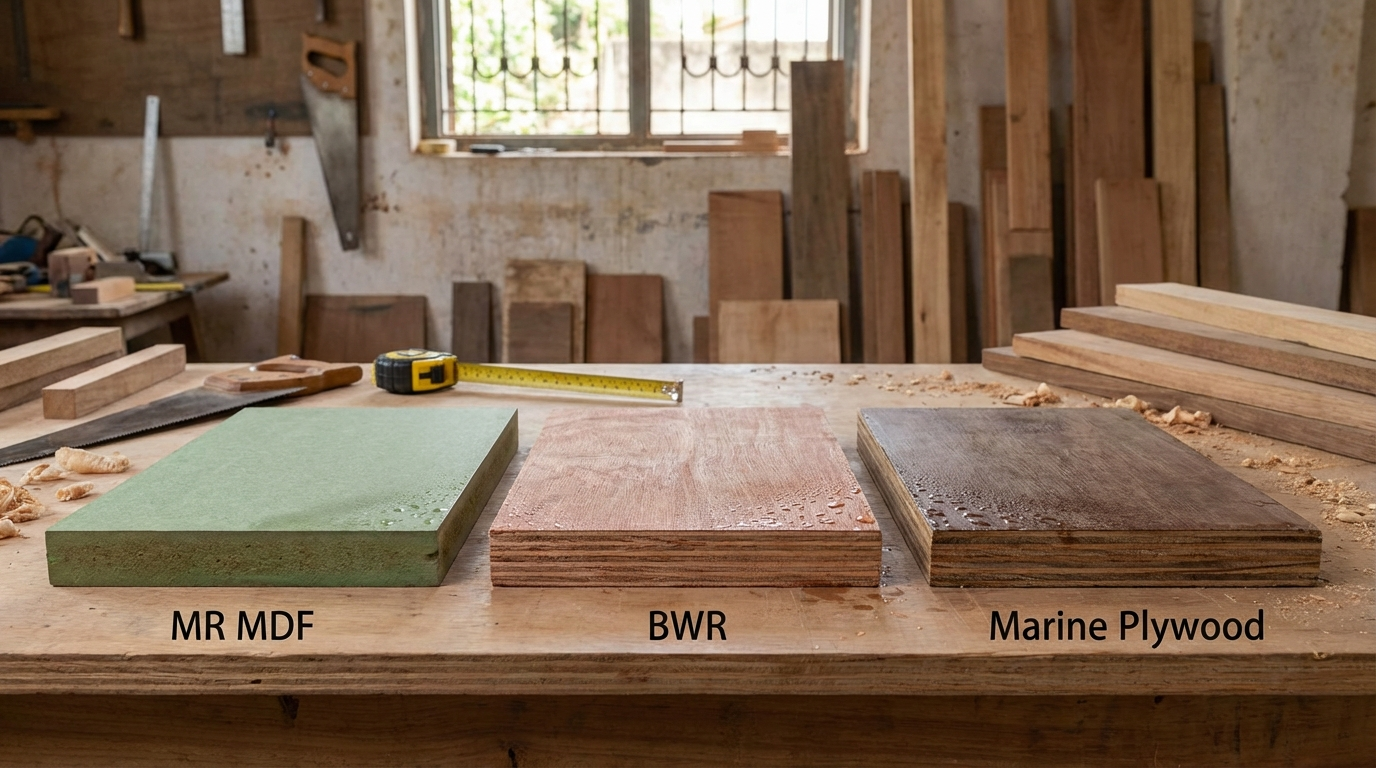
Quick Answer: Waterproof board selection for Indian interiors depends on moisture exposure level—use MR MDF for dry zones with occasional humidity, BWR plywood for semi-wet areas like kitchens, and marine plywood for fully wet zones like bathrooms. No board is truly "waterproof" for permanent submersion in residential use.
If you're in a hurry: For bedroom wardrobes and TV units, MR MDF offers the best value with adequate moisture protection. Kitchen cabinets demand BWR plywood minimum, while bathroom vanities require BWP or marine-grade plywood. The critical factor isn't the board label but proper edge sealing and installation—even marine plywood fails without correct finishing in Indian humidity conditions.
Choose this if:
- MR MDF: Your application is in AC rooms, bedrooms, or living areas with no direct water contact
- BWR Plywood: You're building kitchen cabinets, utility storage, or furniture in humid coastal cities
- BWP/Marine Plywood: Installation involves bathrooms, under-sink units, or outdoor-adjacent areas
- HDHMR: You need MDF-like machinability with higher moisture resistance for modular kitchens
Avoid this if:
- MR MDF: The furniture will be in bathrooms, near sinks, or in non-AC rooms during monsoon
- BWR Plywood: You expect standing water exposure or direct rain contact
- Marine Plywood: Budget is tight and the area is genuinely dry—you're overpaying
- Any board: You plan to skip edge banding or leave cut edges exposed to air
What Waterproof Board Actually Means for Indian Homes
The term "waterproof board" is heavily misused in Indian interior markets. No engineered wood panel is truly waterproof in the sense of surviving permanent water immersion. What manufacturers actually offer is moisture resistance measured in degrees—from humidity tolerance to boiling water survival for specific durations.
Understanding this hierarchy prevents expensive mistakes. The moisture resistance spectrum for interior boards works as follows:
| Board Type | Moisture Resistance Level | What It Actually Survives | BIS Standard |
|---|---|---|---|
| Plain MDF | Very Low | Brief humidity exposure only | IS 12406 |
| MR MDF | Low-Medium | Humidity cycling, not direct water | IS 12406 (MR grade) |
| HDHMR | Medium | Higher humidity, occasional splashes | Manufacturer specifications |
| MR Plywood | Low-Medium | Indoor humidity, not water contact | IS 303 |
| BWR Plywood | Medium-High | Steam, occasional water, 72hr boiling test | IS 303 (BWR grade) |
| BWP/Marine Plywood | High | Prolonged water exposure, boiling water test | IS 710 |
The critical insight for Indian conditions: Mumbai's monsoon humidity differs vastly from Jaipur's dry heat. A board that performs adequately in Bangalore may swell unacceptably in Chennai. Regional climate must inform your choice beyond generic "waterproof" claims.
Why This Matters for Indian Homes
India's climate creates unique stress conditions that European or North American board specifications don't account for. Understanding these factors prevents the common failure modes seen in Indian furniture after 2-3 years.
Monsoon Humidity Impact (June-September)
Relative humidity in coastal and eastern India routinely exceeds 85% for months. Even in "dry" interiors, this moisture penetrates through:
- Unsealed edges of boards
- Gaps around hinges and handles
- Laminate edges that weren't properly pressed
- Board backs left unfinished to save costs
The result: boards absorb moisture, swell 2-4mm in thickness, and never fully recover even when conditions dry. This creates permanent waviness in laminate surfaces, drawer jamming, and shutter misalignment.
Coastal Conditions Amplification
Salt air in cities like Mumbai, Chennai, Kochi, and Visakhapatnam accelerates deterioration. Salt deposits on surfaces attract additional moisture and can corrode metal fittings, which then stain and damage adjacent board surfaces. Coastal homes typically see 30-40% faster degradation than inland installations using identical materials.
Indian Construction Site Realities
Unlike factory-controlled modular installations, most Indian furniture is made on-site where:
- Boards sit exposed during monsoon construction delays
- Cut edges remain unsealed for days before assembly
- Carpenters prioritize speed over moisture sealing
- Edge banding quality varies dramatically by skill level
A premium marine plywood board with poor edge sealing will underperform a properly finished MR MDF in real-world conditions.
MR MDF Explained: What It Is and What It Isn't
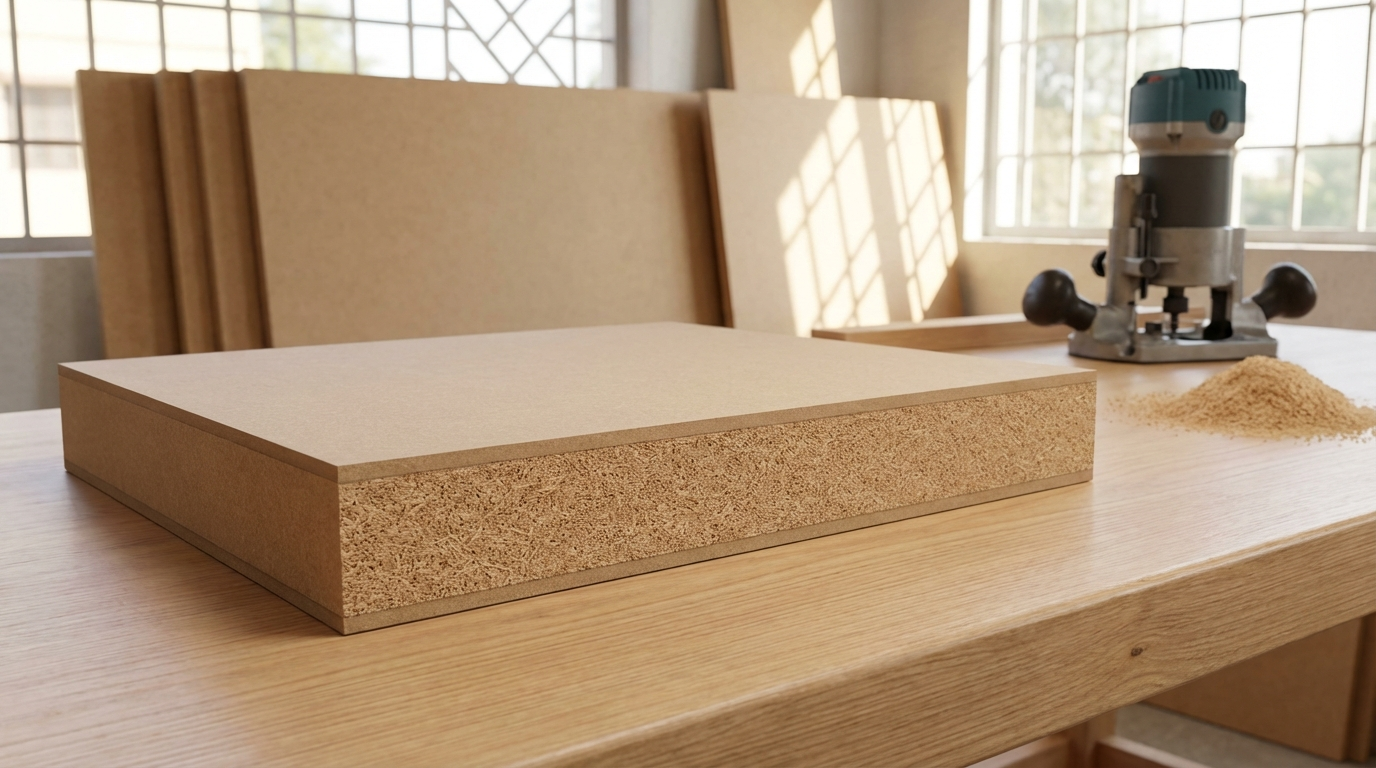
MR MDF (Moisture Resistant Medium Density Fibreboard) uses melamine-urea-formaldehyde resins instead of standard urea-formaldehyde, providing enhanced humidity tolerance. The "MR" designation indicates the board can handle humidity cycling without immediate degradation—it does not mean waterproof.
How MR MDF Performs in Real Conditions
MR MDF boards typically contain green-dyed core fibres (visible when cut) to distinguish them from standard MDF. This visual marker helps verify the grade, though colour alone doesn't guarantee quality—always check for ISI marks or manufacturer certification.
What MR MDF handles well:
- Air-conditioned room humidity fluctuations
- Seasonal monsoon humidity in enclosed spaces
- Occasional surface moisture wiped immediately
- Normal kitchen steam at safe distances from cooktops
What damages MR MDF:
- Standing water on surfaces for more than 30 minutes
- Unsealed edges in bathrooms or near sinks
- Direct contact with wet vessels or containers
- Installation in non-AC rooms in coastal cities during monsoon
MR MDF Thickness Options for Different Applications
| Thickness | Common Applications | Weight per 8x4 Sheet (Approx) |
|---|---|---|
| 6mm | Wardrobe backs, drawer bottoms, wall panels | 18-20 kg |
| 8mm | Shutter backs, partition infills | 24-26 kg |
| 12mm | Shelves, light-duty shutters | 36-38 kg |
| 18mm | Wardrobe shutters, TV units, modular furniture | 52-56 kg |
| 25mm | Tabletops, heavy shelves, structural elements | 72-78 kg |
MR MDF Price Ranges (January 2026)
Prices vary significantly by brand, density, and region. These ranges reflect typical market rates:
- 6mm MR MDF: ₹28-42 per sq ft
- 12mm MR MDF: ₹48-65 per sq ft
- 18mm MR MDF: ₹68-95 per sq ft
- 25mm MR MDF: ₹95-130 per sq ft
Premium brands with higher density and better resin formulations command 20-35% premiums over budget options. For moisture-critical applications, the premium is typically justified by longer service life.
BWR Plywood: The Kitchen Standard
BWR (Boiling Water Resistant) plywood uses phenol-formaldehyde resin for bonding veneers, creating significantly higher water resistance than MR grades. The standard test involves immersing samples in boiling water—BWR grade must survive 72 hours without delamination.
Why BWR Dominates Indian Kitchen Specifications
Indian cooking generates substantial steam and moisture. The combination of pressure cookers, open water vessels, and high-heat tadka preparation creates humidity spikes that standard MR materials cannot handle consistently. BWR plywood's phenolic bonding survives these conditions when properly finished.
Ideal BWR applications:
- Kitchen base unit carcasses
- Kitchen wall unit structures
- Sink-adjacent cabinets (with waterproof laminate)
- Utility area storage
- Pooja room units (incense and dhoop create humidity)
- Wardrobes in non-AC bedrooms in humid cities
BWR vs MR Plywood: Critical Differences
| Parameter | MR Plywood | BWR Plywood |
|---|---|---|
| Resin Type | Urea Formaldehyde | Phenol Formaldehyde |
| BIS Standard | IS 303 (MR) | IS 303 (BWR) |
| Boiling Water Test | Not applicable | 72 hours minimum |
| Humidity Tolerance | Indoor only | Semi-wet zones |
| Typical Price Premium | Base price | 25-40% higher |
| Recommended Use | Dry interiors | Kitchens, humid areas |
BWR Plywood Price Ranges (January 2026)
- 12mm BWR Plywood: ₹75-125 per sq ft
- 18mm BWR Plywood: ₹95-160 per sq ft
- 19mm BWR Plywood (Calibrated): ₹110-175 per sq ft
Calibrated BWR plywood commands premium pricing but delivers consistent thickness crucial for modular kitchen installations where precision matters.
Marine Plywood and BWP: The Wet Zone Solutions
Marine plywood (IS 710 certified) and BWP (Boiling Water Proof) represent the highest water resistance grades available for interior applications. These boards use superior phenolic resins and higher-quality core veneers designed for prolonged water exposure.
When Marine/BWP Grade Is Actually Necessary
Many Indian homeowners over-specify marine plywood for applications where BWR would suffice, wasting 30-50% on material costs. Reserve marine/BWP grade for:
- Bathroom vanity cabinets (direct water splash zones)
- Under-sink kitchen units (pipe leak exposure risk)
- Balcony storage (rain exposure through gaps)
- Outdoor-adjacent furniture (covered patios, sitouts)
- Homes in coastal areas within 2km of seawater
- Basement furniture (groundwater seepage risk)
Marine Plywood Quality Verification
The marine plywood market in India suffers from significant mislabelling. To verify genuine IS 710 grade:
- Check for ISI mark with licence number
- Examine core veneers—should be hardwood without gaps
- Request test certificates from established brands
- Verify uniform thickness across the sheet (calibrated)
- Look for termite and borer treatment certification
Marine/BWP Plywood Price Ranges (January 2026)
- 12mm Marine Plywood: ₹130-180 per sq ft
- 18mm Marine Plywood: ₹160-220 per sq ft
- 19mm BWP Calibrated: ₹150-210 per sq ft
HDHMR: The MDF-Plywood Hybrid Option
HDHMR (High Density High Moisture Resistant) boards occupy a middle ground between MDF and plywood, offering CNC machinability with improved moisture performance. This makes HDHMR increasingly popular for modular kitchen shutters where complex routing is required.
HDHMR Advantages Over Standard MR MDF
- Higher density: 850-900 kg/m³ vs 700-750 kg/m³ for standard MDF
- Better screw holding: Particularly important for hinge zones
- Improved edge quality: Cleaner CNC routing without chipping
- Enhanced moisture resistance: Performs between MR MDF and BWR plywood
When to Specify HDHMR
| Application | HDHMR Suitable? | Notes |
|---|---|---|
| Kitchen wall unit shutters | Yes | Steam exposure manageable |
| Kitchen base unit shutters | Conditional | Only with excellent edge sealing |
| Under-sink cabinets | No | Use BWP plywood |
| Wardrobe shutters | Yes | Ideal for CNC designs |
| Bathroom vanities | No | Use marine plywood |
| TV unit shutters | Yes | Excellent choice |
Decision Framework: Which Board for Which Condition
Use this framework to select the appropriate board grade based on installation conditions rather than generic recommendations:
| Condition | Recommended Board | What to Verify Before Purchase |
|---|---|---|
| AC bedroom, dry climate city | Standard MDF or MR MDF | ISI mark, density rating |
| AC bedroom, coastal/humid city | MR MDF minimum | Green core visible, proper edge banding planned |
| Non-AC bedroom, any climate | MR MDF or MR Plywood | Monsoon storage conditions at site |
| Kitchen (not sink-adjacent) | BWR Plywood or HDHMR | IS 303 BWR certification |
| Kitchen under-sink area | BWP/Marine Plywood only | IS 710 mark, waterproof laminate specified |
| Bathroom vanity | Marine Plywood | IS 710, edge sealing with PU/silicone |
| Balcony/semi-outdoor | Marine Plywood with exterior finish | UV-resistant laminate or paint specified |
| Budget-constrained dry area | Commercial MR Plywood | Core quality, no voids when cut |
Common Buyer Mistakes (And How to Avoid Them)
Mistake 1: Believing "Waterproof" Marketing Claims
Consequence: Boards fail within 2-3 years when exposed to actual moisture because expectations exceeded material capability.
Prevention: Understand that "waterproof" means water-resistant to varying degrees. Ask specifically: "How many hours of boiling water test does this pass?" and verify with BIS standards.
Mistake 2: Using MR Grade in Kitchens to Save Money
Consequence: Swelling near cooktop and sink areas within 18-24 months, laminate delamination, permanent damage requiring replacement.
Prevention: Budget BWR plywood minimum for all kitchen carcasses. The 25-40% premium pays for itself by avoiding complete replacement.
Mistake 3: Specifying Marine Plywood Everywhere
Consequence: 40-60% cost overrun on materials with no functional benefit in dry areas.
Prevention: Reserve marine grade only for wet zones. Living room and bedroom furniture performs identically with MR grades at significant savings.
Mistake 4: Ignoring Edge Sealing Quality
Consequence: Even marine plywood fails when cut edges absorb moisture. Most furniture failures start from unsealed edges, not surface exposure.
Prevention: Specify edge banding on all visible edges and PU sealant on hidden edges. Inspect carpenter's edge banding technique before approving work.
Mistake 5: Not Accounting for Site Storage Conditions
Consequence: Premium boards absorb moisture during construction phase, pre-compromising them before installation.
Prevention: Insist boards remain in plastic wrapping until cutting day. Store elevated off floor on battens. Avoid monsoon-month deliveries if possible.
Mistake 6: Choosing by Brand Name Alone
Consequence: Premium pricing without premium performance when wrong grade is selected from reputed brand.
Prevention: Verify specific grade and certification. A budget brand's BWR plywood outperforms a premium brand's MR grade in moisture-prone areas.
Mistake 7: Skipping Laminate on Kitchen Base Units
Consequence: Exposed board surfaces in kitchen bases absorb spills and splashes, degrading even BWR plywood.
Prevention: Apply laminate or PU finish on all interior surfaces of kitchen base units, not just shutters and visible areas.
Mistake 8: Ignoring Regional Climate Variations
Consequence: Standard specifications fail in extreme conditions—Chennai humidity vs Jodhpur dryness require different approaches.
Prevention: Consult local carpenters about common failure modes in your specific city. Coastal city installations should default to one grade higher than standard specifications.
Failure Modes and How to Prevent Them
Failure Mode 1: Edge Swelling
Symptom: Visible thickness increase along cut edges, laminate lifting at edges, drawer rubbing.
Root Cause: Exposed MDF/plywood edges absorbing atmospheric moisture or direct water contact.
Prevention: Apply edge banding within 24 hours of cutting. Use PVC or ABS edge bands with hot-melt adhesive properly applied.
If Already Happening: Sand swollen edges, apply wood hardener, re-edge band. Severe cases require panel replacement.
Failure Mode 2: Surface Bubbling/Delamination
Symptom: Laminate bubbles appearing, surface peeling, waviness visible under light.
Root Cause: Moisture ingress through unsealed surfaces or edges, adhesive failure from humidity cycling.
Prevention: Ensure all six faces of cut panels are sealed. Use pressure during lamination curing.
If Already Happening: Minor bubbles can be injected with adhesive and pressed. Large areas require re-lamination or replacement.
Failure Mode 3: Core Degradation
Symptom: Soft spots when pressing surface, screw holes enlarging, hinges loosening.
Root Cause: Prolonged moisture exposure causing internal fibre breakdown in MDF or veneer delamination in plywood.
Prevention: Match board grade to moisture exposure level. Ensure drainage in areas where water might collect.
If Already Happening: Panel replacement required. Temporary fix: epoxy filling for screw holes, hinge relocation.
Failure Mode 4: Fungal Growth
Symptom: Musty smell, visible mould on surfaces or edges, black spots.
Root Cause: Sustained moisture above 70% RH combined with organic material in board.
Prevention: Ensure ventilation in closed cabinets. Use anti-fungal treatments in humid climates. Specify boron-treated boards.
If Already Happening: Clean with fungicidal solution, improve ventilation, consider dehumidifier in room.
Failure Mode 5: Warping
Symptom: Shutters not closing flat, visible bow or twist in panels, gaps appearing.
Root Cause: Uneven moisture exposure between faces, inadequate acclimatisation before installation.
Prevention: Store boards flat for 48-72 hours in installation room before cutting. Apply laminate or finish on both faces.
If Already Happening: Mild warping can be corrected with weight and controlled moisture. Severe warping requires replacement.
Failure Mode 6: Hardware Failure Zone Damage
Symptom: Hinges pulling out, shelf pins enlarging holes, handles loosening.
Root Cause: Moisture weakening core around screw holes, improper pilot hole sizing, overloading.
Prevention: Use appropriate pilot hole sizes. Apply wood hardener or PVA in screw zones. Don't exceed load ratings.
If Already Happening: Fill holes with epoxy and toothpicks, redrill. Install larger hardware or relocate mounting points.
Quality Checks Without Lab Tests
Before Buying: Visual and Physical Checks
- Weight test: Lift the sheet—heavier typically indicates higher density and better quality for same thickness
- Edge inspection: Look for voids, gaps, or inconsistent core in plywood; uniform colour in MDF
- Surface check: Run hand across surface feeling for undulations or rough patches
- Stamp verification: ISI mark should include licence number; verify with BIS database if uncertain
- Smell test: Excessively chemical odour may indicate poor formaldehyde control
Questions to Ask Dealer
- "What BIS standard does this board comply with?"
- "Can you show the test certificate for this batch?"
- "How long has this stock been in your warehouse?" (Avoid old stock in humid conditions)
- "What's the density specification for this MDF grade?"
- "Is this calibrated or standard thickness tolerance?"
Red Flags to Avoid
- Price significantly below market range (likely inferior core material)
- No ISI mark or unverifiable licence numbers
- Visible core voids or gaps when examining cut edges
- Delamination visible at sheet corners
- Musty smell indicating prior moisture exposure
- Dealer unable to specify exact grade and standard
After Cutting: Quality Verification
- Core examination: Cut edge should show consistent density throughout without voids
- Thickness consistency: Measure at multiple points—variation over 0.5mm indicates poor calibration
- Edge chip test: Clean cut edges without excessive chipping indicate good quality
- Screw holding test: Drive test screw—should hold firmly without spinning
After Installation: Ongoing Checks
- Monitor edges for any swelling during first monsoon season
- Check shutter alignment monthly for first 6 months
- Verify hinge tightness after 3 months
- Inspect under-sink areas for any moisture damage signs
Tips by User Type
For Homeowners
Durability expectations: Well-specified and installed furniture should last 15-20 years minimum. If your kitchen shows damage within 5 years, either specification or installation was flawed.
Cleaning guidelines:
- Wipe spills immediately—don't let water stand on any surface
- Use slightly damp cloth, not wet
- Avoid water near hinges and handle mounting points
- Never use pressure washers or excess water for cleaning
When to worry: Edge swelling, shutter misalignment, soft spots, musty smell, or visible mould all indicate moisture problems requiring immediate attention before they spread.
For Carpenters
Cutting tips:
- Use sharp TCT blades designed for laminated boards
- Support both sides of cut to prevent chipping
- Cut with laminate face up on table saws, face down on circular saws
Edge preparation:
- Apply edge banding same day as cutting when possible
- Clean dust from edges before applying adhesive
- Use appropriate temperature settings for edge banding machines
Screw zones:
- Pre-drill pilot holes in MDF to prevent splitting
- Keep screws minimum 25mm from MDF edges
- Use appropriate screw length—2/3 board thickness maximum
Hinge areas:
- Use cup hinges designed for board thickness
- Apply PVA or wood hardener in hinge cup area for MDF
- Consider hinge mounting plates for heavy shutters
For Architects and Designers
Specification language:
- Specify BIS standard number (IS 303, IS 710, IS 12406)
- Include density requirements for MDF: "minimum 720 kg/m³"
- Specify edge treatment: "All edges to receive 1mm PVC edge band with hot-melt adhesive"
Wet zone detailing:
- Specify toe kick in separate material (aluminium or marine ply)
- Require silicone sealant at all board-to-wall joints in wet areas
- Detail drainage slopes away from cabinet bases
Finish selection:
- Specify post-formed edges for kitchen counters
- Require laminate on both faces to prevent warping
- Consider PU or acrylic finishes for high-moisture areas
For Modular and OEM Manufacturers
QC checkpoints:
- Incoming material inspection: thickness, density, surface quality
- Post-cutting inspection: edge quality, dimensional accuracy
- Post-lamination inspection: adhesion, bubble-free surface
- Final inspection: hardware alignment, shutter operation
Reducing complaints:
- Standardise on one grade higher than minimum required
- Implement edge sealing on all edges including hidden ones
- Provide clear maintenance guidelines to customers
- Document material specifications for warranty reference
Batch consistency:
- Source from single manufacturer for colour consistency
- Maintain batch tracking for troubleshooting
- Test each incoming batch for moisture content
- Store in climate-controlled environment
Practical Application Guide by Room
Bedroom Furniture Specifications
| Component | Recommended Board | Thickness | Special Considerations |
|---|---|---|---|
| Wardrobe carcass | MR MDF or MR Plywood | 18mm | Upgrade to BWR in coastal cities |
| Wardrobe shutters | MR MDF or HDHMR | 18mm | HDHMR for CNC designs |
| Wardrobe shelves | MR MDF | 18mm | Reinforce spans over 600mm |
| Wardrobe back | MR MDF | 6mm | Seal edges against wall moisture |
| Bed frame | MR Plywood minimum | 18mm | BWR for humid climates |
| Bed storage | MR MDF | 12-18mm | Ventilation provisions for hydraulic beds |
Kitchen Furniture Specifications
| Component | Recommended Board | Thickness | Special Considerations |
|---|---|---|---|
| Base unit carcass | BWR Plywood | 18-19mm | Marine grade for under-sink |
| Wall unit carcass | BWR Plywood or HDHMR | 18mm | HDHMR acceptable (less moisture exposure) |
| Shutters | HDHMR or BWR Plywood | 18mm | HDHMR preferred for CNC profile |
| Shelves | BWR Plywood | 18mm | Laminate both faces |
| Drawer boxes | BWR Plywood | 12mm sides, 6mm bottom | Consider metallic systems for wet areas |
| Tall unit carcass | BWR Plywood | 18-19mm | Ensure ventilation for appliance heat |
Living Room Furniture Specifications
| Component | Recommended Board | Thickness | Special Considerations |
|---|---|---|---|
| TV unit carcass | MR MDF | 18mm | Ventilation for electronics heat |
| TV unit shutters | MR MDF or HDHMR | 18mm | HDHMR for intricate CNC work |
| Bookshelf | MR MDF | 18-25mm | 25mm for spans over 800mm |
| Display unit | MR MDF | 18mm | Glass doors reduce moisture exposure |
| Wall panelling | MR MDF | 12-18mm | 6mm for veneer-finished panels |
Frequently Asked Questions
Is MR MDF truly waterproof for Indian kitchen use?
MR MDF is moisture resistant, not waterproof, and is generally not recommended as the primary material for kitchen carcasses in India. The steam from pressure cookers, humidity from water activities, and occasional splashes create conditions that exceed MR MDF's design limits. However, MR MDF works well for kitchen shutters and wall unit components when properly edge-sealed, especially in air-conditioned homes. For kitchen base units and sink-adjacent areas, BWR plywood remains the safer specification. If budget constraints require MR MDF use in kitchens, ensure impeccable edge banding and apply laminate on all surfaces including interiors.
What is the actual difference between BWR and BWP plywood?
BWR (Boiling Water Resistant) and BWP (Boiling Water Proof) differ primarily in their water resistance duration and testing standards. BWR plywood, manufactured under IS 303, must survive 72 hours of boiling water immersion without delamination. BWP plywood, meeting IS 710 (marine grade) standards, undergoes more rigorous testing and uses superior phenolic resins for indefinite water exposure resistance. In practical terms, BWR handles intermittent moisture exposure like kitchen steam and humidity, while BWP/marine grade is necessary for continuous water exposure scenarios like bathroom installations or outdoor furniture.
Can I use marine plywood throughout my home for maximum durability?
While marine plywood offers the highest water resistance, using it throughout your home is unnecessarily expensive and provides no functional benefit in dry areas. Living rooms, bedrooms, and home offices don't experience moisture levels requiring marine-grade protection. You'll spend 40-60% more on materials without any improvement in durability for these applications. Reserve marine plywood exclusively for bathrooms, under-sink kitchen areas, and outdoor-adjacent installations. For dry interiors, MR MDF or MR plywood delivers identical performance at significantly lower cost.
How do I verify if plywood is genuinely BWR or marine grade?
Genuine BWR and marine plywood carry ISI marks with specific licence numbers that can be verified through the Bureau of Indian Standards database. BWR plywood should reference IS 303 (BWR grade), while marine plywood should reference IS 710. Beyond certification marks, examine the core veneers at cut edges—quality marine plywood uses hardwood veneers without gaps or voids. Request test certificates from the dealer showing boiling water test results. Be wary of boards priced significantly below market rates, as they often use inferior resins labelled as higher grades. Established brand names with traceable manufacturing provide more reliable grade assurance.
Why does my MDF furniture swell only at edges and not on surfaces?
Laminate-covered MDF surfaces have a moisture barrier, but cut edges expose the raw fibre core directly to air. In humid conditions typical during Indian monsoons, this exposed core absorbs atmospheric moisture rapidly, causing localised swelling. The laminate surface prevents moisture penetration from above, creating the characteristic edge-only swelling pattern. This is why edge banding quality matters as much as board selection—a premium MR MDF board with poor edge sealing will fail faster than a standard board with excellent edge treatment. Always insist on edge banding application within 24-48 hours of cutting.
Is HDHMR better than BWR plywood for modular kitchens?
HDHMR and BWR plywood serve different purposes and each has advantages. HDHMR offers superior machinability for CNC-routed shutter designs, consistent density for precise cutting, and adequate moisture resistance for kitchen wall units and shutters. BWR plywood provides better structural strength, higher screw-holding capacity, and greater moisture resistance for base units exposed to potential water contact. The optimal approach combines both: BWR plywood for base unit carcasses and under-sink areas, HDHMR for shutters and wall units where CNC routing creates design value. Neither is universally "better"—they're suited to different components.
How long should waterproof board furniture last in Indian conditions?
Properly specified and installed furniture using appropriate moisture-resistant boards should last 15-20 years minimum in typical Indian residential conditions. Kitchen furniture with BWR plywood typically provides 12-15 years of service before showing significant wear. Bedroom furniture with MR MDF in air-conditioned environments can last 20+ years. Premature failures within 5 years almost always indicate specification errors (wrong grade for conditions), installation failures (poor edge sealing), or manufacturing defects. Regular maintenance, immediate spill cleanup, and avoiding water accumulation near furniture extend service life significantly.
Should I upgrade all furniture to higher moisture-resistant grades in coastal cities?
Coastal cities like Mumbai, Chennai, and Kochi experience higher ambient humidity year-round, and upgrading moisture resistance is advisable but should be selective. For kitchens and bathrooms, definitely specify one grade higher than inland recommendations—marine plywood for areas where BWR would normally suffice. For bedrooms and living rooms in air-conditioned homes, MR MDF remains adequate but ensure exceptional edge sealing. Non-AC rooms in coastal homes should use BWR plywood even for wardrobes. The upgrade cost is typically 20-30% but prevents the premature failures common in coastal installations using standard specifications.
What causes laminate to peel off waterproof plywood in humid conditions?
Laminate peeling from even waterproof plywood occurs due to moisture ingress through unsealed edges rather than through the laminate surface. When cut edges aren't properly sealed, moisture enters the board core, causing expansion that breaks the laminate adhesive bond from underneath. Poor initial lamination pressure, inadequate adhesive application, or using incompatible adhesive types also contribute to peeling. Prevention requires sealing all edges immediately after cutting, using appropriate adhesives (PVA for dry areas, phenolic for wet zones), and ensuring proper pressing during lamination. Once peeling starts, the affected area must be re-laminated after thoroughly drying the core.
How do I choose between MDF and plywood for the same application?
The MDF versus plywood choice depends on the specific requirements of your application. Choose MDF when you need smooth surfaces for painting or laminating, intricate CNC routing or profile cutting, consistent density without grain pattern, and cost-effectiveness for large flat areas. Choose plywood when you need superior screw-holding strength, higher structural load capacity, better moisture resistance at equivalent grades, and durability in areas with mechanical stress. For most furniture, a hybrid approach works best: MDF for visible shutters and panels requiring smooth finishes, plywood for carcasses and structural components requiring strength and better moisture handling.
Can proper edge banding make MR MDF suitable for kitchen base units?
While excellent edge banding significantly improves MR MDF moisture performance, it cannot fully compensate for the material's inherent limitations in high-moisture environments. Even perfectly sealed MR MDF edges face challenges in kitchen base units: steam enters through hinge holes and handle cutouts, moisture accumulates at floor contact points, and any edge band damage from daily use creates entry points for moisture. Professional-grade edge banding extends MR MDF service life in kitchens but doesn't match BWR plywood durability. Use MR MDF for kitchen base units only as a last-resort budget option with full awareness of reduced lifespan—typically 5-7 years versus 12-15 years for BWR plywood.
What maintenance routine extends waterproof board furniture life?
Regular maintenance significantly extends furniture service life regardless of board grade. Daily practices include wiping spills immediately, avoiding standing water on any surface, and keeping areas under sinks dry. Monthly maintenance should include checking hinge tightness, inspecting edge banding for lifting or damage, and cleaning laminate surfaces with appropriate cleaners. Seasonal maintenance during and after monsoon involves checking for swelling or soft spots, ensuring drainage paths aren't blocked, and addressing any musty smells immediately with antifungal treatment. Annually, check all hardware, re-tighten loose screws, and apply silicone sealant refresh around sink cutouts. This routine can add 5-10 years to furniture service life.
Note: This is independent informational content and is not affiliated with any manufacturer. Prices mentioned are indicative ranges and vary by region, brand, and market conditions. Always verify specifications and certifications directly with suppliers before purchase.
Disclaimer: This content is provided for general informational purposes based on industry practices and publicly available information. Product specifications, standards, prices, and availability may vary by manufacturer, region, and time. Readers should independently verify details with manufacturers, dealers, or qualified professionals before making purchase or construction decisions.Want Plywood Suggestions?
Share a few details and a VIR MDF specialist will suggest suitable brands and connect you to responsive dealers.