Prelam MDF vs Laminate on MDF: Which Finish Lasts Longer?
A practical comparison of prelam MDF vs laminate-on-MDF—durability, edge finishing, repairability, and which option suits your budget.
Quick Decision Summary
Prelam MDF typically lasts longer than laminate-on-MDF due to factory-controlled bonding that resists delamination in humid Indian conditions.
If you’re in a hurry: Go for prelam MDF if speed, moisture resistance, and uniform finish matter most—ideal for wardrobes and kitchen cabinets in monsoon-heavy regions like Mumbai or Chennai. It cuts installation time by 30-50% and holds up better against humidity without bubbles. Choose laminate-on-MDF only if you need custom designs or thicker overlays for high-abuse areas, but insist on professional application to match prelam durability. Factor in edge banding for both to prevent swelling.
- Choose prelam MDF if: High humidity site, tight timelines, budget for ready-to-use boards, low customization needs.
- Avoid prelam if: Need unique patterns unavailable in factory stock, heavy surface customization, or ultra-thick laminates for scratch-prone spots.
- Choose laminate-on-MDF if: Access to skilled lamination pros, diverse design options, willingness to invest in quality adhesives.
- Avoid laminate-on-MDF if: DIY or unskilled labor, coastal storage issues, no post-lam curing time.
What This Material/Option Actually Is
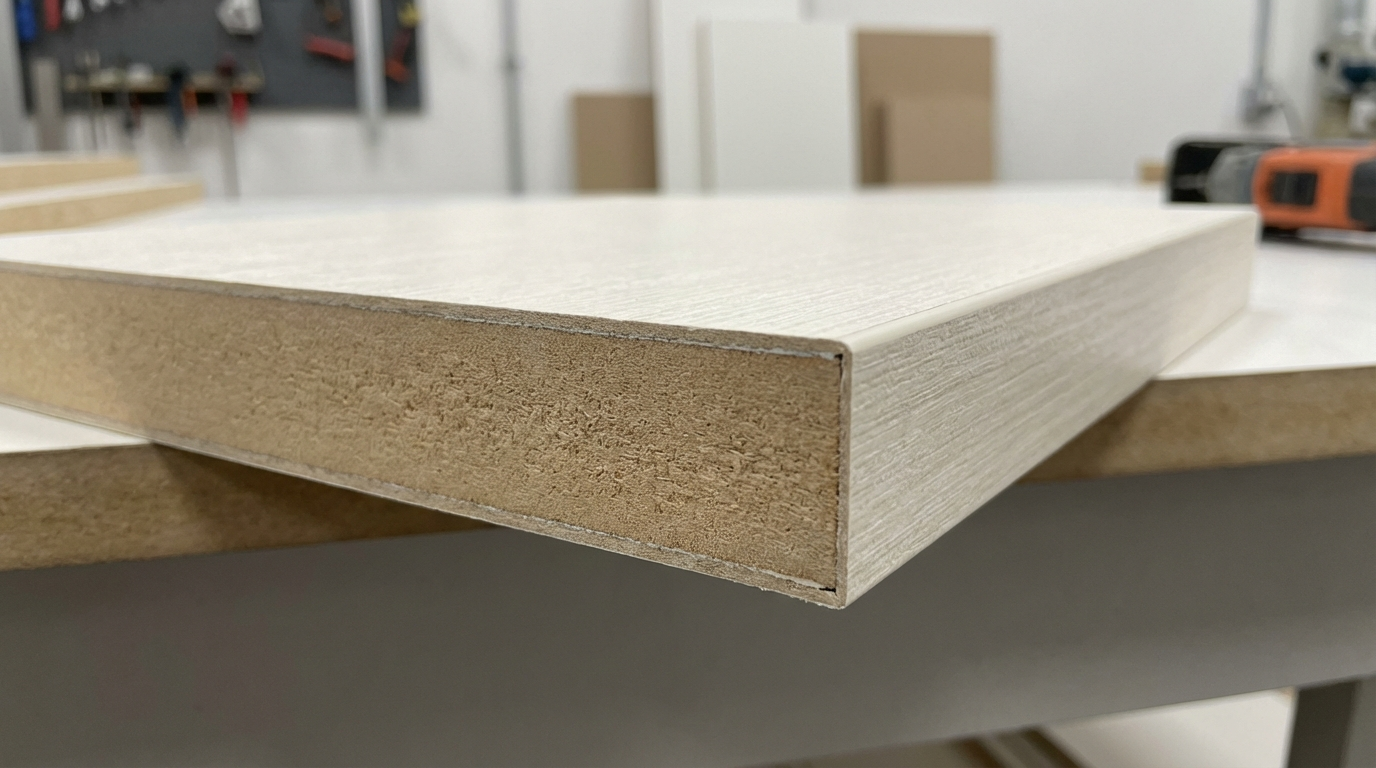
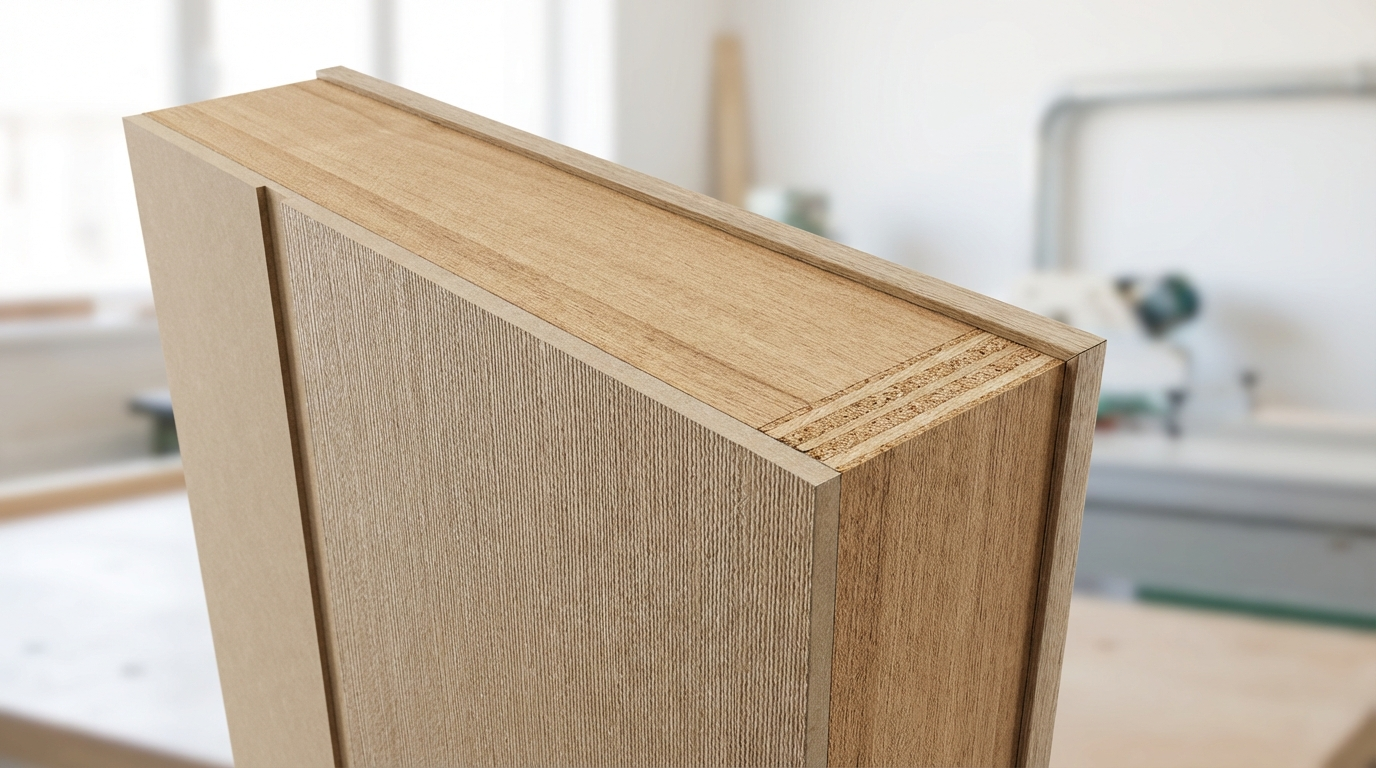
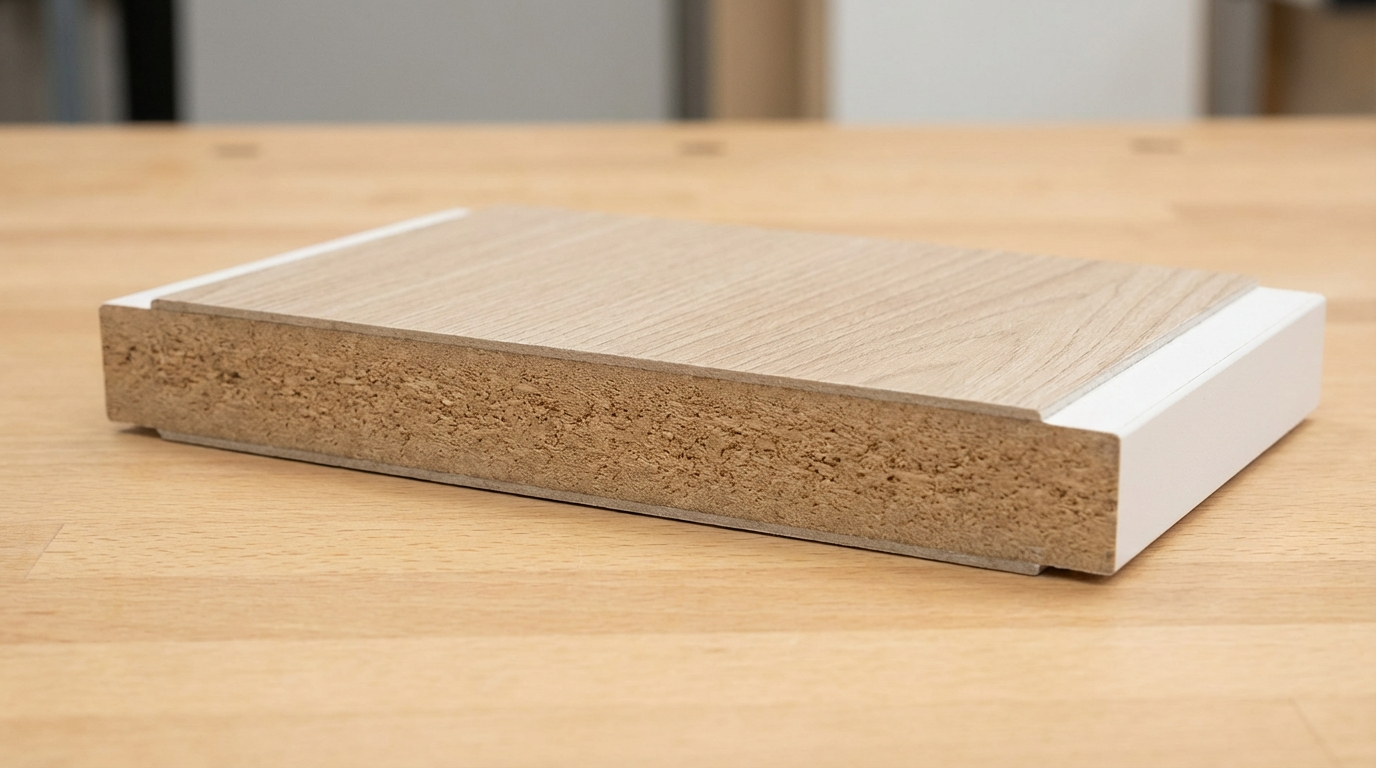
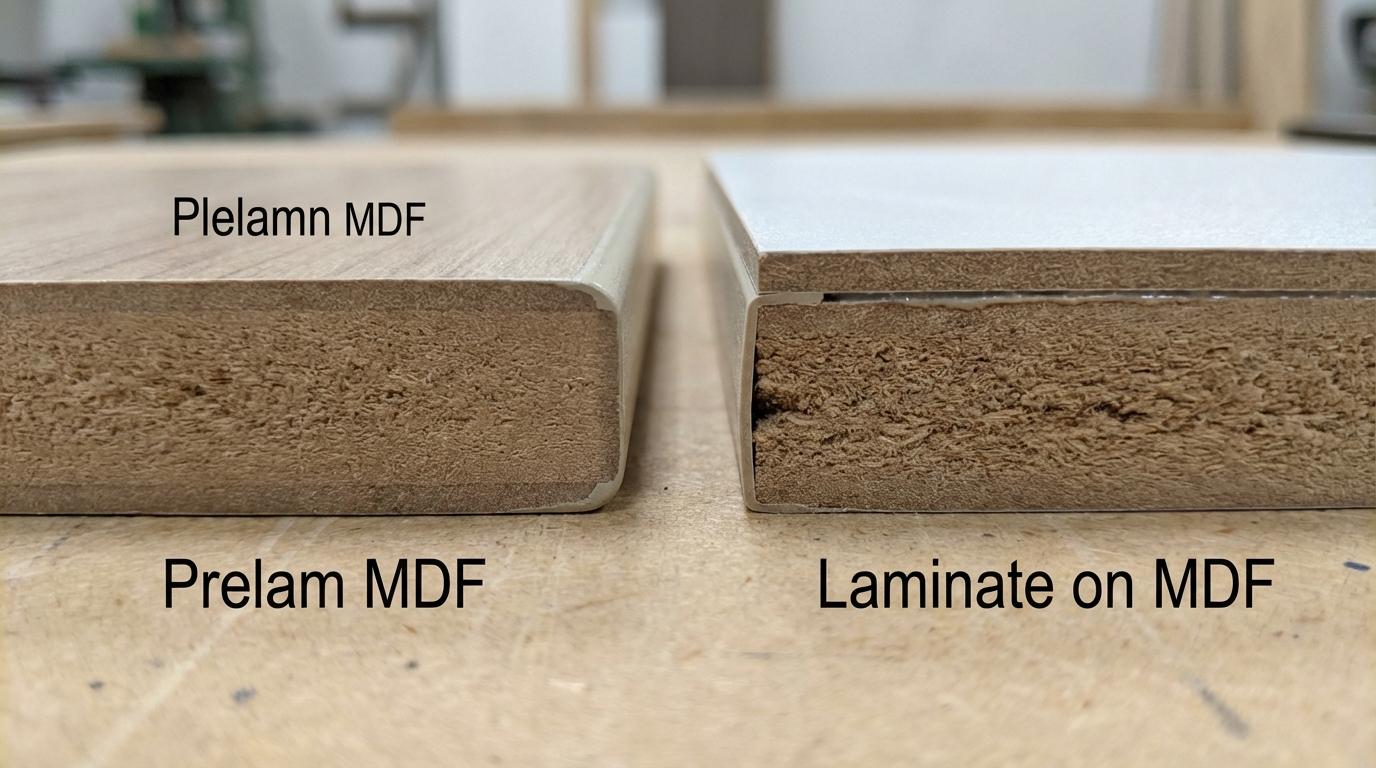
Prelam MDF starts as medium-density fiberboard (MDF) with a decorative laminate layer fused directly onto both faces at the factory under high heat and pressure. This creates a seamless, ready-to-assemble surface. Edges remain unfinished, requiring on-site banding.
Laminate-on-MDF uses plain MDF as the core, where thin laminate sheets (0.6-1.2mm thick) are glued and pressed onto the surface during fabrication or installation. It allows mixing patterns but depends on site workmanship.
Both use MDF cores (typically 700-850 kg/m³ density), but the finish process differs: factory for prelam (consistent pressure), manual/hot-press for laminate (variable quality).
What is Prelam MDF exactly?
Prelam MDF is factory-pre-laminated medium-density fiberboard, where melamine or paper-based decorative layers bond to the MDF core via resins under industrial presses. This ensures uniform thickness (0.1-0.3mm laminate) and adhesion across large sheets. In India, it suits modular workflows as boards arrive cut-to-size ready. Nuance: Not fully sealed—edges need PVC/ABC banding to match full durability. Check by feeling the surface: smooth, no air pockets. Next step: Tap edges post-cutting; hollow sounds signal core issues.
How does laminate-on-MDF differ from prelam?
Laminate-on-MDF applies separate laminate sheets to raw MDF using adhesives like PVA or urea-formaldehyde, then heat-pressing on-site. It offers flexibility for custom sizes but risks poor bonding if glue spreads unevenly. In practice, prelam edges out in consistency. Conditions: Best for architects specifying unique grains. Verify by pressing a fingernail—bubbles indicate weak glue. Next: Test screw hold on scraps; laminate side should not chip.
Why It Matters in Indian Homes and Sites
India's monsoon humidity (70-95% RH) and coastal salt air accelerate swelling in unsealed MDF edges, causing delamination in 20-30% of poorly finished cabinets within 2 years. Prelam reduces this risk with factory bonds that withstand 40-60°C site storage.
Site realities like open godowns, truck exposure, and carpenter shortcuts amplify issues: laminate-on-MDF often bubbles if not cured 24-48 hours in ventilated spaces. In kitchens, oil splashes test surface hardness; prelam melamine resists better than thin site laminates.
Practical impact: Wardrobes in Delhi summers warp less with prelam; coastal Kerala installs need HDFWR cores under either finish for screw-hold longevity.
Price Range and Cost Drivers
Prelam MDF typically ranges Rs 90-220 per sq ft (16-18mm thick), varying by city (higher in metros like Bangalore). Laminate-on-MDF setup costs Rs 120-300 per sq ft, including core (Rs 50-90/sq ft) plus laminate sheets (Rs 40-100/sq ft) and labor.
Cost drivers: Thickness (12mm cheaper than 19mm), density (bohr-resistant variants +20%), finish type (woodgrain vs plain color), resin quality (moisture-resistant +15%), edge treatment (pre-banded +Rs 10-20/linear ft), logistics (add 10-15% from North to South India), wastage (5-15% on curves/CNC), and batch variation.
Example budget for 20 sq ft wardrobe shutters: Prelam ~Rs 2,500-4,500 total; laminate-on-MDF ~Rs 3,000-6,000 (higher if pro lamination). Use this estimator: Core sq ft x rate + (perimeter ft x edge rate) + 10% wastage.
Which is cheaper for a standard kitchen cabinet?
Prelam MDF edges out as cheaper upfront for standard sizes, often 20-40% less than fully laminated setups due to no separate sheet costs. For 30 sq ft cabinets, expect Rs 3,000-6,000 vs Rs 4,500-9,000. Nuance: Laminate wins if buying bulk plain MDF and in-house laminating. Coastal adds 10% for transport. Check: Ask for breakdown—core density, sheet mm, labor hours. Next: Compare quotes specifying 18mm, MR grade, 2mm edge band.
Two-Minute Comparison (What Changes in Real Life)
| Aspect | Prelam MDF | Laminate-on-MDF |
|---|---|---|
| Durability (Humidity Resistance) | High—factory bond resists delam up to 85% RH | Medium—depends on glue; fails if uneven |
| Finish Consistency | Uniform, no bubbles | Variable; pro work matches, DIY poor |
| Customization | Limited to stock designs | High—any sheet available |
| Installation Speed | Fast—cut, band, assemble | Slower—laminate, cure, then finish |
| Repairability | Hard—full panel replace | Easier—spot reglue or overlay |
| Edge Finish | Needs banding; clean post | Banding essential; glue bleed risk |
Choose based on conditions: Prelam for wet zones/high speed; laminate for custom high-abuse dry interiors.
How to Decide or Do This in 5 Steps
- Assess site conditions: Humidity? Monsoon zone? Use moisture meter if possible; pick prelam for >70% RH.
- Map project needs: Custom design? Laminate. Speed? Prelam. List sq ft, thickness, edges.
- Check samples: Scratch test both; weigh for density (heavier better).
- Get workflow fit: CNC shop? Prelam cuts cleaner. Manual? Laminate flexible.
- Verify post-install: 24hr cure, edge seal, test screw holds.
Failure points: Skipping edge band (swells in 6 months); poor acclimation (warps). Prevent: Store 48hrs at site RH.
Can I use laminate on prelam MDF?
Yes, but rarely needed—overlay thin laminate on prelam for custom top layers, using spray adhesive. Direct answer: Works for repairs but adds bulk, risking heat damage to base layer. Nuance: Avoid in humid areas; edges mismatch. In Indian sites, coastal salt accelerates peel-off. Check: Test adhesion on scrap—24hr clamp. Next: Sand lightly first, use 0.6mm sheet max.
Failure Modes and Fixes
1. Delamination (peeling layers): Symptom: Bubbles/air pockets after 6-12 months. Root: Moisture ingress or weak bond (site glue for laminate). Prevent: Acclimatize 72hrs, use MR adhesives. Fix: Scrape, reglue, clamp; replace if core swollen.
2. Edge Swelling: Symptom: Furry/wavy edges post-monsoon. Root: Unbanded raw MDF absorbs water. Prevent: 2mm PVC/ABS band immediately after cut. Fix: Plane edges, re-band; shim if warped.
3. Surface Scratches/Chips: Symptom: White marks from utensils/kids. Root: Thin laminate (<0.8mm). Prevent: 1mm+ overlay in kitchens; felt pads. Fix: Light sand + polish; overlay patch.
4. Screw-Hold Failure: Symptom: Hinges loosen in 1-2 years. Root: Low density near edges. Prevent: Use 18mm+ with particle-filled edges. Fix: Plug with MDF dust + glue, re-screw.
5. Adhesive Bleed (Laminate only): Symptom: Yellow stains at edges. Root: Excess glue squeeze-out. Prevent: Thin even spread, wipe instantly. Fix: Sand after cure.
6. Color Fade/Yellowing: Symptom: Dull after UV/oil exposure. Root: Low-quality paper laminate. Prevent: UV-coated melamine. Fix: Minimal—repaint or overlay.
Quality Checks You Can Do Without Lab Tests
Before buying: Visual—uniform color, no waves; tap test—solid thud, no hollow; scratch with key—resists marks; bend slight— no crack; weight per sq ft (heavier = denser).
After cutting: Edges smooth, no fiber tear (good for CNC); dust minimal; measure thickness variance (<0.2mm).
After installation: Alignment gaps <1mm; edge band flush; water wipe—no swell after 30min; screw torque even.
Red flags: Light weight, wavy surface, cheap sheen (low resin).
Which finish is best for monsoon-prone kitchens?
Prelam MDF suits best for its sealed bond resisting 90%+ RH without bubbling. Direct: Factory pressure beats site glue in steam/oil. Nuance: Pair with HDFWR core, silicone seal joints. Chennai sites show 2x lifespan. Check: Spill water on sample, wipe after hour—no dark spots. Next: Specify 18mm MR prelam + 3mm edge band.
Decision Framework: Prelam vs Laminate-on-MDF
| Condition | Recommended | What to Verify |
|---|---|---|
| Wet zone (kitchen/bath) | Prelam | MR grade, edge band match |
| Coastal humidity | Prelam + HDFWR core | Density >800kg/m³, acclimation log |
| Heavy use (kids/pets) | Laminate (1.2mm thick) | Hardness test, overlay quality |
| Tight budget | Prelam | Base finish, no extras |
| Fast delivery/install | Prelam | Stock availability, cut-to-size |
| High scratch risk | Laminate thick | Key scratch test on sample |
| Custom designs | Laminate | Pro laminator reference |
Common Buyer Mistakes and How to Avoid Them
- Mistake: Skipping edge banding. Avoid: Band within 2hrs of cut; use matching color PVC.
- Buying thin boards (12mm) for cabinets. Avoid: Min 16-18mm for screw hold.
- No acclimation. Avoid: Store 48-72hrs at site temp/RH.
- Cheap adhesives for laminate. Avoid: MR urea or PVA only.
- Ignoring density variation. Avoid: Weigh samples; reject <700kg/m³.
- Dry storage in humid sites. Avoid: Wrap in plastic during monsoon transit.
- Overlooking finish thickness. Avoid: Spec 0.8mm+; fingernail test.
- No post-lam curing. Avoid: 24hrs ventilated before handling.
How do I check if my carpenter can handle laminate-on-MDF?
Direct: Ask for past samples—look for bubble-free edges, even glue. Nuance: Test with scrap: even press, no bleed. Indian carpenters vary; metros better equipped. Conditions: Insist hot-press machine, not hand-roller. Next: Trial small panel, inspect after 48hrs humidity exposure.
Tips for Homeowners, Carpenters, Architects, and OEMs
Homeowner Tips: Durability and Cleaning
Use microfiber + mild soap; avoid abrasives. Do: Felt pads under items. Don’t: Steel wool or ammonia. Inspect edges yearly for gaps.
Carpenter Tips: Cutting, Edge Prep, Fastening
Cut with zero-clearance blade; pre-drill hinges. Edge prep: Clean sawdust before band. Fastening: 35mm screws, 50mm from edge.
Architect Tips: Specs, Detailing, Wet Zones
Spec: 18mm prelam MR, 2.5mm edge, silicone joints. Detail: 5mm overhangs for spills. Wet zones: HDFWR base.
OEM Tips: Repeatability, QC, Reducing Complaints
QC checkpoints: Bond test every batch, density log. Reduce returns: Pre-band curved parts, humidity-controlled packing.
Practical Use Cases (What Works, What Fails)
| Use Case | Recommended Thickness | Finish Notes | Risk Notes |
|---|---|---|---|
| Wardrobe Shutters | 18mm | Prelam woodgrain | Low; edge band key |
| Kitchen Cabinets | 18-19mm | Prelam glossy, laminate thick | High moisture—seal joints |
| TV Units | 16mm | Laminate custom | Scratch risk; pads needed |
| Wall Panels | 12mm | Prelam matte | Ventilation gaps prevent warp |
| Office Partitions | 16mm | Prelam plain | Heavy use—reinforce edges |
Is prelam MDF suitable for coastal homes?
Yes, superior for coasts due to tight factory seals handling 85%+ RH and salt. Direct: Outlasts site laminate by 1.5-2x in Kerala/Goa. Nuance: Pair with termite-treated core. Check: Post-monsoon sample exposure. Next: Add vent holes, distance from walls 10cm.
FAQs
Which lasts longer in daily use?
Prelam MDF generally outlasts laminate-on-MDF in daily Indian home use, thanks to consistent factory adhesion that shrugs off humidity fluctuations better than manually applied sheets. Field experience shows prelam holding finish integrity for 8-12 years in wardrobes, versus 5-8 for amateur-laminated panels. Key is edge protection—both fail without it. For kitchens, prelam's melamine layer resists oil stains longer. Always acclimatize and band edges to maximize life.
Can laminate-on-MDF match prelam durability?
Laminate-on-MDF can approach prelam durability with skilled pros using industrial presses and MR glues, especially in dry interiors. However, in 60-70% of Indian site jobs, inconsistencies like uneven glue lead to earlier bubbles. Trade-off: More design choice but higher failure risk in monsoons. Verify by demanding cured samples and pro credentials.
What thickness works best for both?
18mm strikes the balance for cabinets and shutters—strong screw hold without excess weight/cost. Thinner 16mm suits shelves; 19mm for base units. Both finishes benefit from balanced density to prevent sagging. In humid belts, opt for reinforced-edge variants to counter swelling.
Does prelam need edge banding?
Yes, absolutely—raw edges on prelam MDF absorb moisture like plain boards, leading to swelling in humid storage or sites. Apply 2-3mm PVC/ABS matching the finish right after sizing. This step equalizes both options' longevity, preventing 80% of edge failures seen in Indian projects.
How to clean prelam vs laminate finishes?
Clean both with damp microfiber and neutral soap; dry immediately to avoid water marks. Prelam handles wipes better due to sealed pores; laminate may show glue haze if oversoaped. Avoid acids/bleach on either—fades colors. Weekly dusting prevents scratch buildup in dusty Indian homes.
Is prelam MDF CNC-friendly?
Prelam excels in CNC routing—clean cuts with minimal chipping thanks to surface tension. Laminate-on-MDF risks delam at high speeds if glue-weak. Use upcut bits, low feed for both. Indian modular shops prefer prelam for repeatability and less rework.
Which is better for repairs?
Laminate-on-MDF repairs easier—remove damaged section, reglue patch. Prelam requires full panel swap due to integrated layers. For small scratches, both polish with fine compound. Plan ahead: Modular designs with replaceable parts favor laminate flexibility.
Do they differ in termite resistance?
Neither finish inherently resists termites—protection comes from core treatments like boric acid. Both pair well with termite-grade MDF. Coastal India demands certified cores; check by supplier batch logs, not surface alone.
Can I DIY laminate on MDF?
DIY possible for small projects with contact cement and roller, but results often inferior to prelam—bubbles from uneven pressure common. In humid sites, pros recommended for 24hr clamps. Start with scraps; if no issues after humidity test, scale up cautiously.
Disclaimer: This content is provided for general informational purposes based on industry practices and publicly available information. Product specifications, standards, prices, and availability may vary by manufacturer, region, and time. Readers should independently verify details with manufacturers, dealers, or qualified professionals before making purchase or construction decisions.Want Plywood Suggestions?
Share a few details and a VIR MDF specialist will suggest suitable brands and connect you to responsive dealers.