Waterproof Board – Complete Guide for Indian Buyers
Research-backed waterproof board breakdown with pros/cons, tables, and a clear decision checklist for Indian buyers and carpenters.
Note: This is independent informational content and is not affiliated with any manufacturer.
Quick Decision Summary
Best answer in one line: "Waterproof board" in India typically means HDFWR, marine plywood, or BWP plywood—choose based on your specific wet-zone exposure, budget, and finish requirements.
If you're in a hurry: For kitchen base units, bathroom vanities, and areas with direct water splash risk, look for HDFWR (High-Density Fibreboard Water Resistant) or BWP-grade plywood. Standard MDF will fail in wet zones. Always verify the board's moisture resistance rating before purchase—ask for the boiling water test duration the board can withstand. Budget approximately 15–40% more than standard MDF for genuine water-resistant grades.
- Choose waterproof board if: Your application involves kitchen sink cabinets, bathroom furniture, laundry areas, coastal homes, or any space with consistent humidity above 65%.
- Avoid waterproof board if: You're working on dry-zone furniture (bedroom wardrobes in non-coastal cities), tight budgets with no moisture exposure, or temporary installations where standard MDF suffices.
What "Waterproof Board" Actually Means in Indian Markets
The term "waterproof board" is used loosely across Indian hardware shops, creating significant confusion. In technical terms, no wood-based engineered panel is truly waterproof—they are water-resistant to varying degrees. Understanding this distinction prevents costly mistakes.
What are the different grades of water resistance in engineered boards?
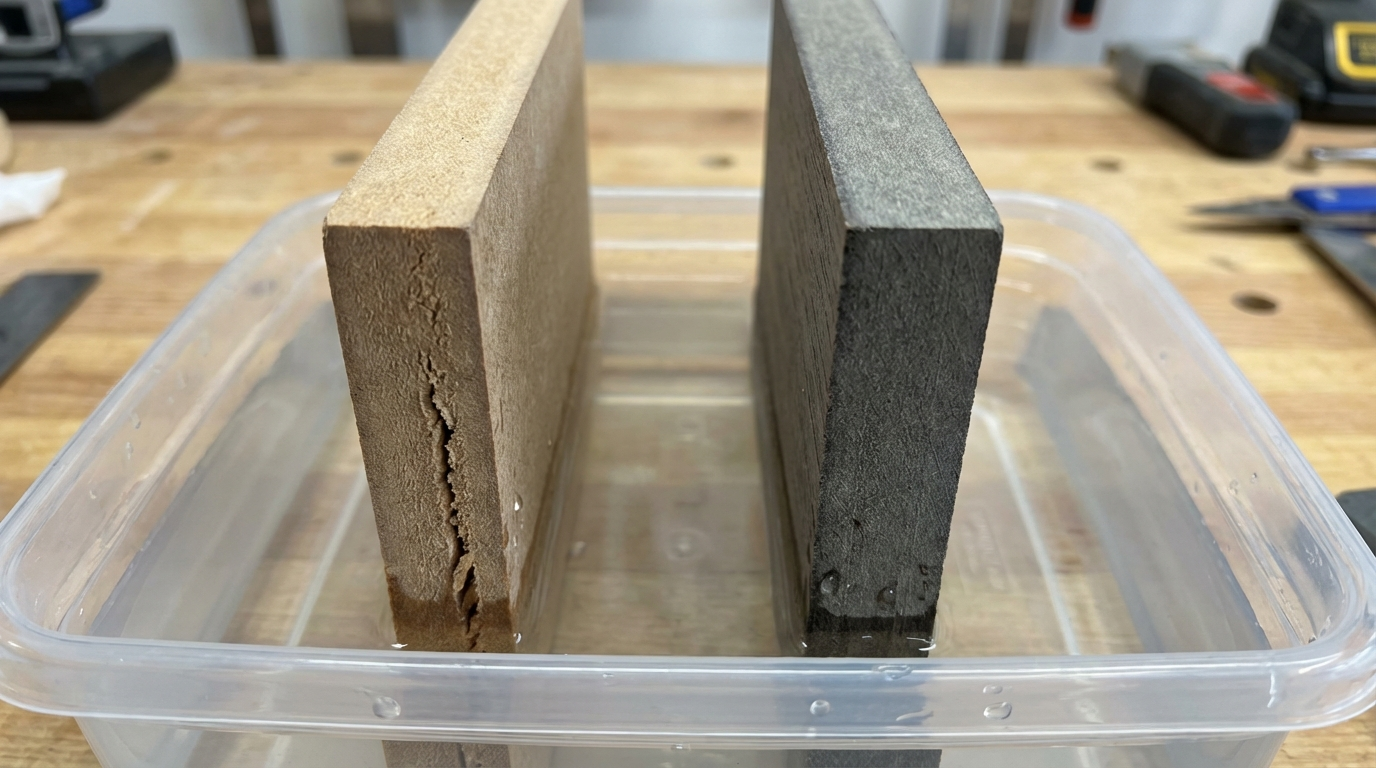
Water resistance in engineered boards is measured by how long the panel can withstand boiling water immersion without delamination or significant swelling. Standard MDF handles humidity poorly and swells rapidly with water contact. Moisture-resistant MDF (often marked MR or green-core) can handle humid environments but not direct water. HDFWR boards withstand boiling water for 8+ hours, making them suitable for kitchen and bathroom use. Marine plywood and BWP (Boiling Water Proof) plywood can withstand 72+ hours, representing the highest water resistance in wood-based panels. Always ask your supplier about the specific boiling water test duration—vague claims of "waterproof" without numbers are red flags.
The Indian market commonly offers these water-resistant options:
- HDFWR (High-Density Fibreboard Water Resistant): Dense fibreboard with moisture-resistant resin, suitable for kitchen cabinets and bathroom vanities
- BWP/Marine Plywood: Cross-laminated veneers with phenolic resin, highest wood-based water resistance
- Moisture-Resistant MDF (MR-MDF): Standard MDF with added wax and moisture-resistant additives—handles humidity, not direct water
- HDHMR (High-Density High Moisture Resistant): Marketing term used by some manufacturers for premium moisture-resistant boards
- PVC Boards: Fully synthetic, genuinely waterproof but different working properties
- WPC (Wood Plastic Composite): Hybrid material with good moisture resistance
Why Water Resistance Matters in Indian Homes and Sites
India's climate creates unique challenges that make water-resistant boards essential in specific applications. Understanding these factors helps you make informed decisions rather than over-specifying (wasting money) or under-specifying (facing premature failure).
How does monsoon humidity affect board selection?
Monsoon humidity in most Indian cities ranges from 70–95% for 3–5 months annually. Standard MDF absorbs this atmospheric moisture, causing gradual swelling, warping, and eventual structural weakness. Even "indoor" furniture faces this risk because Indian homes often lack climate control. The problem compounds in coastal cities where salt-laden humidity accelerates degradation. HDFWR and BWP boards resist this atmospheric moisture absorption, maintaining dimensional stability through monsoon cycles. However, even these boards need proper edge sealing—exposed cut edges remain vulnerable. For non-coastal, non-monsoon-heavy regions, MR-MDF often suffices for general furniture at lower cost.
Critical Indian site realities:
- Storage exposure: Boards often sit in open warehouses or transport vehicles during monsoon, absorbing moisture before reaching your site
- Site conditions: Incomplete buildings lack windows/doors, exposing installed cabinets to rain splash and humidity
- Plumbing proximity: Indian kitchens and bathrooms frequently have minor leaks that go unnoticed for months
- Cleaning practices: Indian homes typically use wet mopping extensively, exposing furniture bases to moisture
- Ventilation gaps: Poor ventilation under sinks and behind cabinets traps humidity
Price Range and Cost Drivers for Waterproof Boards
Waterproof board pricing in India varies significantly based on material type, thickness, brand positioning, and regional availability. These ranges help you budget realistically and identify suspiciously cheap offerings.
What is the typical price range for HDFWR boards in India?
HDFWR boards in India typically range from ₹55 to ₹95 per square foot for 18mm thickness, with variations based on density grade and brand. Thinner options (12mm) cost approximately ₹40–70 per square foot. Premium grades with higher density and better surface finish command prices at the upper end. Coastal city prices often run 10–15% higher due to logistics and demand. Always compare prices for equivalent specifications—density (kg/m³), thickness (mm), and water resistance rating (hours in boiling water). Price alone doesn't indicate quality; some budget brands achieve decent water resistance while premium brands may charge for surface finish quality rather than core water resistance.
| Material Type | Thickness | Typical Price Range (₹/sq ft) | Water Resistance Level |
|---|---|---|---|
| Standard MDF | 18mm | 28–45 | Poor (avoid wet zones) |
| MR-MDF | 18mm | 38–55 | Moderate (humidity only) |
| HDFWR | 18mm | 55–95 | Good (8+ hours boiling) |
| BWP Plywood | 18mm | 85–140 | Excellent (72+ hours) |
| Marine Plywood | 18mm | 110–180 | Excellent (72+ hours) |
| PVC Board | 18mm | 45–75 | Fully waterproof |
| WPC Board | 18mm | 55–90 | Very good |
Key cost drivers to understand:
- Density: Higher density boards cost more but hold screws better and resist impact
- Resin type: Phenolic resin (better water resistance) costs more than melamine-urea formaldehyde
- Surface finish: Pre-laminated or higher-grade surfaces add ₹15–40 per square foot
- Edge treatment: Factory-sealed edges cost more but prevent moisture ingress
- Logistics: Remote locations and smaller orders increase per-unit costs
- Wastage factor: Typical cutting wastage runs 8–15%, factor this into budgets
Budget Estimator: Kitchen Cabinet Project
For a typical 10x8 feet kitchen with base and wall units:
- Estimated board requirement: 180–220 sq ft (including wastage)
- Using HDFWR at ₹75/sq ft: ₹13,500–16,500 for boards alone
- Using BWP plywood at ₹120/sq ft: ₹21,600–26,400 for boards alone
- Add 25–35% for laminates, edge banding, hardware, and labour
Two-Minute Comparison: Waterproof Board Options
Different waterproof board types suit different applications. This comparison helps you match material to use case rather than defaulting to the most expensive option.
| Factor | HDFWR | BWP Plywood | PVC Board | WPC Board |
|---|---|---|---|---|
| Water resistance | Good (8+ hours) | Excellent (72+ hours) | Complete | Very good |
| Surface smoothness | Excellent | Good (needs prep) | Excellent | Good |
| Screw holding | Good | Excellent | Moderate | Good |
| CNC machinability | Excellent | Good | Good | Good |
| Edge banding ease | Excellent | Moderate | Requires special adhesive | Good |
| Weight | Heavy | Medium | Light | Medium |
| Termite resistance | Good | Varies by treatment | Excellent | Excellent |
| Cost (relative) | Medium | High | Medium | Medium-High |
| Best for | Kitchen cabinets, vanities | Heavy-use wet zones | Bathroom cabinets | Outdoor/semi-outdoor |
Is HDFWR better than BWP plywood for kitchen cabinets?
HDFWR and BWP plywood serve different needs even within kitchen applications. HDFWR offers superior surface smoothness, making it ideal for laminate application and CNC-routed designs without additional surface preparation. It's more cost-effective for most kitchen cabinet boxes and shutters. BWP plywood provides better screw-holding strength, making it preferable for heavy-duty applications like pull-out units, drawer boxes bearing significant weight, and areas requiring repeated hinge adjustments. For typical Indian modular kitchens, HDFWR for cabinet boxes and shutters combined with BWP plywood for drawer components often provides the optimal balance. The choice also depends on your carpenter's familiarity—those experienced with plywood may achieve better results with BWP despite HDFWR's theoretical advantages.
Decision Framework: Which Waterproof Board for Your Situation
Use this framework to match your specific conditions to the appropriate board type. Over-specifying wastes money; under-specifying causes premature failure.
| Your Condition | Recommended Material | What to Verify Before Buying |
|---|---|---|
| Direct water splash zone (sink cabinet base) | BWP plywood or PVC | 72-hour boiling test certification, check for voids in plywood layers |
| High humidity, no direct water (kitchen wall units) | HDFWR | Density ≥850 kg/m³, 8-hour boiling test |
| Coastal city, all furniture | HDFWR minimum, BWP for wet zones | Salt spray resistance if available, proper edge sealing |
| Bathroom vanity | PVC or Marine plywood | Complete edge sealing, drainage provision below |
| Budget constraint, moderate humidity | MR-MDF with sealed edges | Green core visible, all edges must be sealed |
| Heavy items, wet zone (pull-out pantry) | BWP plywood | Screw-holding test, no core gaps |
| CNC-routed decorative panels, humid area | HDFWR | Uniform density throughout thickness |
| Outdoor or balcony furniture | WPC or Marine plywood | UV resistance, proper finish specification |
| Rental property, 3-5 year lifespan acceptable | MR-MDF | Proper installation with ventilation gaps |
Practical Use Cases: What Works and What Fails
Real-world performance depends on matching material to application. These use cases reflect typical Indian home conditions and common failure patterns.
| Application | Recommended Board | Thickness | Critical Success Factors | Common Failure Points |
|---|---|---|---|---|
| Kitchen base cabinet carcass | HDFWR/BWP | 18mm | Raised on legs, bottom panel sealed | Floor contact, unsealed bottom edges |
| Kitchen wall cabinet | HDFWR/MR-MDF | 18mm | Back panel ventilation | Steam accumulation from cooking |
| Kitchen shutters | HDFWR | 18mm | All four edges sealed | Bottom edge swelling from splash |
| Bathroom vanity box | PVC/Marine ply | 18mm | Drainage slope, sealed joints | Water pooling inside cabinet |
| Wardrobe (coastal city) | HDFWR | 18mm | Back ventilation, silica gel provision | Fungal growth in corners |
| Wardrobe (dry climate) | Standard MDF | 18mm | Proper edge banding | Edge chipping during use |
| TV unit (general) | MDF/MR-MDF | 18mm | Cable management ventilation | Heat accumulation damage |
| Shoe rack (near entrance) | HDFWR/WPC | 12-18mm | Ventilation gaps, easy cleaning | Moisture from wet shoes |
| Pooja unit | MDF/MR-MDF | 18mm | Heat-resistant backing | Diya/agarbatti heat damage |
| Balcony storage | WPC/Marine ply | 18mm | Complete waterproof finish | Rain splash, UV degradation |
Common Buyer Mistakes and How to Avoid Them
These mistakes cost Indian buyers thousands of rupees in replacements and repairs. Learn from others' experiences to make informed decisions.
Mistake 1: Trusting verbal "waterproof" claims
The problem: Dealers often label any moisture-resistant board as "waterproof" to close sales. Standard MR-MDF gets sold as waterproof, leading to failure in actual wet zones.
How to avoid: Ask specifically about boiling water test duration. Genuine HDFWR withstands 8+ hours; BWP handles 72+ hours. Request written specifications on the invoice.
Mistake 2: Ignoring edge sealing requirements
The problem: Even the best waterproof board fails if cut edges remain exposed. Moisture enters through unsealed edges, causing swelling from inside out.
How to avoid: Budget for complete edge banding on all exposed and hidden edges. Use PVC or ABS edge bands with proper hot-melt adhesive. Check edge sealing quality before final payment.
Mistake 3: Over-specifying for dry zones
The problem: Using marine plywood for bedroom wardrobes in Rajasthan or interior Delhi wastes 40–60% of material budget without benefit.
How to avoid: Map your home's moisture zones. Reserve premium waterproof boards for sink cabinets, bathroom furniture, and coastal applications. Use standard or MR-MDF elsewhere.
Mistake 4: Skipping the bottom panel protection
The problem: Kitchen base cabinets sit close to floors that get mopped daily. Bottom panels absorb moisture through floor contact and splash.
How to avoid: Install cabinets on adjustable legs (minimum 100mm clearance). Apply waterproof sealant or PVC sheet to bottom panel undersides. Ensure proper plinth design.
Mistake 5: Choosing based on price alone
The problem: Cheapest waterproof board often has lower density, poor resin quality, or inconsistent moisture resistance across the sheet.
How to avoid: Compare density specifications (kg/m³), not just price. Check multiple points on the board for consistency. Buy from established dealers with return policies.
Mistake 6: Ignoring storage and transport conditions
The problem: Boards stored in open warehouses during monsoon absorb moisture before reaching your site, compromising even genuine waterproof grades.
How to avoid: Ask about storage conditions. Inspect boards on delivery for swelling signs. Allow 48–72 hours acclimatization at site before cutting.
Mistake 7: Using wrong adhesives and fasteners
The problem: Standard wood glue fails in wet zones. Regular screws rust, creating brown stains and structural weakness.
How to avoid: Use marine-grade adhesives for wet zone joints. Specify stainless steel or coated screws. Ensure proper pilot holes to prevent splitting.
Mistake 8: Neglecting ventilation in design
The problem: Closed cabinet backs trap humidity, creating perfect conditions for fungal growth and accelerated board degradation.
How to avoid: Include ventilation holes or gaps in cabinet backs. Install under-sink areas with drainage consideration. Design for air circulation behind furniture.
Failure Modes and Fixes
Understanding how waterproof boards fail helps you prevent issues and address problems early. These failure modes represent the most common issues in Indian installations.
Failure Mode 1: Edge swelling
Symptom: Edges become soft, puffy, or show discoloration. Laminate lifts near edges.
Root cause: Moisture ingress through unsealed or poorly sealed edges. Even waterproof cores absorb water through exposed fibres.
Prevention: Apply edge banding to all edges including hidden ones. Use quality hot-melt adhesive. Apply edge sealant on critical zones.
Fix if already happening: If minor, sand affected area, apply wood hardener, reseal with waterproof edge band. If severe, panel replacement is often more practical than repair.
Failure Mode 2: Delamination of surface
Symptom: Laminate or veneer peels away from board surface, creating bubbles or lifting sections.
Root cause: Moisture reaching the adhesive layer from below or through edges. Poor initial lamination. Heat damage near cooking zones.
Prevention: Use appropriate adhesives for wet zones. Ensure proper pressing during lamination. Maintain distance from heat sources.
Fix if already happening: For small bubbles, inject adhesive through a needle hole and press. For large areas, professional re-lamination or panel replacement required.
Failure Mode 3: Screw pull-out
Symptom: Hinges become loose. Screws spin freely without holding. Hardware falls off.
Root cause: Moisture weakening the core material around screw holes. Using screws too close to edges. Wrong screw size or type.
Prevention: Use proper pilot holes. Position screws away from edges (minimum 25mm). Apply wood glue in screw holes. Use insert nuts for frequently adjusted hardware.
Fix if already happening: Fill hole with toothpicks and wood glue, re-drill after curing. For critical hardware, install backing plates or move to fresh location.
Failure Mode 4: Fungal/mould growth
Symptom: Black or green spots on board surface or edges. Musty smell from furniture.
Root cause: Persistent humidity above 70% without ventilation. Water trapped in enclosed spaces. Insufficient drying after cleaning.
Prevention: Include ventilation in cabinet design. Use boards with anti-fungal treatment in high-risk zones. Avoid fully enclosed backs in humid areas.
Fix if already happening: Clean with diluted bleach solution, dry thoroughly, apply anti-fungal treatment, improve ventilation. If penetrated deep, replacement needed.
Failure Mode 5: Warping/bowing
Symptom: Board no longer lies flat. Doors don't close properly. Gaps appear between panels.
Root cause: Uneven moisture absorption (one side exposed, other sealed). Improper storage before installation. Single-side lamination creating differential stress.
Prevention: Apply identical finish to both faces of panels. Store flat with uniform support. Allow acclimatization before installation. Use proper thickness for span.
Fix if already happening: Minor warps can sometimes be corrected with moisture equalization and clamping. Severe warps require replacement.
Failure Mode 6: Core degradation
Symptom: Board feels soft when pressed. Density seems reduced. Board crumbles when cut.
Root cause: Prolonged moisture exposure breaking down the resin bonds. Using non-waterproof board in wet application. Manufacturing defect in resin distribution.
Prevention: Use appropriate grade for application. Inspect boards before purchase. Address any water leak sources immediately.
Fix if already happening: No effective repair. Replace affected panels. Investigate and fix moisture source before reinstallation.
Quality Checks You Can Do Without Lab Tests
These field-practical checks help you assess waterproof board quality at purchase, during work, and after installation—without requiring laboratory equipment.
Before Buying: Visual and Physical Checks
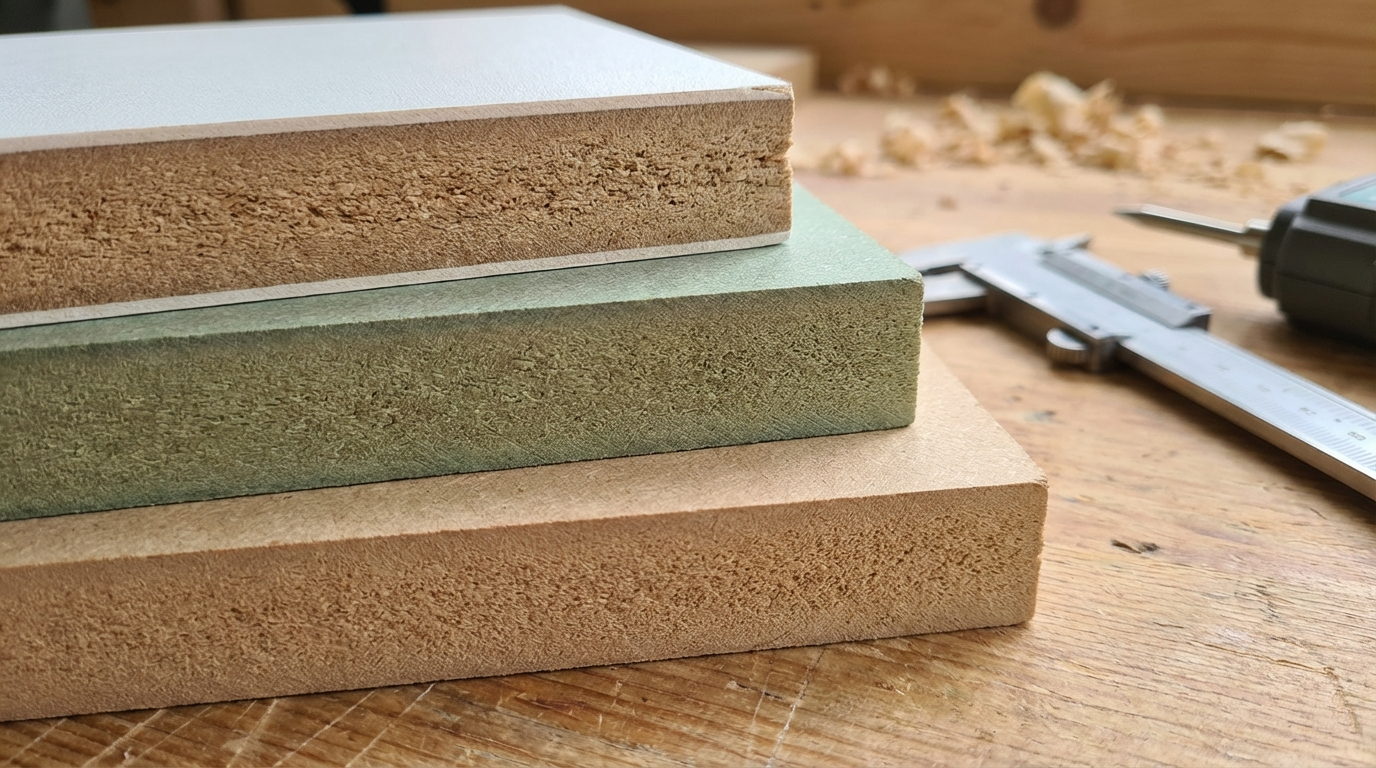
- Edge colour: Genuine moisture-resistant MDF typically shows green colouration in the core. However, some quality boards use other colours—consistency matters more than colour itself.
- Weight test: Lift the board. Higher density (indicating better quality) means noticeably heavier weight. Compare similar-sized boards from different sources.
- Surface uniformity: Run your hand across the surface. Quality boards feel consistently smooth without rough patches, dips, or bumps.
- Edge inspection: Look at cut edges for uniform density throughout thickness. Voids, gaps, or inconsistent colouration indicate manufacturing issues.
- Flex test: For thinner boards (12mm or less), slight flexing should feel uniform, not crackly or overly stiff in patches.
- Smell check: Strong chemical odours indicate excessive formaldehyde or poor resin curing. Quality boards have minimal smell.
Questions to Ask the Dealer
- What is the boiling water test duration for this board?
- What is the density in kg/m³?
- Is this domestically manufactured or imported?
- What are the storage conditions at your warehouse?
- Do you provide written specifications on the invoice?
- What is your return policy if the board shows defects during cutting?
Red Flags to Walk Away From
- Dealer cannot specify boiling water test duration
- Significantly cheaper than market average without explanation
- Boards stored outdoors or in visibly damp conditions
- Inconsistent thickness across the board
- Visible swelling or water damage on stack edges
- Refusal to provide written specifications
After Cutting: Workmanship Quality Cues
- Clean cut quality: CNC or properly tuned saw should produce clean edges without excessive fuzzing or chipping. Rough edges indicate dull tools or poor density.
- Uniform core: Cut edge should show consistent colour and density throughout. Layers, voids, or colour variations suggest quality issues.
- Drilling response: Pilot holes should drill cleanly without the drill bit grabbing or the material crumbling.
- Screw test: Test screw in an offcut—it should hold firmly without spinning freely or splitting the material.
After Installation: Ongoing Quality Indicators
- Edge seal integrity: Check edge banding adhesion at corners and ends after 2–4 weeks. Lifting indicates poor adhesive or moisture issues.
- Panel alignment: Doors and drawers should maintain alignment. Shifting indicates warping or hardware issues.
- Surface condition: Monitor for any bubbling, discoloration, or soft spots developing over first monsoon season.
- Hardware tightness: Check hinge and handle screws after 1 month. Loosening indicates screw-hold problems.
Persona-Specific Tips
For Homeowners: Living with Waterproof Board Furniture
Cleaning do's:
- Wipe spills immediately—even waterproof boards perform better dry
- Use damp (not wet) cloth for regular cleaning
- Dry surfaces after cleaning, especially near edges
- Clean under-sink areas monthly to catch any leaks early
Cleaning don'ts:
- Never let standing water pool on surfaces or inside cabinets
- Avoid abrasive scrubbers that damage laminate surface
- Don't use excessive water while mopping near furniture bases
- Avoid placing wet items directly on surfaces without mat
Maintenance habits:
- Check under-sink cabinet interiors monthly for moisture signs
- Tighten hinges and hardware every 6 months
- Ensure exhaust fans work properly to reduce kitchen humidity
- Use silica gel packets in enclosed wardrobe sections during monsoon
For Carpenters: Working with Waterproof Boards
Cutting best practices:
- Use carbide-tipped blades—HDFWR dulls standard steel quickly
- Support boards fully during cutting to prevent chipping
- Cut with good side up on table saw, good side down on circular saw
- Allow 2mm extra for edge banding when calculating dimensions
Edge preparation:
- Sand cut edges lightly (180 grit) before edge banding
- Remove all dust before applying edge band
- Use appropriate edge band thickness (0.8mm minimum for quality finish)
- Apply edge band to all edges, including concealed ones in wet zones
Fastening guidelines:
- Always pre-drill for screws—HDFWR splits easily without pilot holes
- Keep screws minimum 25mm from edges
- Use confirmat screws for panel-to-panel joints
- Apply wood glue in screw holes for wet zone applications
- Consider dowels plus glue instead of screws for moisture-prone joints
Hinge area reinforcement:
- Use cup hinges with larger mounting plates
- Apply hardener to hinge screw locations before drilling
- For heavy doors, use additional hinges rather than longer screws
For Architects and Designers: Specification Guidelines
Specifying correctly:
- State density requirement (minimum 850 kg/m³ for HDFWR)
- Specify boiling water resistance hours, not just "waterproof"
- Include edge treatment requirements in specifications
- Define acceptable thickness tolerance (typically ±0.3mm)
Wet zone detailing:
- Design 100mm minimum clearance between cabinet base and floor
- Include drainage provisions in sink cabinet designs
- Specify ventilation requirements in cabinet backs
- Detail waterproof membrane requirements where cabinet meets wall
Finish specification logic:
- High-pressure laminate for maximum water resistance on surfaces
- Acrylic finish for high-gloss wet zone applications
- PU finish for customizable colour in moisture-prone areas
- Avoid paper-based laminates in direct splash zones
For OEM/Modular Manufacturers: Quality Control Checkpoints
Incoming material QC:
- Verify thickness at multiple points (centre, corners, edges)
- Check density with sample weight measurement
- Visual inspection for surface defects, edge damage
- Reject batches with visible moisture damage or storage issues
Process QC:
- Verify edge banding adhesion with peel test on samples
- Check screw holding strength on offcuts from each batch
- Confirm all edges sealed before packing
- Document material batch numbers for traceability
Reducing returns and complaints:
- Include care instructions with every delivery
- Photograph installation conditions (moisture, ventilation)
- Document material specifications on invoice
- Offer post-monsoon inspection service for first year
FAQs
Can I use regular MDF in my kitchen if I seal all the edges properly?
While edge sealing significantly improves standard MDF's moisture resistance, it's not recommended for sink cabinets, dishwasher surrounds, or areas with regular water splash. The problem is that even small edge seal failures allow moisture in, and standard MDF absorbs water rapidly through any opening. For kitchen wall units away from direct moisture, properly sealed standard MDF can work, but HDFWR or MR-MDF provides better long-term value for most kitchen applications. The cost difference between standard MDF and MR-MDF (approximately ₹10–15 per square foot) is typically worthwhile given the repair costs if failures occur.
What is the difference between HDFWR and HDHMR boards?
HDFWR (High-Density Fibreboard Water Resistant) and HDHMR (High-Density High Moisture Resistant) are essentially the same product category with different marketing terminology used by various manufacturers. Both refer to high-density fibreboard manufactured with moisture-resistant resins, typically capable of withstanding 8+ hours of boiling water exposure. The key specifications to compare are density (should be 850+ kg/m³), boiling water test duration, and surface quality. Don't choose based on name alone—verify the actual specifications. Some manufacturers use HDHMR for their premium range with additional features like better surface finish or termite resistance.
How do I know if my dealer is selling genuine waterproof board?
Verification requires asking specific questions and checking physical characteristics. Request the boiling water test duration in hours—genuine waterproof boards have specific ratings (8+ hours for HDFWR, 72+ hours for BWP). Ask for the density specification in kg/m³ and written specifications on the invoice. Check the board edges for uniform density and appropriate core colour. Compare weight with similar boards—quality waterproof boards are noticeably heavy. Finally, reputable dealers will offer some return policy for boards that show defects during cutting—reluctance to provide this suggests potential quality issues.
Is marine plywood better than HDFWR for all wet zone applications?
Marine plywood offers superior water resistance (72+ hours vs 8+ hours) but isn't automatically the better choice for all wet zones. HDFWR provides smoother surfaces ideal for laminate application, better CNC machinability for routed designs, and more consistent thickness for modular work. Marine plywood excels where screw-holding strength matters (heavy pull-out units, frequently adjusted hardware), where maximum water resistance is critical (direct splash zones, near floor level), and where panel structural strength is primary. For most kitchen cabinet boxes and shutters, HDFWR provides adequate performance at lower cost. Reserve marine plywood for sink cabinet bases, drawer boxes, and genuinely high-exposure areas.
How long do waterproof boards last in Indian climate conditions?
Lifespan depends on the specific board type, installation quality, and usage conditions. Well-installed HDFWR in proper applications typically lasts 12–15 years with normal maintenance. BWP and marine plywood can exceed 20 years in appropriate applications. The variables that most affect lifespan are edge seal quality (poor sealing can cut life by 50%), ventilation provision (trapped humidity accelerates degradation), and exposure severity (under-sink cabinet bases face more stress than wall units). Installation quality often matters more than board grade—a well-installed MR-MDF can outperform poorly installed HDFWR.
Can I paint directly on waterproof MDF boards?
Yes, waterproof MDF boards (HDFWR) accept paint well, but proper preparation is essential for lasting results. Sand the surface lightly with 180-grit sandpaper to create tooth for primer adhesion. Apply a sealing primer suitable for MDF—this prevents excessive paint absorption and provides uniform finish. Use moisture-resistant or bathroom-grade paint for wet zone applications. Apply two coats of finish paint minimum, allowing proper drying time between coats. Pay special attention to edges, which absorb paint differently—apply extra sealer coats to edges before painting. In wet zones, consider using a topcoat sealer over the paint for additional moisture protection.
Why does my waterproof board furniture still show swelling after one monsoon?
Early swelling despite using waterproof boards typically indicates one of these issues: unsealed or poorly sealed edges (the most common cause), boards that were moisture-damaged before installation (during storage or transport), incorrect board grade for the application (MR-MDF used where HDFWR needed), trapped moisture without ventilation (closed cabinet backs in humid areas), or ongoing water exposure from leaks. Inspect the swelling location—edge swelling suggests sealing issues, while surface swelling indicates lamination failure or board quality problems. Check for any plumbing leaks, ensure ventilation exists, and consider whether the board grade matches your humidity conditions.
What hardware should I use with waterproof boards in bathrooms?
Bathroom furniture hardware must resist corrosion and work well with the density of waterproof boards. Use stainless steel hinges and handles—SS 304 grade provides good corrosion resistance for residential bathrooms. For screw fasteners, stainless steel or zinc-plated screws prevent rust staining. Consider soft-close hinges rated for humid environments. For heavy doors, use three hinges instead of two to distribute load. Drawer slides should be ball-bearing type with corrosion-resistant coating. Apply a drop of thread-locking compound or wood glue on screws to improve holding strength in HDFWR. Periodically check hardware tightness as humidity cycling can loosen fasteners over time.
Should I use PVC boards instead of HDFWR for maximum water protection?
PVC boards offer complete waterproofing but come with trade-offs to consider. PVC cannot be painted easily, limiting finish options to factory colours or laminate application. Screw holding is generally weaker than HDFWR, requiring special fasteners or insert nuts. PVC boards can sag under heavy loads over long spans. The plastic feel and sound differ from wood-based materials, affecting perceived quality. PVC edges require special adhesive for edge banding. For bathroom vanities and areas with constant water exposure, PVC makes sense. For kitchen cabinets where occasional splash is the main concern, HDFWR provides wood-like workability with adequate water resistance. Consider PVC for base panels and bottom boards while using HDFWR for visible elements.
How do I store waterproof boards before installation?
Proper storage preserves board quality and prevents pre-installation moisture damage. Store boards flat on a level surface, supported uniformly to prevent warping. Keep boards at least 150mm off the ground, away from floor moisture. Cover the stack loosely with plastic or tarpaulin during monsoon, but allow air circulation to prevent trapped humidity. Store indoors if possible, or in covered areas protected from rain splash. Allow boards to acclimatize at the installation site for 48–72 hours before cutting—this helps the material adjust to ambient humidity and reduces post-installation warping. Check stored boards for any moisture damage before use, especially if stored during monsoon months.
What causes the white powder on my waterproof board furniture edges?
White powder or efflorescence on edges indicates moisture cycling through the board material. When moisture enters through edges, dissolves internal salts or resin components, and then evaporates, it leaves white residue behind. This signals edge seal failure or ongoing moisture exposure. Clean the affected area, ensure the moisture source is addressed (check for leaks, improve ventilation), and reseal the edge with appropriate edge band or sealant. If the powder recurs, the board may be compromised internally, requiring panel replacement. Prevention involves complete edge sealing during initial installation and maintaining good ventilation to prevent humidity buildup.
Can waterproof boards be used for outdoor furniture?
Standard HDFWR is not suitable for outdoor use—it's designed for wet indoor environments, not direct weather exposure. For outdoor applications, consider marine plywood with proper exterior finish, WPC (Wood Plastic Composite) boards designed for outdoor use, or fully synthetic materials. These materials handle UV exposure, rain, and temperature cycling that would quickly destroy indoor-rated waterproof boards. If you must use wood-based boards for covered balcony furniture, use marine plywood with exterior-grade finish (marine varnish or exterior PU), ensure complete edge sealing, and accept that lifespan will be shorter than purpose-built outdoor materials. Design for easy drainage and avoid water pooling on surfaces.
Disclaimer: This content is provided for general informational purposes based on industry practices and publicly available information. Product specifications, standards, prices, and availability may vary by manufacturer, region, and time. Readers should independently verify details with manufacturers, dealers, or qualified professionals before making purchase or construction decisions.Want Plywood Suggestions?
Share a few details and a VIR MDF specialist will suggest suitable brands and connect you to responsive dealers.