Acoustic Materials for Soundproofing: MDF Panels Guide
Best acoustic materials for soundproofing: MDF panels, installation guide & tips. Create sound-proof rooms with VIR MDF acoustic solutions.
Quick Decision Summary
Quick Answer: MDF panels are highly effective acoustic materials for soundproofing due to their density (typically 680-850 kg/m³), which blocks sound transmission between rooms. For optimal soundproofing in Indian homes, use 18mm or 25mm MDF panels combined with acoustic foam or mineral wool insulation, achieving noise reduction of 25-35 dB depending on installation method.
If you're in a hurry: MDF works for soundproofing by adding mass to walls, ceilings, and doors. Its dense, uniform structure prevents sound waves from passing through easily. For best results in Indian conditions, use MR-MDF (moisture-resistant) in humid areas and standard MDF elsewhere. Budget approximately ₹45-85 per square foot for basic acoustic MDF installations, excluding labour and additional materials.
- Choose MDF acoustic panels if: You need cost-effective soundproofing for home theatres, recording studios, bedrooms, or offices
- Choose MDF acoustic panels if: You want a paintable, smooth surface that integrates with interior design
- Choose MDF acoustic panels if: You're blocking airborne noise like voices, traffic, or music
- Choose MDF acoustic panels if: Budget constraints prevent using specialised acoustic materials
- Avoid MDF acoustic panels if: You need to absorb sound within a room (MDF blocks, doesn't absorb)
- Avoid MDF acoustic panels if: Installation area is exposed to direct water or extreme humidity without MR-grade
- Avoid MDF acoustic panels if: You need portable or temporary soundproofing solutions
- Avoid MDF acoustic panels if: Weight restrictions exist on walls or ceilings
What Acoustic Materials and MDF Panels Actually Mean
Acoustic materials refer to any substance designed to control, absorb, block, or diffuse sound waves within a space. MDF panels, specifically Medium-Density Fibreboard panels, fall into the category of sound-blocking acoustic materials due to their mass and density characteristics.
MDF is an engineered wood product created by breaking down hardwood or softwood residuals into fine fibres, combining them with wax and resin binders, and forming panels through high-temperature pressing. This manufacturing process creates a homogeneous material with consistent density throughout—no knots, grain variations, or voids that could allow sound leakage.
In the acoustic materials hierarchy, MDF occupies a specific position:
| Material Category | Primary Function | Where MDF Fits |
|---|---|---|
| Sound Absorbers | Reduce echo and reverberation | Not primary function |
| Sound Blockers | Prevent transmission between spaces | Primary MDF function |
| Sound Diffusers | Scatter sound waves evenly | When shaped/textured |
| Vibration Dampeners | Reduce structural vibration | Partial contribution |
Common confusion clarified: Many buyers confuse sound blocking with sound absorption. MDF blocks sound from travelling between rooms but doesn't absorb sound within a room like foam or fabric panels do. For complete acoustic treatment, MDF often needs pairing with absorptive materials.
Why Acoustic Soundproofing Matters for Indian Homes
Indian residential and commercial spaces face unique acoustic challenges that Western soundproofing guides rarely address. Understanding these factors determines whether your MDF acoustic installation succeeds or fails.
Monsoon Humidity Impact on Acoustic Installations
During June-September, relative humidity in coastal and central India reaches 80-95%. Standard MDF panels absorb this moisture, causing edge swelling of 2-4mm and potential delamination. This compromises acoustic seals between panels, creating sound leakage paths. MR-MDF (Moisture Resistant) costs approximately 15-20% more but maintains dimensional stability, preserving acoustic integrity throughout monsoon cycles.
Construction Site Realities
Indian construction sites expose materials to dust, moisture, and rough handling before installation. MDF panels stored incorrectly on sites—stacked flat without supports, exposed to rain spray, or kept in direct sunlight—develop warping and edge damage before installation even begins. These pre-installation defects create gaps that severely reduce soundproofing effectiveness.
Acoustic Challenges Specific to Indian Living
- Joint family living: Multiple generations sharing spaces need privacy barriers between bedrooms
- Street noise: Traffic, vendors, and construction create 70-85 dB external noise requiring robust blocking
- Apartment density: Thin partition walls in modern apartments transmit neighbour noise easily
- Religious and festival sounds: Seasonal loud music and celebrations require higher-rated soundproofing
- AC vs non-AC cycling: Temperature variations between air-conditioned and non-AC periods stress panel joints
Types of MDF Acoustic Panels Explained
Not all MDF panels perform equally for soundproofing. Understanding the variations helps you specify the right product for your acoustic application.
| MDF Type | Density Range | Acoustic Use | Best Application | Price Indication (₹/sq ft) |
|---|---|---|---|---|
| Standard MDF | 680-750 kg/m³ | Basic sound blocking | Interior walls, ceilings | 35-55 |
| HDF (High Density) | 800-900 kg/m³ | Superior sound blocking | Studios, theatres | 55-80 |
| MR-MDF | 700-780 kg/m³ | Humid area blocking | Bathrooms, coastal areas | 50-70 |
| Perforated MDF | 680-750 kg/m³ | Sound absorption | Office ceilings, studios | 65-95 |
| Pre-laminated MDF | 680-750 kg/m³ | Finished acoustic walls | Conference rooms, homes | 75-120 |
Perforated MDF: The Sound Absorption Solution
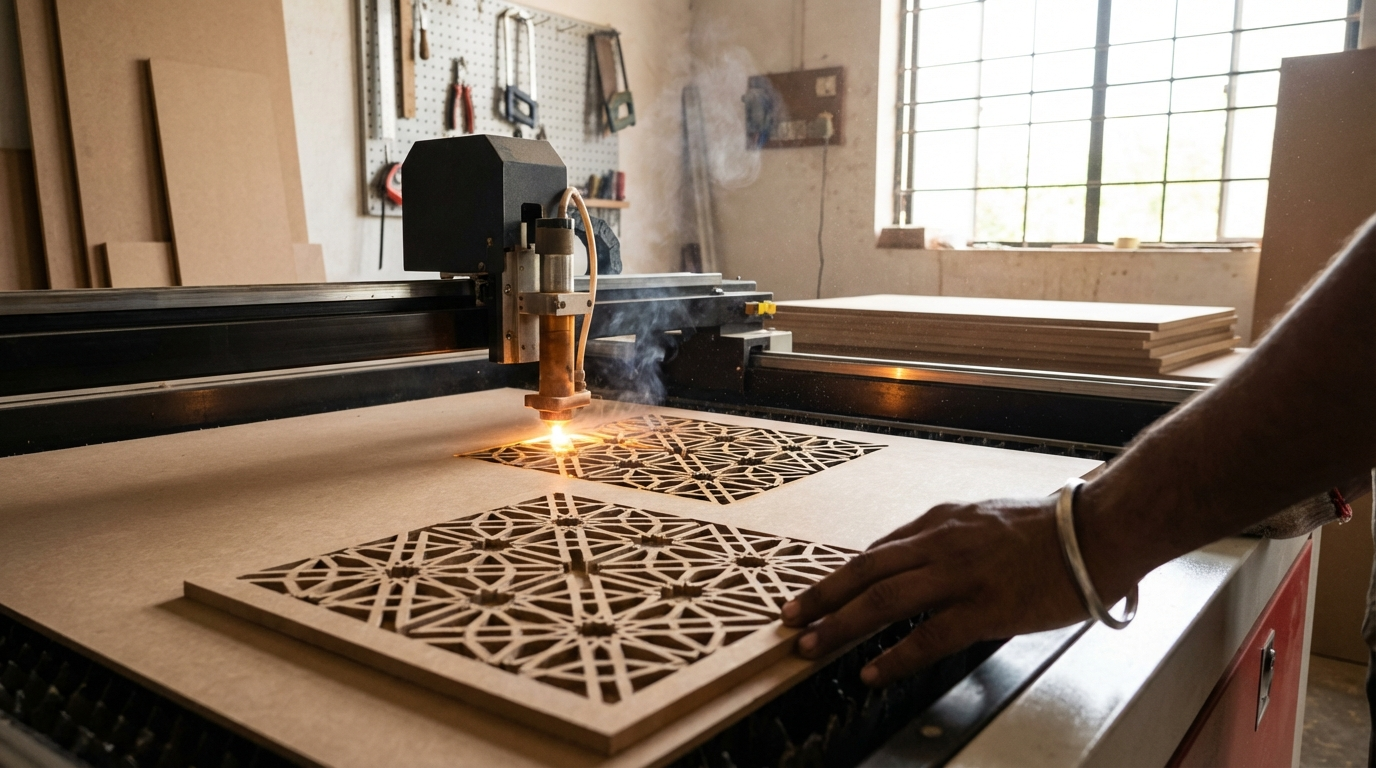
While solid MDF blocks sound, perforated MDF panels with precisely drilled holes transform the material into a sound absorber. The perforations allow sound waves to enter, where backing materials (acoustic felt, mineral wool) absorb the energy. Perforation patterns—typically 8mm holes at 16mm spacing or 6mm holes at 12mm spacing—determine absorption frequencies. This makes perforated MDF ideal for controlling echo in offices, restaurants, and lecture halls.
MDF Thickness for Acoustic Applications
- 6mm MDF: Minimal acoustic benefit, primarily decorative acoustic facing
- 12mm MDF: Light-duty soundproofing, secondary layer applications
- 18mm MDF: Standard acoustic applications, doors, wall panels
- 25mm MDF: High-performance studios, significant noise reduction
- Double 12mm layers: Often outperforms single 25mm due to decoupling effect
How MDF Panels Block Sound: The Science Simplified
Understanding the physics helps you make informed decisions about MDF acoustic installations.
Mass Law Principle
Sound blocking follows the mass law: doubling the mass of a barrier increases its Sound Transmission Class (STC) by approximately 6 dB. MDF's density (680-850 kg/m³) makes it effective because sound waves struggle to vibrate heavier materials. A single 18mm MDF panel weighing approximately 12-14 kg per square metre provides meaningful mass addition to standard Indian brick or block walls.
Why MDF Outperforms Plywood for Acoustics
Plywood contains voids, delamination points, and grain direction variations that create acoustic weak spots. MDF's homogeneous structure means consistent density throughout, leaving no easy paths for sound transmission. However, plywood's layered construction does provide some vibration damping that MDF lacks, making combination approaches effective for demanding applications.
The Air Gap Advantage
Installing MDF panels with a 25-50mm air gap from existing walls dramatically improves soundproofing. This decoupled installation prevents direct vibration transfer and creates a resonant cavity that absorbs additional frequencies. Filling this gap with mineral wool or acoustic insulation further enhances performance, potentially achieving 35-45 dB noise reduction.
Step-by-Step MDF Acoustic Panel Installation Guide
Proper installation determines whether your MDF acoustic treatment succeeds. Follow this sequence for optimal results.
Pre-Installation Preparation
- Acclimatise panels: Store MDF in the installation room for 48-72 hours to adjust to local humidity
- Inspect all panels: Check edges for chips, surfaces for damage, and reject warped sheets
- Plan layout: Minimise joints, stagger seams, and account for electrical outlets
- Prepare surfaces: Clean walls, mark stud locations, and install any required backing insulation
Wall-Mounted MDF Acoustic Panel Installation
- Install battens/framework: Use 25x50mm treated wood battens at 400mm centres, creating the air gap
- Add insulation: Insert 25mm mineral wool or acoustic foam between battens
- Mount first panel: Start from one corner, leaving 3mm expansion gap at floor and ceiling
- Secure with screws: Use 35mm countersunk screws at 200mm intervals around edges, 300mm in field
- Seal joints: Apply acoustic sealant (not silicone) to all panel joints before fitting next panel
- Continue installation: Butt panels tightly, maintaining expansion gaps only at room perimeter
- Seal perimeter: Apply acoustic sealant around all edges where panels meet walls, floor, and ceiling
Critical Failure Points at Each Stage
| Installation Stage | Common Mistake | Consequence | Prevention |
|---|---|---|---|
| Batten installation | Direct wall contact | Sound bridges created | Use acoustic isolation strips |
| Panel cutting | Rough saw blade | Chipped edges, gaps | Use 80-tooth TCT blade minimum |
| Joint sealing | Skipping sealant | Sound leakage paths | Seal every joint without exception |
| Screw fixing | Over-tightening | Surface damage, splitting | Pre-drill, use consistent torque |
| Perimeter gaps | Hard contact with structure | Vibration transmission | Maintain flexible sealed gap |
Decision Framework: Which MDF Acoustic Solution for Which Condition
| Condition/Scenario | Recommended Solution | What to Verify Before Purchase |
|---|---|---|
| Home theatre room | 18mm HDF + 50mm cavity + mineral wool | Room dimensions, door seal quality, HVAC noise |
| Bedroom privacy (apartments) | 12mm MDF over existing wall + acoustic sealant | Current wall construction, shared wall extent |
| Recording studio | Double 12mm MDF, decoupled, with acoustic foam | Frequency range needed, existing room modes |
| Office partition | Perforated MDF ceiling + solid MDF partitions | Fire rating requirements, height regulations |
| Coastal/humid area | MR-MDF with sealed edges, moisture barrier | Annual humidity range, ventilation adequacy |
| Budget-constrained project | Standard 18mm MDF, focus on sealing | Prioritise complete sealing over premium grade |
| Generator room enclosure | 25mm MDF + lead sheet + absorptive lining | Required dB reduction, heat dissipation needs |
| Restaurant/café acoustics | Perforated MDF ceiling panels with backing | Aesthetic requirements, fire compliance |
Common Buyer Mistakes with Acoustic MDF (And How to Avoid Them)
These errors consistently undermine soundproofing projects. Learn from others' expensive lessons.
Mistake 1: Choosing Thickness Over Installation Quality
What happens: Buyers purchase expensive 25mm MDF but install it directly against walls without sealing joints, achieving worse results than properly installed 12mm panels.
Prevention: Budget 30-40% of material cost for proper installation, sealants, and acoustic isolation. A well-installed thinner panel outperforms a poorly installed thick one.
Mistake 2: Ignoring the Weakest Link
What happens: Extensive wall treatment becomes useless because sound travels through an unsealed door gap, electrical outlet, or AC duct.
Prevention: Map all potential sound paths before starting. Address doors (acoustic seals, door bottoms), outlets (acoustic putty pads), and HVAC (lined ducts, acoustic baffles).
Mistake 3: Using Standard Silicone Sealant
What happens: Silicone cures hard and cracks over time, creating gaps. It also doesn't bond well with MDF edges.
Prevention: Use only acoustic sealant (remains permanently flexible) or specialized acoustic caulk. These maintain seal integrity through temperature and humidity cycles.
Mistake 4: Forgetting Edge Sealing
What happens: Raw MDF edges absorb moisture during monsoon, swell, push against adjacent panels, then shrink leaving gaps.
Prevention: Seal all cut edges with PVA-based edge sealer or quality primer before installation. This adds ₹200-400 to material cost but prevents swelling damage.
Mistake 5: Specifying MDF for Impact Noise
What happens: MDF wall treatment does nothing for footstep noise from floors above or impact sounds transmitted through structure.
Prevention: Understand your noise type. MDF excels at airborne noise (voices, music, traffic). For impact noise, you need floor treatments, isolation mounts, or suspended ceiling systems.
Mistake 6: Storing MDF Incorrectly Before Installation
What happens: Panels stored flat without supports bow in the centre. Panels leaning against walls warp. Panels exposed to rain become unusable.
Prevention: Store panels flat on minimum 3 supports per sheet, in dry covered area, for 48+ hours before installation. Inspect each panel before cutting.
Mistake 7: Underestimating Weight Requirements
What happens: Wall fixings fail because 8x4ft 18mm MDF panels weigh 35-40kg each. Standard drywall anchors cannot support this.
Prevention: Plan structural fixing into studs, use appropriate anchor types for wall construction, and distribute weight across multiple fixing points.
Mistake 8: Ignoring Fire Safety Requirements
What happens: Standard MDF in commercial spaces violates fire codes. Fire inspectors require removal and replacement with FR-MDF.
Prevention: Check local fire regulations before specifying. Commercial spaces, escape routes, and public areas typically require fire-retardant MDF (FR-MDF) compliant with IS:848 or equivalent standards.
Failure Modes in MDF Acoustic Installations and Prevention
Failure Mode 1: Panel Sagging on Ceilings
Symptom: Visible bowing between fixing points, eventual panel drop
Root cause: Insufficient fixing points, fixing into ceiling finish rather than joists, humidity-related weight gain
Prevention: Maximum 400mm fixing centres, always fix into structure, use MR-MDF for ceilings
Fix if occurring: Add intermediate supports, replace damaged panels with properly secured MR-grade
Failure Mode 2: Joint Opening After Installation
Symptom: Visible gaps appearing at panel joints within months of installation
Root cause: Panels installed at high humidity then shrinking in dry season, or inadequate joint sealing
Prevention: Install during moderate humidity period, use acoustic sealant in joints, maintain room humidity
Fix if occurring: Reapply acoustic sealant, consider decorative cover strips if gaps exceed 2mm
Failure Mode 3: Edge Swelling and Delamination
Symptom: Edges becoming soft, expanding, surface layer separating
Root cause: Unsealed edges absorbing moisture, particularly during monsoon in non-AC spaces
Prevention: Seal all edges before installation, use MR-MDF in humid areas, ensure adequate ventilation
Fix if occurring: Cut back damaged areas to sound material, edge seal, patch with MR-MDF strips
Failure Mode 4: Sound Bridging Through Fixings
Symptom: Soundproofing performance lower than expected despite correct materials
Root cause: Metal screws creating direct sound paths, acoustic panel touching structure at fixing points
Prevention: Use acoustic isolation washers, resilient channel systems, or adhesive mounting where possible
Fix if occurring: Install isolation clips or resilient bars, add damping layer between panel and structure
Failure Mode 5: Resonance Issues at Specific Frequencies
Symptom: Certain sounds (often bass frequencies) seem amplified rather than blocked
Root cause: Panel size and cavity depth creating resonant system at specific frequency
Prevention: Vary panel sizes, fill cavities with absorbent material, consult acoustic calculator for cavity dimensions
Fix if occurring: Add cavity absorption, install additional damping layer, consider bass traps at room corners
Failure Mode 6: Surface Finish Failure
Symptom: Paint or laminate peeling, surface becoming rough or dusty
Root cause: Inadequate surface preparation, incompatible finish products, moisture ingress
Prevention: Prime MDF surfaces before painting, use compatible laminating adhesives, seal panel backs
Fix if occurring: Sand, re-prime, and refinish, or over-clad with new pre-finished panels
Quality Checks for Acoustic MDF Without Lab Tests
Before Buying: Visual and Physical Inspection
- Weight check: Lift corner of 8x4ft sheet—18mm MDF should feel substantial (35-40kg). Lightweight panels indicate low density
- Edge inspection: Look for consistent colour and density across cut edge. Dark spots or voids indicate quality issues
- Surface flatness: Sight along panel length—any visible bow or twist indicates storage damage
- Tap test: Tap surface in multiple areas—sound should be consistent. Hollow sounds indicate internal voids
- Moisture check: Feel edges and surface—any dampness means reject the panel
Questions to Ask Suppliers
- What is the density specification (should be 680-850 kg/m³ for acoustic use)?
- Is this E1 or E0 formaldehyde emission grade?
- For MR-MDF: What is the 24-hour water swell percentage?
- How long has this batch been in storage?
- What is the core colour (green typically indicates MR treatment)?
After Cutting: Quality Verification
- Edge quality: Clean TCT blade cuts should show smooth, consistent fibres without tearout
- Core inspection: Cross-section should show uniform colour and density throughout
- Screw test: Drive a test screw 25mm from edge—should hold firmly without splitting
- Dust colour: Cutting dust should be uniform brown—grey patches indicate possible moisture damage
After Installation: Performance Verification
- Joint inspection: Run finger along all joints—no gaps should be felt if sealant applied correctly
- Simple sound test: Play music or talk loudly in treated room, check from outside for obvious leakage points
- Seal check: Shine torch at joints from one side, check for light leakage from other side (darkness = good seal)
- Fixture security: Gently push each panel—no movement should occur at fixing points
Tips by User Type
For Homeowners
Durability expectations: Properly installed acoustic MDF panels should last 15-25 years with minimal maintenance. Surface finish may need refreshing every 7-10 years. Watch for joint gaps appearing after seasonal humidity cycles—these can be resealed without replacing panels.
Cleaning guidelines: Dust with dry microfibre cloth monthly. For marks, use slightly damp cloth with mild detergent, then dry immediately. Never use wet cleaning methods or steam cleaners—moisture is MDF's enemy. Avoid abrasive cleaners that damage surface.
When to worry: Soft or spongy areas (moisture damage), visible mould growth, panels pulling away from fixings, or persistent musty smell all indicate problems requiring professional assessment.
For Carpenters and Contractors
Cutting tips: Use 80+ tooth TCT blades for clean edges. Support panels fully during cutting to prevent breakout. Score laminated surfaces before cutting to prevent chipping. Router edges require sharp bits and controlled feed rates to avoid burning.
Edge preparation: Seal all cut edges immediately with PVA-based sealer, especially in humid climates. Allow 24 hours drying before installation. This single step prevents most long-term failure issues.
Screw zones: Pre-drill all screw locations to prevent splitting. Minimum 20mm from edges for face screws. Use countersunk screws and fill for invisible finish. Consider adhesive mounting to eliminate screw sound bridges.
Hinge areas: MDF doesn't hold screws as well as solid wood for hinge applications. Use longer screws, pilot holes, or hinge reinforcement for acoustic doors requiring robust hardware.
For Architects and Designers
Specification language: Specify "MDF compliant with IS:12406 for general purpose or IS:14587 for moisture resistant grades, minimum density 700 kg/m³, E1 formaldehyde class, acoustic installation per manufacturer recommendations with continuous perimeter sealing."
Wet-zone detailing: Even MR-MDF should not contact water directly. Detail raised bases (minimum 50mm from floor in wet areas), sealed panel backs, and adequate ventilation. Consider cement board or marine plywood for direct water exposure areas.
Finish selection: For painted finishes, specify MDF primer plus two coats minimum. For laminate, ensure compatibility with MDF surface and specify moisture barrier on panel backs. Veneer applications require balanced construction (veneer both faces) to prevent warping.
For Modular Kitchen and Furniture Manufacturers
QC checkpoints: Incoming inspection for density, moisture content (below 10%), and dimensional accuracy. Process control for edge sealing before assembly. Final inspection for joint integrity and finish quality.
Reducing acoustic complaints: Most "soundproofing didn't work" complaints trace to unsealed gaps, direct structure contact, or inappropriate material selection. Train installation teams on sealing protocols and document compliance.
Batch consistency: Source from single manufacturer for projects requiring consistent acoustic performance. Density variations between manufacturers affect sound blocking. Keep batch records for warranty claims.
MDF Acoustic Panels Compared to Alternative Materials
| Material | Sound Blocking | Sound Absorption | Cost Factor | Best Use Case |
|---|---|---|---|---|
| MDF 18mm | Good (STC 28-32) | Low (NRC 0.10) | 1x baseline | Cost-effective blocking |
| Perforated MDF + backing | Moderate | Good (NRC 0.65-0.85) | 1.5x | Office ceilings, studios |
| Mass Loaded Vinyl | Excellent | None | 2-3x | Maximum blocking, thin profile |
| Acoustic Foam | None | Excellent (NRC 0.80+) | 1.5x | Echo reduction, studios |
| Mineral Wool | Moderate | Excellent (NRC 0.90+) | 0.8x | Cavity fill, thermal+acoustic |
| Plasterboard (double) | Good (STC 30-35) | Low | 0.7x | Standard construction |
| Plywood 18mm | Moderate (STC 25-28) | Low | 1.2x | Where moisture resistance critical |
Choose MDF when: You need reliable sound blocking at moderate cost, require paintable/laminatable surface, working with competent installation team who understand sealing requirements.
Choose alternatives when: You need pure absorption (use foam/fabric panels), maximum performance in thin space (use MLV), or combination acoustic-thermal performance (use mineral wool systems).
Acoustic MDF Applications: Room-by-Room Guide
Home Theatre Rooms
Use 18-25mm MDF on all walls with 50mm cavity filled with mineral wool. Install perforated MDF panels at first reflection points for sound control within room. Solid core MDF door with acoustic seals essential. Budget: ₹200-350 per sq ft complete installed.
Bedrooms (Privacy Focus)
12mm MDF over existing shared walls provides significant privacy improvement. Focus budget on door sealing—this is usually the weakest point. Consider MDF headboard wall only for budget-limited projects.
Recording Studios
Double-layer 12mm MDF with green glue compound between layers, fully decoupled from structure. Combine with absorptive treatment for balanced room acoustics. Professional acoustic design recommended for serious applications.
Office Spaces
Perforated MDF ceiling panels reduce speech reflection and improve concentration. Solid MDF partitions to ceiling height for meeting room privacy. Consider acoustic felt finish on MDF for premium appearance.
Generator and Utility Rooms
25mm MDF enclosures with internal absorptive lining. Ensure adequate ventilation pathways (acoustic baffles on air inlets). Multiple layers more effective than single thick layer.
Frequently Asked Questions
Is MDF good for soundproofing walls in Indian apartments?
MDF is effective for soundproofing apartment walls, particularly for blocking airborne noise like voices, television, and music from neighbouring units. For typical Indian apartment partition walls (4-inch brick or concrete block), adding 18mm MDF with a 25mm air gap and mineral wool infill can improve sound isolation by 15-25 dB. However, effectiveness depends entirely on installation quality—even small unsealed gaps dramatically reduce performance. Use MR-MDF in coastal cities like Mumbai, Chennai, or Kolkata where humidity exceeds 70% for extended periods. Budget approximately ₹150-250 per square foot for materials and professional installation.
How does MDF compare to acoustic foam for soundproofing?
MDF and acoustic foam serve completely different acoustic functions and are not interchangeable. MDF blocks sound transmission between spaces due to its mass and density—it prevents your neighbour from hearing your music. Acoustic foam absorbs sound within a space, reducing echo and reverberation—it makes your music room sound clearer. For comprehensive acoustic treatment, you typically need both: MDF (or similar mass) to block sound leaving the room, and foam or fabric panels to control sound quality within the room. Using only foam provides zero sound blocking; using only MDF provides no echo control.
What thickness of MDF is best for soundproofing a home theatre?
For dedicated home theatre rooms in Indian homes, 18mm MDF provides the optimal balance of performance and practicality. Single 18mm panels deliver approximately STC 28-32 rating when properly installed with sealed joints. For higher performance, two layers of 12mm MDF with acoustic damping compound between them typically outperforms single 25mm installation because the compound converts vibration to heat. The air cavity behind the MDF matters as much as thickness—50mm cavity with mineral wool infill adds significant low-frequency absorption. Total system design matters more than maximum single-panel thickness.
Can MDF acoustic panels be used in bathrooms and humid areas?
Standard MDF should never be used in bathrooms or areas with direct water exposure—it will swell, delaminate, and fail within months. MR-MDF (Moisture Resistant grade, usually identified by green-coloured core) can be used in adjacent areas with elevated humidity but not in direct wet zones. For bathroom acoustic treatment, consider cement board backing with waterproof membrane, acoustic insulation in wall cavities, and MR-MDF only in areas that stay dry. In all humid applications, sealing all edges and backs of panels is mandatory, not optional.
How much does MDF acoustic panel installation cost in India?
MDF acoustic installation costs vary significantly based on grade, finish, and complexity. Material costs range from ₹35-55 per square foot for standard MDF to ₹75-120 for pre-laminated acoustic panels. Professional installation adds ₹40-80 per square foot depending on complexity, access, and location. Complete acoustic wall treatment (MDF panels, air gap, mineral wool, sealing, finishing) typically runs ₹150-350 per square foot in metro cities. Budget projects focusing only on MDF overlay of existing walls might cost ₹80-120 per square foot. Get itemised quotes specifying material grade, installation method, and sealing protocols to compare accurately.
Do MDF acoustic panels need special maintenance?
MDF acoustic panels require minimal maintenance when properly installed and finished. Dust monthly with dry microfibre cloth to prevent buildup. Check joints annually for gaps (especially after first monsoon cycle) and reseal with acoustic caulk if needed. Avoid wet cleaning—use barely damp cloth for spots, dry immediately. Painted surfaces may need refreshing every 7-10 years. Watch for soft spots indicating moisture damage and address immediately. The most important maintenance is controlling room humidity—consistently high humidity (above 70%) will eventually damage even MR-grade panels.
What is the difference between perforated MDF and solid MDF for acoustics?
Solid MDF blocks sound transmission due to its mass—sound waves cannot easily vibrate the dense material. Perforated MDF (with systematic hole patterns) works oppositely—it allows sound to enter, where backing materials absorb the energy, reducing echo and reverberation within the space. Think of solid MDF as a wall keeping sound out/in, and perforated MDF as a sponge soaking up sound bouncing around inside. Professional acoustic treatment often uses both: perforated panels on ceilings or at reflection points for absorption, solid panels on walls for blocking. The perforation pattern determines which sound frequencies are absorbed most effectively.
How do I know if my MDF acoustic installation is working?
Simple testing methods include: playing consistent audio source (radio, music) in treated room and checking perceived volume from adjacent spaces—reduction should be obvious. Use smartphone decibel meter apps for rough before/after measurements (not laboratory accurate but indicative). Check for obvious leakage by having someone speak loudly while you listen at doors, outlets, and panel joints. Professional verification uses calibrated equipment for STC testing, recommended for studios or commercial installations. Common signs of poor installation include hearing conversations clearly through treated walls, obvious sound at specific points (indicating unsealed gaps), and no perceived difference from pre-installation conditions.
Can I install MDF acoustic panels myself or do I need professionals?
DIY installation is possible for straightforward applications but professional installation is recommended for optimal acoustic performance. The main challenge is not fixing panels to walls—it is achieving complete air sealing at all joints, edges, and penetrations. Professional installers understand acoustic isolation principles, have appropriate tools (acoustic sealant guns, precision cutting equipment), and can identify and address potential sound bridges. For single-wall treatment or decorative acoustic panelling, competent DIY with careful attention to sealing can work. For home theatres, recording studios, or privacy-critical applications, professional installation typically delivers 20-40% better acoustic performance than careful DIY due to sealing expertise.
Is MDF safe for indoor use and what about formaldehyde emissions?
Modern MDF produced to E1 or E0 emission standards is considered safe for indoor use in India. E1 grade (≤8mg/100g formaldehyde content) meets international standards and is suitable for residential applications. E0 grade (≤4mg/100g) offers even lower emissions for sensitive applications. Check manufacturer specifications before purchase—reputable Indian MDF brands clearly state emission class. Once installed and finished (painted, laminated, or sealed), emission levels drop further as formaldehyde release occurs primarily from cut edges and fresh surfaces. For maximum indoor air quality, seal all surfaces, ensure adequate ventilation during and after installation, and specify E0 grade for children's rooms or areas occupied by sensitive individuals.
How long do MDF acoustic panels last in Indian climate conditions?
Properly installed and maintained MDF acoustic panels typically last 15-25 years in controlled indoor environments. Lifespan depends heavily on humidity exposure—air-conditioned spaces with consistent humidity see longer panel life than non-AC spaces with monsoon humidity cycling. Coastal cities present greater challenges due to salt-laden humid air; MR-MDF with proper sealing is essential. Surface finishes may require refreshing every 7-10 years. Early failure (within 5 years) almost always indicates installation problems (inadequate sealing, wrong grade selection, moisture exposure during storage) rather than material defects. Regular inspection of edges and joints, prompt resealing of any gaps, and humidity control extend panel life significantly.
What acoustic rating can I expect from MDF panel installation?
Acoustic performance varies by installation method. Single 18mm MDF panel direct-mounted: STC 28-32. Same panel with 25mm air gap: STC 32-36. With 50mm cavity and mineral wool: STC 38-42. Double 12mm MDF with damping compound: STC 40-45. These are approximate ranges—actual performance depends on sealing quality, flanking paths, and room construction. For reference, normal conversation is audible through STC 30, heard as murmur at STC 40, and inaudible at STC 50. Most residential applications aim for STC 40-45 range. Professional acoustic consultants can calculate expected performance for specific installations and verify with post-installation testing.
Note: This is independent informational content and is not affiliated with any manufacturer. Product performance varies by manufacturer, installation quality, and site conditions. Always verify specifications with suppliers and consider professional acoustic consultation for critical applications.
Disclaimer: This content is provided for general informational purposes based on industry practices and publicly available information. Product specifications, standards, prices, and availability may vary by manufacturer, region, and time. Readers should independently verify details with manufacturers, dealers, or qualified professionals before making purchase or construction decisions.Want Plywood Suggestions?
Share a few details and a VIR MDF specialist will suggest suitable brands and connect you to responsive dealers.