MDF Products: Complete Range of MDF Board Applications
Complete MDF products guide: from furniture to construction applications. Explore VIR MDF product range for every interior need.
Quick Decision Summary
Quick Answer: MDF products encompass a comprehensive range of engineered wood panels including standard MDF, moisture-resistant HDFWR, fire-retardant FR-MDF, flexible bendy MDF, and pre-laminated options—each designed for specific applications from furniture and cabinetry to construction and acoustic treatments in Indian homes and commercial spaces.
If you're in a hurry: Standard MDF works perfectly for dry interior applications like wardrobes and TV units. For kitchens and bathrooms, choose HDFWR (moisture-resistant) grade. Fire-retardant MDF suits commercial buildings with safety requirements. Pre-laminated MDF eliminates painting costs and speeds up project completion. Always match the MDF grade to your specific application conditions—humidity exposure, fire safety needs, and design flexibility requirements.
- Choose standard MDF if: Your project involves dry interior spaces, you want smooth paintable surfaces, budget is a primary concern, or you need consistent machining results
- Choose HDFWR MDF if: Installation involves kitchens, bathrooms, or coastal areas with high humidity exposure
- Choose FR-MDF if: Building codes require fire-retardant materials or the space is commercial/public
- Choose Pre-laminated MDF if: You want ready-to-use panels, reduced labour costs, or faster project completion
- Avoid standard MDF if: The area has direct water exposure, outdoor installation is planned, or structural load-bearing is required
- Avoid HDFWR for exterior use: Even moisture-resistant grades are not waterproof—they resist humidity, not direct water
- Avoid MDF altogether if: You need outdoor structural applications, direct ground contact, or extreme load-bearing capacity
What MDF Products Actually Mean
MDF products refer to the complete family of Medium Density Fibreboard panels manufactured by compressing wood fibres with resin binders under high temperature and pressure. Unlike solid wood or plywood, MDF offers a homogeneous structure without grain patterns, knots, or directional weaknesses—making it ideal for precision cutting, routing, and finishing applications.
In the engineered wood hierarchy, MDF sits between particle board (lower density, less strength) and HDF/hardboard (higher density, thinner sheets). MDF typically has a density of 600-800 kg/m³, providing an optimal balance of workability, strength, and cost-effectiveness for interior applications.
Common confusions clarified:
- MDF vs HDF: HDF (High Density Fibreboard) is denser and thinner, typically used for laminate flooring backing—not interchangeable with MDF for furniture
- MDF vs Plywood: Plywood has cross-laminated veneers with grain direction; MDF has no grain, making it superior for painted finishes but weaker for screw-holding at edges
- MR-MDF vs HDFWR: Both indicate moisture resistance, but HDFWR specifically refers to High Density Fibre Water Resistant grade with enhanced protection
- BWR vs HDFWR: BWR typically refers to plywood grading; HDFWR is the MDF equivalent for moisture-prone applications
Why MDF Product Selection Matters for Indian Homes
India's diverse climate zones create unique challenges that directly impact MDF performance. The monsoon season (June-September) brings sustained humidity levels of 80-95% in many regions, causing improperly specified MDF to swell, warp, or delaminate within months of installation.
Monsoon and Coastal Humidity Impact
Standard MDF in coastal cities like Mumbai, Chennai, or Kolkata faces accelerated moisture absorption due to salt-laden air and year-round humidity above 70%. Without HDFWR grade specification, kitchen shutters may swell within one monsoon season, drawer fronts may refuse to close properly, and edge banding may peel due to substrate expansion.
Real Consequences of Wrong Product Selection
- Swelling at edges: Exposed MDF edges absorb moisture 5-10 times faster than faces—unsealed edges in bathrooms visibly swell within weeks
- Delamination of laminates: When MDF substrate expands, bonded laminates separate at corners and edges first
- Screw pullout failure: Moisture-weakened MDF loses screw-holding capacity, causing hinge failures in heavy shutter doors
- Surface bubbling: Trapped moisture under paint or laminate creates visible bubbles that cannot be repaired without full replacement
Site Handling Realities in India
Construction sites in India often store materials under tarps or in partially complete buildings for weeks. MDF sheets exposed to dust, morning dew, or rain splash during this period absorb moisture before installation even begins. Carpenter skill levels vary significantly—many workshops lack proper edge-sealing equipment, leaving cut edges vulnerable. Transport in open trucks during monsoon exposes MDF to rain damage that only becomes visible after finishing.
Complete Range of MDF Product Types
| MDF Product Type | Density Range | Primary Application | Moisture Resistance | Typical Indian Price Range (per sheet) |
|---|---|---|---|---|
| Standard Interior MDF | 650-750 kg/m³ | Dry interior furniture, shelving | Low | ₹1,800-₹3,500 |
| HDFWR (Moisture Resistant) | 750-850 kg/m³ | Kitchens, bathrooms, humid areas | High | ₹2,800-₹5,000 |
| FR-MDF (Fire Retardant) | 700-800 kg/m³ | Commercial buildings, hospitals, schools | Medium | ₹3,500-₹6,500 |
| Bendy/Flexible MDF | 600-700 kg/m³ | Curved surfaces, designer furniture | Low | ₹4,000-₹7,000 |
| Ultra-Lite MDF | 450-550 kg/m³ | Temporary displays, lightweight furniture | Low | ₹1,500-₹2,800 |
| Pre-laminated MDF | 650-750 kg/m³ | Ready-to-use shutters, partitions | Varies by base | ₹3,200-₹6,000 |
Standard Interior Grade MDF
Standard MDF forms the backbone of interior furniture manufacturing in India. Its uniform density and smooth surface accept paint, veneer, and laminate finishes equally well. Available in thicknesses from 6mm to 25mm, with 8x4 feet sheets being the standard Indian market size. Best suited for wardrobes, TV units, study tables, and display shelving in air-conditioned or naturally dry environments.
HDFWR Moisture Resistant MDF
Treated with moisture-resistant resin during manufacturing, HDFWR MDF resists humidity-induced swelling and maintains dimensional stability in damp environments. Typically identified by green-coloured core (though colour alone should not be the verification method). Essential for kitchen base units, bathroom vanities, and any furniture in coastal or high-humidity regions. Note: moisture-resistant does not mean waterproof—direct water exposure still damages HDFWR over time.
Fire Retardant MDF
FR-MDF incorporates fire-retardant chemicals that slow flame spread and reduce toxic fume emission during fire events. Required by building codes for commercial spaces, hospitals, schools, hotels, and public buildings. Typically comes with fire rating certifications that should be verified before purchase. Costs 40-60% more than standard MDF but mandatory for compliance in regulated spaces.
Bendy and Flexible MDF
Manufactured with flexible resin systems, bendy MDF can curve to radii as tight as 150mm without cracking. Used for curved reception desks, rounded furniture edges, column cladding, and designer interior elements. Requires specific handling techniques and typically needs backing structure once installed in final curved position.
Pre-laminated MDF
Factory-finished with melamine, PVC film, or decorative paper, pre-laminated MDF eliminates on-site painting or lamination work. Available in hundreds of colours, wood grains, and texture patterns. Reduces project timelines significantly and ensures consistent factory-quality finish. Edge banding must match the laminate for professional appearance.
MDF Applications by Room and Use Case
Kitchen Applications
Kitchens represent the most demanding MDF application due to heat, moisture, and heavy daily use. HDFWR-grade MDF is mandatory for all kitchen furniture in Indian conditions.
- Base unit carcasses: 18mm HDFWR with waterproof edge sealing
- Wall unit carcasses: 18mm HDFWR or standard MDF if area is well-ventilated
- Shutter doors: 18mm HDFWR with pre-laminated or painted finish
- Internal shelves: 12mm or 18mm based on span and load
- Drawer fronts: 18mm HDFWR matching shutter specification
- Tall unit panels: 18mm or 25mm for structural stability
Wardrobe and Bedroom Applications
Bedrooms typically maintain lower humidity than kitchens, allowing standard MDF in most non-coastal regions. However, monsoon months may still cause issues in poorly ventilated spaces.
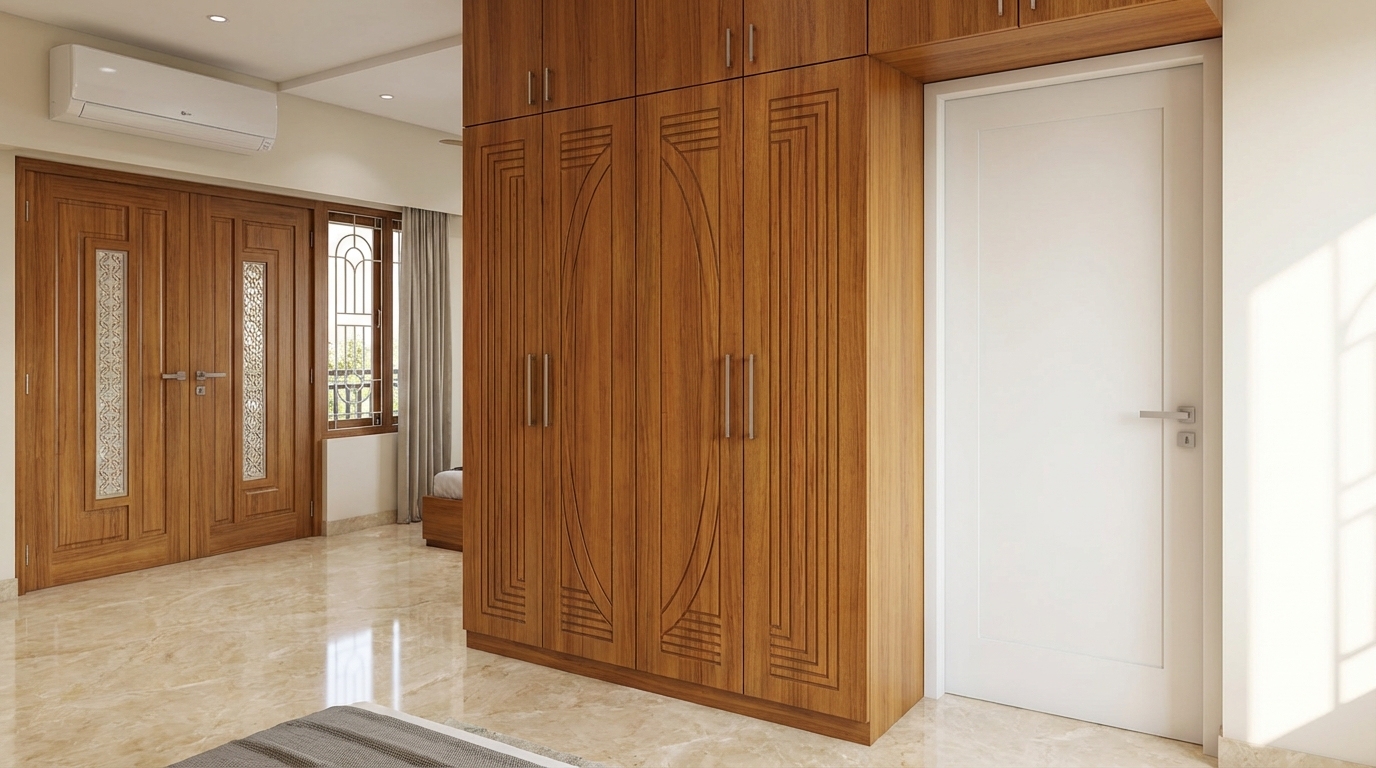
- Wardrobe carcasses: 18mm standard or HDFWR in humid regions
- Sliding wardrobe shutters: 18mm with laminate or veneer finish
- Internal partitions: 12mm MDF for lighter duty
- Drawer systems: 12mm for sides, 6mm for bottom panels
- Bed headboards: 12mm or 18mm with upholstery backing
- Study tables and desks: 18mm or 25mm for work surfaces
Living Room Applications
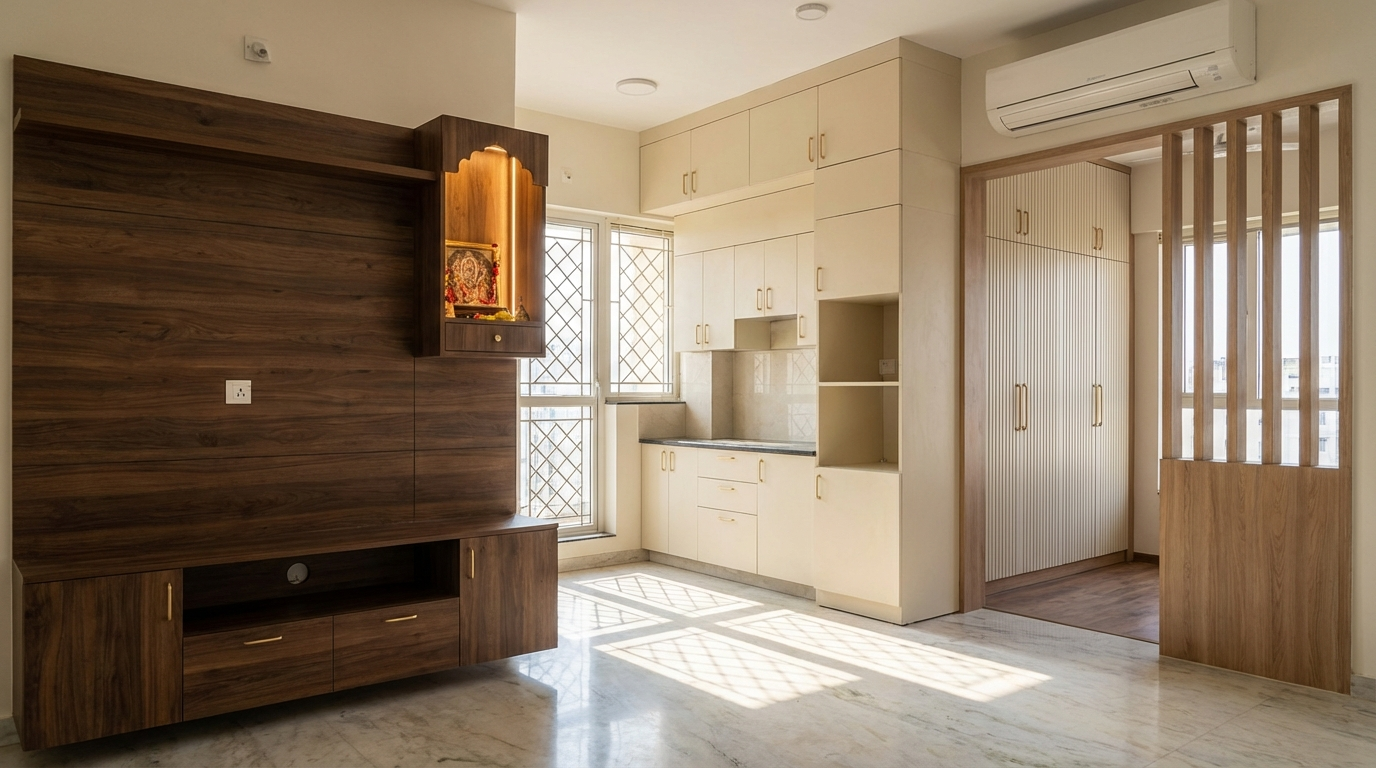
- TV unit carcasses: 18mm standard MDF with laminate finish
- Display shelving: 18mm for spans up to 600mm; add support for longer spans
- Wall panelling: 6mm or 9mm MDF with paint or wallpaper finish
- False ceiling panels: 6mm lightweight MDF or ultra-lite grade
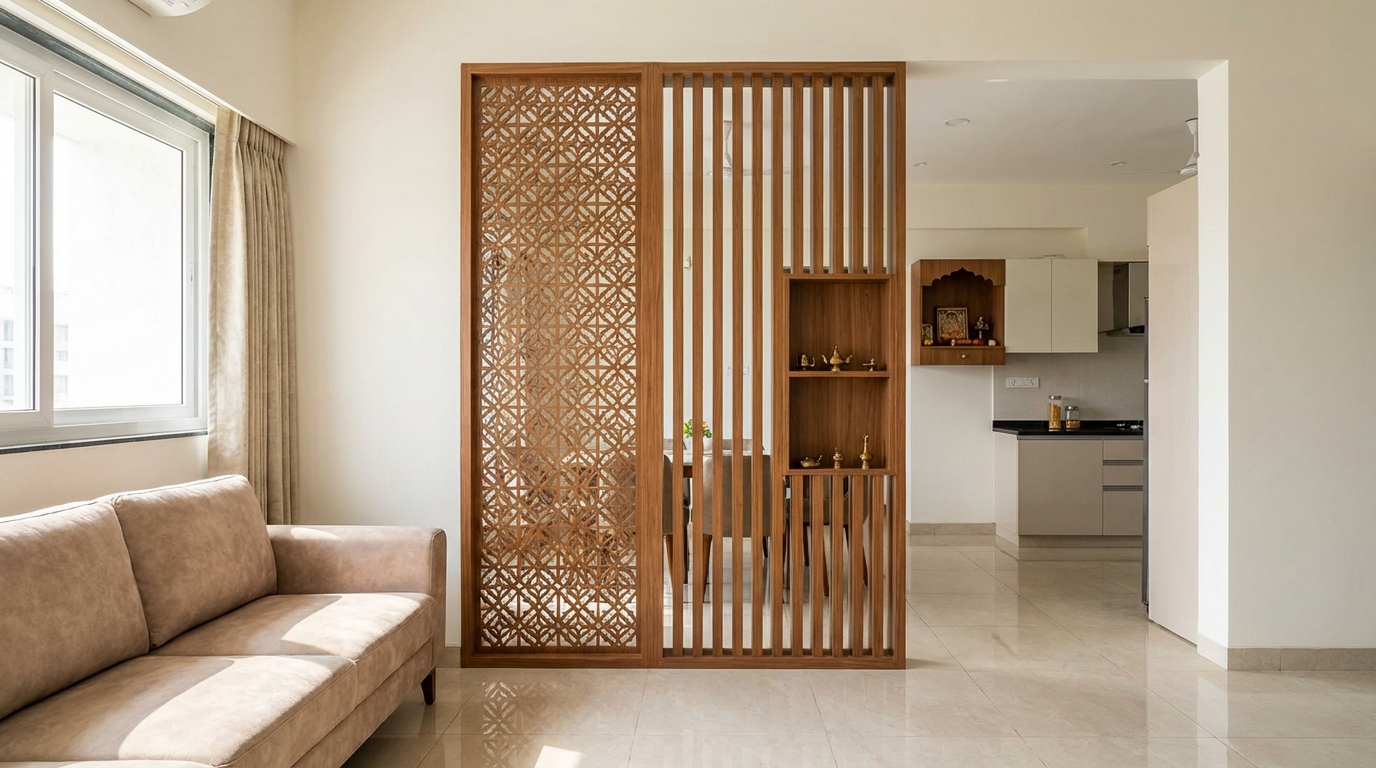
- Room dividers: 12mm MDF with CNC-cut decorative patterns
- Bookshelf units: 18mm for heavy book loads with vertical supports every 600mm
Commercial and Office Applications
- Workstation partitions: 12mm or 18mm with acoustic backing
- Reception desks: 25mm for counter surfaces; bendy MDF for curved elements
- Storage cabinets: 18mm standard with laminate finish
- Acoustic wall panels: 18mm MDF with perforations and acoustic backing
- Retail display fixtures: 18mm pre-laminated for quick installation
- Conference room panelling: 12mm with veneer or paint finish
Construction and Structural Applications
While MDF is not a structural material, it serves important functions in construction finishing:
- Door shutters: 30mm or 35mm solid-core MDF doors for internal use
- Door frames: 25mm MDF with hardwood reinforcement at hinge points
- Skirting and baseboards: 12mm MDF with routed profiles
- Window casings: 18mm MDF for internal trim (not external)
- Subfloor underlayment: 6mm MDF under laminate flooring
- Roof cladding backing: Treated MDF in protected roof spaces only
Decision Framework: Which MDF Product for Which Condition
| Application Condition | Recommended MDF Product | What to Verify Before Purchase |
|---|---|---|
| Dry interior, AC rooms | Standard Interior MDF | Density stamp, smooth surface both sides |
| Kitchen base units | HDFWR grade, 18mm | Green core, moisture test certification |
| Bathroom vanity | HDFWR grade with sealed edges | Complete edge sealing post-cutting |
| Coastal area (any room) | HDFWR grade throughout | Manufacturer moisture rating, local reviews |
| Hospital/school furniture | FR-MDF with fire certification | Fire test certificate, class rating |
| Curved reception desk | Bendy MDF + structural backing | Minimum bend radius specification |
| Budget project, dry area | Standard MDF with proper sealing | Check for consistent density, no soft spots |
| Quick delivery requirement | Pre-laminated MDF | Laminate adhesion quality, edge chip resistance |
| Acoustic treatment | Standard MDF with perforations | Hole pattern, acoustic backing material |
| Temporary exhibition display | Ultra-lite MDF | Weight per sheet, finish acceptance |
Common Buyer Mistakes and How to Avoid Them
Mistake 1: Using Standard MDF in Kitchens
Consequence: Swelling at sink area within 6-12 months, shutter warping, hinge failure. Prevention: Always specify HDFWR for kitchen applications regardless of price difference—replacement costs far exceed the upgrade cost.
Mistake 2: Ignoring Edge Sealing
Consequence: Cut edges absorb moisture rapidly, causing localized swelling even in HDFWR boards. Prevention: Insist on PVC edge banding or paint sealing on all exposed edges immediately after cutting.
Mistake 3: Buying Based on Price Alone
Consequence: Inconsistent density boards lead to routing problems, uneven paint absorption, and screw-holding failures. Prevention: Purchase from established brands; request density certification or perform basic weight-per-sheet verification.
Mistake 4: Over-specifying Thickness
Consequence: Unnecessary weight, higher cost, reduced usable space inside cabinets. Prevention: Use 18mm for carcasses and shutters; 12mm for internal shelves and partitions; 6mm for drawer bottoms and backing panels.
Mistake 5: Storing MDF Sheets Flat on Ground
Consequence: Bottom sheets absorb ground moisture and dust; middle sheets may warp under uneven pressure. Prevention: Store on elevated battens, keep covered, use within 2-3 weeks of delivery during monsoon.
Mistake 6: Not Accounting for Thickness Tolerance
Consequence: 18mm boards from different batches may vary by 0.5-1mm, causing alignment issues in modular furniture. Prevention: Purchase entire project requirement from single batch; verify thickness with calipers before cutting.
Mistake 7: Expecting Waterproof Performance from HDFWR
Consequence: Direct water pooling still damages HDFWR boards over time. Prevention: HDFWR resists humidity, not water—install proper drainage, avoid sink splashback contact, use additional waterproof coatings at high-risk areas.
Mistake 8: Choosing Pre-laminated MDF Without Checking Base Grade
Consequence: Standard MDF base under laminate fails in humid conditions despite protective surface. Prevention: Verify base board grade is HDFWR for kitchen and bathroom pre-laminated panels.
Failure Modes and How to Prevent Them
Failure Mode 1: Edge Swelling
Symptom: Visible bulging at cut edges, laminate lifting at corners. Root Cause: Exposed MDF core absorbing atmospheric moisture through unsealed edges. Prevention: Apply edge banding or primer-paint within 24 hours of cutting. Fix if already happening: Remove affected laminate, sand swollen area, apply wood hardener, re-laminate with sealed edges.
Failure Mode 2: Screw Pullout at Hinges
Symptom: Cabinet doors sagging, hinges loosening, screws spinning freely. Root Cause: MDF has lower screw-holding than solid wood; moisture weakens holding further; repeated stress cycles loosen grip. Prevention: Pre-drill pilot holes, use coarse-thread screws, apply wood glue in holes, use mounting plates for heavy doors. Fix if already happening: Fill holes with epoxy-sawdust mixture, re-drill after curing, or relocate hinges to fresh material.
Failure Mode 3: Surface Bubbling Under Paint
Symptom: Raised bubbles under painted surface, especially near edges. Root Cause: Moisture trapped beneath paint film expands in heat cycles. Prevention: Apply dedicated MDF primer-sealer before painting; ensure boards are moisture-equilibrated before finishing. Fix if already happening: Cannot repair—scrape, sand, seal, and repaint affected area entirely.
Failure Mode 4: Laminate Delamination
Symptom: Laminate peeling at edges and corners, air pockets forming. Root Cause: MDF substrate expansion breaks adhesive bond; poor initial adhesion due to dusty surface. Prevention: Clean substrate thoroughly before lamination; use contact adhesive rated for MDF; apply even pressure during bonding. Fix if already happening: Inject adhesive under lifted laminate, apply pressure with clamps for 24 hours.
Failure Mode 5: Warping of Large Panels
Symptom: Flat panels developing bow or twist over time. Root Cause: Unequal moisture exposure on faces (one side against wall, other exposed to room); unbalanced finishing. Prevention: Apply equal finish to both faces; allow moisture equilibration before installation; use proper backing support. Fix if already happening: Weight flat on opposite curve; equalize finish on both sides; may require replacement if severe.
Failure Mode 6: CNC Routing Edge Tear-Out
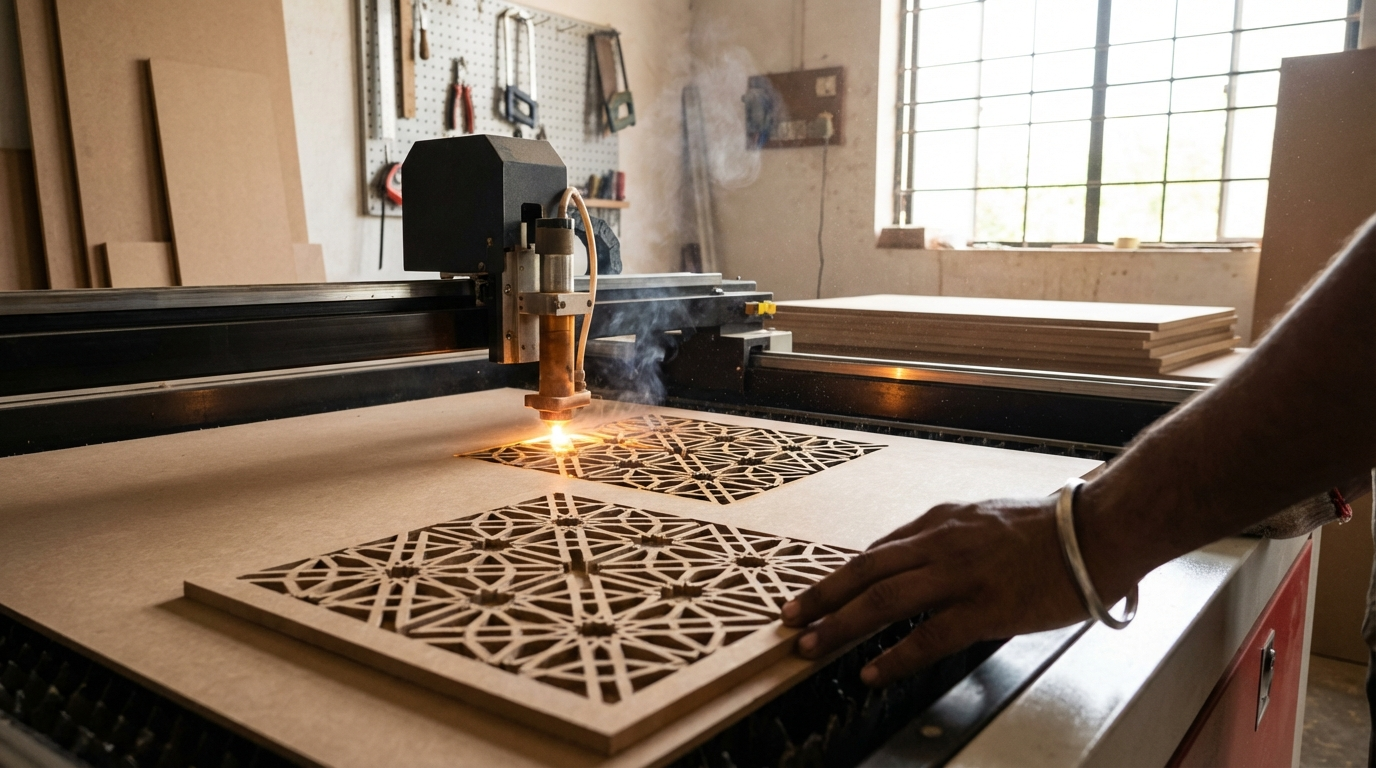
Symptom: Rough, fuzzy edges after CNC cutting or routing; unclean pattern edges. Root Cause: Dull tools, incorrect feed rates, or low-density MDF boards. Prevention: Use sharp carbide-tipped tools; reduce feed rate for detailed work; verify board density before committing to detailed designs. Fix if already happening: Sand carefully with fine grit; fill minor defects with wood filler; primer-seal before painting.
Quality Checks Without Lab Tests
Before Buying: At the Dealer
- Visual inspection: Check both faces for smooth, consistent surface without rough patches or soft spots
- Edge inspection: Factory edges should be clean-cut without layering or delamination visible
- Weight test: Lift corner of sheet—consistent density boards feel evenly heavy; reject sheets that flex excessively
- Knock test: Rap knuckles across surface—solid, consistent sound indicates good density; hollow sounds indicate voids
- Moisture check: Sheets should not feel cool or clammy; avoid sheets stored in open areas during monsoon
- Batch consistency: Compare sheets from same batch for colour consistency and thickness
Questions to Ask the Dealer
- What is the density rating of this MDF? (Target: 700+ kg/m³ for furniture grade)
- Is this interior grade or HDFWR? How can I verify?
- When was this batch manufactured and received?
- What is your return policy for defective sheets?
- Do you have the manufacturer's test certificate available?
After Cutting: Workshop Quality Checks
- Edge quality: Clean-cut edges should show uniform colour throughout; dark lines or separation indicate poor bonding
- Core consistency: Cut cross-section should show even fibre distribution; avoid boards with visible clumps or voids
- Dust character: Fine, consistent sawdust indicates good quality; coarse, chunky dust suggests lower density
- Routing quality: Test-route a small pattern—clean edges indicate machinable quality
After Installation: Ongoing Quality Monitoring
- First monsoon check: Inspect all edges for swelling signs after first monsoon season
- Hinge tightness: Test door alignment and hinge screws every 6 months
- Surface condition: Look for bubbling, peeling, or discolouration indicating moisture problems
- Joint gaps: Expanding gaps between joined panels indicate moisture-related movement
MDF Products for Different Applications: Design Ideas
Living Room Design Applications
- Full-wall entertainment unit with integrated cable management using 18mm pre-laminated MDF
- CNC-cut geometric wall panels as accent wall feature using 12mm MDF
- Floating display shelves with hidden bracket mounting using 25mm MDF
- Window seat with storage underneath using 18mm HDFWR for humid climates
- Room divider with integrated plant shelves using 18mm MDF with waterproof coating
Kitchen Design Applications
- Handleless kitchen cabinets with push-to-open mechanisms using 18mm HDFWR
- Open kitchen shelving with concealed bracket mounting using 25mm HDFWR
- Kitchen island with breakfast counter using 25mm HDFWR with laminate finish
- Pantry pull-out units with adjustable shelving using 18mm HDFWR
- Appliance garage with tambour door using flexible MDF for curved door
Bedroom Design Applications
- Floor-to-ceiling wardrobe with integrated dressing unit using 18mm MDF
- Upholstered bed headboard with side tables using 12mm MDF as backing
- Walk-in closet with open shelving and drawer systems using 18mm MDF
- Study corner with wall-mounted desk using 25mm MDF for work surface
- Bed with hydraulic storage using 12mm MDF for bed platform
Commercial Space Design Applications
- Reception desk with curved front using bendy MDF and solid MDF counter
- Retail display walls with slat-wall MDF panels for merchandise hooks
- Office partition systems with acoustic MDF panels
- Conference room wall panelling using FR-MDF for fire compliance
- Restaurant booth seating frames using 18mm MDF with upholstery
Tips by User Type
For Homeowners
Durability expectations: Properly specified and installed MDF furniture should last 10-15 years with normal use. Expect some minor touch-ups around high-use areas like drawer fronts and shutter edges after 5-7 years.
Cleaning do's: Wipe with slightly damp cloth followed by dry cloth. Use mild soap solution for stubborn marks. Clean spills immediately, especially on horizontal surfaces.
Cleaning don'ts: Never use excess water or soaking-wet cloths. Avoid abrasive cleaners that damage laminate finish. Do not spray water directly on MDF surfaces.
When to worry: Visible swelling at edges, doors not closing properly, laminate peeling, soft spots on surface, or musty odour from furniture indicate moisture damage requiring immediate attention.
For Carpenters and Workshop Professionals
Cutting tips: Use fine-toothed blades (60+ teeth for table saw). Score laminate face first to prevent chipping. Support large sheets fully during cutting to prevent breakage.
Edge preparation: Sand cut edges lightly before edge banding. Apply primer-sealer on edges not receiving banding. Use appropriate temperature settings for PVC edge banding machines.
Screw zones: Pre-drill all screw holes to prevent splitting. Maintain minimum 25mm from edges for screws. Use coarse-thread screws for better holding in MDF. Apply wood glue in pilot holes for permanent joints.
Hinge area reinforcement: For heavy doors, use mounting plates or hardwood inserts at hinge locations. Cup hinges require proper boring depth—too shallow causes surface cracking, too deep weakens holding.
Handling guidelines: Store flat on battens, not on edge. Protect faces during transport. Allow 48-72 hours for moisture equilibration in humid seasons before cutting.
For Architects and Interior Designers
Specification language: Specify "HDFWR-grade MDF conforming to IS:12406 with minimum density 750 kg/m³" for moisture-prone applications. Include edge sealing requirements in specifications.
Wet-zone detailing: Always specify HDFWR for any furniture within 2 metres of water sources. Include waterproof membrane backing for vanity units. Specify raised toe-kicks (100mm minimum) for base units near floor drains.
Finish selection: For high-traffic areas, specify high-pressure laminate over low-pressure melamine. For painted finishes, specify two-coat primer system with polyurethane topcoat for durability.
For Modular Furniture and OEM Manufacturers
QC checkpoints: Incoming inspection for density, moisture content, and dimensional accuracy. In-process checks for edge quality and adhesive bond strength. Final inspection for finish quality and hardware functionality.
Reducing customer complaints: Match MDF grade to application in every project—document grade used. Ensure complete edge sealing before dispatch. Include care instructions with delivered furniture.
Batch consistency: Purchase entire project requirements from single manufacturing batch. Maintain material traceability for warranty claims. Store inventory in climate-controlled environment.
Frequently Asked Questions
What are the different types of MDF products available for furniture making?
MDF products for furniture include standard interior-grade MDF for dry areas, HDFWR moisture-resistant MDF for kitchens and bathrooms, fire-retardant FR-MDF for commercial spaces, flexible bendy MDF for curved designs, and pre-laminated MDF with factory-applied decorative surfaces. Each type serves specific application requirements—standard MDF works for bedrooms and living rooms in non-coastal areas, while HDFWR is essential for any humidity-exposed application. The choice depends primarily on moisture exposure, fire safety requirements, and design complexity of your project.
Can MDF be used in kitchens and bathrooms in Indian conditions?
Yes, MDF can be safely used in kitchens and bathrooms, but only HDFWR (moisture-resistant) grade should be specified. Standard MDF will fail rapidly in these environments due to India's high humidity, especially during monsoon months. Even with HDFWR, proper edge sealing is mandatory—all cut edges must be sealed with edge banding or waterproof coating within 24 hours of cutting. Additionally, ensure proper ventilation in these spaces and avoid direct water contact with MDF surfaces for long-term durability.
What thickness of MDF board should I choose for different applications?
Thickness selection depends on application load and structural requirements. Use 18mm for cabinet carcasses, wardrobe shutters, and furniture frames. Use 25mm for work surfaces, countertops, and heavy-duty shelving. Use 12mm for internal shelves, partitions, and lighter-duty applications. Use 6mm for drawer bottoms, cabinet backs, and underlayment. For doors, 30-35mm thickness is typical. Always calculate shelf span against load—reduce span or increase thickness for heavy book storage.
Is pre-laminated MDF better than laminating MDF on-site?
Pre-laminated MDF offers factory-controlled adhesion quality, consistent finish, and faster project completion. On-site lamination provides more finish options and custom colour matching but depends heavily on workshop skill and equipment quality. For standard colours and patterns, pre-laminated is generally superior due to controlled manufacturing conditions. However, verify that the base board grade matches your requirements—pre-laminated MDF for kitchens should have HDFWR base, not standard MDF, regardless of the laminate protection.
How long does MDF furniture last compared to plywood furniture?
Properly specified and installed MDF furniture typically lasts 10-15 years with normal use, comparable to commercial-grade plywood furniture. The key difference lies in moisture resistance and screw-holding capacity. Plywood performs better at edges and in moderate moisture exposure, while MDF provides superior paint finish and surface consistency. In dry, climate-controlled environments, both materials offer similar longevity. In humid conditions, MDF requires HDFWR grade and careful edge sealing to match plywood durability.
What is the price difference between standard MDF and HDFWR MDF?
HDFWR-grade MDF typically costs 40-60% more than standard interior-grade MDF. For an 8x4 feet, 18mm sheet, standard MDF ranges from ₹2,200-₹3,200 while HDFWR ranges from ₹3,500-₹4,800, depending on brand and location. Despite the higher upfront cost, HDFWR is economically justified for kitchen and bathroom applications—replacing failed standard MDF furniture costs significantly more than the initial upgrade. For dry interior applications in non-coastal areas, standard MDF remains the cost-effective choice.
Can MDF be used for CNC cutting and intricate designs?
MDF is excellent for CNC cutting due to its uniform density and absence of grain direction. It accepts intricate routing, engraving, and three-dimensional carving better than plywood or solid wood. For best results, use MDF with density above 700 kg/m³, maintain sharp tooling, and optimize feed rates for the design complexity. Edge quality depends significantly on MDF density—lower density boards produce fuzzy edges requiring additional finishing. Pre-laminated MDF can also be CNC-cut but requires careful parameter adjustment to prevent laminate chipping.
Is MDF safe for use in homes considering formaldehyde emissions?
Modern MDF boards from reputable manufacturers use low-emission resins that comply with E1 or E0 emission standards, making them safe for residential use. Look for boards certified to relevant emission standards—this information should be available from the manufacturer. Ventilate newly furnished spaces for the first few weeks, as emission rates are highest when boards are fresh. For extra-sensitive environments like nurseries or spaces for people with respiratory conditions, specify E0-rated or formaldehyde-free MDF variants where available.
What are the weight-bearing limitations of MDF shelving?
MDF shelving weight capacity depends on thickness, span, and support method. For 18mm MDF with 600mm unsupported span, expect safe load capacity of approximately 15-20 kg distributed load. Increasing span to 900mm reduces safe load to about 8-10 kg to prevent visible sagging. For heavy book storage, either reduce span with intermediate supports, increase thickness to 25mm, or add support battens underneath. Always apply load gradually and monitor for deflection over the first few weeks.
How do I identify genuine HDFWR MDF from standard MDF?
Genuine HDFWR MDF typically displays a green-coloured core, though colour alone is not definitive proof. Request the manufacturer's test certificate showing moisture resistance ratings. Perform a basic test by placing a small offcut in water for 24 hours—HDFWR shows minimal swelling (under 8%) while standard MDF swells noticeably (15-20% or more). Purchase from authorized dealers of established brands who can provide documentation. The price difference itself is an indicator—if HDFWR is being sold at standard MDF prices, verify authenticity carefully.
Can MDF be repaired if it gets water damaged?
Minor surface water damage on painted MDF can sometimes be repaired by sanding, sealing with wood hardener, and repainting. However, significant swelling damage is generally irreparable—swollen MDF does not return to original dimensions when dried. Localized edge swelling can be addressed by cutting back to sound material and refinishing, but this changes dimensions. Prevention through proper grade selection and edge sealing is far more effective than attempting repairs. For valuable furniture with moderate damage, professional restoration may salvage appearance but structural integrity remains compromised.
What surface finishes work best on MDF products?
MDF accepts virtually all finish types due to its smooth, grain-free surface. Paint finishes work excellently with proper MDF primer-sealer applied first—skip primer and paint absorption becomes uneven. High-pressure laminates provide durable, scratch-resistant surfaces for heavy-use areas. Veneers create natural wood appearance but require skilled application. Melamine and PVC film finishes offer cost-effective decoration. For painted finishes, water-based polyurethane paint systems provide good durability; for maximum durability in high-traffic areas, two-pack polyurethane systems are superior.
Note: This is independent informational content and is not affiliated with any manufacturer. Product specifications, prices, and availability vary by manufacturer and region. Always verify current specifications with your supplier before purchasing.
Disclaimer: This content is provided for general informational purposes based on industry practices and publicly available information. Product specifications, standards, prices, and availability may vary by manufacturer, region, and time. Readers should independently verify details with manufacturers, dealers, or qualified professionals before making purchase or construction decisions.Want Plywood Suggestions?
Share a few details and a VIR MDF specialist will suggest suitable brands and connect you to responsive dealers.