MDF Partition Design: Creative Room Divider Ideas for Homes
Creative MDF partition designs for Indian homes: jali patterns, CNC cuts & modern dividers. Get inspired with VIR MDF partition solutions.
Quick Decision Summary
Quick Answer: MDF partition designs offer Indian homeowners affordable, customizable room dividers that combine functionality with modern aesthetics—available in jali patterns, geometric CNC cuts, and solid laminated panels at typically ₹150-600 per square foot installed, depending on thickness and finish complexity.
If you're in a hurry: For most Indian homes, 12mm or 18mm MDF with CNC-cut jali patterns provides the ideal balance of structural stability, design flexibility, and cost-effectiveness. Choose pre-laminated MDF for low-maintenance partitions or plain MDF with PU paint for custom colour matching. Always specify MR-grade MDF for kitchens or humid areas.
Choose MDF partitions if:
- You want intricate jali or geometric patterns impossible with solid wood
- Budget is a concern but design quality cannot be compromised
- You need lightweight dividers that won't stress floors or walls
- Custom sizes and shapes are required for your specific layout
Avoid MDF partitions if:
- The partition will be in constant direct water contact (wet bathrooms)
- Load-bearing functionality is expected from the partition
- Outdoor or semi-outdoor installation without full weather protection
- Extremely high-traffic commercial areas with heavy impact risk
What MDF Partition Design Actually Means
MDF partition design refers to room dividers and space separators crafted from Medium Density Fibreboard—an engineered wood product made by compressing wood fibres with resin under high heat and pressure. Unlike traditional brick or drywall partitions, MDF partitions are non-structural decorative elements that define spaces while allowing light, air, or visual connection between areas.
In the Indian interior design context, MDF partitions have become the preferred alternative to expensive carved wooden screens (jalis) and heavy wrought iron dividers. The material's uniform density allows CNC machines to cut intricate patterns that would be prohibitively expensive or impossible in natural wood.
Common confusions clarified:
- MDF vs Plywood partitions: MDF offers smoother surfaces and cleaner CNC cuts; plywood provides better screw-holding for heavy mounted elements
- MDF vs PVC partitions: MDF allows painting and veneering; PVC is more moisture-resistant but limited in design complexity
- Partition vs False wall: Partitions are typically freestanding or frame-mounted dividers; false walls are fixed constructions for concealing services
Why MDF Partitions Matter for Indian Homes
Indian residential spaces face unique challenges that make MDF partitions particularly relevant. Open-plan layouts in modern apartments often need visual or functional separation without permanent walls. Joint family setups require privacy solutions that don't sacrifice the connected feeling. Climate considerations—especially monsoon humidity in coastal cities—demand material choices that balance aesthetics with durability.
Monsoon and humidity impact: Standard MDF absorbs moisture and can swell at edges during peak monsoon months (June-September). For cities like Mumbai, Chennai, or Kolkata, specifying MR-grade (Moisture Resistant) MDF is essential for partition longevity. Without proper edge banding, even MR-MDF can show swelling within 2-3 monsoon cycles.
Real consequences of wrong choices:
- Edge swelling and delamination within 18-24 months in humid conditions
- Sagging of unsupported horizontal spans exceeding 600mm without backing frames
- Paint peeling on improperly primed surfaces, especially with water-based finishes
- Screw pull-out if hardware is attached directly to thin MDF without inserts
Site handling realities: MDF sheets delivered during construction are often stored in partially open areas exposed to dust and moisture. Carpenters may cut panels without edge sealing, and installation happens before AC systems are operational. These factors significantly impact long-term partition performance.
Types of MDF Partition Designs Explained
MDF partition designs span from simple solid panels to elaborate architectural screens. Understanding the categories helps match design intent with practical execution.
| Partition Type | Best Thickness | Typical Application | Price Range (per sq ft) | Complexity Level |
|---|---|---|---|---|
| Solid Laminated Panel | 18-25mm | Kitchen-living separation, wardrobes | ₹180-350 | Low |
| CNC Jali Pattern | 12-18mm | Living-dining dividers, pooja rooms | ₹300-550 | Medium-High |
| Geometric Cutout | 12-18mm | Modern apartments, corridors | ₹250-450 | Medium |
| Combination (Solid + Jali) | 18mm | Multifunctional spaces, entries | ₹350-600 | High |
| Sliding/Folding Partition | 12-18mm | Flexible spaces, studios | ₹450-800 | High |
| Backlit Panel | 8-12mm | Feature walls, reception areas | ₹500-900 | High |
What is an MDF Jali Partition?
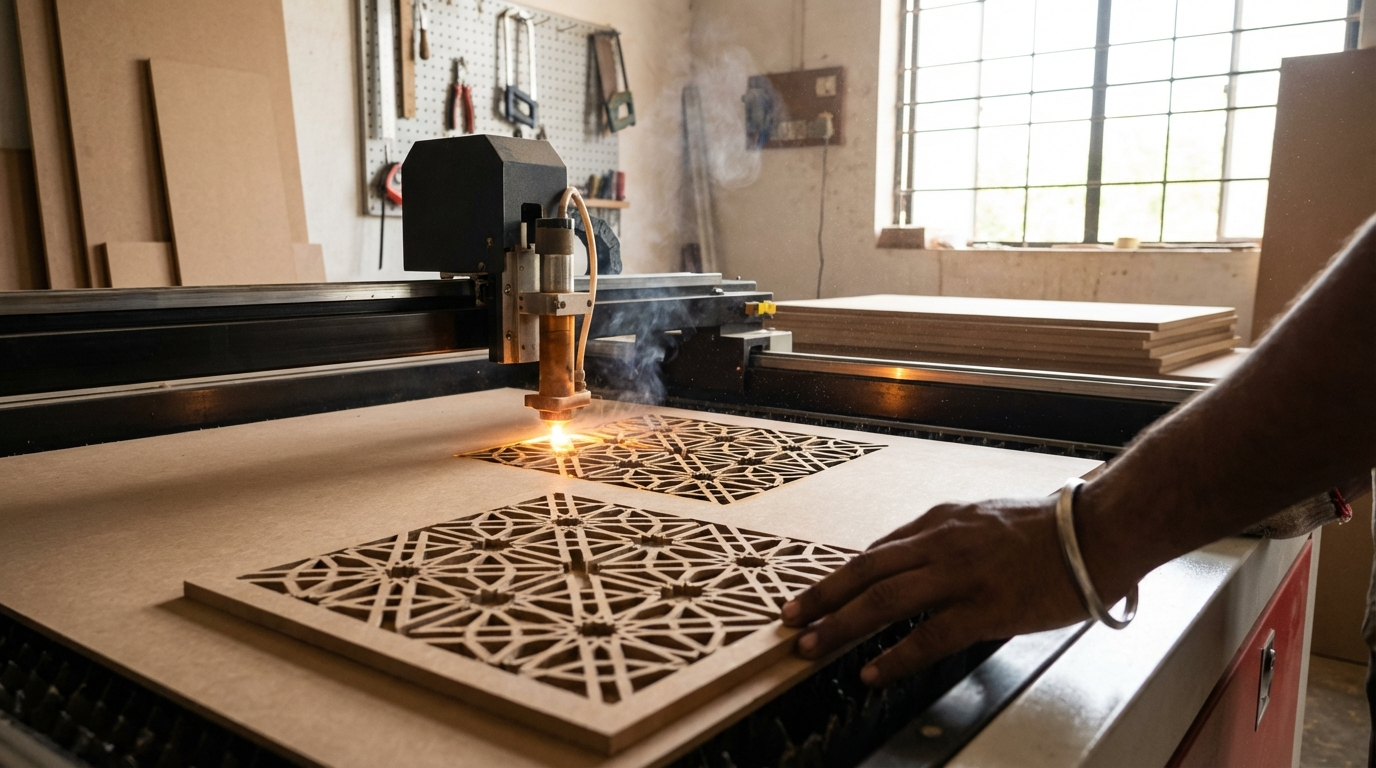
An MDF jali partition is a decorative screen featuring repetitive cut-out patterns created using CNC (Computer Numerical Control) routing. The term "jali" derives from traditional Indian lattice screens found in Mughal architecture, now reinterpreted in engineered materials.
Modern MDF jalis offer pattern precision impossible in hand-carved wood while costing 40-60% less. Common patterns include geometric grids, floral motifs, arabesque designs, and contemporary abstract shapes. The CNC process allows exact replication across multiple panels—critical for large installations requiring pattern continuity.
How Do Geometric Partition Designs Differ from Traditional Jali?
Geometric MDF partitions use angular shapes—rectangles, hexagons, triangles, and lines—arranged in modern compositions. Unlike traditional jali's organic, flowing patterns, geometric designs suit minimalist and contemporary interiors. They typically require less intricate cutting, reducing costs by 15-25% compared to elaborate jali work while providing a cleaner aesthetic.
What Are Combination Partition Designs?
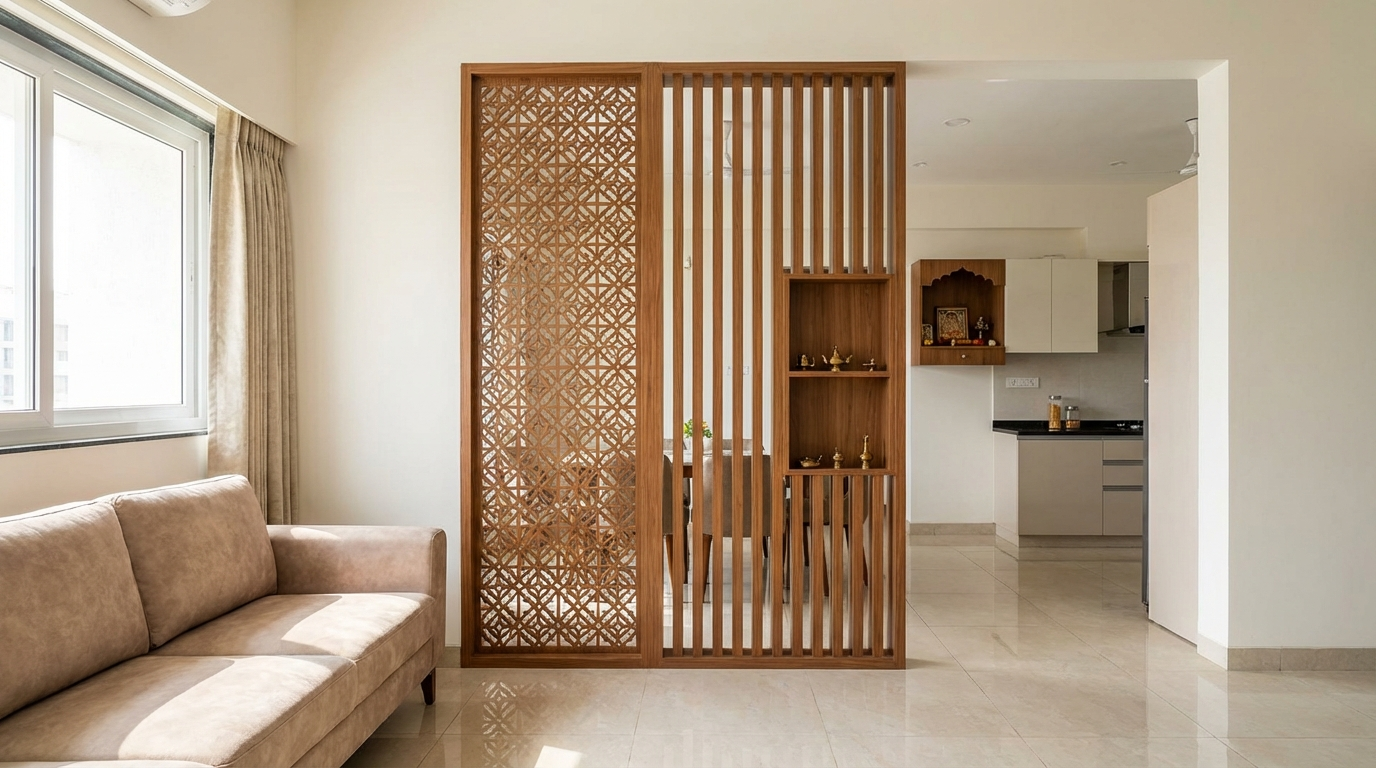
Combination designs integrate solid MDF sections with jali or cutout areas within a single partition. This approach creates functional zones—the solid portion might incorporate storage or display shelves, while the perforated section maintains visual connection. Popular in living-dining separations where some privacy is needed without complete visual blocking.
Creative MDF Partition Ideas by Room Type
Different rooms demand different partition approaches based on functional requirements, traffic patterns, and aesthetic goals.
Living Room to Dining Area Partitions
The living-dining separation is the most common residential partition application in Indian apartments. Effective designs balance visual continuity with spatial definition.
- Half-height breakfast counter with upper jali: Solid 900mm base with storage, topped by 600-900mm jali section
- Full-height geometric screen: Floor-to-ceiling geometric cutouts maintaining sightlines while defining zones
- Asymmetric composition: Varied solid and open sections creating dynamic visual interest
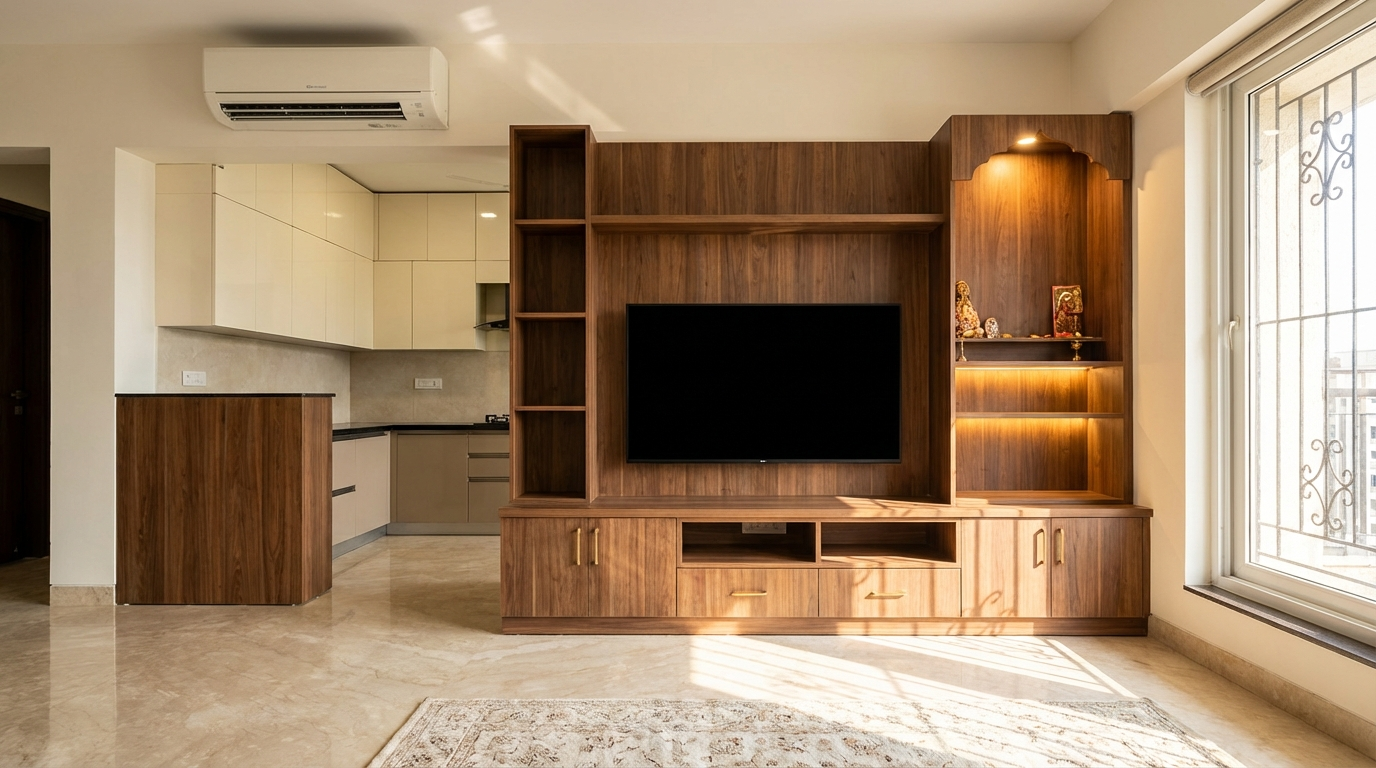
- Display unit partition: Open shelving integrated with solid back panels
Kitchen Partition Designs Using MDF
Kitchen partitions require moisture consideration and practical features like storage or pass-through openings. MR-grade MDF with proper lamination is essential.
- Breakfast bar partition: Counter-height divider with laminated top surface
- Service window frame: MDF surround with open pass-through for serving
- Ventilated upper section: Horizontal louver pattern allowing cooking odour dispersal
- Compact storage partition: Slim partition with built-in spice racks or display niches
Pooja Room Partition Concepts
Temple or pooja room partitions often incorporate traditional motifs while serving privacy and aesthetic functions. Design sensitivity to religious symbolism matters.
- Traditional temple-style jali: Ornate patterns inspired by South Indian temple architecture
- Om or lotus cutout panels: Religious symbols integrated into geometric backgrounds
- Backlit partition: LED strip behind MDF panel creating sacred ambiance
- Sliding temple doors: MDF panels with brass or copper inlay accents
Bedroom and Walk-in Wardrobe Dividers
Bedroom partitions typically require more privacy while maintaining design cohesion with furniture.
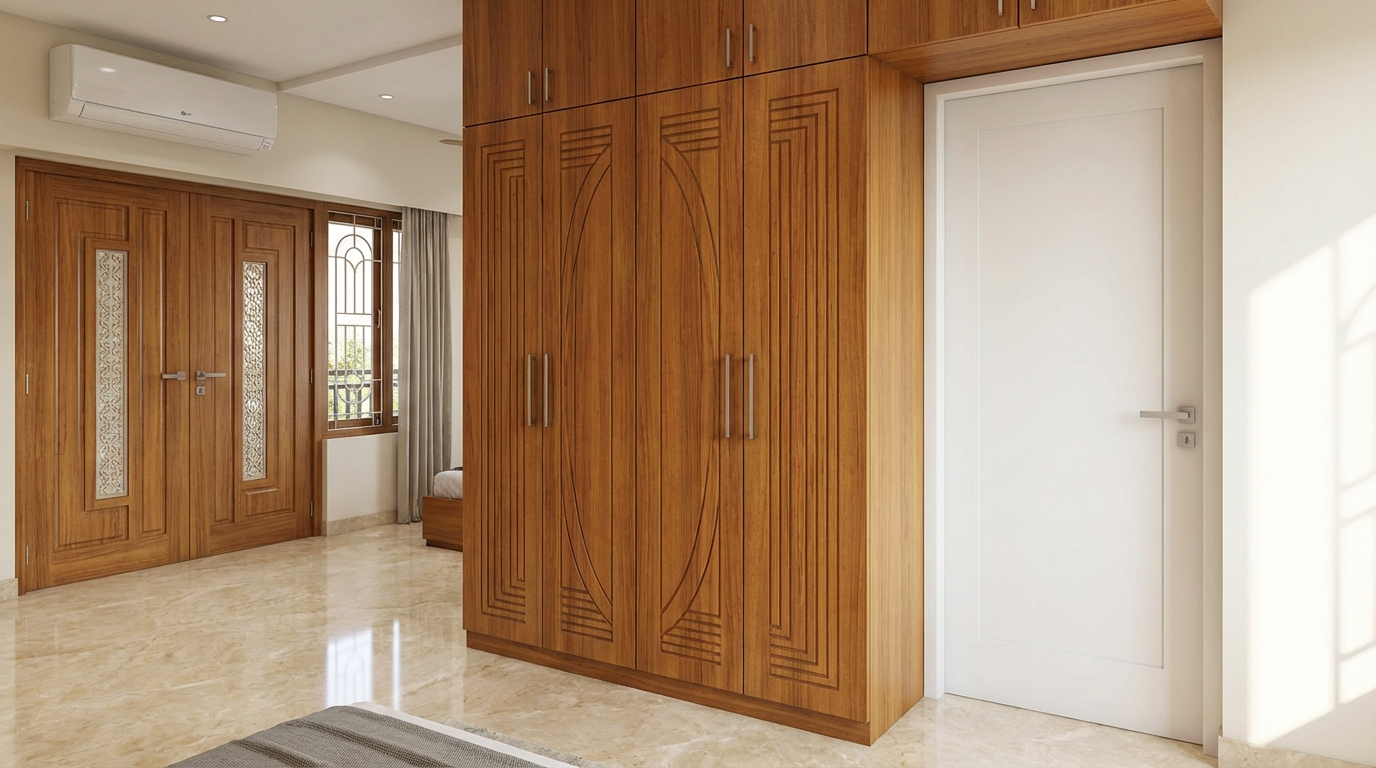
- Wardrobe-integrated partition: Floor-to-ceiling unit with storage on one side, finished panel on other
- Headboard partition: Extended headboard panel creating dressing area behind bed
- Translucent combination: MDF frame with frosted glass or acrylic inserts
Entryway and Foyer Screens
Entry partitions create welcome moments and prevent direct sightlines into living spaces—important in Vastu-conscious homes.
- Privacy screen with shoe storage: Functional base with decorative upper jali
- Mirror-integrated partition: MDF frame with full-length mirror and storage
- Open display partition: Shelving for plants, artifacts, creating gradual transition
Decision Framework: Which MDF Partition for Which Condition
| Condition/Requirement | Recommended Design | MDF Specification | What to Verify |
|---|---|---|---|
| High humidity area (coastal, kitchen) | Solid laminated or minimal cutout | MR-MDF 18mm, full edge banding | MR certification, laminate quality |
| Maximum light passage needed | Extensive jali or geometric grid | Plain MDF 12mm with PU finish | Pattern density, cut edge smoothness |
| Storage integration required | Combination solid + display | 18-25mm for shelving zones | Load-bearing reinforcement, hardware quality |
| Flexible space configuration | Sliding or folding panels | 12-18mm with quality track system | Track mechanism, panel alignment |
| Tight budget constraint | Simple geometric pattern | Pre-laminated MDF 12mm | Laminate adhesion, colour consistency |
| Premium aesthetic required | Detailed jali with backlighting | Plain MDF 12mm + veneer or PU | Veneer grain matching, LED driver quality |
| Child-safe environment | Rounded corners, no sharp cutouts | 18mm with E1 formaldehyde rating | Edge finish, formaldehyde certification |
| Quick installation timeline | Pre-laminated solid panels | Factory-cut to size | Accurate measurements, site readiness |
MDF Partition Thickness Guide
Selecting appropriate MDF thickness directly impacts partition stability, pattern clarity, and installation method.
When Should You Use 8-12mm MDF for Partitions?
Thin MDF (8-12mm) suits decorative applications where structural demands are minimal. Backlit panels, small jali inserts within frames, and lightweight decorative screens work well at these thicknesses. However, unsupported spans should not exceed 400-500mm to prevent warping or flexing. Always frame thin panels within solid MDF or metal structures for stability.
Why is 18mm MDF the Most Popular for Room Dividers?
At 18mm thickness, MDF provides the optimal balance of structural integrity, machining capability, and weight. CNC machines produce clean cuts at this thickness without burning or chipping. Screw-holding is adequate for most hardware, and unsupported spans can extend to 800-900mm with appropriate support. This thickness also matches standard edge banding profiles available in the Indian market.
When Does 25mm MDF Make Sense?
Heavy-duty applications requiring maximum stability or integrated shelving may warrant 25mm MDF. This thickness allows deeper routing for 3D effects and better supports mounted elements like TV brackets or heavy display objects. The weight increase is significant—approximately 40% heavier than 18mm—affecting installation logistics and floor/wall anchor requirements.
Price Ranges and Cost Factors for MDF Partitions
Note: Prices are indicative ranges and vary significantly by location, vendor, and market conditions. Always obtain current quotes from multiple suppliers.
Material Cost Breakdown
| Component | Price Range (2026) | Notes |
|---|---|---|
| Plain MDF 12mm (per sheet 8x4 ft) | ₹1,400-2,200 | Varies by brand and grade |
| Plain MDF 18mm (per sheet 8x4 ft) | ₹2,000-3,200 | E1 grade costs 15-20% more |
| MR-MDF 18mm (per sheet 8x4 ft) | ₹2,800-4,500 | Essential for humid areas |
| Pre-laminated MDF 18mm (per sheet) | ₹3,500-5,500 | Depends on laminate quality |
| CNC cutting (per running ft) | ₹50-150 | Complex patterns cost more |
| PU paint finish (per sq ft) | ₹80-180 | Includes primer and 2 coats |
| Edge banding (per running ft) | ₹15-40 | PVC or ABS options |
Budget Estimation Example
Scenario: 8 ft wide × 7 ft tall living-dining partition with geometric jali pattern
- Total area: 56 sq ft (approximately 1.75 sheets of MDF)
- MDF 18mm plain: ₹4,000-5,600
- CNC cutting (assuming 100 ft routing): ₹5,000-15,000
- PU paint finish: ₹4,500-10,000
- Edge finishing: ₹1,500-3,000
- Hardware and framing: ₹2,000-5,000
- Installation labour: ₹3,000-8,000
- Total estimated range: ₹20,000-47,000
This wide range reflects differences in pattern complexity, finish quality, and regional labour rates.
Installation Methods and Structural Considerations
How Are Floor-Mounted MDF Partitions Installed?
Floor-mounted partitions require a base frame—typically metal channel or wooden battens—anchored to the floor. The MDF panel attaches to this frame using concealed screws or brackets. For partitions exceeding 6 ft in height, top anchoring to the ceiling or a concealed header beam prevents forward/backward movement.
Critical installation checks:
- Floor level verification before frame installation
- Adequate anchor depth in concrete (minimum 50mm for expansion bolts)
- Plumb alignment of vertical frame members
- Gap provision for thermal expansion (typically 3-5mm at edges)
What About Ceiling-Suspended Partitions?
Suspended partitions hang from ceiling tracks, allowing flexible configurations and easier floor cleaning. This method works best for lighter panels (12mm) and moderate spans (under 1200mm width per panel). Ceiling structure must be verified—false ceiling grids cannot support partition weight without additional backing.
Can MDF Partitions Be Freestanding?
Freestanding MDF partitions require weighted bases or outrigger feet to prevent tipping. This configuration suits temporary installations or rental spaces where permanent anchoring isn't possible. Panel height should not exceed 5-6 feet for stability, and width should be proportional to prevent wind-sailing effects from fans or AC airflow.
Common Buyer Mistakes and How to Avoid Them
- Ignoring moisture grade requirements: Specifying plain MDF for kitchen or near-bathroom partitions leads to edge swelling within 1-2 years. Always insist on MR-grade for any area with elevated humidity.
- Underestimating pattern density impact: Highly intricate jali patterns with excessive cutouts weaken the panel structurally. Maintain minimum "web" width of 15-20mm between cutouts for 18mm MDF.
- Skipping edge banding on cutout edges: CNC-cut edges expose raw MDF core to moisture absorption. Budget for edge sealing or accept accelerated deterioration.
- Choosing based on showroom lighting: Backlighting in showrooms flatters jali patterns; your home lighting may reveal cut imperfections. Request samples under natural light before final approval.
- Not verifying CNC file resolution: Low-resolution design files produce rough, stepped cuts instead of smooth curves. Ensure vector files at appropriate resolution for the cutting machine.
- Forgetting maintenance access: Fixed partitions blocking access to electrical panels, plumbing shutoffs, or AC units create problems later. Map services before finalizing partition locations.
- Over-relying on carpenter design capability: Most site carpenters execute designs but lack sophisticated pattern creation skills. Source designs from dedicated designers or CNC vendors.
- Accepting delivery without inspection: Warped panels, surface scratches, and edge damage often go unnoticed at delivery. Inspect each panel before the delivery vehicle leaves.
- Mismatching hardware quality: Premium MDF partition with cheap hinges or tracks fails at connection points first. Allocate 15-20% of budget for quality hardware.
- Ignoring expansion gaps: MDF expands slightly with humidity changes. Partitions butted tightly against walls or ceilings may buckle. Always leave 3-5mm expansion gaps.
Failure Modes and How to Prevent Them
Edge Swelling and Delamination
Symptom: Edges become soft, expand visibly, and laminate starts peeling
Root cause: Moisture absorption through unsealed edges, wrong MDF grade for environment
Prevention: Specify MR-MDF, ensure complete edge banding, seal all CNC cut edges
Fix if occurring: No effective repair; replacement needed. Improve ventilation and seal edges on replacement panels.
Panel Warping and Bowing
Symptom: Partition curves outward or inward, gaps appear at frame connections
Root cause: Unequal moisture exposure (one side air-conditioned, other side humid), inadequate framing
Prevention: Apply same finish both sides, provide adequate framing support, maintain consistent environment
Fix if occurring: Add counter-battens on convex side; severe cases require panel replacement.
Screw Pull-Out Failure
Symptom: Mounted elements (shelves, brackets) come loose, screw holes enlarge
Root cause: Direct screwing into MDF edge grain, undersized screws, repeated adjustment
Prevention: Use metal inserts for adjustable hardware, specify longer screws into face grain, pre-drill correctly
Fix if occurring: Install larger metal inserts with epoxy, reinforce with backing plates.
Paint Peeling and Bubbling
Symptom: Paint lifts from surface, bubbles form especially near edges
Root cause: Inadequate sealing/priming, moisture trapped in MDF, incompatible paint system
Prevention: Apply MDF-specific sealer, allow full drying before topcoat, use compatible primer-paint system
Fix if occurring: Complete stripping required; spot touch-up rarely succeeds on MDF.
CNC Pattern Cracking
Symptom: Thin sections between cutouts develop cracks, pieces break off
Root cause: Pattern design with inadequate web width, impact damage, thermal stress
Prevention: Maintain minimum 15-20mm web width, handle carefully during transport/installation
Fix if occurring: Wood filler for hairline cracks; broken pieces require panel section replacement.
Colour Fading and Yellowing
Symptom: White or light-coloured finishes turn yellow, colours fade unevenly
Root cause: UV exposure, heat from adjacent fixtures, low-quality paint/laminate
Prevention: Use UV-resistant finishes, maintain distance from heat sources, specify quality materials
Fix if occurring: Complete refinishing or laminate replacement required.
Quality Checks Without Lab Tests
Before Buying MDF Sheets
- Visual inspection: Check for surface dents, scratches, and discolouration across the full sheet
- Edge examination: Look for delamination layers, voids, or inconsistent density at cut edges
- Flatness test: Place sheet on flat surface; gaps exceeding 3-4mm indicate warping
- Weight comparison: Significantly lighter sheets may indicate lower density (poorer quality)
- Questions to ask: Manufacturing date (avoid sheets over 6 months old), storage conditions, grade certification
- Red flags: Musty smell (moisture damage), powdery surface (degradation), inconsistent colour across sheet
After CNC Cutting
- Cut edge quality: Edges should be smooth, not burnt or fuzzy; burnt edges indicate wrong settings
- Pattern accuracy: Compare to approved design; check symmetry and dimension consistency
- Core visibility: Uniform density visible at cut; voids or inclusions indicate quality issues
- Thickness consistency: Measure at multiple points; variation exceeding 0.5mm is problematic
After Installation
- Alignment verification: Use level/plumb on all edges; check gap consistency at connections
- Sealing completeness: No visible raw edges; all cut surfaces should be sealed or banded
- Hardware function: Doors/panels should move freely without binding; closures should align
- Finish inspection: Check for missed spots, drips, orange peel, or dust contamination in paint
Tips by User Type
For Homeowners
- Durability expectations: Well-made MDF partitions last 8-15 years with proper care; expect refinishing every 5-7 years for painted surfaces
- Cleaning protocol: Dust with dry microfibre cloth weekly; damp wipe only with well-wrung cloth; never saturate
- When to worry: Soft or spongy feel at edges, persistent musty odour, visible mould growth, laminate lifting
- Minor repairs: Fill small dents with wood filler, touch up scratches with matching paint pen
- Avoid: Harsh chemical cleaners, pressure washing, steam cleaning, mounting heavy objects without proper anchors
For Carpenters and Fabricators
- Cutting tips: Use carbide-tipped blades with 60+ teeth; reduce feed rate on intricate patterns; support panel fully during cuts
- Edge preparation: Sand CNC edges lightly (180-220 grit) before edge banding; remove all dust before adhesive application
- Screw zones: Pre-drill pilot holes at 80% screw diameter; maintain 25mm minimum from edges; use thread-forming screws
- Hinge mounting: Route hinge recesses accurately; use cup hinges with metal backing plates in MDF
- Handling: Store flat on full support; avoid point loads; protect faces during transport with cardboard interleaving
- Finishing sequence: Seal all surfaces including backs before installation; this prevents unequal moisture uptake
For Architects and Interior Designers
- Specification language: Include grade (MR/Plain/FR), thickness, density rating, formaldehyde class (E1/E0), and brand in BOQ
- Wet-zone detailing: Specify MR-grade minimum; add explicit edge sealing requirements; detail junction with flooring to prevent wicking
- Finish selection: Pre-laminated for economy projects; PU paint for colour matching; veneer for premium residential; powder-coated metal frames for commercial
- Design file standards: Provide CNC-ready vector files (DXF/DWG); confirm machine compatibility with fabricator; specify corner radius preferences
- Site coordination: Schedule MDF installation after wet works complete and AC commissioned; specify storage requirements during construction phase
For Modular and OEM Manufacturers
- QC checkpoints: Incoming material inspection, post-CNC dimensional check, pre-dispatch surface inspection, loading protection verification
- Reducing complaints: Full edge banding on all panels regardless of visibility; consistent batch sourcing; humidity-controlled storage
- Batch consistency: Source from single manufacturer per project; verify lot numbers match; compare samples across sheets
- Transport protection: Edge protectors, stretch wrapping, blanket separation between panels, secure stacking to prevent shift
- Documentation: Include material certificates, care instructions, and warranty terms with every delivery
Maintaining MDF Partitions in Indian Conditions
Seasonal Care Considerations
Pre-monsoon (April-May): Inspect all edges for existing damage; apply additional sealer if edge banding shows gaps; ensure room ventilation paths are clear
During monsoon (June-September): Increase ventilation frequency; avoid wet mopping near partition bases; watch for condensation on AC-cooled side of partitions
Post-monsoon (October-November): Check for any swelling or warping that developed; address immediately before permanent damage sets in
Summer (March-May): Keep away from direct sunlight to prevent fading and differential expansion; maintain consistent AC operation if installed
Long-term Maintenance Schedule
- Weekly: Dust removal with dry cloth
- Monthly: Inspect edges and joints for damage; check hardware function
- Annually: Deep cleaning with appropriate products; touch up minor scratches; lubricate moving parts
- Every 5-7 years: Evaluate refinishing needs for painted partitions; check structural integrity
MDF Partition Design Trends in 2026
Current Indian interior design trends are shaping MDF partition aesthetics and applications:
- Fluted and ribbed patterns: Vertical groove patterns replacing flat surfaces for texture
- Mixed material combinations: MDF frames with metal mesh, rattan inserts, or glass panels
- Biophilic elements: Leaf and botanical patterns reflecting nature connection trends
- Backlit features: LED integration within jali creating ambient lighting effects
- Earthy colour palettes: Moving beyond white and wood tones to terracottas, olives, and warm neutrals
- Multifunctional integration: Partitions incorporating planters, charging stations, display niches
Frequently Asked Questions
What is the best thickness for MDF partition designs in Indian homes?
For most residential MDF partition designs, 18mm thickness provides optimal balance between structural stability and design flexibility. This thickness allows CNC machines to create clean cuts for jali patterns while maintaining adequate strength for floor-to-ceiling installations. Use 12mm only for framed decorative panels or backlit applications, and consider 25mm when integrating shelving or mounting heavy objects. In humid coastal cities, always combine appropriate thickness with MR-grade specification.
Can MDF partitions be used in kitchens without getting damaged?
MDF partitions can function effectively in kitchens when proper specifications are followed. Use only MR-grade (Moisture Resistant) MDF, ensure complete edge banding including CNC cut edges, apply waterproof laminate or marine-grade paint, and maintain minimum 100mm distance from cooking areas. Even with these precautions, avoid placing MDF partitions directly adjacent to sinks or dishwashers where water splash is frequent. Regular inspection of edges during monsoon months helps catch early damage before it spreads.
How much does an MDF jali partition cost in India?
MDF jali partition costs typically range from ₹300-600 per square foot installed, depending on pattern complexity, MDF grade, finish quality, and regional labour rates. Simple geometric patterns at the lower end, intricate traditional jali at higher end. A typical 8x7 feet living-dining partition may cost between ₹20,000-50,000 complete. Pre-laminated options reduce cost by 15-20% compared to painted finishes. Always obtain itemized quotes separating material, CNC cutting, finishing, and installation to understand cost drivers.
What is the difference between MR-MDF and normal MDF for partitions?
MR-MDF (Moisture Resistant MDF) contains special resin formulation that significantly reduces water absorption and swelling compared to standard MDF. While standard MDF may swell 10-15% in thickness when exposed to humidity, MR-grade typically limits this to 3-5%. The difference becomes critical in coastal cities, kitchen applications, or any space with inconsistent air conditioning. MR-MDF costs approximately 30-50% more than standard grade but offers substantially longer service life in Indian humidity conditions.
How long do MDF partitions typically last in Indian conditions?
Properly specified and maintained MDF partitions last 10-15 years in controlled indoor environments with consistent air conditioning. In naturally ventilated spaces with monsoon exposure, expect 6-10 years depending on location and maintenance. Key longevity factors include initial material grade selection, complete edge sealing, appropriate finish system, and ongoing moisture management. Painted finishes may require refreshing every 5-7 years, while quality laminates often last the full partition lifespan without major intervention.
Can MDF partitions support mounted TVs or shelves?
MDF partitions can support mounted elements when properly reinforced. For TVs, install backing boards (additional MDF or plywood layer) behind mounting points, use metal inserts or toggle bolts rather than direct screws, and ensure partition framing can handle the load. Shelving requires similar consideration—specify 18-25mm MDF for shelf spans under 600mm, add support brackets for longer spans, and limit weight to 15-20 kg per 600mm span. Never mount heavy items to thin jali sections or near extensive cutout areas.
What finish options work best for MDF partition panels?
Finish selection depends on budget, aesthetic goals, and environmental conditions. Pre-laminated MDF offers economical, durable surfaces with consistent quality. PU (Polyurethane) paint provides unlimited colour options and smooth finishes but requires skilled application. Veneer suits premium residential applications wanting natural wood appearance. Membrane or vacuum-pressed finishes create seamless wraparound surfaces. For humid areas, laminate and PU paint outperform veneer. For high-traffic areas, commercial-grade laminates resist scratching better than paint.
How do I maintain MDF partition designs during monsoon season?
Monsoon maintenance for MDF partitions requires proactive attention. Increase ventilation to prevent moisture buildup, especially in non-AC spaces. Avoid wet mopping near partition bases—wipe up any water immediately. Run dehumidifiers in coastal areas during peak humidity days. Inspect edges weekly for early signs of swelling and address immediately. Never store wet items (umbrellas, mops) against MDF surfaces. If swelling begins, improve ventilation and consider sealing affected edges with additional sealant after drying.
Are MDF partitions safe for children's rooms considering formaldehyde concerns?
Modern MDF manufactured to E1 or E0 standards has formaldehyde emissions within safe limits for residential use, including children's rooms. E1 grade (maximum 0.1 ppm emissions) is standard in quality MDF; E0 (maximum 0.05 ppm) offers even lower emissions. Request certification from the supplier confirming emission class. Additional safety comes from proper finishing—sealed and painted MDF emits significantly less than raw material. For maximum safety consciousness, specify E0 grade and ensure all surfaces including backs are sealed before installation.
What is the difference between CNC-cut and laser-cut MDF jali partitions?
CNC routing uses rotating cutting tools and suits MDF well, producing clean cuts at appropriate thicknesses (12-25mm) without burning. Laser cutting uses focused heat and works better on thinner materials (up to 12mm MDF); thicker materials may show burnt edges requiring additional finishing. CNC allows for 3D profiling and varying depths; laser produces only through-cuts. For most residential MDF partitions, CNC routing offers better results and more design flexibility. Laser cutting may suit very intricate, thin decorative panels where CNC limitations become apparent.
Can I paint an existing laminated MDF partition a different colour?
Painting over laminated MDF is possible but requires proper preparation for adhesion. Sand the laminate surface lightly with 180-220 grit to create tooth, clean thoroughly to remove dust and oils, apply adhesion-promoting primer specifically designed for laminates, then topcoat with appropriate paint. Results vary—high-gloss laminates are harder to paint successfully than matte finishes. This process works for colour changes but rarely matches the durability of original laminate or properly applied paint on raw MDF. Consider this approach for temporary updates rather than long-term solutions.
How do sliding MDF partition panels compare to fixed installations?
Sliding MDF partitions offer spatial flexibility—opening to expand areas for entertaining, closing for privacy—but require quality track systems costing ₹2,000-8,000 per metre depending on capacity and design. Fixed partitions provide greater stability, easier installation, and lower cost. Sliding panels are limited to lighter weights (12-18mm MDF) and require perfectly level floors or ceiling-mounted tracks. For Indian homes, sliding works well in living-dining separations where occasional full openness is desired; fixed installations suit permanent room definitions and areas requiring mounted elements.
Note: This is independent informational content and is not affiliated with any manufacturer. Always verify current prices, specifications, and suitability with qualified professionals before making purchase decisions.
Disclaimer: This content is provided for general informational purposes based on industry practices and publicly available information. Product specifications, standards, prices, and availability may vary by manufacturer, region, and time. Readers should independently verify details with manufacturers, dealers, or qualified professionals before making purchase or construction decisions.Want Plywood Suggestions?
Share a few details and a VIR MDF specialist will suggest suitable brands and connect you to responsive dealers.