Advertise Your Brand! Contact Us
How-To15 Jan 2026

How to Cut MDF Board at Home: Tools, Techniques & Safety Tips

How to cut MDF board at home: best tools, cutting techniques & safety tips. Step-by-step guide for clean cuts without chipping.

How to Cut MDF Board at Home: Tools, Techniques & Safety Tips

Quick Answer: To cut MDF board at home, use a circular saw with a fine-toothed carbide blade (60-80 teeth), set blade depth to 3mm beyond the board thickness, apply masking tape along the cut line to prevent chipping, and always wear a dust mask rated N95 or higher. For curved cuts, use a jigsaw with 12-14 TPI blade. Score the cut line with a utility knife before sawing for cleanest results.

Quick Decision Summary

Cutting MDF board at home requires the right tools, proper technique, and essential safety precautions. Whether you're building kitchen cabinets, installing wardrobes, or creating custom furniture, mastering MDF cutting will save you money and give you professional results.

If you're in a hurry: Use a circular saw with a 60-80 tooth carbide blade for straight cuts. Apply masking tape on both sides of the cut line, score with a utility knife first, and cut with the good side facing up. Always wear an N95 dust mask—MDF dust contains formaldehyde resins that are harmful when inhaled. Work outdoors or ensure excellent ventilation.

Choose this cutting method if:

  • You need straight cuts on 8x4 ft sheets → Circular saw with guide rail
  • You're cutting curves or shapes → Jigsaw with fine-tooth blade
  • You need precise, repeatable cuts → Table saw with zero-clearance insert
  • You're working with thin MDF (3-6mm) → Utility knife with multiple passes

Avoid DIY cutting if:

  • You don't have proper respiratory protection
  • Your workspace lacks ventilation or dust extraction
  • You need CNC-precision cuts for modular furniture
  • You're cutting pre-laminated MDF without experience (high chipping risk)

What Cutting MDF Board Actually Means

Cutting MDF board refers to the process of sizing Medium Density Fibreboard sheets to specific dimensions using hand tools or power tools. Unlike natural wood, MDF is an engineered panel made from compressed wood fibres bound with urea-formaldehyde resin, resulting in a uniform density throughout the board—typically 650-850 kg/m³.

This uniform density makes MDF behave differently from plywood or solid wood during cutting:

  • No grain direction: You can cut in any direction without worrying about splitting along the grain
  • Fine dust production: MDF creates extremely fine particles that require superior dust control
  • Edge quality: Cut edges are porous and absorb moisture readily
  • Blade wear: The resin content dulls blades faster than natural wood

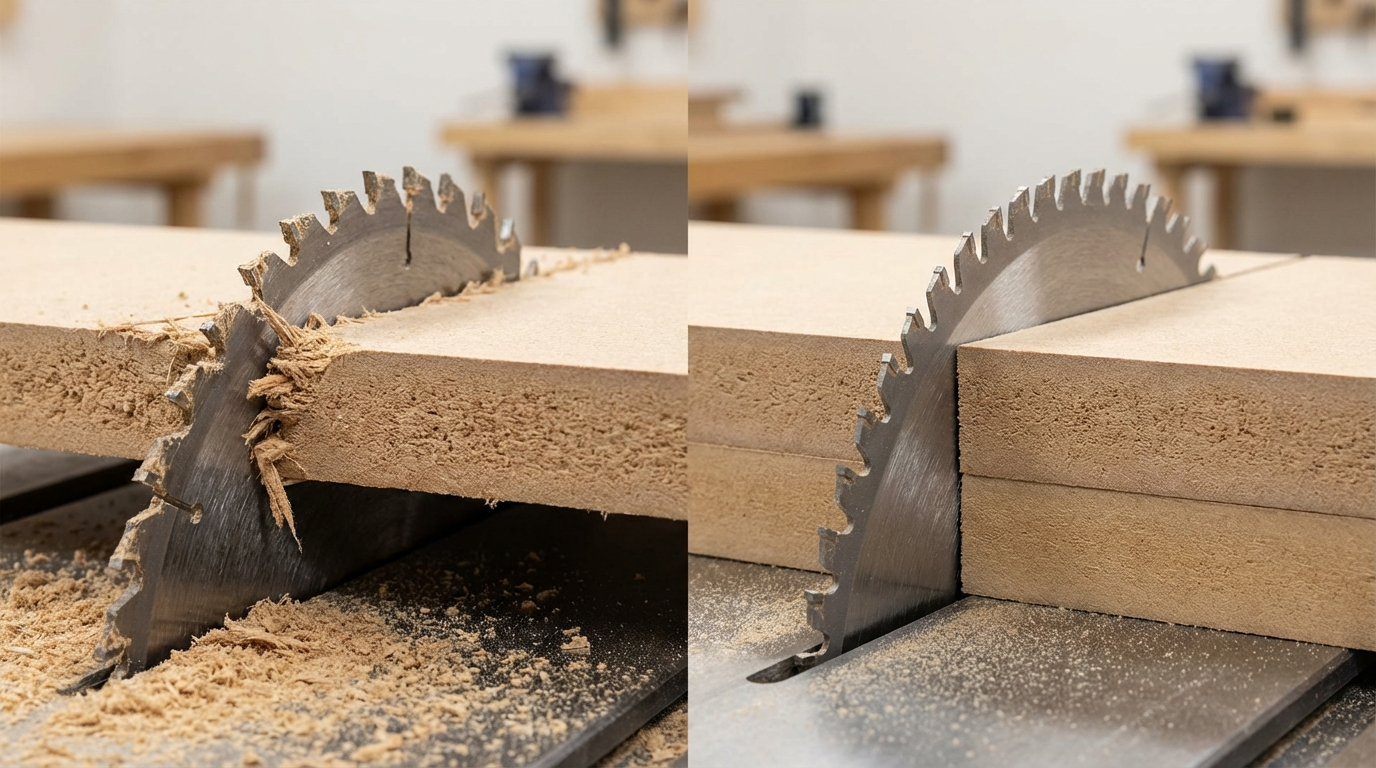
Common confusion clarified: Many people assume MDF cuts like plywood—it doesn't. Plywood has alternating grain layers that resist chipping differently. MDF chips when the blade teeth exit the material, regardless of direction, making technique more important than cut orientation.

Why Proper MDF Cutting Matters for Indian Homes

In India's climate conditions, how you cut MDF directly impacts its long-term performance. Poor cutting technique creates exposed edges that act as moisture entry points—critical during monsoon months (June-September) when relative humidity often exceeds 80% in coastal and humid regions.

Monsoon and humidity impact:

  • Rough-cut edges absorb 3-5x more moisture than factory edges
  • Swelling typically starts within 48-72 hours of exposure to high humidity
  • Delamination and edge bulging common in poorly cut panels
  • AC cycling (on-off) creates moisture fluctuations that stress cut edges

Real consequences of poor cutting:

  • Wardrobe shutters that won't close properly after one monsoon
  • Kitchen cabinet edges swelling near sink and cooking areas
  • TV unit backs developing wavy surfaces
  • Screw joints loosening due to edge degradation

Site handling realities in India:

  • MDF sheets often stored on construction sites exposed to dust and moisture
  • Carpenter workshops may lack proper dust extraction
  • Edge sealing often skipped to save time and cost
  • Transport damage from rough handling creates stress points

Essential Tools for Cutting MDF Board

Selecting the right tool depends on your cut type, MDF thickness, and available workspace. Here's a comprehensive breakdown for Indian DIYers and carpenters:

Tool Best For MDF Thickness Range Blade Specification Approximate Cost Range (India)
Circular Saw Long straight cuts, breaking down sheets 6mm - 25mm 60-80 teeth, carbide-tipped ₹2,500 - ₹15,000
Jigsaw Curves, cutouts, intricate shapes 6mm - 18mm 12-14 TPI, downward teeth ₹1,800 - ₹8,000
Table Saw Precise repeatable cuts, ripping 6mm - 25mm 60-80 teeth, zero-clearance insert ₹8,000 - ₹45,000
Hand Saw Small cuts, no power access 6mm - 12mm 11+ TPI, fine-tooth panel saw ₹300 - ₹1,500
Utility Knife Thin MDF, scoring 3mm - 6mm Sharp snap-off blade ₹100 - ₹500
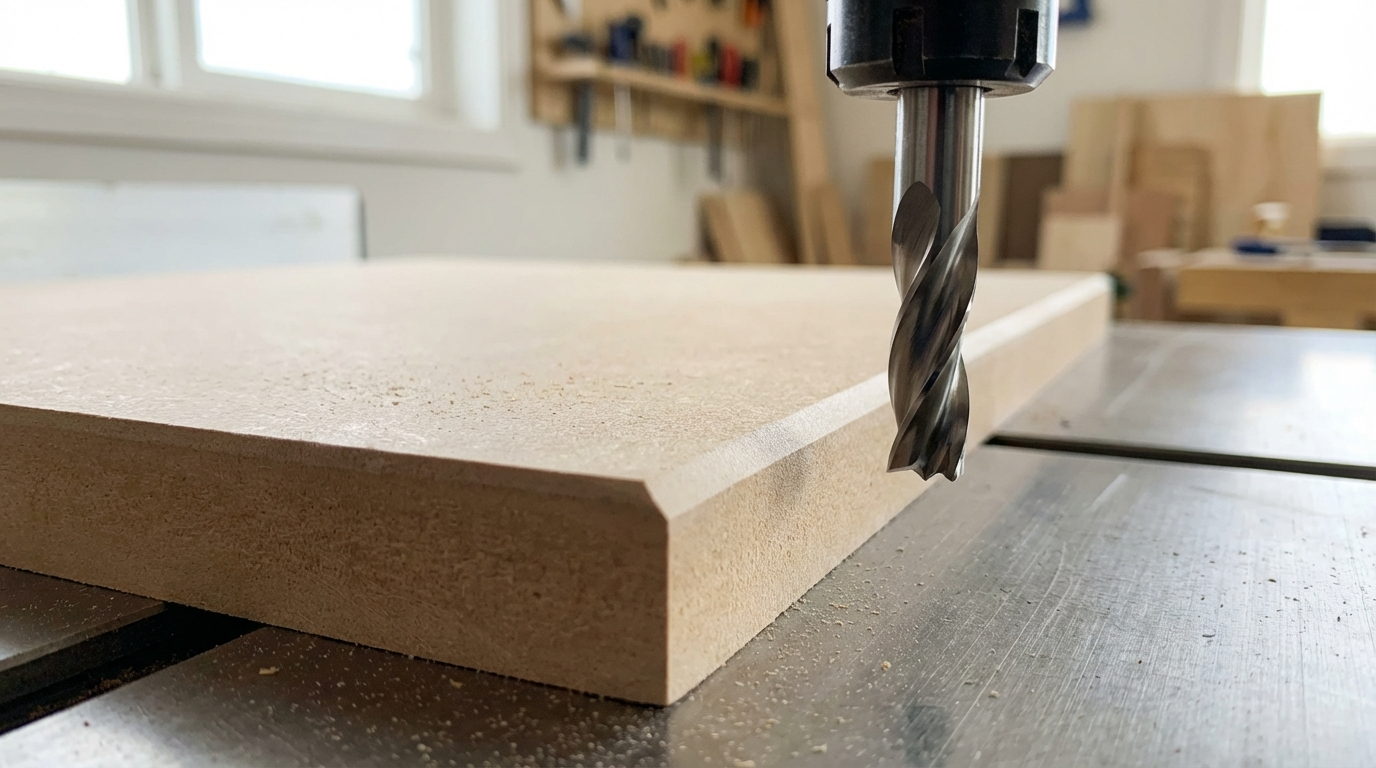
Router Edge profiles, dadoes, patterns 6mm - 25mm Carbide spiral upcut bit ₹3,500 - ₹20,000

What blade specifications actually mean for MDF cutting?

The tooth count on your blade directly affects cut quality. For MDF, higher tooth counts (60-80 teeth on a 185mm blade) create finer cuts with less chipping. However, more teeth generate more friction and heat, which can burn the resin in MDF. The solution: maintain steady feed speed—neither too fast (chipping) nor too slow (burning).

Carbide-tipped blades last 5-10x longer than steel blades when cutting MDF because the resin content rapidly dulls conventional steel. Investing in quality carbide blades—typically ₹800-₹2,500 per blade—saves money long-term and produces cleaner cuts.

Why do Indian carpenters often use lower-quality blades?

Cost sensitivity and availability drive blade choices at local hardware stores. However, using a ₹200 steel blade that dulls after two sheets versus a ₹1,200 carbide blade lasting twenty sheets makes the carbide option more economical. The real cost is in rework—a chipped edge on a pre-laminated panel means replacing the entire sheet.

Step-by-Step Guide: Cutting MDF with Power Tools

How to cut straight lines with a circular saw

This is the most common method for breaking down 8x4 ft MDF sheets into workable sizes for furniture and cabinets.

Step 1: Prepare your workspace

  • Set up two sawhorses with the MDF sheet fully supported
  • Ensure no sagging in the middle of the sheet
  • Position the cut line so the waste piece falls away freely
  • Check ventilation—work outdoors or set up dust extraction

Step 2: Mark and tape the cut line

  • Measure twice using a steel tape measure
  • Mark with a sharp pencil or marking knife
  • Apply masking tape along both sides of the cut line (2-inch wide tape works well)
  • Re-mark the line on top of the tape

Step 3: Set blade depth correctly

  • Blade should extend 3mm beyond the MDF thickness—no more
  • For 18mm MDF, set blade depth to 21mm
  • Excessive blade depth increases chipping and reduces control

Step 4: Clamp a straight edge guide

  • Use a factory edge from another sheet or a dedicated guide rail
  • Measure the distance from blade to saw base edge
  • Position guide exactly that distance from your cut line
  • Clamp firmly at both ends—movement during cutting ruins the line

Step 5: Score before cutting (optional but recommended)

  • Run a utility knife along the cut line with firm pressure
  • Make 2-3 passes to create a groove 1-2mm deep
  • This breaks surface fibres cleanly before the saw blade arrives

Step 6: Make the cut

  • Start the saw and let it reach full speed before contact
  • Begin slowly to establish the cut groove
  • Maintain steady, consistent pressure—don't force the saw
  • Let the saw weight and blade do the work
  • Keep the base plate flat against the guide throughout

Step 7: Support the offcut

  • Have a helper support the waste piece as you finish
  • Never let the cut piece fall—it can bind the blade or splinter
  • For solo work, position supports to catch the offcut

How to cut curves with a jigsaw

Jigsaws excel at curved cuts for speaker cutouts, decorative panels, and furniture components with rounded corners.

Preparation:

  • Transfer your pattern to the MDF using a template or direct marking
  • Apply masking tape over the entire cut area
  • For interior cutouts, drill a 10mm starter hole inside the waste area

Blade selection:

  • Use 12-14 TPI (teeth per inch) blades for smooth cuts
  • Choose blades with downward-pointing teeth—these push material down, reducing top-surface chipping
  • For tight curves under 25mm radius, use narrower blades (6mm width)

Cutting technique:

  • Set jigsaw to low pendulum action or no pendulum for smoothest cuts
  • Start slowly to establish the cut
  • Let the blade do the cutting—forcing causes blade wander
  • For tight curves, make relief cuts perpendicular to your line up to the curve
  • Remove waste sections progressively to reduce binding

How to achieve precision cuts with a table saw

Table saws provide the most accurate, repeatable cuts—essential for modular furniture components where parts must fit precisely.

Setup requirements:

  • Verify fence is perfectly parallel to blade (use a dial indicator if available)
  • Install a zero-clearance insert to prevent chip-out at the cut line
  • Set blade height to 3mm above MDF thickness
  • Position outfeed support for sheets longer than the table

Cutting procedure:

  • Stand to the side, never directly behind the blade
  • Feed material at steady pace—hesitation causes burning
  • Use push sticks for cuts narrower than 150mm
  • Never reach over the spinning blade
  • Let cut pieces clear before reaching to collect them

Cutting MDF Without Power Tools

Not everyone has access to power tools, and sometimes hand cutting is the practical choice for small projects or when working in spaces without electricity.

How to cut MDF with a hand saw

A fine-toothed panel saw (11+ TPI) can cut MDF effectively for smaller projects.

Technique:

  • Clamp a straight edge guide along your cut line
  • Start the cut with the saw at 45 degrees
  • Use long, smooth strokes—short choppy strokes create rough edges
  • Let the saw weight do the cutting work
  • Maintain 45-degree angle throughout for better control
  • Support the cut section to prevent breakout at the end

Limitations:

  • Tiring for cuts longer than 60cm
  • Difficult to maintain perfectly straight lines over long distances
  • Not practical for thick MDF (18mm+) or multiple cuts

How to cut thin MDF with a utility knife

For MDF sheets 6mm or thinner, a utility knife can create clean cuts without sawdust.

Method:

  • Mark your line precisely with a steel straightedge
  • Hold the straightedge firmly—it must not move during scoring
  • Make 5-8 passes with firm pressure, cutting progressively deeper
  • Each pass should follow exactly the same line
  • Once scored halfway through thickness, carefully snap along the line
  • Support both sides evenly during snapping to prevent ragged edges

Best applications:

  • Wardrobe backing panels (3-4mm MDF)
  • Cabinet back panels
  • Template making
  • Small craft projects

Preventing Common MDF Cutting Problems

Understanding failure modes helps you prevent them before they ruin your workpiece.

Why does MDF chip during cutting?

Chipping occurs when blade teeth exit the material and tear fibres instead of cutting them cleanly. This happens due to dull blades, incorrect blade type, excessive speed, or unsupported material edges. The solution involves multiple prevention strategies: use sharp carbide blades, apply masking tape, score before cutting, support both sides of the cut, and cut with the good side facing up (for circular saws) or down (for table saws with upward-cutting blades).

What causes burn marks on MDF edges?

Burn marks result from friction heat generated when the blade dwells too long in one spot or when feeding too slowly. The resin in MDF has a low combustion point—extended contact with spinning blade teeth generates enough heat to scorch the material. Solutions include maintaining steady feed rate, ensuring blade sharpness, checking blade alignment, and using blade lubricant or wax on larger cuts.

How to prevent MDF edge swelling after cutting?

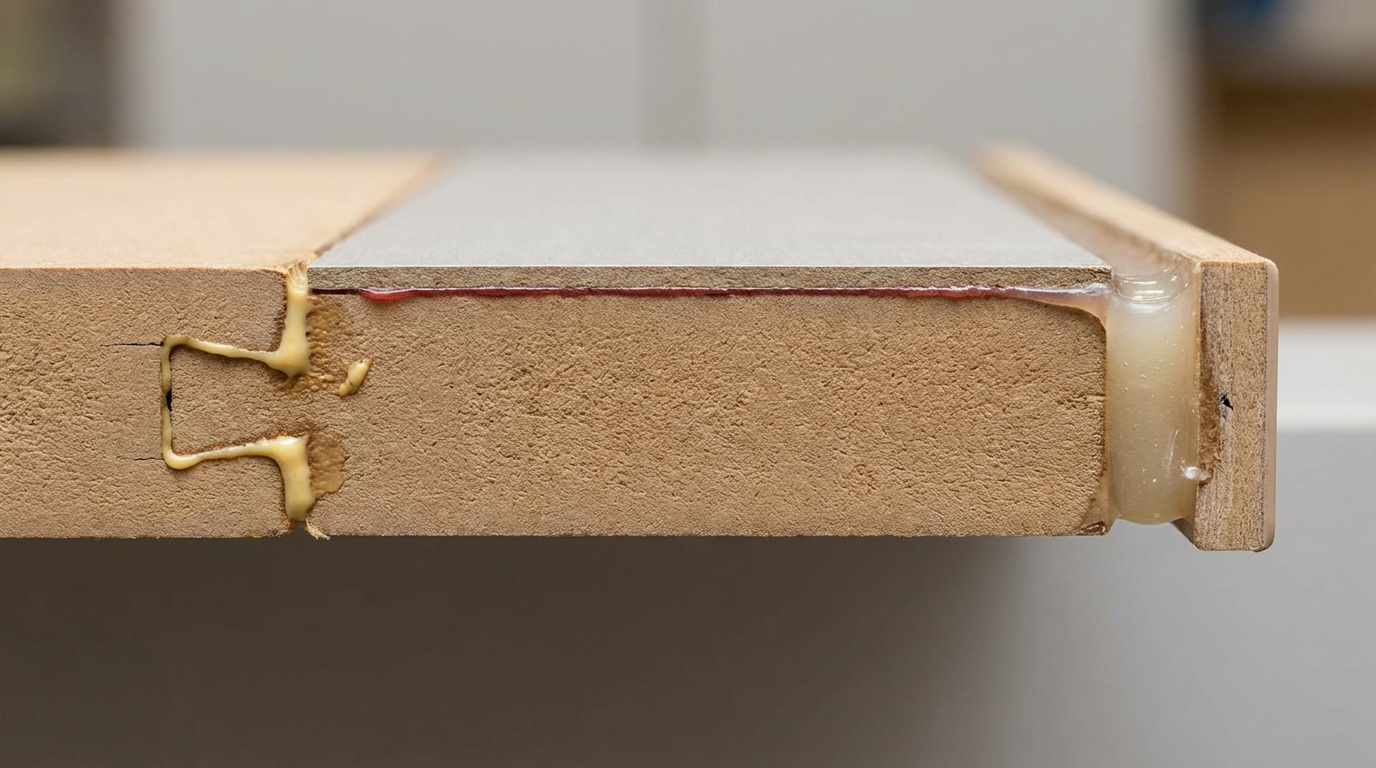
Fresh-cut MDF edges are highly porous and absorb moisture rapidly—critical in India's humid climate. Seal all cut edges within 24 hours using PVA-based wood sealer, shellac-based primer, or edge banding tape. For kitchen and bathroom applications, use moisture-resistant MDF (MR-MDF or HDHMR) and apply waterproof sealant to edges. Store cut pieces flat in a dry area until installation.

Decision Framework: Which Cutting Method for Which Situation

Situation Recommended Method What to Verify Before Starting
Breaking down 8x4 ft sheets Circular saw with guide rail Guide rail straight, blade sharp, full sheet support
Kitchen cabinet components Table saw for precision Fence calibration, blade perpendicular, dust extraction
Wardrobe shutter cutouts (handle holes) Jigsaw with fine blade Starter hole drilled, template secured, blade condition
Speaker cabinet circular cuts Router with circle jig Jig radius correct, bit sharp, multiple passes planned
Thin backing panels Utility knife scoring Steel edge clamped, blade sharp, 5+ passes scored
Edge profiles and chamfers Router with bearing-guided bit Bit height set, feed direction correct, light passes
No power available Hand saw with guide Saw sharp (11+ TPI), guide clamped, material supported
Pre-laminated MDF Score + circular saw or track saw Laminate face scored, sharp blade, tape applied

Safety Precautions: Protecting Yourself While Cutting MDF

MDF dust poses serious health risks that many Indian workshops underestimate. The fine particles contain formaldehyde-based resins used in manufacturing. Prolonged exposure without protection can cause respiratory irritation, allergic reactions, and potentially more serious health effects.

Essential safety equipment

Respiratory protection (non-negotiable):

  • N95 or P100 rated dust mask minimum—cloth masks are insufficient
  • For extended cutting sessions, use a proper respirator with replaceable filters
  • Replace disposable masks after 8 hours of use or when breathing becomes difficult
  • Fit-test your mask—gaps around nose and chin defeat the purpose

Eye protection:

  • Safety glasses or goggles that seal around eyes
  • Regular spectacles do not protect adequately
  • Clean lenses frequently—dust accumulation impairs vision

Hearing protection:

  • Foam earplugs or earmuffs when using power tools
  • Circular saws typically operate at 90-100 dB—damaging after 15 minutes without protection

Workspace requirements:

  • Work outdoors whenever possible
  • If indoors, ensure cross-ventilation with exhaust fan pulling air away from you
  • Connect shop vacuum to power tools with dust ports
  • Clean up dust immediately—don't let it accumulate and become airborne again
  • Never use compressed air to blow off MDF dust—this disperses it throughout the room

Edge Finishing After Cutting MDF

Cut MDF edges require finishing for both appearance and moisture protection—especially important for furniture in Indian homes facing monsoon humidity.

Sanding cut edges

Process:

  • Start with 120-grit sandpaper to remove blade marks
  • Progress to 180-grit, then 220-grit for smooth finish
  • Use a sanding block to maintain flat, even edges
  • Sand in direction along the edge, not across the face
  • Remove all dust with tack cloth before sealing

Sealing cut edges

For painted MDF:

  • Apply PVA sealer (mix: 10 parts PVA : 1 part water) to edges
  • Allow to dry completely (2-4 hours)
  • Sand lightly with 220-grit
  • Apply shellac-based primer before painting
  • Primer prevents edge absorption that causes uneven paint finish

For moisture-prone areas:

  • Use waterproof wood sealer or marine-grade primer
  • Apply two coats with light sanding between
  • Consider edge banding for maximum protection

Edge banding application

Iron-on edge banding process:

  • Cut banding 10mm longer than edge
  • Position band centered on edge
  • Apply household iron on cotton setting
  • Move slowly along edge, pressing firmly
  • Roll immediately with hard roller or block
  • Trim overhang with utility knife or edge trimmer
  • Sand flush with 220-grit on a block

Common Buyer Mistakes (And How to Avoid Them)

Mistake 1: Using dull or incorrect blades
Consequence: Chipping, burning, rough edges requiring extensive rework. Prevention: Invest in quality carbide blades; replace when cuts show burning or excessive chipping.

Mistake 2: Not wearing respiratory protection
Consequence: Respiratory irritation, potential long-term health effects from formaldehyde exposure. Prevention: Always wear N95 mask minimum; use respirator for extended cutting.

Mistake 3: Cutting unsupported MDF sheets
Consequence: Binding blade (dangerous kickback), splintering at cut end, inaccurate cuts. Prevention: Full support on sawhorses, helper supporting offcuts, outfeed tables for table saws.

Mistake 4: Ignoring edge sealing
Consequence: Moisture absorption, swelling, delamination within months—especially during monsoon. Prevention: Seal all cut edges within 24 hours; use moisture-resistant MDF for wet areas.

Mistake 5: Forcing the blade through material
Consequence: Blade wander, rough cuts, overheated motor, potential blade breakage. Prevention: Let blade cut at its own pace; if bogging down, blade is dull.

Mistake 6: Working without ventilation
Consequence: Dust accumulation creating health hazard and fire risk. Prevention: Work outdoors or ensure exhaust ventilation; use dust extraction.

Mistake 7: Cutting pre-laminated MDF like plain MDF
Consequence: Laminate chipping along entire cut line, ruining expensive material. Prevention: Score laminate with knife first, use fine-tooth blade, apply tape, cut laminate-side down on table saw.

Mistake 8: Skipping the masking tape step
Consequence: Visible chipping on exposed edges. Prevention: 60 seconds to apply tape saves hours of filling and sanding or replacing the panel.

Failure Modes and How to Prevent Them

Failure Mode 1: Blade kickback during circular saw use
Symptom: Saw suddenly jerks backward toward operator. Root Cause: Blade binding in cut due to unsupported material pinching closed. Prevention: Support both sides of cut, use riving knife, never remove blade guard. Fix if happening: Release trigger immediately, wait for blade to stop, re-support material properly.

Failure Mode 2: Chipping on laminated MDF surface
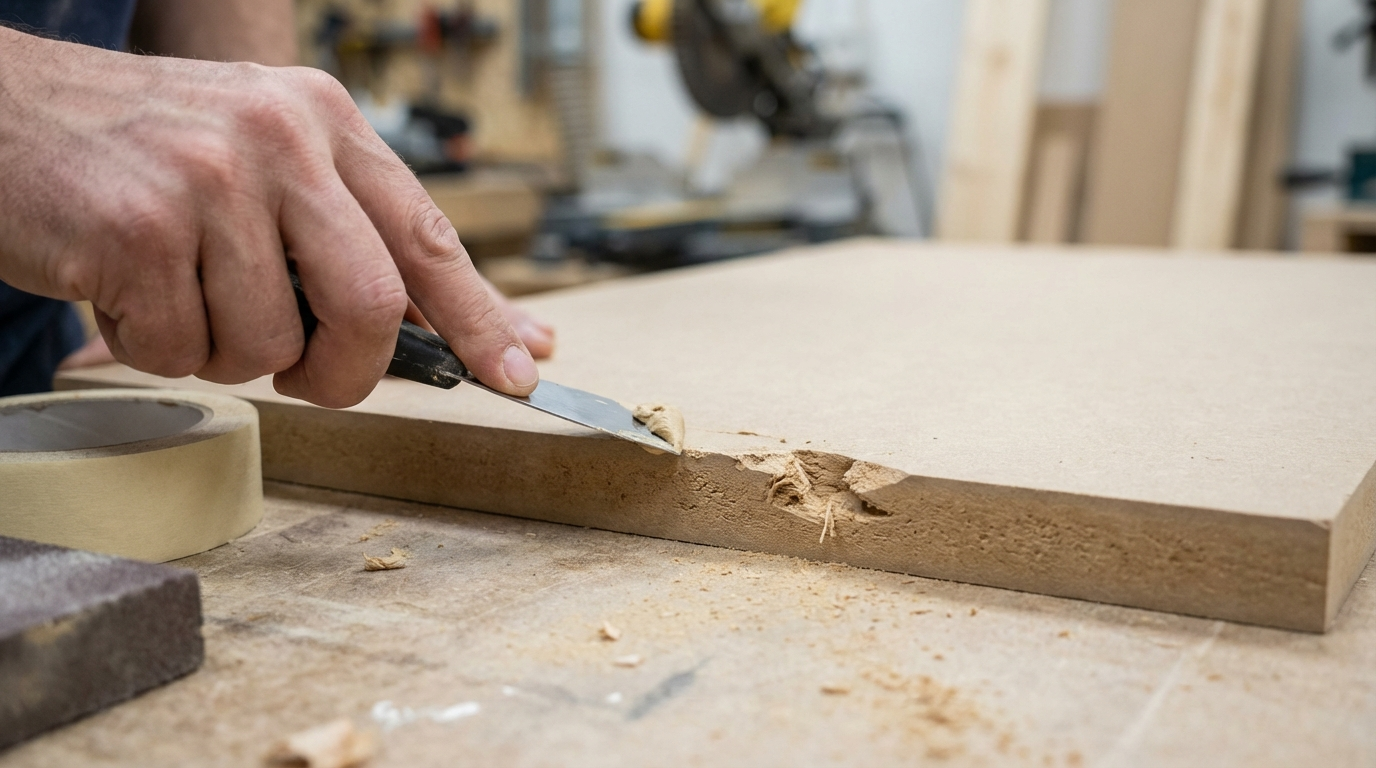
Symptom: Ragged, torn laminate along cut line. Root Cause: Blade teeth tearing laminate rather than cutting cleanly. Prevention: Score laminate with knife, apply tape, use 80+ tooth blade, cut laminate-side down on table saw. Fix if already happening: Fill with colour-matched filler, sand smooth, or apply edge banding to cover.

Failure Mode 3: Cut edge swelling after installation
Symptom: Edges bulging, boards no longer fitting in place. Root Cause: Moisture absorption through unsealed cut edges during monsoon or from proximity to water sources. Prevention: Seal edges immediately after cutting, use MR-MDF for wet areas, ensure ventilation in installed location. Fix if already happening: Sand swollen area, apply waterproof sealer, may require panel replacement if severe.

Failure Mode 4: Burn marks on cut edges
Symptom: Dark brown or black marks along cut line. Root Cause: Blade dwelling too long, dull blade, or extremely slow feed rate. Prevention: Maintain steady feed speed, keep blades sharp, use blade lubricant on long cuts. Fix if already happening: Sand away burned layer before sealing/painting.

Failure Mode 5: Inaccurate cuts despite careful measurement
Symptom: Pieces don't fit together, gaps or overlaps at joints. Root Cause: Guide movement during cutting, blade wander, or measuring from wrong reference point. Prevention: Double-clamp guides, use sharp blades, measure from same reference for mating pieces, account for blade kerf (typically 2-3mm). Fix if already happening: Re-cut slightly oversized and trim to fit, or fill gaps if minor.

Failure Mode 6: MDF warping after cutting
Symptom: Cut pieces develop curve or twist. Root Cause: Moisture imbalance—one face absorbing more moisture than other, or releasing internal stress from cutting. Prevention: Store MDF flat, seal all surfaces including edges, allow material to acclimatize before cutting. Fix if already happening: Stack flat with weight on top in dry environment for 48-72 hours; may self-correct.

Quality Checks Without Lab Tests

Before buying MDF for your project

Visual checks:

  • Edges should be uniform brown colour throughout—darker or lighter bands indicate density variations
  • No visible swelling, soft spots, or delamination on factory edges
  • Surface should be completely smooth—bumps or depressions indicate manufacturing issues
  • Sheet should lie flat—warped stock likely has moisture issues

Questions to ask the dealer:

  • Is this standard MDF or moisture-resistant (MR-MDF)?
  • What is the thickness tolerance? (Should be ±0.2mm for quality boards)
  • How long has this stock been in the warehouse?
  • Are factory edges sealed or exposed?

Red flags to watch for:

  • Musty smell indicating moisture exposure
  • Visible swelling at corners or edges
  • Price significantly below market rate (may be rejected/second-grade stock)
  • Dealer unable to confirm grade or manufacturer

After cutting: Quality verification

Edge quality checks:

  • Run finger along cut edge—should feel relatively smooth, not fuzzy
  • No visible tear-out deeper than 1mm
  • Edge colour consistent with face colour (burning shows darker)
  • Cut line straight when checked against steel straightedge

Core consistency:

  • Cut edge should show uniform colour and density
  • No voids, gaps, or foreign material visible
  • Core shouldn't be noticeably darker or lighter than surface layers

After installation: Ongoing checks

First monsoon season:

  • Check all edges for swelling—particularly near sinks, windows, exterior walls
  • Verify shutter/drawer alignment hasn't shifted
  • Look for any surface waviness indicating moisture absorption

Maintenance indicators:

  • Any softness at edges requires re-sealing
  • Screw joints feeling loose may indicate edge degradation
  • Musty smell near MDF furniture suggests moisture issue

Tips by User Type

For Homeowners

Durability expectations: Properly cut and sealed MDF in dry areas (bedrooms, living rooms) typically lasts 10-15 years without issues. In humid areas (kitchens, bathrooms), expect 5-8 years with proper maintenance. Budget for replacement of high-wear items (cabinet doors, drawer fronts) every 8-10 years.

Cleaning do's and don'ts:

  • DO: Wipe with slightly damp cloth, dry immediately
  • DO: Use mild soap solution for stubborn marks
  • DON'T: Use soaking wet cloths—water penetrates finishes
  • DON'T: Use abrasive cleaners—damages surface finish
  • DON'T: Leave spills sitting—clean immediately

When to worry:

  • Edges feeling soft or spongy—moisture damage starting
  • Visible swelling—requires immediate attention before spreading
  • Surface delamination—board may need replacement
  • Musty smell—hidden moisture issue needs investigation

For Carpenters

Cutting efficiency tips:

  • Batch similar cuts together to minimize setup time
  • Cut all pieces from one sheet before moving to next
  • Mark waste clearly to avoid cutting wrong side
  • Keep blade changes to minimum by planning cut sequence

Edge preparation:

  • Sand all edges before assembly—easier than after
  • Apply sealer to edges that will be hidden—prevents moisture issues
  • For edge banding, ensure edges are clean and dust-free
  • Pre-drill screw holes to prevent splitting

Screw zones and hinge areas:

  • Pre-drill all screw holes 80% of screw diameter
  • Use coarse-thread screws designed for MDF
  • For hinge cups, drill at exact depth specified—over-drilling weakens hold
  • Consider reinforcing hinge areas with hardwood dowels for heavy doors

Handling during transport:

  • Keep sheets flat—never store vertically without full support
  • Protect edges during transport—dings difficult to repair
  • Cover with tarp/plastic if transporting in open vehicle
  • Stack with spacers if storing on site

For Architects and Designers

Specification language:

  • Specify MDF grade: Standard, MR-MDF (moisture-resistant), or FR-MDF (fire-retardant)
  • Include thickness tolerance: ±0.2mm for quality work
  • Specify edge treatment: Sealed, edge-banded, or exposed
  • Note acceptable chipping tolerance: typically 0.5mm maximum

Wet-zone detailing:

  • Specify MR-MDF or HDHMR for kitchens and bathrooms
  • Detail edge sealing requirements in drawings
  • Show skirting/kickboard clearances from floor (10-15mm gap)
  • Specify ventilation requirements for enclosed cabinets

Finish selection considerations:

  • Pre-laminated MDF reduces site work but limits customization
  • Painted MDF offers colour flexibility but requires skilled application
  • Veneered MDF provides natural wood appearance at lower cost
  • High-gloss finishes show imperfections—requires A-grade boards

For Modular Kitchen Manufacturers

Quality control checkpoints:

  • Incoming inspection: Check moisture content (should be 8-12%), verify grade
  • Post-cutting: Inspect edge quality, measure dimensional accuracy
  • Post-edging: Verify adhesion, check for gaps or bubbles
  • Pre-dispatch: Final dimensional check, finish inspection

Reducing customer complaints:

  • Use MR-MDF for all kitchen applications—standard MDF fails at sink areas
  • Seal all edges including hidden ones
  • Include care instructions with delivery
  • Photograph installations for reference if issues arise

Batch consistency:

  • Source boards from single manufacturer lot when possible
  • Calibrate cutting equipment daily
  • Maintain blade sharpness records—replace at scheduled intervals
  • Store boards in climate-controlled environment

Frequently Asked Questions

What is the best saw blade for cutting MDF board at home?

The best saw blade for cutting MDF at home is a carbide-tipped blade with 60-80 teeth for a 185mm (7.25 inch) circular saw. Carbide teeth stay sharp significantly longer than steel when cutting MDF because the resin in MDF rapidly dulls conventional blades. Higher tooth counts produce smoother cuts with less chipping, though they cut slightly slower. For jigsaws, use a blade with 12-14 TPI (teeth per inch) with downward-pointing teeth to reduce surface chipping. Replace blades when you notice increased chipping, burning, or the motor working harder than usual.

How do I cut MDF without chipping the edges?

Preventing chipping when cutting MDF requires a multi-step approach. First, apply masking tape along both sides of your cut line—this supports the surface fibres during cutting. Second, score the cut line with a sharp utility knife, making 2-3 passes to create a groove 1-2mm deep. Third, use a sharp, fine-toothed carbide blade appropriate for your tool. Fourth, cut with the good side facing up when using a circular saw (facing down for table saw). Fifth, ensure material is fully supported on both sides of the cut. Finally, maintain steady feed speed—too fast causes chipping, too slow causes burning.

Can I cut MDF board with a hand saw without power tools?

Yes, you can cut MDF with a hand saw, though it requires more effort and technique than power cutting. Use a fine-toothed panel saw with at least 11 TPI (teeth per inch) for smoothest results. Clamp a straight edge guide along your cut line for accuracy. Start the cut at a 45-degree angle, using long smooth strokes rather than short choppy movements. Let the saw weight do most of the work—forcing creates rough edges. Hand cutting works well for smaller projects and cuts under 60cm. For thin MDF (6mm or less), a utility knife with multiple scoring passes followed by snapping is often easier than sawing.

Why does my MDF burn when cutting and how do I prevent it?

MDF burns during cutting because friction heat from the blade exceeds the combustion point of the resin binding the fibres. This happens when the blade dwells too long in one spot, the feed rate is too slow, or the blade is dull and generates excess friction. To prevent burning: maintain a steady, consistent feed rate throughout the cut; keep blades sharp and replace them when cuts consistently show burn marks; apply candle wax or blade lubricant to the blade for long cuts; ensure blade teeth are appropriate for MDF (carbide, not steel); and never stop the saw while the blade is still in contact with the material.

Is MDF dust dangerous and what protection do I need when cutting?

MDF dust poses genuine health risks and requires proper protection during cutting. The fine particles contain urea-formaldehyde resins used in manufacturing, which can cause respiratory irritation, trigger allergies, and potentially have long-term health effects with prolonged exposure. At minimum, wear an N95-rated dust mask when cutting MDF—cloth masks and surgical masks are insufficient. For extended cutting sessions, use a proper respirator with replaceable filters. Additionally, wear safety glasses to protect eyes, work in well-ventilated areas or outdoors, and connect dust extraction to power tools where possible. Never use compressed air to blow off MDF dust as this disperses it throughout your workspace.

How do I seal MDF edges after cutting to prevent moisture damage?

Sealing MDF edges after cutting is essential, especially in India's humid climate where unsealed edges can absorb moisture within 48-72 hours during monsoon season. For painted MDF, mix PVA adhesive with water (10:1 ratio) and apply to edges, let dry for 2-4 hours, sand lightly with 220-grit, then apply shellac-based primer before paint. For moisture-prone areas like kitchens and bathrooms, use dedicated waterproof wood sealer or marine-grade primer, applying two coats with light sanding between. For maximum protection, apply iron-on edge banding tape which creates a moisture barrier and finished appearance. Seal all edges including hidden ones—moisture can enter anywhere and spread through the board.

What thickness MDF should I use for different furniture applications?

MDF thickness selection depends on the application and structural requirements. For wardrobe backing panels and cabinet backs, 3-4mm MDF provides adequate rigidity while minimizing weight and cost. For shelving under 60cm span with light loads, 12mm works well; for longer spans or heavy loads, use 18mm. Kitchen cabinet carcasses typically use 18mm for sides and 16-18mm for shelves. Wardrobe shutters and drawer fronts commonly use 18mm for rigidity. TV unit tops and heavy-use surfaces need 18-25mm. Decorative wall panels can use 6-12mm depending on mounting method. Always consider the load, span, and mounting when selecting thickness—under-specifying causes sagging and failure over time.

Can I use a circular saw to cut pre-laminated MDF without damaging the surface?

Yes, you can cut pre-laminated MDF with a circular saw, but it requires additional precautions to prevent laminate chipping. First, score the laminate surface along your cut line with a sharp utility knife, making 3-4 passes with firm pressure. Apply masking tape on both sides of the cut line for extra support. Use a fine-toothed blade with 80+ teeth—coarser blades chip laminate more readily. Set blade depth to just 3mm beyond material thickness. Cut with the laminate side facing up (as circular saws cut upward on the top surface, this puts the clean cut on the visible side). Feed slowly and steadily without stopping mid-cut. For highest quality results on pre-laminated panels, a track saw provides superior edge finish.

How do I make precise curved cuts in MDF for speaker boxes or decorative panels?

Making precise curved cuts in MDF requires a jigsaw with the right blade and technique. Use a blade with 12-14 TPI with downward-pointing teeth to minimize top-surface chipping. For interior cutouts, drill a starter hole (10mm minimum) inside the waste area. Apply masking tape over the entire cut area and transfer your pattern on top. Set jigsaw to low or no pendulum action for smoothest cuts. Let the blade do the cutting—forcing causes blade wander and rough edges. For tight curves under 25mm radius, use a narrower blade (6mm width). Make relief cuts (perpendicular cuts up to your line) to help navigate tight turns. After cutting, sand edges smooth with 120-grit progressing to 220-grit. For perfect circles, use a router with a circle-cutting jig for superior results.

What is the difference between cutting standard MDF and moisture-resistant MDF?

Cutting moisture-resistant MDF (MR-MDF or green MDF) follows the same techniques as standard MDF, but there are practical differences to consider. MR-MDF is typically denser and harder than standard MDF due to the moisture-resistant resins used, which means blades may dull slightly faster. The higher density can cause more heat buildup during cutting, increasing burn risk—maintain steady feed speed and ensure blade sharpness. MR-MDF usually costs 15-25% more than standard MDF, making precise cutting more important to minimize waste. Despite its moisture resistance, cut edges of MR-MDF should still be sealed, as the resistance comes from the resin throughout the board, not just the surface. The green colour in the core distinguishes MR-MDF from standard MDF—verify you're cutting the correct material.

How long should I let MDF acclimatize before cutting for furniture?

MDF should acclimatize to your workspace environment for 48-72 hours before cutting for furniture projects. This allows the board's moisture content to equalize with the ambient humidity, reducing the risk of warping or dimensional changes after cutting. Store sheets flat with spacers between them for air circulation, in the room where the furniture will be installed if possible. This is particularly important in India during monsoon season when humidity levels fluctuate significantly, or when bringing MDF from an air-conditioned showroom to a non-AC workspace. If boards have been stored in a humid warehouse or exposed to moisture during transport, extend acclimatization to 4-5 days. Check sheets for flatness before cutting—significant warping indicates moisture issues that may not resolve with acclimatization alone.

What are the best practices for storing cut MDF pieces before assembly?

Proper storage of cut MDF pieces prevents warping, moisture damage, and edge deterioration before assembly. Store all pieces flat—never lean against walls where they can bow. Place on a flat surface with full support, using spacers between layers for air circulation. Cover with plastic sheeting to protect from dust while allowing some air movement (don't seal completely as this can trap moisture). Seal all cut edges within 24 hours of cutting, even if assembly is delayed—this is the most critical storage step. Keep storage area dry with stable temperature; avoid areas near exterior walls, windows, or water sources. If storing for more than one week, check pieces periodically for warping or moisture absorption. In humid seasons, consider running a dehumidifier in the storage area.

Disclaimer: This content is provided for general informational purposes based on industry practices and publicly available information. Product specifications, standards, prices, and availability may vary by manufacturer, region, and time. Readers should independently verify details with manufacturers, dealers, or qualified professionals before making purchase or construction decisions.

Want Plywood Suggestions?

Share a few details and a VIR MDF specialist will suggest suitable brands and connect you to responsive dealers.
+91

Information submitted will be processed in accordance with our Privacy Policy.

Related reads

View all
How to Cut MDF Board: DIY Guide