Kitchen Laminate Colours – Complete Guide for Indian Buyers
Research-backed kitchen laminate colours breakdown with pros/cons, tables, and a clear decision checklist for Indian buyers and carpenters.
Quick Decision Summary
Best answer in one line: Choose kitchen laminate colours based on your cooking habits, natural light availability, and cleaning frequency—not just visual appeal.
If you're in a hurry: For most Indian kitchens with heavy daily use, mid-tone woodgrain or matte-finish neutrals (grey, beige, warm white) hide oil stains and scratches better than glossy darks or pure whites. Avoid high-gloss black near stovetops—it shows every fingerprint and grease mark within days. Textured matte finishes in the 0.8mm to 1mm thickness range offer the best balance of durability, cleanability, and realistic appearance for typical Indian cooking conditions.
- Choose light neutrals if: Your kitchen has limited natural light, compact space, or you want easy maintenance with minimal visible staining.
- Choose bold colours if: You have a large, well-ventilated kitchen with dedicated cleaning routines and want a statement design.
- Avoid high-gloss finishes if: Your kitchen sees heavy frying, masala grinding, or has multiple family members cooking daily.
- Avoid pure white if: Your water supply has high mineral content or your kitchen lacks exhaust ventilation.
What Kitchen Laminates Actually Are
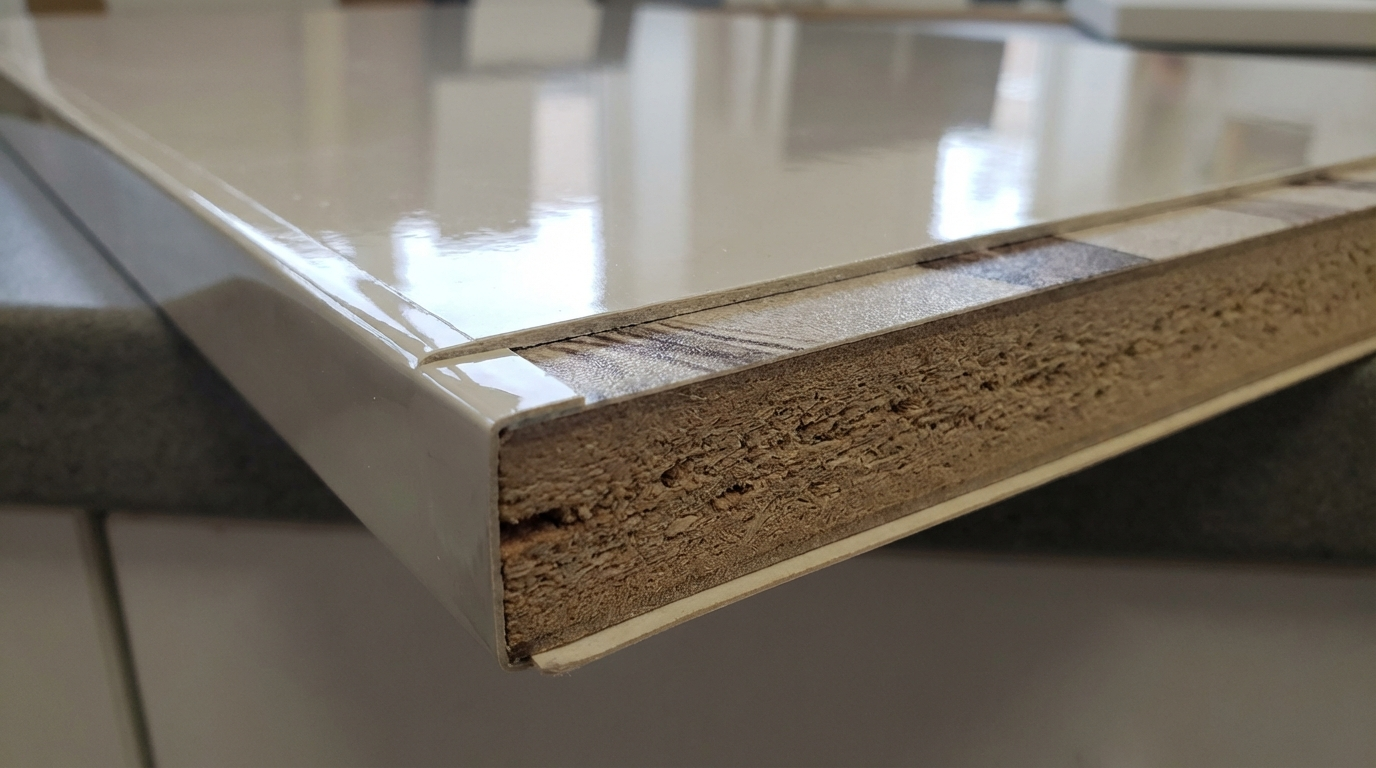
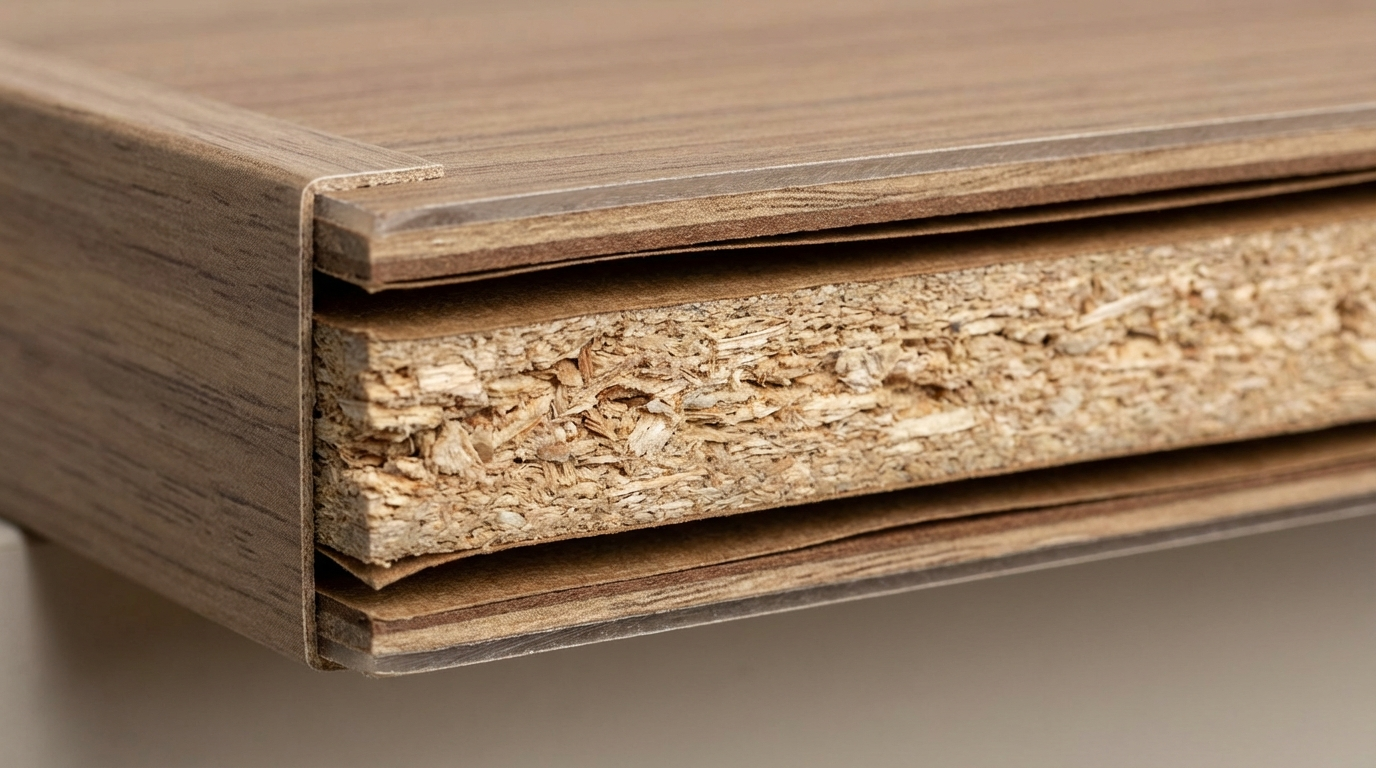
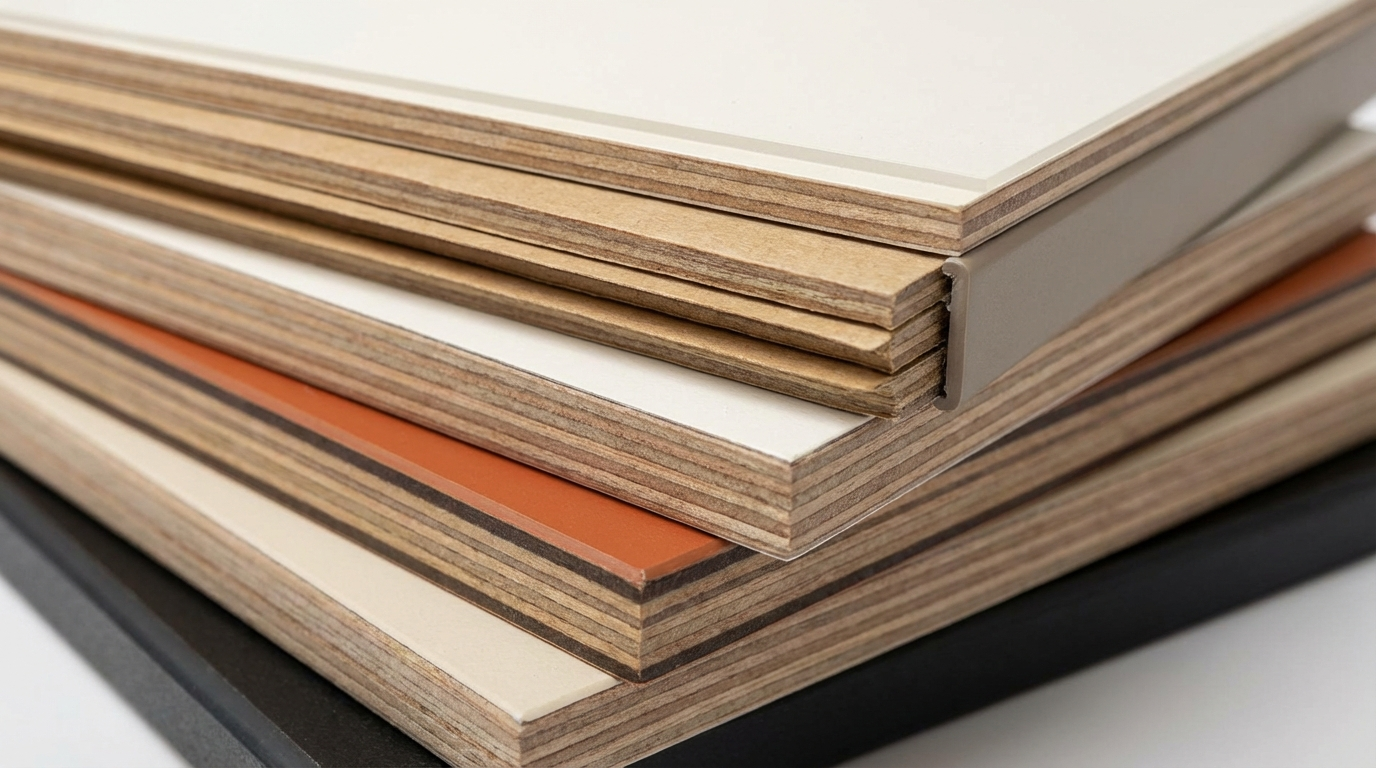
Kitchen laminates are thin decorative sheets bonded to a substrate board (typically MDF, plywood, or particle board) to create finished cabinet surfaces. These sheets consist of multiple layers of kraft paper impregnated with phenolic resins, topped with a decorative layer and a protective melamine overlay. The colour and pattern you see is printed on the decorative layer, while the melamine surface provides scratch and moisture resistance.
In the Indian market, kitchen laminates typically come in thicknesses ranging from 0.6mm (economy grade) to 1.5mm (post-forming or heavy-duty grade). The 0.8mm to 1mm range is most commonly used for kitchen cabinets. Pre-laminated boards (where the laminate is factory-bonded to the substrate) are increasingly popular for modular kitchen production, while separate laminate sheets are still preferred by carpenters for custom on-site work.
How are kitchen laminates different from acrylic or PU finishes?
Laminates are pressure-bonded sheets with the colour embedded in the material itself, making them highly resistant to fading and surface damage. Acrylic sheets offer a high-gloss mirror finish but are significantly more expensive and prone to scratching in high-use areas. PU (polyurethane) paint finishes allow unlimited colour customization but require skilled application, proper curing time, and are more vulnerable to chipping from pot impacts. For most Indian kitchens with budget constraints and heavy daily use, laminates offer the most practical balance of durability, cost, and design variety. The colour stability of laminates over 8-10 years typically outperforms painted finishes in humid kitchen environments.
Why Kitchen Laminate Colour Choice Matters in Indian Homes
Indian kitchens present unique challenges that directly affect laminate colour performance. Heavy oil-based cooking creates persistent grease films that settle on all surfaces. Turmeric, commonly used in daily cooking, leaves yellow stains that are particularly visible on white and light-coloured surfaces. The combination of steam, heat, and splatter near cooking zones accelerates surface degradation if the laminate quality or colour choice is mismatched to usage.
Monsoon humidity levels in coastal and central India can reach 85-95% for extended periods. While the laminate surface itself resists moisture, the edges and substrate beneath are vulnerable. Light-coloured laminates tend to show edge darkening more prominently when moisture infiltration begins. In contrast, woodgrain patterns and mid-tone colours mask early signs of edge damage, giving you more time to address the problem before it becomes visually obvious.
Does natural light affect how laminate colours appear in Indian kitchens?
Natural light dramatically changes laminate colour perception throughout the day. North-facing kitchens in Indian homes receive cooler, indirect light that can make warm-toned laminates appear duller than showroom samples. South-facing kitchens get harsh afternoon sun that washes out lighter colours and creates glare on glossy surfaces. Yellow-tinted artificial lighting, common in many Indian homes, shifts cool greys toward green and can make pure whites look yellowish. Always evaluate laminate samples in your actual kitchen space, under both natural daylight and your installed artificial lighting, before finalizing colours. The difference between showroom appearance and installed reality is one of the most common sources of buyer disappointment.
Popular Kitchen Laminate Colour Categories for Indian Buyers
Understanding colour categories helps narrow choices before evaluating specific shades. Each category performs differently under Indian kitchen conditions.
What are the safest laminate colours for Indian cooking conditions?
Mid-tone woodgrain finishes in walnut, oak, or teak shades consistently rank as the safest choices for Indian kitchens. These colours effectively hide oil splatter, fingerprints, and minor scratches while maintaining a warm, traditional aesthetic that appeals to most family members. Warm beige and greige (grey-beige blend) solids offer similar practical benefits with a more contemporary look. These mid-tones don't show dust accumulation as readily as dark colours and don't reveal turmeric staining as prominently as whites. For base cabinets that receive the most abuse from foot traffic, pot storage, and cleaning mop contact, these safer colours significantly reduce visible wear over time.
Whites and Off-Whites
Pure whites create spacious, bright kitchen aesthetics but require disciplined cleaning routines. Off-whites with warm undertones (cream, ivory, antique white) are more forgiving of yellowing from cooking fumes. Matte white finishes hide fingerprints better than gloss but can develop visible cleaning streaks if wiped inconsistently.
Greys and Neutrals
Grey laminates range from cool blue-greys to warm taupe-greys. Lighter greys work well in compact kitchens, while charcoal and slate greys suit larger spaces with good lighting. Grey shows dust less than black but more than mid-tones. Consider grey with subtle texture to break up the flat appearance.
Woodgrain Patterns
Woodgrain laminates mimic natural wood appearance at a fraction of the cost. Light oak and maple patterns brighten spaces; walnut and dark teak add richness. Textured woodgrains with embossed surfaces feel more authentic and hide minor scratches better than smooth woodgrain prints.
Bold and Accent Colours
Red, yellow, green, and blue laminates can create striking kitchen designs but require careful application. These colours work best as accent elements—island fronts, upper cabinet strips, or single feature walls—rather than full kitchen coverage. Bold colours can feel overwhelming in compact Indian kitchens and may limit future design flexibility.
Two-Minute Comparison: Colour Families for Indian Kitchens
| Colour Family | Best Kitchen Size | Maintenance Level | Hides Oil Stains | Shows Fingerprints | Indian Cooking Suitability |
|---|---|---|---|---|---|
| Pure White (Gloss) | Small-Medium | High | Poor | Very High | Low – needs daily wiping |
| Off-White/Cream (Matte) | Any | Medium | Fair | Low | Moderate – weekly deep clean |
| Light Grey (Matte) | Small-Medium | Medium | Good | Low | Good – forgiving |
| Charcoal/Dark Grey | Large | High | Good | High (dust visible) | Moderate – dust shows |
| Light Woodgrain | Any | Low | Excellent | Very Low | Excellent – most forgiving |
| Dark Woodgrain | Medium-Large | Medium | Excellent | Medium | Good – shows dust |
| Bold Colours (Red/Blue) | Large | High | Varies | High | Low – accent use only |
| Black (Gloss) | Very Large | Very High | Poor | Extreme | Very Low – impractical |
Key takeaway: Light-to-mid woodgrain and matte neutrals offer the best practical performance for typical Indian cooking. Reserve high-gloss and bold colours for low-touch areas or accent applications.
How to Decide on Kitchen Laminate Colours in 5 Steps
A structured approach prevents the common mistake of selecting colours based solely on showroom appeal.
Step 1: Assess Your Kitchen's Natural Light
Stand in your kitchen at three times: morning (8-9 AM), midday (12-1 PM), and evening (5-6 PM). Note which areas receive direct sunlight, which stay in shadow, and how artificial lights affect overall brightness. Darker kitchens need lighter laminates to avoid a cave-like feeling. Well-lit kitchens can handle darker or bolder colours without feeling oppressive.
Step 2: Evaluate Your Cooking Patterns
Heavy daily frying and tadka preparation creates fine oil mist that settles on surfaces within a 2-meter radius of the stovetop. If this describes your kitchen, prioritize mid-tones and matte finishes for cabinets near the cooking zone. Occasional cooking or mostly boiled/steamed meals allows more flexibility with lighter colours and glossier finishes.
Step 3: Define Your Cleaning Commitment
Be honest about cleaning frequency. Daily wipe-downs? White and glossy finishes become feasible. Weekly cleaning only? Choose colours and textures that forgive neglect. If your household employs domestic help with variable cleaning quality, select forgiving colours that don't show streak marks or incomplete wiping.
Step 4: Consider Long-Term Flexibility
Neutral colours (whites, greys, woodgrains) allow easier future updates to accessories, backsplash, and appliances. Bold colour commitments (red cabinets, blue accents) limit your future design options and may affect resale appeal. If you anticipate kitchen updates within 5-7 years, choose versatile neutrals.
Step 5: Test Samples in Your Space
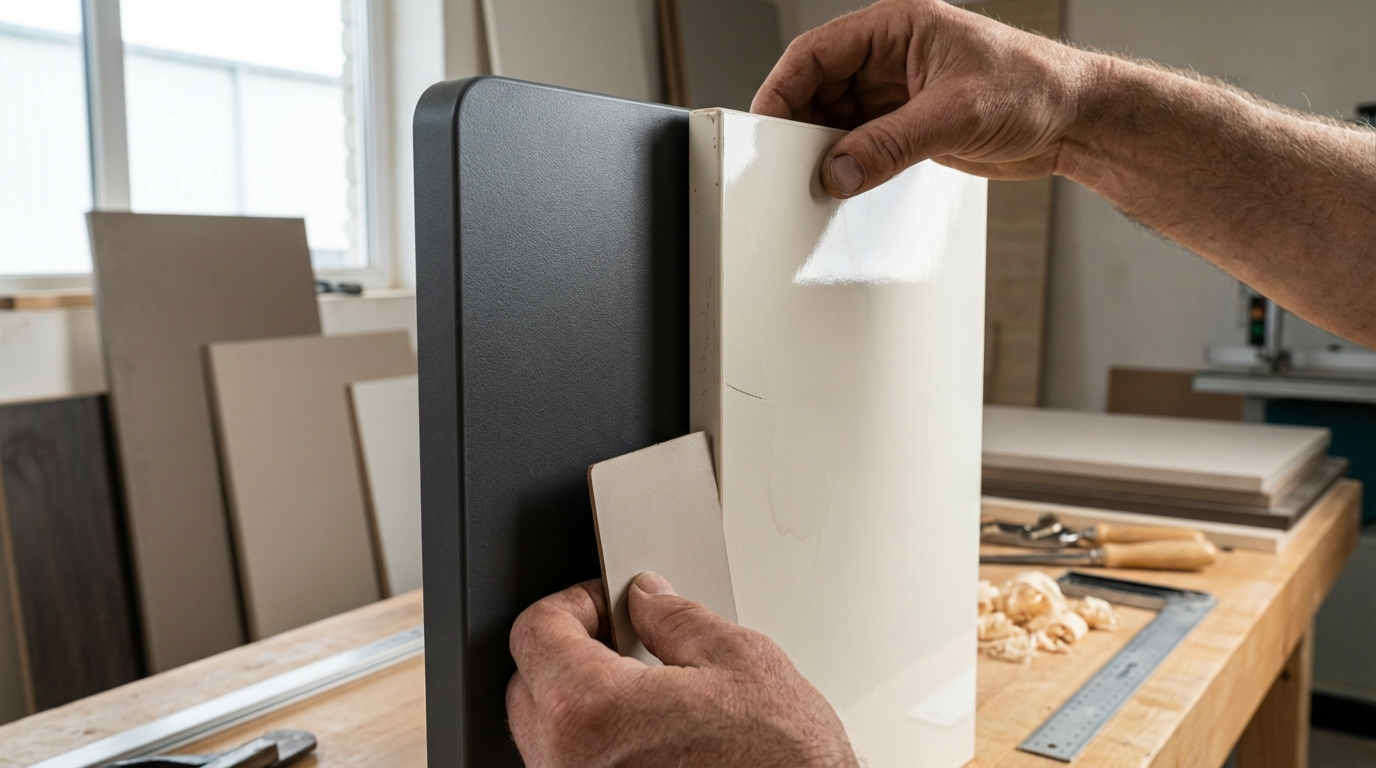
Never finalize colours from catalogues or screens. Obtain physical samples (most dealers provide small pieces) and tape them to your existing cabinets or walls. Live with the samples for at least 3-4 days, observing them under different lighting conditions. Check how they look when splashed with water, touched with oily fingers, and wiped with a damp cloth.
Decision Framework: Matching Colours to Kitchen Conditions
| Kitchen Condition | Recommended Colour Approach | Finish Type | What to Verify |
|---|---|---|---|
| Heavy frying/tadka daily | Mid-tone woodgrain or warm beige | Matte or suede texture | Sample oil-stain test; wipe after 2 hours |
| Coastal/high humidity area | Avoid pure whites; choose darker neutrals | Any; focus on edge sealing | Check substrate quality; ensure PVC edge band |
| Compact kitchen (<80 sq ft) | Light colours; avoid dark all-over | Matte preferred; gloss acceptable | Sample in actual space; assess visual expansion |
| Large open kitchen (>150 sq ft) | Can use contrasts; dark base, light wall units | Any; consider anti-fingerprint for islands | Check colour consistency across multiple sheets |
| Limited cleaning time | Textured mid-tones; avoid gloss and pure white | Textured matte or embossed | Test fingerprint visibility; streak resistance |
| Modern/minimalist aesthetic | White with grey accents; solid colours | Matte or soft touch | Anti-fingerprint coating availability |
| Traditional/warm aesthetic | Medium woodgrains; teak, walnut tones | Embossed woodgrain texture | Pattern repeat; check for visible seams |
| Rental property/resale focus | Neutral woodgrain or light grey | Standard matte | Mass-market appeal; avoid bold choices |
Common Buyer Mistakes with Kitchen Laminate Colours
These errors are observed repeatedly in Indian kitchen installations. Avoiding them saves money and prevents early replacement.
Mistake 1: Selecting from phone screens or printed catalogues
Digital and printed colours never match physical laminates accurately. Screen brightness, colour calibration, and printing variations create significant discrepancies. Always evaluate physical samples in your space.
Mistake 2: Choosing glossy black for main kitchen cabinets
Glossy black surfaces show every fingerprint, water droplet, dust particle, and cleaning streak. Within weeks of installation, these kitchens look perpetually dirty despite regular cleaning. Reserve black gloss for small accent areas only.
Mistake 3: Ignoring the stovetop zone
Cabinets within arm's reach of the cooking surface receive the most abuse. Using the same colour throughout ignores this reality. Consider slightly darker or more textured laminates for stovetop-adjacent cabinets, even if the rest of the kitchen uses lighter colours.
Mistake 4: Matching laminate exactly to flooring
Attempting exact colour matches between cabinets and floor tiles often fails because material textures reflect light differently. Slight contrast between cabinet and floor colours creates better visual depth and hides the inevitable colour variation.
Mistake 5: Selecting colours under showroom lighting
Showrooms use bright, colour-corrected lighting that flatters samples. Your kitchen likely has different lighting conditions. Take samples home; evaluate under your specific lights.
Mistake 6: Forgetting about handles and hardware
Silver handles look different against white versus grey laminates. Gold/brass hardware can clash with cool-toned greys. Consider hardware colour when selecting laminate colours, or plan to choose hardware after laminate installation.
Mistake 7: Choosing multiple bold colours
Using red, blue, and yellow together in the same kitchen creates visual chaos. If using bold colours, limit to one accent colour and keep the rest neutral.
Mistake 8: Ignoring edge band colour matching
Edge banding that doesn't match the laminate face creates visible lines at every cabinet edge. This is especially noticeable with solid colours. Ensure your fabricator sources matching edge bands from the same manufacturer batch as the laminate sheets.
Failure Modes and Fixes for Kitchen Laminate Colours
Failure Mode 1: Yellowing of White Laminates
Symptom: White cabinets develop yellowish tinge within 1-2 years, especially near cooking areas.
Root cause: Cooking oil vapors deposit on surfaces; heat accelerates oxidation of melamine surface; poor ventilation traps fumes.
Prevention: Install effective chimney/exhaust; choose off-white with warm undertones instead of pure white; select anti-yellowing grade laminates where available.
If already happening: Regular cleaning with mild dish soap can slow progression but cannot reverse yellowing. Severely yellowed panels may require replacement.
Failure Mode 2: Visible Colour Mismatch Between Sheets
Symptom: Adjacent cabinet doors show noticeably different shades of the "same" colour.
Root cause: Laminate sheets from different production batches have slight colour variations; fabricator mixed batches.
Prevention: Ensure all sheets for your kitchen come from the same batch; check batch numbers before cutting.
If already happening: Rearrange doors so mismatched panels are on separate cabinet banks rather than adjacent; severe mismatch requires replacement sheets from a single batch.
Failure Mode 3: Pattern Repeat Visibility in Woodgrains
Symptom: Same wood knot pattern appears on multiple adjacent doors, creating artificial appearance.
Root cause: Woodgrain patterns repeat at regular intervals; poor layout planning places repeats adjacent to each other.
Prevention: Ask fabricator to stagger patterns; specify different sheet areas for adjacent doors; choose patterns with longer repeat intervals.
If already happening: Cannot be fixed without replacing doors. Some installers swap door positions to minimize visual repetition.
Failure Mode 4: Dark Colour Fading Near Windows
Symptom: Dark-coloured laminates near windows become noticeably lighter over time.
Root cause: UV exposure degrades pigments; inferior quality laminates fade faster.
Prevention: Choose UV-resistant grade laminates for window-adjacent cabinets; install window films or curtains to reduce direct sun exposure.
If already happening: Fading is irreversible. Replace affected panels with UV-resistant alternatives.
Failure Mode 5: Edge Darkening on Light Laminates
Symptom: Edges of light-coloured laminates develop dark lines or spots.
Root cause: Moisture penetration through poorly sealed edges; substrate absorbs water and discolours.
Prevention: Ensure proper PVC edge banding with adhesive sealing; avoid placing wet items directly on cabinet surfaces; address any plumbing leaks immediately.
If already happening: Cannot reverse discoloration. Re-edge-band if caught early; replace panel if substrate is swollen.
Failure Mode 6: Gloss Surface Scratching
Symptom: High-gloss surfaces develop visible scratch networks, especially on frequently used cabinets.
Root cause: Abrasive cleaning cloths; rough handling of pots and utensils; rings and bangles contact during opening.
Prevention: Use soft microfiber cloths only; install soft-close hinges to prevent slam damage; consider matte finish for high-use areas.
If already happening: Minor scratches may be buffed with plastic polish; severe scratching requires panel replacement.
Quality Checks You Can Do Without Lab Tests
Before Buying: Visual and Tactile Inspection
- Colour consistency: Compare multiple sheets from the batch side-by-side under natural light. Variations of more than one shade are problematic.
- Surface uniformity: Run your hand across the surface. Feel for bumps, depressions, or inconsistent texture that indicates manufacturing defects.
- Edge condition: Check factory edges for chips, cracks, or delamination signs. Poor edge quality suggests brittle material.
- Backing paper: Quality laminates have uniform brown backing paper without patches or inconsistent colour.
What questions to ask the dealer?
Ask for batch numbers and confirm all sheets are from the same production run. Request the pattern repeat distance for woodgrain laminates—longer repeats mean less artificial appearance. Inquire about the specific grade (commercial, industrial, post-forming) and whether it matches your application needs. Ask about claimed thickness and verify with a measuring tool if possible. Request information about scratch resistance grade and whether the product is suitable for horizontal surfaces (countertops) versus vertical surfaces (cabinet doors). Reputable dealers should answer these questions readily; evasiveness suggests inferior products.
After Cutting: Edge and Core Examination
- Core colour: The core should be uniform brown/black. White spots or inconsistent colour indicate poor paper saturation.
- Edge chipping: Clean cuts on a sharp saw should not produce chips larger than 0.5mm. Excessive chipping indicates brittle material or cutting issues.
- Delamination tendency: Press firmly on a cut corner edge. Quality laminate should not separate from the core.
After Installation: Ongoing Quality Assessment
- Colour consistency verification: View all installed doors together in natural daylight. Note any panels that stand out for replacement consideration.
- Edge band adhesion: Gently press edge bands after 48 hours. Any movement or gaps indicate poor adhesion requiring rework.
- Alignment check: Close all doors and drawers; check for consistent gaps and alignment. Colour inconsistencies become more visible when alignment is poor.
Practical Tips by User Type
For Homeowners: Daily Living Considerations
- Establish a quick daily wipe-down routine for stovetop-adjacent cabinets, regardless of colour choice.
- Use mild dish soap solution, not harsh chemical cleaners that can dull surfaces over time.
- Avoid placing hot vessels directly on laminate surfaces—heat damage causes permanent discoloration.
- Keep cabinet interiors dry; moisture from wet utensils damages substrates from inside.
- Address any leaks near cabinets immediately—water damage appears as colour changes at edges.
- Plan for high-use areas: handles get touched hundreds of times daily, so consider how colours show wear.
For Carpenters and Fabricators: Workmanship Essentials
- Store laminate sheets flat, away from direct sunlight, in climate-controlled conditions when possible.
- Cut with appropriate blades (80+ teeth for clean edges on laminates).
- Always verify batch consistency before cutting; mark sheets from different batches clearly.
- Position woodgrain patterns thoughtfully—avoid obvious repeats on adjacent doors.
- Match edge band colour precisely; slight variations become very visible on solid colours.
- Allow adhesive proper curing time before delivery; rushed work leads to edge failures.
- Handle glossy surfaces with clean cotton gloves to prevent installation fingerprints.
For Architects and Interior Designers: Specification Details
- Specify laminate grade appropriate to application (post-forming for curved edges, standard for flat surfaces).
- Consider long-term maintenance capabilities of your client when recommending colours.
- Include edge treatment specifications in drawings—exposed core edges fail faster and look unfinished.
- Account for lighting design when selecting laminate colours; specify sample evaluation under installed lighting.
- Document batch requirements clearly to prevent colour variation issues during execution.
- For wet-adjacent areas (near sinks), specify water-resistant substrates regardless of laminate choice.
For OEM and Modular Kitchen Manufacturers: Production Consistency
- Maintain batch inventory logs; never mix batches within single kitchen orders.
- Implement incoming quality checks for colour consistency across sheet bundles.
- Train assembly staff on pattern matching for woodgrain laminates.
- Establish standard photography conditions for pre-delivery documentation to manage customer expectations.
- Include colour variation disclaimers in contracts for custom orders using new batches.
- Track return/complaint data by colour to identify problematic products or batches.
Colour Combinations That Work for Indian Kitchens
What two-colour combinations work best for kitchen cabinets?
Two-tone kitchens use contrasting colours for upper and lower cabinets to create visual interest while maintaining practical benefits. The most successful Indian kitchen combinations use darker or more saturated colours for base cabinets (which face more wear from feet, cleaning, and storage) and lighter colours for wall-mounted upper cabinets (which reflect light and make spaces feel larger). A walnut-toned base with cream uppers is perhaps the most popular combination, offering traditional warmth with practical benefits. Grey base with white uppers creates a contemporary look. Avoid placing the lighter colour on base cabinets—they will show wear faster and look dirty sooner.
Recommended Two-Tone Combinations
- Walnut base + cream uppers: Traditional, warm, hides wear on bases while keeping kitchen bright.
- Charcoal grey base + light grey uppers: Modern monochromatic scheme; adds depth without bold colour.
- Dark oak base + white uppers: Classic contrast; the dark wood grounds the space while white opens it up.
- Navy base + light woodgrain uppers: Bold but balanced; navy adds personality without overwhelming.
- Olive green base + off-white uppers: Earthy, natural feel; works well in kitchens with garden views.
Colour Approaches by Kitchen Layout
L-Shaped Kitchens
Use the same colour family throughout to unify the L-shape. Reserve accent colours for the corner cabinet or end panel. Avoid breaking the L with contrasting colours at the corner—this fragments the visual flow.
Parallel/Galley Kitchens
Lighter colours on both sides prevent the corridor effect from feeling oppressive. If using two tones, apply them consistently on each side rather than one colour per wall.
U-Shaped Kitchens
The enclosed feel of U-shapes benefits from lighter colours overall. Use darker accents on the central wall (facing the cook) for visual interest without closing in the space.
Island Kitchens
Islands can carry a contrasting colour since they're visually separated from perimeter cabinets. This is an ideal location for bold colour experiments while keeping perimeter cabinets neutral.
Finish Types and Their Impact on Colour Appearance
Does matte versus glossy change how colours look?
The same colour pigment appears significantly different in matte versus glossy finishes. Glossy surfaces reflect light directly, making colours appear brighter and more saturated—but also showing every imperfection, fingerprint, and dust particle. Matte surfaces scatter light, creating softer colour appearance with better hiding of surface imperfections. A matte charcoal grey looks sophisticated and hides fingerprints; a glossy charcoal grey looks dramatic but requires constant cleaning. For colours you love but worry about maintenance, choosing the matte version provides similar aesthetic impact with practical benefits. Textured finishes add another dimension, making colours appear even more forgiving while adding tactile interest.
Finish Options and Their Characteristics
- High gloss: Mirror-like reflection; most vibrant colours; highest maintenance; best for low-touch accent areas.
- Standard gloss: Reflective but not mirror-like; good colour saturation; moderate maintenance.
- Satin/semi-matte: Subtle sheen; balanced colour appearance; good practical choice for most applications.
- Full matte: No reflection; softer colour appearance; excellent fingerprint hiding; increasingly popular for modern designs.
- Suede/soft touch: Velvety feel; muted colour appearance; very forgiving of marks; premium option.
- Textured/embossed: Surface pattern adds depth; breaks up colour uniformity; excellent for hiding wear.
FAQs About Kitchen Laminate Colours
Which laminate colour is best for a small Indian kitchen?
For compact Indian kitchens (typically under 80 square feet), lighter colours create the illusion of more space by reflecting available light. Off-whites, light woodgrains in maple or ash tones, and pale greys work well to open up small spaces visually. However, pure white in a small kitchen used for heavy Indian cooking can become a maintenance burden—the limited ventilation in compact kitchens concentrates cooking fumes, leading to faster yellowing. A warm off-white or light woodgrain with subtle texture provides the space-enhancing benefits of light colour while being more forgiving of the cooking residue that accumulates in smaller kitchens.
Can I use different laminate colours for upper and lower kitchen cabinets?
Two-tone kitchen designs are both popular and practical in Indian homes. The typical approach uses darker or more saturated colours for base cabinets and lighter colours for wall-mounted upper cabinets. This makes practical sense because base cabinets face more physical wear from foot traffic, cleaning equipment, and frequent pot storage, while upper cabinets primarily receive hand contact when opening doors. The visual effect creates grounding at the base while keeping the eye-level and above portions bright. Ensure both colours come from the same manufacturer for consistent quality, and verify that matching edge bands are available for both colours.
How do I prevent laminate colours from fading in my kitchen?
Fading primarily results from prolonged UV exposure and heat damage. Cabinets near windows receiving direct afternoon sun are most vulnerable—consider installing UV-filtering window film or adjustable blinds to reduce exposure. Avoid placing cabinets directly adjacent to ovens or stove backsplash areas where radiant heat is highest. When selecting laminates for high-light areas, ask specifically about UV resistance ratings. Darker colours generally fade more noticeably than lighter ones because the contrast between faded and unfaded areas is more visible. Regular cleaning prevents the accumulation of cooking residue that can create permanent discoloration distinct from true fading.
Are glossy laminate colours hard to maintain in Indian kitchens?
Glossy finishes in Indian kitchens present genuine maintenance challenges due to our cooking style. The fine oil mist generated during tadka and deep frying settles on glossy surfaces and creates visible films. Fingerprints from handling typical Indian meals (which often involve more hand contact with food) show prominently on gloss surfaces. Water splashes leave visible spots. If you prefer glossy finishes for their bright, modern appearance, consider limiting them to upper cabinets away from the stovetop, using them only as accent panels, or committing to daily wipe-downs as part of your routine. Anti-fingerprint glossy laminates exist but still require more care than matte alternatives.
What colour laminate hides oil stains and fingerprints best?
Mid-tone woodgrain patterns with textured surfaces hide oil stains and fingerprints most effectively. The varied pattern breaks up the appearance of stains that would be obvious on solid colours, while the texture prevents the surface accumulation pattern visible on smooth finishes. Among solid colours, warm beige and greige (grey-beige blends) in matte or suede finishes perform well. The texture physically prevents the distinct fingerprint pattern from forming, while the mid-tone colour avoids the contrast that makes stains visible on very light or very dark surfaces. If you must use solid colours, choose matte or suede finishes over gloss for significantly improved practical performance.
Should kitchen laminate colours match with the living room furniture?
In open-plan Indian homes where kitchens are visible from living areas, some colour coordination helps create visual flow. However, exact matching is neither necessary nor always desirable. Kitchens serve functional purposes requiring practical colour choices that may differ from aesthetic choices suitable for living rooms. A complementary approach works better—if living room furniture is in warm wood tones, kitchen laminates in similar warmth (but not identical shade) create harmony. Cool grey living room furniture coordinates with cool-toned kitchen laminates. The goal is avoiding jarring contrast, not perfect matching. Semi-open kitchens with partial visibility can use more distinct colour schemes since the separation is more defined.
How often should I change my kitchen laminate colours?
Quality kitchen laminates installed with proper edge sealing and reasonable maintenance should last 10-15 years without requiring replacement for functional reasons. Colour-driven replacement typically happens sooner due to changing design preferences, home sale preparation, or accumulated wear that makes cleaning ineffective. Mid-tone, neutral colours have longer aesthetic lifespan because they don't date as quickly as bold trends. If you anticipate wanting to update your kitchen appearance within 5-7 years, choose neutral colours that allow accessory and backsplash updates to refresh the look without cabinet replacement. Budget for eventual replacement when choosing colours—less expensive laminates may allow more frequent updates compared to premium options that should last longer.
Can dark laminate colours work in kitchens without natural light?
Dark colours in kitchens without natural light can work if artificial lighting is thoughtfully designed. Under-cabinet LED strips illuminating countertops, interior cabinet lighting, and multiple ceiling light sources can compensate for lack of daylight. However, dark colours will make the space feel smaller and more enclosed regardless of lighting. If you prefer darker colours in a windowless kitchen, consider limiting them to base cabinets while using lighter colours for upper cabinets and backsplash areas. This grounds the space without creating an oppressive feeling. Ensure lighting colour temperature is warm (2700-3000K) to prevent dark colours from appearing cold and uninviting.
Why does my white laminate kitchen look yellowish compared to the sample?
Several factors cause white laminates to appear yellowish after installation. Your kitchen's artificial lighting colour temperature significantly affects white appearance—warm bulbs (below 3000K) add yellow cast, while cool bulbs can make whites appear blue. The wall paint colour reflects onto cabinet surfaces, tinting the apparent colour. Cooking fumes deposit on surfaces over time, creating actual yellowing that differs from lighting effects. Finally, sample evaluation conditions rarely match actual kitchen conditions. If your white looks yellow from day one, the issue is likely lighting—try replacing bulbs with neutral 4000K options. If yellowing develops over time, improve ventilation and cleaning frequency to slow the process.
What colours are trending for Indian kitchens in 2024-2025?
Current Indian kitchen colour trends lean toward soft, nature-inspired palettes moving away from the stark whites and bold reds of previous years. Sage green and olive tones have gained popularity for their calming effect and connection to nature. Warm greys with beige undertones (greige) remain strong for their versatility. Fluted or ribbed textures in neutral colours add visual interest without bold colour commitment. Two-tone combinations using darker bases with lighter uppers continue to dominate. However, trend-following should be tempered by practical considerations—a colour that photographs beautifully may perform poorly under actual Indian cooking conditions. Evaluate trends against your specific usage patterns before committing.
Selecting kitchen laminate colours requires balancing aesthetic preferences with practical Indian cooking realities. The best choice isn't the most beautiful sample in the showroom—it's the colour that looks good in your specific kitchen, under your lighting, with your cooking habits, and your cleaning routines. Take time to test samples in your actual space, consider long-term maintenance implications, and choose finishes appropriate to your lifestyle. A thoughtfully selected laminate colour will serve your kitchen well for many years, while an impulsive choice can lead to frustration and premature replacement.
Disclaimer: This content is provided for general informational purposes based on industry practices and publicly available information. Product specifications, standards, prices, and availability may vary by manufacturer, region, and time. Readers should independently verify details with manufacturers, dealers, or qualified professionals before making purchase or construction decisions.
Want Plywood Suggestions?
Share a few details and a VIR MDF specialist will suggest suitable brands and connect you to responsive dealers.