Laminate Thickness – Specs, Measurement Methods & Selection Guide
Clear, research-backed explanation of laminate thickness with examples, FAQs, and practical tips for Indian homes and furniture work.
Quick Decision Summary
Best answer in one line: For most Indian furniture applications, 0.8mm to 1mm laminate thickness offers the optimal balance of durability, workability, and cost-effectiveness.
If you're in a hurry: Standard 0.8mm laminates work well for vertical surfaces like wardrobe shutters and wall panels. Choose 1mm for horizontal surfaces facing wear—kitchen countertops, office desks, and dining tables. Go thicker (1.25mm to 1.5mm) only for high-traffic commercial spaces or areas with heavy impact risk. Thin 0.6mm laminates suit curved applications and postforming but sacrifice some durability.
- Choose 0.8mm if: Budget is tight, surfaces are vertical, and abuse levels are moderate
- Choose 1mm if: Horizontal surfaces need scratch resistance, or you want better edge finishing
- Avoid thin laminates (below 0.7mm) if: The surface will face daily abrasion, moisture exposure, or heavy objects
- Avoid thick laminates (above 1.5mm) if: You need postforming, curved edges, or have budget constraints
What Laminate Thickness Actually Means
Laminate thickness refers to the total measurement of a high-pressure decorative laminate (HPL) sheet from its decorative surface layer to its backing. This composite material consists of multiple layers of kraft paper saturated with phenolic resin, topped with a decorative paper layer and protective melamine overlay, all compressed under high heat and pressure.
In the Indian market, laminate thickness typically ranges from 0.6mm to 1.5mm for regular decorative laminates, while compact laminates extend from 2mm to 25mm. The thickness directly influences three critical performance factors: surface durability, flexibility during installation, and overall cost per sheet.
How does laminate thickness differ from substrate thickness?
A common confusion among buyers involves mixing up laminate thickness with the total panel thickness after bonding. When a 0.8mm laminate is glued onto 18mm plywood, the finished panel measures approximately 18.8mm—not 0.8mm. The laminate is merely the surface layer that provides aesthetics and protection. The substrate (plywood, MDF, particleboard) provides structural strength. Always specify both separately when ordering: substrate type and thickness plus laminate grade and thickness. This prevents costly miscommunication with fabricators and ensures your furniture dimensions match architectural drawings.
Why Laminate Thickness Matters in Indian Homes and Sites
Indian conditions demand more from laminate surfaces than many temperate climates. The combination of monsoon humidity, extreme summer heat, and variable storage conditions creates unique stress patterns that thicker laminates handle more reliably.
What happens to thin laminates during Indian monsoons?
During monsoon months, relative humidity in coastal and high-rainfall regions routinely exceeds 80-90%. Thin laminates (0.6mm or below) bonded to particle board or standard MDF can develop micro-movements at edges where moisture penetrates. The substrate swells unevenly, and the thin laminate surface cannot resist the expansion forces, leading to visible edge lifting within 2-3 monsoon cycles. Thicker laminates (0.8mm and above) provide better dimensional stability and resist edge stress more effectively. However, thickness alone cannot compensate for poor edge sealing or inappropriate substrate choice in wet zones.
Site storage conditions across India vary dramatically. Laminates stored in open godowns without humidity control, exposed to dust and occasional rain splash, face degradation before even reaching the fabricator. Thicker grades survive rough handling better—they resist corner chips from stacking and minor impact during transport. For projects in humid states like Kerala, West Bengal, or coastal Maharashtra, specifying minimum 0.8mm thickness with proper edge treatment becomes essential rather than optional.
Measurement Methods for Laminate Thickness
Accurate thickness measurement ensures you receive what you ordered and helps verify quality consistency across batches. While laboratory testing uses precision instruments, several practical methods work for site verification.
Can you measure laminate thickness without special equipment?
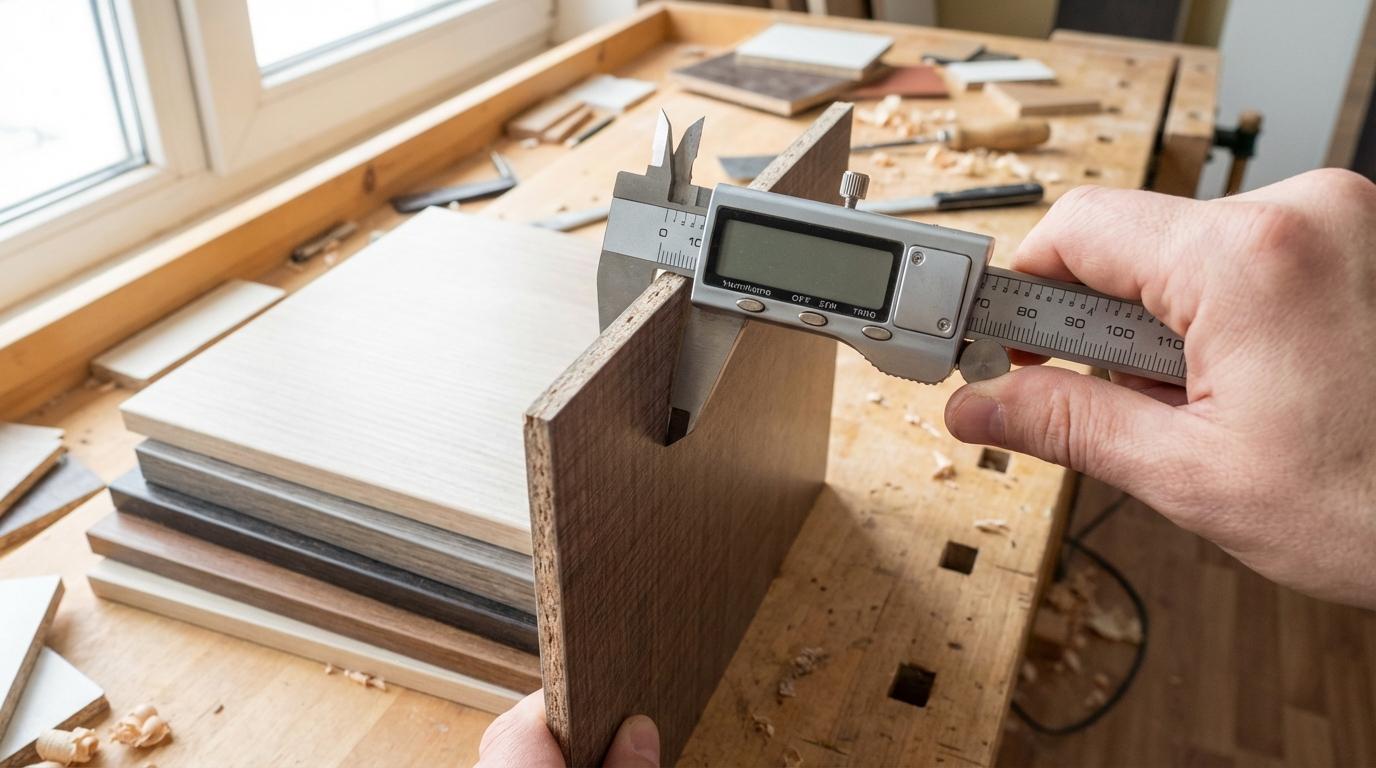
Yes, with reasonable accuracy for verification purposes. A digital vernier caliper (available for under ₹500) measures laminate thickness to 0.01mm precision—sufficient for quality checks. Take readings at four corners and the center of each sheet, as manufacturing variations can create 0.02-0.05mm differences across a single sheet. Acceptable variation for quality laminates should stay within ±0.05mm of the stated thickness. If you find sheets varying by 0.1mm or more, this indicates quality control issues worth raising with your supplier.
For quick field checks without instruments, stack ten sheets of the same grade and measure the total height with a standard steel ruler. Divide by ten for average thickness. This method detects significant variations but lacks precision for fine quality verification.
| Measurement Method | Equipment Needed | Precision Level | Best Use Case |
|---|---|---|---|
| Digital Vernier Caliper | Digital caliper (0.01mm) | High (±0.02mm) | Incoming material QC, dispute resolution |
| Micrometer Screw Gauge | Precision micrometer | Very High (±0.01mm) | Laboratory testing, batch certification |
| Stack Method | Steel ruler | Low (±0.1mm) | Quick field verification, bulk receipts |
| Manufacturer Certificate | None (documentation) | Stated only | Specification compliance, project records |
Standard Thickness Options Available in India
The Indian laminate market offers several standard thickness grades, each suited to specific applications. Understanding these options helps match material to purpose without overspending.
What is the most commonly used laminate thickness in Indian furniture?
The 0.8mm thickness dominates Indian residential furniture applications, accounting for the majority of decorative laminate sales. This grade offers adequate durability for wardrobes, TV units, and bedroom furniture while remaining cost-effective. Its popularity also ensures wide availability across design patterns and finishes. For projects requiring better performance without significantly higher costs, 1mm has gained steady market share, particularly in modular kitchen shutters and commercial furniture where surface wear demands extra protection.
Thickness Categories and Typical Applications
- 0.6mm (Thin/Postforming Grade): Curved surfaces, wrapped edges, rolled columns, reception desks with radius corners
- 0.7mm (Economy Grade): Low-budget projects, back panels, internal partitions with minimal wear
- 0.8mm (Standard Grade): Wardrobe shutters, TV units, study tables, bedroom furniture, vertical surfaces
- 1mm (Heavy-Duty Grade): Kitchen countertops, office desks, dining tables, high-traffic horizontal surfaces
- 1.25mm (Premium Grade): Commercial counters, laboratory furniture, school desks, restaurant tables
- 1.5mm and above (Industrial Grade): Hospital furniture, industrial workstations, outdoor-rated applications
Decision Framework: Choosing the Right Thickness
Selecting appropriate laminate thickness involves balancing multiple factors. This framework helps match specific conditions to optimal choices.
| Condition/Requirement | Recommended Thickness | Key Verification Points |
|---|---|---|
| Wet zone (kitchen near sink, bathroom vanity) | 1mm minimum + BWR substrate | Edge sealing method, substrate grade certificate |
| Coastal location (high salt air humidity) | 1mm minimum + marine-grade substrate | Delamination resistance test, edge protection |
| Heavy daily use (office desks, school furniture) | 1mm to 1.25mm | Surface abrasion rating, impact resistance |
| Tight budget residential project | 0.8mm on plywood | Visual surface quality, consistent thickness |
| Fast delivery requirement | 0.8mm (widest stock availability) | Design/color availability in stock |
| High scratch risk (kids' rooms, pet areas) | 1mm with scratch-resistant finish | Surface hardness rating, matte vs gloss choice |
| Curved/postformed edges needed | 0.6mm postforming grade | Minimum bend radius specification |
| Fire-rated commercial application | As per fire rating requirement | Fire test certification, compliance documentation |
Price Range and Cost Drivers
Laminate pricing in India varies significantly based on thickness, finish type, brand positioning, and order quantities. Understanding these drivers helps optimize material budgets.
How much does laminate thickness affect the price per sheet?
Thickness contributes roughly 15-25% to price variation between adjacent grades. A 1mm laminate typically costs 20-30% more than 0.8mm in the same design and finish. However, finish type often impacts pricing more dramatically—high-gloss laminates may cost 50-70% more than matte versions in the same thickness. Specialty finishes like anti-fingerprint, metallic, or textured surfaces command premium pricing regardless of thickness. When budgeting, calculate total surface area first, then evaluate whether upgrading thickness provides meaningful value for your specific application.
Indicative Price Ranges (Per 8ft x 4ft Sheet)
- 0.7mm economy grade: ₹700 to ₹1,200
- 0.8mm standard grade: ₹900 to ₹1,800
- 1mm heavy-duty grade: ₹1,200 to ₹2,500
- 1.25mm premium grade: ₹1,800 to ₹3,500
- High-gloss finish (any thickness): Additional 40-70% premium
- PVC laminates: ₹4,000 to ₹11,000 per sheet
Note: Prices vary by region, order quantity, design complexity, and market conditions. Always obtain current quotations.
Budget Estimation Example: Modular Kitchen
For a typical 100 sq.ft. modular kitchen with upper and lower cabinets, estimating laminate requirement involves calculating shutter faces, side panels, and exposed surfaces. Assuming 60% coverage efficiency (accounting for cutting waste), you would need approximately 8-10 laminate sheets. At 0.8mm standard grade averaging ₹1,400 per sheet, laminate material cost runs ₹11,200 to ₹14,000. Upgrading to 1mm for countertop-adjacent shutters adds ₹3,000-4,000 to the material budget—often worthwhile for moisture-prone areas.
Common Buyer Mistakes and How to Avoid Them
Laminate selection errors frequently lead to premature failure, aesthetic disappointment, or budget overruns. Learning from common mistakes prevents expensive corrections.
Why do laminates fail prematurely in Indian kitchens?
The primary failure mode in Indian kitchens involves edge delamination near sinks and cooktops. This occurs when thin laminates (0.6-0.7mm) are used on particleboard substrates without proper edge banding or sealing. Steam from cooking and water splashes penetrate exposed edges, causing the substrate to swell and break the adhesive bond. Prevention requires: using minimum 0.8mm laminate on BWR plywood or HDHMR, applying quality PVC or ABS edge banding on all exposed edges, and maintaining the kitchen exhaust system to reduce moisture accumulation. If delamination has begun, the affected panel usually requires complete replacement rather than repair.
Eight Critical Mistakes to Avoid
- Specifying thickness without substrate: Always define both laminate thickness AND substrate type/thickness together. A 1mm laminate on poor-quality particleboard fails faster than 0.8mm on good plywood.
- Ignoring finish-thickness interaction: High-gloss finishes show surface imperfections more readily. Thinner laminates may telegraph substrate irregularities through glossy surfaces. Use 0.8mm minimum for gloss finishes.
- Using postforming grades for flat surfaces: 0.6mm postforming laminates cost similarly to 0.8mm standard grades but offer less durability. Reserve thin grades only where bending is actually required.
- Skipping edge treatment on thick laminates: Thicker laminates show more visible edge lines. Without proper edge banding matching the surface color, the brown kraft paper core creates aesthetic issues.
- Ordering without checking batch consistency: Large projects should source all laminate from a single production batch. Different batches may show subtle color variations visible when panels are installed adjacent.
- Storing laminates flat without supports: Laminate sheets stored flat without intermediate supports develop permanent bowing. Store vertically in A-frame racks or horizontally with supports every 600mm.
- Cutting laminates face-down: Cutting laminate face-down on table saws causes edge chipping on the decorative surface. Always cut face-up with fine-tooth blades (80+ teeth for 10-inch diameter).
- Applying laminates to damp substrates: Plywood or MDF with moisture content above 12% causes adhesive failure. Acclimatize materials in the installation environment for 48-72 hours before bonding.
Failure Modes and Fixes
Understanding how laminates fail helps prevent problems and identify early warning signs requiring intervention.
Edge Delamination
Symptom: Laminate lifting from substrate starting at edges, visible gap between surface and core
Root Cause: Moisture penetration through unsealed edges, inadequate adhesive coverage near edges, or using contact cement near wet zones
Prevention: Apply edge banding before lamination on moisture-prone panels, use PVA or PUR adhesives for better water resistance, ensure 100% adhesive coverage within 15mm of all edges
If Already Occurring: Minor lifting can sometimes be re-glued with wood adhesive and clamped for 24 hours. Extensive delamination requires panel replacement.
Surface Scratching
Symptom: Visible scratches, loss of gloss in traffic areas, white marks on dark surfaces
Root Cause: Insufficient surface hardness for application, using high-gloss in high-wear areas, abrasive cleaning methods
Prevention: Select matte or textured finishes for high-traffic surfaces, use 1mm or thicker grades for horizontal work surfaces, specify scratch-resistant grades for commercial applications
If Already Occurring: Light scratches on matte surfaces can be minimized with furniture polish. Deep scratches cannot be repaired—panel replacement is the only solution.
Impact Chipping
Symptom: Chips at corners, broken edges, crater-like damage from dropped objects
Root Cause: Thin laminate on brittle substrate, inadequate edge radius, impact exceeding material capacity
Prevention: Use minimum 1mm laminate on work surfaces, round all exposed corners to minimum 3mm radius, consider compact laminates for high-impact areas
If Already Occurring: Small chips can be filled with color-matched repair wax. Large chips require edge strip replacement or panel change.
Adhesive Bleed-Through
Symptom: Yellowish stains visible through laminate surface, uneven color tone
Root Cause: Excessive adhesive application, using wrong adhesive type, substrate resin bleeding through thin laminate
Prevention: Apply adhesive per manufacturer specifications (typically 120-150 gsm), use appropriate adhesive for laminate type, allow substrate to cure fully before lamination
If Already Occurring: Cannot be reversed. Panel must be replaced with correct process.
Warping and Bowing
Symptom: Curved panels, doors that don't close flat, visible bowing in large surfaces
Root Cause: Laminating only one side of panel, unequal moisture exposure, inadequate curing time
Prevention: Always apply balancing laminate on back surface, maintain consistent environmental conditions during curing, use appropriate substrate thickness for span
If Already Occurring: Minor bowing may self-correct with balanced lamination on reverse side. Severe warping requires panel replacement.
Color Fading
Symptom: Uneven color tone, bleached appearance near windows, visible difference between exposed and covered areas
Root Cause: UV exposure on non-UV-resistant grades, chemical exposure from cleaning agents, heat damage from cooktops
Prevention: Specify UV-resistant grades for sun-exposed areas, use only recommended cleaning products, maintain adequate clearance from heat sources
If Already Occurring: Fading cannot be reversed. Consider furniture repositioning to even out exposure, or replace affected panels.
Quality Checks You Can Do Without Lab Tests
Practical quality verification helps ensure you receive materials that meet project requirements without specialized laboratory equipment.
Before Buying: Visual and Documentation Checks
- Surface inspection: Check for scratches, pinholes, color inconsistencies, or printing defects under good lighting. Reject sheets with visible flaws on decorative surface.
- Thickness verification: Measure at least 5 sheets per batch with digital calipers. Variation exceeding ±0.05mm suggests quality control issues.
- Batch documentation: Request batch number and production date. For large orders, ensure all sheets come from the same batch to avoid color variation.
- Storage condition assessment: Check if laminates are stored flat with supports, protected from moisture, and away from direct sunlight. Poor storage causes pre-installation damage.
- Flexibility test: Gently flex a sheet corner. Quality laminates flex smoothly without cracking sounds. Brittle behavior indicates degradation or inferior materials.
After Cutting: Workmanship Verification
- Edge quality: Clean cuts should show minimal chipping on both faces. Excessive chipping indicates dull blades, wrong cutting direction, or material defects.
- Core color: The kraft paper core should appear uniform brown without dark spots, which may indicate resin inconsistencies.
- Delamination check: Attempt to lift laminate at cut edges with fingernail. Quality laminates resist separation; easy lifting indicates bonding problems.
- Dimensional accuracy: Measure cut pieces against specifications. Excessive variation suggests cutting equipment calibration issues.
After Installation: Performance Verification
- Adhesion test: After 48-hour cure, tap surfaces firmly with knuckles. Hollow sounds indicate poor adhesive contact requiring attention.
- Edge sealing inspection: Run finger along all edges. Any gaps or exposed substrate edges represent moisture entry points.
- Alignment check: Ensure pattern alignment across adjacent panels meets design intent. Misalignment is difficult to correct post-installation.
- Cleaning test: Wipe surface with damp cloth. Water should not penetrate or cause any surface change on quality installations.
Practical Tips by User Type
For Homeowners: Durability and Maintenance
Do:
- Clean laminate surfaces with soft damp cloth and mild soap solution
- Use cutting boards and trivets—never cut or place hot vessels directly on laminate
- Wipe water splashes immediately, especially near edges
- Apply furniture wax periodically on matte finishes for added protection
- Ensure adequate ventilation in kitchens and bathrooms to reduce humidity
Don't:
- Use abrasive cleaners, steel wool, or harsh chemicals on laminate surfaces
- Allow water to pool on horizontal surfaces or seep into joints
- Drag heavy objects across laminate—lift and place instead
- Expose laminate to prolonged direct sunlight without UV protection
- Attempt DIY repairs with household adhesives—consult professionals
For Carpenters and Fabricators: Workmanship Excellence
- Cutting: Use 80-tooth or higher blade count for clean cuts. Cut face-up on table saws, face-down on track saws. Support sheet fully to prevent vibration.
- Edge preparation: Sand cut edges lightly with 180-grit before edge banding. Remove all dust with tack cloth before adhesive application.
- Adhesive application: Maintain consistent spread rate (120-150 gsm typical). Both surfaces should feel tacky-dry before contact. Use J-roller with firm pressure from center outward.
- Hinge and hardware zones: Pre-drill pilot holes for all screws. For thicker laminates, countersink through laminate layer to prevent surface cracking.
- Handling: Always carry sheets vertically with two people for 8x4 sheets. Never drag sheets—surface scratches occur easily during handling.
- Acclimatization: Store materials in installation environment for minimum 48 hours before processing. This equalizes moisture content and prevents post-installation movement.
For Architects and Designers: Specification Best Practices
- Specification clarity: Define laminate thickness, finish type, color code, and substrate type separately. Include edge treatment requirements in specifications.
- Wet zone detailing: Specify minimum 1mm thickness with BWR or marine-grade substrates. Detail edge sealing methods and drainage slopes for countertops.
- Sample approval: Require physical samples from actual production batch before bulk ordering. Digital catalogs don't capture true color and texture.
- Maintenance documentation: Provide clients with laminate care instructions as part of project handover. This reduces premature failure complaints.
- Fire rating compliance: For commercial projects, verify laminate fire rating meets local building code requirements. Document compliance in project records.
For OEM and Modular Furniture Manufacturers: Quality Control Systems
- Incoming inspection: Implement thickness verification sampling (minimum 2% of sheets) for each delivery. Maintain supplier quality records.
- Batch tracking: Record batch numbers for all laminate used in each production lot. This enables traceability for warranty claims.
- Process standardization: Document adhesive spread rates, curing times, and environmental conditions. Consistent processes reduce defect rates.
- Edge banding verification: Inspect edge adhesion on sample pieces from each production run. Peel testing identifies adhesion failures before dispatch.
- Customer feedback loop: Track warranty claims by laminate grade, thickness, and application type. This data guides future specification improvements.
Thickness Selection for Specific Applications
| Application | Recommended Thickness | Finish Consideration | Risk Factor |
|---|---|---|---|
| Wardrobe shutters | 0.8mm standard | Matte or textured hides fingerprints | Hinge area stress, handle impact |
| Kitchen wall cabinets | 0.8mm standard | Anti-fingerprint preferred | Steam exposure, grease accumulation |
| Kitchen base cabinets | 1mm heavy-duty | Matte, easy-clean finish | Moisture from floor mopping, kick marks |
| Kitchen countertop cladding | 1mm to 1.25mm | Scratch-resistant, non-glossy | Knife marks, hot vessel damage, water pooling |
| Office desks | 1mm minimum | Matte, anti-glare preferred | Writing pressure, equipment drag, daily wear |
| Reception counters | 1mm to 1.25mm | High-gloss acceptable for visual impact | Public traffic, bag placement, leaning |
| TV units | 0.8mm standard | Finish to match décor | Minimal wear, dust accumulation |
| Study tables (children) | 1mm recommended | Matte, scratch-resistant | Writing marks, spills, rough use |
| Bathroom vanity | 1mm + waterproof substrate | Matte or satin, anti-bacterial optional | Constant humidity, water splashes |
| Wall paneling | 0.8mm sufficient | Texture adds depth perception | Impact from furniture, cleaning damage |
FAQs
What is the ideal laminate thickness for Indian residential furniture?
For most Indian residential applications, 0.8mm laminate thickness provides the best balance of performance and value. This thickness handles normal wear on wardrobe shutters, TV units, and bedroom furniture effectively while remaining economically practical. However, for horizontal surfaces like kitchen countertops, study tables, and dining tables that face more intensive daily use, upgrading to 1mm thickness is recommended. The additional investment in thicker laminate—typically 20-30% more—provides meaningfully better scratch resistance and impact durability that justifies the cost over the furniture's lifespan.
How do I measure laminate thickness accurately at the dealer's shop?
Carry a digital vernier caliper for accurate on-site measurement—basic models cost under ₹500 and provide 0.01mm precision. Take readings at all four corners and the center of the sheet, as manufacturing variations exist. Quality laminates should measure within ±0.05mm of the stated thickness. If you don't have a caliper, ask the dealer to measure while you observe, or use the stack method: measure ten identical sheets together and divide by ten. Any significant deviation from specifications justifies requesting a different batch or negotiating price adjustment.
Can thin 0.6mm laminates be used for kitchen cabinets?
Using 0.6mm laminates for kitchen cabinets is technically possible but not recommended for most situations. These thin grades are designed primarily for postforming applications where the laminate must bend around curves. In flat kitchen applications, 0.6mm laminates offer reduced impact resistance, lower durability against scratches, and less protection for substrate edges. Kitchen environments also involve heat, steam, and moisture that thin laminates resist less effectively. Reserve 0.6mm grades only for specific curved elements like rounded counter edges, and use 0.8mm minimum for flat cabinet surfaces.
Why does laminate edge chipping occur, and how can it be prevented?
Laminate edge chipping results from three primary causes: improper cutting technique, inadequate blade quality, and incorrect handling. When cutting laminates face-down on table saws, the blade exit point creates chip-out on the decorative surface. Prevention involves cutting face-up with fine-tooth blades (80+ teeth for 10-inch diameter), using scoring blades on panel saws, and ensuring proper blade height (teeth clearing material by 5-8mm). Additionally, support the sheet fully during cutting to prevent vibration, and never force the material through the blade. After cutting, careful handling prevents mechanical damage to freshly cut edges.
What substrate should be used under thick laminates in humid areas?
In humid Indian environments—particularly coastal regions, monsoon-prone areas, or wet zones like kitchens and bathrooms—substrate selection matters as much as laminate thickness. BWR (Boiling Water Resistant) grade plywood forms the minimum acceptable standard for such applications. For even better performance, consider HDHMR (High Density High Moisture Resistant) boards or marine-grade plywood. Particle board and standard MDF should be avoided in high-humidity applications regardless of laminate thickness, as moisture penetration through edges or minor surface damage causes substrate failure. The laminate thickness recommendation increases to minimum 1mm for these areas to provide additional moisture barrier properties.
How does laminate finish type affect thickness selection?
Finish type and thickness interact importantly. High-gloss finishes show substrate imperfections more readily than matte surfaces—any unevenness, dust particles trapped during lamination, or telegraphing of substrate grain becomes visible. For glossy finishes, use minimum 0.8mm thickness and ensure substrate surface preparation is excellent. Textured and matte finishes are more forgiving, allowing 0.7mm thickness in some applications. Additionally, high-gloss surfaces show scratches more visibly, making the scratch-resistance benefit of thicker laminates more valuable. When specifying high-gloss for horizontal work surfaces, 1mm thickness is strongly recommended.
Is there a difference between branded and unbranded laminate thickness accuracy?
Significant quality differences exist between established laminate manufacturers and unbranded products. Reputable producers maintain thickness consistency within ±0.05mm across production batches and provide documentation of quality parameters. Unbranded laminates may show variations of 0.1mm or more within a single batch, affecting installation quality and long-term performance. Beyond thickness consistency, established manufacturers also provide better surface durability, color consistency, and reliable technical specifications. For critical applications in commercial projects or premium residential work, sourcing from documented quality sources reduces risk substantially.
What thickness is recommended for postformed laminate countertops?
Postforming—where laminate is bent around curved edges under heat—requires special thin grades, typically 0.6mm to 0.7mm with specific flexibility characteristics. Standard thickness laminates (0.8mm and above) cannot be successfully postformed as they crack during bending. When specifying postformed countertops, ensure the fabricator sources certified postforming-grade material with documented minimum bend radius specifications. The visible flat surfaces of postformed counters use the same thin material, making them more susceptible to wear than countertops with separately applied thick laminate and edge banding. Consider this trade-off between seamless aesthetics and surface durability.
How long do different laminate thicknesses typically last in Indian conditions?
Laminate lifespan depends more on application conditions and maintenance than thickness alone, but general expectations exist. Quality 0.8mm laminate on properly prepared substrates typically serves 10-15 years in normal residential use before showing significant wear. Heavy-duty 1mm grades in commercial applications may need replacement after 7-10 years due to intensive use, while the same material in residential settings can exceed 15 years. Indian conditions—particularly monsoon humidity and dust—accelerate wear compared to controlled environments. Proper maintenance, edge sealing, and appropriate finish selection for the application extend useful life significantly.
Can laminate thickness compensate for poor substrate quality?
No, laminate thickness cannot compensate for inadequate substrate quality. The laminate provides surface protection and aesthetics, while the substrate provides structural integrity, screw-holding capacity, and dimensional stability. Thick laminate on poor particleboard still fails due to substrate swelling, screw pull-out, or internal board degradation. Think of laminate as protective clothing—it shields from external factors but cannot strengthen what's underneath. Always invest in appropriate substrate quality first, then select laminate thickness based on surface performance requirements. This combination approach delivers durable, long-lasting furniture.
What causes laminate color variation between batches, and how is it managed?
Color variation between production batches occurs due to normal manufacturing variables: paper stock differences, resin chemistry variations, and curing condition fluctuations. While quality manufacturers minimize these variations, some difference between batches is unavoidable. Managing this requires ordering all laminate for a single project from one batch, verified by matching batch numbers on sheet packaging. For large projects spanning multiple deliveries, request the supplier to reserve sufficient quantity from a single production run. When adjacent panels might be viewed together—like kitchen cabinet doors—batch matching becomes critical for professional results.
Are thicker laminates always better value despite higher cost?
Thicker laminates offer better durability but don't always represent better value—context determines optimal choice. For vertical surfaces with light use (wardrobe interiors, back panels, wall units), 0.8mm provides adequate performance at lower cost. The premium for thicker material delivers no practical benefit in these applications. Conversely, for horizontal work surfaces, high-traffic areas, or commercial applications, the durability improvement from 1mm or thicker grades justifies the 20-40% higher material cost through extended service life and reduced maintenance. Evaluate each application independently rather than applying uniform thickness across all project elements.
Disclaimer: This content is provided for general informational purposes based on industry practices and publicly available information. Product specifications, standards, prices, and availability may vary by manufacturer, region, and time. Readers should independently verify details with manufacturers, dealers, or qualified professionals before making purchase or construction decisions.
Want Plywood Suggestions?
Share a few details and a VIR MDF specialist will suggest suitable brands and connect you to responsive dealers.