MDF Board: Meaning, Uses, Pros/Cons & How to Choose the Right Grade
Everything you need to know about MDF board—what it is, where it works best, common myths, and a clear checklist for selecting the right grade.
Quick Decision Summary
MDF board is compressed wood fibers offering smooth, affordable surfaces for Indian interiors like wardrobes and cabinets.
If you’re in a hurry: Pick moisture-resistant (MR) MDF grade at 16-18mm thickness for most home projects. It balances cost and performance in humid conditions. Laminate the surface and seal edges tightly. Verify density above 700 kg/m³ by feel and supplier specs. Avoid standard grade in kitchens or coastal areas—opt for boiling water-resistant (BWR) instead. This setup cuts swelling risks during monsoons while keeping budgets under control for typical 100 sq ft wardrobe jobs.
- Choose this if you need uniform finish, CNC machining ease, and moderate loads in dry-to-humid zones.
- Avoid this if facing direct water splashes, heavy impacts, or outdoor exposure—switch to HDFWR or marine plywood.
What This Material/Option Actually Is
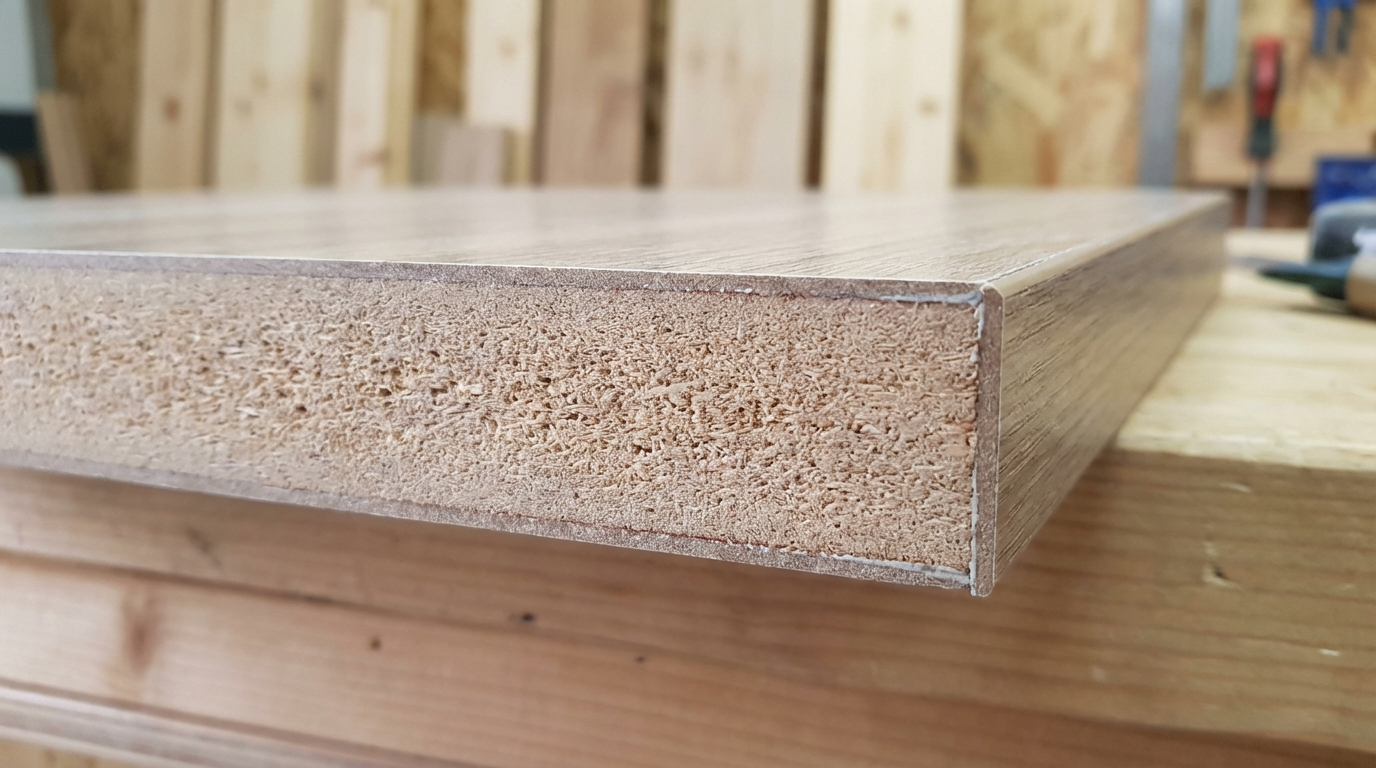
MDF stands for Medium Density Fiberboard. It forms by breaking down wood into fine fibers, mixing with resins and wax, then pressing under heat and pressure into dense sheets. Densities typically range from 650-800 kg/m³, denser than particleboard but softer than solid wood.
This engineered panel suits flat-pack furniture and modular interiors. Available in thicknesses from 3mm to 25mm, it accepts paints, laminates, or veneers evenly due to its smooth face. In India, factories produce it in standard, moisture-resistant, and water-resistant variants to handle local climates.
It differs from plywood (layered veneers) or particleboard (coarse chips)—MDF offers consistency for intricate routing but needs edge protection.
Why It Matters in Indian Homes and Sites
Indian sites face monsoon humidity above 80%, coastal salt air, and poor storage—standard MDF swells at edges if exposed over 24 hours. This leads to screw pull-outs in cabinets or warping in wardrobes.
Proper grades prevent delamination in kitchens near sinks. Workmen often cut panels on-site without sealing, amplifying risks. Coastal projects like Mumbai apartments demand BWR types to resist 90%+ RH. Urban transport delays mean acclimatizing sheets 48 hours indoors cuts failures by half.
Choosing right avoids callbacks: a swollen TV unit edge ruins finishes, hikes rework costs 20-30%.
Meaning, Types, and Where People Get Confused
What is the full form of MDF board?
MDF means Medium Density Fiberboard. Direct answer: it's not a solid wood but recycled fibers glued and compressed for panels 3-25mm thick. Nuance: density marks quality—under 650 kg/m³ feels spongy, suits low-end shelves; 750+ handles cabinets. In India, check supplier density claims by tapping—solid thud means good compression. Next step: ask for test certificate or weigh a sample sheet against specs.
Are there different grades of MDF?
Yes, main types: standard (dry use), MR (up to 24-hour water soak), BWR (boiling water test), and HR (high resistance). Standard suits bedrooms; MR for kitchens. Confusion arises as labels vary—always verify soak test pass. Coastal users pick BWR to beat salt corrosion. Check: immerse edge sample in water 2 hours; no swelling means MR-grade viable.
Common misunderstandings:
- MDF is plywood—no, fibers vs layers; MDF machines smoother.
- All MDF is waterproof—false; only BWR grades resist boiling.
- Thinner always cheaper to work—under 12mm warps under load.
- No termite risk—resins deter but untreated wood fibers attract; pair with anti-termite primer.
- Paint hides all defects—rough edges chip paint in humid storage.
Pros and Cons in Real-World Use
Pros shine in uniformity: no knots mean flawless laminates, CNC cuts precise curves for wardrobes. Cost stays low—20-30% under plywood for same size. Weights less, easing transport in city traffic.
Cons hit moisture: standard grade absorbs 10-15% water in monsoons, swelling 5-8%. Screw hold weakens after cycles—use inserts for hinges. Dust during cutting irritates; mask up.
| Aspect | Pros | Cons | India Fix |
|---|---|---|---|
| Surface | Smooth for finishes | Scratches easily | Laminate + edge band |
| Moisture | MR grades resist | Swells untreated | Seal all cuts |
| Strength | Consistent density | Poor screw hold | Wall anchors |
| Cost | Affordable bulk | Extras add up | Buy pre-lam |
Practical Use Cases (What Works, What Fails)
| Application | Thickness | Finish Notes | Risk Notes |
|---|---|---|---|
| Wardrobe shutters | 18mm MR | Laminate both sides | Edge seal vs humidity |
| Kitchen cabinets | 18mm BWR | High-pressure laminate | Splash guards essential |
| TV units | 12-16mm standard | PU paint | Avoid floor contact |
| Wall panels | 8mm MR | Veneer | Acclimatize 48hrs |
| Partitions | 16mm MR | Melamine | Reinforce joints |
Wardrobes work with 18mm MR—handles 50kg shelves. Fails in bathrooms: swelling delams finishes.
Can MDF be used for kitchen cabinets in India?
Yes, with BWR grade and sealed edges. Direct: suits modular setups under sinks if laminated HPL. Nuance: monsoons demand 72-hour soak-tested boards; standard fails in 20% RH spikes. Coastal kitchens add silicone seals. Check: post-install, wipe spills instantly; test screw hold with 5kg pull.
How to Choose the Right Grade in 5 Steps
- Assess site conditions: Dry bedroom? Standard. Kitchen/coastal? MR or BWR.
- Match thickness to load: Shelves 18mm+; panels 12mm.
- Pick surface needs: Laminate for durability, paint for custom.
- Verify density: Tap test—dull thud bad; crisp good. Aim 700+ kg/m³.
- Seal and acclimatize: Edge band cuts; store 48 hours at site RH.
Failure point: skipping step 1—30% monsoon callbacks.
Price Range and Cost Drivers
Typically Rs 40-120 per sq ft for 18mm sheets, varying by city (Delhi 10% under Mumbai). Thinner 12mm drops 20-30%.
Drivers: thickness (biggest), density (higher resists better), grade (BWR +30%), finish (pre-lam +15-25%), logistics (remote +20%). Wastage 10-15% in cuts.
Budget example: 100 sq ft wardrobe—Rs 6,000-12,000 base + Rs 2,000 edges/lam. Quote checklist: specify grade/thickness/density/sheet size/city delivery.
What is the cost of MDF per sq ft?
Ranges Rs 40-120/sq ft for common 18mm. Direct: standard cheapest; BWR priciest. Nuance: bulk buys cut 15%; finishes double it. Monsoon surcharges add 10%. Next: list project sq footage + grade + city for accurate quote.
Failure Modes and Fixes
- Symptom: Edge swelling. Cause: Moisture via cuts. Prevent: Seal with PVA 24 hours post-cut. Fix: Sand + reband if minor.
- Screw pull-out. Cause: Low density cycles. Prevent: Use plugs/anchors. Fix: Refasten with epoxy.
- Delamination. Cause: Poor resin/humidity. Prevent: MR grade. Fix: Clamp + adhesive if early.
- Surface scratches. Cause: Soft face. Prevent: Laminate. Fix: Fill + repaint.
- Chipping on cuts. Cause: Dull tools. Prevent: Carbide blades. Fix: Route edges.
- Warping. Cause: Uneven moisture. Prevent: Acclimatize. Fix: Discard severe cases.
Quality Checks You Can Do Without Lab Tests
Before buying: Visual—uniform color, no voids. Tap sides—consistent sound. Weigh sample: heavy = dense. Ask soak test proof.
After cutting: Edges smooth, no crumble. Test screw: holds 5kg without spin.
Post-install: Check gaps under 1mm, edges sealed, no flex under load.
Red flags: Soft feel, color patches, wet storage stacks.
How to check MDF quality at site?
Tap test + screw trial. Direct: firm thud and tight hold signal good. Nuance: compare to known sample; soft means under-density. India tip: post-monsoon, check swell after wet cloth 1 hour. Next: reject if expands >2%.
Decision Framework: Matching Conditions to Choices
| Condition | Recommended Grade/Finish | What to Verify |
|---|---|---|
| Wet zone (kitchen) | BWR, HPL laminate | Boil test pass, edge seal |
| Coastal humidity | MR min, sealed edges | Density 750+, acclimatize |
| Heavy use (kids) | 18mm+, abrasion finish | Screw hold test |
| Tight budget | Standard 16mm prelam | No voids, dry storage |
| Fast delivery | Stock MR sheets | Batch consistency |
| High scratch risk | Laminated + PVC edge | Surface hardness rub |
Common Buyer Mistakes and How to Avoid Them
- Mistake 1: Cheapest standard grade for kitchen. Avoid: Spec MR/BWR upfront.
- 2: Ignoring thickness—12mm shelves sag. Avoid: Load calc (10kg/sqft min).
- 3: No edge sealing post-cut. Avoid: PVA dip routine.
- 4: Wet storage. Avoid: Tarpaulin covers, vertical stacks.
- 5: Wrong screws—self-tappers strip. Avoid: Coarse wood screws + pilots.
- 6: Skipping acclimatization. Avoid: 48hr site room.
- 7: Paint over unsealed. Avoid: Primer first.
- 8: Overlooking density. Avoid: Tap/weigh checks.
Tips for Different Users
Homeowners: Clean with damp cloth only—no abrasives. Avoid water pooling; check hinges yearly.
Carpenters: Cut with 60-tooth blade; pre-drill screws; edge band before assembly. Handle in pairs to prevent flex.
Architects/Designers: Detail 2mm edge returns; spec MR for elevations; coordinate CNC tolerances ±0.5mm.
OEM/Modular makers: QC tap test per batch; standardize inserts for repeatability; track returns for grade tweaks.
Is MDF good for wardrobes?
Yes, 18mm MR excels. Direct: smooth for sliders, holds 40kg shelves. Nuance: laminate hides fingerprints; seal bottoms vs floor moisture. India: monsoons need ventilation gaps. Check: load test prototype shelf.
Is MDF termite resistant?
Partially—resins deter but fibers vulnerable. Direct: pair with termite fluid treatment. Nuance: MR grades fare better in soil contact zones. Prevention: elevate 150mm off floors. Next: inspect annually for frass.
FAQs
What is MDF made of?
MDF consists of wood fibers from hardwoods/softwoods, mixed with urea-formaldehyde resin, wax, and pressed at 180-200°C. This creates uniform density without grain. In India, eucalyptus fibers dominate for availability. Buyers confuse it with chipboard—fibers make it smoother for routing. Always confirm resin type verbally for low-formaldehyde options in bedrooms. Handling tip: wear masks during sanding to avoid dust.
Can MDF be used outdoors?
No, even BWR degrades under rain/UV. Fibers break down in 6-12 months. Indoor only, away from windowsills. Coastal winds accelerate failure—use alternatives like HPL cement boards. If semi-exposed, seal multiple times but expect 2-year life. Verify by UV lamp test on sample: no yellowing initially.
Is MDF stronger than plywood?
No, plywood edges better in bending; MDF uniform but pulls screws easier. For cabinets, plywood wins loads; MDF for faces. Trade-off: MDF cheaper for flats. Test: cantilever shelf—MDF sags sooner. India modular favors MDF for speed.
How to cut MDF without chipping?
Use zero-clearance insert, carbide blade, score first. Cut face down for laminates. Post-cut, route edges lightly. Monsoon humidity softens—cut dry stock. Carpenter rule: clean blade every 10 sheets.
Does MDF absorb water?
Standard yes, 12-20% by weight; MR limits to 8%. Swells visibly in hours. Prevent: laminate + silicone edges. Coastal sites: BWR only. Check: drop water, wipe after 30min—no mark good.
What thickness MDF for shelves?
18mm for 60cm span, 40kg load. Thinner flexes in humidity. Calc: span/3 = min thickness cm. Wardrobes: reinforce center. Verify: deflection under fist <2mm.
Can you paint MDF directly?
Yes, after primer/sealer. Sand 180-grit first. Two coats PU for durability. Avoid in wet zones—chips peel. India tip: humidity-cure paint 24hr between coats.
Is pre-laminated MDF worth it?
Yes for speed, hides core. Cuts labor 30%, uniform finish. Downside: harder CNC repairs. Budget: +20% but saves site time. Check sync edges match.
How long does MDF last in homes?
10-20 years with care. MR in kitchens: 12+ years. Failures from moisture cut half. Maintenance: dust weekly, no drags. Track via annual door flex test.
Disclaimer: This content is provided for general informational purposes based on industry practices and publicly available information. Product specifications, standards, prices, and availability may vary by manufacturer, region, and time. Readers should independently verify details with manufacturers, dealers, or qualified professionals before making purchase or construction decisions.Want Plywood Suggestions?
Share a few details and a VIR MDF specialist will suggest suitable brands and connect you to responsive dealers.