MDF Density Explained: What It Means and How It Affects Strength & Screws
MDF density affects screw holding, machining, and finish quality. Learn how to choose the right density for furniture, shutters, and panels.
Quick Decision Summary
Higher MDF density (750-850 kg/m³) boosts screw holding and strength for heavy-use furniture, while lower (650-750 kg/m³) suits budget light-duty panels.
If you’re in a hurry: Pick 700+ kg/m³ density MDF for wardrobes or kitchen shutters in humid Indian sites to ensure screws stay firm despite monsoon swelling. Test screw hold by driving a 4-inch wood screw into scrap—aim for no stripping after 5 toggles. Lower densities work for wall panels or TV units in dry interiors but need extra edge sealing. Always verify density stamp on edges during loading, as coastal transport can mislead visual checks.
- Choose 750+ kg/m³ if: heavy hinges, kids' rooms, coastal homes, or modular kitchens.
- Avoid low density (<700 kg/m³) if: screw-heavy designs, wet zones, or poor storage sites.
What This Material/Option Actually Is
MDF, or Medium Density Fiberboard, gets its name from density—the mass per cubic volume, measured in kg/m³. Standard ranges fall between 650-850 kg/m³, made by compressing wood fibers with resins under heat and pressure.
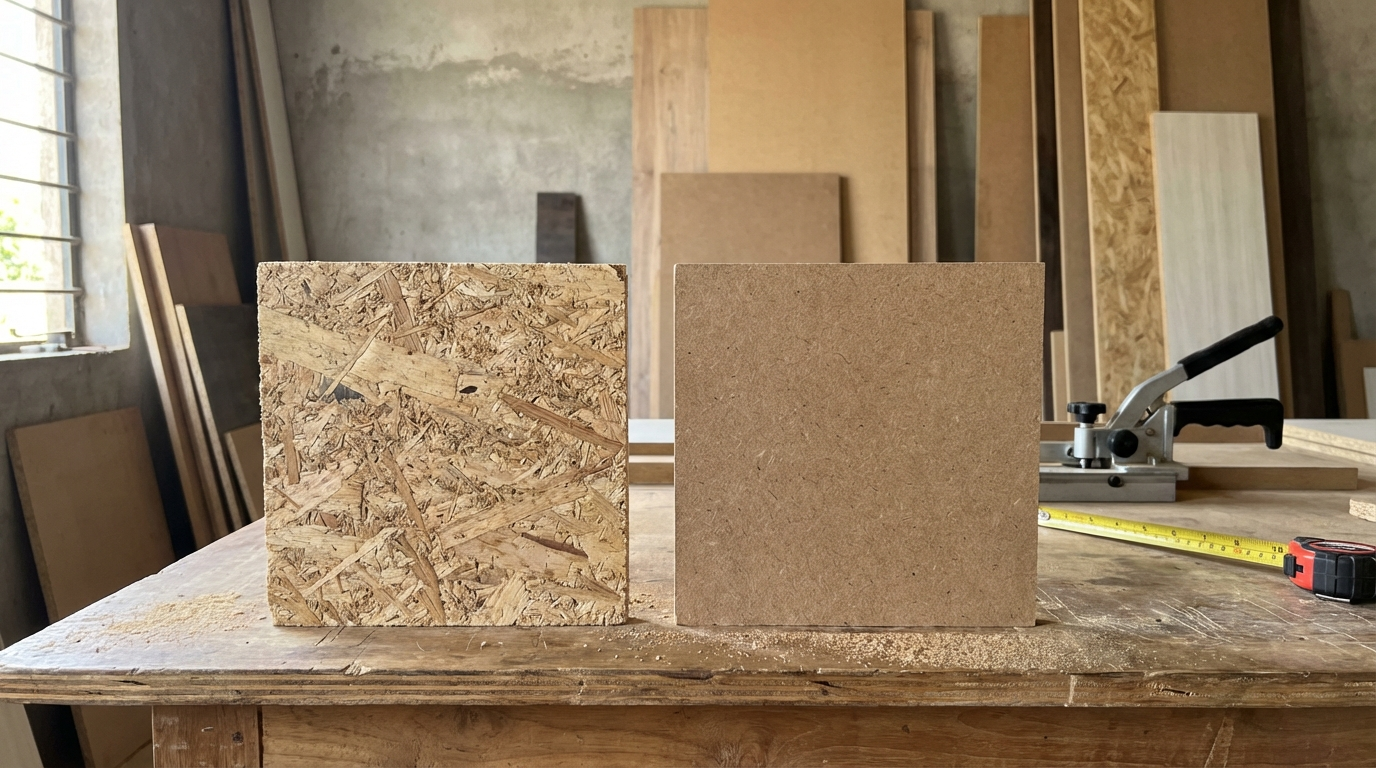
Density varies by manufacturer formulations: lower for cost-sensitive panels, higher for structural needs. It's not uniform like plywood; fibers align randomly, so density impacts uniform strength across the board.
In Indian workflows, density dictates CNC routing ease, laminate adhesion, and screw grip. Thicker boards (18mm+) amplify density effects—low-density versions sag under weight, high-density hold finishes crisp.
Why It Matters in Indian Homes and Sites
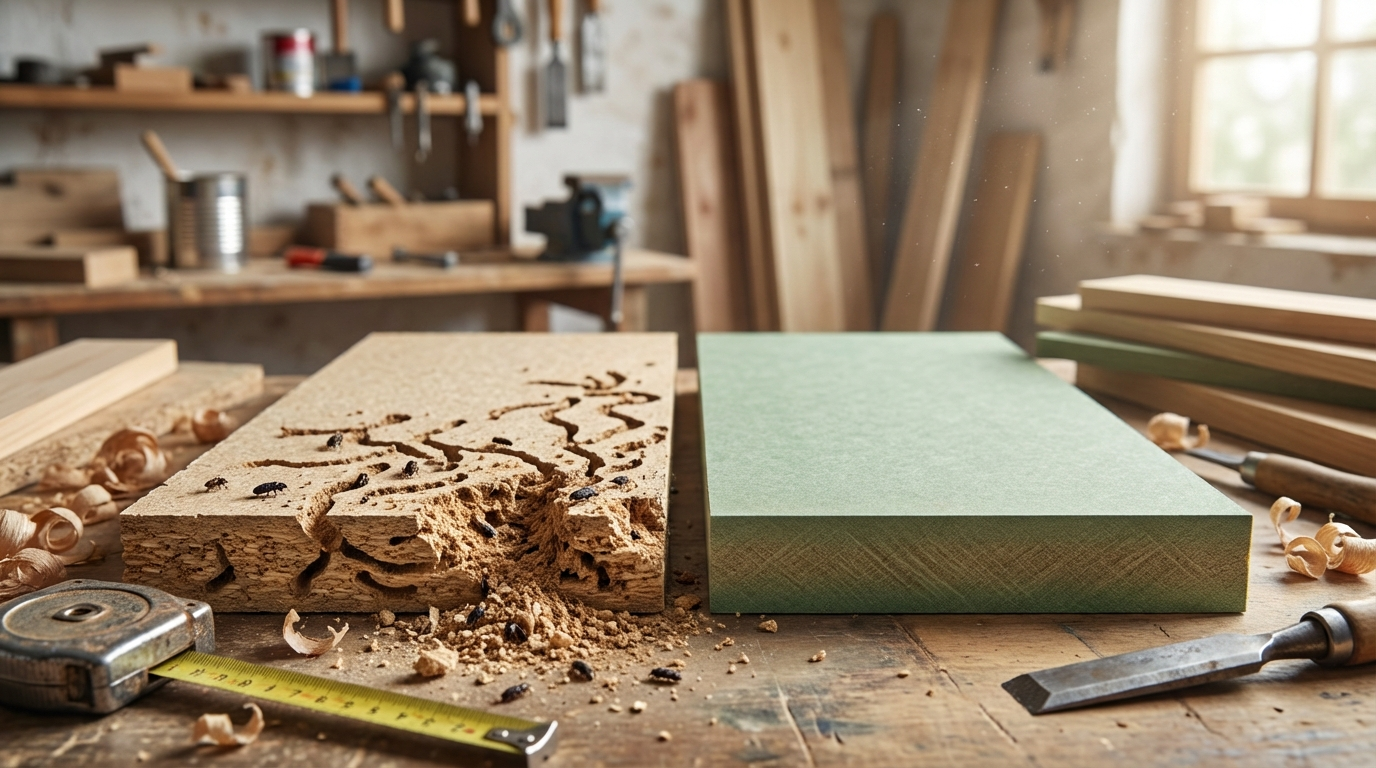
Monsoon humidity (70-90% RH) softens low-density MDF, weakening fiber bonds and causing screw holes to enlarge over time. Coastal areas like Mumbai or Chennai add salt-laden air, accelerating edge swelling if density dips below 700 kg/m³.
Site realities—open godowns, truck exposure, or carpenter yard storage—drop effective density via moisture pickup. Result: shutters warp, wardrobe shelves droop, TV units chip at edges.
High-density options resist these, holding screws 20-30% tighter in humid tests, vital for modular interiors where rework costs spike.
Meaning, Types, and Where People Get Confused
MDF density means kilograms per cubic meter (kg/m³) of the compressed fiber-resin matrix. It gauges compactness: tighter fibers mean higher numbers, stronger performance.
Types break down as:
- Standard/Low: 650-700 kg/m³—light, affordable for partitions.
- Medium: 700-750 kg/m³—balanced for cabinets.
- High: 750-850 kg/m³—robust for shutters, furniture carcasses.
What density range counts as "high-density MDF"?
High-density MDF starts at 750 kg/m³, offering superior screw retention and sag resistance. Ideal for 18mm shutters in kitchens. Nuance: exceeds standard by 10-20% compactness, but harder to nail. Check by weighing a known-size sample—divide weight by volume for kg/m³. Next step: tap edges; high-density sounds solid, low feels hollow.
Is MDF density the same as HDF?
No—MDF tops at 850 kg/m³; HDF pushes 850-1000+ for doors/shelves. MDF suits broad interiors; HDF for ultra-strength. In India, confuse them at humid sites—HDF holds better long-term. Verify: ask for density cert stamp, not just "high-density" label.
- Confusion 1: Density = thickness—no, 18mm low-density sags faster than 12mm high.
- Confusion 2: Higher always better—overkill for walls, machines poorly.
- Confusion 3: Uniform across board—cores can vary 50 kg/m³.
- Confusion 4: Moisture-proof if high density—needs MR grade too.
- Confusion 5: Weighs less than plywood—high-density rivals it.
How Density Affects Strength and Screw Holding
Higher density packs fibers tighter, boosting compressive strength by 30-50% and bending resistance—key for shelf spans over 60cm.
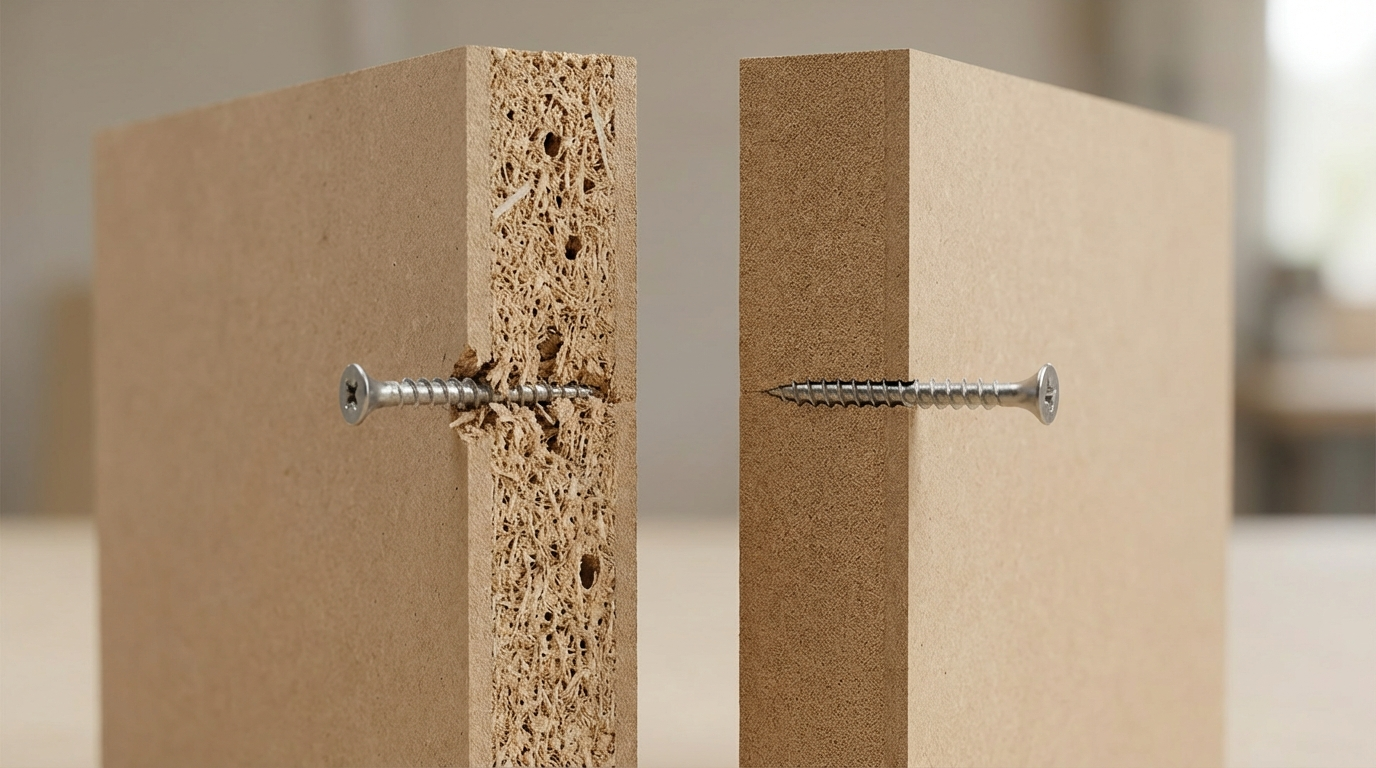
Screw holding: Low density (<700) strips after 3-5 cycles; high (800+) endures 10+ in hinges. Resins bind fibers, so density correlates directly with grip.
In India, post-monsoon, low-density loses 15-20% hold from swelling.
Does higher MDF density mean better screw holding?
Yes—750+ kg/m³ grips screws 25% tighter, resisting pull-out in door hinges. Conditions: test with #8 wood screws at 25mm depth. Low density fails in kids' furniture. Check: drive screw into edge, wiggle—if loose, skip for load-bearing.
How to Decide or Do This in 5 Steps
- Assess load/use: Heavy (wardrobes)? 750+. Light (panels)? 650+.
- Check site humidity: Coastal/monsoon? Add 50 kg/m³ buffer.
- Test sample: Screw/nail scrap; measure pull-out force informally.
- Verify stamp: Edges must show kg/m³—ignore verbal claims.
- Balance cost/machining: High density slows CNC feeds by 10-20%.
Failure point: Skipping step 3 leads to site rework. Prevention: Buy 5% extra for tests.
Price Range and Cost Drivers
MDF prices span Rs 800-1800 per sheet (8x4 ft, 18mm), driven by density. Low (650-700): Rs 800-1100; high (750+): Rs 1200-1800.
Drivers: density (20-30% uplift), thickness (Rs 50-100/mm), resin (MR adds 10%), logistics (coastal +15%), city (Tier-1 +20%). Wastage: high-density cuts cleaner, saves 5%.
Budget example: 10-sheet wardrobe (Rs 12,000-18,000 total). Quote checklist: specify density/thickness/MR grade, sheet size, delivery terms.
Two-Minute Comparison: Low vs Medium vs High Density MDF
| Aspect | Low (650-700 kg/m³) | Medium (700-750) | High (750-850) |
|---|---|---|---|
| Screw Hold | Weak; strips fast in humidity | Good for light loads | Excellent; 10+ cycles |
| Strength (Sag Resistance) | Poor over 50cm spans | Fair for shelves | Strong; 80cm+ safe |
| Machining | Easy CNC, less dust | Balanced | Harder; slower feeds |
| Finish Quality | Rougher; needs sanding | Smooth | Glass-like |
| India Humidity Fit | Dry interiors only | Moderate | Monsoon/coastal |
| Cost Premium | Base | +10-15% | +25-40% |
Choose high for kitchens (wet/abuse); low for partitions (budget/speed).
Practical Use Cases: What Works, What Fails
| Use Case | Recommended Density | Thickness | Risk Notes |
|---|---|---|---|
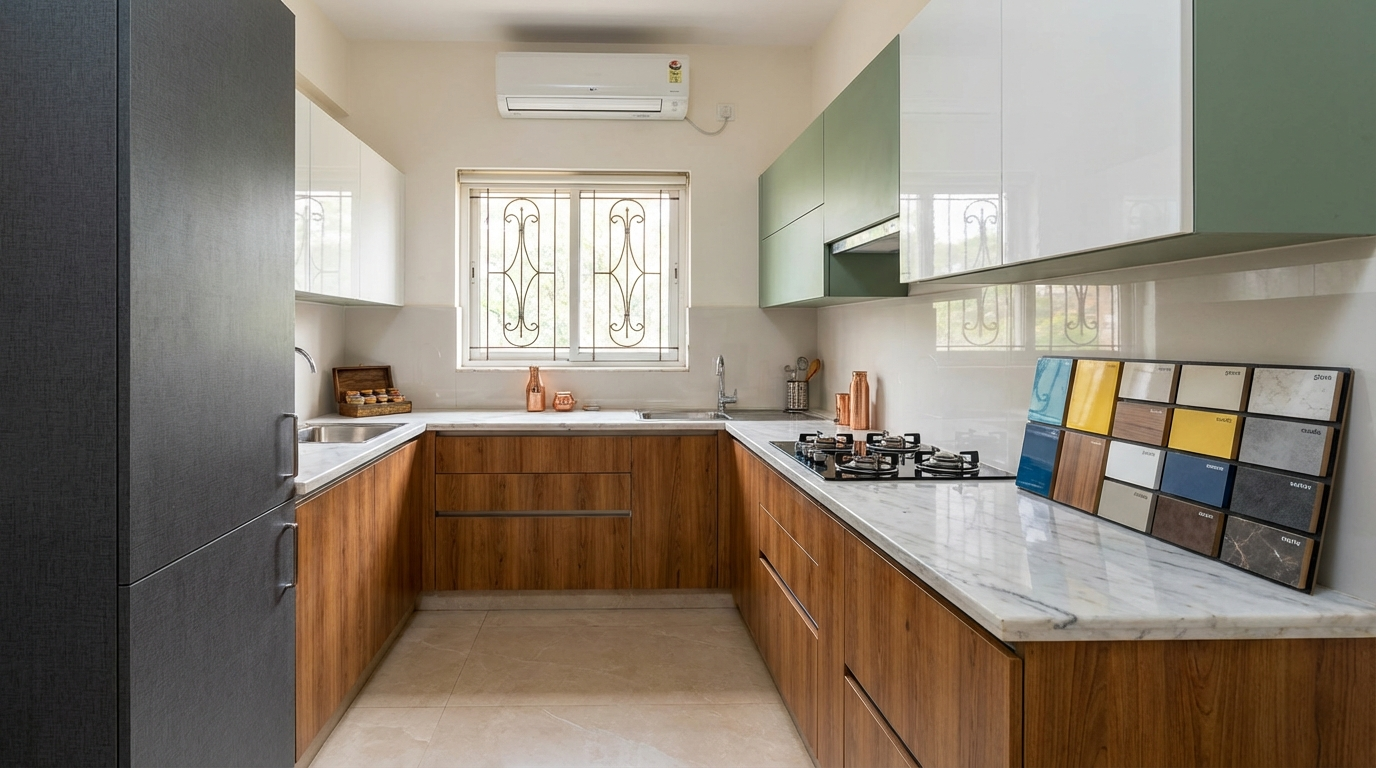
| Kitchen Shutters | 750+ | 18mm | Low risks swelling/screw fail |
| Wardrobe Carcass | 700-800 | 18mm | Edge seal vital in humidity |
| TV Unit Shelves | 700+ | 15-18mm | Avoid low for TV weight |
| Wall Panels | 650-700 | 8-12mm | Low load, dry zones |
| Office Partitions | 700 | 12mm | Balance cost/impact |
Failure Modes and Fixes
- Symptom: Screw stripping. Root: Low density + humidity. Prevent: 750+ kg/m³, pre-drill. Fix: Epoxy fill, redrill offset.
- Edge swelling. Root: Moisture on low density. Prevent: MR grade, seal post-cut. Fix: Sand, re-laminate.
- Sag in shelves. Root: Span >60cm low density. Prevent: 750+, ribs. Fix: Reinforce underside.
- CNC chipping. Root: High density wrong feeds. Prevent: Slow RPM. Fix: Sand edges.
- Delamination. Root: Poor resin in low density. Prevent: Density stamp check. Fix: Clamp, resin inject.
- Finish scratches. Root: Soft low-density surface. Prevent: Laminate overlay. Fix: Buff, recoat.
Decision Framework for Choosing MDF Density
| Condition | Recommended Density | Verify/Notes |
|---|---|---|
| Wet zone (kitchen) | 750-850 kg/m³ | MR grade; screw test |
| Coastal humidity | 750+ | Edge seal; storage check |
| Heavy use (kids) | 750-800 | Impact test; thickness 18mm |
| Tight budget | 650-700 | Dry interiors only |
| Fast CNC delivery | 700 | Balanced feeds |
| High scratch risk | 750+ | Laminate finish |
Quality Checks You Can Do Without Lab Tests
Before buying: Tap board—high density rings solid. Weigh sample (1ft² x thickness). Ask density range, check edge stamp. Red flag: No markings, warped stack.
After cutting: Smooth edges? No fuzz = good density. Screw test: 25mm depth, no crack.
After install: Check alignment; clean with microfiber only. Humidity test: expose scrap to steam, measure swell.
How do I check MDF density on site?
Weigh a sample: cut 300x300x18mm, weigh on scale, calculate kg/m³ (weight in kg / 0.000162 m³). Direct: 750+ feels hefty. Nuance: Varies by batch. Next: Compare to plywood sample for benchmark.
Common Buyer Mistakes and How to Avoid Them
- Mistake 1: Trusting "high density" verbal claims. Avoid: Demand edge stamps.
- Mistake 2: Ignoring humidity zone. Avoid: Add 50 kg/m³ for coasts.
- Mistake 3: Low density for screws. Avoid: Pre-test every batch.
- Mistake 4: No edge sealing. Avoid: Apply post-cut in monsoons.
- Mistake 5: Over-spanning shelves. Avoid: Max 60cm low density.
- Mistake 6: Wrong CNC speeds. Avoid: High density = 50% slower feed.
- Mistake 7: Poor storage. Avoid: Cover stacks, elevate.
- Mistake 8: Skipping MR in kitchens. Avoid: Density + moisture resistance combo.
- Mistake 9: Budget over strength. Avoid: Calculate rework costs.
- Mistake 10: No sample tests. Avoid: Buy test sheets first.
Tips by User Persona
Homeowners: Durability: Wipe spills instantly, avoid water near edges. Don't overload shelves—limit 20kg/m. Use cam locks over screws for easy fixes.
Carpenters: Cutting: High density needs sharp 60-tooth blade. Edge prep: Bevel before banding. Fastening: Pre-drill 80% depth. Hinges: Offset 10mm from edge.
Architects/Designers: Specs: Mandate 750+ kg/m³ + MR for wet zones. Detailing: 2mm PVC edge. Finish: Matte laminate hides density flaws.
OEM/Modular Makers: Repeatability: Batch-test density. QC: Screw pull-out log. Reduce complaints: 18mm min carcass, pre-seal all.
What MDF density is best for wardrobe shutters?
750-800 kg/m³ for firm screw hold in sliding mechanisms. Suits Indian humidity. Nuance: Pair with soft-close hinges. Check: Install test door, cycle 50 times.
Can low-density MDF handle kitchen cabinets?
Only in dry climates with extra bracing. Typically fails in monsoons via swelling. Opt 700+ instead. Step: Simulate load with weights post-install.
FAQs
What is a good MDF density for screw holding in furniture?
A good range is 750 kg/m³ and above, as it provides denser fiber packing for screws to grip without stripping, especially under repeated door slams. In Indian wardrobes, this holds #8 screws at 30mm depth securely for years. Lower densities work for nails but fail hinges. Factors like pre-drilling and MR grade enhance it further. Always test on scrap: insert, remove five times—if intact, approve for project.
How does MDF density impact machining and CNC work?
Higher density (800+) resists chipping but requires slower feeds (10-15m/min) and sharper bits to avoid heat buildup. Low density machines fast but fuzzes edges, needing extra sanding. For Indian carpenters, balance: medium 700-750 for most routers. Tip: Vacuum dust aggressively—high density generates more. Verify post-cut: clean 45° bevel means right density match.
Why does low-density MDF fail faster in humid areas?
Looser fibers absorb monsoon moisture easier, swelling 10-15% and loosening bonds, leading to screw play and warps. Coastal salt worsens it. High density repels better due to tighter matrix. Prevent by storing vertical, sealing edges immediately. If failing, dry out, sand, and reinforce— but upgrade next time for monsoons.
Is higher density MDF worth the extra cost for home use?
Yes for high-traffic like kitchens or kids' rooms, cutting rework by 30%. For walls, no—save on low. Cost drivers push +25%, but longevity pays in India’s climate. Calculate: wardrobe rework Rs 5000 vs upfront Rs 2000 extra. Decision: List loads first.
How to test screw holding in MDF before buying?
Grab scrap: drive 4-inch wood screw perpendicular to face at 25mm depth, toggle 5-10 times. No stripping? Good. Edge screws tougher—test both. In humid sites, steam-expose first. Red flag: cracks around hole means low density. Buy only passing batches.
Does MDF density affect laminate adhesion?
Yes—high density offers smoother, denser surface for stronger glue bonds, reducing bubbles in humid installs. Low density needs primer. For Indian pre-lams, 750+ shines. Prep: Sand 180-grit, apply within 30min. Test: Peel corner after 24hr cure.
What thickness pairs best with high-density MDF?
18mm for strength leverage—high density maximizes it without bulk. 12mm for panels. Avoid thin high-density; brittle. In shutters, 18mm holds 50kg uniform load. Check span tables mentally: 750+ safe 80cm unsupported.
Can I mix densities in one project?
Possible but risky—match for uniform expansion in humidity. Use high carcass, medium doors. Indian tip: Label batches. Failure: Mismatched swell misaligns. Standardize to medium 700+ for simplicity.
How does density influence MDF weight for transport?
High density adds 20-30% weight per sheet, hiking coastal freight 15%. Plan: 700kg truck loads. Lighter low suits remote sites. Weigh sample: high feels plywood-like heavy.
Disclaimer: This content is provided for general informational purposes based on industry practices and publicly available information. Product specifications, standards, prices, and availability may vary by manufacturer, region, and time. Readers should independently verify details with manufacturers, dealers, or qualified professionals before making purchase or construction decisions.Want Plywood Suggestions?
Share a few details and a VIR MDF specialist will suggest suitable brands and connect you to responsive dealers.