MDF Doors: Types, Designs & Why They're Perfect for Interiors
MDF door guide: panel designs, skin doors, routing patterns & prices. Discover why VIR MDF doors are ideal for Indian interior applications.
Quick Decision Summary
Quick Answer: MDF doors are engineered wood doors made from medium-density fibreboard, offering superior paint finish, warp resistance, and design flexibility compared to solid wood doors, making them the preferred choice for Indian interior applications in 2026.
If you're in a hurry: MDF doors outperform solid wood for interior use because they don't warp in Indian humidity conditions, accept paint and lacquer finishes flawlessly, and cost 30-50% less than equivalent hardwood doors. For wet areas like bathrooms, specify HDFWR (High-Density Fibreboard Water Resistant) doors. Standard 32mm thickness works for bedrooms and living areas, while 35mm or 38mm is recommended for main entrances and high-traffic zones.
Choose MDF doors if:
- You want a perfectly smooth, paint-grade finish without wood grain showing through
- Your home experiences significant humidity fluctuations (monsoon swelling concerns)
- Budget is a priority but you refuse to compromise on aesthetics
- You need intricate CNC-routed panel designs or 3D patterns
Avoid MDF doors if:
- The door will be exposed to direct rain or outdoor elements (use exterior-grade alternatives)
- You specifically want visible natural wood grain (consider veneered MDF instead)
- Installation location has no protection from water splashes without proper edge sealing
- Extremely heavy-duty commercial applications with constant impact
What MDF Doors Actually Mean
MDF doors are interior doors constructed using Medium-Density Fibreboard as the primary material. MDF itself is an engineered wood product manufactured by compressing wood fibres with resin under high heat and pressure, resulting in a dense, uniform panel without the knots, voids, or grain variations found in natural timber.
In the Indian door market hierarchy, MDF doors sit between hollow-core flush doors (budget option) and solid hardwood doors (premium option). They offer the workability and finish quality approaching solid wood while maintaining cost efficiency and dimensional stability that natural timber cannot match.
Common confusions clarified:
- MDF door vs flush door: Flush doors have a hollow or semi-hollow core with face veneers; MDF doors use solid MDF throughout or as substantial panels
- MDF door vs wooden door: MDF is made FROM wood fibres but is engineered; "wooden doors" typically refers to solid timber construction
- MDF door vs HDF door: HDF (High-Density Fibreboard) is denser and stronger than standard MDF, often specified for high-traffic areas
- MDF skin door vs MDF panel door: Skin doors use thin MDF sheets over a frame; panel doors use thicker MDF with routed/moulded designs
Why MDF Doors Matter for Indian Homes
Indian interior environments present unique challenges that make MDF doors particularly suitable. Understanding these factors helps you specify the right door type for each application.
Monsoon and Humidity Performance
During June-September monsoons, indoor humidity in coastal cities like Mumbai, Chennai, and Kolkata routinely exceeds 80%. Solid wood doors absorb this moisture unevenly, causing warping, sticking, and gaps. MDF's uniform density means it expands and contracts as a single unit rather than differentially, significantly reducing warping incidents. However, standard MDF still needs proper edge sealing—exposed edges are the weak point where moisture enters.
Air-Conditioned vs Non-AC Room Cycling
Many Indian homes have AC in bedrooms but not in corridors. This creates a moisture gradient across the door. Solid wood doors often develop cracks along the grain due to this cycling. MDF's homogeneous structure handles these transitions better, though consistent edge protection remains essential.
Real Consequences of Wrong Door Choice
- Swelling and jamming: Doors that won't close during monsoons, requiring planing
- Edge delamination: Unprotected MDF edges absorbing moisture and swelling visibly
- Paint peeling: Moisture trapped under paint causing bubbling and flaking
- Hinge failure: Screws losing grip in moisture-damaged material
- Termite damage: In non-treated boards, especially ground-floor installations
Site Handling Realities
Indian construction sites often store doors improperly—stacked against walls, exposed to cement dust, or left in partially completed rooms during monsoons. MDF doors survive this better than veneered flush doors (which show dents and scratches easily) but still require keeping them flat, elevated off floors, and covered until installation.
Types of MDF Doors Explained
MDF doors come in several construction types, each suited to different applications, budgets, and design requirements. Understanding these categories helps you specify correctly.
| Door Type | Construction | Thickness Range | Best Applications | Price Range (Per Door) |
|---|---|---|---|---|
| MDF Skin Door | Thin MDF sheets (3-4mm) over timber/engineered frame | 30-35mm overall | Bedrooms, bathrooms, budget projects | ₹2,500-₹4,500 |
| Solid MDF Panel Door | Thick MDF panels (16-18mm) with routed designs | 32-38mm overall | Living rooms, main bedrooms, offices | ₹4,000-₹8,000 |
| MDF Moulded Door | Factory-pressed MDF with embossed patterns | 32-35mm overall | Uniform multi-door projects, apartments | ₹3,500-₹6,000 |
| HDFWR Door | High-density water-resistant core with MDF skin | 32-40mm overall | Bathrooms, kitchens, coastal areas | ₹5,500-₹9,000 |
| Veneered MDF Door | MDF core with natural wood veneer facing | 32-38mm overall | Premium interiors wanting wood look | ₹7,000-₹15,000 |
| Laminated MDF Door | MDF core with high-pressure laminate surface | 32-35mm overall | Commercial spaces, high-traffic areas | ₹5,000-₹10,000 |
MDF Skin Doors: Budget-Friendly Basics
Skin doors use thin MDF sheets (typically 3mm or 4mm) laminated over a wooden or engineered frame structure. The interior may be hollow, honeycomb-filled, or solid-core depending on grade. These doors offer the smooth, paint-ready MDF surface at lower cost but have limitations in terms of sound insulation and impact resistance.
Solid MDF Panel Doors: Design Flexibility
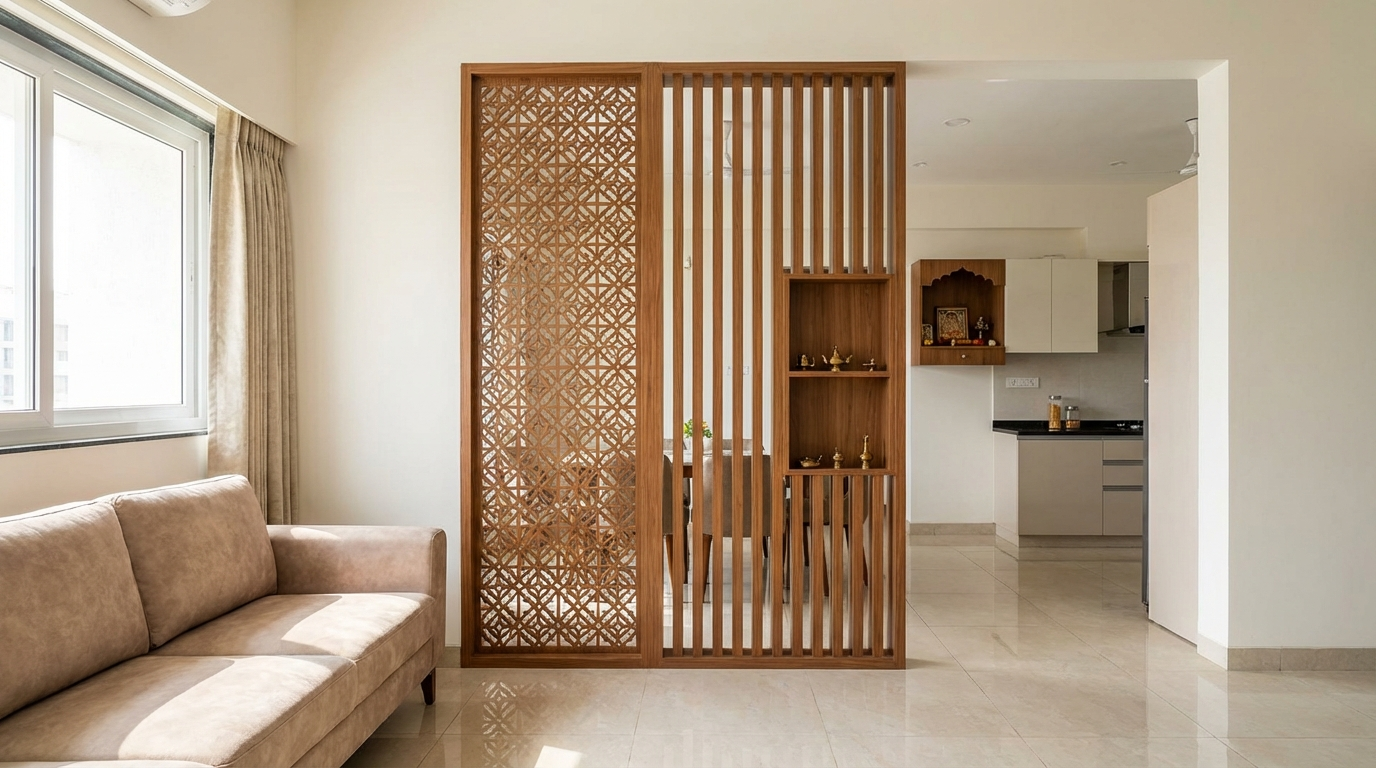
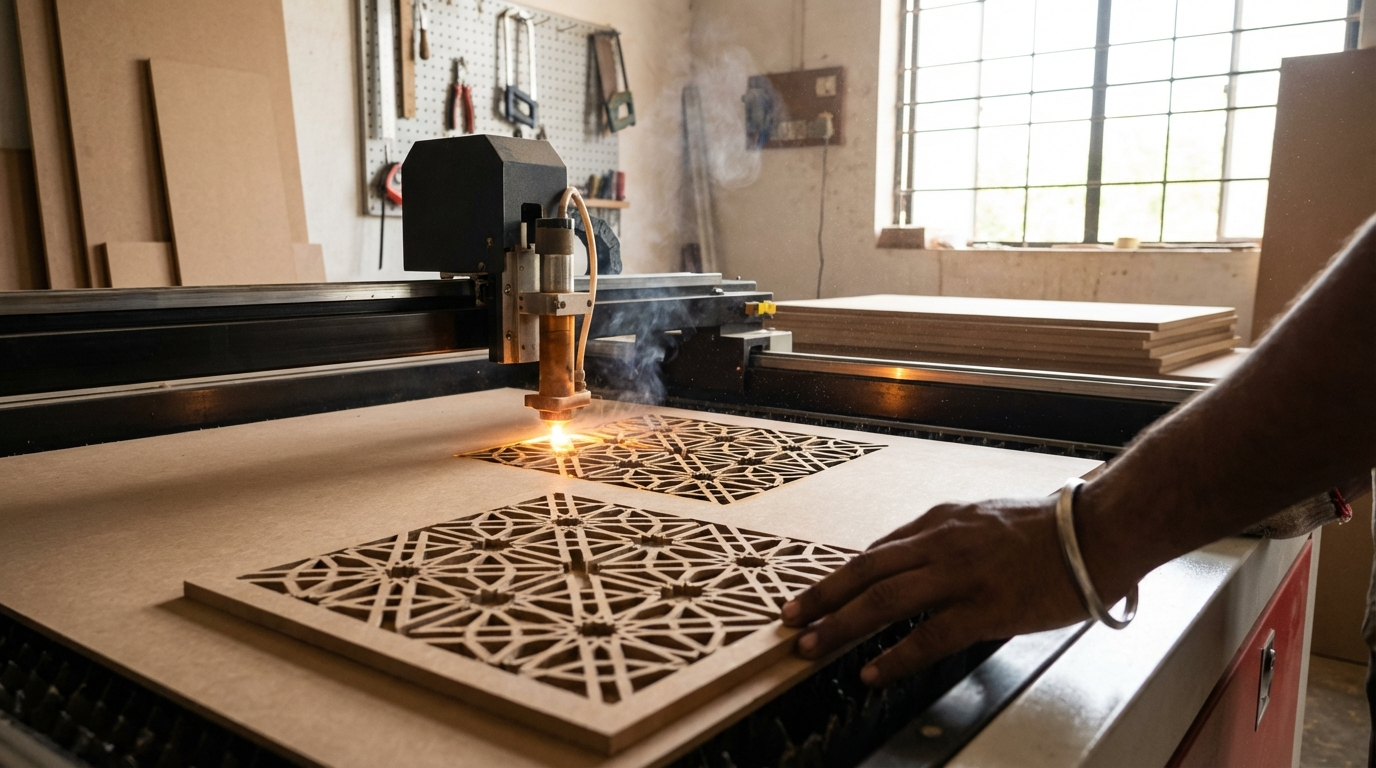
Panel doors use substantial MDF sheets (16mm, 17mm, or 18mm) that can be CNC-routed, moulded, or carved with intricate designs. This construction allows for raised panels, recessed panels, geometric patterns, and decorative profiles impossible to achieve economically with solid wood. The homogeneous MDF core machines cleanly without grain tear-out.
HDFWR Doors: Moisture-Resistant Performance
For bathrooms, kitchens, utility areas, and coastal locations, HDFWR (High-Density Fibreboard Water Resistant) doors provide enhanced protection. The denser core and water-resistant resins significantly reduce moisture absorption. Note that "water-resistant" means better performance in humid conditions—not waterproof. Edge sealing remains critical even with HDFWR.
MDF Door Designs and Routing Patterns
One of MDF's greatest advantages for doors is design versatility. The uniform density allows CNC routers to create clean, precise patterns impossible with natural wood's varying hardness zones.
Popular MDF Door Design Categories
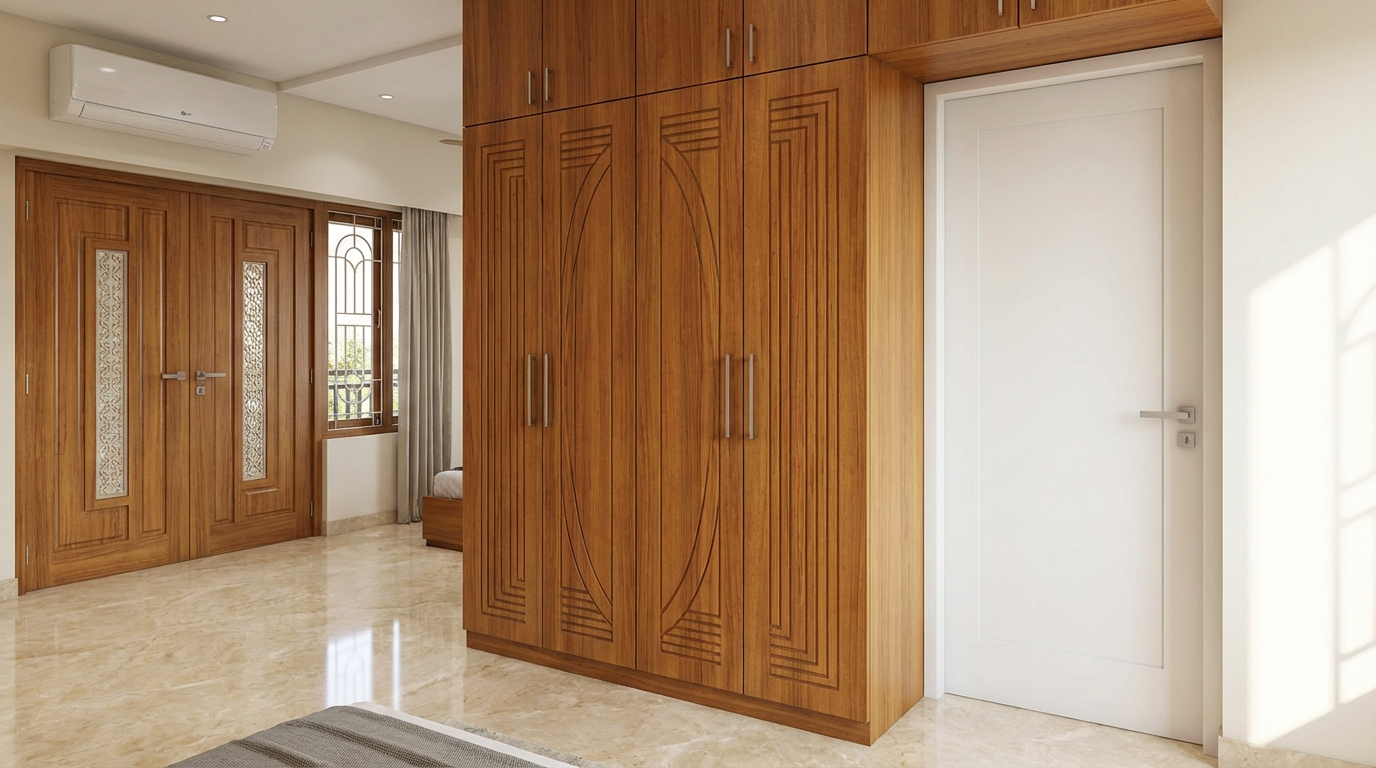
Classic Panel Designs:
- 2-panel vertical (colonial style)
- 4-panel traditional
- 6-panel heritage
- Raised panel with beveled edges
- Recessed panel with square profiles
Contemporary Designs:
- Horizontal groove patterns (3-line, 5-line, 7-line)
- Vertical channel designs
- Geometric patterns (squares, rectangles, diamonds)
- Minimalist single-groove flush
- Asymmetric modern layouts
Decorative and Artistic Patterns:
- Moroccan-inspired geometric
- Art Deco arches and curves
- Floral and organic motifs
- 3D wave patterns
- Custom CNC designs from client artwork
Routing Depth and Finish Considerations
Routing depth affects both aesthetics and structural integrity. Shallow routes (3-5mm) create subtle shadows suitable for minimalist designs. Deep routes (8-12mm) produce dramatic effects but reduce door strength. For doors thinner than 32mm, keep routing depth under 6mm to maintain structural integrity.
After routing, MDF requires proper sealing before painting. The routed edges are more absorbent than flat surfaces and will show texture differences if not primed adequately. Two coats of primer with light sanding between coats typically suffices for professional results.
Decision Framework: Which MDF Door for Which Condition
| Condition/Location | Recommended Door Type | What to Verify Before Buying |
|---|---|---|
| Master bedroom with AC | Solid MDF panel door, 35mm | Edge sealing complete, primer quality, hinge reinforcement |
| Children's bedroom | Laminated MDF door | Scratch resistance rating, edge banding quality |
| Attached bathroom | HDFWR door with laminate/PU finish | Water-resistant certification, bottom edge sealing |
| Kitchen entry | HDFWR door, 32mm minimum | Grease-resistant finish, easy-clean surface |
| Living room main door (interior) | Premium MDF panel or veneered MDF, 38mm | Sound rating (STC 30+), weight capacity for hardware |
| Pooja room | Carved MDF panel door | Routing depth, design detail clarity |
| Rental apartment (budget) | MDF skin door, hollow core | Frame quality, skin adhesion, basic finish |
| Coastal area home | HDFWR with marine-grade edge sealing | Salt-air resistance, hardware corrosion protection |
| Office cabin doors | Solid MDF with acoustic core option | STC rating for privacy, fire rating if required |
| Wardrobe internal doors | Thin MDF (12mm) routed panels | Slide mechanism compatibility, weight considerations |
MDF Door Price Factors and Ranges
MDF door prices in India vary significantly based on construction type, size, design complexity, and finish level. Understanding these factors helps budget accurately.
Price-Influencing Variables
Core Material Grade:
- Standard MDF: Base price level
- HDF (High-Density): 15-25% premium
- HDFWR (Water-Resistant): 25-40% premium
- Fire-retardant MDF: 30-50% premium
Door Size (Standard Indian Sizes):
- 6'6" × 2'6" (78" × 30"): Standard bedroom
- 7' × 3' (84" × 36"): Main entrance, living room
- 7' × 3'6" (84" × 42"): Double door panels
- Custom sizes: 10-20% additional
Design Complexity:
- Plain flush: Base price
- Simple routing (2-3 lines): 10-15% addition
- Panel designs (4-6 panels): 20-30% addition
- Complex CNC patterns: 40-60% addition
- 3D moulded designs: 50-80% addition
Finish Level:
- Unfinished (raw MDF): Lowest price
- Primed only: 5-10% addition
- Paint finished (2-coat): 20-30% addition
- PU lacquer finish: 35-50% addition
- Laminate faced: 30-45% addition
- Veneer faced: 50-100% addition
Indicative Price Ranges (January 2026)
| Door Category | Basic Finish | Premium Finish | Notes |
|---|---|---|---|
| MDF skin door (hollow core) | ₹2,000-₹3,500 | ₹3,500-₹5,000 | Frame quality varies significantly |
| MDF skin door (solid core) | ₹3,500-₹5,000 | ₹5,000-₹7,500 | Better sound insulation |
| MDF panel door (routed) | ₹4,500-₹7,000 | ₹7,000-₹12,000 | Design complexity affects price |
| HDFWR bathroom door | ₹5,500-₹8,000 | ₹8,000-₹12,000 | Essential for wet areas |
| Laminated MDF door | ₹5,000-₹8,000 | ₹8,000-₹14,000 | Laminate brand affects durability |
| Veneered MDF door | ₹7,000-₹12,000 | ₹12,000-₹20,000 | Veneer species determines cost |
Note: Prices exclude installation, hardware, and frame. Actual prices vary by location, quantity, and supplier. Always get multiple quotes.
Common Buyer Mistakes (And How to Avoid Them)
Years of industry observation reveal recurring mistakes that lead to door failures, budget overruns, and unsatisfactory results. Learn from others' experiences.
Mistake 1: Choosing standard MDF for bathrooms
Consequence: Edge swelling within 6-12 months, paint peeling, structural weakening. Prevention: Always specify HDFWR for any room with water exposure, including attached bathrooms and kitchens.
Mistake 2: Ignoring edge sealing on routed doors
Consequence: Moisture enters through absorbent routed areas, causing localized swelling and finish failure. Prevention: Ensure all routed edges receive adequate primer/sealer before topcoat—ask your carpenter to demonstrate edge sealing process.
Mistake 3: Installing doors before room painting/plastering completes
Consequence: Paint splashes, plaster dust absorption, moisture damage from drying walls. Prevention: Doors should be the last item installed, after all wet work completes and room dries adequately.
Mistake 4: Specifying hollow-core for main doors
Consequence: Poor sound insulation, flimsy feel, security concerns. Prevention: Main bedroom and living area doors should be solid-core or minimum 16mm panel construction.
Mistake 5: Not checking door weight vs hinge capacity
Consequence: Sagging doors, stripped hinge screws, doors not closing properly. Prevention: Solid MDF doors are heavy—use 4-inch butt hinges with longer screws, or specify 3 hinges for doors over 25kg.
Mistake 6: Assuming all white MDF doors are equal
Consequence: Colour mismatch between doors from different batches/suppliers. Prevention: Order all doors for a project from single batch, or accept slight variation. Check samples in actual lighting.
Mistake 7: Over-routing thin doors
Consequence: Structural weakness, visible routing shadows from opposite side. Prevention: For doors under 32mm, keep routing depth under 5mm. For decorative deep routing, specify 35mm+ doors.
Mistake 8: Skipping the primer on MDF
Consequence: Uneven paint absorption, multiple coats needed, texture differences showing. Prevention: MDF requires dedicated MDF primer—not just any primer. Two coats with sanding between is standard.
Mistake 9: Not accounting for frame compatibility
Consequence: Gaps between door and frame, improper closing, visible misalignment. Prevention: Measure existing frames accurately. Specify door size accounting for 3mm clearance on each side and 8-10mm at bottom.
Mistake 10: Storing doors improperly at site
Consequence: Warping from uneven support, surface damage, moisture absorption. Prevention: Store doors flat on level surface, keep covered, elevate off floor, maintain in dry area until installation.
Failure Modes and How to Prevent Them
Understanding how MDF doors fail helps you prevent problems before they occur and address issues when they appear.
Edge Swelling
Symptom: Door edges appear thicker, paint cracks at edges, door doesn't fit frame.
Root Cause: Moisture absorption through inadequately sealed edges, particularly bottom edge in bathroom applications.
Prevention: Factory edge sealing, additional sealer application before painting, ensuring bottom edge clears floor by 10mm, installing door sweep instead of dragging contact.
Fix if already happening: Sand affected areas, apply waterproof wood filler, seal thoroughly, repaint. If extensive, replacement may be more economical.
Surface Bubbling/Peeling
Symptom: Paint bubbles up, peels in sheets, shows underlying MDF.
Root Cause: Moisture trapped under paint, inadequate primer adhesion, incompatible paint types layered.
Prevention: Use MDF-specific primer, ensure door is completely dry before painting, apply thin coats with adequate drying time.
Fix if already happening: Scrape all loose paint, sand smooth, check for underlying moisture damage, re-prime and paint with proper products.
Hinge Screw Pullout
Symptom: Door sags, hinges come loose, screws strip out of MDF.
Root Cause: MDF doesn't hold screws as well as solid wood, especially with repeated stress from heavy doors.
Prevention: Use longer screws (minimum 1.5 inches), drill pilot holes, apply wood glue in holes before screwing, use 3 hinges for heavy doors.
Fix if already happening: Fill old holes with wooden dowels and wood glue, let cure 24 hours, drill new pilot holes, reinstall with longer screws.
Routing Area Damage
Symptom: Routed patterns show chipping, edges of routes become fuzzy or damaged.
Root Cause: Impact damage to exposed edges, moisture affecting unsealed routed areas, cleaning with abrasive materials.
Prevention: Ensure routed areas are sealed as thoroughly as flat surfaces, avoid impact on decorative areas, clean with soft cloth only.
Fix if already happening: Wood filler for chips, fine sanding, re-seal and touch up paint.
Warping (Bowing or Twisting)
Symptom: Door doesn't sit flat in frame, gaps visible, door sticks at certain points.
Root Cause: Uneven moisture exposure (one side in AC, other in humid corridor), improper storage before installation, inadequate core density.
Prevention: Specify higher density MDF for areas with humidity differentials, ensure consistent finish on both faces, proper storage during construction.
Fix if already happening: Minor warps can sometimes be corrected by placing door flat under weight for several days. Severe warps require replacement.
Laminate/Veneer Delamination
Symptom: Surface layer peeling away from MDF core, bubbles under laminate.
Root Cause: Poor adhesive application, moisture ingress at edges, excessive heat exposure near door.
Prevention: Verify factory lamination quality, seal all edges including exposed laminate edges, keep doors away from heat sources.
Fix if already happening: Small areas can be re-glued with contact cement and clamped. Extensive delamination requires professional re-facing or replacement.
Quality Checks Without Lab Tests
You don't need sophisticated equipment to assess MDF door quality. These practical checks help evaluate products in showrooms, at supplier locations, or after delivery.
Before Buying: Showroom and Sample Checks
Visual inspection:
- Surface should be uniformly smooth without visible fibres or texture variation
- Edges should be clean-cut without fraying or crumbling
- Routed patterns should have crisp, clean lines without fuzzy edges
- No visible voids, chips, or surface defects
- Colour should be consistent across the door face
Physical tests:
- Rap knuckles on surface—solid core sounds solid, hollow core sounds hollow
- Press firmly on centre of door—excessive flex indicates low density or hollow core
- Check weight—heavier generally indicates denser, higher-quality MDF
- Scratch test on hidden edge with fingernail—easy scratching indicates low density
Questions to ask supplier:
- What is the core density (should be 650-750 kg/m³ for standard MDF, 800+ for HDF)?
- Is this moisture-resistant grade (for bathroom/kitchen applications)?
- What is the formaldehyde emission class (E1 or E0 preferred)?
- Where are edges sealed, and what sealer is used?
- What warranty covers, and what voids it?
Red flags to watch:
- Supplier cannot provide density or grade specifications
- Price significantly below market range (suggests substandard material)
- Uneven thickness across door when measured at multiple points
- Strong chemical smell (indicates high formaldehyde, poor manufacturing)
- Visible layering or separation at cut edges
After Cutting/Routing: Workshop Quality
- Cut edges should be solid without visible voids or layering
- Routing should not expose different-coloured core layers
- No burn marks from dull router bits (indicates workshop quality)
- Consistent thickness at routed areas
After Installation: Performance Verification
- Door should swing freely without sticking
- Consistent gap around frame (3mm typical)
- Hinges secure without movement at screws
- Paint finish uniform without visible primer showing through
- Latch and lock engage smoothly
Tips by User Type
For Homeowners
Durability expectations: Properly installed and finished MDF doors should last 15-20 years with normal use. Bathroom doors in humid areas may need refinishing every 8-10 years. Budget for touch-up painting every 5-7 years for high-traffic doors.
Cleaning do's and don'ts:
- DO wipe with slightly damp soft cloth
- DO use mild soap solution for stubborn marks
- DO dry immediately after any wet cleaning
- DON'T use abrasive cleaners or scrubbing pads
- DON'T allow water to pool at bottom edge
- DON'T use harsh chemicals that can damage finish
When to worry: Visible swelling at edges, paint bubbling, door sticking that worsens over time, screws coming loose repeatedly. Address these early—small problems become expensive replacements if ignored.
For Carpenters and Contractors
Cutting tips:
- Use carbide-tipped blades—MDF dulls steel blades quickly
- Score cut lines to prevent surface chipping
- Support large sheets fully to prevent breakage
- Wear proper dust protection—MDF dust is fine and harmful
Edge preparation:
- Sand cut edges with 120-grit, then 180-grit
- Apply edge sealer or diluted PVA before primer
- Pay special attention to bottom edges for bathroom doors
- Use edge banding for exposed edges on quality work
Screw zones and hinges:
- Always drill pilot holes in MDF—it splits easily
- Use screws at least 1.5 times the MDF thickness
- Consider hinge reinforcement plates for heavy doors
- Apply wood glue in screw holes for permanent installations
Handling precautions:
- MDF doors are heavier than they look—use proper lifting techniques
- Store flat, never leaning, to prevent warping
- Keep wrapped until installation to prevent damage
- Allow doors to acclimatize to room conditions 48 hours before installation
For Architects and Interior Designers
Specification language:
- State density requirement: "MDF core density minimum 700 kg/m³"
- Specify moisture grade: "HDFWR grade compliant with IS standards for wet areas"
- Define edge treatment: "All edges sealed with moisture-resistant edge sealer before priming"
- Include formaldehyde class: "E1 emission class or equivalent"
Wet-zone detailing:
- Specify 10mm clearance at door bottom in bathrooms
- Call out door sweep rather than threshold contact
- Note PU lacquer or marine-grade finish for moisture areas
- Consider kickplate at bottom 150mm for splash protection
Finish selection guidance:
- High-traffic areas: Laminate or PU lacquer (harder wearing)
- Design-focused areas: Paint or veneer (more customizable)
- Budget projects: Melamine or standard paint
- Premium projects: Natural veneer over MDF core
For Modular Furniture and OEM Manufacturers
Quality control checkpoints:
- Incoming material: Check density, thickness consistency, moisture content
- After cutting: Verify no voids, consistent edge quality
- After routing: Confirm clean patterns, no chipping
- After finishing: Uniform coverage, proper cure time observed
- Final inspection: Dimensional accuracy, finish quality, hardware fitment
Reducing customer complaints:
- Document MDF grade and source for traceability
- Provide care instructions with every door
- Clearly state warranty exclusions (improper installation, water damage)
- Use consistent suppliers for batch uniformity
Batch consistency:
- Order project quantities from single production batch
- Store all doors under identical conditions
- Apply finishes under controlled environment
- Maintain consistent drying times between coats
MDF Door Installation Best Practices
Proper installation determines whether your MDF door performs well for years or fails prematurely. These practices apply whether you're installing yourself or supervising a carpenter.
Pre-Installation Checklist
- Verify door dimensions match frame opening (with proper clearances)
- Confirm all wet work (painting, plastering) is complete and dry
- Check door for any transport damage before accepting delivery
- Allow door to acclimatize to room temperature and humidity for 48 hours
- Gather all hardware: hinges, screws, locks, handles
- Ensure frame is level and plumb—doors don't fix frame problems
Installation Sequence
Step 1: Mark hinge positions on door and frame (typically 150mm from top, 230mm from bottom, centre hinge for heavy doors)
Step 2: Cut hinge mortises to exact depth—too deep causes hinge binding, too shallow creates gaps
Step 3: Drill pilot holes for all screws—never drive screws directly into MDF
Step 4: Install hinges on door first, then hang on frame
Step 5: Check swing and clearance—adjust as needed
Step 6: Install lock/latch, drilling pilot holes
Step 7: Install strike plate with proper alignment
Step 8: Install handles and any additional hardware
Step 9: Final check: smooth operation, consistent gaps, secure hardware
Critical Installation Points
- Bottom clearance: 8-10mm for normal rooms, 10-12mm for bathrooms (to clear threshold/tiles)
- Side clearance: 2-3mm each side for wood frames, 3-4mm for metal frames
- Top clearance: 2-3mm
- Hinge side gap: Slightly tighter (2mm) than latch side (3mm) to ensure proper closure
Frequently Asked Questions
Are MDF doors good for Indian bathrooms?
Standard MDF doors are not suitable for Indian bathrooms due to high humidity levels, especially during monsoons. However, HDFWR (High-Density Fibreboard Water Resistant) doors are specifically designed for bathroom applications and perform well when properly installed with complete edge sealing. Ensure the bottom edge has 10-12mm clearance and is sealed with waterproof edge treatment. Apply PU lacquer or marine-grade finish rather than standard paint. Even with HDFWR, avoid direct water contact—these are water-resistant, not waterproof.
How long do MDF doors last in Indian climate conditions?
Properly specified and installed MDF doors typically last 15-20 years in Indian conditions. Key factors affecting longevity include correct grade selection (HDFWR for wet areas), complete edge sealing before finishing, quality paint or laminate application, and proper installation with adequate clearances. Bathroom doors may need refinishing every 8-10 years. Doors in air-conditioned rooms with proper humidity control can last longer than those in naturally ventilated spaces with extreme humidity variations.
What is the price difference between MDF doors and wooden doors in India?
MDF doors typically cost 30-50% less than equivalent solid hardwood doors while offering comparable or better paint finish quality. A basic MDF panel door costs ₹4,000-₹8,000, while similar solid wood doors range from ₹8,000-₹15,000. The savings increase for doors requiring intricate designs—CNC routing in MDF is significantly cheaper than carving solid wood. However, premium veneered MDF doors approach solid wood prices (₹10,000-₹20,000) while offering MDF's dimensional stability advantages.
Can MDF doors be used for exterior applications in India?
Standard MDF and even HDFWR doors are not recommended for exterior applications exposed to rain, direct sunlight, and extreme weather. For covered external areas like balcony doors or passage doors with overhead protection, exterior-grade MDF with proper finishing and maintenance can work. For true exterior applications, consider marine plywood doors, WPC (Wood Plastic Composite) doors, or solid hardwood doors. If MDF must be used near exterior areas, ensure no direct weather exposure and maintain finishes rigorously.
How do MDF skin doors compare to solid MDF panel doors?
MDF skin doors use thin MDF sheets (3-4mm) over a frame structure, while solid MDF panel doors use substantial MDF panels (16-18mm) throughout. Skin doors cost less (₹2,500-₹5,000) but offer limited design options and less sound insulation. Solid panel doors (₹4,500-₹12,000) allow intricate CNC routing, provide better acoustic performance, and feel more substantial. For main rooms and living spaces, solid panel doors are preferred. Skin doors work well for utility areas, rental properties, and budget-conscious projects where basic function suffices.
Do MDF doors require special hinges or hardware?
MDF doors don't require special hinges but do need appropriate hinge selection based on door weight. Solid MDF doors are heavier than hollow-core alternatives—a 7' × 3' solid MDF door can weigh 25-35 kg. Use 4-inch butt hinges with screws at least 35mm long (penetrating well into frame). For doors over 25 kg, install three hinges instead of two. Always drill pilot holes—MDF splits easily with direct screw driving. Consider hinge reinforcement plates for frequently used doors. Standard mortise locks and handles work fine with appropriate pilot holes.
Why does MDF door paint peel in humid Indian cities?
Paint peeling on MDF doors in humid cities like Mumbai, Chennai, and Kolkata typically results from moisture absorption through inadequately sealed edges or surfaces. The moisture gets trapped under the paint film, causing bubbling and peeling. Prevention requires using MDF-specific primer (not regular wood primer), sealing all edges including routed areas before priming, applying thin paint coats with adequate drying time between coats, and ensuring the door is completely dry before finishing. Using moisture-resistant topcoats and maintaining consistent room humidity also helps.
What thickness MDF is best for interior doors in India?
For Indian interior doors, 32mm overall thickness is the standard for bedroom and internal room doors. Use 35mm for main bedroom doors and living room entrances where a more substantial feel is desired. For main entrance doors (interior-facing), 38mm provides better sound insulation and security perception. Bathroom doors can be 30-32mm but must be HDFWR grade. For wardrobe internal doors and light-duty applications, 25mm may suffice. Remember that routing depth reduces effective thickness—account for this when specifying thinner doors with decorative patterns.
How to identify quality MDF doors from low-grade products?
Quality MDF doors exhibit uniform surface smoothness without visible fibres or texture variation. Check edges—they should be clean-cut without crumbling. Quality doors feel heavier due to higher density (700+ kg/m³). Rap the surface—solid cores sound solid, hollow cores sound hollow. Ask suppliers for density specifications and moisture resistance grade documentation. Avoid products with strong chemical smells (indicates high formaldehyde). Price is also an indicator—significantly cheap doors likely use substandard MDF. Check for ISI mark or equivalent certification where available.
Can I paint MDF doors myself, or is professional finishing necessary?
DIY painting of MDF doors is possible but requires proper technique and products for professional results. Key requirements: use MDF-specific primer (absorbs differently than wood), apply two primer coats with light sanding between, use quality acrylic or enamel topcoat, apply thin coats rather than one thick coat, ensure adequate drying time between coats (24 hours for primer, 4-6 hours between topcoats). Common DIY mistakes include skipping primer, using wrong primer type, applying too thick, and not sanding between coats. Professional finishing ensures warranty compliance and consistent results but adds ₹800-₹1,500 per door.
Are MDF doors termite-resistant in Indian conditions?
Standard MDF offers some termite resistance compared to natural wood due to the resin content from manufacturing, but it's not completely termite-proof. For ground-floor installations, coastal areas, or regions with known termite problems, specify termite-resistant MDF that contains added borate or other termite-deterrent chemicals during manufacturing. Even with termite-resistant MDF, avoid ground contact, ensure proper clearance at bottom, and consider termite treatment to surrounding areas. Regular inspection for termite tubes or damage helps catch problems early.
What's the difference between MDF door, HDF door, and HDFWR door?
MDF (Medium-Density Fibreboard) has density of 600-750 kg/m³ and suits standard interior applications. HDF (High-Density Fibreboard) has density of 800-900 kg/m³, offering better strength, screw holding, and impact resistance for high-traffic areas. HDFWR (High-Density Fibreboard Water Resistant) adds water-resistant resins to the HDF composition, making it suitable for bathrooms, kitchens, and humid environments. Price progression follows density: MDF (base) → HDF (15-25% more) → HDFWR (25-40% more). Choose based on application requirements rather than defaulting to cheapest option.
Note: This is independent informational content about MDF doors and is not affiliated with any specific manufacturer or brand. Prices, specifications, and availability may vary by location and supplier. Always verify current specifications with your chosen supplier and ensure products meet local building codes and standards.
Disclaimer: This content is provided for general informational purposes based on industry practices and publicly available information. Product specifications, standards, prices, and availability may vary by manufacturer, region, and time. Readers should independently verify details with manufacturers, dealers, or qualified professionals before making purchase or construction decisions.Want Plywood Suggestions?
Share a few details and a VIR MDF specialist will suggest suitable brands and connect you to responsive dealers.