MDF for Acoustic Panels: How It’s Used + Simple Design Tips
MDF is common in acoustic panel frames and backers. Learn how it’s used, finish considerations, and simple design tips for cleaner installations.
Quick Decision Summary
MDF provides stable, machinable frames and backing for acoustic panels, enhancing sound absorption in home theaters and studios.
If you’re in a hurry: Opt for 12-18mm moisture-resistant MDF for frames and backers in Indian conditions. Build panels 2x4 feet with rockwool insulation wrapped in breathable fabric. Seal all edges to prevent monsoon swelling. Place at first reflection points for best results. This setup cuts echoes effectively without complex tools, but verify density above 700kg/m³ for screw hold.
- Choose this if: You need cost-effective, easy-to-cut panels for dry interiors like living rooms or offices, with good CNC routing for perforations.
- Avoid this if: Panels face direct water splashes or coastal humidity without moisture-resistant grade, risking delamination.
What This Material/Option Actually Is
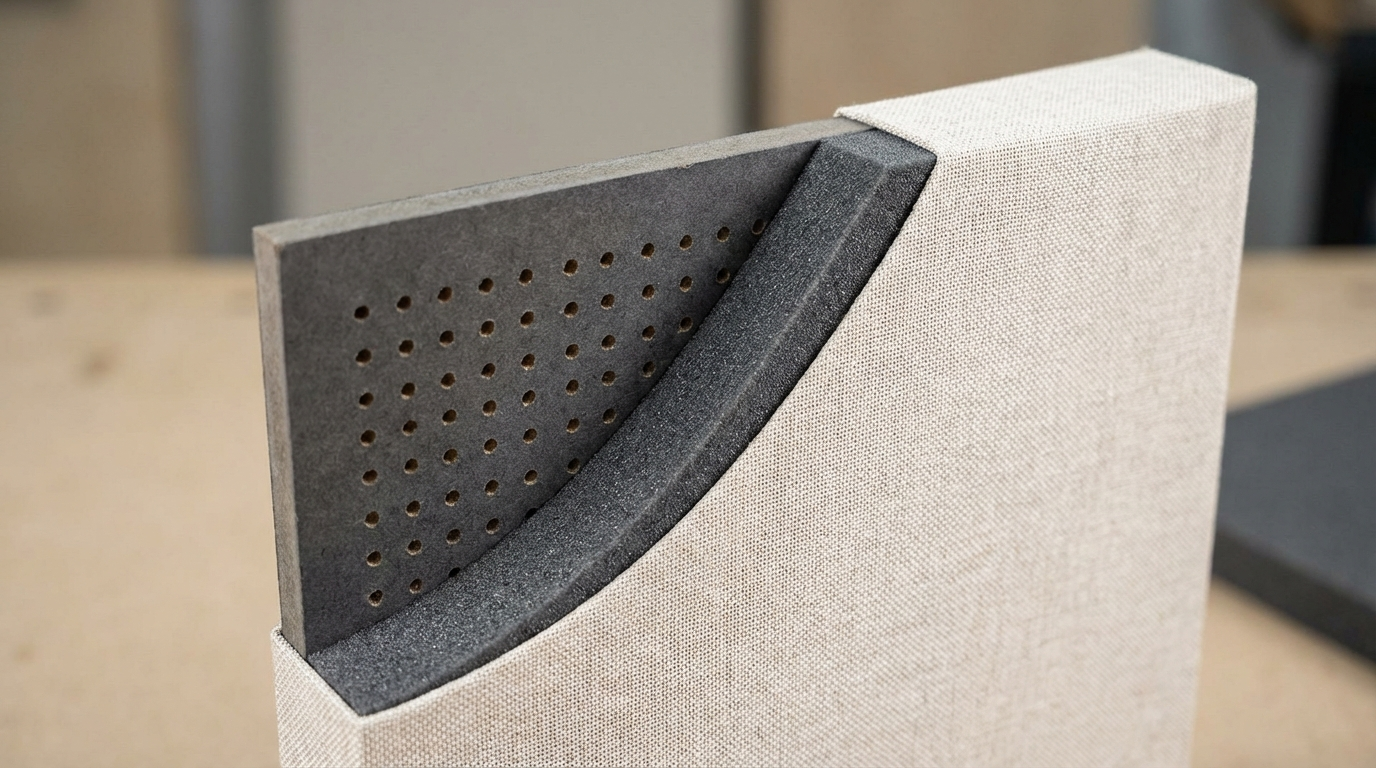
MDF, or medium-density fiberboard, is an engineered panel made from wood fibers bonded with resins under heat and pressure. In acoustic panels, it acts as the structural frame or solid backing sheet, typically 12mm to 18mm thick. Its uniform density—often 700-800kg/m³—makes it stable for holding insulation like rockwool or foam.
Unlike plywood, MDF cuts cleanly without splinters, ideal for DIY frames from 1x4-inch strips or perforated fronts for diffusion. Backers prevent sound leakage. In India, standard MDF suits dry zones, while moisture-resistant (MR) variants use special resins for humid areas.
Pre-laminated or melamine-faced MDF adds finish options, but raw sheets dominate acoustic builds for fabric wrapping.
Why It Matters in Indian Homes and Sites
Monsoon humidity (70-90% RH) and coastal salt air swell standard MDF edges by 5-10%, weakening screw holds in frames. Site storage under tarps often exposes sheets to dew, causing core softening before installation.
In home theaters or offices, poor moisture handling leads to sagging panels and muffled acoustics over time. Coastal Mumbai or Chennai projects need MR MDF to maintain flatness. Workmanship realities—like rushed edge sealing—amplify risks during peak season installs.
Benefits shine in controlled AC spaces: MDF's density aids bass trapping, outperforming lighter pine frames in vibration control.
Practical Use Cases (What Works, What Fails)
MDF excels in non-wet acoustic applications due to its flat surface and machinability. Frames from ripped MDF boards support insulation firmly, while perforated sheets create absorbers.
| Use Case | Recommended Thickness | Finish Notes | Risk Notes (India-Specific) |
|---|---|---|---|
| Home theater walls | 12-18mm | Raw for fabric wrap; edge banded | Monsoon swelling if unsealed; use MR grade |
| Office partitions | 9-12mm backer | Painted or wrapped | Dust buildup scratches; coastal humidity warps |
| Studio ceilings | 18mm frame | Unfinished internal | Weight sag in humid storage; reinforce corners |
| Restaurant booths | 12mm perforated | Slat overlay | Grease/oil stains; ventilation poor in kitchens |
| Conference rooms | 15mm hybrid | Melamine face | High traffic chips edges; verify density |
What fails: Exposed edges in bathrooms or balconies delaminate quickly.
What thickness of MDF works best for acoustic panel frames?
Use 12-18mm for frames—12mm for lightweight home setups, 18mm for heavy studio bass traps. This range balances rigidity and weight. Thinner risks flexing under insulation pressure; thicker adds unnecessary bulk.
In India, match to site: MR 15mm for humid zones prevents bowing. Test by loading a sample frame with 50kg equivalent. Next, calculate panel count via room dimensions (aim 20-30% coverage).
Can standard MDF handle home studio acoustics?
Yes, for dry interiors, its density absorbs mid-frequencies well as backing. Pair with 50-100mm rockwool for broadband control. Avoid in garages or outdoors.
Nuance: Indian summers warp thin sheets; acclimate 48 hours. Check by tapping—solid thud means good density. Install with Z-clips for air gap.
Design Ideas You Can Actually Build
Focus on simple, carpenter-friendly designs using basic tools. Prioritize edge sealing and insulation depth for efficacy.
- Corner Bass Traps: 18mm MR MDF frame (2x2 feet base, triangular), 100mm insulation. Logic: Traps low frequencies; MR for corner humidity. Fabric wrap, edge tape. Coastal fit: Excellent, seals prevent mold.
- Wall Absorbers: 12mm backer, 50mm foam, burlap cover. Perforate front 20% for diffusion. Dry rooms only; laminate edges.
- Ceiling Clouds: 15mm panels suspended, slat overlay on MDF. Ventilation logic: Airflow dries moisture.
- Behind-Screen Panels: 9mm lightweight, full fabric. Budget saver for TV units.
- Slat Diffusers: Groove-cut MDF slats on felt backer. CNC-friendly; monsoon-proof with sealant.
- Partition Screens: Modular 12mm frames, hinged. Office use; verify screw pilot holes.
- Home Office Pod: Curved MDF frame, hybrid insulation. Architect spec: Radius sand smooth.
- Karaoke Booth: Double-layer 12mm with air gap. High abuse; reinforce with battens.
- Restaurant Divider: Perforated 15mm, vinyl wrap. Grease-resistant; coastal salt rinse.
- Podcast Nook: Compact 18mm box frame. Dense MDF for isolation.
- Gym Walls: Impact-resistant 18mm, rubber back. Sweat zones: MR essential.
- Balcony Panels (Protected): Slim 9mm, portable. Avoid direct rain.
- Conference Diffuser Array: Grid-perforated sheets. Light reflection boosts rooms.
- TV Unit Backer: Flat 12mm seamless. Hidden, cost-low.
- Stairwell Absorbers: Angled frames, durable wrap. Echo control in apartments.
Should I perforate MDF for better acoustics?
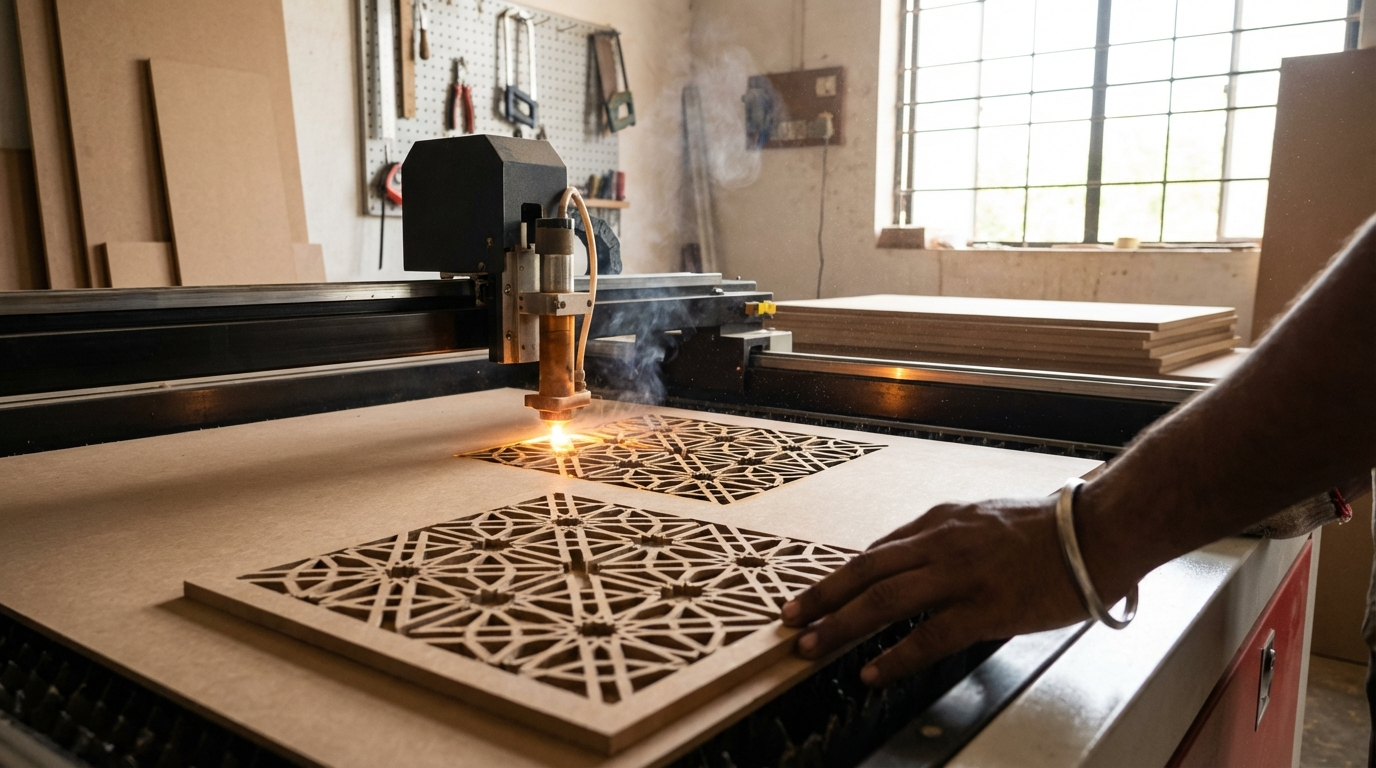
Yes, 10-20% micro-perforations (3-6mm holes) on front sheets improve mid-high absorption by channeling sound into insulation. Use CNC for uniformity.
Conditions: Dry areas only; seal holes against dust. India tip: Monsoon clogs perforations—add mesh. Verify by sound test post-install.
How do I place acoustic panels for maximum effect?
Target first reflection points: Sit in listening spot, use mirror on walls to find bounce spots. Cover 20-30% surfaces, corners first.
Nuance: Avoid overkill—flutter echoes need diffusion too. Indian homes: AC vents dry panels. Measure reverb pre/post with clap test.
Failure Modes and Fixes
- Symptom: Edge swelling
Root: Humidity exposure.
Prevention: MR MDF, PVA sealant on all cuts.
Fix: Sand, re-seal; replace if core soft. - Symptom: Screw pull-out
Root: Low density.
Prevention: Pilot holes, 700+ kg/m³ boards.
Fix: Epoxy anchors or battens. - Symptom: Panel sagging
Root: Thin frame overload.
Prevention: 15mm min, corner braces.
Fix: Reinforce internals. - Symptom: Poor absorption
Root: Shallow insulation.
Prevention: 50mm+ depth, air gap.
Fix: Add layers behind. - Symptom: Fabric tears
Root: Sharp edges.
Prevention: Sand radii, staples inside.
Fix: Re-wrap taut. - Symptom: Chipping on cuts
Root: Dull blade.
Prevention: Scoring pass, zero-clearance insert.
Fix: Filler, sand smooth. - Symptom: Warping post-install
Root: Uneven AC.
Prevention: Acclimatize 72 hours.
Fix: Shim level, monitor RH.
Quality Checks You Can Do Without Lab Tests
Before buying:
- Tap sheet: Uniform thud, no hollows.
- Edge inspection: Smooth, no voids.
- Ask: Density spec, MR certification process.
- Weight test: Heavier feels denser.
- Red flag: Warped stack, musty smell.
After cutting:
- Edges crisp, no fuzz—good resin.
- Bend test: Minimal flex.
- Screw hold: Pilots grip firm.
After installation:
- Level check, no bows.
- Edge seal intact, no moisture beads.
- Clean with damp cloth— no swelling.
Does MDF need sealing for acoustic use?
Always seal cut edges with PVA or wax to block moisture ingress, especially in India. Unsealed absorbs humidity fast.
Nuance: Perforated needs internal coat too. Check: Wipe edge wet, dry time under 30 min. Apply 2 coats pre-assembly.
Decision Framework for Acoustic Panel Projects
| Condition | Recommended MDF/Finish | What to Verify |
|---|---|---|
| High humidity/monsoon | MR 15mm, edge sealed | Sample edge after 24hr damp cloth |
| Coastal/salt air | HMR 18mm frame | Density >750kg/m³, no surface efflorescence |
| Heavy use/office | Laminated 12mm backer | Scratch test with key |
| Tight budget/DIY | Standard 12mm raw | Flatness <2mm over 1m |
| Fast delivery | Pre-cut strips, melamine | Batch uniformity by eye |
| High scratch risk | Thick fabric wrap over | Cut quality, no chips |
| CNC heavy | High-density 18mm | Clean router test cut |
| Wet zones near | Avoid; use PVC alt | Never—switch material |
Common Mistakes and How to Avoid Them
- No acclimatization: Panels warp. Avoid: Store site 72hrs.
- Skipping edge seal: Swells fast. Avoid: 2 coats PVA.
- Thin frames: Sags. Avoid: 15mm min.
- Poor insulation fit: Gaps leak sound. Avoid: Friction-fit exact.
- Over-stapling fabric: Tears. Avoid: Glue + hidden staples.
- Wrong placement: No effect. Avoid: Mirror method.
- Low-density MDF: Loose screws. Avoid: Tap/weigh test.
- No braces: Rattles. Avoid: Corners + mid-supports.
- Rushed monsoon install: Fails quick. Avoid: Dry days only.
- Forget air gap: Reduced bass trap. Avoid: 25mm spacers.
Tips Tailored to Your Role
Homeowners: Durability do: Weekly vacuum fabric. Don’t: Wet wipe MDF edges. Check monthly for bows in AC-off monsoons.
Carpenters: Cutting: Score first, 3000rpm blade. Edge prep: Sand 220 grit. Fastening: 4mm pilots, 40mm screws in zones. Handle stacked flat.
Architects/Designers: Spec MR for elevations under 60% RH. Detail 50mm insulation depth. Wet-zone: Vent gaps. Finish: Breathable wraps.
OEM/Modular Makers: QC: Density gauge, flatness jig. Repeatability: Template cuts. Reduce returns: Pre-seal kits, humidity labels.
Is moisture-resistant MDF worth the extra cost for acoustics?
Yes in humid India—prevents 80% failure modes. Standard suits deserts like Rajasthan.
Trade-off: 20-30% pricier but lasts 5x longer. Verify: Ask resin type (urea-melamine). Budget: Factor site RH meter.
What insulation pairs best with MDF panels?
Rockwool 50-100kg/m³ density, 50-100mm thick—non-combustible, effective broadband. Avoid foam in fire-risk zones.
India: Dust-resistant wraps. Check: Compress test for firmness. Install: No compression over 10%.
FAQs
Why choose MDF over plywood for acoustic frames?
MDF cuts smoother for custom slots and holds fabric taut without grain telegraphing. Its density damps vibrations better in bass-heavy rooms. Plywood suits exteriors but splinters more. In Indian workshops, MDF reduces sanding time by half. Trade-off: Less screw strength—use inserts. For home builds, rip 25mm strips into frames; verify by mock assembly.
Can MDF acoustic panels go in bathrooms?
No for standard; use HMR or PVC hybrids only, with full encapsulation. Direct steam swells even MR grades over time. Opt for slimmer designs hung high. Indian coastal bathrooms amplify risks—add exhaust fans. Alternative: Tile backs with absorbers elsewhere. Test viability by humidity logging first month.
How many panels for a 12x10 feet room?
Typically 8-12 panels (2x4 feet) covering 25% walls/ceiling, prioritizing corners and fronts. Calculate via online calculators or clap test baseline. Indian apartments: Factor furniture absorption. Start minimal, add iteratively. Pro tip: Asymmetric placement avoids dead spots.
Does laminating MDF affect sound performance?
Minimal impact if thin melamine—breathable fabrics over raw outperform glossy. Laminates reflect highs; perforate if needed. For offices, pre-lam speeds install. Seal laminate edges same as raw. In humid sites, laminated holds better visually. Verify: Fabric tension test post-wrap.
What tools for DIY MDF acoustic panels?
Circular saw, stapler, clamps, table saw optional. Sealant brush, sandpaper 180-320 grit. For perforations: Drill guide or CNC. Indian carpenters: Jigsaw suffices for basics. Safety: Dust mask for MDF fines. Workflow: Frame first, insulate, wrap last.
How to clean MDF acoustic panels?
Vacuum fabric weekly with soft brush; spot clean dry cloth. Avoid water on edges—wipe immediately if splashed. Monsoon: Dehumidifier nearby. For stained wraps, replace outer layer. Durability: Fabric choice key (polyester over cotton). Longevity: 5-7 years routine care.
Are there fire safety issues with MDF panels?
Standard MDF is Class B; pair with FR rockwool and fabric for safety. Avoid foam in public spaces. Indian norms: Check local bylaws for studios. Prevention: No exposed glue lines. Test: Flame near edge—self-extinguish preferred.
Can I paint MDF for acoustic panels?
Yes, acrylic flat paint on sealed surface—two thin coats. Enhances aesthetics in visible spots. Avoid gloss for absorption. Dry 24hrs between. India: Humidity cures slow—ventilate. Alternative: Fabric for better sound.
What's the difference between absorber and diffuser panels using MDF?
Absorbers: Thick insulation behind solid/perforated MDF. Diffusers: Slotted or curved MDF scatters sound. Hybrid: Perforated front. Room size dictates: Small rooms absorb more. Design: 12mm slots for diffusion. Test both for balance.
Disclaimer: This content is provided for general informational purposes based on industry practices and publicly available information. Product specifications, standards, prices, and availability may vary by manufacturer, region, and time. Readers should independently verify details with manufacturers, dealers, or qualified professionals before making purchase or construction decisions.Want Plywood Suggestions?
Share a few details and a VIR MDF specialist will suggest suitable brands and connect you to responsive dealers.