MDF for CNC & Jali Panels: Best Thickness, Bit Choice & Finishing Tricks
Get cleaner CNC cuts in MDF. Learn thickness selection, basic bit considerations, dust management, and finishing tricks for premium results.
Quick Decision Summary
For CNC Jali panels in MDF, pick 6-12mm thickness with single flute upcut bits for clean cuts, then seal edges immediately.
If you’re in a hurry: Opt for 8-10mm MR-grade MDF in coastal or monsoon-prone areas—balances machinability and stability. Use 6-8mm single flute bits at 18,000 RPM for intricate Jali patterns to minimize chipping. Manage dust with extractors, and finish with 2-3 coats of PU sealer plus edge banding. Test scraps first to dial feeds/speeds, avoiding thin sheets under 6mm that warp or chip easily during Indian site handling.
- Choose this if… you need affordable, repeatable decorative perforations for wardrobes, TV units, or partitions in dry interiors.
- Avoid this if… high-moisture kitchens or exteriors—switch to HDFWR or PVC for better water resistance.
What This Material/Option Actually Is
MDF, or Medium Density Fiberboard, is an engineered panel made from wood fibers bonded with resins under heat and pressure. For CNC and Jali work, it shines due to its uniform density (typically 700-850 kg/m³), which allows precise routing without knots or grain tearout common in plywood.
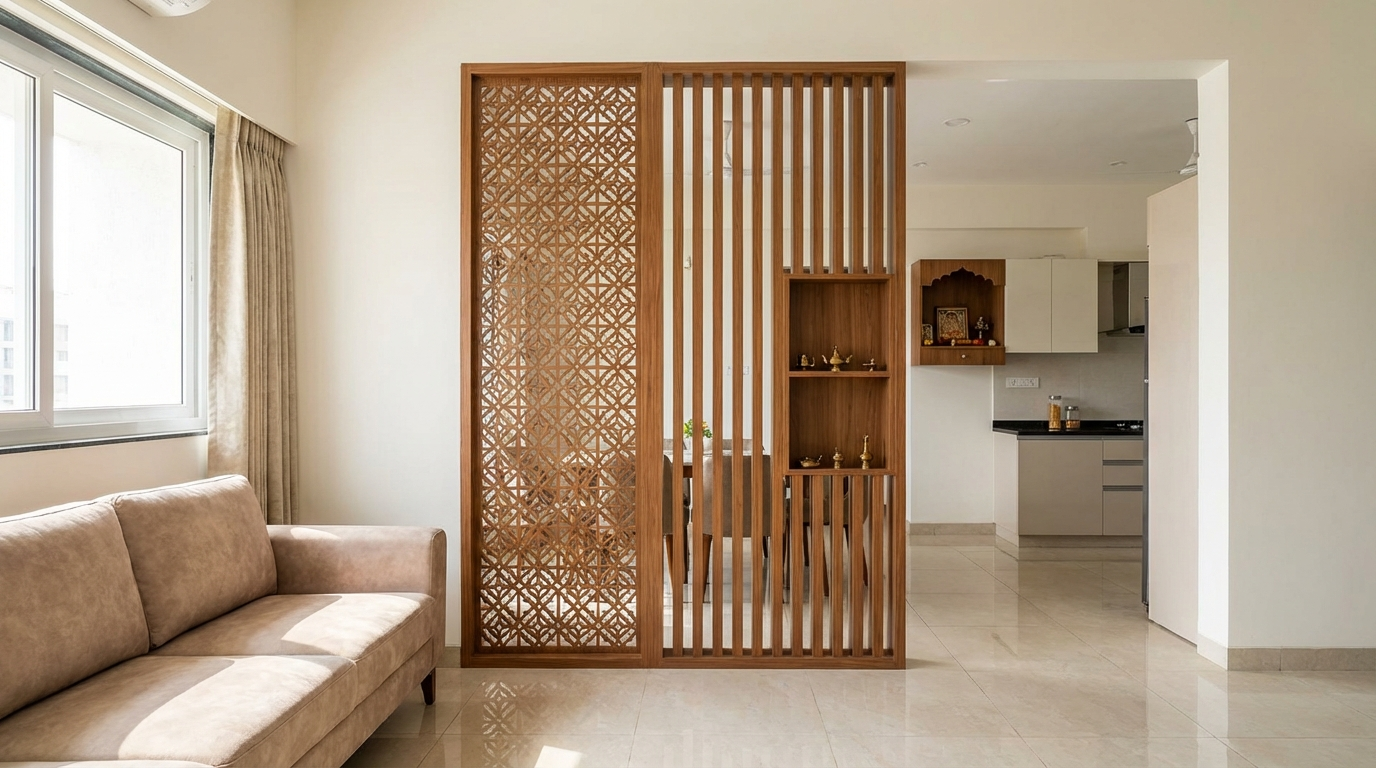
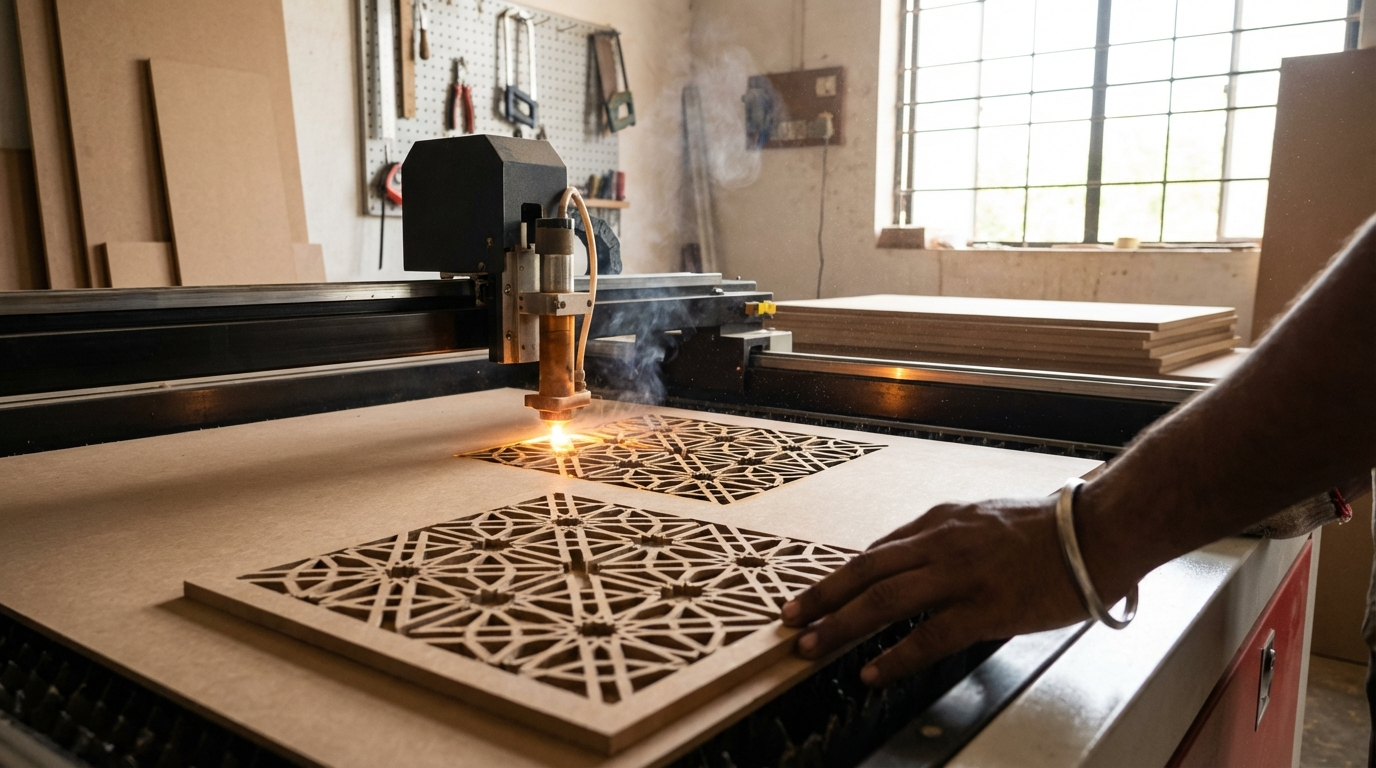
Jali panels refer to perforated decorative screens cut via CNC—think intricate lattice designs for Indian-style interiors like wardrobes or wall dividers. MDF suits this because it machines smoothly, holds fine details, and accepts paints or laminates well. Variations like moisture-resistant (MR) MDF add wax or special resins for humid conditions, while pre-laminated options skip extra surfacing.
It fits modular workflows: cut, edge-band, assemble. Not for load-bearing; pair with frames for strength.
Why It Matters in Indian Homes and Sites
In India, monsoon humidity (70-90% RH) and coastal salt air swell MDF edges if unsealed, leading to delamination in wardrobes or TV units. Site realities like poor storage—stacked sheets in open godowns—cause warping before cutting.
CNC Jali panels excel in ventilated dry zones (living rooms, offices) but fail in kitchens without MR grade. Screw hold weakens post-humidity exposure, so pre-drill for hinges. Dust from MDF cutting clogs workshop vacs in dusty sites, risking health and machine jams. Proper finishing extends life amid daily wipes and AC fluctuations.
How to Decide or Do This in 5 Steps
- Assess project needs: Measure span for Jali (e.g., 600x1200mm wardrobe door). Factor humidity—MR for coastal Mumbai, standard for dry Delhi interiors.
- Select thickness: 6mm for lightweight screens, 12mm for sturdier partitions. Test stability by flexing sample sheets.
- Prep CNC setup: Zero Z-axis precisely; use compression bits for double-sided cuts. Run at 15,000-20,000 RPM, 3-5m/min feed.
- Cut and inspect: Vacuum dust mid-job. Check for chipping—adjust plunge rate if edges fuzz.
- Finish and seal: Sand 220-grit, apply edge band, 2x primer + PU topcoat. Acclimatize 48hrs before install.
Common failure: Skipping dust extraction leads to blade dulling fast in resin-heavy MDF.
What is the best MDF thickness for CNC Jali panels?
8-10mm works best for most Jali—holds detail without sagging. Thinner 6mm suits overlays; 12-18mm for structural screens. In India, thicker resists monsoon flex better but machines slower.
Nuance: Match to span/load—600mm wide needs 10mm min. Verify by cutting sample: thin sheets chip on upcut, thick ones burn. Next step: Buy 10 sheets extra for tests, check density uniformity by tapping (consistent thud).
Which CNC bits cut MDF without chipping?
Single flute upcut 6-8mm diameter for roughing, downcut for finish passes. Carbide-tipped, 1-2 flutes reduce heat buildup.
Conditions: High RPM (18k+) for fine Jali; slower feeds in humid stock to avoid tearout. India tip: Clean bits daily from resin gum. Test: Run scrap at project speeds—if edges clean, proceed; else swap flute count.
Practical Use Cases (What Works, What Fails)
| Application | Recommended Thickness | Finish Notes | Risk Notes (India Context) |
|---|---|---|---|
| Wardrobe Doors | 8-12mm | Laminate + PVC edge band | Humidity swelling at base; elevate storage |
| TV Unit Screens | 6-9mm | Spray PU paint | Dust buildup in vents; add filters |
| Office Partitions | 10-15mm | Veneer + sealer | AC dry-out cracks; acclimatize |
| Wall Panels | 6-8mm | Primer + emulsion | Monsoon warp; MR grade only |
| Kitchen Back Panels | Avoid standard; use MR 12mm | Laminate full face | Steam delam; switch to WPC |
Works: Intricate motifs hold sharp. Fails: Undersized thickness bows under weight.
Design Ideas You Can Actually Build
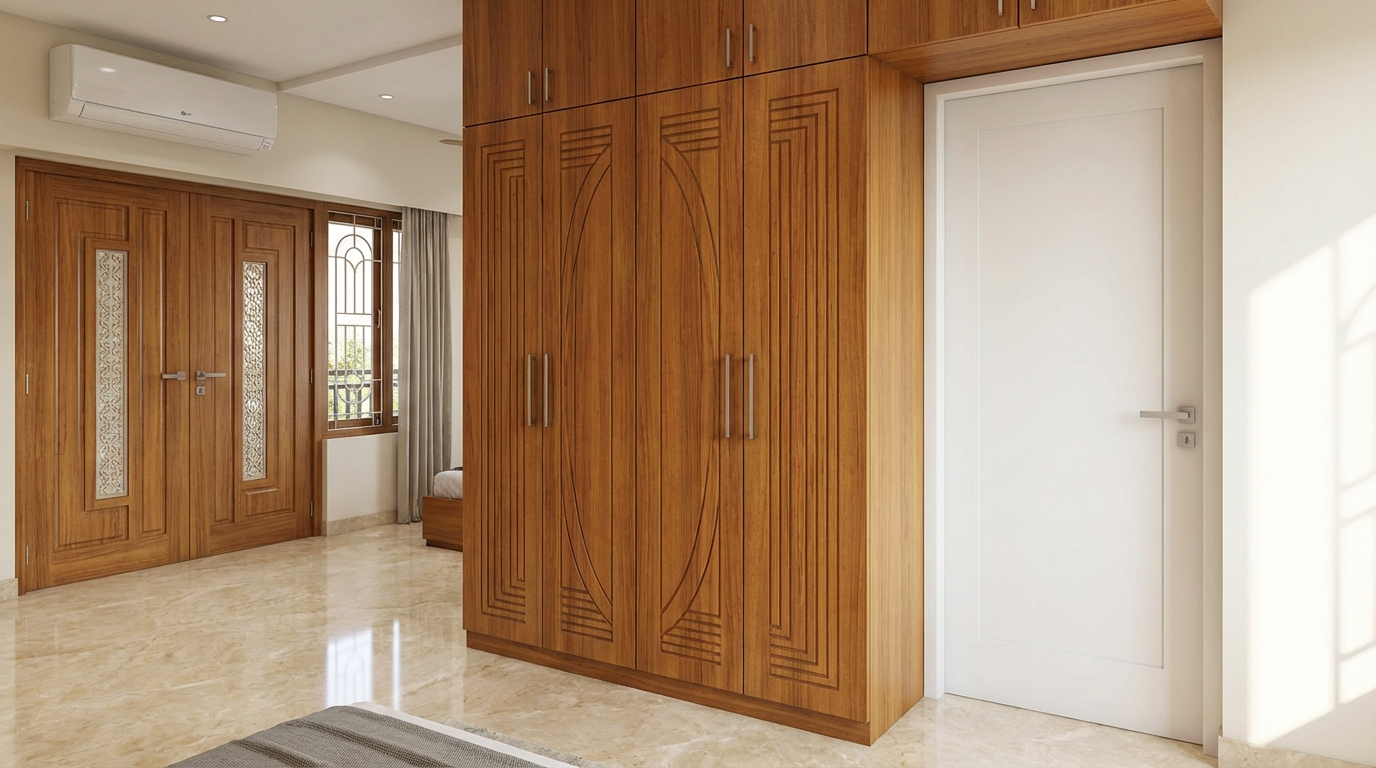
Wardrobes (5 ideas): 1) Geometric Jali doors (8mm MDF, white laminate)—light flow, hides shelves. 2) Floral screens (6mm overlay on 18mm frame)—monsoon-stable with edge tape. 3) Asym lattice (10mm, grey PU)—modern, screw-fixed.
TV Units (4 ideas): 4) Speaker grills (6mm perf, black paint)—dust-proof backing. 5) Side vents (9mm slant cuts)—upcut bits for clean. 6) Floating shelves with Jali (12mm)—load-test first.
Partitions/Walls (6 ideas): 7) Room dividers (12mm MR, wood-look laminate)—coastal fit. 8) Headboards (8mm, textured paint)—bedside humidity ok. 9) False ceilings (6mm drops)—ventilated. 10) Niche screens (10mm curved)—multi-pass CNC. 11) Bar counters (9mm backsplash Jali)—splash-seal edges. 12) Pooja cabinets (8mm motifs)—dust-free finish.
Each: CNC flatbed, 2D/3D software export. India-fit: Acclimatize 3 days pre-cut.
Best Thickness Choices for CNC and Jali
Thickness drives cut quality: 3-5mm too fragile, snaps in clamps. 6-9mm ideal for fine Jali (0.5-2mm slots). 10-12mm for spans over 800mm. 15-18mm for framed panels.
Trade-off: Thinner faster/cheaper but warps in transit; thicker stable but dustier cuts. Monsoon rule: +2mm buffer in humid zones. Test: Clamp sample, route Jali—measure slot accuracy post-cut.
Can I use 3mm MDF for lightweight Jali?
No for standalone—too brittle, chips 50% more. Use as overlay on fabric/ply frame.
Nuance: Fine for decor overlays in dry AC rooms. Coastal? Skip—swells instantly. Check: Flex test; if bends >5mm, reinforce. Next: Laminate both sides for sandwich strength.
Does thickness affect CNC speed?
Yes—thinner passes quicker (8m/min), thick needs multi-pass slowing 30%.
Conditions: Jali density high? Drop feed 20%. India workshops: Overheat risk in summer—coolant mist. Verify: Time a test panel; aim <10min/sq.m for viability.
Bit Choice and Types for Clean MDF Cuts
Straight flute single: Best starter for MDF—evacuates chips fast. Upcut pulls waste up (roughing), downcut shears down (finish). 2-flute for stability in 12mm+.
Diameters: 3mm micro for details, 8-12mm for slots. RPM: 18-24k; chipload 0.05-0.1mm. Dull bits chip 3x more—hone weekly.
India tip: Resin gums in heat; use PCD for 10x life in volume jobs.
What RPM and feed for MDF Jali on CNC?
18,000 RPM, 4m/min feed for 8mm bits—clean without burn.
Nuance: Soft MDF? Up feed 20%; dense? Slow plunge. Monsoon stock softer—watch tearout. Test: Sample run, inspect under light for fuzz; adjust chipload down 10% if needed.
Finishing Tricks for Premium Jali Results
Post-cut: Blow dust, 180-grit sand. Seal edges with wax/PU—blocks humidity ingress. Faces: 2x filler primer, wet-sand, 3x PU (matt/satin). Laminates? Heat-press post-cut.
Tricks: Vacuum table prevents shift; tape backside for splinter guard. India: Wipe with damp cloth only post-cure—avoids white haze.
How to finish CNC-cut MDF edges perfectly?
Immediate edge banding (0.45mm PVC) + PUR glue for humid seal.
Nuance: Thin Jali? Manual tape first. Coastal: Extra wax coat. Check: Rub edge—if powdery, re-sand/seal. Next: Trim flush with flush-trim bit.
Failure Modes and Fixes
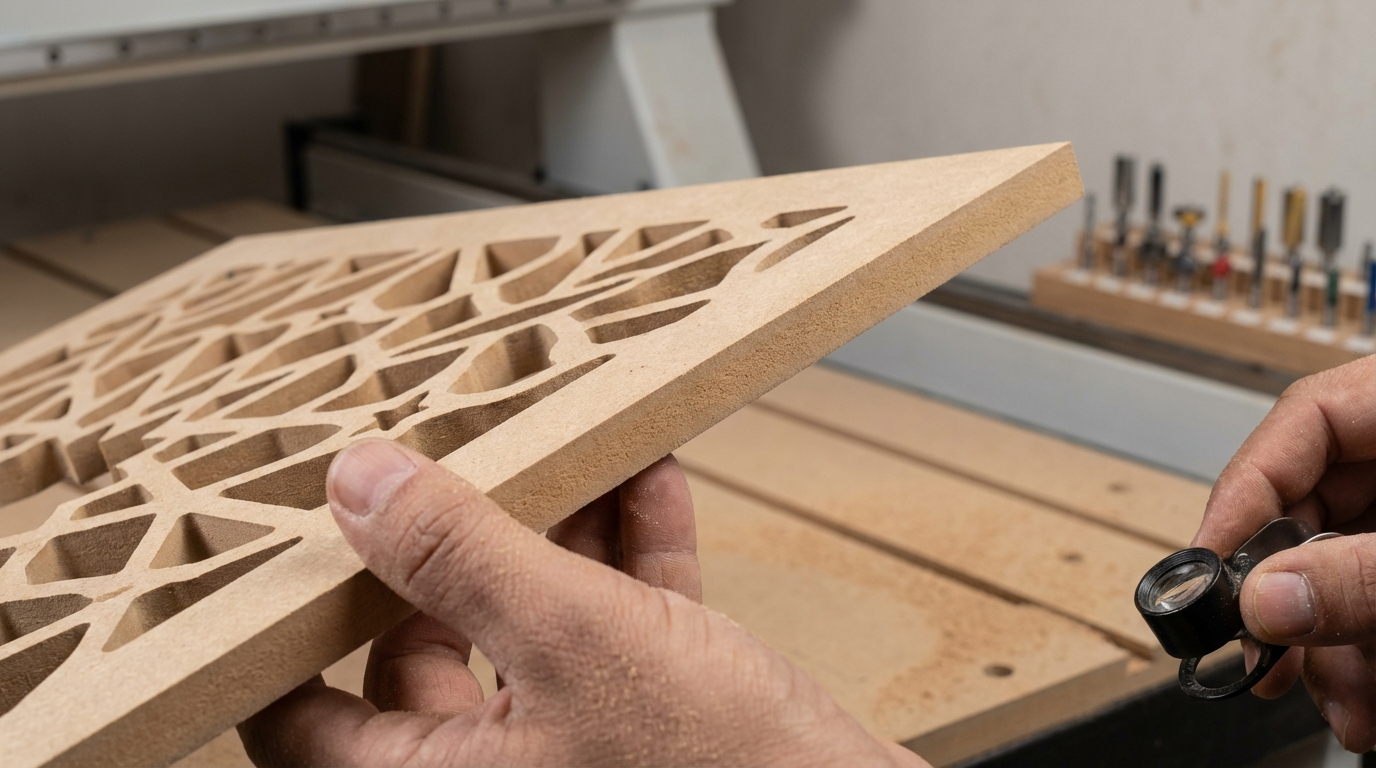
- Symptom: Edge chipping. Cause: Wrong bit/flute. Prevent: Single flute upcut. Fix: Sand + filler.
- Symptom: Burning marks. Cause: Low feed/high RPM. Prevent: Dial speeds. Fix: Scrape + repaint.
- Symptom: Warping post-cut. Cause: Humidity gradient. Prevent: MR grade + AC store. Fix: Discard/flatten press.
- Symptom: Dust clogs slots. Cause: No extraction. Prevent: 99% vac + air blast. Fix: Ultrasonic clean.
- Symptom: Tearout on exit. Cause: Downcut missing. Prevent: Compression bit. Fix: Backing tape.
- Symptom: Delam after install. Cause: Unsealed edges. Prevent: Full perimeter seal. Fix: Re-band/replace.
Decision Framework Table
| Site Conditions | Recommended Specs | What to Verify |
|---|---|---|
| High humidity/monsoon | MR MDF 10-12mm, downcut bits, PUR edge band | Edge swell test: Wet/dry cycle sample |
| Coastal/salty air | HDFMR 9-12mm, sealed laminate, 2-flute bits | Salt spray mock: Wipe edges weekly |
| Heavy use/kids | 12mm+, abrasion-resin finish, compression bits | Scratch test: Keys on sample |
| Tight budget | Standard 6-8mm, basic PU, single flute | Price/kg uniform; no visible voids |
| Fast delivery | Pre-cut blanks 8mm, straight bits | Acclimation stamp: 48hr min |
| High scratch risk | Laminated 10mm, 1mm edge, nano-coat | Finger rub: No fingerprints linger |
Quality Checks You Can Do Without Lab Tests
Before buying: Tap sheet—even tone, no hollows. Weigh sample—650g+ for 12mm/sq.m. Flex ends—minimal bow. Ask: Resin type? MR cert process?
After cutting: Inspect slots—uniform width, no fuzz >0.2mm. Edge sharp? Blow through—clean evac. Measure thickness drop <0.5mm.
Post-install: Check alignment gaps <1mm. Wipe edge— no swelling after 24hr damp. Hinge pull test: No creep.
Red flags: Visible fibers on face, uneven density stripes.
Common Buyer and Maker Mistakes (And Fixes)
- Mistake 1: Ignoring thickness—6mm for doors sags. Fix: Span calc (L/60 rule).
- 2: Cheap bits—dulls in 10 sheets. Fix: Carbide min.
- 3: No dust vac—health/site mess. Fix: 100cfm extractor.
- 4: Dry-cut in monsoon—swells mid-job. Fix: AC store 72hr.
- 5: Skip edge seal—delams in 6 months. Fix: Auto-bander.
- 6: Wrong RPM—burns Jali. Fix: Spindle tach check.
- 7: No test cuts—wastes sheet. Fix: 10% scrap budget.
- 8: Install green—shrinks. Fix: 7-day site acclimate.
- 9: Over-tight screws—cracks. Fix: Pre-drill 80% dia.
- 10: Paint wet—blisters. Fix: 24hr dry between coats.
Tailored Advice for Different Users
Homeowners: Durability: Seal edges yourself with brush-on wax. Don’t: Wipe with harsh cleaners—use microfiber damp. Do: Elevate base 150mm from floor.
Carpenters: Cutting: Clamp firm, zero accurate. Edge prep: 45deg chamfer pre-band. Fastening: Glue + screw in zones. Handle: Gloves to avoid oils.
Architects/Designers: Specs: Detail MR + thickness in drawings. Wet zones: Alt materials. Finish: Sample board approvals. Logic: Jali % open <40% for strength.
OEM/Modular Makers: Repeatability: CNC program library. QC: Auto-inspect slots. Reduce returns: Pack with silica packs. Scale: Bulk MR buys.
Is MDF better than plywood for CNC Jali?
MDF yes—smoother, no splinters. Plywood grains tear.
Nuance: Costlier but zero waste. India: Plywood termite edge. Check: Cut both samples—count rejects. Next: MDF for precision jobs.
How to manage MDF dust in Indian workshops?
HEPA vac + pod enclosures, mask N95.
Nuance: Wet vac for slurry. Monsoon: Dry stock first. Check: Visibility post-cut. Next: Weekly filter clean.
FAQs
Can standard MDF handle intricate Jali designs?
Yes, typically for 0.8mm+ slots in 8mm thickness—uniform fibers hold detail. In Indian dry interiors, it excels for wardrobes or partitions. However, dense motifs over 50% open area weaken structure; frame it. For monsoon zones, MR variant prevents edge fray. Always prototype: Load DXF to CNC, inspect at 10x mag for burrs. Acclimatize sheets to site RH first—avoids mid-job distortion common in humid godowns.
What bit diameter for fine Jali perforations?
3-4mm bits for details under 5mm, scaling to 6mm for slots. Single flute evacuates fine dust best. In volume Indian shops, this cuts time 20% vs multi-flute. Trade-off: Smaller bits snap easier—stabilize with collet nuts. Test feeds: Start conservative, ramp up. Post-coastal humidity, inspect for corrosion; oil lightly. Pair with V-bit for tapers in ethnic designs.
Does Jali thickness change with CNC passes?
Minimal drop (0.1-0.3mm) from heat—use air cool. Multiple passes on 12mm keep accuracy. Indian site heat amplifies—morning cuts best. Verify with caliper grid; >0.5mm redo. Finish: Sand uniform to spec. For overlays, tolerance ±0.2mm critical.
How long does CNC-cut MDF Jali last indoors?
10+ years sealed properly—PU + edge band. Unsealed edges fail in 2-3 monsoons via swelling. Home use: Light duty fine. Heavy wipe zones: Laminate over. Track: Annual edge check. Replace if gaps open >1mm.
Is MR MDF necessary for all Jali projects?
No—dry zones (bedrooms) standard suffices, saves 15-20%. Coastal/kitchen: Yes, resists 24hr soak. Check: Drop water on sample— no bubble in 30min. Workflow: Same CNC params. Bulk buy tip: Mix grades per zone.
What finishing prevents yellowing on MDF Jali?
UV-stable PU topcoat, 60% solids. Primer first blocks tannins. India sun through windows fades—tint grey. Apply 50micron wet. Cure 7 days full hardness. Alternative: Laminate for zero maint.
Can I CNC Jali on pre-laminated MDF?
Yes, but score first—avoids peel. Downcut bits preserve surface. Edges: Re-band post-cut. Ideal for fast modulars. Risk: Lam peel in heat—PUR glue. Test adhesion pull.
How to fix chipped Jali edges after CNC?
Spot-fill with MDF dust + PVA, sand 320, re-seal. Prevent: Tape backside. Minor chips invisible post-paint. Major: Recut section. India dust: Vacuum fill to avoid grit.
Best CNC software settings for MDF Jali?
Aspire/AutoCAD: 0.2mm kerf comp, ramp plunge 10%. Tab slots for hold-down. Export HPGL. Indian machines: G-code verify dry run. Library ethnic patterns speeds repeat jobs.
Disclaimer: This content is provided for general informational purposes based on industry practices and publicly available information. Product specifications, standards, prices, and availability may vary by manufacturer, region, and time. Readers should independently verify details with manufacturers, dealers, or qualified professionals before making purchase or construction decisions.Want Plywood Suggestions?
Share a few details and a VIR MDF specialist will suggest suitable brands and connect you to responsive dealers.