MDF for Kitchen Cabinets: Where It Works, Where It Fails (and Safer Alternatives)
MDF can work in kitchens in the right places. Learn where MDF is safe, how to protect it from moisture, and when plywood is the smarter call.
Quick Decision Summary
MDF suits dry interior cabinet parts in kitchens but fails in wet zones without heavy protection.
If you’re in a hurry: Use standard MDF (15-18mm) for enclosed shelves and backs away from sinks or stoves, always with full lamination and edge sealing. Avoid exposed edges or steam-prone areas during Indian monsoons or coastal humidity. Switch to moisture-resistant HDFWR or marine plywood for shutters, sinksides, or high-spill spots to prevent swelling. This balances cost and longevity in real site conditions.
- Choose this if: Low-moisture zones, tight budget, smooth finishes needed, fast CNC cutting.
- Avoid this if: Direct water contact, poor ventilation, coastal homes, heavy daily spills.
What This Material/Option Actually Is
MDF, or medium-density fiberboard, consists of fine wood fibers bonded with resins under heat and pressure. It creates a uniform, smooth panel ideal for painting or laminating. In kitchen cabinets, it appears as carcasses, shelves, or shutters after surface treatments like melamine or PVC foils.
Variations include moisture-resistant types with added waxes or resins, but standard MDF absorbs water readily. Thicknesses range from 9mm for partitions to 18mm for load-bearing shutters. It machines cleanly for modular designs but needs edge banding to hide raw fibers.
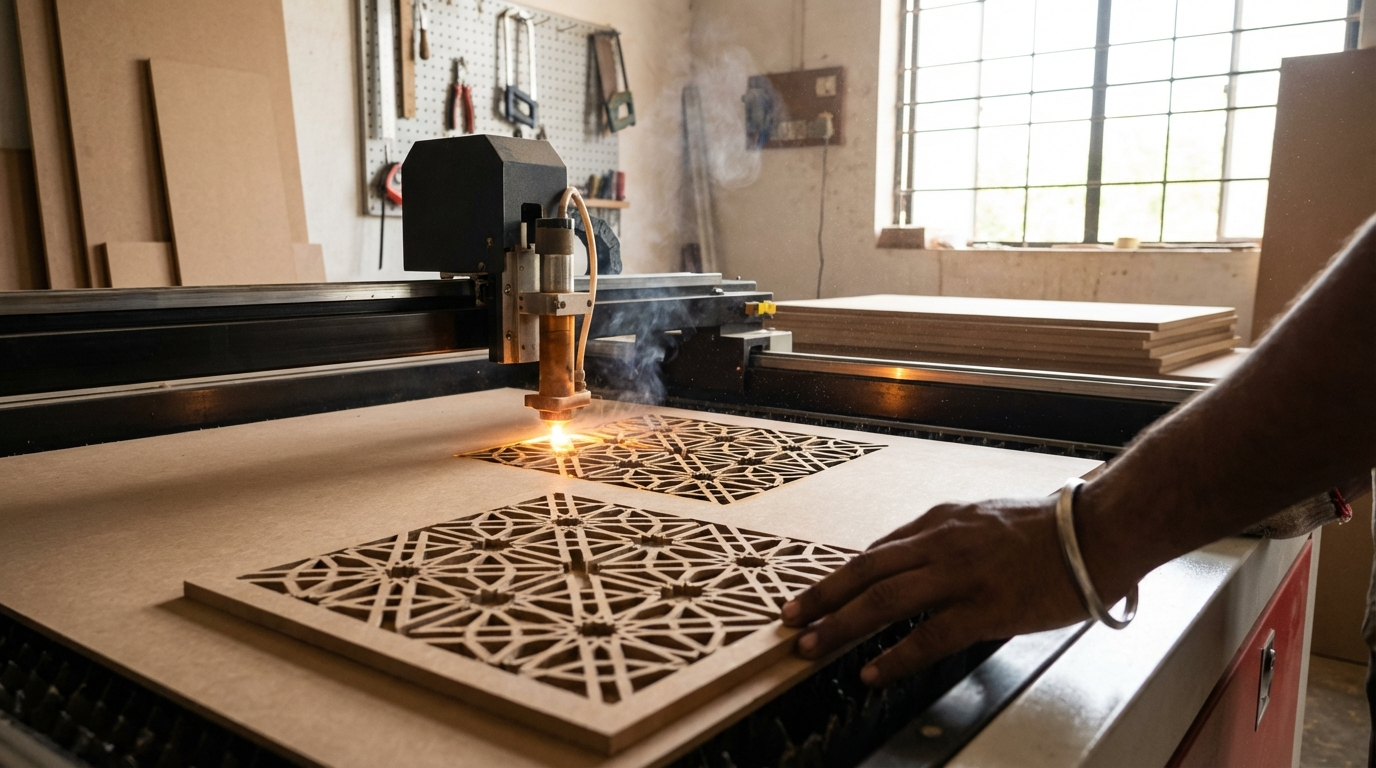
In Indian workflows, MDF cuts dust-free on CNC tables, holds screws decently in dry areas, and laminates evenly for uniform looks. However, unprotected edges swell in humidity, a common site issue.
Why It Matters in Indian Homes and Sites
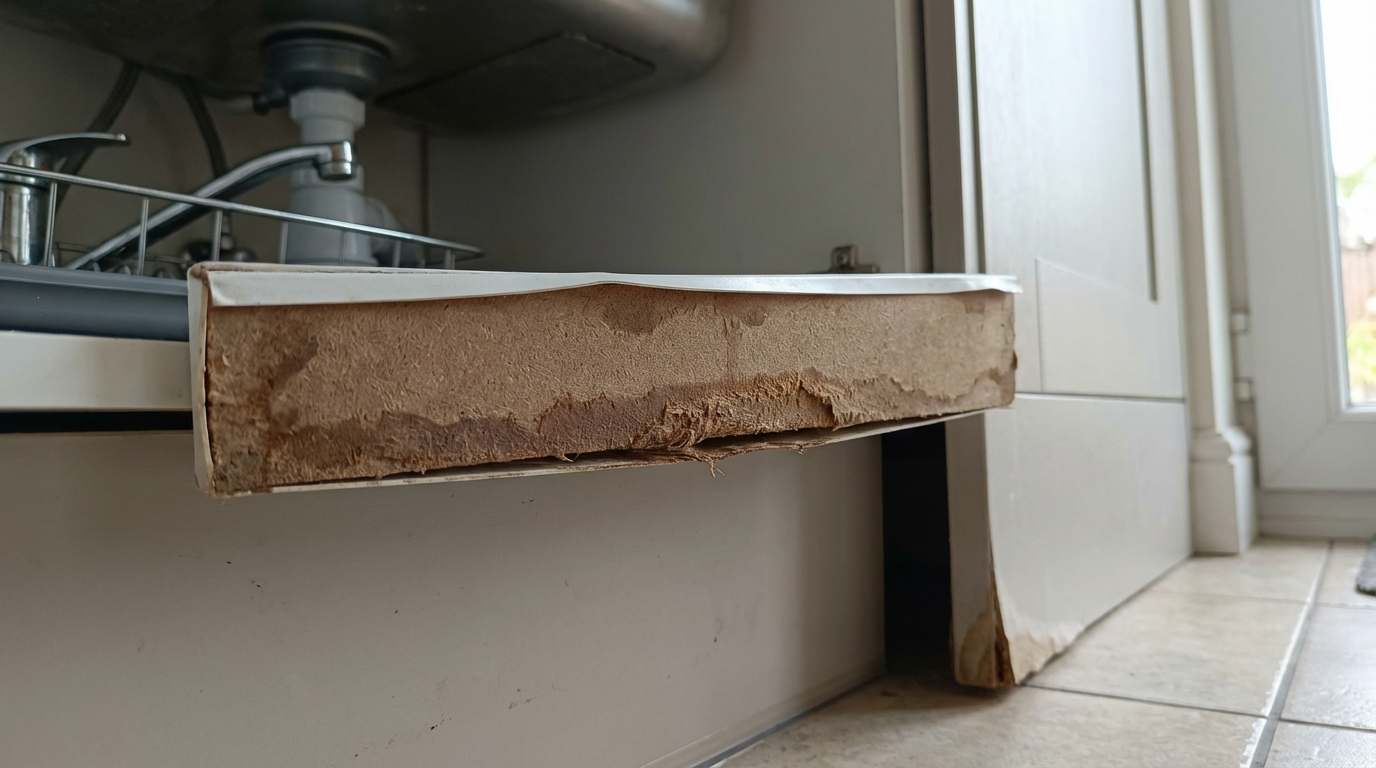
Indian kitchens face monsoon humidity above 80%, coastal salt air, and steam from cooking. MDF soaks up moisture at edges, leading to swelling that warps cabinets over time. Poor storage at dealers exposes sheets to rain, causing delamination before installation.
Site realities like uneven ventilation, spills from grinding masalas, or oily wiping accelerate failures. In contrast, well-protected MDF saves carpenter time on finishing while plywood handles abuse better. Trade-off: MDF offers flawless surfaces for laminate work but demands rigorous sealing in humid zones.
Consequences include loose hinges, sagging shelves, and peeling laminates, hiking rework costs. Coastal projects see faster issues due to salt corrosion on fittings paired with MDF.
Practical Use Cases (What Works, What Fails)
MDF shines in low-exposure cabinet parts but buckles under water. Here's a breakdown:
| Kitchen Zone | MDF Suitable? | Recommended Thickness | Finish/Protection Notes | Risk Notes |
|---|---|---|---|---|
| Enclosed carcass sides (away from sink) | Yes | 15-18mm | Full melamine lamination + PVC edge bands | Low if sealed; monitor monsoon storage |
| Internal shelves (dry goods only) | Yes | 12-15mm | Laminate top only; seal all edges | Medium; avoid oil spills |
| Door shutters (low steam) | Conditional | 18mm | High-pressure laminate + thick edges | High if near stove; use HDFWR instead |
| Sink base or chimney surround | No | N/A | Switch to plywood/HDFWR | Swells fast from splashes/steam |
| Wall cabinets (top shelves) | Yes | 15mm | Pre-laminated; ventilated backs | Low humidity risk if elevated |
Is MDF Safe for Kitchen Cabinet Shutters?
Standard MDF works for shutters in dry kitchens if fully laminated on both sides and edges sealed with 2mm PVC. Direct answer: Yes for low-moisture homes, but add resin treatments for safety. Nuance: In monsoon-prone areas, steam from tadka cooking penetrates edges, causing 10-15% swell within months. Coastal sites worsen this with salt-laden air.
Practical check: Press a wet cloth on an edge sample for 30 minutes; no warping means okay for shutters. Next step: Specify "MR grade" and verify density over 700kg/m³ via tap test—heavier feels solid.
Where Does MDF Work Best in Modular Kitchens?
Best in hidden carcasses and partitions. Direct answer: Internal frames and backs, fully enclosed. Conditions: Pair with good ventilation to avoid trapped humidity. In Indian modular setups, CNC-routed MDF assembles fast for L-shaped islands.
Failure risk rises near gas stoves. Check: After cutting, edges should sand smooth without fuzzing. Next: Apply edge bands immediately post-CNC to block moisture entry during monsoons.
Two-Minute Comparison (What Changes in Real Life)
| Aspect | Standard MDF | HDFWR | Marine Plywood | PVC/WPC |
|---|---|---|---|---|
| Moisture Resistance | Low (swells edges) | Medium (wax additives) | High (boiled glue) | Excellent (non-porous) |
| Screw Hold (Dry) | Good initially | Better | Excellent | Poor (needs inserts) |
| CNC Finish | Smooth, no tearout | Smooth | Splinters edges | Clean but brittle |
| Cost Driver | Low base | +20-30% | +40-50% | +50% but lightweight |
| Indian Monsoon Fit | Sealed interiors only | Shutters okay | All zones | Wet areas best |
Choose MDF for budget smooth finishes in dry spots; plywood for wet durability despite rougher edges.
Failure Modes and Fixes
- Symptom: Edge swelling (wavy after 6 months). Root: Unsealed raw edges absorb humidity. Prevention: Apply 2mm PVC or ABS bands pre-install. Fix: Sand swollen area, re-band, or replace panel if over 5mm warp.
- Symptom: Delamination (laminate bubbles). Root: Poor glue or steam penetration. Prevention: Use high-pressure laminates (1mm+). Fix: Re-laminate or patch; check ventilation.
- Symptom: Sagging shelves. Root: Under-thick panels or overload. Prevention: 15mm+ for 600mm spans. Fix: Add supports or swap to plywood.
- Symptom: Screw loosening. Root: Fiber crush in humid MDF. Prevention: Pilot holes + anchors. Fix: Use wall plugs or reinforce.
- Symptom: Surface scratches. Root: Soft face vs utensils. Prevention: 0.8mm laminate. Fix: Polish minor; replace if deep.
- Symptom: Chipping at hinges. Root: Repeated stress. Prevention: Soft-close hinges + 18mm thick. Fix: Re-drill with inserts.
Common Buyer Mistakes and How to Avoid Them
- Mistake 1: Skipping edge sealing. Avoid: Insist on full banding during quote; check post-CNC.
- Mistake 2: Using 12mm for shutters. Avoid: Specify 18mm for door loads in Indian homes.
- Mistake 3: Ignoring storage. Avoid: Inspect sheets for water stains on-site.
- Mistake 4: Sink-side MDF. Avoid: Reserve plywood for 1m radius around wet zones.
- Mistake 5: Cheap laminates. Avoid: Feel thickness; 0.7mm+ resists peels.
- Mistake 6: No ventilation gaps. Avoid: Design 5mm backs for air flow.
- Mistake 7: Overloading dry shelves. Avoid: Limit 10kg per meter span.
- Mistake 8: Coastal use without MR. Avoid: Test sample in humid box overnight.
Can MDF Be Used Near Kitchen Sinks?
No, not standard MDF. Direct answer: Switch to HDFWR or plywood within 500mm of sink. Nuance: Splashes during dishwashing penetrate laminates in humid Indian kitchens, causing core rot in weeks. Monsoon vapors compound this.
Next step: Map wet zones on plan; use PVC for base cabinets. Verify: Drop water on sample edge—dry in 1 hour means marginal okay, else reject.
What Thickness of MDF for Kitchen Cabinets?
18mm for shutters/frames, 15mm shelves. Direct answer: Match to span and load. Conditions: Thinner risks sag in steamy environments. Coastal needs denser boards.
Check: Weigh sample; 20-25kg per 8x4 sheet signals quality. Next: CNC test cut for clean edges.
Quality Checks You Can Do Without Lab Tests
Before Buying
- Tap test: Uniform thud means even density.
- Edge inspection: Smooth, no voids.
- Weight check: Heavier resists warp.
- Ask: Resin type, MR additives?
After Cutting
- No fuzz on CNC edges.
- Screw test: Holds 5 turns without stripping.
- Bend test: Slight flex, no crack.
After Installation
- Level check: No sag post-load.
- Wipe test: No water beading issues.
- Edge seal: Continuous band coverage.
Decision Framework: Choose the Right Material for Your Kitchen Zone
| Condition | Recommended Material/Finish | What to Verify |
|---|---|---|
| High moisture (sink/stove) | Marine plywood or HDFWR, full laminate | Boil test on sample; edge seal quality |
| Coastal humidity | HDFWR + wax resin, PVC edges | Density >750kg/m³; salt spray resistance |
| Heavy use/abuse | Plywood 18mm, HPL finish | Screw pull-out strength; scratch test |
| Tight budget | MDF interiors only, melamine | Full sealing; storage condition |
| Fast delivery/CNC | Pre-lam MDF, 15mm | Smooth rout; batch uniformity |
| High scratch risk | PVC/WPC overlay on HDF | 0.5mm+ foil; impact test |
Tips for Homeowners, Carpenters, Architects, and OEMs
Homeowners: Clean with microfiber only; avoid soaking wipes. Do: Ventilate post-cooking. Don’t: Place hot pots directly.
Carpenters: Pre-drill hinges; band edges same day. Use 4mm pilot for screws. Handle sheets flat to prevent bow.
Architects/Designers: Spec MR grades for zones; detail 10mm gaps for air. Layer finishes for steam barriers.
OEM/Modular Makers: QC screw zones pre-ship; standardize banding. Track returns for humidity patterns to refine specs.
Design Ideas You Can Actually Build
- L-Shape Island: MDF carcass (sealed), plywood shutters. Logic: Cost save inside; durable face. Fit: Urban apartments, add ventilation.
- Wall Pantry: 12mm MDF shelves, laminate. Edges PVC. Good for dry spices; avoid dals.
- Tall Chimney Cabinet: HDFWR full, HPL. Handles steam; coastal safe.
- Base Drawers: MDF sides, plywood base. Fast CNC; seal bottoms extra.
- Open Shelves: Avoid MDF; plywood with brackets. Scratch-proof finish.
- Corner Unit: MDF internals routed, edge-banded. Space-efficient for small kitchens.
- LED-lit Shutters: Lam MDF, groove for lights. Smooth finish shines.
- Sink Tower: Plywood only; no MDF.
Should I Use Laminated MDF for Kitchens?
Yes, if full coverage. Direct answer: Lamination blocks top moisture, but edges need bands. Conditions: Melamine for budget, HPL for durability. Indian oily kitchens demand thicker foils.
Next: Verify adhesion by scraping; no peel. Monsoon tip: Extra sealant coat.
How to Protect MDF Edges in Humid Kitchens?
Double-band with PVC. Direct answer: 2mm ABS/PVC on all cuts. Nuance: CNC flush-trim prevents gaps. Fails if carpenter skips.
Check: Tug test post-install; secure hold. Step: Apply silicone in corners.
FAQs
Is MDF stronger than plywood for cabinets?
MDF offers uniform strength without knots but weakens faster in moisture compared to plywood's layered durability. In dry zones, MDF holds shelves evenly under even loads like utensils. Plywood excels in screw grip for hinges amid Indian kitchen steam. Trade-off favors plywood for longevity, MDF for finish speed. Verify by loading a sample span; MDF sags more if thin.
Does MDF swell in kitchens?
Yes, unprotected edges swell 10-20% in humidity. Full sealing limits this to minimal. Monsoon sites see faster uptake from poor storage. HDFWR variants resist better with resins. Prevention hinges on immediate banding post-cut. Test: Wet edge overnight; under 2mm change is usable.
What is the best alternative to MDF for wet kitchens?
Marine plywood provides boiled-water resistance for sinksides. It handles spills without core damage, unlike MDF. Coastal homes pair it with ventilation. Costlier but reduces callbacks. Spec cross-bands for twist resistance. Check grain alignment for quality.
Can I paint MDF for kitchen cabinets?
Yes, after primer and sanding for smooth adhesion. Two coats polyurethane seals against oils. Avoid direct steam; edges chip paint fast. Better for dry walls than shutters. Indian humidity demands sanding sealer first. Durability lags laminates long-term.
How long does MDF last in kitchens?
5-8 years sealed in dry zones, 2-4 near moisture. Depends on usage, sealing, climate. Monsoon accelerates wear 2x. Regular checks extend life. Replace if warp exceeds 3mm.
Is HDFWR MDF good for kitchen shutters?
HDFWR handles moderate steam better than standard. Wax resins cut absorption. Ideal for mid-kitchen shutters. Still seal edges fully. Coastal okay with HPL. Weighs more for stability.
Why do MDF cabinets peel in India?
Steam penetrates thin laminates; humidity warps core. Poor edge prep common. Use 1mm HPL, ventilate. Avoid cheap glue lines. Site drying post-monsoon helps.
Should I use MDF for kitchen drawers?
Yes for sides if sealed; plywood bottoms. Smooth slides well. Avoid full water exposure. 12mm suffices for light loads. Band all joints.
Does thickness matter for MDF in humid areas?
Thicker (18mm) slows warp but doesn't prevent. Protection trumps size. Pair with MR grades. Test load deflection.
Can PVC boards replace MDF in kitchens?
PVC excels in wet zones; waterproof core. Lighter, no swell. Costlier routing. Good for bases. Verify weld seams.
Disclaimer: This content is provided for general informational purposes based on industry practices and publicly available information. Product specifications, standards, prices, and availability may vary by manufacturer, region, and time. Readers should independently verify details with manufacturers, dealers, or qualified professionals before making purchase or construction decisions.Want Plywood Suggestions?
Share a few details and a VIR MDF specialist will suggest suitable brands and connect you to responsive dealers.