MDF for Speakers/Subwoofer Boxes: Why It’s Used + Thickness & Build Tips
MDF is popular for speaker enclosures due to its density and uniformity. Learn thickness guidance, sealing tips, and finishing ideas.
Quick Decision Summary
MDF suits speaker and subwoofer boxes for its uniform density that minimizes sound distortion and enables tight seals.
If you’re in a hurry: Opt for 18-25mm thick MR-grade MDF for most home speaker builds in India. Seal all edges and joints with wood glue and silicone for airtightness, especially in humid areas. Brace internals for subs over 10 inches. This setup handles monsoon swelling risks while keeping costs low. Test for resonance post-build by tapping panels—dull thud means success. Avoid thin sheets under load-bearing vibrations.
- Choose this if… you need smooth cuts, good screw hold, and budget-friendly acoustics for home theaters or custom audio setups.
- Avoid this if… your site has constant high moisture without sealing, or you prioritize ultra-lightweight portables over sound quality.
What This Material/Option Actually Is
MDF stands for Medium Density Fiberboard, an engineered panel made by compressing wood fibers with resins under heat and pressure. It creates a smooth, uniform sheet ideal for speaker enclosures where consistent density prevents vibrations that distort bass.
In speaker builds, standard MDF (600-750 kg/m³ density) works for dry interiors, while moisture-resistant (MR) variants add wax or melamine resins for better humidity tolerance. These panels come plain or pre-laminated, but raw sheets dominate DIY audio projects for custom shaping.
Unlike plywood's layered grain, MDF's homogeneity ensures no weak spots for sound waves, making it a staple for subwoofers needing deep, resonant-free bass.
Why It Matters in Indian Homes and Sites
India's monsoon humidity (70-90% RH) and coastal salt air accelerate MDF swelling if unsealed, leading to loose joints in speaker boxes over time. Poor storage in open godowns exposes sheets to rain splashes, causing edge delamination before cutting.
On sites, carpenter handling often skips acclimation, so panels warp under Bangalore summers or Mumbai downpours. For audio setups in living rooms, this means buzzing panels from screw pull-out or air leaks distorting highs.
Practical upside: MDF's density beats plywood for screw hold in humid wardrobes doubling as media units, but demands full sealing for 5-10 year life in tier-2 cities with erratic AC use.
Why MDF Excels for Speaker and Subwoofer Boxes
MDF's high density absorbs vibrations better than lighter boards, reducing cabinet resonance that muddies sound. Its smooth surface allows precise CNC routing for ports and rebates, essential for phase-aligned bass reflex designs.
For subwoofers, uniformity ensures even glue bonds for driver mounting, preventing rattles. In India, where home theaters pair with modular furniture, MDF integrates seamlessly without grain telegraphing through veneers.
Why choose MDF over plywood for speaker boxes?
Choose MDF for its isotropic density—no directional grain means consistent sound damping across panels. Plywood often resonates at certain frequencies due to voids. In practice, MDF cuts cleaner for internal braces, vital for 12-inch subs.
Nuance: Plywood edges better in extreme wet zones without sealing, but for enclosed speakers, MDF's sealability wins. Check by weighing samples— heavier MDF signals better fill for acoustics. Next, tap a cut edge: uniform thud over plywood's ring confirms suitability.
Does thickness affect sound quality in MDF speaker boxes?
Yes, thicker MDF (22-25mm) reduces panel flex for cleaner bass, especially subs. Thinner 12-18mm suits tweeter boxes or satellites. Thicker panels demand more bracing to avoid weight-related sags.
In Indian humidity, thicker sheets resist swelling longer but raise costs 20-30%. Verify by flexing a sample sheet horizontally—minimal bow under hand pressure means good stiffness. Scale up: build a test brace for your driver size before full assembly.
Recommended Thickness Guide for Speaker Boxes
Thickness choice hinges on driver size, box volume, and site conditions. For bookshelf speakers (4-6 inch drivers), 15-18mm suffices. Midrange towers need 18-22mm. Subwoofers over 10 inches demand 25mm+ with cross-bracing every 150mm.
In coastal India, add 2-3mm buffer for humidity flex. Cost driver: 18mm runs lower per sheet, but thicker cuts down brace material by 15%.
| Driver Size/Type | Recommended Thickness | Bracing Notes | India Risk Adjustment |
|---|---|---|---|
| 4-6" bookshelf | 15-18mm | Minimal, corner only | MR grade for monsoons |
| 6-8" tower | 18-22mm | Vertical every 200mm | Seal edges twice |
| 10-12" sub | 22-25mm | Cross + vertical grid | Full silicone joints |
| 15"+ pro sub | 25-30mm | Dense grid, double walls | Acclimatize 48hrs |
How to Build Speaker Boxes with MDF in 5 Steps
- Plan and cut: Sketch box volume per driver specs (use Thiele-Small params). CNC or table-saw cuts; sand edges bevel-free. Check squareness with try-square.
- Brace internals: Glue 25x50mm strips forming X or H patterns. Pre-drill for screws to avoid splits.
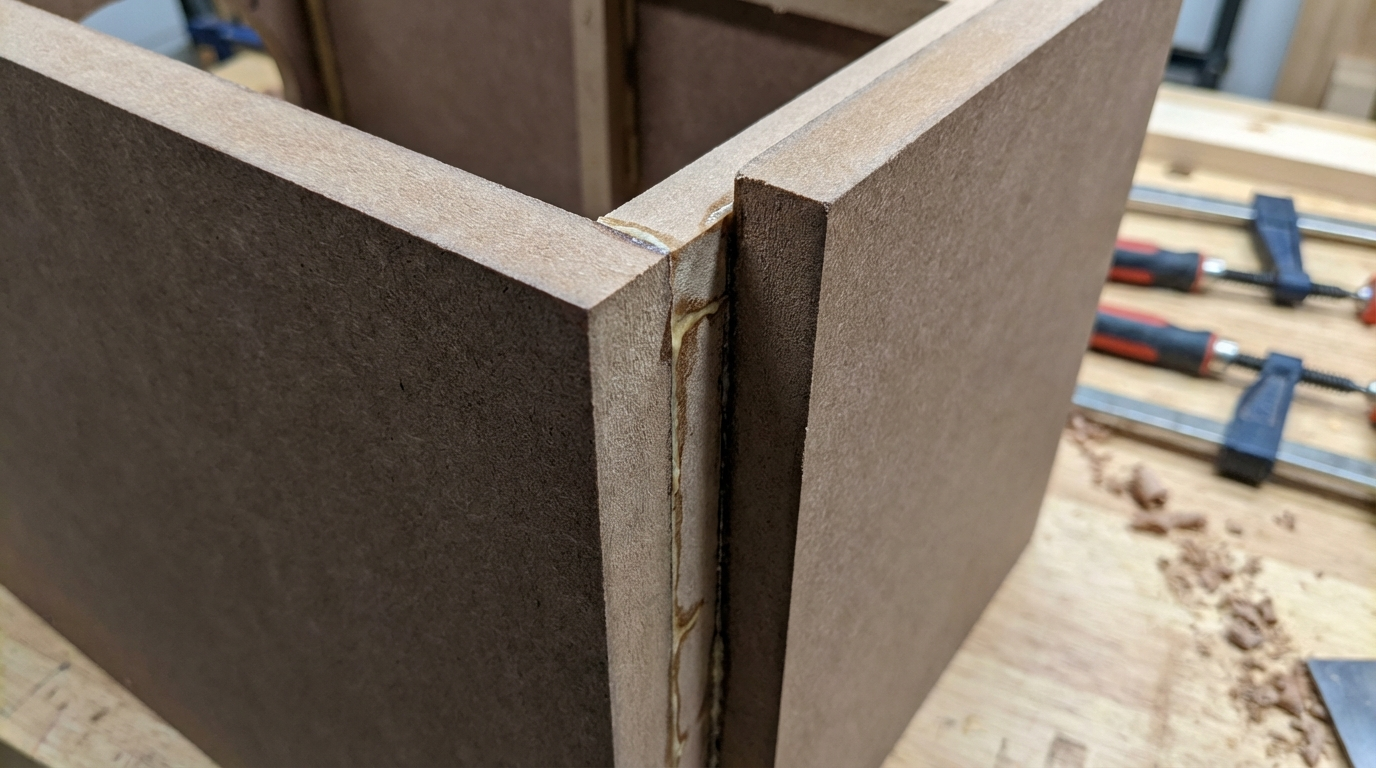
- Assemble dry: Clamp panels, test-fit driver holes. Mark seams for glue.
- Seal airtight: Apply PVA glue + brad nails, then silicone caulk inside joints. Let cure 24hrs.
- Finish outside: Prime, paint or veneer. Mount drivers with T-nuts for secure hold.
Failure point: Skipping step 4 causes air leaks, killing bass. In humid sites, wet-sand between coats.
Practical Use Cases (What Works, What Fails)
| Use Case | Thickness | Finish Notes | Risk Notes (India) |
|---|---|---|---|
| Home theater satellites | 15mm | Carpet wrap | Low humidity OK; seal for AC fluctuations |
| Center channel | 18mm | Paint + grille | Vibration from movies—brace well |
| Car sub box (trunk) | 22mm | Truck liner | Monsoon car washes: full waterproofing |
| Wall-mounted pair | 18mm | Veneer | Coastal salt: MR + edge band |
| Large living room sub | 25mm | Laminate | Dust + kids: durable topcoat |
Design Ideas You Can Actually Build
- Corner bass trap sub: 25mm MDF, triangular braces; logic: density kills room modes. Black paint finish, PVC edge for monsoons.
- Hidden wall speakers: 18mm recessed boxes; flush grille cloth. Seal back fully for coastal damp.
- TV stand integrated: 22mm with internal sub chamber; laminate to match furniture. Brace under load points.
- Portable Bluetooth pair: 15mm lightweight; rubber feet. Avoid humidity exposure.
- Multi-driver tower: 22mm stepped baffles; veneer sides. Double-seal for tier-2 city storage.
- Ceiling down-firers: 18mm vented; white paint. Acclimatize before install.
- Car audio wedge: 25mm angled; bedliner coat. Vibration-proof screws.
- Patio outdoor pair: MR 18mm fully sealed; marine varnish. Test rain resistance.
Failure Modes and Fixes
- Symptom: Buzzing at high volume. Root: Panel flex or loose braces. Prevent: Thicker MDF + glue blocks. Fix: Add foam damping tape inside.
- Symptom: Edge swelling post-monsoon. Root: Unsealed raw edges. Prevent: Epoxy all cut edges pre-assembly. Fix: Sand and re-seal if minor.
- Symptom: Screw pull-out in driver holes. Root: Undersized pilots or thin walls. Prevent: T-nuts + washers. Fix: Epoxy plugs and redrill.
- Symptom: Air leaks whistling highs. Root: Poor joint sealing. Prevent: Silicone bead inside. Fix: Inject caulk via small holes.
- Symptom: Veneer bubbling in humidity. Root: Moisture under film. Prevent: MR base + acclimation. Fix: Strip and repaint with primer.
- Symptom: Chipping on transport. Root: No edge banding. Prevent: PVC tape post-cut. Fix: Filler + sand smooth.
Can MDF speaker boxes survive Indian monsoons?
Yes, if fully sealed with MR-grade and silicone joints, they hold 2-3 years outdoors. Internal damping cloth absorbs minor moisture. In practice, garages see less warp than open balconies.
Conditions: Avoid direct rain; use dehumidifiers in Mumbai flats. Check: Weigh box pre/post-humidity test—stable weight means success. Next: Annual edge inspection.
Is 18mm MDF enough for subwoofers?
For 8-10 inch subs in sealed boxes, yes; add braces for ported. Larger drivers flex it at 100dB+. Trade-off: Lighter/cheaper vs potential resonance.
India angle: Pairs well with home AC. Verify: Play sine waves at box resonance freq—listen for peaks. Brace if needed.
Decision Framework: Matching MDF to Your Project
| Condition | Recommended Specs | What to Verify |
|---|---|---|
| High humidity/coastal | MR MDF, 20mm+, full epoxy seal | Edge water test: no swelling in 24hrs |
| Heavy vibration (big subs) | 25mm+, dense bracing grid | Tap test: dull thud everywhere |
| Tight budget | 18mm standard, minimal braces | Weight per sheet: uniform density |
| Fast DIY build | Pre-cut 18mm, glue-only joins | Cut edges smooth, no blowout |
| High scratch risk (kids/pets) | Laminate face, PVC edges | Scratch with key: surface holds |
| Large room acoustics | 22mm, internal damping | Flex under palm: minimal bend |
Common Mistakes to Avoid (8 Key Ones)
- Mistake 1: Skipping edge sealing—leads to monsoon puffing. Fix: Coat all cuts twice.
- Mistake 2: Wrong thickness for driver—buzzes ensue. Fix: Match table above.
- Mistake 3: No internal bracing—panels drum. Fix: Grid every 150mm.
- Mistake 4: Dry assembly only—leaks kill bass. Fix: Glue + nails + caulk.
- Mistake 5: Ignoring acclimation—warps on site. Fix: 48hrs in room temp.
- Mistake 6: Cheap screws—pull out fast. Fix: Coarse wood + washers.
- Mistake 7: Paint without primer—peels in dust. Fix: 2 coats shellac first.
- Mistake 8: Overlooking port tuning—muddy sound. Fix: Calc volume precisely.
Quality Checks You Can Do Without Lab Tests
Before buying: Inspect for uniform color, no lumps/swells. Weigh two sheets—similar heft means consistent density. Ask for MR stamp; tap side—solid thunk.
After cutting: Edges should not crumble; sand smooth easily. Check squareness with mitre—under 0.5mm error.
After install: Run bass sweep—no rattles. Wipe edges monthly; reseal if soft. Vibration test: shake gently, listen for internals.
How to check MDF density for speakers without tools?
Compare weight and tap tone: heavy with dull thud signals 700+ kg/m³ ideal for damping. Float small piece in water—slow sinker is dense.
Nuance: Varies by batch; reject if patchy. Next: Cut test piece, brace, play loud—quiet means good.
Practical Tips by User Type
For Homeowners
Focus durability: Seal everything, use carpet covers for dust. Don’t place near AC drips. Clean with microfiber only—harsh chemicals swell finishes. Test sound monthly.
For Carpenters
Cut with zero-clearance blade to avoid chipping. Pre-drill all holes 70% depth. Edge-band before assembly. Handle sheets vertically in humid shops to prevent sag.
For Architects/Designers
Spec 18-25mm MR with brace details in drawings. Detail silicone beads in joints. For wet zones, hybrid with PVC backs. Match finishes to room palette.
For OEM/Modular Makers
QC: Batch-tap all panels. Standardize jigs for repeatability. Reduce returns by pre-sealed edges. Track complaints—swelling? Switch resins seasonally.
What's the cost range for MDF speaker boxes?
Ranges Rs. 2,000-8,000 per pair, driven by thickness (18mm low-end), sheet size, and sealing extras. City variation: +20% metros. Wastage from curves adds 10%.
Estimate: 2 sheets 18mm for bookshelves. Quote checklist: thickness, MR grade, cut size, delivery.
FAQs
Why is MDF preferred for subwoofer boxes in India?
MDF's density around 700 kg/m³ dampens vibrations effectively, crucial for bass-heavy subs in echoey Indian living rooms. Uniformity allows precise port cuts without weak grains. In humid climates, MR variants resist swelling better than plywood when sealed. Builders favor it for easy CNC workflows in modular audio furniture. Trade-off: Heavier than alternatives, but sound payoff justifies for home theaters. Always brace for 200L+ volumes to prevent flex during parties.
Can I use 12mm MDF for speaker boxes?
12mm works only for tiny satellite tweeters under low power, as it flexes easily distorting sound. For anything over 4 inches, upgrade to 18mm minimum. In Indian sites, thin sheets warp faster from transport jolts. If budget-tight, reinforce with extra braces but expect compromises in deep bass. Test: Build a prototype, thump bass—no buzz means viable. Otherwise, avoid for mains or subs to prevent early failures.
How do I seal MDF speaker boxes airtight?
Glue joints with PVA, clamp 24hrs, then apply internal silicone bead along all seams. Line walls with 3mm acoustic foam for extra damping. In monsoons, add external edge primer. This combo handles 90% RH without leaks. Common skip: Forgetting driver cutouts—caulk those too. Post-build, smoke test: puff near joints, no escape confirms seal. Recheck yearly in coastal areas.
Does veneer work on MDF speaker boxes?
Veneer adds premium looks matching wardrobes, but iron-on types bubble in humidity unless MR base used. Apply post-assembly with contact cement, roll bubbles out. Pros: Hides MDF texture. Cons: Extra weight. In India, pair with PU topcoat for dust resistance. Check adhesion: Tape test after cure. Ideal for visible home setups, less for hidden subs.
Can MDF handle car subwoofers?
Yes, 22-25mm with bedliner coating withstands trunk vibes and washes, but seal rigorously for under-seat damp. Bracing prevents road resonance. Coastal cars need full waterproofing. Trade-off: Heavier than plastic, but superior bass. Verify: Road-test with bass-heavy tracks—no rattles. Common fail: Loose ports from bumps.
What's the best paint for MDF speakers?
Primer first (shellac blocks moisture), then acrylic enamel for smooth, durable finish. Spray 3 coats for vibration resistance. Black matte absorbs sound visually. In dusty India, add clear topcoat. Avoid oil paints—slow dry warps panels. Test: Flex painted sample—no cracks.
How much bracing for MDF sub boxes?
Vertical braces every 150-200mm, plus horizontals forming panels. For 25mm walls, 25x25mm strips suffice. Glue + screw. Reduces flex by 70%. In large boxes, add corner dowels. India tip: Extra in humid zones for swell prevention. Calc: Bracing volume <20% internal space.
Is HDF better than MDF for speakers?
HDF (higher density 800+ kg/m³) damps even better for pro subs, but costs 30% more and harder to source. MDF suffices for home use. Both uniform, but HDF edges in screw hold. Choose HDF for vibration-heavy; MDF for budget. Verify density tap—deeper thud wins.
Common issues with MDF in humid Indian climates?
Swelling at unsealed edges, loosening joints over 1-2 monsoons. Fixes: MR grade, epoxy edges, acclimate. Poor storage worsens. Long-term: 5+ years with care. Monitor: Soft spots signal redo. Pair with dehumidifiers in media rooms.
Disclaimer: This content is provided for general informational purposes based on industry practices and publicly available information. Product specifications, standards, prices, and availability may vary by manufacturer, region, and time. Readers should independently verify details with manufacturers, dealers, or qualified professionals before making purchase or construction decisions.Want Plywood Suggestions?
Share a few details and a VIR MDF specialist will suggest suitable brands and connect you to responsive dealers.