MDF for Wardrobe Shutters: How to Prevent Sagging, Chipping & Swelling
Build long-lasting MDF wardrobe shutters with the right thickness, hinges, edge banding, and moisture precautions—no more sagging doors.
Quick Decision Summary
Use 18mm thick moisture-resistant MDF with full PVC edge banding, heavy-duty concealed hinges, and proper acclimatization to prevent sagging, chipping, and swelling in wardrobe shutters.
If you’re in a hurry: Opt for BWR-grade or MR MDF boards of at least 18mm thickness for shutters wider than 450mm. Always apply 2mm PVC edge tape on all exposed edges before lamination. Install 3-4 heavy-duty hinges per door to handle weight and humidity swings common in Indian homes. Store boards flat in dry conditions for 48 hours before cutting. This setup typically lasts 8-10 years without major issues in monsoon-prone areas.
- Choose this if: Wardrobes in bedrooms with moderate humidity, budget under standard plywood costs, and smooth laminated finishes needed.
- Avoid this if: High-moisture zones like bathrooms or coastal kitchens without HDFWR upgrade; use PVC or WPC instead.
What This Material/Option Actually Is
MDF, or Medium Density Fiberboard, is an engineered panel made by compressing wood fibers with resins under heat and pressure. For wardrobe shutters, it comes in standard, moisture-resistant (MR), boiling water-resistant (BWR), or termite-proof variants. Thicknesses range from 12mm to 25mm, with 18mm being common for shutters due to balance of strength and weight.
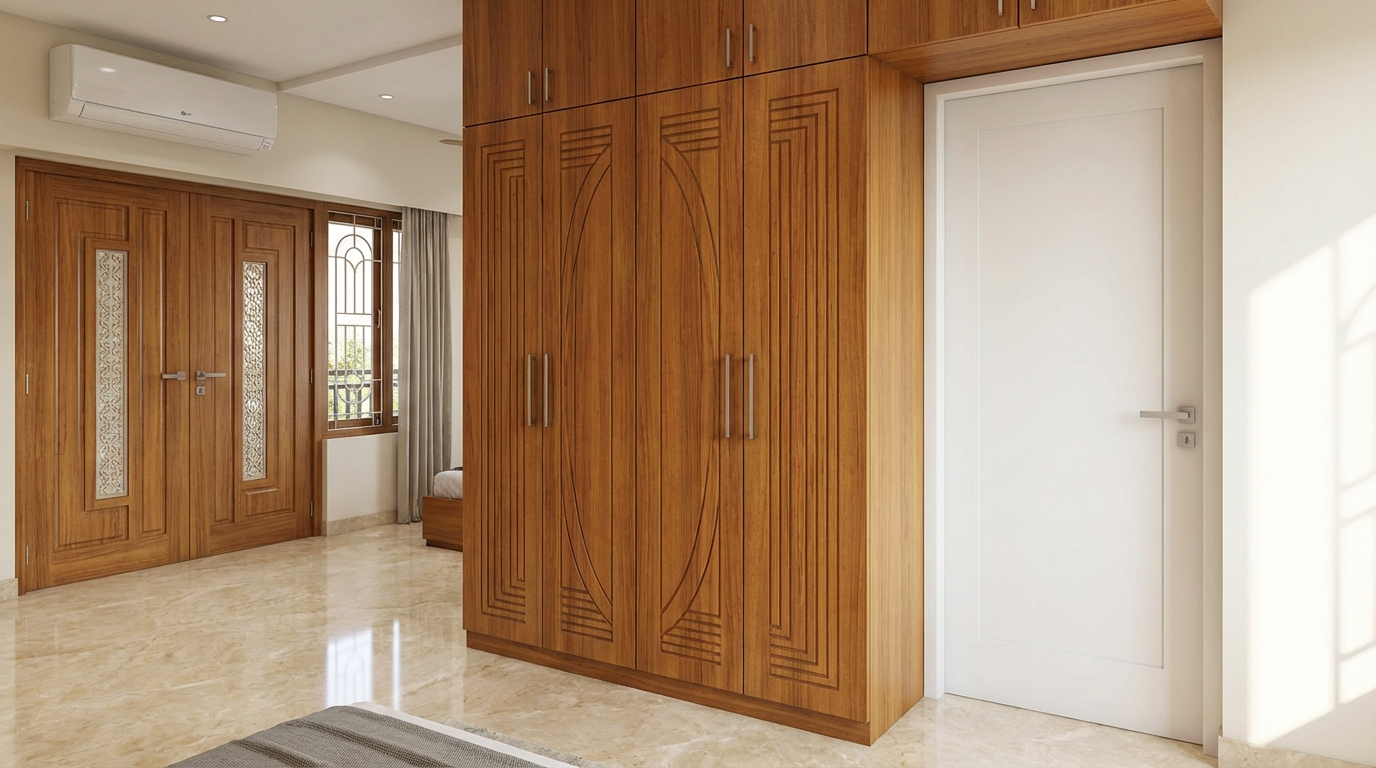
In wardrobe applications, MDF shutters are typically laminated with melamine, PVC foil, or decorative laminates for aesthetics and protection. They differ from plywood by offering smoother surfaces for printing or veneering but lower screw-holding strength without inserts. Prelaminated options arrive with factory-applied surfaces, reducing site finishing needs.
Hybrid uses include MDF cores with PVC or WPC edges for better moisture barriers. This makes MDF versatile for modular wardrobes but requires specific prep to avoid common pitfalls like edge swelling.
Why It Matters in Indian Homes and Sites
Indian climates bring high humidity during monsoons (70-90% RH), coastal salt air, and poor site ventilation, accelerating MDF swelling if unprotected. Wardrobe shutters face daily pulls, child impacts, and cleaning with wet cloths, leading to chipping at edges and sagging from hinge wear.
Poor storage during transport—stacked vertically in trucks—causes warping before installation. In apartments, uneven floors amplify sagging. Using untreated MDF in Mumbai or Chennai can swell edges by 5-10% in first monsoon, delaminating laminates.
Proper specs ensure 10+ years life: denser boards resist sagging, sealed edges block moisture, robust hinges distribute load. This cuts callbacks for carpenters and replacements for homeowners.
Can MDF wardrobe shutters really handle daily use in humid Indian bedrooms?
Yes, 18-19mm MR or BWR MDF shutters handle daily use well if edges are fully banded and hinges are soft-close concealed types. Density above 700 kg/m³ provides stiffness against sagging. In humid bedrooms (60-80% RH), acclimatize boards 48 hours in site conditions to match expansion.
Nuance: Lighter laminates like 0.8mm paper foil scratch easier than 1mm PVC; pair with edge protection. Check hinge load rating (20-30kg per pair). Next step: Weigh a sample board—under 20kg for 2x1m feels right for easy handling without flex.
How to Decide or Do This in 5 Steps
- Assess site conditions: Measure humidity (use hygrometer if possible) and door size. For widths over 600mm or heights above 2m, minimum 18mm thickness.
- Select board grade: MR for inland, BWR/HDFWR for coastal. Verify density stamp (650+ kg/m³).
- Plan finishing: Full 2mm PVC edging on cut edges post-CNC. Laminate both sides evenly to prevent cupping.
- Choose hardware: 3-4 hinges per door, 35mm cup type for 18mm thick. Soft-close for smooth operation.
- Install with checks: Acclimatize 48 hours, level frame, gap 2-3mm for expansion. Seal gaps with silicone.
Common failure: Skipping step 1 leads to swelling. Test: Tap edges post-cut—if hollow sound, resin poor.
What thickness of MDF works best for wardrobe shutters?
18mm is optimal for most wardrobe shutters up to 700mm wide, balancing weight (under 25kg/door) and stiffness against sagging. For larger sliders over 900mm, use 19-25mm or reinforce with internal frames.
Conditions: 12-15mm suits lightweight cabinets but sags in 2-3 years under humid loads. Verify by flex test: Hold 600mm span horizontally—if bows over 5mm, too thin. In Indian sites, thicker cuts transport costs but halves repair calls.
Practical Use Cases (What Works, What Fails)
| Use Case | Recommended Thickness | Finish Notes | Risk Notes |
|---|---|---|---|
| Standard bedroom wardrobe (hinged, 600mm wide) | 18mm MR MDF | 1mm melamine laminate + PVC edges | Low sagging if 3 hinges; watch edge chips during moves |
| Coastal master wardrobe (sliding doors) | 19mm BWR/HDF | Double-sided PVC foil | High swelling risk—seal tracks; fails without acclimatization |
| Children's room (frequent access) | 18mm with inserts | Scratch-resistant laminate | Chipping at handles; reinforce with metal plates |
| Modular walk-in (heavy storage) | 25mm reinforced | Pre-laminated + ABS edges | Sagging rare but hinge shear common—use 4+ hinges |
| Budget rental unit | 16mm standard | Paper foil only | Fails fast in monsoons—avoid humid cities |
Works when specs match load/humidity; fails on thin boards or open edges in wet seasons.
Design Ideas You Can Actually Build
Bedroom basics (4 ideas):
- Plain slab shutters: 18mm MDF, white melamine, slim aluminum handles. Logic: Minimalist, easy CNC routing. Coastal fit: Add BWR grade.
- Shaker-style framed: MDF infill with solid perimeter. Edge: PVC on cuts. Prevents sagging in tall units.
- Grooved panels: Vertical lines via CNC, 1mm laminate. Handles humidity if sealed.
- Mirrored sliders: Back-laminate mirror foil on 19mm. Reinforce bottom edge against cleaning moisture.
Modular/upscale (4 ideas):
- Floating frame look: Internal MDF frame in 18mm panel. Hinges hidden for clean lines.
- Textured linen finish: 3D foil on HDF. Chip-proof for high-touch areas.
- LED-integrated: Cut slots post-laminate, edge-seal thoroughly.
- Bi-fold with glass: Upper glass, lower solid MDF banded edges.
Each prioritizes edge protection for India’s dust/humidity.
Price Range and Cost Drivers
Expect ₹80-₹150 per sq ft for plain MR MDF boards (18mm), rising to ₹120-₹220 with lamination and edging. Shutters for a 6x7ft wardrobe (4 doors) typically total ₹8,000-₹15,000 material cost.
Drivers: Thickness (18mm +20%), grade (BWR +30%), finish (PVC laminate +40%), edges (full banding +15%), city logistics (Mumbai +25% over inland). Wastage 10-15% from CNC cuts. Quote checklist: Specify thickness, grade, sqm qty, edge type, delivery flat-wrapped.
Failure Modes and Fixes
- Sagging doors: Symptom: Bottom gap widens. Cause: Thin board (<18mm) or weak hinges. Prevent: 18mm+ with 35kg-rated hinges (3-4 per door). Fix: Reinforce with frame or replace hinges.
- Edge chipping: Symptom: White core exposed at corners. Cause: No banding or CNC burrs. Prevent: 2mm PVC tape post-cut, radius edges. Fix: Fill with putty, re-band.
- Surface swelling: Symptom: Bubbled laminate. Cause: Moisture ingress at edges. Prevent: Acclimatize, seal gaps. Fix: Sand affected area, re-laminate patch.
- Hinge tear-out: Symptom: Screws loosen. Cause: Particle board density low. Prevent: Use inserts or pilot holes. Fix: Plug holes, re-drill.
- Delamination: Symptom: Peeling finish. Cause: Uneven lamination or humidity. Prevent: Factory prelam or hot-press. Fix: Spot glue, clamp.
- Cracking at joints: Symptom: Hairlines post-install. Cause: No expansion gaps. Prevent: 2mm gaps, silicone seal. Fix: Fill, repaint.
How do you stop MDF shutters from chipping during handling?
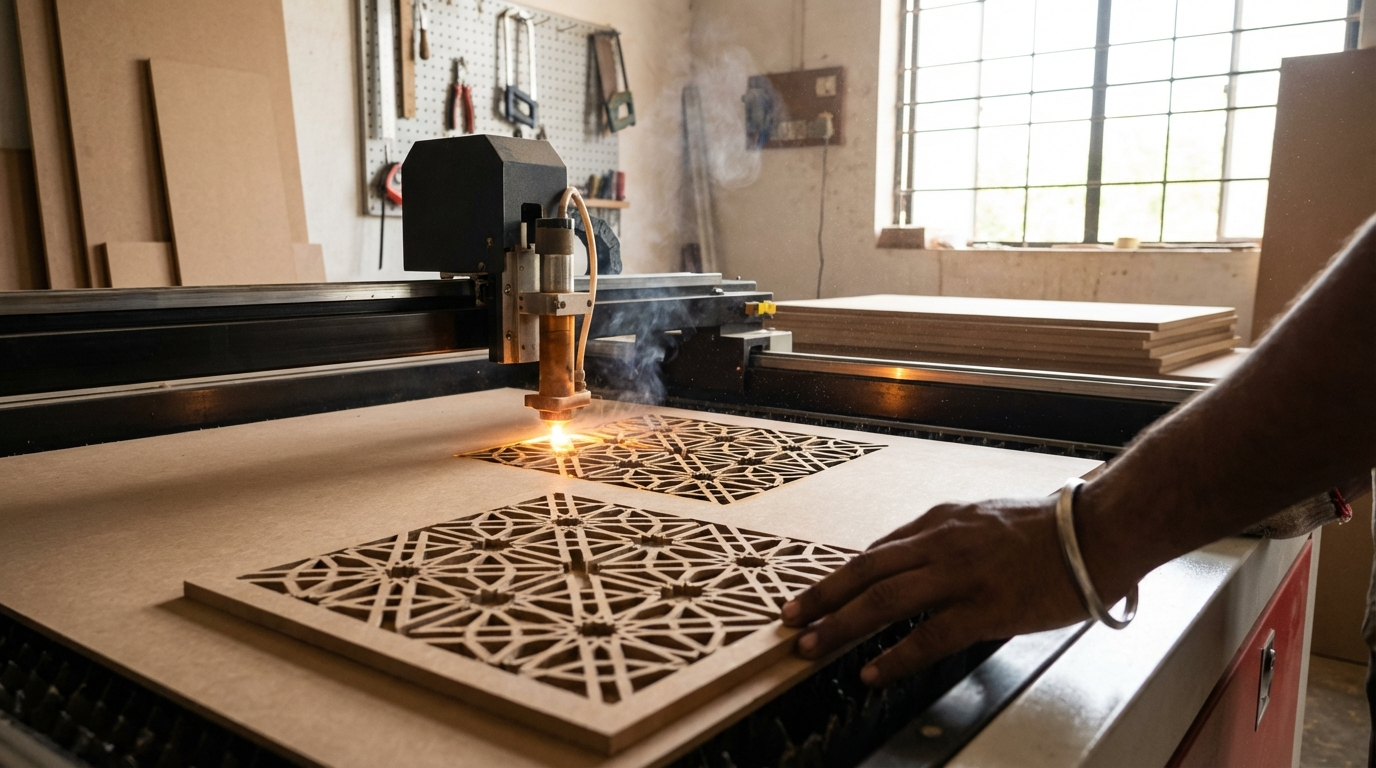
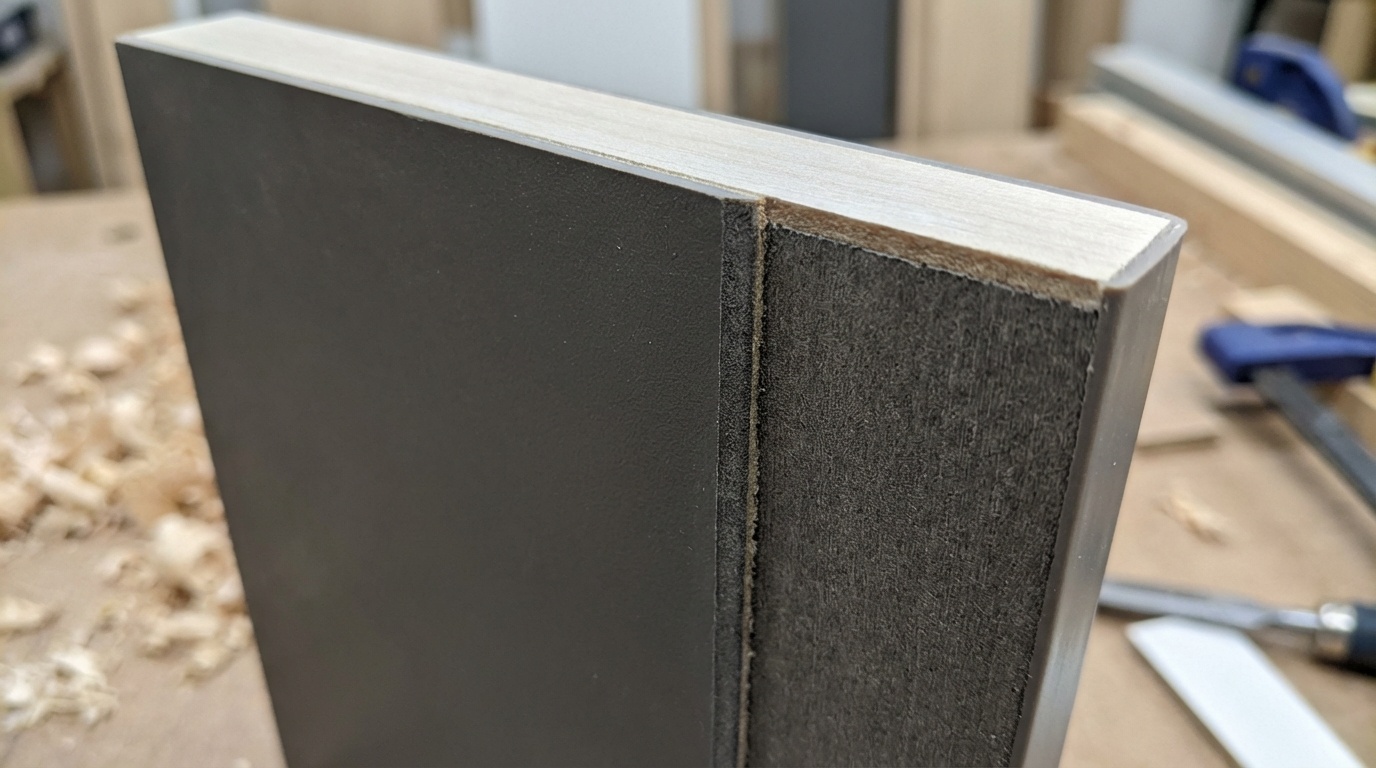
Apply 2mm thick PVC or ABS edge banding to all cut edges immediately after CNC routing, using hot-melt glue for strong adhesion. Radius corners slightly (2mm) to reduce impact points.
In Indian sites, wrap doors in bubble during transport. Nuance: Thinner tapes chip easier on dense boards. Check: Tug tape after 24 hours—if pulls off, reapply. This prevents 80% of handling chips.
Common Buyer and Carpenter Mistakes (and Avoidances)
- Mistake 1: Choosing 12-15mm for cost savings. Avoid: Calculate span—sags in monsoons. Use 18mm.
- 2: Skipping edge banding on factory cuts. Avoid: Always band post-CNC; moisture enters fast.
- 3: Cheap stamped hinges. Avoid: Specify concealed, 20kg+ load; test swing.
- 4: No site acclimatization. Avoid: 48 hours flat in room humidity.
- 5: Uneven lamination (one side only). Avoid: Balance both sides against cupping.
- 6: Vertical storage pre-cut. Avoid: Flat stack, covered from dust/rain.
- 7: Oversized doors without frames. Avoid: Internal stiffeners for >600mm.
- 8: Wet cleaning habits. Avoid: Microfiber dry wipe; damp max.
- 9: Ignoring density. Avoid: Tap test—solid thud, not hollow.
Will MDF wardrobe shutters swell during Indian monsoons?
No, if using MR/BWR grades with sealed edges and proper gaps. Swelling under 2% typical with precautions vs 10%+ untreated.
Conditions: Coastal needs HDFWR. Check: Weigh post-monsoon—if +5% wet, seal failed. Next: Install dehumidifier or vent fans in wardrobes.
Decision Framework
| Condition | Recommended Specs | Verify By |
|---|---|---|
| Wet zone (monsoon heavy) | BWR MDF 18mm, full PVC edges, silicone gaps | Edge water test—no darkening |
| Coastal (salt air) | HDFWR 19mm, double laminate | Density stamp 750+ kg/m³ |
| Heavy use (kids/pets) | 18mm + inserts, ABS edges, 4 hinges | Flex test under weight |
| Tight budget | 16mm MR prelam, basic hinges | Compare total project cost incl labor |
| Fast delivery | Stock 18mm MR, factory prelam | Lead time under 7 days |
| High scratch risk | HDF with 1.2mm PVC foil | Nail scratch test on sample |
Quality Checks You Can Do Without Lab Tests
Before buying: Visual—uniform color, no delams. Tap—uniform sound. Questions: "MR/BWR grade? Density?" Red flag: Vague answers.
After cutting: Edges smooth? No fuzz. Screw test in waste—holds 5 turns? Banding flush.
After install: Level doors (plumb bob), even gaps, swing test 50x no bind. Clean test—damp cloth no marks.
What hinges prevent sagging in MDF wardrobe doors?
Heavy-duty concealed hinges (35mm cup, 20-30kg load rating) with 3-4 per door, soft-close preferred. Position 75mm from top/bottom, central.
Nuance: Integrated dampers for humid swings. Check: Lift door by hinge— no droop. In India, brass over steel for corrosion.
Tips by User Type
Homeowners: Durability do: Dry wipe only, annual hinge lube. Don’t: Hang wet clothes inside, drag for cleaning.
Carpenters: Cutting: Zero-clearance blade, edge-band hot. Fastening: Pilot holes 3mm, zones 50mm inset. Handle flat-stacked.
Architects/Designers: Specs: 18mm min, BWR coastal, detail 2mm gaps. Finish: Balance laminates. Wet-zone: Vent slots.
OEM/Modular makers: QC: Density check every batch, banding pull-test. Reduce returns: Pre-acclimatize in factory RH chamber.
FAQs
Is 18mm MDF thick enough for heavy wardrobes?
Yes, 18mm suffices for most heavy wardrobes up to 30kg loaded, paired with proper hinges. It resists sagging better than thinner options in standard spans. In Indian conditions, combine with internal frames for bottom-heavy storage. Verify by loading a sample horizontally—if deflection under 3mm at center, good. This thickness also keeps doors light for easy operation, reducing hinge stress over time.
Why do MDF shutters chip easily at edges?
Chipping occurs because raw MDF edges lack fiber interlocking, exposing crumbly core to impacts. Factory edges may be sealed but CNC cuts expose raw material. In sites with rough handling or kids, chips form fast. Prevent by immediate 2mm PVC banding with overlap on faces. Post-install, add bumper strips. This adds minor cost but saves refinishing labor in dusty Indian homes.
How to avoid swelling in monsoon climates?
Swelling hits untreated edges first as humidity rises. Use MR/BWR grades, acclimatize 48-72 hours site-side, and seal all joints with silicone. Design wardrobes with vent gaps or back vents. Avoid ground storage pre-install. In practice, this keeps expansion under 1-2%, maintaining alignment. Monitor with simple tape measure on gaps annually.
Can you use standard MDF or must it be moisture-resistant?
Standard MDF works in dry inland areas with precautions but risks swelling in 60%+ RH. Upgrade to MR for bedrooms, BWR for coastal. The resin difference boosts water resistance without much price jump. Check boards post-rain exposure—no warping means suitable. This choice cuts long-term headaches in variable Indian weather.
What edge banding thickness for wardrobe shutters?
2mm PVC or ABS is standard for durability against pulls and cleaning. Thinner 1mm suits prelam but chips easier. Apply post-cut with 45-degree ends for corners. Heat roller ensures bond in humid sites. This protects core from moisture and impacts, essential for 10-year life.
How many hinges per MDF wardrobe door?
Three for doors up to 600mm wide, four for taller/wider. Space evenly: 100mm top/bottom, intermediates. Use cup-and-strike for flush fit on 18mm thick. This distributes 20-25kg load, preventing sag. Test post-install by removing center screw—door stable.
Does lamination prevent all MDF issues?
Lamination protects surfaces from scratches but not edges or cores from moisture/sagging. Always band edges and choose balanced application. In monsoons, foil laminates outperform paper. Combine with right thickness for full protection, avoiding bubbles from humidity mismatch.
Can MDF shutters be painted directly?
Yes, after sanding and primer, but expect chipping without edge protection. Use PU paints for durability. Laminates offer better finish consistency. In high-humidity, paint seals pores but needs topcoat. Test adhesion on scrap—scratch after 24 hours.
What's the lifespan of well-made MDF shutters?
8-12 years typical in Indian homes with proper specs and care. Factors: Grade, handling, cleaning. Coastal shortens to 6-8 without BWR. Regular checks extend it—lube hinges yearly. Replacements rare if failures fixed early.
Disclaimer: This content is provided for general informational purposes based on industry practices and publicly available information. Product specifications, standards, prices, and availability may vary by manufacturer, region, and time. Readers should independently verify details with manufacturers, dealers, or qualified professionals before making purchase or construction decisions.Want Plywood Suggestions?
Share a few details and a VIR MDF specialist will suggest suitable brands and connect you to responsive dealers.