MDF vs Blockboard: Which Is Better for Wardrobes, Doors & Shelves?
MDF or blockboard? Compare strength, screw holding, finish quality, and warping risk with a simple decision table for common furniture parts.
Quick Decision Summary
Blockboard works better for heavy-load shelves and wardrobe frames in humid Indian conditions; MDF shines for smooth, laminated doors and panels where finish uniformity matters.
If you’re in a hurry, pick blockboard for structural parts like wardrobe shelves or door frames needing strong screw holding and stability against monsoon warping. Opt for MDF in low-load areas like wardrobe backs or flush doors where paint or laminate adhesion is key, and edges stay sealed. Always match to site humidity—blockboard handles coastal swings better if quality strips are used, while standard MDF risks swelling without moisture-resistant upgrades. Verify density and core quality on-site before cutting.
- Choose blockboard if: heavy items on shelves (books, clothes stacks), high humidity zones, frequent screw adjustments, budget prioritizes strength over finish speed.
- Choose MDF if: smooth laminated/painted surfaces, CNC routing for curves, low-load panels, fast modular assembly.
- Avoid blockboard if: exposed cuts without edge banding (shows strips), ultra-smooth finish needed, tight weight limits.
- Avoid MDF if: repeated screw holding (hinges loosen), direct moisture exposure, heavy cantilever shelves.
What MDF Actually Is
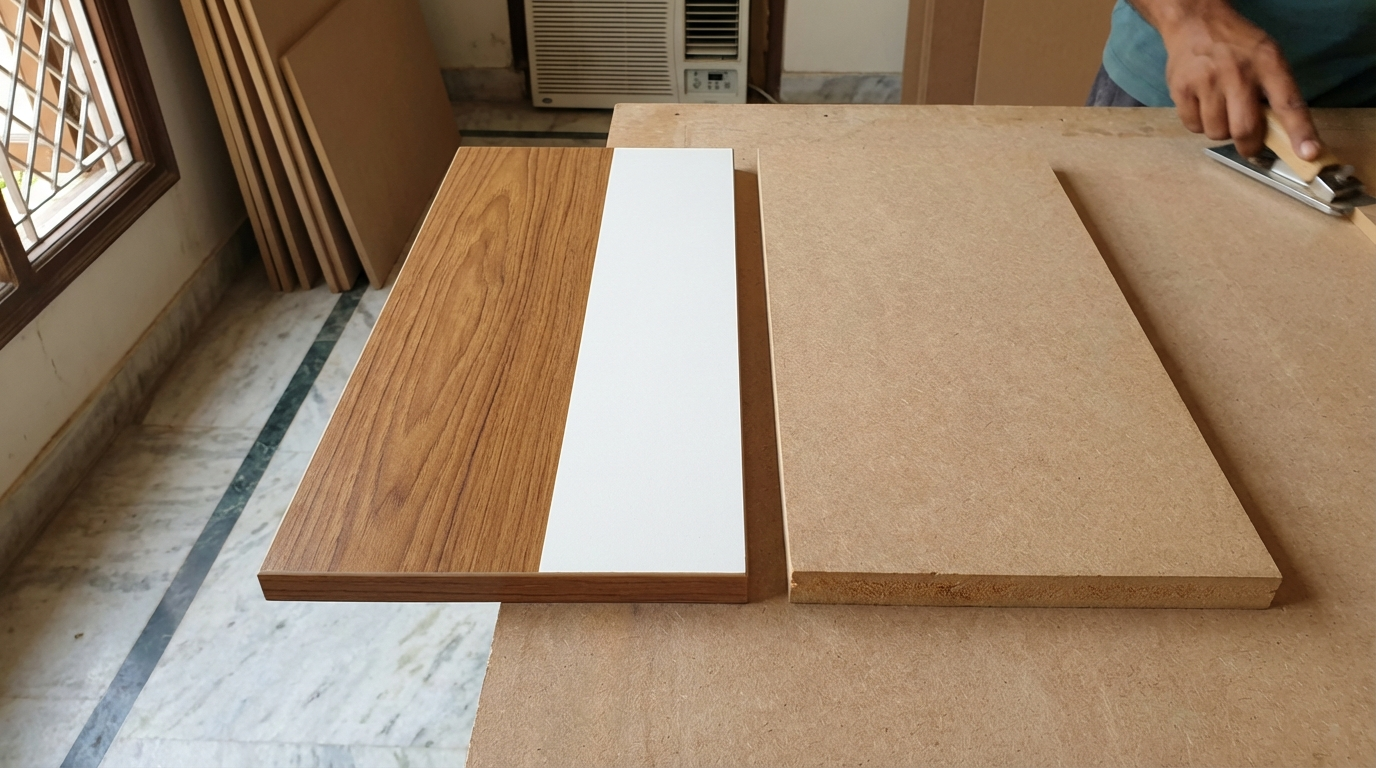
MDF stands for medium-density fiberboard, an engineered panel made by breaking wood into fine fibers, mixing with resins, and pressing under heat and pressure. This creates a uniform, smooth sheet ideal for laminates, paints, and CNC work. Available in standard, moisture-resistant (MR), and high-density variants, thicknesses range from 3mm to 25mm typically used in furniture.
In wardrobe contexts, MDF excels where surface quality trumps raw strength—think laminated shutters or shelving backs. Its consistency suits Indian modular workflows, but core density (usually 650–800 kg/m³) affects screw grip, often needing inserts for hinges.
What Blockboard Actually Is
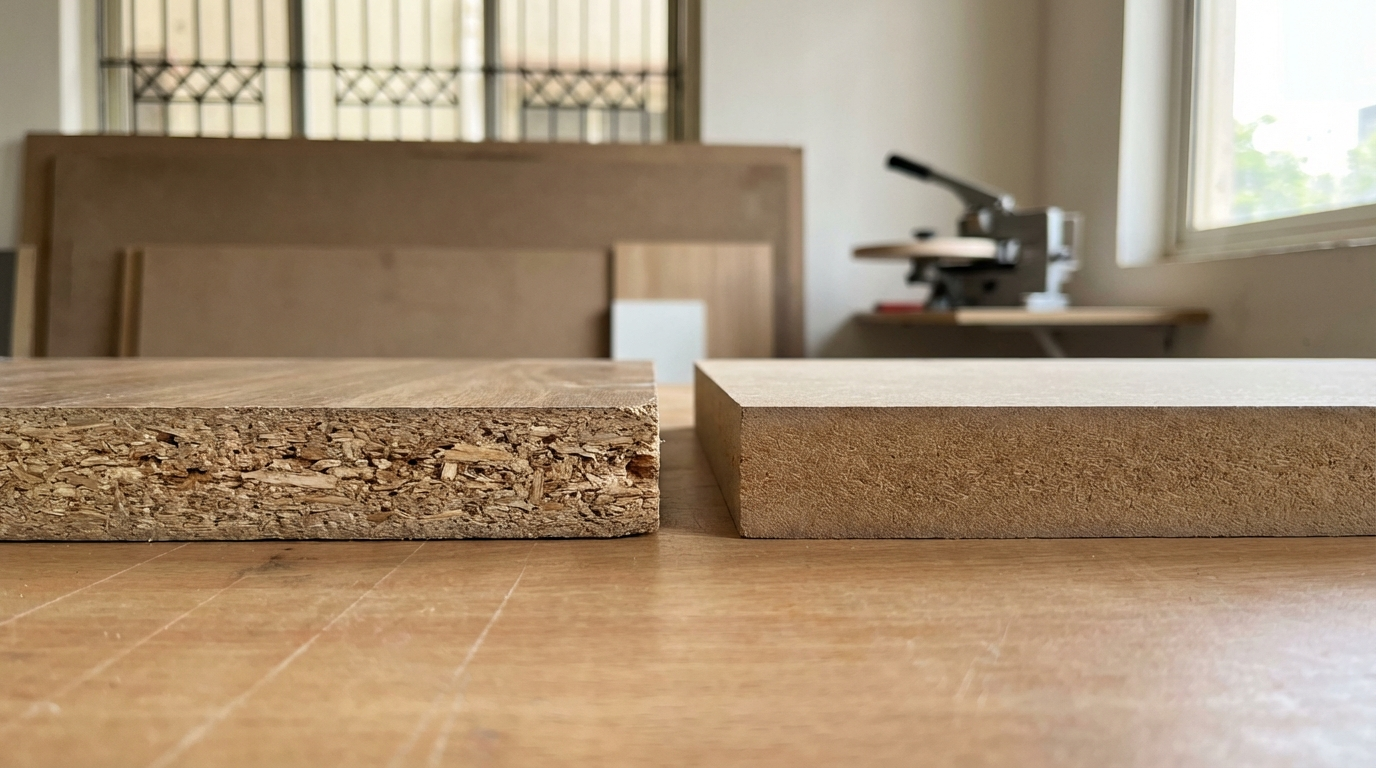
Blockboard consists of a core of softwood strips (like pine or poplar) glued side-by-side, sandwiched between thin plywood face veneers. This hybrid design offers better rigidity and screw-holding than pure particleboard, with thicknesses from 18mm to 25mm common for furniture carcasses.
For shelves and doors, blockboard provides structural support, resisting sagging under weight. In India, it's favored for wardrobes due to stability, but quality varies—poor gluing leads to delamination in humid storage yards.
Why It Matters in Indian Homes and Sites
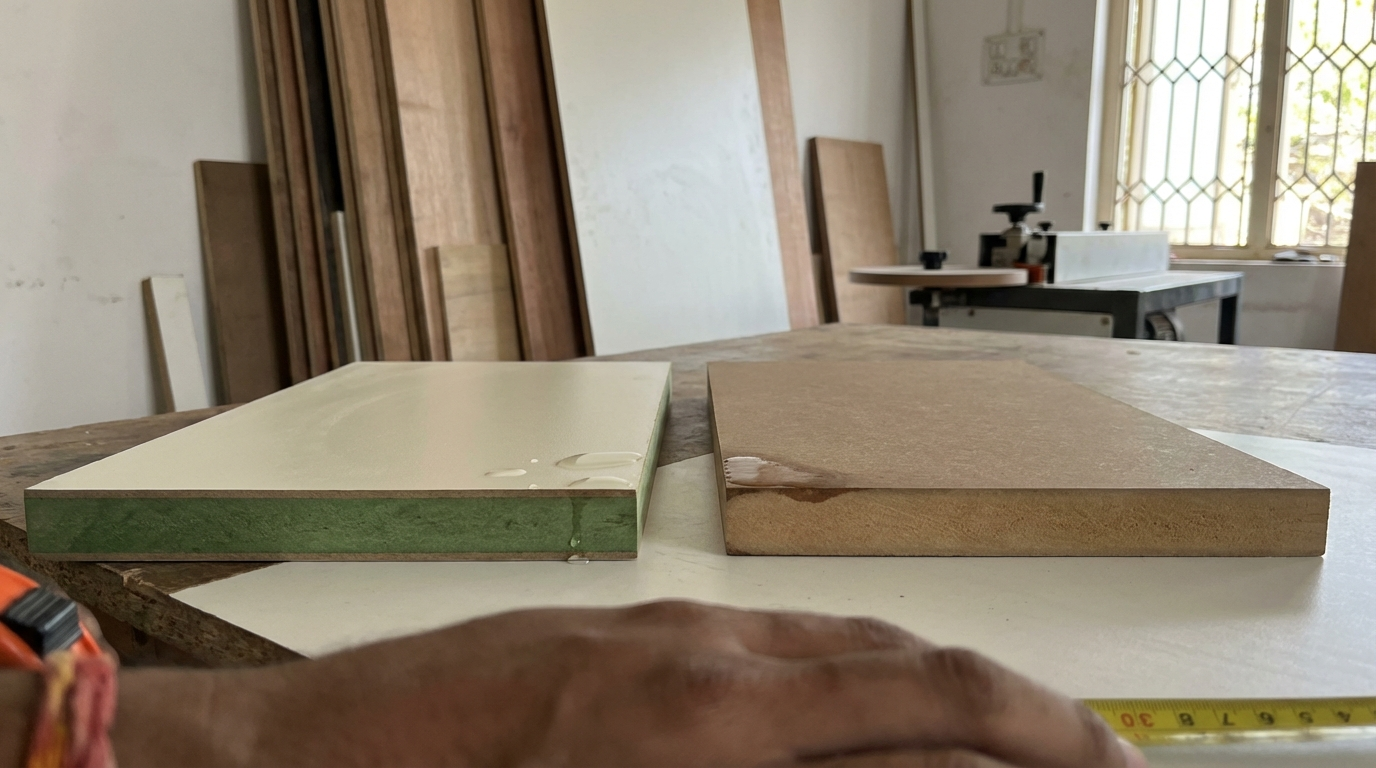
India's monsoon humidity (70–90% RH), coastal salt air, and poor site ventilation amplify material weaknesses. MDF absorbs moisture faster, causing edge swelling in unpacked wardrobes during rainy transport. Blockboard's strip core twists if strips warp unevenly, common in open godowns.
Site realities like carpenter handling (wet rags on panels), delayed edge banding, and dust buildup demand choices that forgive workmanship gaps. For wardrobes in Mumbai apartments or Kerala homes, prioritize screw stability for adjustable shelves; doors need warp resistance against daily swings.
Two-Minute Comparison (What Changes in Real Life)
Key differences emerge in load, finish, and durability under Indian conditions. Blockboard holds screws 2–3x longer for hinges; MDF machines smoother for veneers but chips on edges without care.
| Factor | MDF | Blockboard |
|---|---|---|
| Strength (load-bearing shelves) | Moderate; sags under 20–30kg/m without support | High; handles 40–60kg/m easily |
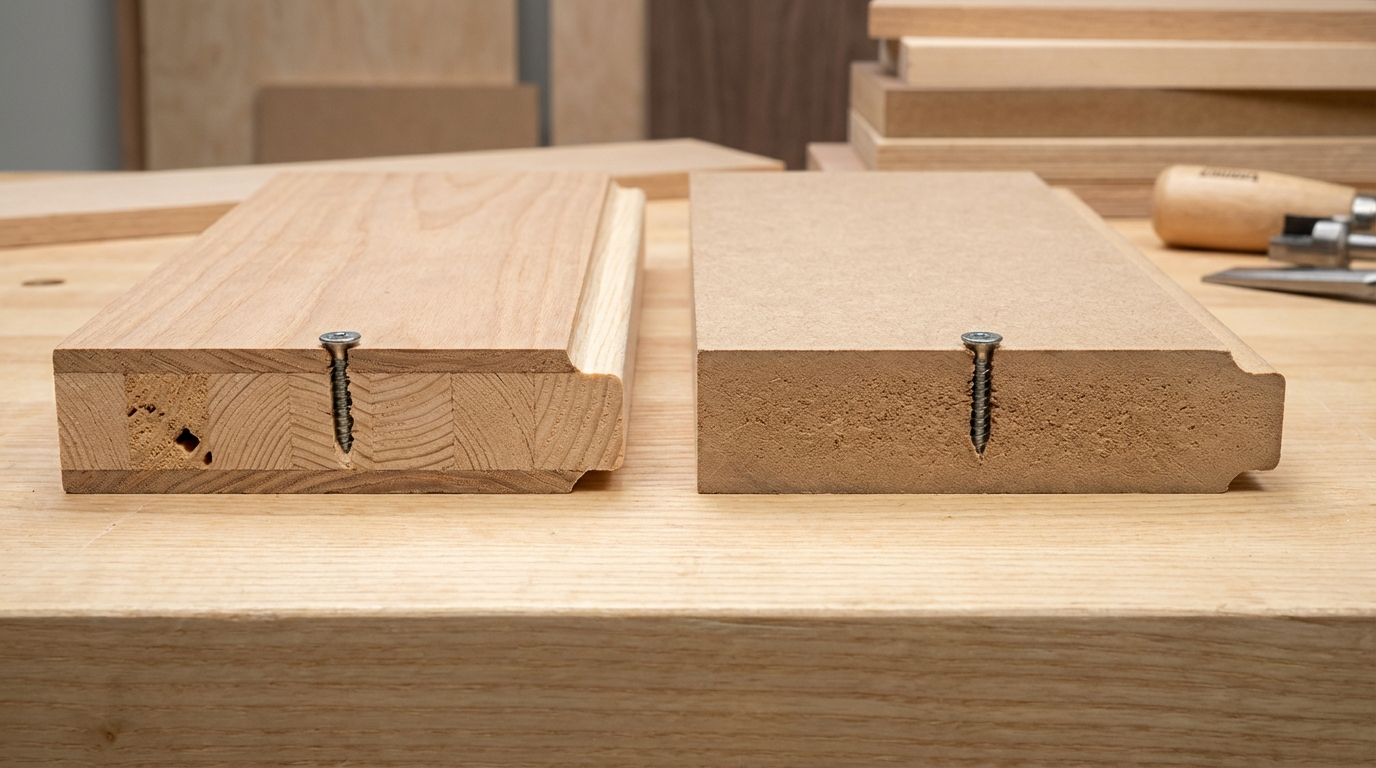
| Screw Holding (hinges, handles) | Poor initially, weakens fast | Excellent, lasts years |
| Finish Quality (laminate/paint) | Superior smoothness | Good but veneer grain shows |
| Warping Risk (monsoon) | High if not MR | Medium; core strips stabilize |
| Moisture Resistance | Low standard; MR variants better | Better inherent core |
| CNC/Edge Work | Easy, no tear-out | Risky; strips visible if miscut |
Use this for quick scans: blockboard for strength-first builds, MDF for aesthetic panels.
Is MDF stronger than blockboard for wardrobe shelves?
No, blockboard is stronger for shelves. Its strip core distributes weight evenly, preventing sag in heavy wardrobes (books, linens). MDF, being fiber-based, compresses under sustained loads over 20kg per meter without extra supports. In Indian homes with stacked clothes, blockboard lasts 5–10 years longer. Check by pressing shelf center—minimal deflection signals good blockboard. For MDF shelves, limit to light storage or add metal braces; always verify density stamp (700+ kg/m³ ideal).
Price Range and Cost Drivers
Expect Rs. 50–120 per sq ft for both, varying by thickness (18mm common: MDF Rs. 70–100, blockboard Rs. 80–110). Cost drivers include density (higher = pricier), moisture treatment (+20%), face quality (veneer grade), city logistics (Mumbai +15% over inland), and wastage (10–15% on curves).
For a 6x4 ft wardrobe carcass: MDF ~Rs. 8,000–12,000 total panels; blockboard ~Rs. 9,000–14,000. Add edge banding (Rs. 5–15/m) and laminate (Rs. 200–500/sheet). Quote checklist: specify thickness, MR grade, face mm, delivery protected packing.
Decision Framework Table
| Condition | Recommended Choice | What to Verify |
|---|---|---|
| Wet zone (kitchen-adjacent wardrobe) | Blockboard or MR MDF | Core dryness, no delam on tap |
| Coastal high humidity | Blockboard (tight strips) | Strip alignment straight, no gaps |
| Heavy use shelves (50kg+) | Blockboard 18–25mm | Screw test: holds 3x without pullout |
| Tight budget | Standard MDF 18mm | Density >650 kg/m³, flat sheet |
| Fast modular delivery | MDF prelam | Uniform color, no bubbles |
| High scratch risk (kids/pets) | MDF + thick laminate | Hardness test: nail resists |
Which is better for wardrobe doors: MDF or blockboard?
Blockboard for heavier swing doors needing stable hinges; MDF for lightweight flush designs. Blockboard resists warp from daily use in humid bedrooms, holding screws firmly. MDF suits slim 16mm doors with laminates, lighter on frames. In monsoon-prone areas, seal MDF edges doubly. Test door: swing 50x—minimal flex good. Match to frame weight; hybrid (blockboard frame, MDF panel) often wins for balance.
Practical Use Cases (What Works, What Fails)
| Part | Recommended | Thickness | Risk Notes |
|---|---|---|---|
| Wardrobe shelves | Blockboard | 18–25mm | MDF sags if >1m span |
| Door shutters | MDF or blockboard | 16–18mm | Edge chip on MDF |
| Partitions/back panels | MDF | 6–12mm | Blockboard too heavy |
| Carcass sides | Blockboard | 18mm | Screw grip vital |
Failure Modes and Fixes
- Shelf sagging: Symptom: center dips after months. Cause: MDF under heavy load. Prevention: use blockboard or add ribs. Fix: reinforce underside with battens.
- Hinge loosening: Symptom: doors droop. Cause: MDF poor grip. Prevention: blockboard or inserts. Fix: redrill with anchors.
- Edge swelling: Symptom: wavy laminate. Cause: monsoon exposure. Prevention: immediate banding. Fix: sand, reseal.
- Core delamination: Symptom: bubbles in veneer. Cause: poor glue in blockboard. Prevention: tap test pre-buy. Fix: replace panel.
- Surface scratches: Symptom: white marks. Cause: soft MDF face. Prevention: laminate overlay. Fix: polish lightly.
- Warping twists: Symptom: non-flat doors. Cause: uneven strip moisture. Prevention: acclimatize 48hrs. Fix: clamp straight, shim.
Does blockboard warp more than MDF?
Not usually—blockboard's strips provide cross-grain stability against humidity swings, outperforming standard MDF which expands uniformly but swells edges. Poor blockboard warps if strips are green wood. In coastal India, store both vertically, covered. Acclimatize panels 2–3 days in site RH. Check flatness with straightedge; bow >2mm rejects it. For doors, blockboard edges banded tightly lasts seasons longer.
Common Buyer Mistakes and How to Avoid
- Mistake 1: Ignoring thickness—using 12mm shelves. Avoid: specify 18mm+ for loads, check caliper.
- Mistake 2: Skipping MR in humid areas. Avoid: ask for boil test proof visually.
- Mistake 3: Poor storage—stacked flat in rain. Avoid: vertical racks, tarps.
- Mistake 4: No edge banding on MDF. Avoid: PVC/ABC tape immediately post-cut.
- Mistake 5: Screw direct into MDF. Avoid: pilot holes + inserts.
- Mistake 6: Veneer-only blockboard faces. Avoid: inspect light-through for gaps.
- Mistake 7: Budget cuts on density. Avoid: weight test—should feel solid.
- Mistake 8: No acclimatization. Avoid: 48hr site rest before assembly.
Can I use MDF for heavy wardrobe shelves?
Only with supports; pure MDF shelves sag under 25kg+ over 1m spans due to fiber compression. Add metal channels or blockboard hybrids for stability. In Indian homes with bulky storage, limit MDF to uppers. Verify by load test sample: 20kg center—no >5mm dip. Pair with thicker 25mm for bottoms. Trade-off: lighter weight but needs engineering.
Quality Checks You Can Do Without Lab Tests
Before buying: Tap sheet—hollow sound flags voids. Straightedge test flatness. Screw driver plunge: resistance good. Visual: uniform color, no knots/strips peeking.
After cutting: Edges smooth? No fuzz on MDF, straight strips on blockboard. Moisture: no darkening.
After install: Level check, screw torque test, wipe edges for seal integrity. Daily: microfiber clean, no abrasives.
Tips for Homeowners
Focus on low-maintenance: laminate MDF panels, blockboard frames. Avoid water spills—wipe instantly. For cleaning, mild soap only; no steel wool on laminates. In monsoons, use dehumidifiers near wardrobes. Inspect hinges yearly for looseness, tighten early. Budget extra 10% for edge treatments to prevent peeling in humid rooms.
Tips for Carpenters
Cut MDF with fine blade (60-tooth), zero clearance for clean edges. Blockboard: score first to avoid strip tear. Fasten in zones—double screws near hinges. Edge band hot-melt for MDF, PVC for blockboard. Handle with gloves to avoid oils; store off-floor. In coastal sites, assemble dry days only.
Tips for Architects and Designers
Spec blockboard for spans >900mm, MDF for curved fascias. Detail double edge bands in wet zones. Call out density min 700kg/m³, strip width uniform. For modular, pre-fab MDF kits reduce site errors. Balance aesthetics (MDF smooth) with structure (blockboard core).
Is blockboard good for modular wardrobes?
Yes, especially carcasses—strong screw zones for knock-down assembly. Strips resist twist during transport vibrations common in India. MDF better for pre-lam panels. Verify uniform glue lines; test disassembly 3x. In OEM lines, blockboard cuts returns by 30% on hinge fails. Acclimatize parts separately.
How to Decide in 5 Steps
- Assess load/site: heavy/humid? Blockboard.
- Check budget/thickness: balance Rs./strength.
- Inspect samples: screw/flat/moisture tests.
- Plan finishes: laminate favors MDF.
- Acclimatize + band edges before final.
Which is cheaper long-term: MDF or blockboard?
Blockboard often cheaper over 5 years—fewer repairs from screw fails/sag. Initial MDF savings erode with inserts/replacements in humid use. Factor site labor: MDF cuts faster. Track via sample wardrobe: blockboard holds value better. Prevent by hybrid: MDF faces on block cores.
FAQs
Can MDF replace blockboard entirely in wardrobes?
Not ideally—MDF lacks screw strength for adjustable shelves or heavy doors, leading to frequent fixes in Indian homes. Use hybrids: blockboard for loaded frames, MDF panels. This balances cost and durability, suiting monsoon variability. Always add reinforcements where MDF compresses; test prototypes under expected weights for site-specific tweaks.
Does moisture affect MDF more than blockboard?
Yes, standard MDF swells 10–15% faster in 80% RH, risking laminate bubbles. Blockboard's sealed core resists better if strips are kiln-dried. In coastal areas, choose MR MDF or premium blockboard. Prevention: plastic wrap transport, vertical storage. Post-exposure, dry slowly; replace if warped >3mm.
How to check blockboard quality on-site?
Look for straight strip alignment (no zigzags), solid tap sound (no voids), and veneer without bubbles. Screw test: holds firmly without spinning. Weight it—heavier signals dense core. In Indian yards, reject damp sheets; demand recent batch. These cues predict 2–3x longer life versus flaky ones.
Is 18mm enough for wardrobe shelves?
Yes for both if spans <1m and loads moderate; blockboard handles more. For deeper shelves, go 25mm blockboard. Indian wardrobes often overload—add cleats. Check deflection under 30kg: <5mm pass. Thicker adds stability but weight/cost; optimize per room layout.
Why do MDF screws pull out easily?
Fiber structure crumbles around screws under torque, unlike blockboard's solid strips. In hinge areas, use threaded inserts or glue. For repeated access, blockboard wins. Prep: pilot 70% diameter, avoid edges <40mm. This extends life in daily-use doors by years.
Can I paint blockboard directly?
Possible after sanding/primer, but veneer grain shows versus MDF's smoothness. Use 2–3 coats PU for durability. In humid sites, seal edges first. MDF paints flawlessly for uniform finishes; blockboard suits textured looks. Test patch for adhesion—key for lasting wardrobes.
What's better for kids' room wardrobes?
Blockboard carcass with laminated MDF doors—strength plus scratch resistance. Heavy play demands robust shelves; easy-clean surfaces. Avoid plain MDF frames. Seal all edges, use soft-close hinges. This combo withstands abuse while keeping aesthetics clean in active homes.
How long do these last in Indian climate?
Well-made blockboard: 8–15 years; MDF: 5–10 years with care. Factors: humidity control, workmanship, load. Monsoon accelerates wear—ventilate wardrobes. Regular checks prevent small issues; hybrids extend to 12+ years reliably across regions.
Should I mix MDF and blockboard in one wardrobe?
Absolutely—blockboard for shelves/frames (strength), MDF for backs/doors (finish). Saves 10–20% cost, optimizes performance. Ensure matching thickness for alignment. In modular designs, this reduces weight while holding integrity; common in pro Indian workflows.
Disclaimer: This content is provided for general informational purposes based on industry practices and publicly available information. Product specifications, standards, prices, and availability may vary by manufacturer, region, and time. Readers should independently verify details with manufacturers, dealers, or qualified professionals before making purchase or construction decisions.Want Plywood Suggestions?
Share a few details and a VIR MDF specialist will suggest suitable brands and connect you to responsive dealers.