Particle Board vs MDF: Key Differences & Which is Better
Particle board vs MDF comparison: density, strength, moisture resistance & price. Learn which board is better for your furniture project. Expert advice.
Quick Decision Summary
Quick Answer: MDF (Medium Density Fibreboard) is denser, stronger, and better for painted furniture requiring smooth finishes, while particle board is lighter, cheaper, and suitable for budget furniture where appearance matters less. For Indian homes, MDF performs better in humid conditions when properly sealed, but particle board wins on cost and ease of handling.
If you're in a hurry: Choose MDF for wardrobe shutters, kitchen cabinet doors, decorative panels, and any furniture you plan to paint. Choose particle board for cabinet carcasses, internal shelving, false ceilings, and budget-friendly furniture in dry areas. Both materials struggle with direct water contact, but MDF recovers better from humidity exposure than particle board.
Choose MDF if:
- You need a smooth, paint-ready surface without wood grain texture
- Your furniture requires detailed CNC routing or edge profiling
- Screws and hinges need strong holding power over years of use
- The application involves moderate humidity (with proper edge sealing)
Choose Particle Board if:
- Budget is your primary constraint and you need maximum coverage
- The furniture is for low-moisture, low-stress applications
- You're covering surfaces with laminate or veneer anyway
- Weight matters (wall-mounted units, transport considerations)
What Particle Board and MDF Actually Mean
Particle board and MDF are both engineered wood products made from wood waste, but the similarity ends there. Understanding what goes into each material helps you predict how it will perform in your home.
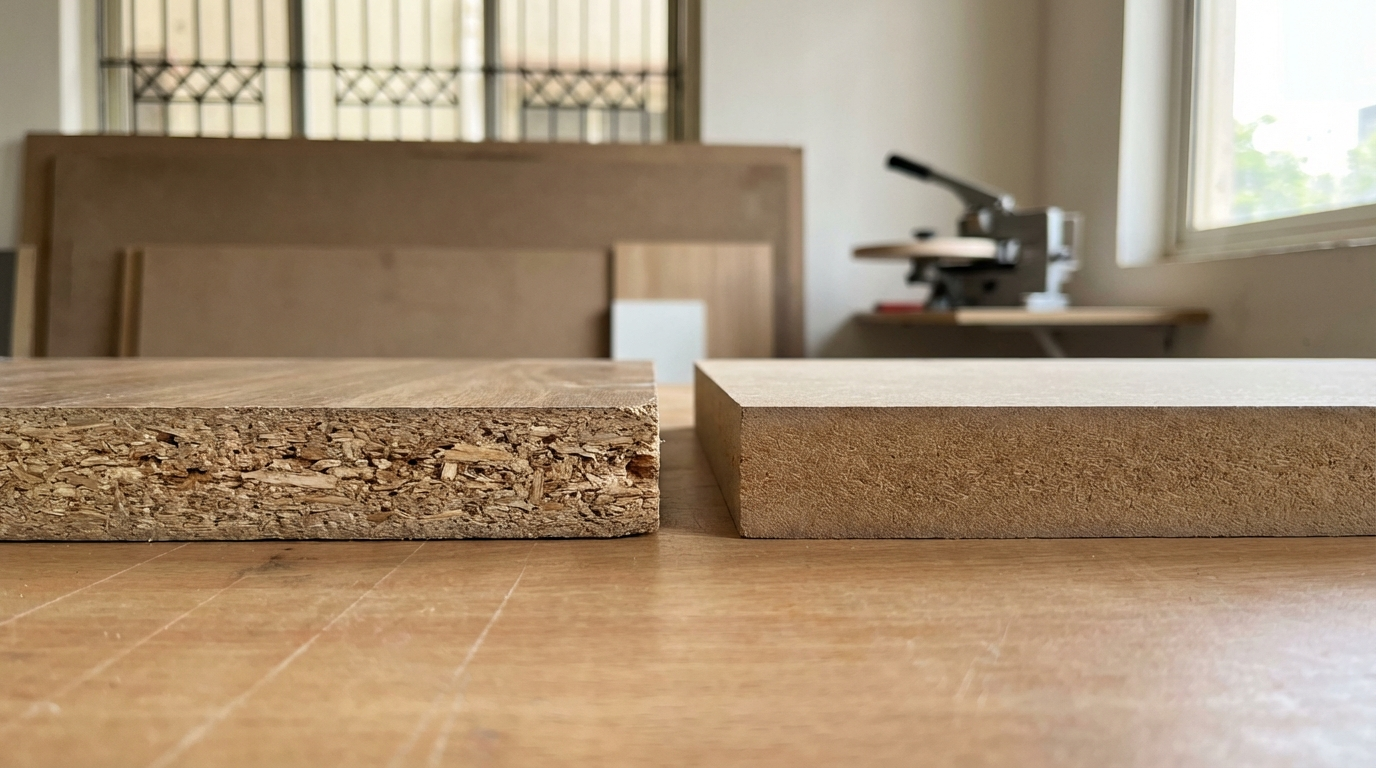
Particle board (also called chipboard) is manufactured from wood chips, sawdust, and shavings bonded together with synthetic resin under heat and pressure. The particles vary in size, creating a coarse internal structure with visible wood chips when you look at a cut edge. Typical composition includes 83-88% wood particles, 6-8% formaldehyde-based resins, 5-7% water, and 1-2% wax.
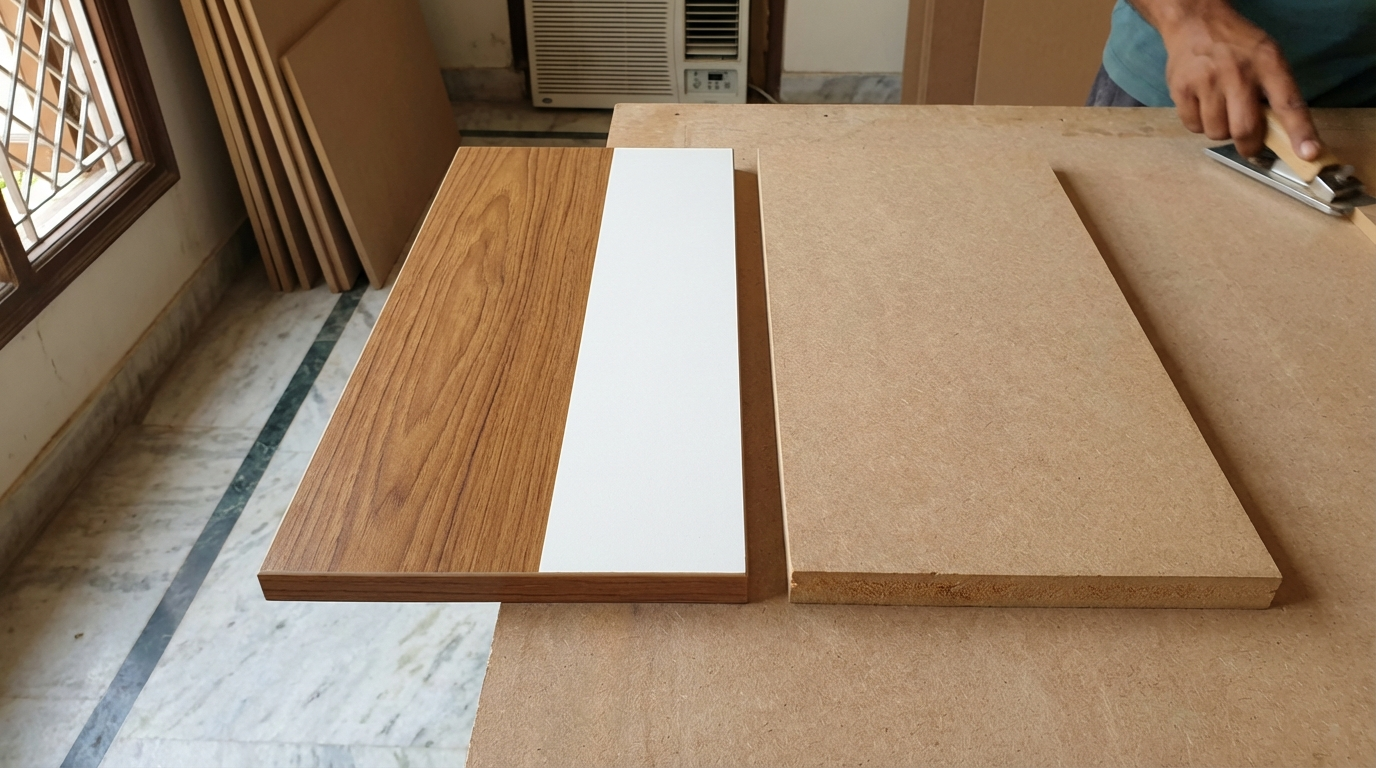
MDF (Medium Density Fibreboard) is made from wood fibres that have been broken down much finer than particle board—almost to a pulp consistency. These uniform fibres are mixed with resin and wax, then compressed under higher pressure and temperature than particle board. The result is a denser, more homogeneous material with a smooth, grain-free surface.
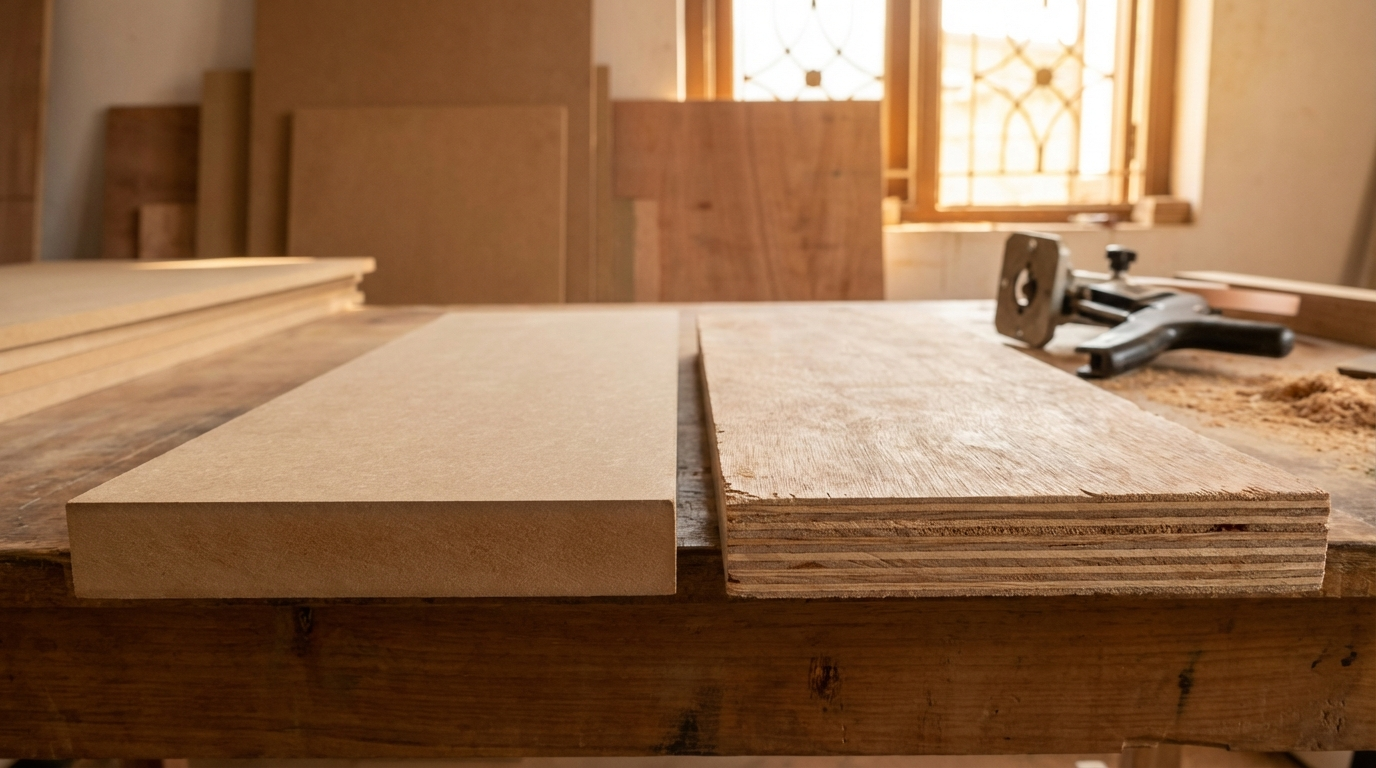
Where these materials fit in the hierarchy: Solid wood sits at the top for strength and durability, followed by plywood, then MDF, then particle board, and finally low-density fibreboard. However, cost follows the reverse order, making particle board and MDF attractive alternatives for budget-conscious projects.
Common Confusions Clarified
MDF is not "fake wood"—it's real wood fibres in engineered form. Particle board is not the same as MDF—they differ in density, strength, and particle size. Neither material is waterproof—even moisture-resistant variants only delay water damage, not prevent it entirely. HDF (High Density Fibreboard) is denser than MDF, not just another name for it.
Why This Comparison Matters for Indian Homes
India's diverse climate creates unique challenges for engineered wood products. The particle board vs MDF decision carries more weight here than in temperate countries.
Monsoon and Humidity Impact
During June to September, relative humidity in coastal and central India regularly exceeds 80%. Both particle board and MDF absorb moisture from the air, but they respond differently:
- Particle board swells unevenly due to its coarse particle structure—edges puff up, surfaces bubble under laminates, and screws loosen as the material expands
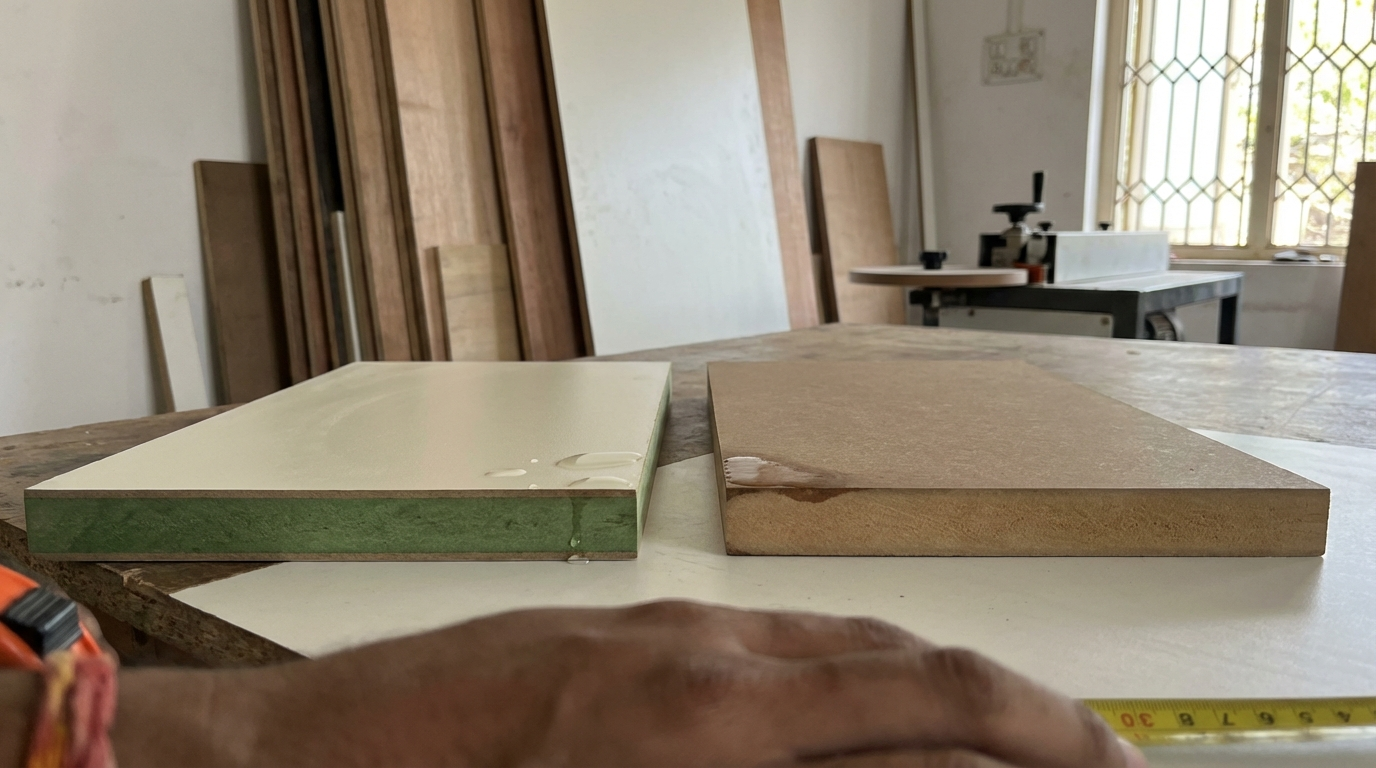
- MDF swells more uniformly but absorbs water faster due to its fine fibre structure—unsealed edges act like sponges
In cities like Mumbai, Chennai, and Kolkata, this means your furniture experiences stress cycles every year. Materials expand during monsoons and contract in winter, eventually leading to warping, delamination, or joint failure.
Real Consequences You'll Face
Swelling: Particle board kitchen cabinets near sinks often show puffy edges within 2-3 monsoon seasons. MDF wardrobe shutters may stick in their frames during humid months.
Delamination: Laminate or veneer surfaces can separate from both substrates when moisture enters through unsealed edges or drill holes.
Screw failure: Particle board loses screw-holding capacity faster than MDF. Hinge screws in particle board cabinet doors commonly strip out after 3-4 years of daily use.
Structural sagging: Particle board shelves under heavy loads (books, utensils) develop permanent sag over time, especially in humid environments.
Site Handling Realities
Indian construction sites expose materials to dust, moisture, and rough handling before installation. Boards stored on-site during pre-monsoon months may absorb significant moisture before your carpenter even cuts them. MDF's higher density makes it more resistant to transport damage, while particle board corners chip easily during handling.
Head-to-Head Comparison: Particle Board vs MDF
This detailed comparison covers every parameter that matters for furniture and interior applications in Indian conditions.
| Parameter | Particle Board | MDF | Winner (Conditions Apply) |
|---|---|---|---|
| Density | 590-700 kg/m³ | 700-850 kg/m³ | MDF (stronger, but heavier) |
| Surface Smoothness | Rough, requires laminate/veneer | Very smooth, paint-ready | MDF (for painted finishes) |
| Screw-Holding Capacity | Moderate, loosens over time | Good, better edge grip | MDF (for hinges, hardware) |
| Moisture Resistance | Poor, swells quickly | Poor-Moderate, absorbs fast but recovers better | Neither (both need sealing) |
| Weight | Lighter | 25-30% heavier | Particle board (for wall units) |
| Price (per sq ft, 18mm) | ₹30-60 | ₹45-90 | Particle board (budget projects) |
| Machining Quality | Chips at edges | Clean cuts, smooth profiles | MDF (for CNC, routing) |
| Paint Adhesion | Requires extensive prep | Excellent, minimal prep | MDF (for lacquer, PU, duco) |
| Typical Lifespan | 8-12 years | 12-18 years | MDF (with proper care) |
| Load-Bearing Capacity | Lower, prone to sagging | Moderate, better than particle board | MDF (for shelving) |
When to Choose Particle Board
- Internal carcasses of modular furniture covered by laminate
- False ceiling panels in air-conditioned spaces
- Temporary furniture or rental property fit-outs
- Large projects where material cost dominates budget
- Wall-mounted units where weight is a concern
When to Choose MDF
- Cabinet doors and drawer fronts requiring paint finish
- Decorative wall panelling with routed designs
- Speaker boxes and acoustic applications
- Furniture requiring strong hinge and screw retention
- Any application with CNC-cut profiles or detailed edges
Price Ranges and Cost Factors in India (January 2026)
Pricing varies by brand, thickness, grade, and location. These ranges reflect typical retail prices in major Indian cities.
Particle Board Pricing
| Thickness | Plain/Raw (per sq ft) | Pre-laminated (per sq ft) |
|---|---|---|
| 9mm | ₹18-28 | ₹32-45 |
| 12mm | ₹22-35 | ₹38-55 |
| 18mm | ₹30-50 | ₹48-72 |
| 25mm | ₹42-65 | ₹65-95 |
MDF Pricing
| Thickness | Plain MDF (per sq ft) | Pre-laminated MDF (per sq ft) |
|---|---|---|
| 6mm | ₹22-35 | ₹38-55 |
| 12mm | ₹35-55 | ₹55-80 |
| 18mm | ₹45-75 | ₹72-105 |
| 25mm | ₹60-95 | ₹95-140 |
Cost Drivers to Consider
Brand premium: Established brands typically cost 15-25% more than local manufacturers but offer better consistency and warranty support.
Moisture-resistant variants: MR-grade particle board or HDFHMR boards cost 20-35% more than standard grades.
Pre-laminated vs raw: Factory-laminated boards save edge-banding labour but limit finish options and cost 40-60% more.
Transport: Boards are typically 8x4 feet. Delivery charges vary by location—expect ₹500-1500 per trip in metros.
Budget Estimation Example
For a standard 7x7 feet wardrobe using 18mm boards:
- Particle board (pre-laminated): Approximately ₹8,000-12,000 for material only
- MDF (pre-laminated): Approximately ₹12,000-18,000 for material only
- Add 30-50% for hardware, edge-banding, labour, and finishing
Decision Framework: Which Board for Which Condition
Use this framework to make quick, confident decisions based on your specific situation.
| Condition/Application | Recommended Choice | What to Verify Before Buying |
|---|---|---|
| Kitchen cabinets (sink area) | Neither—use BWR plywood or HDHMR | Check for "BWR" or "710 grade" marking |
| Kitchen cabinets (dry zones) | MDF with sealed edges | Confirm edge-banding is factory-applied or will be done properly |
| Wardrobe shutters (painted) | MDF | Surface should be defect-free, uniform thickness |
| Wardrobe carcass | Particle board (pre-laminated) | Check laminate adhesion at corners |
| TV unit shelving | MDF (for visible), particle board (for hidden) | Consider expected load of equipment |
| Coastal city installation | MR-MDF or HDHMR | Ask for moisture-resistant grade specifically |
| Budget rental fit-out | Particle board throughout | Accept shorter lifespan, plan for replacement |
| Heavy bookshelf | MDF with support battens | Span should not exceed 60cm without support |
| Acoustic panels | MDF | Higher density provides better sound performance |
| False ceiling | Particle board (AC rooms only) | Ensure room is climate-controlled year-round |
Common Buyer Mistakes (And How to Avoid Them)
These mistakes cost Indian homeowners money, time, and frustration every year. Learn from others' errors.
Mistake 1: Using Particle Board Near Water Sources
Consequence: Swelling, delamination, and mould growth within 1-2 monsoon seasons.
Prevention: Never use particle board within 30cm of sinks, washbasins, or areas prone to water splashes. Choose BWR plywood or HDHMR for these zones.
Mistake 2: Ignoring Edge Sealing
Consequence: Moisture enters through exposed edges, causing internal swelling even when surfaces look fine.
Prevention: Insist on PVC edge-banding on all exposed edges. Machine-applied edge-banding is more durable than manual application.
Mistake 3: Overloading Particle Board Shelves
Consequence: Permanent sag develops within months, worsening over time.
Prevention: Limit particle board shelf spans to 45cm for loaded shelves. Add centre support battens for longer spans. Use MDF for heavy-load applications.
Mistake 4: Buying Based on Price Alone
Consequence: Cheap boards may have inconsistent density, poor surface quality, or higher formaldehyde emissions.
Prevention: Check board weight (denser is generally better), inspect surface for defects, and ask about emission standards (E1 or E0 grades are safer).
Mistake 5: Painting Particle Board Without Proper Prep
Consequence: Paint peels, flakes, or shows uneven texture due to particle board's rough surface.
Prevention: Apply wood filler, sand thoroughly, use primer before painting. Or simply choose MDF for painted applications.
Mistake 6: Assuming MR-Grade Means Waterproof
Consequence: Boards still fail when exposed to standing water or prolonged humidity.
Prevention: MR (Moisture Resistant) only means slower moisture absorption, not waterproofing. Still requires sealing and proper ventilation.
Mistake 7: Storing Boards Improperly Before Use
Consequence: Boards absorb moisture or warp before installation, compromising final furniture quality.
Prevention: Store flat on level surface, covered with plastic, in ventilated area away from direct sunlight and ground moisture.
Mistake 8: Using Wrong Screw Sizes
Consequence: Screws split particle board or don't grip MDF edges properly.
Prevention: Use pilot holes for both materials. Choose screws with coarse threads for particle board. Consider cam locks or dowels for frequently disassembled furniture.
Failure Modes and How to Prevent Them
Understanding how these materials fail helps you specify, install, and maintain them correctly.
Failure Mode 1: Edge Swelling
Symptom: Edges become puffy, soft, or discoloured. Laminate lifts at corners.
Root cause: Moisture entering through unsealed or poorly sealed edges.
Prevention: Apply quality edge-banding before installation. Use waterproof PVA glue during application. Avoid installing in high-moisture areas.
Fix if already happening: Sand affected area, apply wood hardener, re-edge-band. Severe cases require panel replacement.
Failure Mode 2: Surface Delamination
Symptom: Laminate or veneer bubbles, peels, or separates from substrate.
Root cause: Poor adhesion during manufacturing, moisture ingress, or heat damage.
Prevention: Buy from reputable brands with quality control. Avoid placing hot items directly on laminate surfaces.
Fix if already happening: Small bubbles can sometimes be re-adhered with heat and pressure. Large delamination requires re-laminating or replacement.
Failure Mode 3: Screw Pullout
Symptom: Hinges become loose, screws spin without gripping, doors sag.
Root cause: Repeated stress on screws, moisture weakening material, wrong screw type.
Prevention: Use pilot holes, apply wood glue in screw holes, consider hinge inserts or mounting plates.
Fix if already happening: Fill old holes with toothpicks and wood glue, let dry, re-drill. For repeated failures, use larger screws or relocate hardware.
Failure Mode 4: Structural Sagging
Symptom: Shelves bow in the middle, doors don't close properly, gaps appear.
Root cause: Excessive load, inadequate support spans, material creep over time.
Prevention: Design with proper support intervals. Use MDF for loaded shelves. Add back panels for structural rigidity.
Fix if already happening: Add centre support battens. Remove excess weight. Severe sag may require shelf replacement.
Failure Mode 5: Formaldehyde Off-Gassing
Symptom: Persistent chemical smell, eye/throat irritation, especially in new furniture.
Root cause: High formaldehyde content in adhesive resins, poor ventilation.
Prevention: Choose E1 or E0 grade boards. Allow new furniture to off-gas in ventilated space before moving to bedrooms.
Fix if already happening: Increase ventilation, seal all exposed surfaces with paint or laminate, consider air purifiers.
Failure Mode 6: Corner Chipping
Symptom: Corners break off during handling or use, exposing raw material.
Root cause: Impact damage, poor handling, inherent brittleness of particle board.
Prevention: Handle boards carefully, use corner protectors during transport, apply edge-banding early.
Fix if already happening: Fill with wood filler, sand smooth, re-laminate or paint to match.
Quality Checks Without Lab Tests
You don't need a laboratory to assess board quality. These practical checks help you identify good and bad material.
Before Buying: Visual and Physical Checks
Weight test: Lift the board. Heavier boards of the same size generally indicate higher density and better quality. Compare similar-thickness boards from different brands.
Surface inspection: Look for bubbles, dents, scratches, or thickness variations. Run your hand across the surface—it should feel uniformly smooth (especially for MDF).
Edge examination: Look at the cut edge. MDF should show uniform, fine fibres. Particle board should have even particle distribution without large voids or loose areas.
Flexibility test: Gently flex a board sample. Excessive flexibility in particle board indicates low density. MDF should feel relatively rigid.
Smell check: Strong chemical odour indicates high formaldehyde content. Mild wood smell is normal and acceptable.
Questions to Ask the Dealer
- What is the density grade of this board?
- Is this E1 or E0 emission standard?
- Do you have moisture-resistant variants?
- What is the warranty period and coverage?
- Can you provide a test certificate or technical data sheet?
Red Flags to Watch For
- Unusually low prices compared to market rates (may indicate seconds or rejected batches)
- No brand marking or batch information on the board
- Dealer unable to answer basic technical questions
- Boards stored in damp or exposed conditions
- Visible defects being offered at "discount" (defects often worsen over time)
After Cutting: What to Check
Edge quality: Clean cuts without excessive chipping indicate proper board density. Particle board will always chip slightly, but excessive crumbling suggests poor quality.
Core consistency: The core should appear uniform throughout. Dark spots, voids, or inconsistent particle distribution indicate manufacturing defects.
Dust colour: Uniform dust colour suggests consistent material. Mixed colours or foreign particles indicate contaminated raw material.
After Installation: Maintenance Checks
- Check edge-banding adhesion after 2-3 months—peeling indicates poor application
- Monitor for warping during monsoon season
- Tighten loose screws promptly before holes enlarge
- Clean spills immediately—don't let water sit on surfaces
- Ensure adequate ventilation around furniture to prevent moisture buildup
Tips by User Type
For Homeowners
Durability expectations: Well-maintained MDF furniture can last 12-18 years in Indian conditions. Particle board typically lasts 8-12 years. Budget for replacement when choosing cheaper materials.
Cleaning do's and don'ts:
- DO use damp (not wet) cloth for cleaning
- DO wipe spills immediately
- DON'T use harsh chemicals or abrasives
- DON'T let water pool on surfaces or edges
- DO use coasters under wet glasses
When to worry: Soft or spongy edges, persistent musty smell, visible mould, doors that won't close properly, or screws that keep coming loose all indicate moisture damage requiring attention.
For Carpenters and Contractors
Cutting tips: Use fine-toothed blades (minimum 60 teeth for 10" blade) to reduce chipping. Score the cut line with a knife before cutting particle board for cleaner edges.
Edge preparation: Sand edges lightly before edge-banding. Apply heat evenly when using iron-on edge tape. Use PVC edge-band with pre-applied adhesive for better results than manual glue application.
Screw zones: Pre-drill all screw holes. Keep screws at least 20mm from edges in particle board, 15mm in MDF. Use wood glue in screw holes for permanent installations.
Hinge areas: Reinforce hinge mounting areas with hardwood inserts or metal mounting plates for heavy doors. Apply extra adhesive around hinge cups.
Handling: Always carry boards vertically with two people. Store flat on level surface. Protect corners during transport.
For Architects and Interior Designers
Specification language: Specify density (minimum 680 kg/m³ for MDF), emission class (E1 or better), moisture resistance grade where required, and acceptable brands or equivalents.
Wet-zone detailing: Specify waterproof substrates (BWR plywood, HDHMR) within 300mm of water sources. Call out edge-sealing requirements explicitly. Detail kickboard gaps for floor cleaning access.
Finish selection: MDF for painted/lacquered finishes requiring smooth surfaces. Particle board acceptable under high-pressure laminates where cost matters. Always specify edge-banding for exposed edges.
For Modular and OEM Manufacturers
QC checkpoints: Incoming material inspection for density, thickness consistency, surface defects. Process checks for edge-banding adhesion, drilling accuracy, hardware fit. Final inspection for alignment, finish quality, hardware function.
Reducing complaints: Most field complaints trace to moisture damage or hardware failure. Factory edge-sealing and proper hardware selection prevent 70%+ of warranty claims.
Batch consistency: Maintain supplier relationships for consistent material. Test each new batch before production. Document material certificates for warranty support.
Practical Applications and Design Ideas
Both materials find extensive use across residential and commercial interiors. Here's where each performs best.
Kitchen Applications
- Cabinet carcasses: Pre-laminated particle board for internal structure (avoid near sink)
- Cabinet doors: MDF for painted finishes, particle board acceptable under laminate
- Drawer boxes: MDF for durability with heavy-use drawers
- Open shelving: MDF with proper support for visible shelves
- Kickboards: PVC or aluminium preferred over both materials
Bedroom and Wardrobe Applications
- Wardrobe shutters: MDF for paint finish, particle board for laminate
- Internal shelving: Particle board acceptable for folded clothes
- Drawer fronts: MDF for smooth painted or routed designs
- Loft storage: Particle board for hidden storage areas
- Headboard panels: MDF for upholstered or painted designs
Living Room Applications
- TV unit shelving: MDF for visible shelves, particle board for concealed areas
- Wall panelling: MDF for routed or painted decorative panels
- Display cabinets: MDF for painted finishes requiring clean edges
- Storage benches: Particle board carcass with MDF lid for seating
- Floating shelves: MDF with concealed metal brackets
Office and Study Applications
- Desk tops: MDF under laminate for smooth writing surface
- Bookshelves: MDF with support battens for heavy books
- File storage: Particle board acceptable for internal divisions
- Cable management boxes: Either material works
- Acoustic panels: MDF wrapped with fabric for sound absorption
Frequently Asked Questions
Is MDF stronger than particle board for furniture?
Yes, MDF is significantly stronger than particle board due to its higher density (700-850 kg/m³ versus 590-700 kg/m³). The fine, uniform fibres in MDF create a more cohesive structure that resists bending and holds screws better. For furniture applications requiring structural integrity—like wardrobe doors, drawer fronts, or loaded shelves—MDF performs noticeably better. However, strength comes with weight; MDF is 25-30% heavier than equivalent particle board, which matters for wall-mounted installations.
Which board is better for kitchen cabinets in India?
Neither standard particle board nor MDF is ideal for complete kitchen cabinet construction in Indian conditions. For cabinet carcasses in dry zones, pre-laminated particle board offers acceptable performance at lower cost. For cabinet doors requiring paint finish, MDF is better. However, for sink areas and zones with water exposure, use BWR plywood or HDHMR (High-Density High Moisture Resistance) boards instead. The combination approach—particle board carcass, MDF doors, BWR near water—balances cost and durability.
How long does particle board furniture last compared to MDF?
With proper care and installation, particle board furniture typically lasts 8-12 years in Indian conditions, while MDF furniture can last 12-18 years. The lifespan difference comes from MDF's better moisture resistance and screw-holding capacity. Both materials last longer in air-conditioned environments and shorter in coastal or high-humidity areas. Proper edge-sealing, avoiding water exposure, and not overloading shelves significantly extend lifespan for both materials.
Can I paint particle board the same way as MDF?
No, particle board requires significantly more preparation before painting compared to MDF. MDF's smooth, uniform surface accepts paint directly after light sanding and priming. Particle board's coarse texture requires wood filler to fill surface irregularities, multiple sanding passes, and heavy primer coats before painting. Even then, the finish won't be as smooth as painted MDF. If a painted finish is important for your project, choose MDF to save labour and achieve better results.
Is particle board safe for indoor furniture considering formaldehyde?
Both particle board and MDF contain formaldehyde-based resins that can off-gas volatile organic compounds (VOCs). The safety depends on the emission grade—look for E1 (≤0.1 ppm) or E0 (≤0.05 ppm) rated boards, which meet international safety standards. New furniture should be aired out in a ventilated space for 2-4 weeks before placing in bedrooms. Once surfaces are sealed with laminate, veneer, or paint, off-gassing reduces significantly. Avoid boards with strong chemical smell.
Which material holds screws better for hinges and handles?
MDF holds screws better than particle board, particularly at edges and in areas subject to repeated stress like hinge locations. The dense, uniform fibre structure of MDF grips screw threads more consistently. Particle board screws tend to loosen over time as the coarse particles compress. For both materials, always pre-drill pilot holes, use coarse-threaded screws, and consider hinge mounting plates or inserts for heavy doors. Apply wood glue in screw holes for permanent installations.
What thickness should I use for wardrobe shutters and shelves?
For wardrobe shutters, 18mm thickness is standard in India for both particle board and MDF—it provides adequate rigidity without excessive weight. For internal shelves holding clothes, 12mm or 18mm works depending on span length. For bookshelves or heavy-load applications, use 18mm or 25mm MDF with support battens at 45-60cm intervals. Avoid particle board for shelves spanning more than 45cm under load, as it will sag over time.
How do I protect particle board and MDF from monsoon humidity?
Complete edge-sealing is the most critical protection—ensure all exposed edges have PVC edge-banding applied with waterproof adhesive. Apply laminate or paint on all visible surfaces. Maintain adequate ventilation around furniture; avoid pushing wardrobes flush against external walls where condensation forms. Use moisture-resistant variants (MR-MDF, MR particle board) in humid regions. Run dehumidifiers or AC during peak monsoon to keep indoor humidity below 60%. Address any water leaks immediately.
What is the price difference between particle board and MDF per square foot?
In Indian markets as of January 2026, particle board typically costs ₹30-60 per square foot for 18mm thickness (plain/raw), while MDF ranges from ₹45-90 per square foot for the same thickness. Pre-laminated versions cost 40-60% more for both materials. Moisture-resistant grades add 20-35% to base prices. The total cost difference for a typical wardrobe project is 30-50%, making particle board the budget choice. However, factor in MDF's longer lifespan when calculating value.
Can MDF or particle board be used for bathroom vanities?
Standard MDF and particle board should not be used for bathroom vanity construction due to constant high humidity and water splash exposure. Both materials will swell and deteriorate quickly in bathroom conditions. For bathroom vanities, use marine plywood, HDHMR (High-Density High Moisture Resistance) boards, or PVC boards specifically designed for wet environments. If you must use MDF, choose HDFWR (High Density Fibre Water Resistant) grade with complete waterproof sealing on all surfaces and edges.
Which board is more eco-friendly—particle board or MDF?
Both materials use recycled wood waste, making them more environmentally friendly than using virgin timber. Particle board typically contains 83-88% recycled wood particles, while MDF uses similar percentages of wood fibres. The environmental impact depends more on the adhesive resins used and the source forest certification. Look for FSC or PEFC certification indicating sustainable sourcing. Choose boards with lower formaldehyde emission ratings (E0 or E1) for better indoor air quality and environmental performance.
How do I identify good quality MDF or particle board at the shop?
Check weight first—denser boards indicate higher quality. Examine the cut edge for uniform particle/fibre distribution without voids or dark spots. Surface should be smooth (especially MDF) without bubbles or dents. Smell the board—strong chemical odour indicates high formaldehyde. Ask for the technical specification sheet showing density, emission class, and moisture resistance. Buy from established dealers who can provide brand information and warranty support. Avoid boards stored in damp or exposed conditions.
Disclaimer: This content is provided for general informational purposes based on industry practices and publicly available information. Product specifications, standards, prices, and availability may vary by manufacturer, region, and time. Readers should independently verify details with manufacturers, dealers, or qualified professionals before making purchase or construction decisions.Want Plywood Suggestions?
Share a few details and a VIR MDF specialist will suggest suitable brands and connect you to responsive dealers.