Melamine Board vs MDF: Which Surface Finish is Better?
Melamine board vs MDF comparison: durability, looks, cost & applications. Expert guide to choosing the right finish for your furniture.
Quick Decision Summary
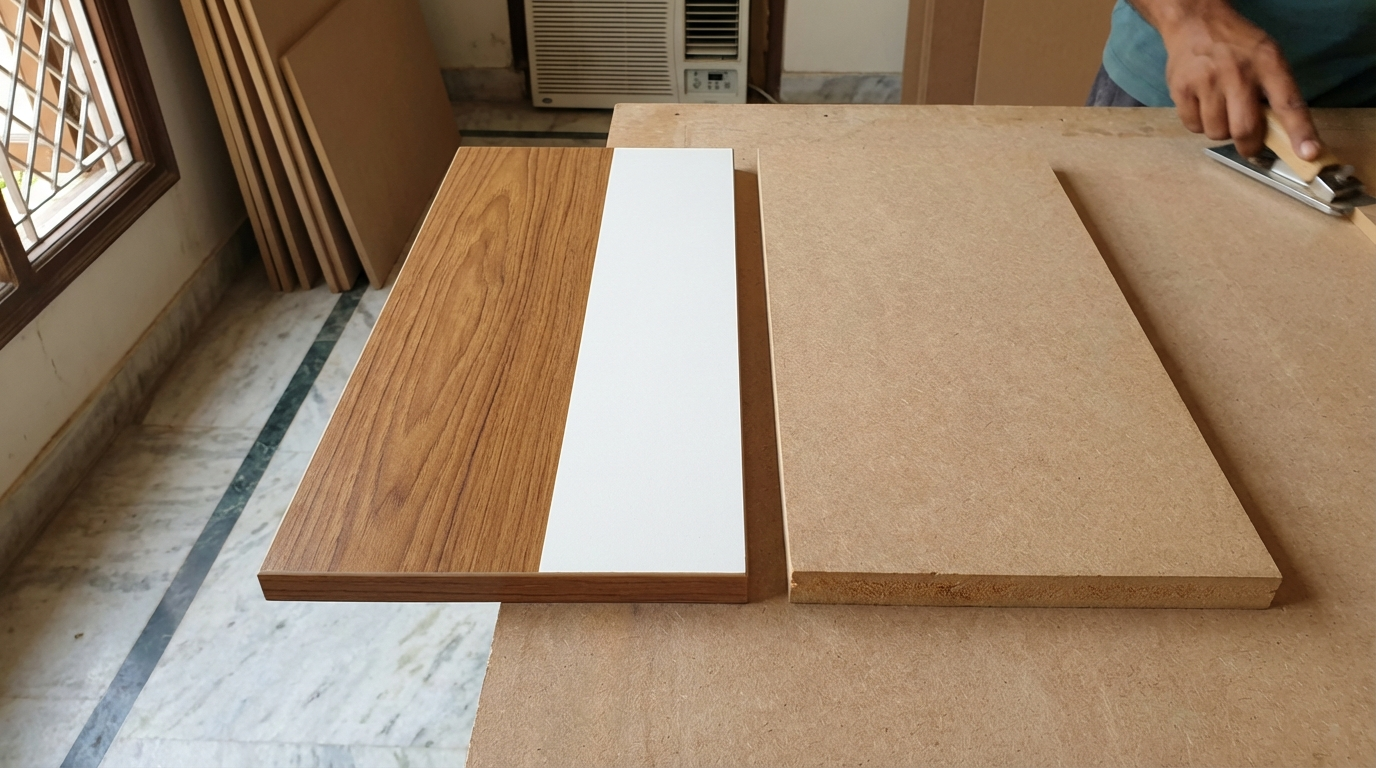
Quick Answer: Melamine board is MDF or particleboard with a pre-applied decorative resin surface, while plain MDF is a raw engineered wood panel requiring separate finishing. Choose melamine for ready-to-use, moisture-resistant surfaces in kitchens and bathrooms; choose plain MDF when you need to paint, veneer, or create custom router-cut designs.
If you're in a hurry: Melamine boards come factory-finished with scratch-resistant, wipeable surfaces in hundreds of colours and wood-grain patterns—ideal for modular kitchens, wardrobes, and office furniture where speed and durability matter. Plain MDF gives you a smooth, uniform substrate that takes paint beautifully and allows intricate CNC routing—perfect for painted shutters, decorative panels, and custom furniture where you control the final look.
Choose melamine board if:
- You need a ready-to-install surface without painting or laminating
- Your application involves moisture exposure (kitchen cabinets, bathroom vanities)
- You want consistent factory-finished aesthetics across multiple units
- Budget and timeline are tight—no finishing labour required
Avoid melamine board if:
- You need intricate routed edges or 3D profiles
- Custom paint colours or spray finishes are required
- You're doing architectural mouldings or curved components
- The project demands veneer application or wood-look depth
What Melamine Board and MDF Actually Mean
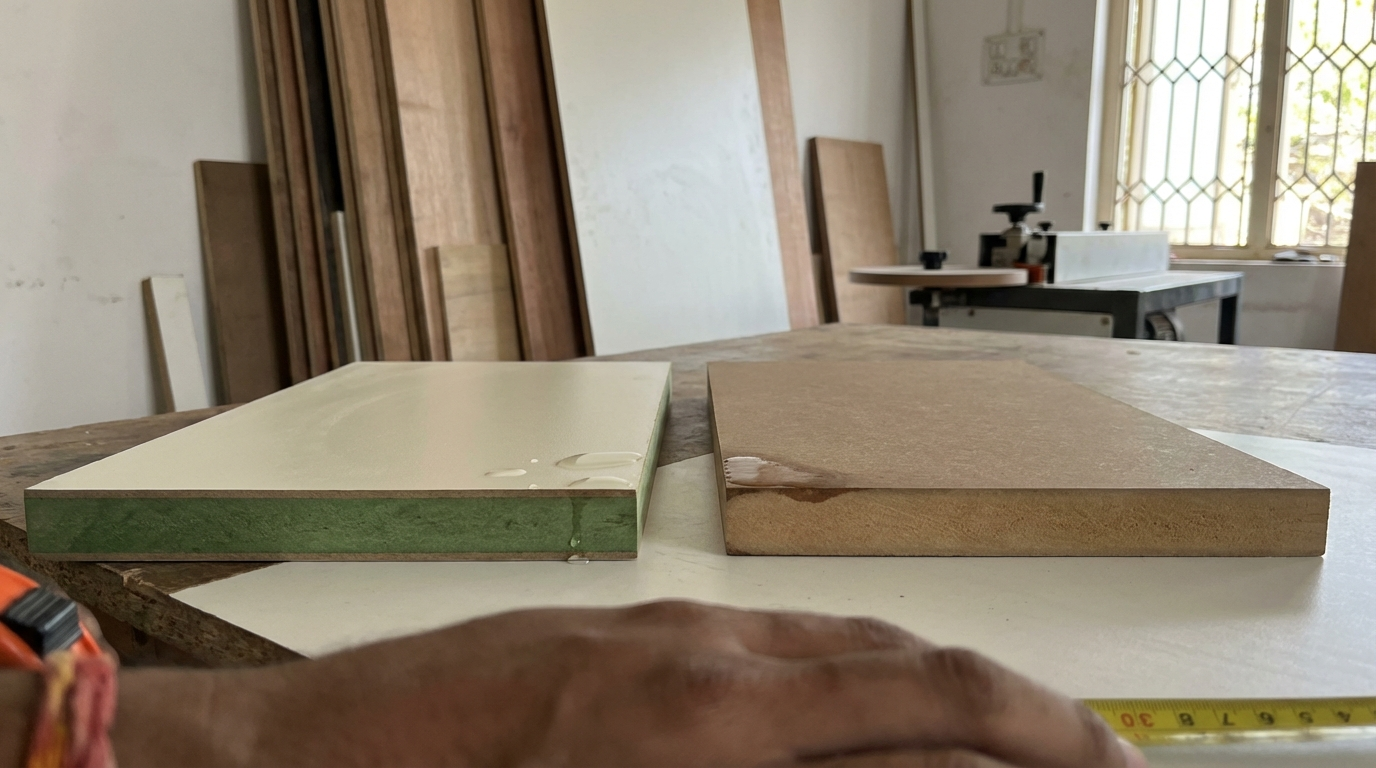
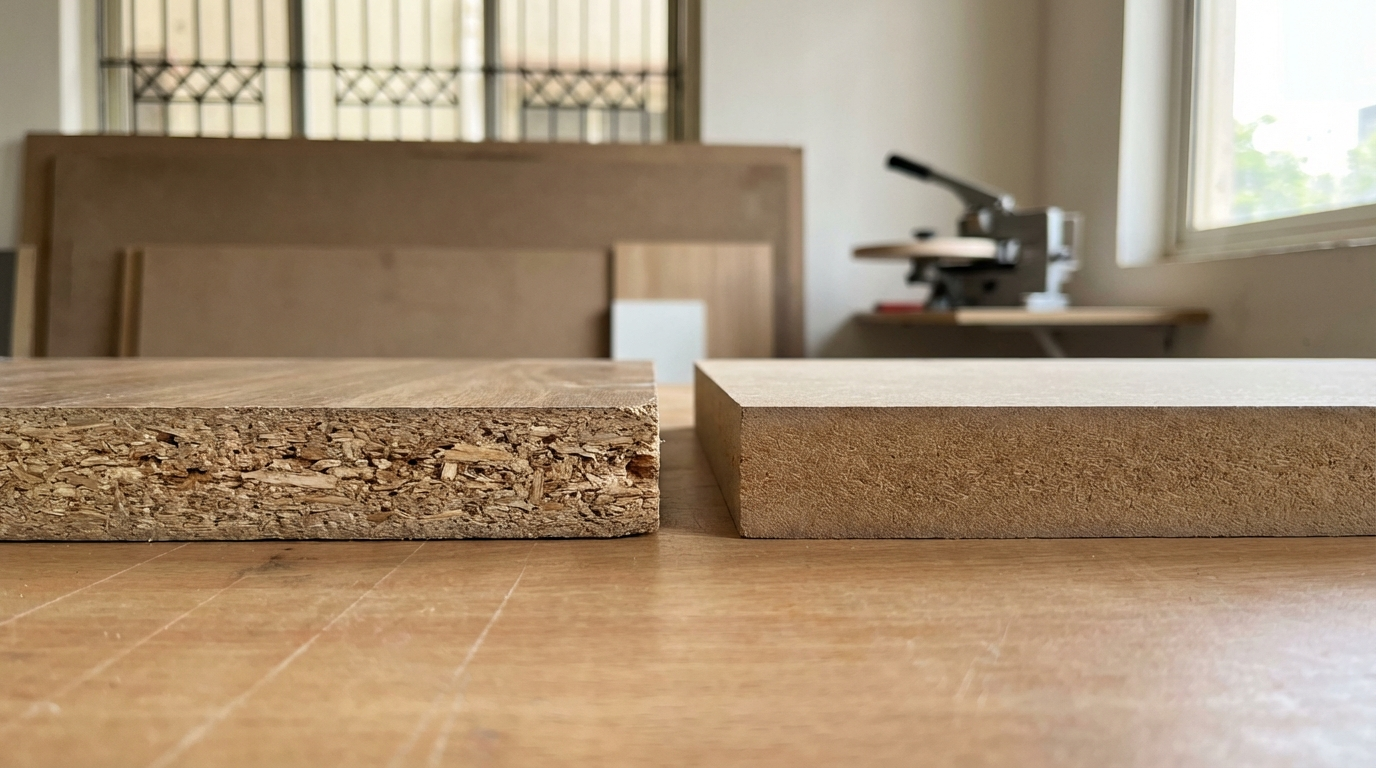
The melamine board vs MDF confusion exists because these terms describe different things entirely. MDF (Medium Density Fibreboard) refers to the core material—wood fibres bonded with resin under heat and pressure to create a dense, smooth, grain-free panel. Melamine board describes a finished product where decorative resin-impregnated paper is thermally fused onto a substrate, which could be MDF, particleboard, or HDF.
In simpler terms: MDF is like an unfinished canvas, while melamine is a canvas that comes pre-painted and sealed. You can have melamine-faced MDF (where the melamine coating sits on an MDF core) or melamine-faced particleboard (MFC, where the coating sits on a chipboard core). When Indian dealers say "melamine board," they typically mean MFC or pre-laminated particleboard with a melamine finish.
Common Terminology Confusion in India
Indian markets use several overlapping terms that create confusion:
- Pre-laminated MDF/Particle Board: Usually means melamine-faced boards
- Plain MDF: Raw, unfinished MDF requiring painting or laminating
- Laminated MDF: Could mean melamine-faced or HPL-faced MDF
- Action Tesa, Greenply Pre-lam: Brand names for melamine-faced particleboard
- White MDF: Sometimes means melamine-faced white, sometimes primer-coated MDF
Always clarify with your supplier whether you're getting raw MDF (needs finishing) or pre-finished melamine board (ready to use).
Why This Comparison Matters for Indian Homes
India's climate creates unique challenges that make this choice critical. During monsoon months (June-September), relative humidity in coastal cities like Mumbai, Chennai, and Kolkata regularly exceeds 80-90%. Even in Delhi, humidity swings from 20% in winter to 75%+ during monsoons. These moisture cycles stress furniture materials differently.
Monsoon and Humidity Impact
Plain MDF behaviour: Standard MDF absorbs moisture through exposed edges and surfaces. In high humidity, this causes gradual swelling—edges expand first, followed by surface waviness. If a plain MDF shutter isn't sealed properly with primer and paint on all six sides (including edges), expect visible swelling within 2-3 monsoons. The damage is irreversible once core fibres expand.
Melamine board behaviour: The factory-applied melamine skin acts as a moisture barrier on both faces. However, cut edges remain vulnerable. If edge-banding fails or wasn't applied, moisture enters the particleboard or MDF core from edges. In kitchens, this typically shows as swollen edges near sinks and dishwashing areas first.
Real Consequences on Site
- Swelling near wet zones: Undersink cabinets and areas near cooking hobs see maximum moisture. Melamine with proper edge-banding survives better than painted MDF here.
- Delamination risks: Poor-quality melamine facing can peel when moisture penetrates edges. This appears as bubbling or lifting of the decorative surface.
- Paint failure on MDF: If MDF isn't primed adequately (especially edges), paint absorbs unevenly, creating patchy finishes that crack and peel over time.
- Screw-holding degradation: Both materials lose screw-holding capacity when moisture-damaged. Hinges become loose, shelf supports fail, and drawer runners wobble.
Storage During Construction
Indian construction sites often store materials in partially completed buildings where dust, cement particles, and moisture exposure are common. Plain MDF left uncovered absorbs ambient moisture within days. Melamine boards are more forgiving but still need protection from rain, wet floors, and stacking directly on damp concrete.
Head-to-Head Comparison: Melamine Board vs MDF
| Parameter | Melamine Board (Pre-finished) | Plain MDF (Raw) | Winner Condition |
|---|---|---|---|
| Surface Finish | Factory-applied, consistent, scratch-resistant | Raw—requires painting, laminating, or veneering | Melamine for speed; MDF for custom colours |
| Moisture Resistance | Good on faces, edges need sealing | Poor unless moisture-resistant grade (MR-MDF) | Melamine for wet-adjacent areas |
| Machinability | Limited—surface chips on routing | Excellent—smooth routing, shaping, profiling | MDF for CNC work and mouldings |
| Paintability | Not designed for painting over | Superb—takes primer and paint beautifully | MDF for painted finishes |
| Design Options | 100+ colours, wood grains, textures available | Unlimited—any paint colour or veneer possible | Depends on customisation needs |
| Edge Treatment | Requires edge-banding (matching or contrasting) | Can be painted, routed, or edge-banded | MDF for seamless painted edges |
| Installation Time | Faster—no finishing time needed | Slower—needs priming, painting, drying | Melamine for tight deadlines |
| Repair Ease | Difficult—chips and scratches visible | Easier—can sand and repaint damaged areas | MDF for long-term maintenance |
| Cost (Material Only) | ₹45-85/sq ft (18mm, depending on brand) | ₹35-55/sq ft (18mm plain MDF) | Similar when finishing costs added to MDF |
| Density | 500-650 kg/m³ (particleboard core typical) | 600-800 kg/m³ (denser, heavier) | MDF for structural applications |
Understanding Core Differences in Composition
How MDF is Manufactured
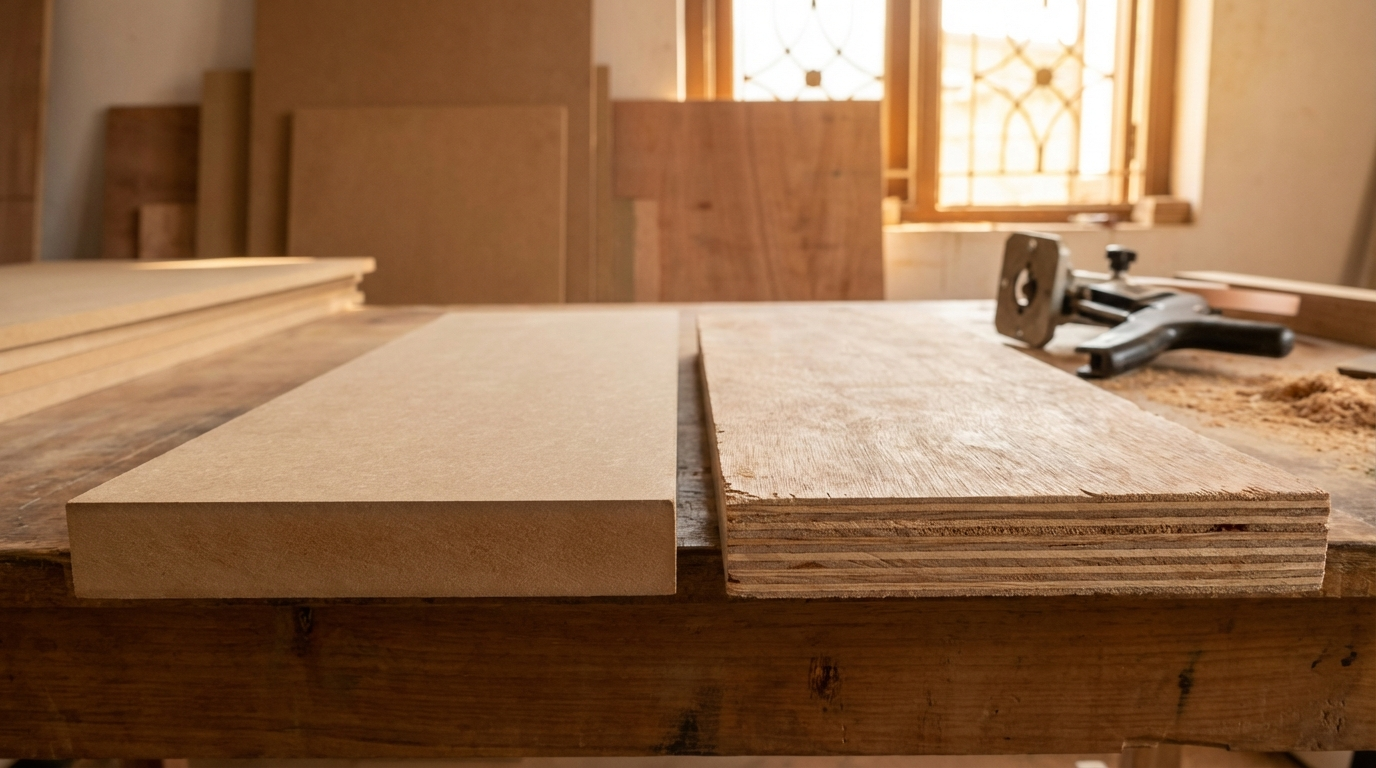
MDF production starts with wood chips (typically from plantation timber or wood waste) that are broken down into fine fibres using defibrators. These fibres are mixed with synthetic resin (usually urea-formaldehyde) and wax, then formed into a mat and pressed under high temperature (150-200°C) and pressure. The result is a homogeneous board with no grain direction, consistent density throughout, and an exceptionally smooth surface.
Key MDF characteristics:
- Density range: 600-800 kg/m³ (denser than most natural woods)
- Surface: Smooth on both faces, no voids or knots
- Edge quality: Dense, accepts paint and routing cleanly
- Internal bond: Strong throughout—no weak layers
How Melamine Boards are Made
Melamine boards start with a substrate—usually particleboard (wood chips bonded with resin) or MDF. Decorative paper is saturated with melamine-formaldehyde resin, then thermally fused onto the substrate under heat and pressure (typically 300-500 PSI). This creates a 0.2-0.5mm tough, scratch-resistant decorative surface bonded permanently to the core.
Key melamine board characteristics:
- Surface hardness: Harder than painted MDF, resists scratches
- Decorative layer: Pre-printed patterns—wood grain, solid colours, textures
- Core quality: Varies significantly based on manufacturer
- Edge exposure: Cut edges reveal the particleboard/MDF core underneath
What This Means Practically
When you cut or route melamine board, the decorative surface chips easily because the hard melamine layer is brittle. This limits design options to straight cuts with properly scored edges. MDF, being homogeneous throughout, routes cleanly in any direction—you can create shaker-style profiles, rounded edges, and intricate CNC patterns without chipping.
Decision Framework: Which Option for Which Condition
| Application/Condition | Recommended Choice | What to Verify Before Buying |
|---|---|---|
| Modular kitchen cabinets (carcass) | Melamine board (HDFWR or BWR grade if available) | Core density, edge-banding quality, ISI mark if applicable |
| Kitchen shutter (visible doors) | MDF with lacquer/paint OR high-end melamine | Profile requirements—melamine won't allow routed designs |
| Wardrobe internals (shelves, partitions) | Melamine board | 18mm thickness minimum, scratch-resistant surface |
| Wardrobe shutters (visible) | Depends on design—melamine for flat, MDF for profiles | Handle cutout method, hinge screw zones |
| Bathroom vanity | Melamine on marine-grade or BWR core | Edge sealing, undersink protection, hardware quality |
| TV unit with backlit panels | Plain MDF (for CNC routing grooves) | Minimum 12mm thickness for routing, primer compatibility |
| Wall panelling with texture | MDF (for 3D routing) or pre-textured melamine | Fire rating if required, installation adhesive compatibility |
| Office workstations | Melamine board | Abrasion resistance rating, edge-banding durability |
| Children's furniture | Melamine (easier cleaning, more durable surface) | E1 or E0 formaldehyde emission rating for safety |
| Painted architectural mouldings | Plain MDF | Density uniformity, dust from cutting (use mask) |
| Budget rental property furniture | Melamine board | Cost per sq ft, basic durability for 3-5 year lifespan |
| High-end custom furniture | MDF with premium finish (veneer, PU lacquer) | Multiple primer coats, spray finish quality |
Price Ranges and Cost Factors in India (January 2026)
Note: Prices vary significantly by city, brand, thickness, and order quantity. These ranges are indicative for 8x4 ft sheets in major metros.
Plain MDF Pricing
| Thickness | Standard MDF (₹/sheet) | MR-MDF (₹/sheet) | Notes |
|---|---|---|---|
| 6mm | ₹800-1,200 | ₹1,000-1,500 | Backing panels, drawer bottoms |
| 12mm | ₹1,400-1,900 | ₹1,800-2,400 | Shelves, lighter shutters |
| 18mm | ₹1,800-2,500 | ₹2,400-3,200 | Most common for shutters, carcass |
| 25mm | ₹2,500-3,500 | ₹3,200-4,200 | Heavy-duty shelves, tabletops |
Melamine Board Pricing
| Thickness | Economy Brands (₹/sheet) | Premium Brands (₹/sheet) | Notes |
|---|---|---|---|
| 8mm | ₹900-1,300 | ₹1,200-1,600 | Backing, light panels |
| 12mm | ₹1,400-1,800 | ₹1,800-2,400 | Shelves, internal partitions |
| 18mm | ₹1,800-2,400 | ₹2,400-3,500 | Standard for most furniture |
| 25mm | ₹2,800-3,600 | ₹3,600-4,800 | Commercial counters, heavy use |
True Cost Comparison (Including Finishing)
When comparing melamine board vs MDF for a typical 100 sq ft wardrobe project:
Melamine board route:
- Material (18mm): ₹4,500-6,000
- Edge-banding: ₹800-1,500
- No painting required
- Total material cost: ₹5,300-7,500
Plain MDF route (painted finish):
- Material (18mm): ₹3,500-5,000
- Primer (2 coats): ₹400-600
- Paint (2 coats): ₹600-1,000
- Labour for finishing: ₹1,500-3,000
- Total material + finishing: ₹6,000-9,600
Plain MDF typically becomes more expensive once finishing costs are added, unless you're painting in bulk where spray setup costs are amortised.
Aesthetics and Design Flexibility Compared
Melamine Board Aesthetics
Modern melamine boards offer impressive variety. Leading manufacturers provide:
- Wood grain prints: Oak, walnut, teak, ash—from subtle to bold grains
- Solid colours: Whites, greys, pastels, bold accents—matte and gloss
- Textured surfaces: Linen, leather, stone, concrete effects
- Synchronized textures: Where the surface texture follows the printed grain pattern
The limitation: whatever design you see is what you get. No mixing colours on a single panel, no gradient effects, no custom shades. If the manufacturer doesn't make your exact colour, you can't have it.
Plain MDF Aesthetics
MDF offers unlimited finishing possibilities:
- Spray painting: Any colour from any paint brand, custom mixed
- Lacquer finishes: High-gloss piano finish, satin, matte—your choice
- Veneer application: Real wood veneers for authentic wood appearance
- Textured paints: Special effects, metallic, antiqued finishes
- Two-tone designs: Different colours on same piece
The trade-off: achieving these finishes requires skilled painters, proper spray equipment, and time for multiple coats and curing.
Profile and Routing Options
This is where MDF wins decisively:
- Shaker profiles: Classic recessed panel look—impossible on melamine
- Rounded edges: Bullnose, ogee, chamfer profiles
- CNC patterns: Geometric grooves, fluting, wave patterns
- 3D wall panels: Decorative dimensional surfaces
Melamine is limited to flat surfaces with edge-banding. Any routing through the melamine surface exposes the unattractive particleboard core underneath.
Common Buyer Mistakes (And How to Avoid Them)
Mistake 1: Choosing melamine for kitchen shutters expecting routed designs
Consequence: The carpenter can't create shaker-style or profiled doors from melamine—you're stuck with flat slab doors.
Prevention: If you want any profile on shutter faces, specify plain MDF with paint/lacquer finish from the start.
Mistake 2: Using plain MDF in bathroom without proper sealing
Consequence: Edges swell within months, paint peels, hinges become loose.
Prevention: Use MR-MDF grade minimum, seal all edges with primer before painting, apply silicone sealant at wall junctions.
Mistake 3: Not specifying edge-banding quality for melamine
Consequence: Cheap PVC edge-banding peels off within 1-2 years, especially in kitchen heat zones.
Prevention: Specify 1mm or 2mm ABS/acrylic edge-banding with PUR glue (not standard EVA hot-melt).
Mistake 4: Comparing raw MDF price to melamine without adding finishing costs
Consequence: Budget overrun when painting costs exceed expectations.
Prevention: Get complete quotations including primer, paint, labour, and edge treatment before deciding.
Mistake 5: Using standard melamine board in undersink cabinet
Consequence: Particleboard core swells from plumbing leaks or condensation.
Prevention: Use BWR (Boiling Water Resistant) grade boards for undersink, or apply waterproof membrane lining.
Mistake 6: Expecting melamine scratches to be repairable
Consequence: Deep scratches expose the brown particleboard core permanently.
Prevention: Accept that melamine is touch-up resistant only for minor scuffs. For high-scratch-risk areas, consider lacquered MDF which can be recoated.
Mistake 7: Storing MDF sheets flat on damp floors during construction
Consequence: Bottom sheets absorb moisture, causing permanent waviness.
Prevention: Store vertically on raised platforms, cover with plastic sheeting, use moisture barriers.
Mistake 8: Not checking formaldehyde emission ratings
Consequence: Cheap boards emit odour for months, potential health concerns in closed rooms.
Prevention: Specify E1 or E0 emission class, especially for children's rooms and bedrooms.
Failure Modes and How to Prevent Them
Melamine Board Failures
Edge swelling near water sources
Symptom: Puffed, softened edges near sink or dishwasher
Root cause: Water penetration through inadequate edge-banding
Prevention: Use PUR-glued edge-banding, apply silicone sealant at countertop joints
Fix if happening: Cut off damaged section, replace with new panel, improve sealing
Surface delamination/bubbling
Symptom: Melamine layer lifting from substrate, creating bubbles
Root cause: Moisture under surface, heat damage, or manufacturing defect
Prevention: Buy from reputable manufacturers, avoid placing near direct heat sources
Fix if happening: Cannot be repaired—panel replacement required
Edge-band peeling
Symptom: Edge tape lifting, revealing exposed core
Root cause: Poor adhesive (EVA in humid conditions), thin tape, mechanical damage
Prevention: Specify 1mm+ ABS edge-banding with PUR adhesive
Fix if happening: Remove old tape, reapply with contact adhesive or PUR glue
Screw holes stripping
Symptom: Hinges or handles becoming loose, screws spinning freely
Root cause: Repeated opening/closing, moisture-weakened core
Prevention: Use proper hinge cups, pre-drill accurately, don't overtighten
Fix if happening: Fill with wood filler + toothpicks, redrill, or relocate hinge
Plain MDF Failures
Edge absorption and swelling
Symptom: Visibly thicker edges, paint cracking along edges
Root cause: Unsealed edges absorbing humidity over time
Prevention: Apply extra primer coats on edges (MDF edges absorb more), seal thoroughly
Fix if happening: Sand down, apply wood hardener, reprime and repaint
Paint adhesion failure
Symptom: Paint peeling in sheets, especially on edges
Root cause: Insufficient primer, painting over dusty surface, incompatible products
Prevention: Use MDF-specific primer, sand between coats, ensure dust-free surface
Fix if happening: Strip paint completely, sand, reprime with proper system
Surface denting
Symptom: Visible dents and impressions on surface
Root cause: Impact damage—MDF is dense but not impact-resistant
Prevention: Handle carefully during transport and installation
Fix if happening: Fill with automotive body filler, sand smooth, repaint
Sagging shelves
Symptom: Long spans bowing in middle over time
Root cause: Insufficient thickness for span, overloading, moisture weakening
Prevention: Use 18mm+ for spans over 60cm, add mid-supports for longer spans
Fix if happening: Add central support bracket, or replace with thicker board
Quality Checks Without Lab Tests
Before Buying: Visual and Physical Checks
For melamine boards:
- Hold board at eye level—surface should be flat, no waves or undulations
- Check all four edges for chips or damage from factory/transport
- Look for consistency in colour across different sheets from same batch
- Press thumbnail into surface—shouldn't leave mark on quality melamine
- Smell test—strong chemical odour indicates high formaldehyde emission
- Check core density by lifting—heavier generally means denser core
For plain MDF:
- Surface should be uniform light brown without dark patches
- No visible voids or inclusions when viewing edge
- Edge should show consistent density throughout thickness
- Board should be flat—sight along length to check for warping
- Weight test—18mm quality MDF should feel substantial, not lightweight
Questions to Ask Suppliers
- What is the core density (kg/m³)? Quality MDF: 680-750+; Quality particleboard for melamine: 600+
- What emission class? E1 minimum, E0 preferred for residential
- Is this board ISI marked or certified to any standard?
- What is the moisture resistance grade? Standard, MR, or BWR?
- What thickness tolerance? Should be within ±0.3mm
- What is the internal bond strength? Higher means better screw-holding
After Cutting: What to Look For
- MDF edge: Should be smooth, uniform, no voids or layers visible
- Melamine edge: Minimal chipping if cut with proper blade (score and cut)
- Both: No burning or discolouration from blade friction
- Test drilling: Screw should grip firmly, not spin freely after insertion
After Installation: Maintenance and Warning Signs
- Check edges near wet zones monthly for first year—early swelling detection
- Monitor hinge screws for loosening—retighten before stripping occurs
- Look for edge-banding lifting, especially near heat sources (ovens, hobs)
- Check painted MDF for paint cracking along edges—indicates moisture issue
Tips by User Type
For Homeowners
Durability expectations: Both materials, when properly specified and installed, should last 10-15+ years in normal residential use. Melamine requires less maintenance but is harder to repair. Painted MDF can be refreshed with new paint but needs more initial care.
Cleaning guidelines:
- Melamine: Wipe with damp cloth, mild soap solution. Avoid abrasive scrubbers.
- Painted MDF: Similar care, but be gentler—paint finish is softer than melamine.
- Never use harsh chemicals (bleach, acetone) on either surface.
When to worry:
- Any visible swelling at edges—address immediately before spreading
- Hinges becoming loose repeatedly—indicates core damage
- Bubbling on melamine surface—moisture has penetrated
- Paint peeling on MDF—moisture or adhesion issue needs attention
For Carpenters and Contractors
Cutting melamine:
- Use 80-tooth TCT blade minimum, 100-tooth preferred
- Score cut line with knife or scoring blade before main cut
- Feed slowly to prevent chip-out
- Support sheet fully—cantilever causes breakout
Cutting MDF:
- 60-tooth blade sufficient for clean cuts
- Excellent for CNC routing—no grain direction issues
- Use dust extraction—MDF dust is fine and hazardous
- Wear P2/N95 mask when cutting or sanding
Edge preparation:
- Melamine edges must be edge-banded—no exceptions for visible edges
- MDF edges need extra primer (2-3 coats vs 1-2 for faces)
- Sand MDF edges lightly between primer coats
Screw and hinge zones:
- Pre-drill pilot holes in both materials
- Don't over-tighten—particleboard cores strip easily
- For heavy doors, use 35mm hinge cups with 4+ screws per hinge
- Consider cam locks and dowels for flat-pack assembly
For Architects and Interior Designers
Specification language:
- Specify "Pre-laminated particle board with melamine finish, 18mm, E1 emission, density ≥620 kg/m³"
- Specify "Medium Density Fibreboard, 18mm, MR grade, density ≥700 kg/m³, for paint finish"
- Include edge-banding specifications: "1mm ABS edge-banding with PUR adhesive"
Wet-zone detailing:
- Specify BWR grade for undersink and bathroom applications
- Detail waterproof membrane lining for undersink cabinet bases
- Show silicone sealant at all countertop-to-cabinet junctions
- Consider aluminium edge profiles for high-moisture areas
Finish selection guidance:
- Melamine ideal for: repetitive elements, large projects, commercial spaces
- Painted MDF ideal for: custom colours, profiled doors, high-end residential
- Consider PU-coated MDF for best of both—durability plus custom finish
For Modular Furniture Manufacturers
QC checkpoints:
- Incoming material inspection: density, thickness tolerance, surface defects
- After cutting: edge quality, dimension accuracy
- After edge-banding: bond strength test (peel test), alignment
- After assembly: hinge operation, drawer movement, gap consistency
Reducing customer complaints:
- Use consistent board batches for same order—colour matching
- Never skip edge-banding even on "hidden" edges in humid climates
- Include care instructions with delivery
- Use quality hardware—hinges and runners fail before boards do
Batch consistency:
- Order complete project requirement from single batch
- Store boards in climate-controlled area before processing
- Allow 48 hours acclimatisation if boards moved between different humidity environments
Frequently Asked Questions
Is melamine board the same as MDF with laminate?
No, they are related but different. Melamine board has a thin (0.2-0.5mm) decorative paper layer saturated with melamine resin and thermally fused to the substrate. This is thinner and less durable than high-pressure laminate (HPL), which is typically 0.8-1.2mm thick and glued onto the substrate separately. Melamine-faced boards are produced in a single pressing operation at the factory, while laminated MDF involves a separate lamination step. Both provide decorative surfaces, but HPL is more impact-resistant and can be applied to curved surfaces, while melamine is more economical and sufficient for most furniture applications.
Can I paint over melamine boards if I want to change the colour?
Technically yes, but it requires specific preparation and isn't ideal. Melamine's smooth, non-porous surface doesn't accept paint readily. You'll need to thoroughly clean and degrease the surface, lightly sand with 180-grit sandpaper to create mechanical adhesion, apply a bonding primer specifically designed for melamine/laminate surfaces, then apply your topcoat. Even with proper preparation, paint adhesion on melamine is never as strong as paint on primed MDF. For colour changes, replacing panels or applying new laminate/vinyl wrap is often more durable than painting over melamine.
Which material is better for modular kitchen cabinets in India?
For the carcass (box structure), melamine-faced boards on moisture-resistant cores are typically the practical choice—they're factory-finished, wipeable, and resist the humidity and splashes common in Indian kitchens. For shutters (doors), it depends on your design preference: flat contemporary doors work well in melamine, while shaker-style or profiled doors require MDF with paint or lacquer finish. Many Indian modular kitchens use a combination—melamine carcass with either melamine shutters (budget-friendly) or lacquered MDF shutters (premium look). Always specify BWR or marine-grade cores for areas near sinks regardless of which surface you choose.
Does MDF emit more formaldehyde than melamine boards?
Formaldehyde emission depends on the manufacturing process and resin system used, not inherently on whether the board is MDF or melamine-faced. Both products use formaldehyde-based resins in their core. However, the melamine surface does act as a barrier, potentially reducing emissions from the faces of the board (though edges still emit). The emission class (E0, E1, E2) is what matters—E1 boards emit ≤0.1ppm formaldehyde and are safe for residential use. E0 boards emit even less. When comparing products, look at the emission rating rather than just the material type. Always specify E1 minimum for bedrooms and children's furniture.
How long does melamine board furniture last compared to MDF furniture?
Both materials can last 10-15+ years with proper specification and care. The failure mode differs: melamine boards typically fail at edges first (swelling from moisture ingress) or from surface damage (chips and scratches that can't be repaired). MDF furniture typically fails from paint degradation (peeling, yellowing) or moisture damage to improperly sealed edges. In high-humidity environments like coastal Indian cities, properly edge-banded melamine often outlasts painted MDF because the factory-applied surface is more moisture-resistant than site-applied paint. In dry climates with careful use, painted MDF can be maintained longer through periodic repainting.
Why does melamine board chip when cutting but MDF cuts cleanly?
MDF is homogeneous throughout—the same material from surface to core—so there's nothing to chip. Melamine board has a hard, brittle decorative layer (melamine resin) bonded to a softer core (particleboard or MDF). When a saw blade exits the cut, it can lift and break this brittle surface layer, causing chip-out. Prevention requires scoring the cut line first (breaking the melamine surface in a controlled way), using fine-tooth blades (80+ teeth), cutting slowly, and ensuring the decorative face is positioned correctly relative to blade rotation direction. Professional CNC machines use scoring blades that spin opposite to the main blade, eliminating chip-out entirely.
Can melamine boards be used for bathroom vanity units?
Yes, but with specific precautions for Indian bathroom conditions. Use melamine-faced boards with BWR (Boiling Water Resistant) or marine-grade particleboard cores—standard E1 particleboard will swell in high bathroom humidity. All edges must be properly edge-banded; any exposed edge will absorb moisture. Apply silicone sealant where the countertop meets the cabinet and where cabinets meet walls. Consider raised legs or plinths to prevent floor water contact. Even with these precautions, avoid direct water spray on melamine surfaces. For areas directly behind or beside bathtubs or showers, tile or waterproof alternatives are safer than any wood-based board.
Is MR-MDF as water-resistant as melamine board?
MR-MDF (Moisture Resistant MDF) has water-repellent additives in its core but doesn't have a protective surface layer. Melamine board has a moisture-resistant surface but may have a non-MR core. Neither is truly waterproof. For practical comparison: unpainted MR-MDF will still absorb moisture over time if edges are exposed; it just swells slower than standard MDF. Melamine board's surface repels water splashes but fails if moisture enters through edges. The ideal solution for wet areas combines both approaches: MR-MDF or BWR particleboard core with melamine or laminate surface, plus proper edge-banding. This gives you both core stability and surface protection.
What thickness should I choose for wardrobe shelves—melamine or MDF?
For standard wardrobe shelves (60-80cm span), 18mm is the minimum recommended thickness for both materials. Melamine-faced boards are common because they're ready-finished and wipeable—ideal for shelf surfaces that see sliding items. If your span exceeds 80cm without mid-support, move to 25mm thickness or add a central support to prevent sagging. MDF shelves offer no particular advantage for wardrobes unless you're painting them to match profiled doors. Weight capacity matters too: fully loaded book shelves need 25mm regardless of span. Always check the manufacturer's span recommendations for your specific board density.
How do I match melamine board edges to the face colour perfectly?
Most melamine board manufacturers offer matching edge-banding tapes in the same colour and finish as their board range. When ordering, specify the exact decor code (e.g., "Action Tesa AT-001 Alpine White") and request matching 1mm or 2mm ABS edge-tape. The match is usually excellent for solid colours and slightly less perfect for wood grains (the tape is flat while the board may have textured grain). For critical visual applications, some designers use contrasting edge-banding intentionally (black edge on white board, or aluminium edge profiles) which eliminates the matching problem entirely while creating a contemporary aesthetic.
Does melamine board come in fire-retardant grades for commercial use?
Standard melamine boards are not fire-retardant. For commercial applications requiring fire ratings (offices, hospitals, hotels, public buildings), you need to specifically request FR (Fire Retardant) grade boards. These use fire-retardant treated particleboard or MDF cores with standard or FR-enhanced melamine surfaces. Alternatively, some projects use non-combustible substrates (cement boards, magnesium oxide boards) with laminate or veneer surfaces for areas requiring strict fire compliance. Always check local building codes and specify exact fire rating requirements (Class A, B, etc.) when specifying for commercial projects. Note that FR boards are significantly more expensive than standard grades.
Why do some melamine boards cost twice as much as others?
Price differences in melamine boards reflect core density, surface quality, and brand positioning. Economy boards typically have lower-density particleboard cores (550-600 kg/m³), thinner melamine layers, and limited quality control. Premium boards have higher-density cores (620-680+ kg/m³), thicker and harder melamine surfaces with synchronized textures, and tighter manufacturing tolerances. The core density directly affects screw-holding strength and weight capacity. Surface quality affects scratch resistance and colour consistency. For furniture that needs to last 10+ years with daily use, the premium price often justifies itself in durability. For temporary displays or rental properties, economy boards may suffice.
Note: This is independent informational content and is not affiliated with any manufacturer or brand mentioned in search queries.
Disclaimer: This content is provided for general informational purposes based on industry practices and publicly available information. Product specifications, standards, prices, and availability may vary by manufacturer, region, and time. Readers should independently verify details with manufacturers, dealers, or qualified professionals before making purchase or construction decisions.Want Plywood Suggestions?
Share a few details and a VIR MDF specialist will suggest suitable brands and connect you to responsive dealers.