MDF vs Marine Plywood: When Paying More Is Actually Worth It
Marine plywood costs more—sometimes for good reason. Compare MDF vs marine ply by moisture risk, strength, and lifetime value.
Quick Decision Summary
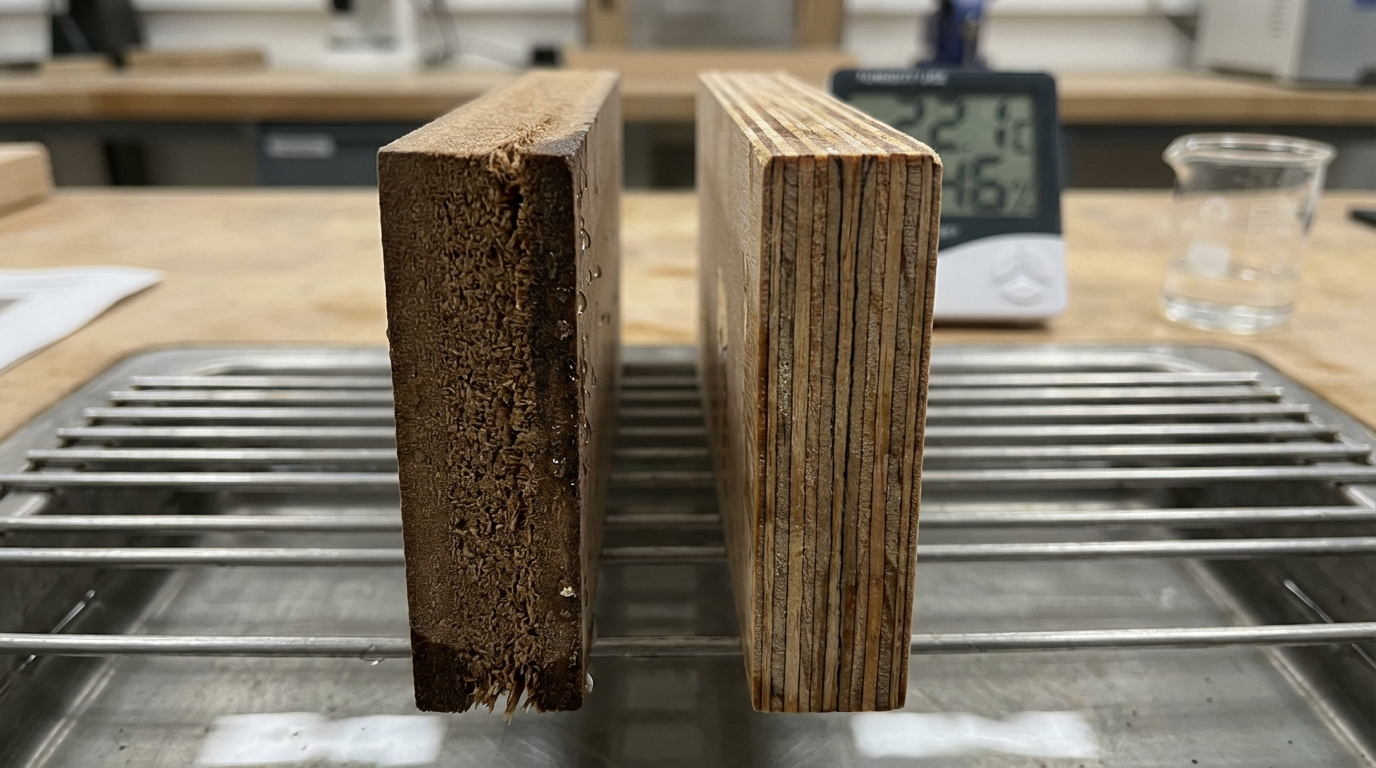
Opt for marine plywood over MDF when moisture exposure is high, like in coastal kitchens or monsoon-prone bathrooms; use MDF for cost savings in fully dry wardrobes and partitions.
If you’re in a hurry: Marine plywood justifies 2-3x higher upfront cost in wet zones due to superior water resistance and screw-holding strength, preventing costly replacements after 1-2 monsoons. MDF works well in air-conditioned dry interiors, offering smoother finishes for laminates at lower prices. Factor your site's humidity, ventilation, and budget—dry homes save 40-60% with MDF, but coastal or steamy kitchens demand marine ply to avoid swelling failures.
- Choose marine plywood if: heavy steam, coastal humidity above 80%, frequent water splashes, or load-bearing shelves.
- Choose MDF if: interior dry zones, budget under Rs 300/sq ft, smooth laminate finishes needed, or fast CNC routing.
- Avoid marine plywood if: tight timelines (sourcing delays), low-abuse dry walls, or no edge sealing skills.
- Avoid MDF if: exposed to direct water, poor site ventilation, or termite-prone ground floors.
What These Materials Actually Are
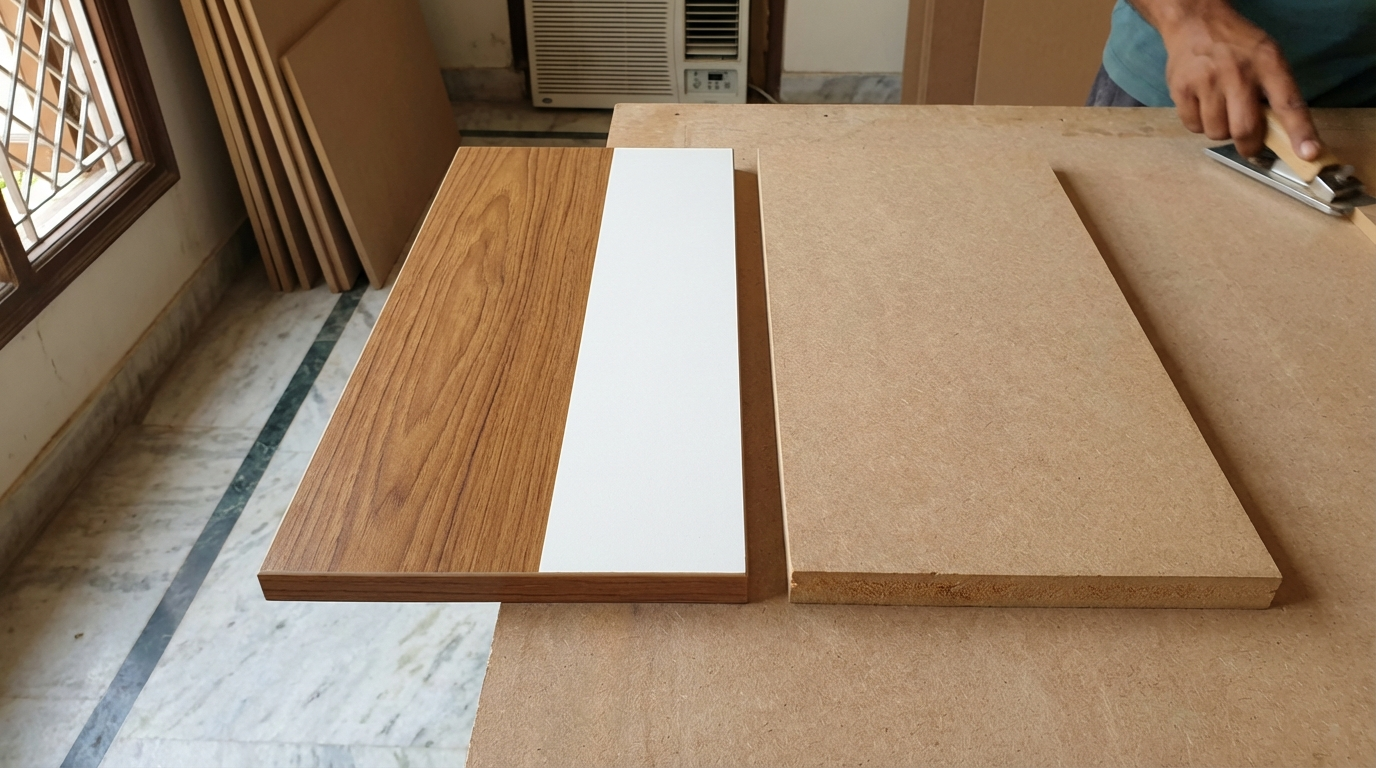
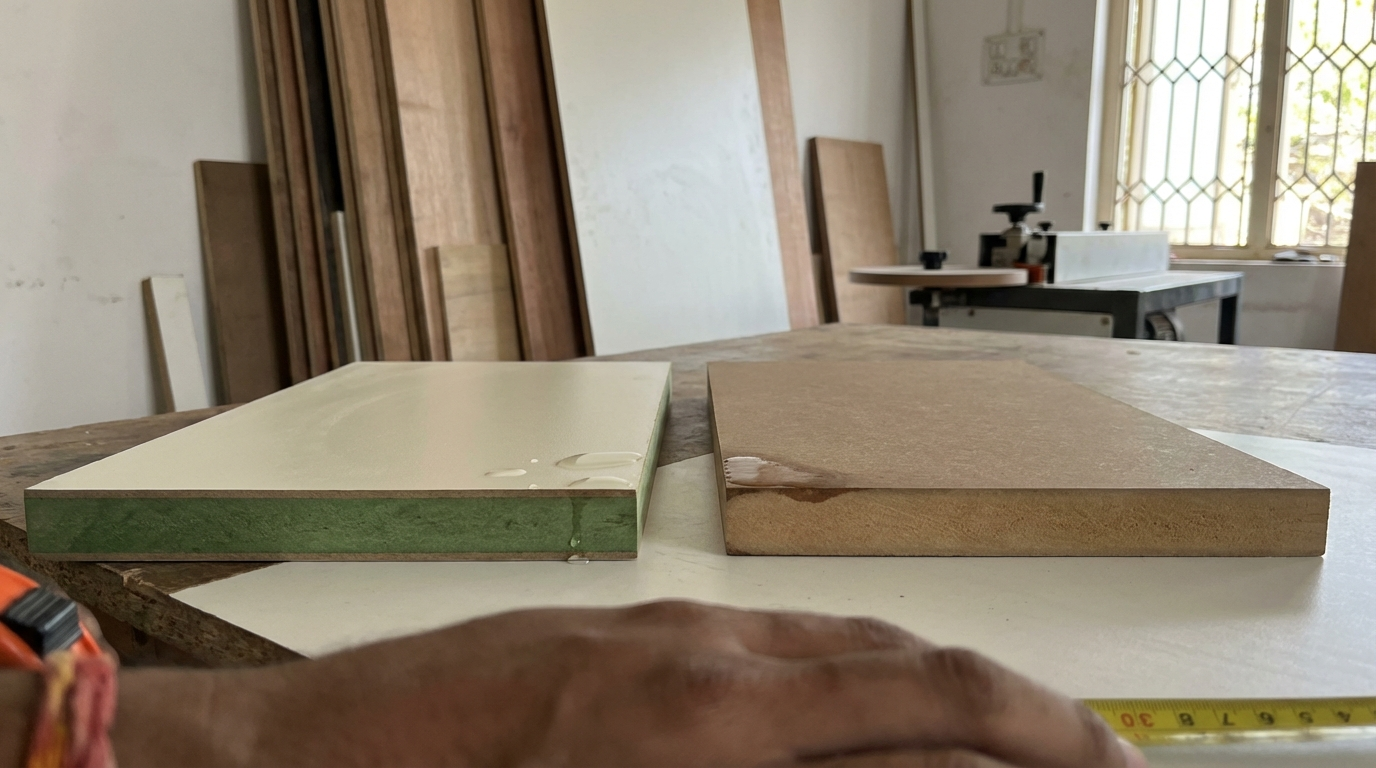
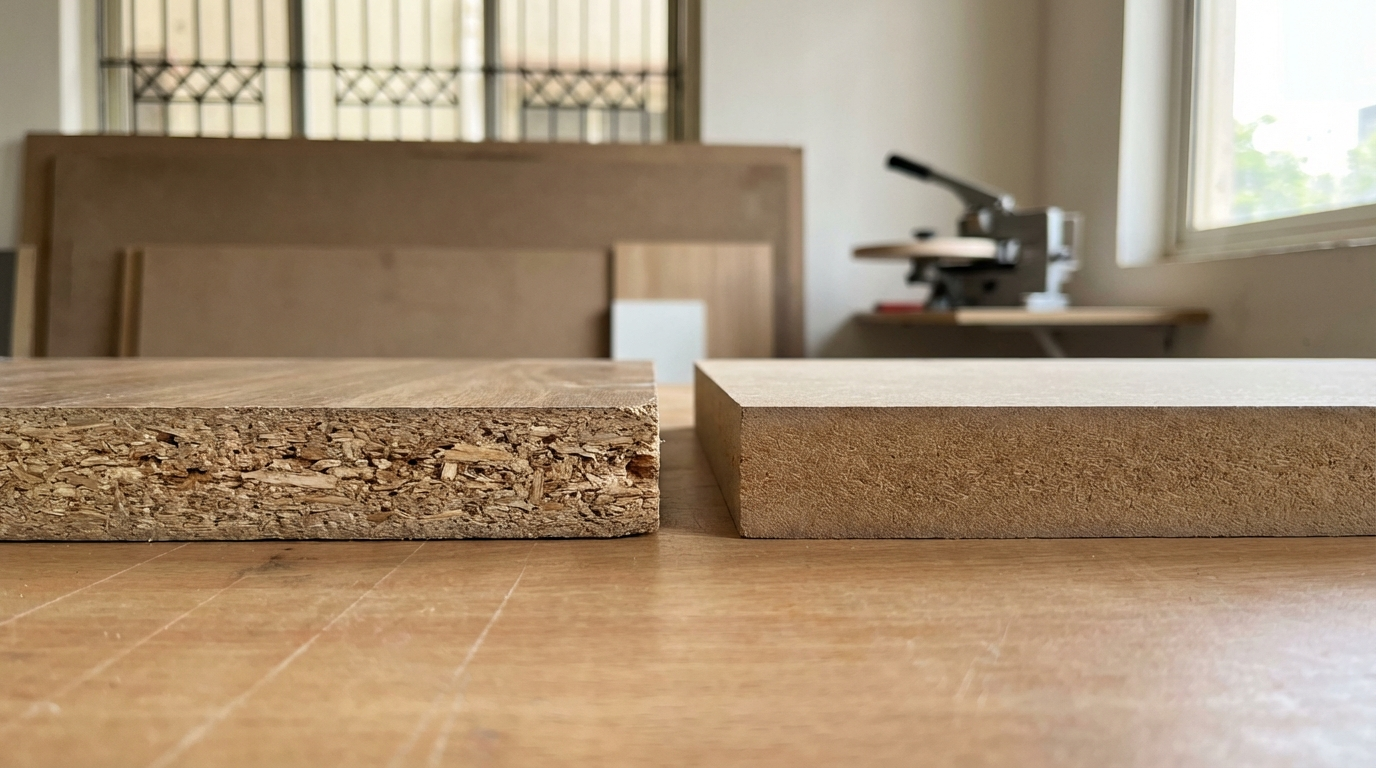
MDF, or Medium Density Fiberboard, is an engineered panel made by compressing wood fibers with resins under heat and pressure. It creates a uniform, smooth board ideal for painting or laminating, typically in densities of 700-850 kg/cum. Available in moisture-resistant (MR) variants, but standard types suit dry conditions only.
Marine plywood is a high-grade plywood constructed from multiple veneer layers glued with phenolic or BWP (Boiling Water Proof) resins, designed for submersion resistance. It uses hardwood cores like gurjan or sal, bonded to withstand boiling tests, making it suitable for structural wet applications. Thicknesses range from 12-25mm, with voids minimized for strength.
Both fit modular interiors, but MDF excels in flat-pack furniture, while marine ply handles framing or exposed edges better. In India, local mills produce both, but quality varies by resin content and pressing cycles.
Why It Matters in Indian Homes and Sites
India's monsoon season pushes indoor humidity over 85% for months, causing MDF edges to swell 10-20% if unsealed, leading to laminate peeling in wardrobes. Coastal areas like Mumbai or Chennai add salt-laden air, accelerating delamination without marine-grade glues.
Site realities amplify risks: open godowns during transport absorb moisture, poor ventilation traps steam from cooking, and carpenter shortcuts like exposed cuts fail fast. Marine plywood holds screws 2-3x better in humid cabinets, reducing hinge failures. Dry AC rooms favor MDF for its vibration-free stability during CNC work.
Lifetime value shifts: MDF lasts 5-8 years in dry zones but fails in 1-2 wet monsoons; marine ply endures 15+ years with proper sealing, cutting rework costs in high-risk projects.
Price Range and Cost Drivers
Basic 18mm MDF typically ranges Rs 60-120 per sq ft, while marine plywood falls Rs 180-350 per sq ft, varying 2-3x higher. Thinner 12mm cuts 20-30% off, 25mm adds 40-50%. City differences: metros like Delhi add 15-25% logistics, Tier-2 like Jaipur saves 10%.
Key drivers include thickness, density (higher for marine), resin type (urea for MDF, phenolic for marine), and face quality (smooth vs textured). Edge treatments like PVC banding add Rs 20-40/sq m, wastage from CNC curves 10-15%. Finish laminates boost MDF costs less than marine due to better adhesion.
For a 8x6 ft kitchen shutter: MDF setup ~Rs 25,000-40,000; marine ~Rs 60,000-90,000. Always quote with specs: "18mm MR MDF, 0.8mm laminate both sides, 2mm edge band."
Which is cheaper long-term: MDF or marine plywood?
Marine plywood often proves cheaper over 10 years in moisture zones, as MDF replacements after 2 monsoons double costs. Direct answer: calculate lifetime by dividing total project cost (material + labor + fixes) by expected years—MDF wins in dry AC bedrooms (Rs 50/year per sq ft), marine in kitchens (Rs 40/year despite upfront premium).
Nuance: factor site ventilation and sealing quality. Coastal homes tip marine ahead due to salt corrosion. Next step: track humidity with a Rs 500 meter; over 70% RH favors marine. Verify quotes including 10% wastage buffer.
Two-Minute Comparison Table
| Factor | MDF | Marine Plywood | Real-World Notes |
|---|---|---|---|
| Moisture Resistance | Low (MR up to 24hr soak) | High (BWP, boiling resistant) | MDF swells in monsoon kitchens; marine holds in bathrooms. |
| Strength & Screw Hold | Medium, weakens wet | High, stable layers | Marine takes 50kg/shelf; MDF limits 20kg humid. |
| Weight | Lighter (25kg/8x4 sheet) | Heavier (40-50kg) | MDF easier install; marine needs 2 workers. |
| Machinability | Excellent, no tear-out | Good, but veneer chips | CNC favors MDF for curves. |
| Surface Finish | Ultra-smooth | Graded faces | MDF laminates perfectly. |
| Cost per sq ft (18mm) | Rs 60-120 | Rs 180-350 | MDF saves 50-60% dry. |
Use this for quick scans: marine edges out in wet/strength, MDF in finish/speed for dry interiors.
Decision Framework: MDF or Marine Plywood?
| Site Condition | Recommended Choice | What to Verify Before Buying |
|---|---|---|
| High moisture kitchen (steam splashes) | Marine Plywood 18-19mm | BWP glue line, no core voids, edge sealable faces. |
| Coastal humidity >80% | Marine Plywood | Hardwood core, salt-resistant finish, thickness gauge. |
| Heavy use shelves (kids/pets) | Marine Plywood 18mm | Screw pull-out test sample, layer count >9. |
| Tight budget dry wardrobe | MDF MR 18mm | Density >750kg/cum, uniform edges, laminate adhesion. |
| Fast delivery, CNC heavy | MDF | Smooth faces, no resin lumps, cut sample. |
| High scratch risk TV unit | MDF with prelam | 0.7mm+ laminate, edge band match, humidity test. |
Is marine plywood worth it for wardrobes?
Not usually—stick to MR MDF for enclosed wardrobes, saving 50% without moisture risk if ventilated. Direct answer: only if wardrobe base touches damp floors or coastal storage.
Nuance: open wardrobes in humid bedrooms need marine for screw stability. Check: measure room RH; under 65% MDF suffices. Next: specify "MR MDF 18mm, full edge banding" to carpenters.
Failure Modes and Fixes
- Symptom: Edge swelling/peeling laminate. Root: MDF exposed to humidity without seal. Prevention: full PVC edge band + silicone gaps. Fix: sand, re-laminate or replace panel.
- Symptom: Screw loosening in hinges. Root: MDF softens wet; marine better but voids weaken. Prevention: pilot holes + anchors. Fix: re-drill larger, add epoxy filler.
- Symptom: Delamination layers separating. Root: inferior glue in humid sites. Prevention: BWP marine only for wet. Fix: clamp + adhesive injection if early.
- Symptom: Warping/bowing shelves. Root: uneven moisture or overload. Prevention: balance spans under 60cm. Fix: reinforce underside or discard.
- Symptom: Veneer chipping on cuts. Root: marine ply tear-out on CNC. Prevention: scoring blade + tape. Fix: filler + repaint edges.
- Symptom: Termite attack on base. Root: ground contact without treatment. Prevention: elevate 15cm + termite oil. Fix: full replace affected.
Does MDF warp in Indian monsoons?
Yes, standard MDF warps 5-10% if humidity spikes without MR grade or sealing. Direct answer: MR MDF holds better but limits to dry zones; marine ply resists warping fully.
Nuance: enclosed cabinets fare ok, but open shelves fail fast. Check: store sheets flat, wrapped plastic pre-monsoon. Next step: test sample soak 24hr—minimal swell ok for low risk.
Quality Checks You Can Do Without Lab Tests
Before Buying
- Tap sheet evenly—no hollow thuds signal voids.
- Inspect edges: straight, no gaps/delams.
- Ask: "Resin type? Core wood? Soak test pass?"
- Weigh sample: marine heavier per thickness.
- Red flag: wet storage yard, mismatched thickness.
After Cutting
- Edges smooth? No fiber pull-out (MDF good sign).
- Screw test: 3 holds firm in scrap.
- Bend lightly: no cracks (marine strength).
After Installation
- Check gaps: silicone seal all edges.
- Clean test: wipe wet cloth, no marks/swells.
- Load test shelves 1 week: stable.
Common Buyer Mistakes and How to Avoid
- Mistake 1: Using plain MDF in kitchens—avoid by zoning: dry walls MDF, wet cabinets marine.
- Mistake 2: Skipping edge sealing—always PVC/ABS band full perimeter pre-install.
- Mistake 3: Wrong thickness (12mm shelves)—spec 18mm min for spans over 50cm.
- Mistake 4: Poor storage (stacked outdoors)—wrap + elevate in godown 1 month pre-cut.
- Mistake 5: Overloading without bracing—MDF max 15kg/shelf; marine 40kg.
- Mistake 6: Ignoring ventilation—add exhaust fans in humid rooms.
- Mistake 7: Cheap laminates on marine—match 0.8mm thick for adhesion.
- Mistake 8: Coastal no-salt prep—rinse plywood pre-use, silicone all joints.
Can I paint MDF directly for bathrooms?
No, paint won't block moisture—MDF absorbs leading to bubbling. Direct answer: use marine ply base, then marine-grade paint + 2 epoxy coats.
Nuance: dry bathrooms ok with MR MDF + primer, but steam zones fail. Check: finger-nail edge scratch test post-paint. Next: ventilate 48hr cure time.
Tips for Homeowners
Durability do: wipe spills instantly, use soft cloths, elevate cabinets 10cm floor. Don't: abrasive cleaners, direct hose, overload drawers. Budget: allocate 20% extra for sealing. Monitor monsoons—tape edges if gaps show.
Tips for Carpenters
Cutting: zero-clearance blade for marine veneers, 6000RPM CNC MDF. Edge prep: clean router bits, full band overlap. Fastening: 4mm pilot holes, zones 50mm in. Hinges: marine holds Euro 35mm best. Handle: gloves to avoid oils.
Tips for Architects and Designers
Specs: "18mm BWP marine, 1.5mm ABS edge, 0.8mm HPL." Wet zones: marine + upstands. Finishes: MDF prelam for seamless. Detail: 5mm expansion gaps humid areas. Logic: dry elevations MDF, wet bases marine.
Tips for OEM and Modular Makers
Repeatability: CNC program offsets for marine chip-out. QC: 10% screw-pull batch test. Reduce returns: pre-seal edges factory. Complaints drop 70% with MR MDF dry kits, marine wet modules.
Is marine plywood termite-proof?
No, but better resistance with treated veneers. Direct answer: both need anti-termite oil dips; marine's density slows entry.
Nuance: ground floors elevate + powder both. Check: probe base for tunnels post-install. Next: annual spray contractor schedule.
Practical Use Cases Table
| Application | MDF Thickness/Finish | Marine Thickness/Finish | Risk Notes |
|---|---|---|---|
| Kitchen cabinets | Not recommended | 18mm + HPL + PVC edge | Steam swelling high. |
| Wardrobe shutters | 18mm prelam | 18mm if coastal | Dry ok MDF. |
| TV unit | 16-18mm painted | Not needed | Scratch low. |
| Bathroom vanity | MR 12mm limited | 19mm tiled | Water direct. |
| Office partitions | 12mm fabric | Not needed | AC dry. |
FAQs
Can MDF replace marine plywood everywhere to save costs?
No, only in controlled dry environments—MDF cuts expenses but risks failure in 70% Indian homes with seasonal humidity. MR MDF extends use to semi-wet with sealing, yet marine's layered glue outperforms for longevity. Evaluate by mapping wet zones first; hybrid works—marine frames, MDF infills. Always prioritize site RH over savings.
Which holds weight better for heavy shelves?
Marine plywood supports 2-3x loads due to cross-grain veneers, ideal for kitchen racks over 30kg. MDF buckles under sustained weight if humid, needing plywood bracing. Test spans: under 60cm both ok, longer marine only. Factor deflection—marine <1mm/50cm load.
How to store these boards before installation?
Stack horizontally on pallets, 15cm off ground, wrapped in polythene, away from walls/windows. Monsoon prep: AC godown or dehumidifier. Marine tolerates brief exposure better; MDF swells fastest. Check weekly for condensation—air gaps prevent.
Does thickness change the choice much?
Yes—12mm for lightweight partitions (MDF fine), 18-25mm structural (marine preferred). Thicker MDF adds weight/cost without moisture gain; marine scales strength linearly. Match to span/load: 18mm standard India kitchens.
What finish works best on each?
MDF takes laminates/paints flawlessly for seamless looks; marine needs HPL or veneer due to texture. Edge banding essential both—PVC for MDF, ABS marine. Test adhesion scraps first.
Is MR MDF enough for coastal areas?
Rarely—MR handles 24hr soak but salt/humidity degrade faster than BWP marine. Use marine for bases/edges, MR MDF uppers if ventilated. Monitor first monsoon.
How does CNC routing differ?
MDF cuts chip-free at high speeds; marine veneers splinter—use compression bits, tape edges. MDF dust finer, vacuum essential. Program shallower passes marine.
Can I mix both in one project?
Yes, smartly: marine wet cores, MDF dry faces. Transition seals prevent moisture wick. Saves 30% vs full marine. Spec clearly to carpenters.
What if budget forces MDF in kitchen?
Minimize risk: full enclosure, exhaust fan, heavy sealing, MR grade min. Expect 3-5 year life vs marine's 15. Not ideal, but workable low-use.
Disclaimer: This content is provided for general informational purposes based on industry practices and publicly available information. Product specifications, standards, prices, and availability may vary by manufacturer, region, and time. Readers should independently verify details with manufacturers, dealers, or qualified professionals before making purchase or construction decisions.Want Plywood Suggestions?
Share a few details and a VIR MDF specialist will suggest suitable brands and connect you to responsive dealers.