MDF vs OSB: Differences, Uses & Which One is Better for Interiors?
MDF and OSB serve different jobs. Compare surface finish, strength directionality, moisture behavior, and where each makes sense indoors.
Quick Decision Summary
MDF works best for visible furniture and cabinets needing smooth finishes; OSB fits budget structural backings or hidden supports in dry interiors.
If you’re in a hurry: Pick MDF for wardrobes, kitchen shutters, or TV units where painting or laminating matters—its uniform surface takes finishes evenly without telegraphing strands. OSB shines in non-visible roles like shelving backs or partition frames, offering directional strength at lower cost, but its rough texture demands heavy covering in humid Indian sites. Avoid OSB for exposed surfaces unless sealed thickly, as monsoon exposure risks surface roughening.
- Choose MDF if you need smooth, paintable surfaces for modular interiors or detailed CNC work.
- Choose OSB if budget limits apply and strength trumps finish in concealed applications.
- Avoid MDF in high-moisture zones without MR variants; skip OSB for finish-critical visible panels.
What MDF and OSB Actually Are
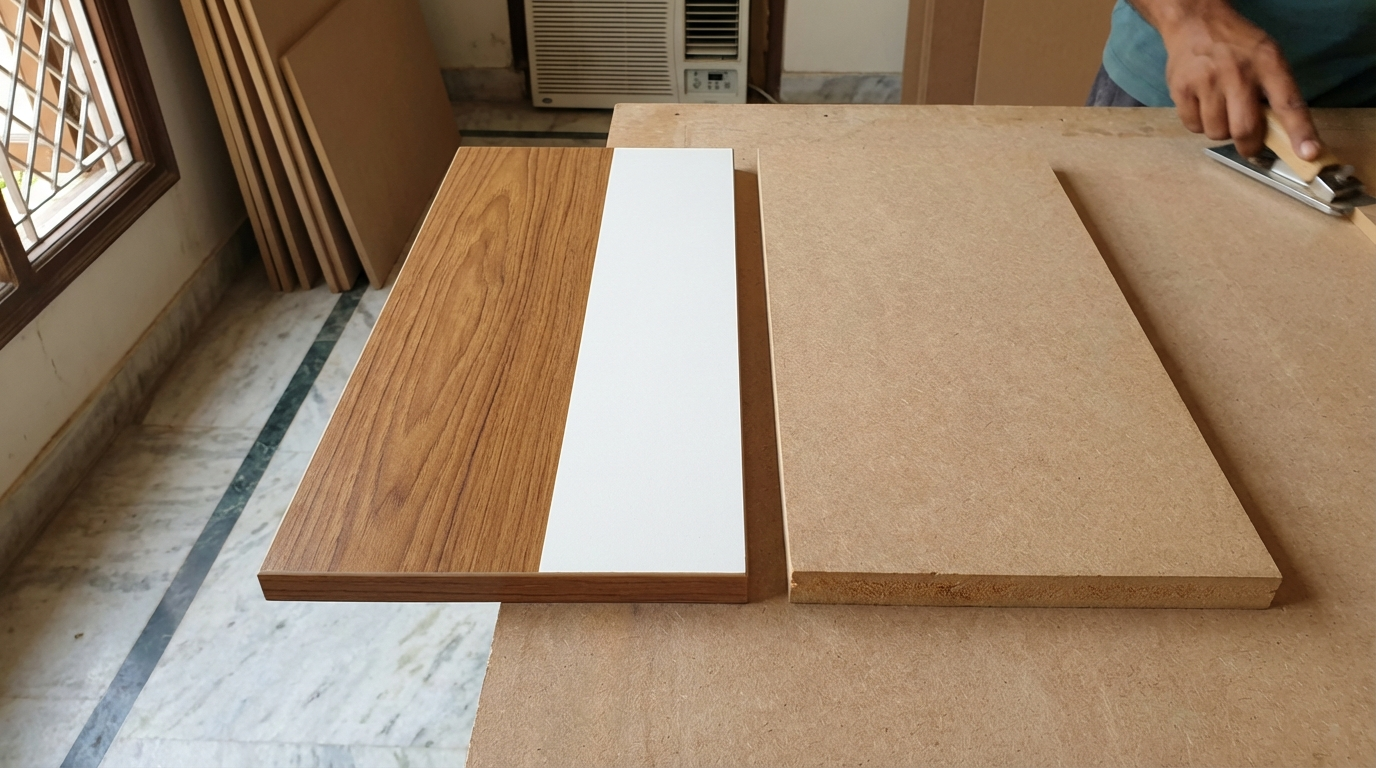
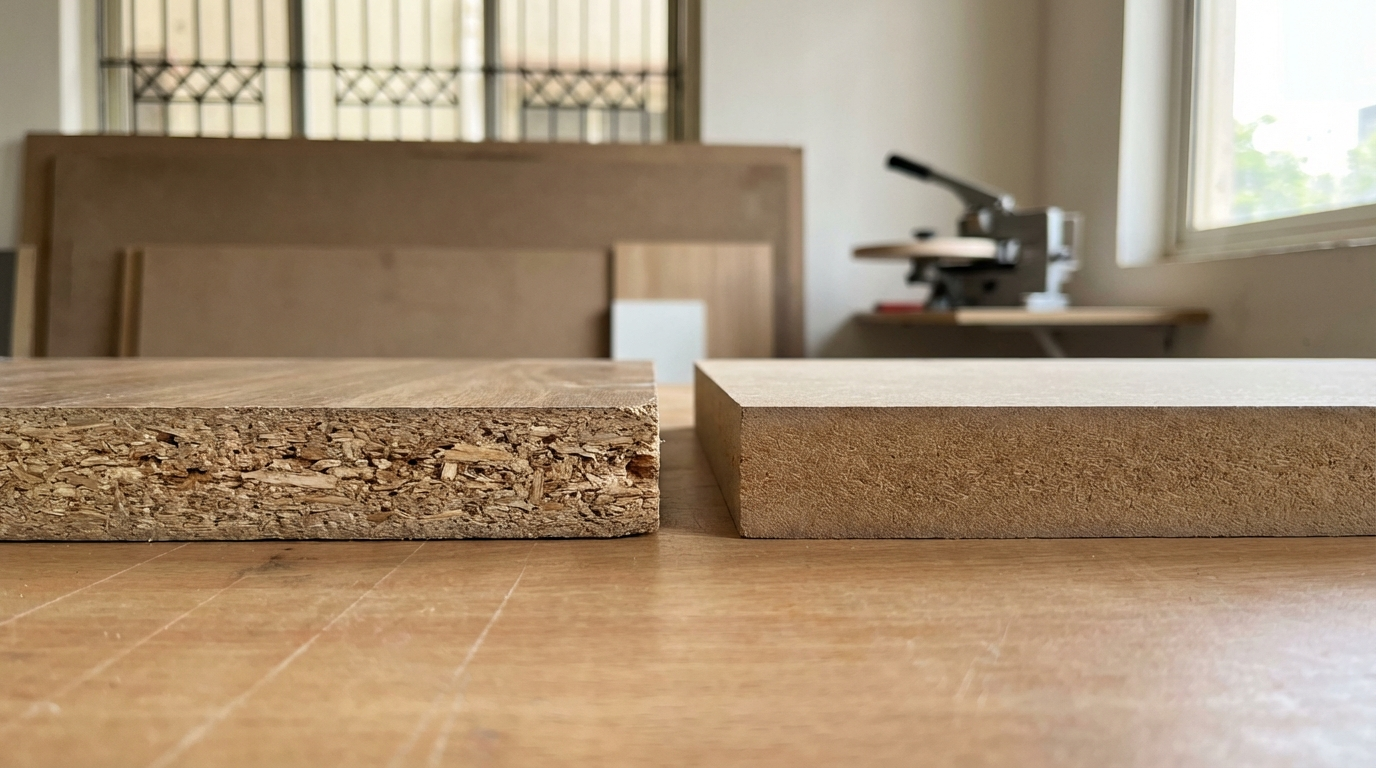
MDF, or Medium Density Fiberboard, forms by breaking wood into fine fibers, mixing with resins, and pressing under heat into dense, uniform sheets. This creates a smooth, isotropic material—meaning strength feels even in all directions—ideal for interiors requiring consistent machining.
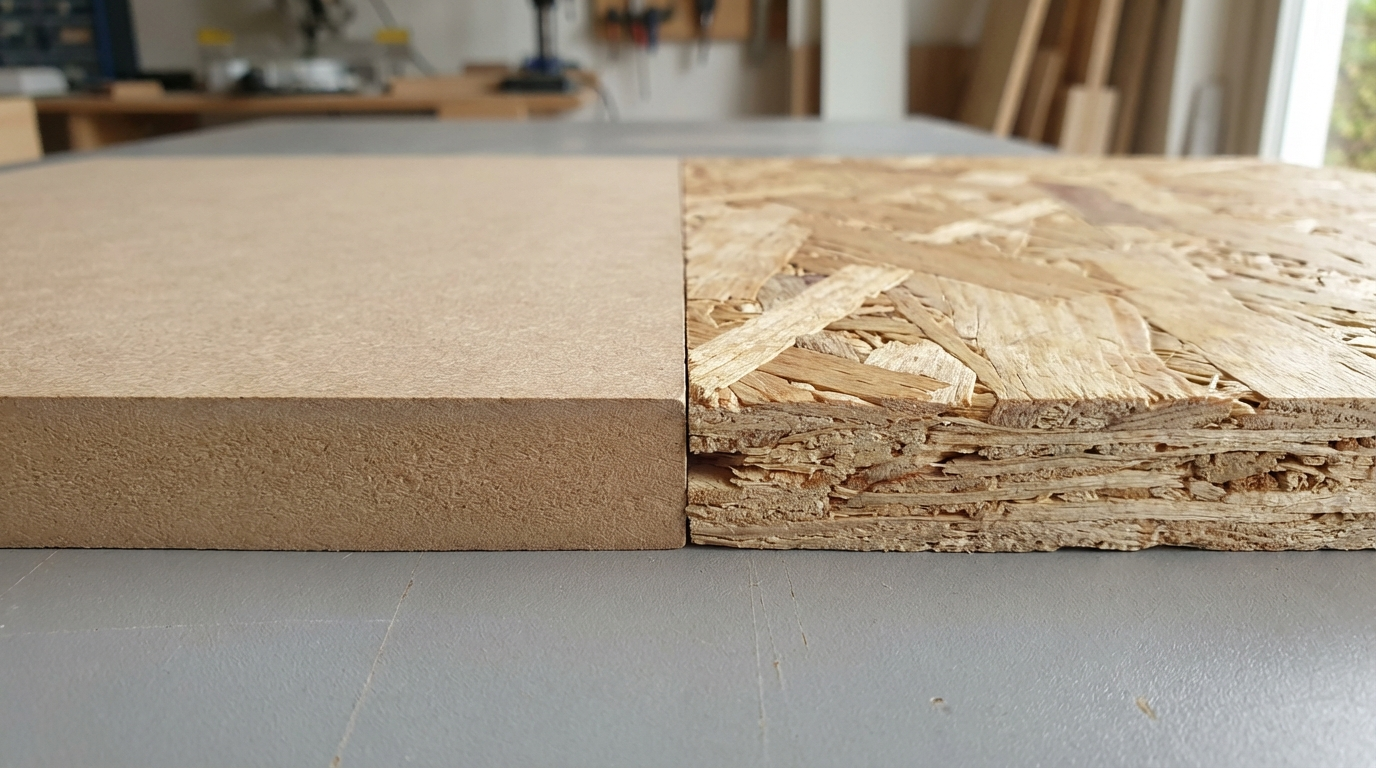
OSB, or Oriented Strand Board, uses larger wood strands layered with strands oriented in cross directions, bonded with waterproof resins. This gives high directional strength (stronger along strands) but a textured surface from visible flakes, suiting structural rather than decorative roles.
Both are engineered woods cheaper than solid timber, but MDF leans toward furniture-grade uniformity while OSB targets construction panels. In Indian workflows, MDF dominates cabinets; OSB appears in framing or as plywood alternatives.
Why MDF vs OSB Matters in Indian Homes and Sites
India's monsoon humidity (70-90% RH), coastal salt air, and dusty sites amplify board vulnerabilities. MDF swells at edges if unsealed during godown storage or transport rains, weakening screw holds in wardrobes. OSB holds up better to brief wettings but sheds strands when cut, complicating site cleanup.
Site realities like poor ventilation in Mumbai flats or Chennai apartments demand moisture-smart choices. Unprotected MDF in kitchens warps shutters; OSB in partitions resists but looks raw if not covered. Workmanship gaps—rushed edge sealing or overtight screws—expose trade-offs: MDF machines cleanly for carpenters, OSB needs blade tweaks to avoid tear-out.
Two-Minute Comparison Table
| Factor | MDF | OSB |
|---|---|---|
| Surface Finish | Smooth, uniform; direct laminate/paint | Rough, strand-visible; needs filler/seal |
| Strength Direction | Isotropic (even all ways) | Anisotropic (stronger lengthwise) |
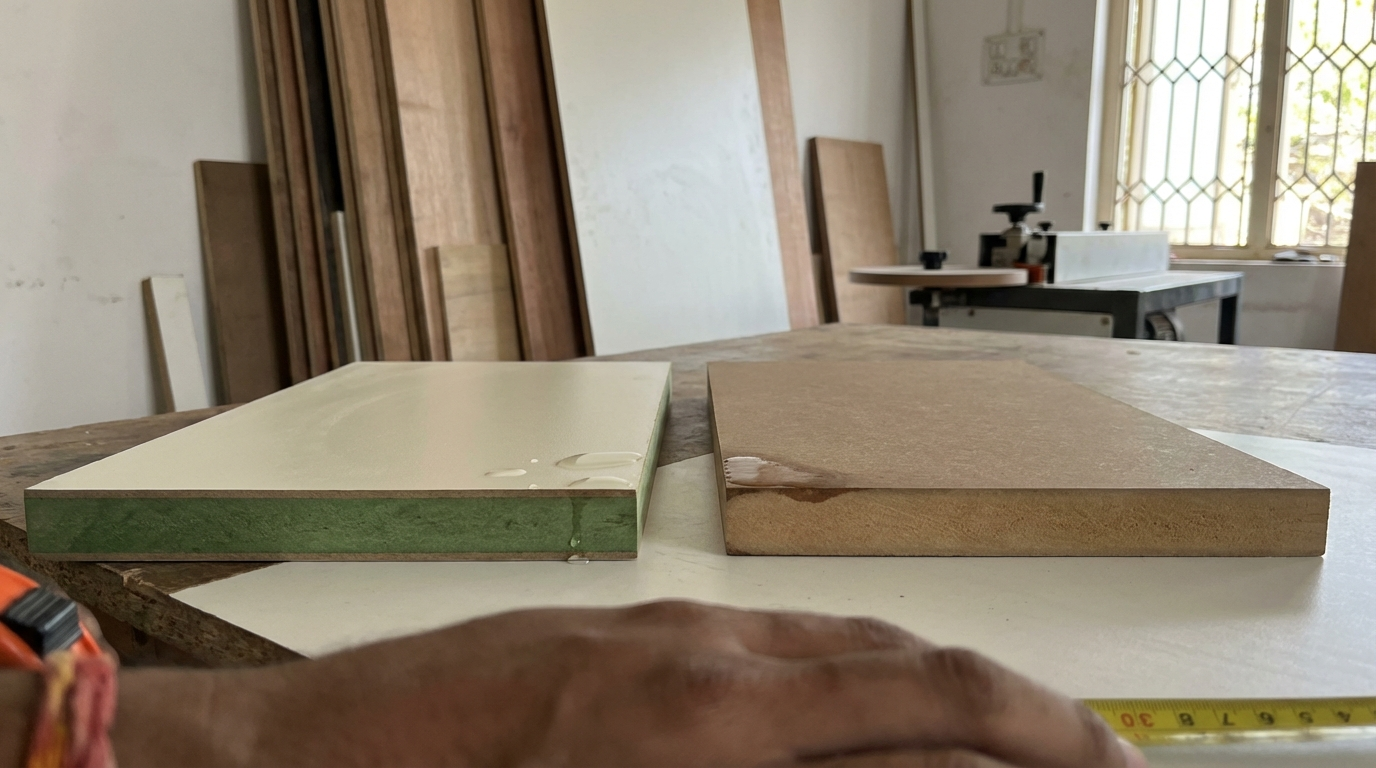
| Moisture Behavior | Swells easily unless MR grade | Better resistance; minor warp |
| Weight per Sheet | Heavier (denser) | Lighter |
| CNC Machining | Clean cuts, no tear-out | Strand pull; slower feeds |
| Typical Interior Use | Cabinets, doors, moldings | Back panels, subfloors |
Use this table for quick scans: MDF prioritizes aesthetics, OSB economy and load-bearing.
Is MDF or OSB better for strength in furniture?
OSB typically offers superior bending strength along its strands, making it better for load-bearing shelves or spans in wardrobes. MDF provides even screw-holding across surfaces but fatigues under heavy point loads.
Nuance: In Indian homes, OSB suits horizontal shelves >1m span if oriented correctly; MDF fits vertical dividers. Check by pressing sheet center—minimal flex favors OSB. Next: Test screw pull-out on samples; OSB edges chip less under repeated use.
Which handles Indian monsoon humidity better?
OSB resists moisture swelling more than standard MDF, thanks to oriented strands and resins. MR-MDF closes the gap but still needs sealing.
Conditions: Coastal Kerala sites favor OSB for partitions; Delhi dry zones either works. Verify: Wet corner overnight—OSB warps less. Seal edges with PU before install to extend life.
Price Range and Cost Drivers
Expect Rs 800-1500 per 8x4 sheet for 18mm MDF, Rs 600-1200 for OSB—varies by density (700-850 kg/m³ MDF vs 600-700 OSB), moisture grade, and city logistics (Mumbai premiums 20% over inland).
Drivers: Thickness (12-25mm), resin type (MR adds 15-25%), edge profiling, transport (stack flat to cut damage), wastage (OSB cuts cleaner). For a 10x6 wardrobe: MDF ~Rs 25k-35k material; OSB ~Rs 18k-28k if backs only.
Checklist for quotes: Specify thickness/density/MR status/sheet size; ask batch variation; factor 10-15% wastage + edge banding.
Practical Use Cases Table
| Application | Recommended Board | Thickness Range | Finish Notes | India Risk Notes |
|---|---|---|---|---|
| Kitchen Shutters | MDF (MR) | 18-19mm | Laminate topcoat | Seal edges vs spills |
| Wardrobe Carcass | MDF sides, OSB back | 18mm carcass, 9mm back | Paint/laminate visible | Monsoon storage warp |
| TV Unit Shelves | OSB (load-bearing) | 15-18mm | Heavy veneer | Dust hides texture |
| Wall Partitions | OSB framed | 12mm | Cladding over | Humidity flex |
| Office Desks | MDF top | 18mm | Direct polish | Scratch-prone |
Decision Framework Table
| Site Condition | Recommended Choice | What to Verify |
|---|---|---|
| Wet zone (kitchen) | MR-MDF or sealed OSB | Edge seal test; density stamp |
| Coastal humidity | OSB with coating | Warp after 24h damp |
| Heavy use (kids' room) | MDF laminated | Screw hold sample |
| Tight budget | OSB hidden parts | Strand alignment mark |
| Fast delivery | Stock MDF | Batch consistency |
| High scratch risk | Laminate MDF | Surface hardness tap |
Can OSB be used for visible furniture in India?
Yes, but only with thick fillers, veneers, or laminates to mask strands; bare OSB looks industrial.
Conditions: Fine for rustic office desks if sealed; fails in glossy home cabinets. Check: Sand sample—if smooth post-filler, viable. Next: CNC test for tear-out in humid shops.
Does MDF hold screws better than OSB?
MDF excels in uniform screw-holding across faces; OSB stronger at edges but directional.
Nuance: Wardrobe hinges favor MDF; shelf brackets OSB lengthwise. Verify: Insert/remove 10 screws—minimal crumble wins. Pilot holes prevent both splitting.
Failure Modes and Fixes
- Symptom: Edge swelling post-monsoon. Root: Unsealed exposure. Prevent: PU edge coat pre-install. Fix: Sand, reseal if minor; replace if delam.
- Symptom: Screw pull-out in cabinets. Root: Undersized pilots or overload. Prevent: 4mm holes, even spacing. Fix: Plug, redrill nearby.
- Symptom: OSB strand tear during cuts. Root: Dull blade/wrong feed. Prevent: Carbide blade, slow speed. Fix: Fill, sand smooth.
- Symptom: MDF sagging shelves. Root: Thin span overload. Prevent: 18mm min, center support. Fix: Add brackets underneath.
- Symptom: Surface scratches on laminate. Root: Abrasive cleaning. Prevent: Microfiber only. Fix: Buff minor; overlay patch.
- Symptom: Delamination in humid storage. Root: Poor resin. Prevent: Acclimatize 48h site. Fix: Discard affected sheets.
Why does OSB warp less than MDF?
OSB's cross-oriented strands and exterior resins distribute moisture stress evenly, minimizing swell.
India angle: Survives godown leaks better. Test: Submerge edge—measure expansion (<5% OSB). Seal anyway for longevity.
Quality Checks You Can Do Without Lab Tests
Before buying: Tap sheet—even tone means uniform density. Weigh corner—consistent heft. Ask resin type/MR proof; eye for strand voids in OSB.
After cutting: Edges should not fuzz (MDF clean, OSB minimal chip). Screw test: 5 holds firm. Wet edge 1h—no puff.
Post-install: Check alignment gaps <1mm; tap for hollows. Clean test: Damp cloth—no marks.
Red flags: Warped stacks, color streaks, off odors.
8 Common Buyer Mistakes and How to Avoid
- Mistake: Ignoring humidity grade. Avoid: Specify MR for <60% RH zones.
- Mistake: Bare OSB visible. Avoid: Plan coverings pre-order.
- Mistake: Wrong thickness for span. Avoid: Calc load (10kg/m shelf=18mm).
- Mistake: Skipping acclimatization. Avoid: 2 days site before cut.
- Mistake: Dull blades on OSB. Avoid: Dedicated coarse tooth set.
- Mistake: Overtight hinges on MDF. Avoid: Torque limit, washers.
- Mistake: Budget-only choice. Avoid: Factor lifetime + rework.
- Mistake: No edge sealing. Avoid: Factory profile or site PU.
Tips by User Persona
Homeowners: Durability do: Seal edges, use coasters. Don’t: Drag cleaners, overload shelves. Clean weekly microcloth.
Carpenters: Cut OSB lengthwise first; pilot all MDF screws. Handle sheets vertical to avoid sag. Edge-band same day.
Architects/Designers: Spec density >750kg/m³; detail wet-zone flashings. Match finishes to board grain direction.
OEM/Modular Makers: QC screw grids; batch-test moisture. Standardize OSB backs for repeatability, cut returns 20%.
Is OSB cheaper long-term for interiors?
Often yes for hidden parts—lower upfront + less warp rework. MDF costs more but fewer finish complaints.
Trade-off: High-humidity sites tip to OSB. Track: Quote full project incl labor; revisit after 1 year.
Can I paint OSB directly for budget cabinets?
Possible with primer + 2-3 filler coats, but texture shows through thin paint.
Best for matte finishes. Test: Spray sample—smooth? Proceed. India tip: Humidity dries slow, sand between coats.
FAQs
Which is easier to cut and shape for custom interiors?
MDF cuts like butter on standard CNC or table saws, producing dust-free edges perfect for modular wardrobes or curved fascias. OSB requires adjusted feeds to prevent strand pluck, suiting straight structural cuts. In Indian shops with variable tools, MDF reduces rework; OSB demands sharp carbide blades. Always wear masks—OSB flakes more.
Does OSB work well under laminates in humid climates?
OSB accepts laminates after sanding and primer, holding better in monsoons than MDF due to moisture tolerance. However, strands may telegraph if pressed thin. Coastal users seal first; verify adhesion pull test on scrap. Suits budget kitchens if not steam-exposed.
What's the weight difference impact on installation?
OSB sheets run 20-30% lighter, easing solo handling for site partitions or up-ladders. MDF's density aids stability but strains two-man lifts. Factor stairs in apartments—MDF stacks tighter. Both need flat transport to prevent bows.
Can MDF replace plywood entirely in furniture?
MDF substitutes well for non-structural furniture faces, offering smoother finishes at similar cost. Lacks plywood's shear strength for frames. Hybrid: MDF skins on plywood cores. Check span tables; acclimatize to avoid monsoon twists.
How to store sheets before interior projects?
Stack horizontally under cover, elevate off ground, fan-circulate air 48h post-delivery. Wrap edges plastic in humid godowns. OSB tolerates brief rain; MDF sheets vertical if space-tight. Inspect for mold weekly.
Which holds up better to kids or pets scratching?
Laminated MDF resists surface scratches best; bare OSB flakes easily. Add kick-plates on lowers. Clean habits extend both—avoid abrasives. Test: Key scrape sample.
Is OSB termite-resistant for Indian wardrobes?
OSB's resins deter termites better than plain MDF, but treat both with borates for tunnels. Elevate off floors; ventilate. No board is immune—inspect annually.
When to hybrid MDF and OSB in one project?
Use OSB for strong backs/shelves, MDF for visible fronts—cuts cost 15-20% without finish loss. Align grains at joints. Ideal for large TV units; test joints for flex.
Does thickness matter more in MDF or OSB?
Critical for both: 18mm min shelves. OSB spans farther per mm due to strands; MDF needs thicker for sag. Calc: 600mm span=18mm both. Varies by load.
Disclaimer: This content is provided for general informational purposes based on industry practices and publicly available information. Product specifications, standards, prices, and availability may vary by manufacturer, region, and time. Readers should independently verify details with manufacturers, dealers, or qualified professionals before making purchase or construction decisions.Want Plywood Suggestions?
Share a few details and a VIR MDF specialist will suggest suitable brands and connect you to responsive dealers.