MDF vs Plywood: Which is Better for Furniture in 2026?
MDF vs Plywood comparison: strength, durability, price & best uses. Find out which board is better for wardrobes, kitchens & interiors. Expert guide.
Quick Decision Summary
Quick Answer: MDF vs Plywood comparison comes down to your specific application—choose MDF for smooth painted finishes, intricate designs, and budget-friendly interior furniture; choose plywood for structural strength, moisture-prone areas, and screw-holding applications in Indian homes.
If you're in a hurry: For painted wardrobes and TV units in air-conditioned rooms, MDF typically offers better value. For kitchen cabinets (especially sink units), bathroom furniture, and any application requiring strong screw grip, plywood remains the safer choice. In coastal Indian cities or during monsoon season, always lean towards marine-grade or BWR plywood for wet-zone applications.
Choose MDF if:
- You're planning to paint the furniture with a smooth, flawless finish
- Your project requires intricate CNC routing or detailed carved designs
- The furniture will be used in dry, climate-controlled interiors
- Budget is a primary concern and you need maximum coverage per rupee
Choose Plywood if:
- The furniture will be exposed to moisture, humidity, or water splashes
- You need strong screw-holding capacity for hinges and hardware
- Structural strength and load-bearing capacity are critical
- You're building for coastal areas or high-humidity regions in India
What MDF and Plywood Actually Mean
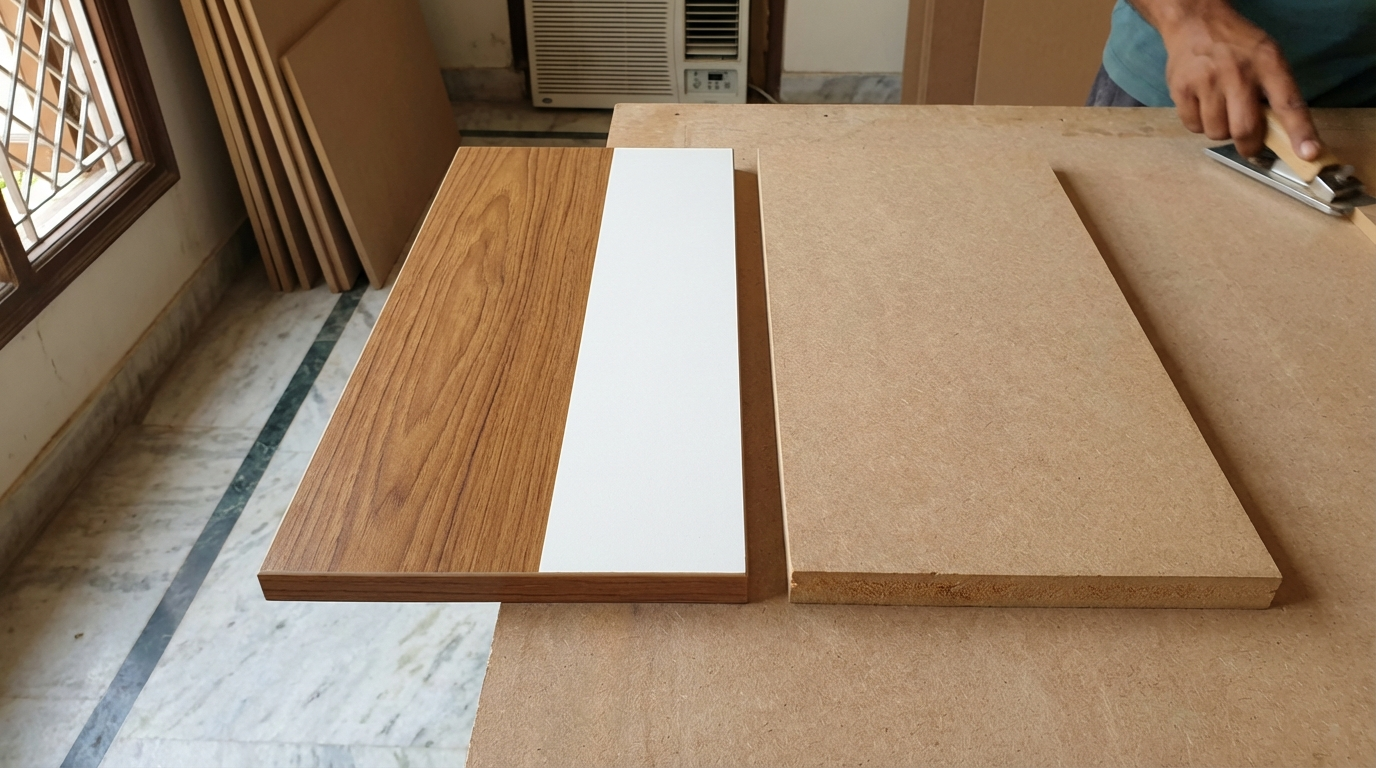
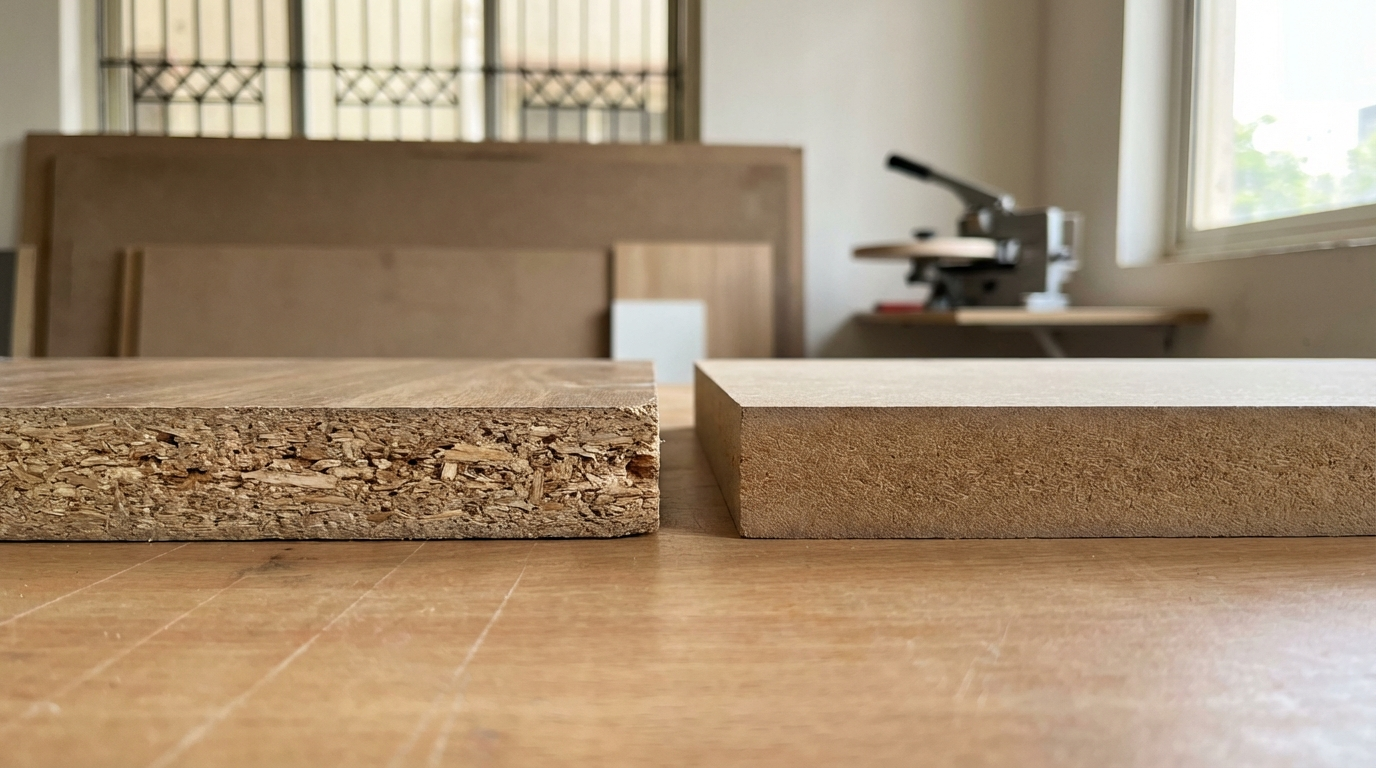
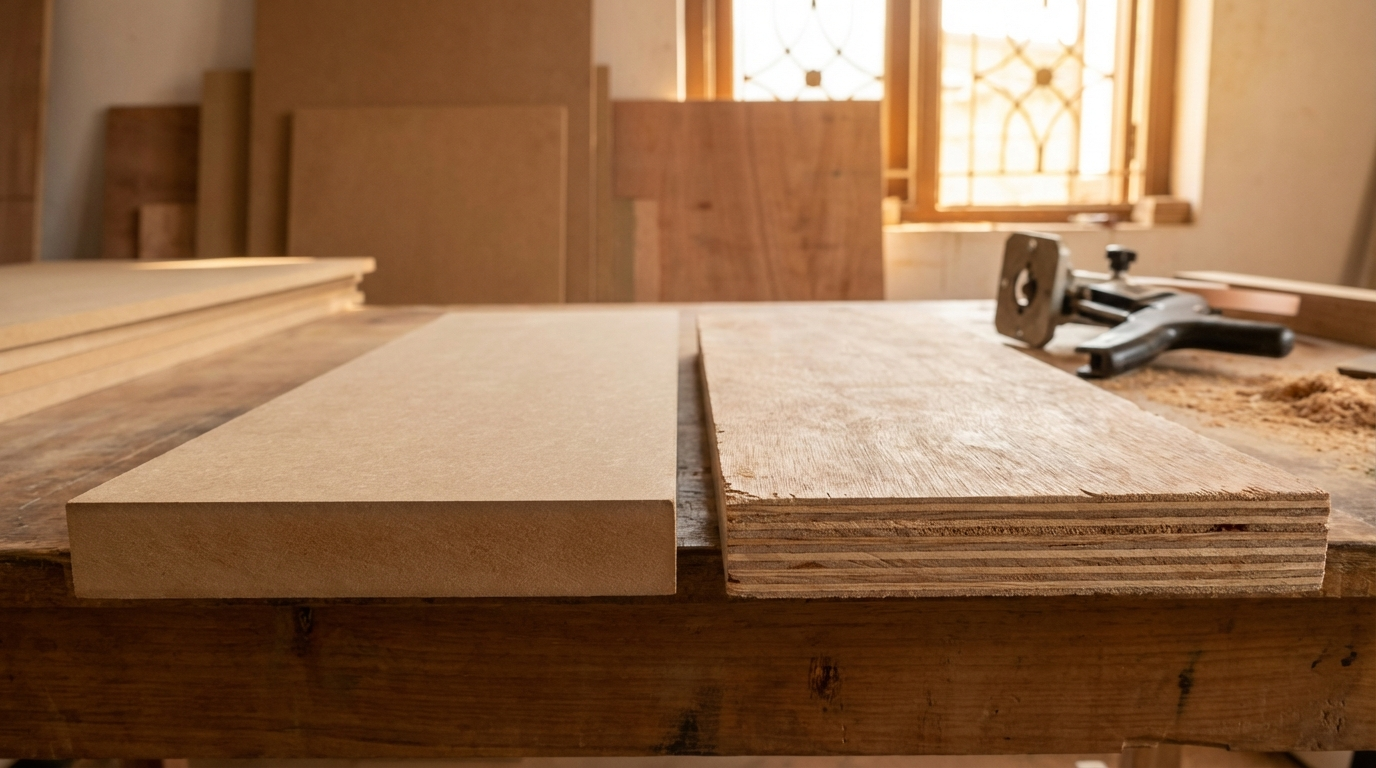
MDF (Medium Density Fiberboard) is an engineered wood panel made by breaking down hardwood and softwood residuals into fine wood fibers, combining them with wax and resin binders, and pressing them into dense, uniform sheets under high heat and pressure. The result is a homogeneous board with no grain direction, consistent density throughout, and edges that can be machined without splintering.
Plywood is manufactured by layering thin veneers of wood (called plies) with their grain directions alternating at 90 degrees to each other. These layers are bonded using adhesives under heat and pressure. This cross-grain construction gives plywood its characteristic strength, dimensional stability, and resistance to splitting.
Where they fit in the material hierarchy:
- Solid wood → Most expensive, natural beauty, prone to warping
- Plywood → Engineered for strength, good moisture variants available
- MDF → Engineered for smooth finishes, best for painted applications
- Particle board → Budget option, weakest in the category
Common confusions clarified: Many people assume MDF is simply "compressed sawdust" and therefore inferior. In reality, MDF undergoes sophisticated manufacturing that creates a denser, more uniform product than many realize. Similarly, not all plywood is created equal—commercial-grade plywood differs vastly from BWR (Boiling Water Resistant) or marine-grade variants in performance.
Why This Matters for Indian Homes
The MDF vs Plywood debate takes on unique dimensions in the Indian context due to climate challenges that don't exist in temperate countries where much of the available online advice originates.
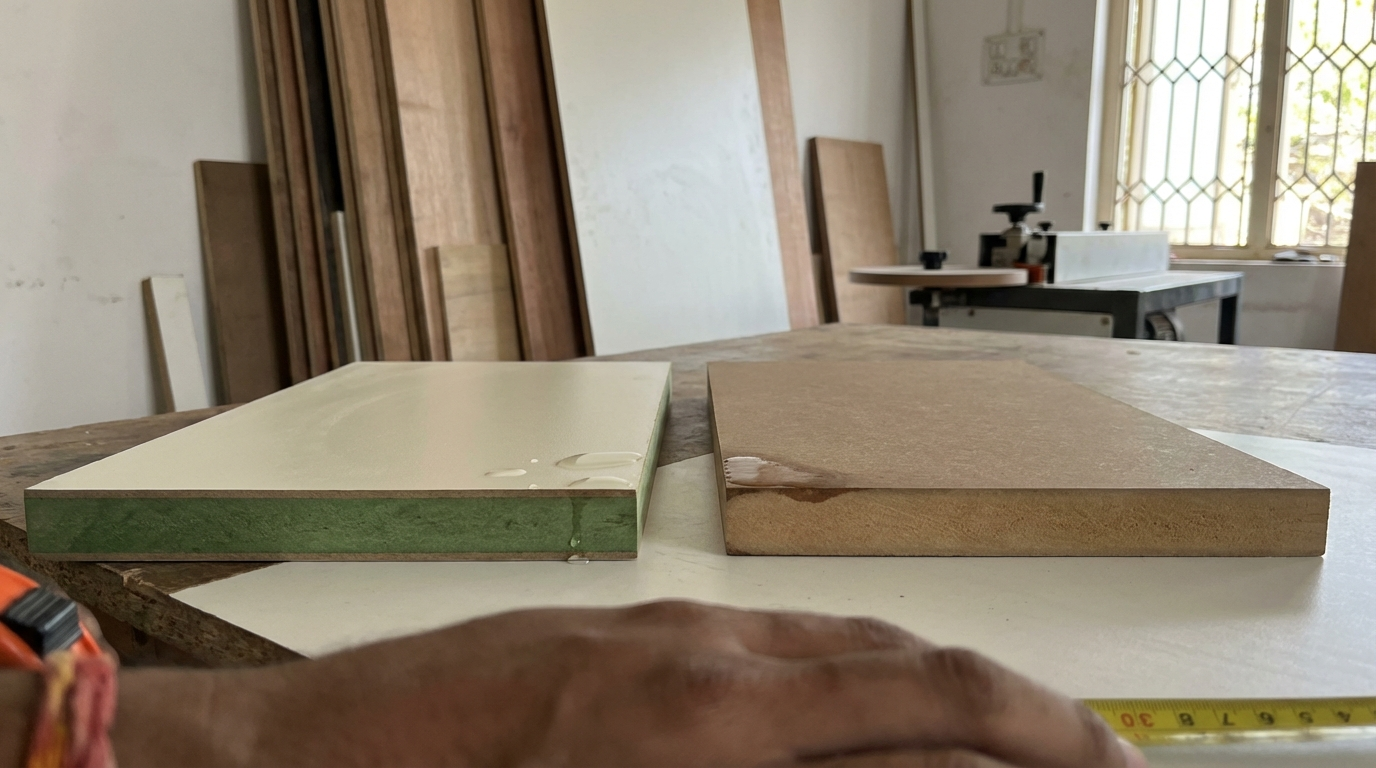
Monsoon and humidity impact: During June through September, relative humidity in many Indian cities regularly exceeds 80-90%. Standard MDF, without proper edge sealing, can absorb moisture through exposed edges, leading to swelling and eventual delamination. This is particularly problematic in cities like Mumbai, Chennai, Kolkata, and coastal Karnataka and Kerala.
Real consequences of wrong material choice:
- Swelling: MDF absorbs moisture and expands, causing wardrobe doors to jam and not close properly
- Delamination: Surface laminate peels away from the core in humid conditions
- Screw failure: Repeated moisture cycling weakens MDF's screw-holding capacity over time
- Sagging: Horizontal MDF shelves under load can develop permanent bowing in humid environments
Site handling realities: In Indian construction, materials often sit exposed on-site for days or weeks before installation. MDF boards stored improperly—touching wet floors, exposed to rain splashes through open windows, or stacked in partially constructed rooms—can absorb moisture before installation even begins. Plywood, while not immune, typically handles such site abuse better.
Regional considerations:
- Coastal cities (Mumbai, Chennai, Kochi): Higher salt content in air accelerates degradation; moisture-resistant variants essential
- Northern plains (Delhi, Jaipur): Extreme temperature variations between seasons; dimensional stability matters
- Hill stations: Cold and damp conditions require careful material selection
- Central India: Hot and relatively dry; standard MDF performs acceptably in AC environments
Head-to-Head Comparison: MDF vs Plywood
This detailed comparison covers the parameters that matter most when choosing between MDF and plywood for furniture applications in 2026.
| Parameter | MDF | Plywood | Winner (Condition-Based) |
|---|---|---|---|
| Surface Smoothness | Extremely smooth, no grain visible | Wood grain visible on surface | MDF (for painted finishes) |
| Screw-Holding Capacity | Moderate; pilot holes recommended | Excellent; holds screws firmly | Plywood (for hardware-heavy applications) |
| Moisture Resistance | Poor (standard); Moderate (MR-MDF) | Good (BWR); Excellent (Marine) | Plywood (for wet zones) |
| Weight | Heavier per square foot | Lighter and easier to handle | Plywood (for large installations) |
| Edge Quality | Clean cuts, no splintering | Layers visible, needs edge banding | MDF (for visible edges) |
| Machining & Routing | Excellent for intricate designs | Limited; prone to splintering | MDF (for CNC work) |
| Structural Strength | Lower; can sag under load | Higher; good load-bearing | Plywood (for shelving) |
| Price (per sq ft) | Generally 15-25% lower | Higher, especially for BWR grades | MDF (for budget projects) |
| Paint Finish Quality | Superior; smooth, even coat | Grain may show through | MDF (for lacquered/painted work) |
| Flexibility | Rigid; will crack if bent | Can bend slightly without breaking | Plywood (for curved applications) |
When to choose MDF over Plywood?
MDF becomes the preferred choice when surface finish quality is paramount. For wardrobes with painted or lacquered finishes, TV unit shutters with high-gloss laminates, and any furniture requiring CNC-routed patterns or designs, MDF delivers superior results. The absence of grain means paint adheres evenly, and the homogeneous core allows intricate cutting without the risk of layers separating.
When to choose Plywood over MDF?
Plywood excels in applications demanding structural integrity and moisture resistance. Kitchen base cabinets, bathroom vanities, sink units, and any furniture in utility areas benefit from plywood's superior performance. The cross-grain construction prevents warping even under humidity stress, and the material holds screws firmly even after repeated opening and closing of doors and drawers.
Price Ranges and Cost Factors in India (2026)
Understanding the cost structure helps you make budget-appropriate decisions. Prices vary significantly based on thickness, grade, brand, and regional availability.
MDF Price Ranges (per 8x4 ft sheet)
| Thickness | Standard MDF | MR-MDF (Moisture Resistant) | Pre-laminated MDF |
|---|---|---|---|
| 6mm | ₹800 - ₹1,200 | ₹1,000 - ₹1,500 | ₹1,400 - ₹2,000 |
| 12mm | ₹1,400 - ₹2,000 | ₹1,800 - ₹2,500 | ₹2,200 - ₹3,200 |
| 18mm | ₹2,200 - ₹3,000 | ₹2,800 - ₹3,800 | ₹3,400 - ₹4,800 |
| 25mm | ₹3,200 - ₹4,200 | ₹4,000 - ₹5,200 | ₹4,800 - ₹6,500 |
Plywood Price Ranges (per 8x4 ft sheet)
| Thickness | Commercial Grade | BWR (Boiling Water Resistant) | Marine Grade |
|---|---|---|---|
| 6mm | ₹900 - ₹1,400 | ₹1,300 - ₹1,900 | ₹1,800 - ₹2,600 |
| 12mm | ₹1,800 - ₹2,600 | ₹2,600 - ₹3,600 | ₹3,500 - ₹4,800 |
| 18mm | ₹2,800 - ₹3,800 | ₹4,000 - ₹5,500 | ₹5,500 - ₹7,500 |
| 25mm | ₹4,200 - ₹5,500 | ₹6,000 - ₹8,000 | ₹8,000 - ₹11,000 |
Cost driver breakdown:
- Brand premium: Established manufacturers typically charge 15-30% more than regional brands
- ISI certification: Certified products cost more but offer quality assurance
- Moisture resistance: MR or BWR grades add 25-40% to base price
- Pre-laminated options: Add ₹600-1,200 per sheet over raw board cost
- Thickness: Price increases roughly proportional to thickness
Budget estimation example (standard 3-door wardrobe):
- Using 18mm MDF with laminate: ₹18,000 - ₹28,000 (material cost)
- Using 18mm BWR Plywood with laminate: ₹26,000 - ₹40,000 (material cost)
- Difference: 30-45% higher for plywood, but justified in high-humidity areas
Decision Framework: Which Option for Which Condition
Use this framework to make quick, confident decisions based on your specific situation.
| Condition/Application | Recommended Choice | What to Verify Before Purchase |
|---|---|---|
| Kitchen sink cabinet (wet zone) | BWR or Marine Plywood | Check for ISI mark; verify "BWR" stamp on each sheet |
| Coastal area installation | Marine Plywood | Request boiling water test certificate from dealer |
| Bedroom wardrobe (AC room) | MDF with proper edge sealing | Ensure all edges receive laminate or edge banding |
| Heavy-use shelving (books, files) | Plywood | Choose 18mm minimum; verify no core gaps |
| CNC-routed decorative panels | MDF | Check for uniform density; no soft spots |
| Bathroom vanity | BWR Plywood or HDFWR | Ensure proper sealing of all cut edges |
| Tight budget, dry interior | Standard MDF | Plan for complete edge sealing during installation |
| High-gloss painted finish | MDF | Use primer designed for MDF; sand between coats |
| Modular kitchen carcass | Plywood for base; MDF acceptable for wall units | Different materials for different risk zones is acceptable |
| Kids' furniture (rough use) | Plywood | Better impact resistance and screw retention |
Common Buyer Mistakes (And How to Avoid Them)
Years of industry observation reveal recurring mistakes that lead to furniture failures and buyer disappointment. Here's what to watch for:
Mistake 1: Using standard MDF in kitchens
Consequence: Swelling near sink, steam damage near cooktop, and delamination within 2-3 years.
Prevention: Use MR-MDF at minimum; prefer plywood for base cabinets. Always seal cut edges.
Mistake 2: Ignoring edge sealing on MDF
Consequence: Moisture enters through raw edges, causing localized swelling even in otherwise dry rooms.
Prevention: Insist on complete edge banding or laminate wrapping for all MDF components.
Mistake 3: Assuming all plywood is waterproof
Consequence: Commercial-grade plywood delaminates in wet zones, wasting the premium paid.
Prevention: Specifically request BWR or Marine grade; verify ISI marks and grade stamps.
Mistake 4: Over-tightening screws in MDF
Consequence: Screws strip out the soft core, especially near edges, leading to loose hinges.
Prevention: Use pilot holes; consider cam locks or confirmat screws designed for engineered boards.
Mistake 5: Choosing based on price alone
Consequence: Cheap boards fail prematurely; replacement costs exceed initial savings.
Prevention: Match material grade to application risk; spend more on high-risk zones.
Mistake 6: Storing boards flat on wet floors during construction
Consequence: Moisture absorption from concrete floor damages boards before installation.
Prevention: Store on raised platforms; keep plastic sheeting beneath and above stacks.
Mistake 7: Not accounting for Indian humidity variations
Consequence: Furniture designed for dry climates fails during monsoon months.
Prevention: Design with 3-5mm expansion gaps; use moisture-resistant grades in humid cities.
Mistake 8: Trusting verbal claims about board quality
Consequence: Receiving inferior quality than promised; no recourse after installation.
Prevention: Check ISI marks physically; buy from authorized dealers; retain purchase receipts.
Failure Modes and How to Prevent Them
Understanding how these materials fail helps you design installations that avoid common pitfalls.
MDF Failure Mode 1: Edge Swelling
Symptom: Edges become puffy, soft, and visibly expanded; laminate may lift at edges.
Root cause: Moisture entry through unsealed or poorly sealed edges.
Prevention: Complete edge banding with PVC or ABS tape; use waterproof adhesive for lamination.
Fix if already happening: Cut back affected area; seal with waterproof primer; re-laminate with proper adhesive.
MDF Failure Mode 2: Surface Delamination
Symptom: Laminate or veneer peels away from MDF core, often starting at corners.
Root cause: Poor adhesive application or moisture penetration weakening the bond.
Prevention: Use high-quality adhesives; ensure proper pressing during lamination; maintain edge seals.
Fix if already happening: Remove loose laminate; clean surface; re-apply with contact cement under pressure.
MDF Failure Mode 3: Screw Pullout
Symptom: Hinges become loose; doors sag; screws no longer grip.
Root cause: Repeated stress on screws in MDF's relatively soft core; moisture weakening the material.
Prevention: Use pilot holes; apply wood glue in screw holes; consider metal inserts for heavy doors.
Fix if already happening: Fill stripped holes with wooden dowels and glue; re-drill; use longer screws.
Plywood Failure Mode 1: Delamination of Plies
Symptom: Layers separate, especially at edges; veneer peels away from core.
Root cause: Water exposure on non-waterproof grades; poor manufacturing quality.
Prevention: Use BWR/Marine grade for wet areas; verify quality before purchase; seal all edges.
Fix if already happening: Apply waterproof wood glue between separated layers; clamp firmly; seal exposed edges.
Plywood Failure Mode 2: Core Voids
Symptom: Hollow spots when tapping; screws find no grip in certain areas; visible gaps at cut edges.
Root cause: Poor manufacturing with gaps between veneer layers.
Prevention: Inspect cut edges before purchase; tap test multiple areas; buy from reputed brands.
Fix if already happening: Avoid placing hardware in void areas; fill visible voids with wood filler.
Plywood Failure Mode 3: Warping
Symptom: Board bows or twists; doors don't align properly; gaps appear.
Root cause: Uneven moisture absorption; poor storage; unbalanced veneer construction.
Prevention: Store flat with even support; apply finish equally on both faces; use proper thickness for span.
Fix if already happening: Minor warps may flatten under weight over time; severe cases require replacement.
Quality Checks Without Lab Tests
You don't need sophisticated equipment to assess board quality. Here are practical checks anyone can perform.
Before Buying: Visual and Physical Checks
For MDF:
- Look at the cut edge—density should appear uniform throughout thickness
- Press your thumbnail into the edge—excessive softness indicates low density
- Check for consistent thickness using a measuring tape at multiple points
- Sight along the surface for flatness—no undulations should be visible
- Smell the board—extremely strong chemical odor may indicate high formaldehyde
For Plywood:
- Examine edge to count plies—more plies generally means better quality for given thickness
- Look for voids or gaps between plies at the edge
- Tap multiple areas—hollow sound indicates internal gaps
- Check face veneer for patches, repairs, or visible defects
- Verify ISI mark and grade stamp are present and legible
Questions to Ask the Dealer
- What grade is this board? (Get specific: MR, BWR, Marine, etc.)
- Which manufacturer? Can I see the brand marking on the sheet?
- What's the density rating for this MDF?
- Do you have the test certificate for this batch?
- What's your return policy if the board has hidden defects?
Red Flags to Watch For
- Unusually low prices compared to market rates (suggests inferior quality)
- Missing or illegible brand/grade markings
- Reluctance to show cut edges or demonstrate quality
- Pre-cut sheets that prevent edge inspection
- Storage conditions exposing boards to rain or ground moisture
After Cutting: Quality Verification
- Edge quality: Clean cuts without excessive crumbling (MDF) or splintering (plywood)
- Core consistency: No unexpected voids, color variations, or density changes
- Smell test: Cut surfaces releasing excessive chemical odor warrant concern
After Installation: Maintenance Checks
- Check edges monthly during first monsoon season for any swelling signs
- Verify hinge screws remain tight after 3 months of use
- Inspect underneath sinks and near water sources for moisture damage
- Clean laminate surfaces with mild cleaners—harsh chemicals damage both materials
Practical Applications: MDF vs Plywood by Room
Different rooms present different challenges. Here's a room-by-room guide for optimal material selection.
Kitchen Applications
| Component | Recommended Material | Why This Choice |
|---|---|---|
| Base cabinet carcass | BWR Plywood | Proximity to floor moisture, water splashes |
| Wall cabinet carcass | MR-MDF or Plywood | Lower moisture risk; either works |
| Shutter/doors | MDF (for paint) or Plywood (for laminate) | Depends on desired finish |
| Sink cabinet | Marine Plywood | Direct water exposure risk |
| Tall unit near refrigerator | MR-MDF or Plywood | Heat and condensation from appliance |
Bedroom Applications
| Component | Recommended Material | Why This Choice |
|---|---|---|
| Wardrobe carcass | MDF or Plywood | Both work in dry, AC environments |
| Wardrobe shutters (painted) | MDF | Superior paint finish |
| Bed frame | Plywood | Better screw grip for assembly/disassembly |
| Study table | MDF or Plywood | Either works; MDF if painting |
| Dressing unit | MDF | Smooth finish for mirror frame and drawers |
Living Room Applications
| Component | Recommended Material | Why This Choice |
|---|---|---|
| TV unit | MDF | Smooth surfaces for contemporary designs |
| Wall panels | MDF | Easy to route patterns; takes paint well |
| Display shelves | Plywood | Better load-bearing for books and decor |
| Bar cabinet | Plywood | Potential liquid spills |
| Partition with storage | MDF + Plywood combination | MDF for visible surfaces; plywood for structure |
Bathroom Applications
| Component | Recommended Material | Why This Choice |
|---|---|---|
| Vanity cabinet | BWR or Marine Plywood | Constant humidity and water splashes |
| Mirror frame | HDFWR or Marine Plywood | Steam exposure from showers |
| Storage shelves | Marine Plywood | High humidity environment |
| Toilet storage unit | BWR Plywood | Moisture and cleaning chemical exposure |
Tips by User Type
For Homeowners
Durability expectations: Well-made MDF furniture in appropriate applications should last 8-12 years. Plywood furniture, properly maintained, can last 15-20 years. Don't expect kitchen cabinet performance to match bedroom furniture—different environments mean different lifespans.
Cleaning guidelines:
- Use damp (not wet) cloths for daily cleaning
- Avoid harsh chemical cleaners on laminated surfaces
- Wipe water splashes immediately—don't let water pool on surfaces
- Use coasters under hot cups and wet glasses
When to worry:
- Edges feeling soft or puffy—indicates moisture damage beginning
- Hinges becoming loose despite tightening—screw holes may be failing
- Laminate lifting at corners—adhesive failure, possibly moisture-related
- Visible warping of doors or panels—environmental stress or poor quality
For Carpenters
Cutting tips:
- MDF creates fine dust—use proper respiratory protection and dust extraction
- Use high-tooth-count blades for cleaner MDF cuts
- Score plywood surface with utility knife before cutting to prevent splintering
- Support long panels fully to prevent breakage during cutting
Edge preparation:
- MDF edges should be sealed before lamination—use appropriate primer
- Plywood edges need proper banding to hide ply layers
- Apply edge tape with sufficient heat for proper adhesion
- Trim excess edge tape flush without damaging the surface
Hardware zones:
- Pre-drill all screw holes in MDF to prevent splitting
- Use wood glue in MDF screw holes for better grip
- For heavy doors on MDF, consider metal inserts
- Plywood holds screws better but still benefits from pilot holes near edges
For Architects and Designers
Specification language:
- Specify exact grade: "BWR Plywood ISI marked" not just "plywood"
- Include density requirements for MDF: "MDF minimum density 720 kg/m³"
- Note edge treatment requirements in specifications
- Specify moisture-resistant variants for areas within 1 meter of water sources
Wet-zone detailing:
- Raise base cabinets 100-150mm on aluminum legs near floor drains
- Specify waterproof membrane under sink cabinets
- Detail edge sealing requirements for all cut edges
- Consider HDFWR or marine plywood for bathroom furniture specifications
Finish selection guidance:
- High-gloss finishes show imperfections—MDF provides better substrate
- Wood veneer finishes work better on plywood due to similar expansion rates
- Matte laminates hide minor surface variations—either substrate works
For Modular and OEM Manufacturers
Quality control checkpoints:
- Incoming inspection: Check thickness tolerance (±0.3mm acceptable)
- Moisture content testing: Should be 8-12% for optimal performance
- Surface inspection: Mark and segregate sheets with defects
- Edge quality verification: Random cut tests per batch
Reducing customer complaints:
- Match material grade to end-use environment documented in order
- Ensure 100% edge sealing—the most common complaint source
- Use appropriate hardware—not generic screws—for engineered boards
- Provide installation guidelines specifying moisture protection
Batch consistency:
- Source from consistent manufacturers—switching brands changes machining behavior
- Store incoming material properly—ground moisture ruins entire batches
- Season large orders before cutting—allow acclimation to workshop conditions
Types and Variations Explained
MDF Variations Available in India
Standard MDF: Basic interior-grade board for dry applications. Suitable for furniture in air-conditioned spaces. Available in thicknesses from 2.5mm to 30mm.
MR-MDF (Moisture Resistant): Enhanced with moisture-resistant resins. Green-colored core in most brands. Suitable for kitchens (wall units), utility areas, and humid climates. Costs approximately 25-35% more than standard MDF.
HDF (High Density Fiberboard): Denser version with better hardness and durability. Often used for flooring and high-wear surfaces. Superior screw-holding compared to standard MDF.
HDFWR (HDF Water Resistant): Combines high density with moisture resistance. Premium option for bathroom applications. Increasingly popular in modular furniture.
FR-MDF (Fire Retardant): Treated with fire-retardant chemicals. Required for commercial applications, hospitals, and schools. Commands significant premium.
Pre-laminated MDF: Factory-applied melamine or laminate finish. Saves installation time. Limited design options compared to post-laminated. Edges still require treatment.
Plywood Grades in India
Commercial Plywood (MR Grade): Moisture-resistant for general interior use. Suitable for furniture in normal humidity conditions. Most economical plywood option.
BWR Plywood (Boiling Water Resistant): Can withstand prolonged moisture exposure. Recommended for kitchens, especially base units. ISI marked products pass specific tests.
Marine Plywood: Highest water resistance rating. Uses waterproof adhesives throughout. Suitable for bathrooms and external applications. Significantly higher cost.
Calibrated Plywood: Precision-sanded for uniform thickness. Essential for lamination and veneer applications. Commands premium for dimensional accuracy.
Flexible Plywood: Thin plies allowing bending. Used for curved furniture elements. Requires supporting framework.
Common Misunderstandings
- "MDF is just sawdust" — False. MDF uses refined wood fibers under controlled manufacturing, resulting in a denser, more uniform product than this description suggests.
- "All plywood is waterproof" — False. Only BWR and Marine grades offer meaningful water resistance. Commercial plywood will delaminate with water exposure.
- "Plywood is always better than MDF" — Context-dependent. For painted finishes and CNC work, MDF often performs better.
- "MDF is unsafe due to formaldehyde" — Partially true historically. Modern E1 and E0 emission standards significantly reduce formaldehyde concerns. Sealed MDF releases minimal emissions.
- "Thicker is always stronger" — Misleading. A well-made 18mm board outperforms a poor-quality 25mm board. Quality matters more than thickness alone.
- "Brand doesn't matter for plywood" — False. Manufacturing quality varies enormously. Established brands generally provide more consistent products.
Frequently Asked Questions
Is MDF or plywood better for kitchen cabinets in Indian climate?
For kitchen cabinets in India, the answer depends on the specific cabinet location. Base cabinets near the sink and floor should use BWR or marine-grade plywood due to water splash exposure and floor mopping moisture. Wall cabinets can safely use MR-MDF or plywood since they face less direct moisture contact. The high humidity during monsoon months (June-September) makes moisture-resistant grades essential in cities like Mumbai, Chennai, Kolkata, and coastal regions. Standard MDF in kitchen base units typically fails within 2-3 years due to edge swelling from floor moisture.
Which is more durable for wardrobes—MDF or plywood?
In air-conditioned bedrooms with controlled humidity, both MDF and plywood wardrobes can last 10-15 years with proper maintenance. Plywood offers better screw retention for hinges over repeated use, making it preferable for frequently used wardrobes. MDF provides superior painted finishes but may require hinge reinforcement on heavy doors. For non-AC rooms in humid climates, plywood offers better long-term durability. The key to MDF wardrobe longevity is complete edge sealing—every cut edge must receive laminate or edge banding to prevent moisture entry.
What is the price difference between MDF and plywood in 2026?
In the Indian market as of January 2026, MDF typically costs 15-25% less than equivalent-thickness plywood. For example, 18mm standard MDF ranges from ₹2,200-3,000 per 8x4 sheet, while commercial-grade plywood of the same thickness costs ₹2,800-3,800. However, when comparing moisture-resistant grades, the gap narrows—MR-MDF at ₹2,800-3,800 versus BWR plywood at ₹4,000-5,500. Pre-laminated boards add ₹600-1,200 per sheet regardless of core material. Regional price variations exist, with metro cities typically commanding higher prices than tier-2 towns.
Can MDF be used in bathrooms?
Standard MDF should never be used in bathrooms due to the high humidity environment. However, HDFWR (High Density Fiberboard Water Resistant) can be used for bathroom vanities and mirror frames with proper precautions. All edges must be completely sealed, the cabinet should be raised off the floor using aluminum legs, and direct water contact must be avoided. Even with these precautions, BWR or marine plywood remains the safer choice for bathroom furniture in India, where humidity levels during monsoon can exceed 90% and bathroom ventilation is often inadequate.
Why does MDF swell at the edges?
MDF swelling occurs because the compressed wood fibers at cut edges readily absorb moisture from the air or direct water contact. Unlike the smooth manufactured surfaces, cut edges expose the porous internal structure. Once moisture enters, the fibers expand—sometimes increasing edge thickness by 10-15%—and this expansion is usually irreversible. Prevention requires sealing all cut edges with laminate, edge banding, or appropriate primers before or immediately after cutting. This is particularly critical in Indian conditions where seasonal humidity variations are extreme.
Which board holds screws better for furniture hardware?
Plywood significantly outperforms MDF in screw-holding capacity due to its layered veneer construction. The cross-grain structure provides multiple layers of wood for screws to grip. MDF's homogeneous fiber structure offers less mechanical grip, and repeated insertion-removal cycles (common with adjustable shelves or relocated hinges) weaken MDF screw holes faster. For heavy doors or frequently adjusted hardware, use pilot holes in MDF, apply wood glue, or install metal inserts. For critical applications like kitchen cabinet hinges that cycle thousands of times, plywood is the safer choice.
Is plywood eco-friendly compared to MDF?
Both materials have environmental considerations. MDF typically uses wood residuals and waste fibers that might otherwise be discarded, giving it recycling credentials. However, both MDF and plywood use formaldehyde-based adhesives in manufacturing, though modern production often meets E1 or E0 emission standards that significantly reduce off-gassing. Plywood requires harvesting of logs for veneer production. From a durability perspective, longer-lasting furniture (often plywood in demanding applications) may be more sustainable than furniture requiring earlier replacement. Look for FSC-certified products if sustainability is a priority.
How do I identify genuine BWR plywood from fake products?
Genuine BWR plywood should carry an ISI mark (IS:303) clearly stamped on each sheet along with the manufacturer's name and grade designation. Check that the stamp appears on the board itself, not just on packaging that could be reused. Ask dealers for test certificates corresponding to specific batches. Visually, BWR plywood should have consistent ply thickness, minimal core voids visible at edges, and face veneer without excessive repairs. A boiling water test (placing a small sample in boiling water for 72 hours) should show no delamination on genuine BWR grade—though this destroys the sample. Buy from authorized dealers of established brands for greatest assurance.
Can I use MDF for outdoor furniture?
Standard MDF should never be used outdoors as it will absorb moisture and fail rapidly—typically within months of outdoor exposure. Even MR-MDF is designed only for high-humidity interior conditions, not direct weather exposure. For outdoor furniture in India, use marine-grade plywood (properly sealed), treated solid wood, WPC (Wood Plastic Composite), or other outdoor-rated materials. If you must achieve an MDF-like painted finish for a protected outdoor area (covered balcony), use exterior-grade MDF or Tricoya (acetylated MDF) which is specifically engineered for outdoor use but commands a significant price premium.
What thickness of MDF or plywood is best for wardrobes?
For wardrobe construction in India, 18mm thickness is the standard choice for carcass (main structure), doors, and shelving. This provides adequate strength for typical wardrobe dimensions and loads. For particularly tall wardrobes (above 8 feet) or those with heavy sliding doors, consider 25mm for the carcass. Back panels can use thinner 6mm or 8mm material. Internal drawer components often use 12mm. Avoid using less than 18mm for wardrobe carcass to prevent sagging and ensure proper screw grip for hardware. Always verify that shelves spanning more than 600mm are either 18mm minimum or have additional support to prevent bowing under load.
How long does MDF furniture last compared to plywood?
Under appropriate conditions, MDF furniture typically lasts 8-12 years while plywood furniture can last 15-20 years or more. However, environment dramatically affects this. MDF in humid conditions without AC may show problems within 3-5 years. Plywood in wet zones without proper grade selection fails similarly fast. Quality of construction matters as much as material choice—well-built MDF furniture with proper edge sealing outperforms poorly constructed plywood furniture. Heavy-use items like kitchen cabinets and children's furniture see faster wear regardless of material. For maximum longevity, match material grade to application and ensure proper installation.
Which is better for CNC routing and detailed designs?
MDF is substantially better for CNC routing and detailed carved designs. Its homogeneous structure without grain direction allows clean cuts in any direction without splintering. The consistent density means uniform cutting resistance for predictable results. Plywood's layered construction causes problems: veneer layers can chip, grain direction affects cut quality, and core voids create unexpected behavior. For decorative wall panels, intricate furniture designs, and signage, MDF is the industry standard. If strength is needed along with detailed designs, consider routing MDF panels and mounting them on plywood structural frames.
Note: This is independent informational content and is not affiliated with any manufacturer or brand mentioned.
Disclaimer: This content is provided for general informational purposes based on industry practices and publicly available information. Product specifications, standards, prices, and availability may vary by manufacturer, region, and time. Readers should independently verify details with manufacturers, dealers, or qualified professionals before making purchase or construction decisions.Want Plywood Suggestions?
Share a few details and a VIR MDF specialist will suggest suitable brands and connect you to responsive dealers.