MDF vs Plywood vs Particle Board: Which Material Is Best for Furniture?
A simple, honest comparison of MDF, plywood, and particle board—strength, moisture, finish quality, and where each material is the best buy.
Quick Decision Summary
No single material wins overall—MDF suits smooth finishes in dry zones, plywood handles moisture and loads best, particle board fits tight budgets with low demands.
If you’re in a hurry: Pick plywood for kitchens or coastal areas prone to monsoon humidity, as it resists warping better. MDF works for wardrobes and TV units needing paint or laminate in controlled indoor spaces. Skip particle board unless budget rules and use is light, like shelving backs. Always factor thickness (12-18mm common), edge sealing, and site ventilation. Test screw hold on samples and check density by weight for value.
- Choose MDF if: Prioritizing flat surfaces for lamination, low cost, and dry interiors like bedrooms.
- Choose plywood if: Needing strength, screw-holding, and moisture resistance in wet zones or heavy-use furniture.
- Choose particle board if: Ultra-low budget, hidden parts, or temporary setups with no weight stress.
- Avoid particle board if: Any moisture exposure or visible finishes expected.
- Avoid MDF if: High humidity or structural loads without supports.
- Avoid plywood if: Needing ultra-smooth paint-ready faces on a shoestring budget.
What Are MDF, Plywood, and Particle Board?
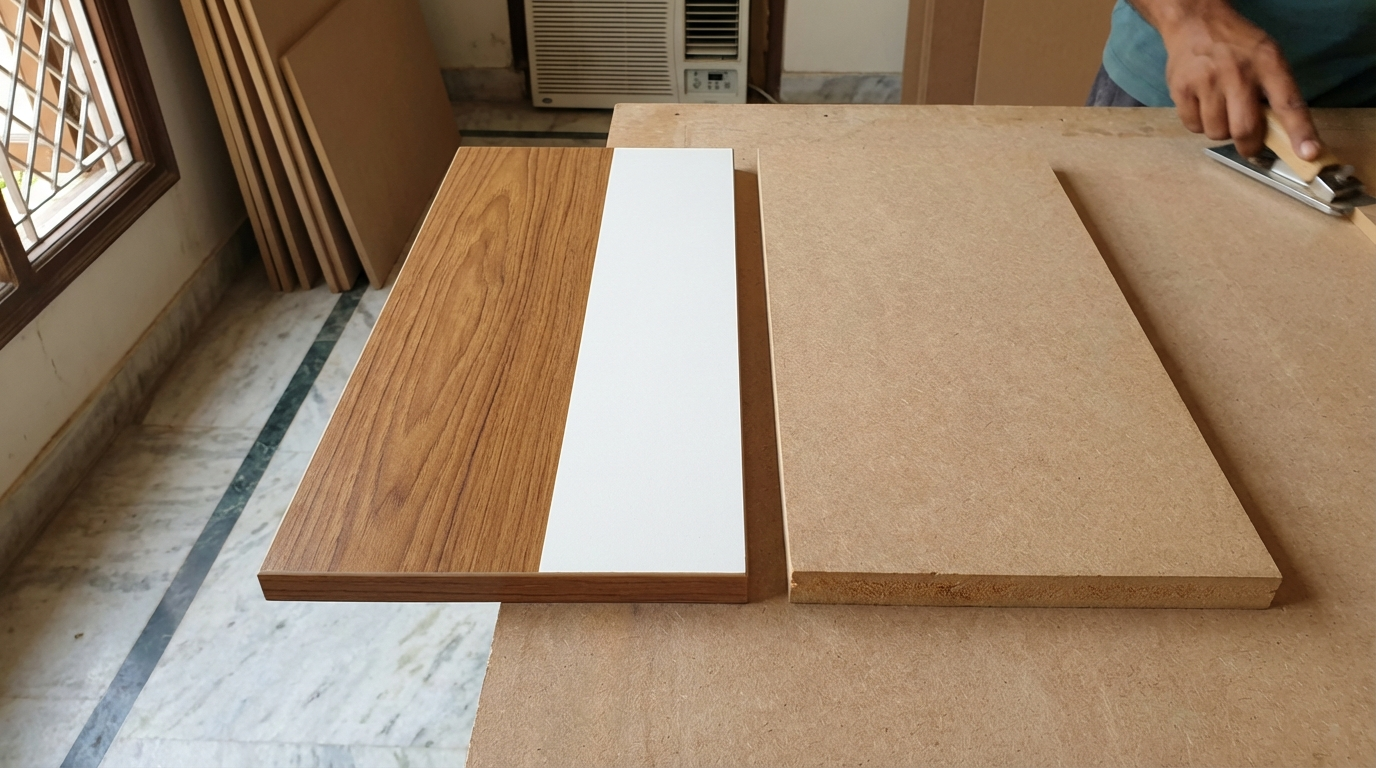
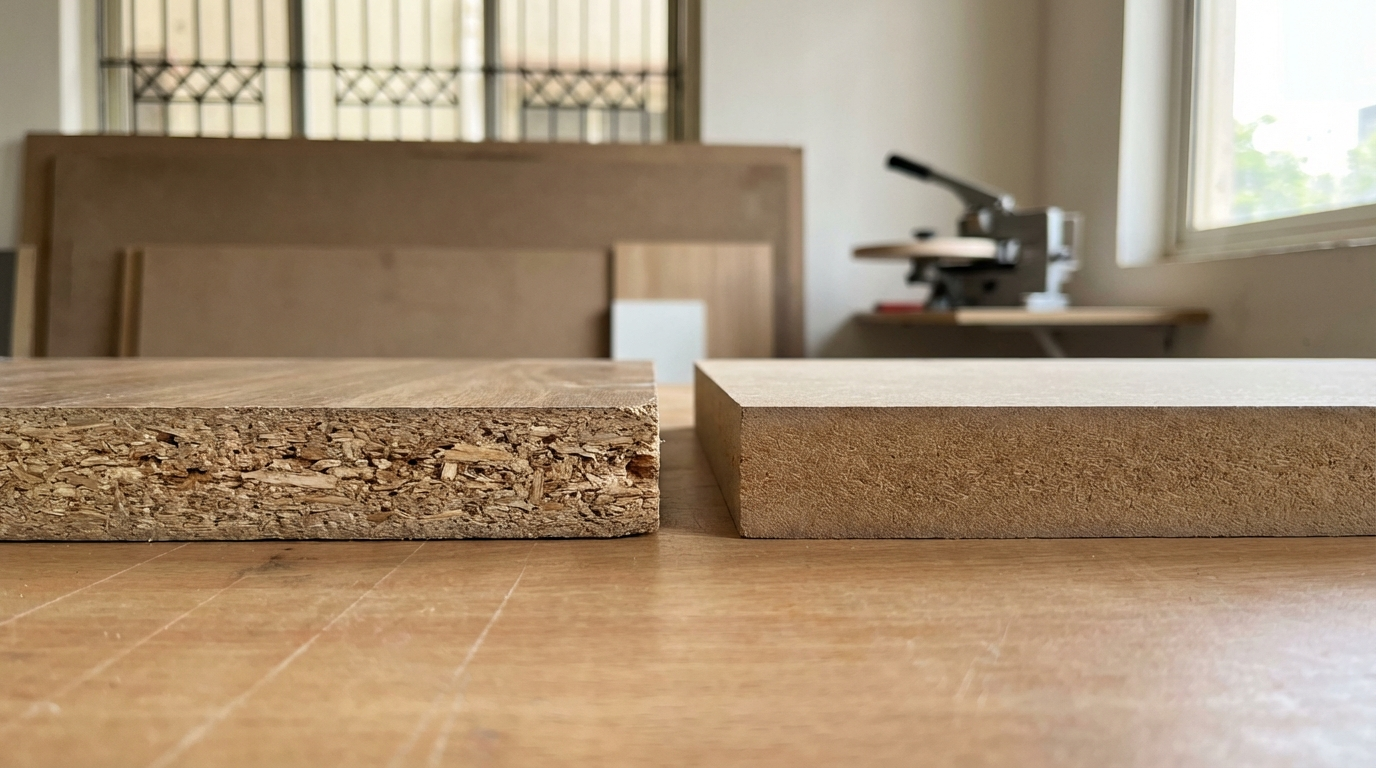
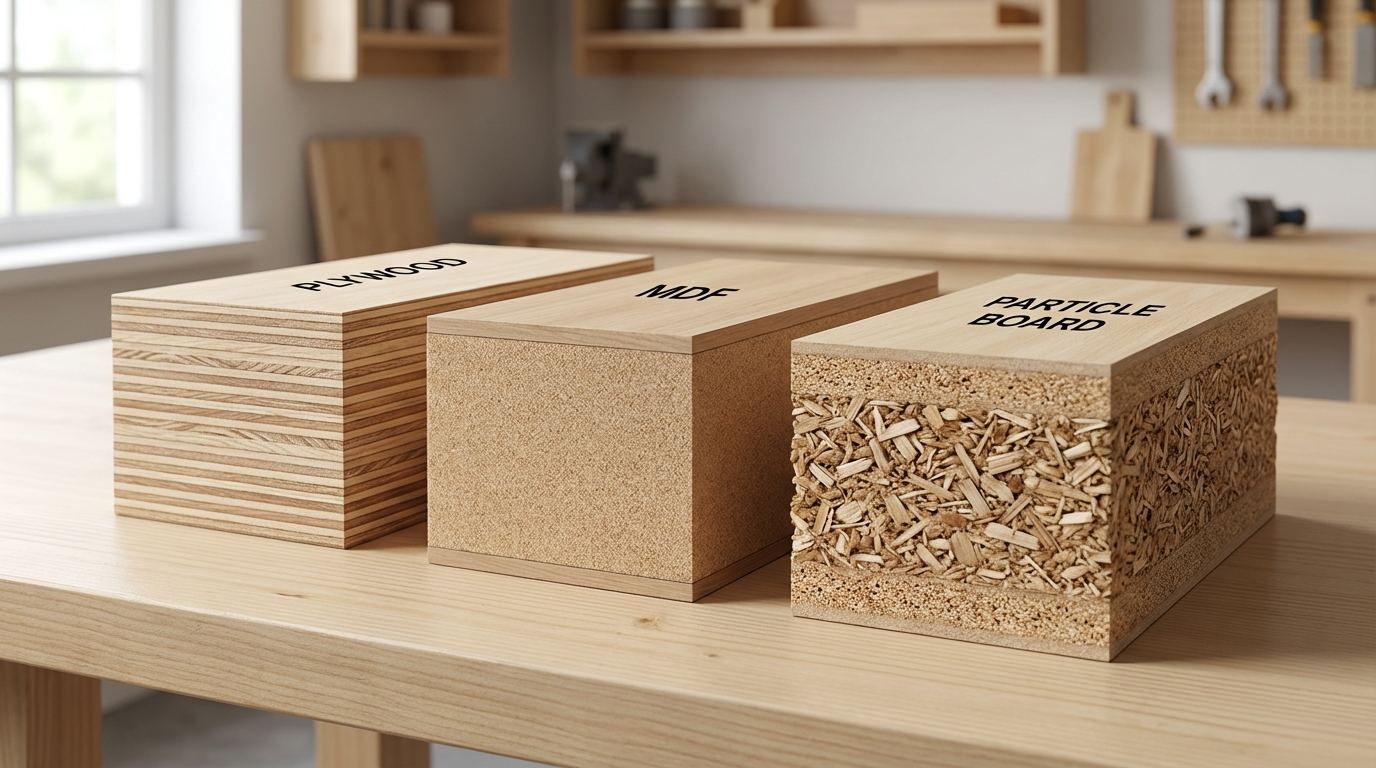
MDF, or Medium Density Fiberboard, forms from fine wood fibers mixed with resin, pressed under heat and pressure into dense, uniform sheets. It cuts smoothly for intricate designs but absorbs moisture easily without treatment.
Plywood stacks thin wood veneers glued cross-grain for balanced strength. Inner plies provide stability, outer faces offer natural wood grain or sanded smoothness. Grades like BWR (boiling water resistant) suit humid conditions.
Particle board, also called chipboard, uses larger wood chips and flakes bonded with urea-formaldehyde resin. Lowest density of the three, it crumbles under stress but machines easily for basic shapes.
These engineered panels dominate Indian furniture workflows over solid wood due to availability, consistency, and machinability. Thicknesses from 3mm to 25mm cover shelves to shutters, with 18mm standard for load-bearing.
Why It Matters in Indian Homes and Sites
Monsoon humidity (70-90% RH) and coastal salt air swell untreated edges, causing delamination or sagging. Poor storage in open godowns adds moisture pickup during transport from northern mills to southern sites.
Site realities like uneven walls, carpenter haste, and post-install spills test material limits. Plywood's cross-layers resist warping in ventilated kitchens; MDF shines in air-conditioned bedrooms but fails near sinks without sealing.
Particle board suits dry, low-abuse zones but disintegrates in humid wardrobes. Screw holding drops 30-50% in damp conditions across all, demanding pilot holes and anchors. Ventilation gaps and edge banding prevent 80% of early failures in typical projects.
Two-Minute Comparison (What Changes in Real Life)
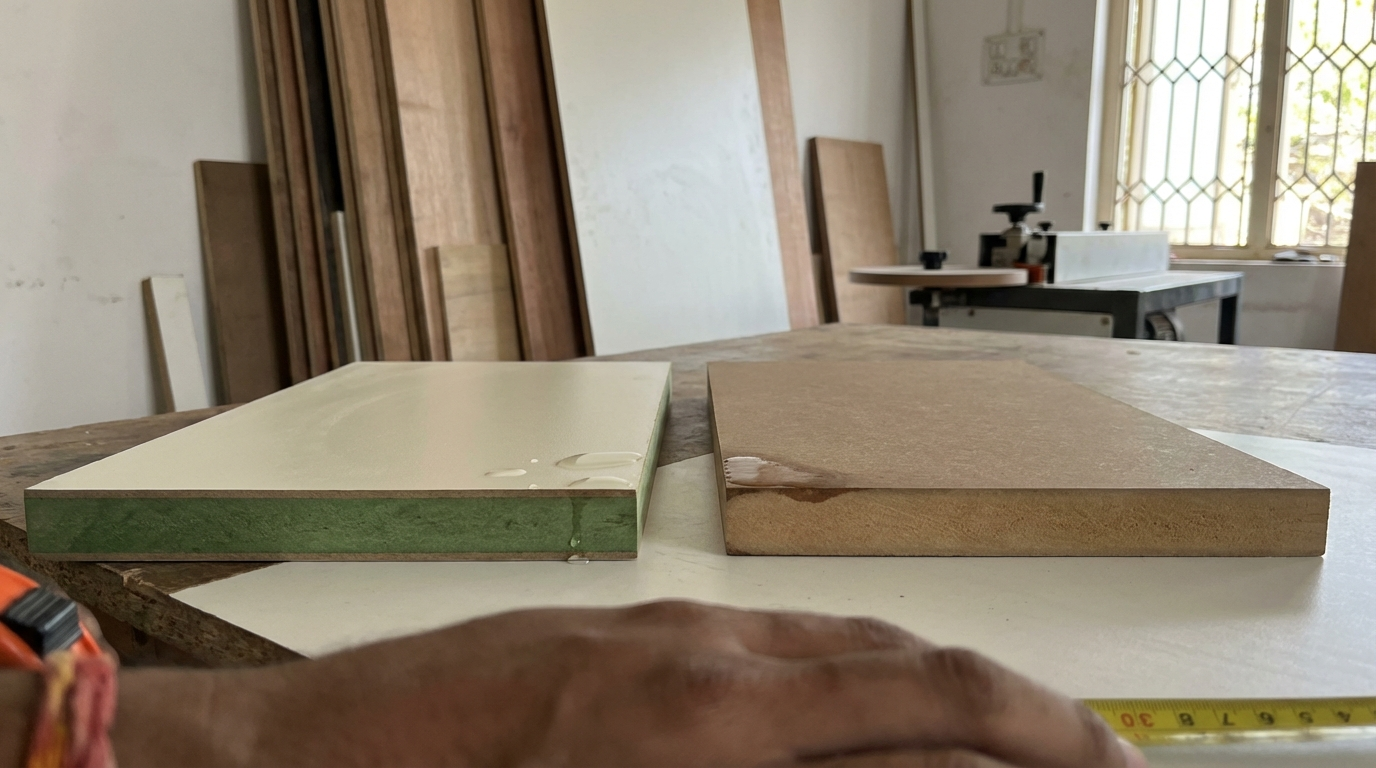
Core differences show in handling, finishing, and longevity under Indian conditions. Density drives screw hold—MDF (700-800kg/m³) beats particle board (500-650kg/m³) but trails plywood (600-700kg/m³ with grains). Moisture swells particle board most (10-15%), then MDF (5-8%), plywood least (2-4% if treated).
| Factor | MDF | Plywood | Particle Board |
|---|---|---|---|
| Density & Weight | Medium-heavy, uniform | Medium, layered strength | Lightest, inconsistent |
| Moisture Resistance | Fair (needs sealing) | Good (BWR grades) | Poor, swells fast |
| Screw Holding | Good initially, weakens wet | Best long-term | Weak, pulls out easy |
| Surface Finish | Smoothest for paint/laminate | Grain needs filling | Rough, hides easy |
| Cut Quality | No splintering | May chip veneers | Crumbs at edges |
| Cost per sqm (18mm) | Medium | Highest | Lowest |
| Best For | Modular cabinets, dry zones | Wet areas, structures | Hidden backs, budget |
Use this table for quick scans—real performance varies by grade, thickness, and sealing.
Is MDF stronger than plywood?
Plywood typically outperforms MDF in bending strength and screw retention due to cross-grain layers, holding 20-30% more load in spans like wardrobe shelves. MDF resists compression better for flat panels but warps under humidity without HDF upgrades. For furniture legs or heavy tops, plywood wins; for drawer sides, MDF suffices. Check by loading sample shelves—deflection under 10kg tells stability. In monsoons, seal both edges fully.
Does particle board warp like MDF?
Particle board warps more severely (up to 15% swell) than MDF in humidity, crumbling at cut edges. MDF holds shape better indoors but still needs lamination. Test by wetting edges overnight—particle board delaminates first. Avoid both in kitchens; plywood or moisture-resistant variants only. Proper acclimation (48hrs indoors) cuts risks 50%.
Price Range and Cost Drivers
Expect 18mm sheets: particle board ₹800-1400/sqm, MDF ₹1200-2000/sqm, plywood ₹1500-2800/sqm. Ranges shift 20-40% by city—Mumbai coastal premiums add logistics, Delhi dry zones cheaper. Drivers: thickness (add 10-15%/3mm), density (higher = pricier), resin (MR/BWR +20%), pre-laminate (+30-50%), edge banding (₹20-50/rm).
For a 6x2ft wardrobe shutter (2sqm): particle ₹2000-3500 total material; MDF ₹3000-5000; plywood ₹4000-7000. Factor 10-15% wastage, transport ₹200-500. Thicker for shelves hikes 25%.
How to ask for a quote checklist:
- Specify thickness, size, grade (MR/BWR).
- Mention finish (raw/plain/prelam).
- Ask density test or weight/sqm.
- Include delivery, cut-to-size fee.
- Request samples for screw test.
Decision Framework: Match Conditions to Material
| Site Condition | Recommended Material | Thickness/Finish Notes | Verify Checklist |
|---|---|---|---|
| Wet zone (kitchen/sink) | Plywood BWR | 18mm+, melamine laminate, PVC edge | Boil test edge, veneer quality |
| Coastal humidity | Plywood MR or HDFMR | Seal all edges, ventilation gaps | Weight/sqm, resin smell |
| Heavy use (kids/pets) | Plywood | High-pressure laminate, 1.5mm edge | Screw hold test x3 |
| Tight budget | Particle board (dry only) | Hidden, 12mm painted | No voids on tap |
| Fast delivery/smooth CNC | MDF | Prelam, 0.8mm edge band | Flatness with straightedge |
| High scratch risk | MDF/HDF with laminate | Thick overlay, rounded edges | Surface scratch test |
| Dry interiors | MDF or particle | Paint-ready, basic edge tape | Uniform color, no lumps |
Use this for project bids—adjust for span/load via span tables (e.g., 18mm spans 60cm safely).
Which is cheapest for wardrobes?
Particle board undercuts at ₹800-1200/sqm but limits to dry, light-duty. MDF at ₹1200-1800 balances cost-finish for full shutters. Plywood ₹1500+ justifies for longevity. Total wardrobe (10sqm): save ₹3000 with particle but risk replacement in 2yrs monsoon. Quote full spec; negotiate cut-to-size to cut waste 10%.
Can I use MDF in bathrooms?
Standard MDF fails fast—swells 8%+ in steam. Opt HDFMR or PVC boards instead; plywood BWR if ventilated. Seal edges with 2mm PVC, add silicone gaps. Test sample in humid room 1wk. Poor choice without upgrades wastes money.
Quality Checks You Can Do Without Lab Tests
Before buying: Weigh sheets (heavier = denser, better hold). Tap for hollows—solid thud good. Sight edges for uniformity, no gaps. Ask resin type (PF better than UF for moisture). Sample cut: clean without tear-out.
After cutting: Check edge swell resistance—finger-wet and dry. Screw test: 3x in face/edge, pull after 24hrs. Flatness: ruler along diagonal (<1mm sag).
Post-install: Press edges for give, load shelves gradually. Clean with damp cloth only on laminates. Red flags: yellowing resin, rough faces, lightweight feel.
- Visual: No dark spots/swirls (poor mixing).
- Smell: Mild resin, not pungent.
- Bend test: Slight flex ok, snap bad.
Failure Modes and Fixes
Symptom: Edge swelling/delamination. Root: Moisture ingress post-cut. Prevention: Acclimate 48hrs, PVC edge band all cuts. Fix: Sand, re-band; replace if core wet.
Symptom: Screw pull-out. Root: Low density, no pilot holes. Prevention: Undersize bits, anchors in particle/MDF. Fix: Larger screws or plugs.
Symptom: Surface sagging/warping. Root: Undersized spans, humidity. Prevention: 18mm+ for 60cm, supports. Fix: Reinforce underneath.
Symptom: Chipping at cuts. Root: Dull tools on plywood veneers. Prevention: Carbide blades, score first. Fix: Fill, sand, refinish.
Symptom: Laminate bubbling. Root: Poor press/heat mismatch. Prevention: Match thermal expansion. Fix: Re-press or replace sheet.
Symptom: Termite attack. Root: Untreated edges in infested zones. Prevention: Borate spray, elevated storage. Fix: Isolate, treat locally.
Why does furniture sag after monsoon?
Humidity softens resins, dropping internal bonds—MDF/particle worst. Plywood holds if BWR. Prevent by dehumidifiers, sealed edges, no floor contact. Check annually: tap for dullness. Reinforce with battens if early sag. Acclimatize new pieces 1wk.
How to fix chipped plywood edges?
Sand flush, apply wood filler matching grain, prime, edge band over. Use 120-grit up to 220. For prevention, tape cut lines pre-saw. Test on scrap—CNC fine-tooth bits cut clean 90% cases. Full replace if veneer lifts.
Common Buyer Mistakes and How to Avoid Them
- Mistake: Buying thinnest/cheapest without load calc. Avoid: Span rule—12mm max 40cm, 18mm 60cm.
- Mistake: Ignoring storage—open truck in rain. Avoid: Plastic wrap, upright stack indoors.
- Mistake: No edge sealing on cuts. Avoid: Band immediately post-CNC.
- Mistake: Painting without primer on MDF. Avoid: 2-coat sealer first.
- Mistake: Overloading shelves sans supports. Avoid: 5kg/sqft limit, battens every 50cm.
- Mistake: Coastal use of standard particle. Avoid: MR plywood min.
- Mistake: Skipping screw tests. Avoid: Pull test 5 samples each face/edge.
- Mistake: Poor acclimation. Avoid: 48-72hrs room conditions pre-install.
- Mistake: Generic quotes sans specs. Avoid: List thickness/grade/finish.
- Mistake: No ventilation in cabinets. Avoid: 5mm gaps top/bottom.
Advice for Different Users
Tips for Homeowners
Focus durability: Laminate over raw panels, wipe spills instantly, avoid direct water. Use coasters on tops. Inspect yearly for loose screws—tighten early. Budget 20% extra for edges. In monsoons, silica packs in cabinets absorb humidity. Choose plywood for kitchens to cut replacement odds 50%.
Tips for Carpenters
Cut with sharp 60-tooth blades, pilot 70% screw dia. Edge band hot-melt for MDF. Clamp laminates 2hrs. For plywood, fill grain before paint. Handle sheets vertically to avoid bows. In humid sites, work morning-only, fan-dry cuts.
Tips for Architects/Designers
Spec density min 650kg/m³, BWR for wet. Detail 2mm edge all around, hinge zones reinforced. Use modular grids for repeatability. Simulate loads in drawings. Coastal: Add overhangs, drains. Verify supplier samples match specs.
Tips for OEM/Modular Makers
Standardize QC: Weigh, tap, screw tests per batch. CNC programs per density. Reduce returns via pre-banded blanks. Track complaints—moisture tops list, fix with MR upgrades. Bulk store conditioned (40-50%RH).
Practical Use Cases (What Works, What Fails)
| Application | Best Material | Thickness | Finish/Edge | India Risk Notes |
|---|---|---|---|---|
| Kitchen shutters | Plywood BWR | 18mm | High gloss laminate, 2mm PVC | Monsoon steam—seal hinges |
| Wardrobe carcass | MDF | 15-18mm | Prelam, ABS edge | Dry AC rooms only |
| TV unit shelves | MDF | 18mm | Paint, profiled edge | Supports every 45cm |
| Office partitions | Plywood | 12mm | Veneer, T-edge | Heavy doors need blocks |
| Bed slats | Particle | 12mm | Raw, none | Hidden, dry bedrooms |
Best for modular kitchens?
Plywood BWR 18mm with laminate—resists spills, holds heavy pots. MDF ok for uppers if sealed. Avoid particle. Edge fully, stainless hardware. In humid cities, add extractors. Cost 20% more upfront saves remodels.
Good for kids' furniture?
Plywood base with rounded laminate MDF overlays—strength + smooth clean. 18mm min, anti-tip fixings. Scratch-resistant finishes key. Test drop impacts on samples. Monsoon: Elevate off floors.
FAQs
Which material is easiest to work with?
MDF machines smoothest—no splinters, uniform cuts for CNC profiling. Plywood veneers chip if blades dull; particle crumbles. Prep: Tape plywood lines, sharp bits all. In workshops, MDF speeds 20-30% but seal post-cut to block humidity ingress common in Indian sites. Weight helps stability on tablesaws.
Is plywood worth the extra cost?
Yes for longevity in 70% cases—better screw hold, less warp over 5yrs. MDF/particle cheaper initially but redo costs mount in monsoons. ROI highest in kitchens/wardrobes. Compare total project: plywood adds ₹2000/wardrobe but halves failures. Verify grade visually.
Can particle board be used for cabinets?
Only hidden/light-duty in dry zones—backs or partitions. Faces fail under weight/moisture. Upgrade to MDF for doors. Acclimate, edge tape strictly. Many coastal projects regret it post-monsoon sag. Budget hacks: Mix with plywood frames.
How thick for furniture shelves?
18mm standard spans 60cm safely under 10kg/sqft; 12mm limits 40cm light use. Factor overhangs—add supports. Plywood strongest, MDF next. Test load gradually post-install. Indian homes overload often; brace extras prevent cracks.
Does MDF take paint well?
Best of three—prime with MDF sealer (2 coats) for flawless finish. Sand 180-grit between. Plywood needs grain filler first; particle rough. Humidity dries slow—fan assist. Lasts 5+yrs indoors with topcoat. Avoid direct sun fade.
What about termites in these panels?
Resins deter but edges vulnerable—treat with borate spray pre-install. Store off-ground, ventilate. Plywood cores resist better. Infested zones: Add barriers. Annual checks catch early nibbles. Coastal salt aids prevention oddly.
Best edge banding method?
Hot-melt PVC 2mm for durability—machines fast, seals moisture. Tape for temp. Pre-glued rolls suit small shops. Overlap corners, trim flush. Fails if underheated; practice on scrap. India heat warps cheap tapes quick.
How to store sheets before use?
Vertical racks, wrapped plastic, 40-60%RH room 48hrs min. Avoid floors/godowns. Monsoon: Indoor only. Warped sheets scrap 10% projects. Label batches for FIFO. Coastal: Silica packs extra. Disclaimer: This content is provided for general informational purposes based on industry practices and publicly available information. Product specifications, standards, prices, and availability may vary by manufacturer, region, and time. Readers should independently verify details with manufacturers, dealers, or qualified professionals before making purchase or construction decisions.
Want Plywood Suggestions?
Share a few details and a VIR MDF specialist will suggest suitable brands and connect you to responsive dealers.