MDF vs Solid Wood: When MDF is Smarter (and When It’s Not)
Solid wood isn’t always the best choice. Compare MDF vs solid wood on stability, finish, cost, and durability with practical examples.
Quick Decision Summary
MDF outperforms solid wood in humid Indian conditions for stability and cost, but solid wood suits high-impact or aesthetic heirlooms.
If you’re in a hurry: Pick MDF for modular kitchens, wardrobes, or TV units in monsoon-prone areas—its uniformity resists warping better than solid wood, cuts faster for carpenters, and finishes smoothly under laminates. Solid wood fits better for exposed furniture like dining tables where natural grain adds value and screw-holding lasts decades. Check project humidity, budget, and finish needs first.
- Choose MDF if: tight budget, high humidity site, uniform finish needed, fast CNC routing, or hidden carcass work.
- Avoid MDF if: heavy daily abuse, premium natural look required, heirloom pieces, or outdoor exposure without sealing.
What This Material/Option Actually Is
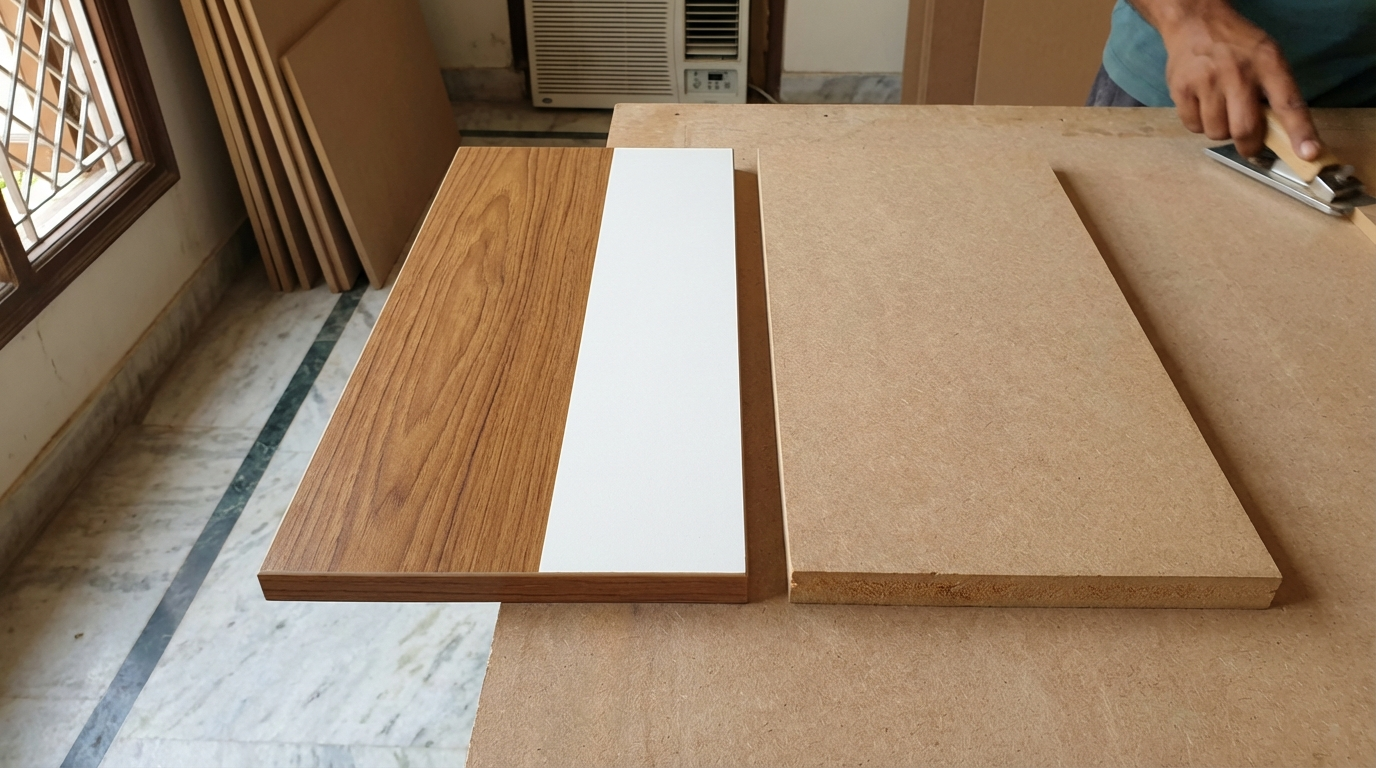
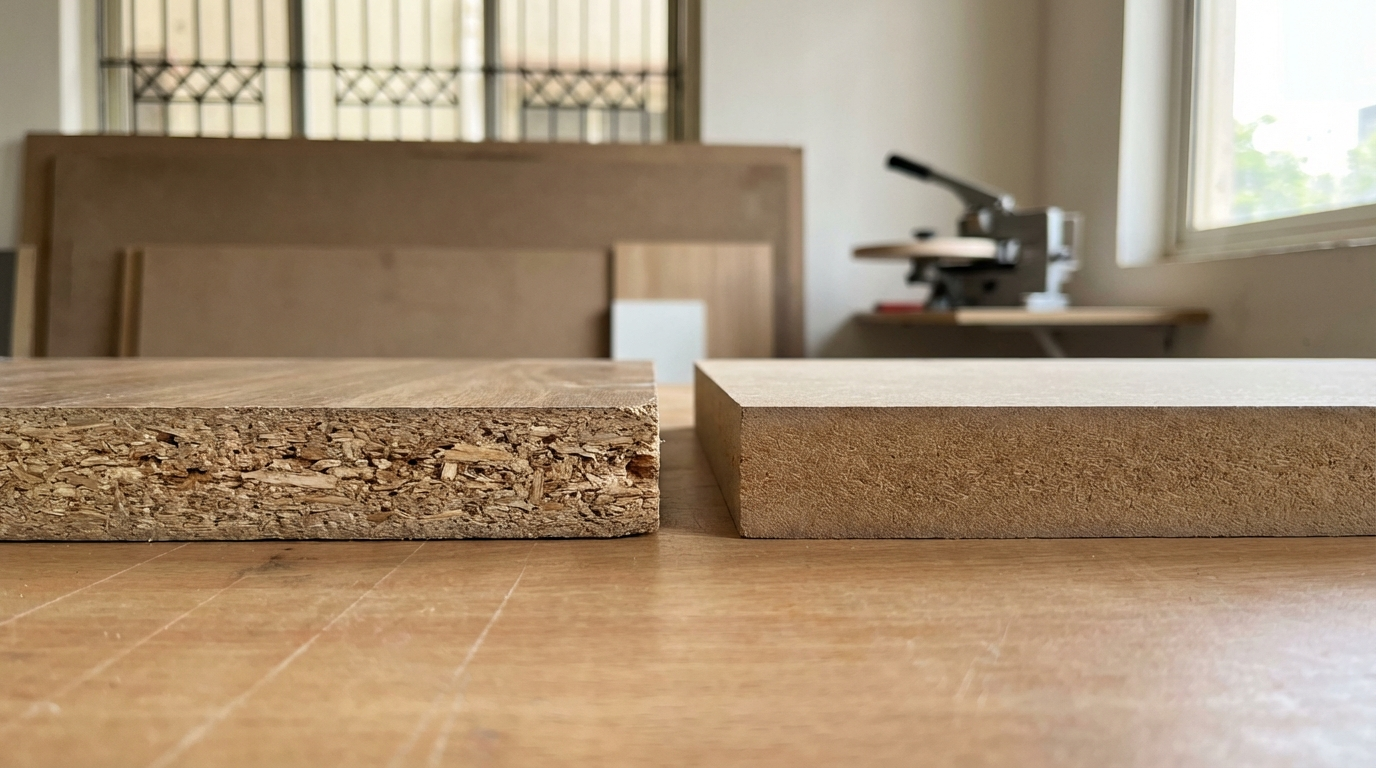
MDF, or Medium Density Fiberboard, is an engineered panel made by breaking down wood fibers, mixing with resins and wax, then pressing under heat and pressure. It creates a smooth, dense sheet ideal for laminates or paint. Common thicknesses run from 3mm to 25mm, with moisture-resistant variants using added resins for wet zones.
Solid wood refers to natural timber planks or boards cut directly from tree trunks, like teak, sheesham, or pine. It retains natural grain, knots, and varying densities. In India, hardwoods like teak dominate premium work, while softwoods like pine suit budget builds. Unlike MDF, it expands/contracts with moisture and shows unique patterns per piece.
Both fit interior finishing, but MDF standardizes production while solid wood varies by log quality and seasoning.
Why It Matters in Indian Homes and Sites
India’s monsoon humidity (70-90% RH) and coastal salt air cause solid wood to warp, crack, or twist if not kiln-dried properly—common in transit from northern mills to southern sites. MDF stays flat due to cross-fibers, but edges swell without sealing in damp storage.
Site realities like poor ventilation during plywood godown stacking or carpenter sheds amplify issues: solid wood bows under weight, MDF chips if dragged wet. In kitchens or bathrooms, steam hits solid wood joints first, loosening glue; HDFWR variants handle this better. For wardrobes in humid Mumbai flats, MDF carcasses prevent sagging shelves over years.
Two-Minute Comparison (What Changes in Real Life)
Key differences show in daily use: MDF machines evenly for modular fits, solid wood repairs naturally but seasons unpredictably.
| Factor | MDF | Solid Wood |
|---|---|---|
| Stability in Humidity | High—minimal warp if sealed | Low—expands/contracts 8-12% |
| Finish Quality | Smooth base for laminates/paint | Grain needs filling/sanding |
| Cost per Sheet (18mm) | Typically lower, varies by density | Higher due to sourcing/seasoning |
| Screw Holding | Good initially, weakens over pulls | Excellent long-term grip |
| CNC Routing Speed | Fast, no tear-out | Slower, grain direction matters |
| Repair Ease | Patch/fill edges | Sand/refinish naturally |
Choose based on site: MDF for speed in dry interiors, solid wood for visible durability.
Price Range and Cost Drivers
Expect MDF sheets (8x4 ft, 18mm) in the range of Rs 1,200-2,500 typically, while solid wood equivalents like seasoned teak run Rs 4,000-8,000 or more. Variations stem from thickness (12mm cheaper than 25mm), density (700-850 kg/m³), resin type for moisture resistance, edge profiling, and city logistics—Mumbai adds 15-20% over inland hubs.
Finish boosts costs: pre-laminated MDF adds 20-30%, veneer on solid wood 40%. Wastage from CNC nesting hits MDF less (5% vs 15% for irregular solid planks). For a 10x6 ft wardrobe carcass, MDF totals Rs 15,000-25,000 installed; solid wood doubles that with labor.
How to ask for a quote:
- Specify thickness, size, density grade, moisture resistance if needed.
- Ask for FOB vs delivered rates, sheet wastage estimate.
- Include edge banding/melamine cost per meter.
Is MDF Cheaper Long-Term Than Solid Wood?
Yes, MDF often proves cheaper over 5-10 years in Indian homes due to no warping repairs and faster install saving carpenter days. Initial savings of 40-60% compound with low maintenance—no annual oiling like solid wood. However, in low-humidity Delhi bungalows, solid wood’s longevity offsets costs if premium grain justifies it. Check by calculating total ownership: add install, edge sealing, and repaint cycles. Next, test sample screw pulls after humidity exposure.
Practical Use Cases (What Works, What Fails)
| Application | Recommended Material | Thickness Range | Finish Notes | Risk Notes |
|---|---|---|---|---|
| Kitchen Carcass | MDF | 18-25mm | Laminate | Seal edges vs steam |
| Wardrobe Doors | Solid Wood | 18-20mm | Veneer | Monsoon warp if unsealed |
| TV Unit Shelves | MDF | 12-18mm | Paint | Light load only |
| Dining Table Top | Solid Wood | 25-40mm | Polish | High scratch resistance |
Can MDF Replace Solid Wood in Kitchens?
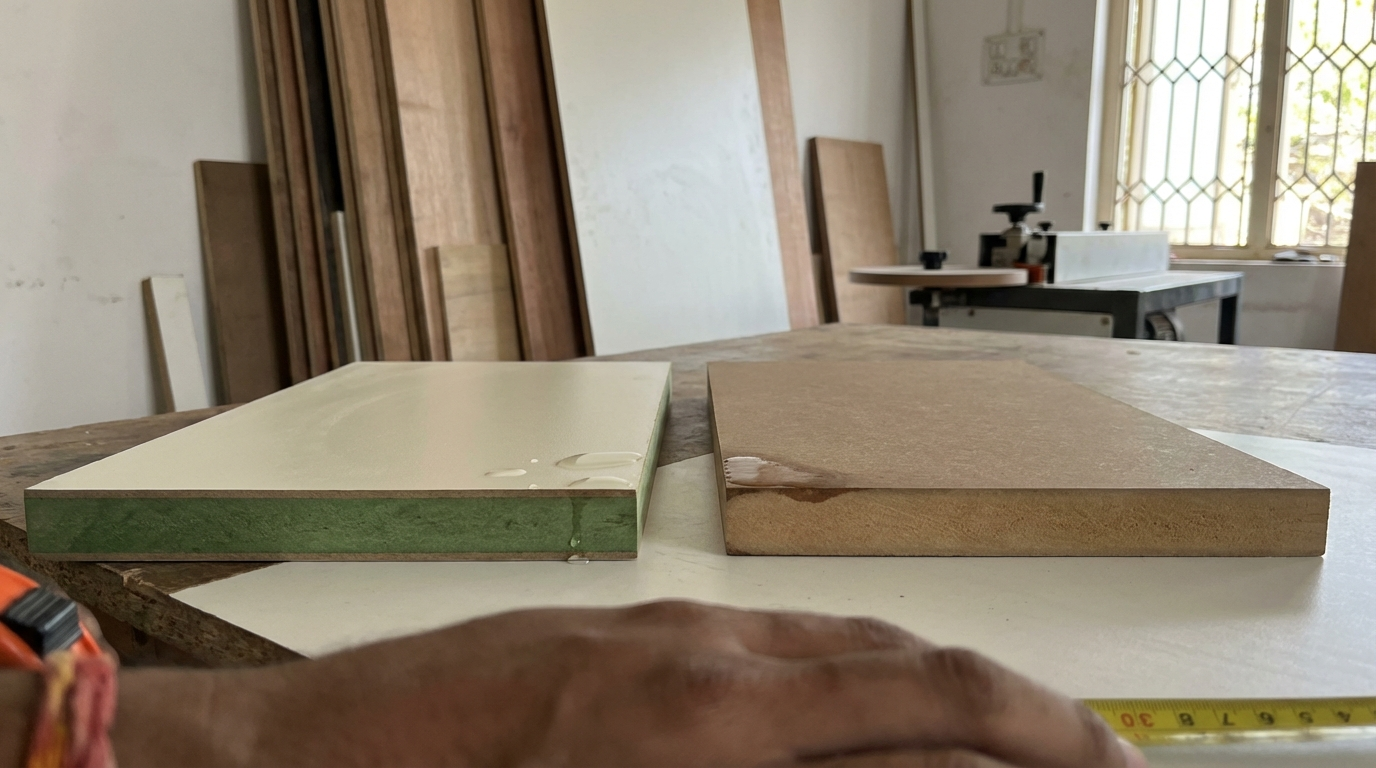
MDF works well for hidden carcasses but pair with HDFWR in steam-heavy Indian kitchens—seal all edges with 2mm PVC banding to block moisture. It fails if exposed without laminate, swelling at cuts. Solid wood doors add heft but risk joint gaps in humidity. Verify by pressing damp cloth on sample overnight; no swell means good. Next, spec resin content verbally with supplier.
Failure Modes and Fixes
- Symptom: Edge swelling. Root: Unsealed cuts absorb monsoon moisture. Prevention: Apply edge tape pre-install. Fix: Sand, seal with resin filler; replace if core delams.
- Symptom: Screw pull-out. Root: Repeated door slams in MDF. Prevention: Use 35mm confirms + pilot holes. Fix: Insert wooden plugs, re-screw.
- Symptom: Surface scratches. Root: Laminate on MDF chips easier than solid polish. Prevention: Felt pads under items. Fix: Touch-up paint matching.
- Symptom: Warping bows. Root: Solid wood poor seasoning + humidity swing. Prevention: AC-dry before use. Fix: Clamp straight, re-season months.
- Symptom: Delamination. Root: Cheap resin in MDF + steam. Prevention: HDFWR grade. Fix: Worst case, dismantle/rebuild.
- Symptom: Knot falls out. Root: Solid wood defects. Prevention: Inspect pre-cut. Fix: Fill epoxy, sand smooth.
Why Does Solid Wood Warp in Indian Monsoons?
Solid wood absorbs 10-15% moisture radially, causing uneven expansion—common in un-AC godowns. MDF’s fibers bind tighter, limiting to 2-3%. Nuance: Quarter-sawn teak resists better than plain-sawn pine. Check by measuring plank width pre/post humidity chamber sim at site. Prevent with boric treatment + ventilation stacks.
Quality Checks You Can Do Without Lab Tests
Before buying:
- Tap sheet—uniform thud means even density; hollow spots signal voids.
- Press edges firmly—no crumbling in standard MDF.
- Ask cut date; avoid >3 months old stock for moisture pickup.
After cutting: Smooth edges without fuzz? Good resin. Test screw in waste: holds 20kg?
After install: Check gaps <1mm, wipe test for water beading on seal.
How to Spot Low-Quality MDF at Site?
Low-quality shows crumbly edges, visible lumps, or weight under 30kg per 18mm sheet. Drop test: no crack on 1m fall. In India, coastal lots often damp—weigh vs spec. Next, cut sample: fibers should compress, not splinter.
Decision Framework: MDF or Solid Wood?
| Site Condition | Recommended Choice | What to Verify |
|---|---|---|
| Wet zone (kitchen) | MDF/HDFWR + laminate | Edge seal integrity |
| Coastal humidity | MDF moisture-resistant | Resin type verbal confirm |
| Heavy use (kids/pets) | Solid wood top + MDF base | Hardness by scratch test |
| Tight budget | MDF prelam | Density via weight |
| Fast delivery | MDF stock | |
| High scratch risk | Solid + polish | Grain uniformity |
Should I Use MDF for Wardrobe Carcasses?
Yes, MDF excels for carcasses—stable shelves don’t sag like solid in humid cupboards. Use 18mm with melamine backer. Avoid for heavy sliding doors. In Chennai humidity, add termite wax. Check post-assemble: twist by hand; none means fit.
Common Mistakes and How to Avoid Them
- Skipping edge sealing on MDF. Avoid: Band all cuts same day.
- Using standard MDF in bath zones. Avoid: Spec WR variant.
- Overloading MDF shelves. Avoid: Limit 20kg/sqft, reinforce.
- Not acclimating solid wood. Avoid: Site-stack 7 days.
- Cheap glue on joints. Avoid: PVA type II for humidity.
- Ignoring grain direction in solid. Avoid: Mark pre-cut.
- Wet storage transit. Avoid: Plastic wrap sheets.
- No pilot holes in MDF. Avoid: 3mm drill always.
Advice by User Type
Tips for Homeowners
Clean MDF with damp cloth only—no abrasives. For solid, oil quarterly. Don’t overload; use wall anchors. In monsoons, silica packs in wardrobes.
Tips for Carpenters
Cut MDF dust-free with 60-tooth blade. Edge band hot-melt for pull. Solid: Plane against grain last. Fasten MDF 38mm from edge.
Tips for Architects/Designers
Spec MDF density 750+ kg/m³ for CNC. Detail solid joints as finger for strength. Wet zones: 0.5mm overhang lips.
Tips for OEM/Modular Makers
Nest MDF 95% efficiency. QC: Caliper thickness ±0.5mm. Reduce returns by pre-sealed samples.
Is Solid Wood Better for Furniture Legs?
Solid wood legs handle impact better—no split risk like MDF under point loads. Use 40x40mm teak for dining. MDF ok for skirtings if banded. Coastal: Treat ends extra. Verify by stomp test on sample.
FAQs
Does MDF swell less than solid wood?
MDF typically swells 7-10% at edges vs solid wood’s 12-15% full-panel movement in 90% RH cycles common during Indian monsoons. Its engineered fibers distribute moisture evenly, staying flatter for door alignments. Solid wood’s rays expand radially first, bowing panels. Seal MDF cuts immediately and store solid planks vertically in ventilated sheds to minimize. Test your batch by soaking edge 24hrs—minimal puff means reliable for wardrobes.
Can I paint MDF as easily as solid wood?
Yes, MDF’s smooth face takes primer/paint better without grain filler, ideal for white wardrobes. Solid needs sanding/sealing for even coats. In dusty sites, MDF hides imperfections post-laminate. Avoid direct sun fade on both; use UV paints. Prep MDF with sanding sealer first for pro finish matching solid polished tables.
Which holds hinges better over time?
Solid wood retains screw grip longer under daily pulls, as fibers compress/recover. MDF loosens after 500 cycles unless reinforced with inserts. For kitchen cabinets, use Euro hinges with backer blocks on MDF. In humid Bangalore homes, solid sheesham outlasts by 2x. Always pilot and add glue initially.
Is MDF termite-resistant like treated solid wood?
Standard MDF resists via density/resins, but add boric variants for coastal Gujarat. Solid needs pressure treatment. Check infestation history in godowns. Prevent both with 100mm site clearance + repellents. MDF’s uniformity spots issues early via surface checks.
How does weight compare for shipping?
MDF sheets weigh 25-35kg (18mm), easier for solo handling vs solid 40-60kg planks. Reduces labor in multi-story installs sans elevators. Factor density: high-grade MDF nearer solid but cuts lighter post-nesting. Stack flat, 10 high max.
Can MDF be used outdoors?
No, even WR variants degrade in rain—resins leach. Solid hardwoods like teak weather better sealed. Limit MDF to covered verandahs max. For partitions, hybrid: MDF core + solid frame. Verify exposure hours yearly.
Which is easier for beginners to work with?
MDF—predictable cuts, no splits, forgiving clamps. Solid varies by moisture/grain, needs experience planing. Start carpenters on MDF cabinets. Tool up with zero-clearance inserts for tear-free edges on both.
Does solid wood add resale value?
Yes, natural teak cabinets boost home value 10-15% in premium markets like Pune villas. MDF suits rentals for cost. Balance with hybrid: solid fronts, MDF boxes. Inspect finish wear before listing.
Disclaimer: This content is provided for general informational purposes based on industry practices and publicly available information. Product specifications, standards, prices, and availability may vary by manufacturer, region, and time. Readers should independently verify details with manufacturers, dealers, or qualified professionals before making purchase or construction decisions.Want Plywood Suggestions?
Share a few details and a VIR MDF specialist will suggest suitable brands and connect you to responsive dealers.