MDF Wardrobe Designs: Modern Ideas & Construction Guide
Stunning MDF wardrobe designs for Indian bedrooms. Modern layouts, internal fittings & construction tips using VIR MDF. Free design catalog.
Quick Decision Summary
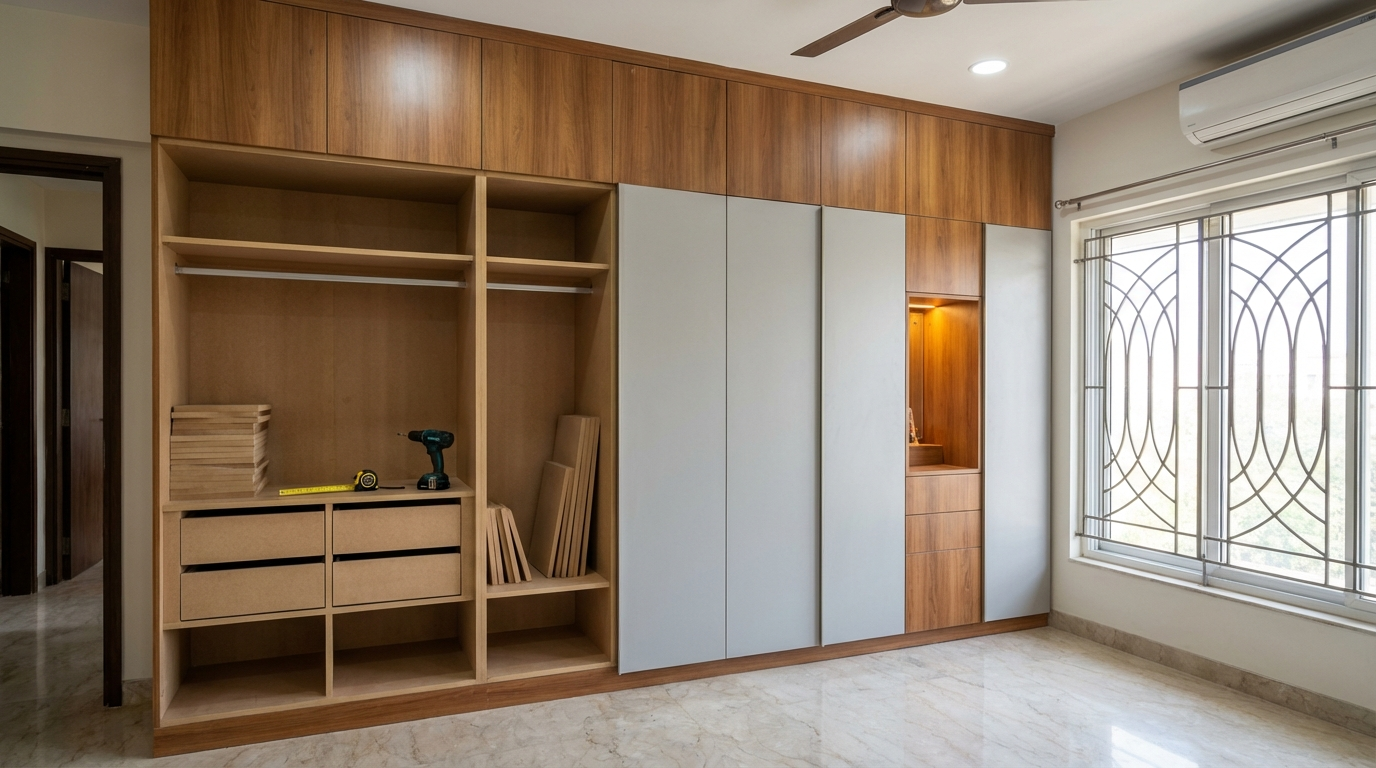
Quick Answer: MDF wardrobe designs offer the perfect balance of affordability, smooth finish, and customization for Indian bedrooms. Choose MDF for painted wardrobes, routed door patterns, and budget-conscious projects where humidity is controlled.
If you're in a hurry: MDF wardrobes work exceptionally well in air-conditioned bedrooms with controlled humidity. For a 6x7 feet sliding wardrobe, expect costs starting from ₹45,000-65,000 using 18mm MDF with laminate finish. Always specify moisture-resistant MDF (MR-MDF) for Indian conditions, ensure proper edge banding on all exposed edges, and avoid placing MDF wardrobes in bathrooms or balcony-adjacent areas without proper sealing.
Choose MDF wardrobes if:
- You want smooth, seamless painted finishes without wood grain showing through
- Your bedroom has air conditioning or low humidity levels
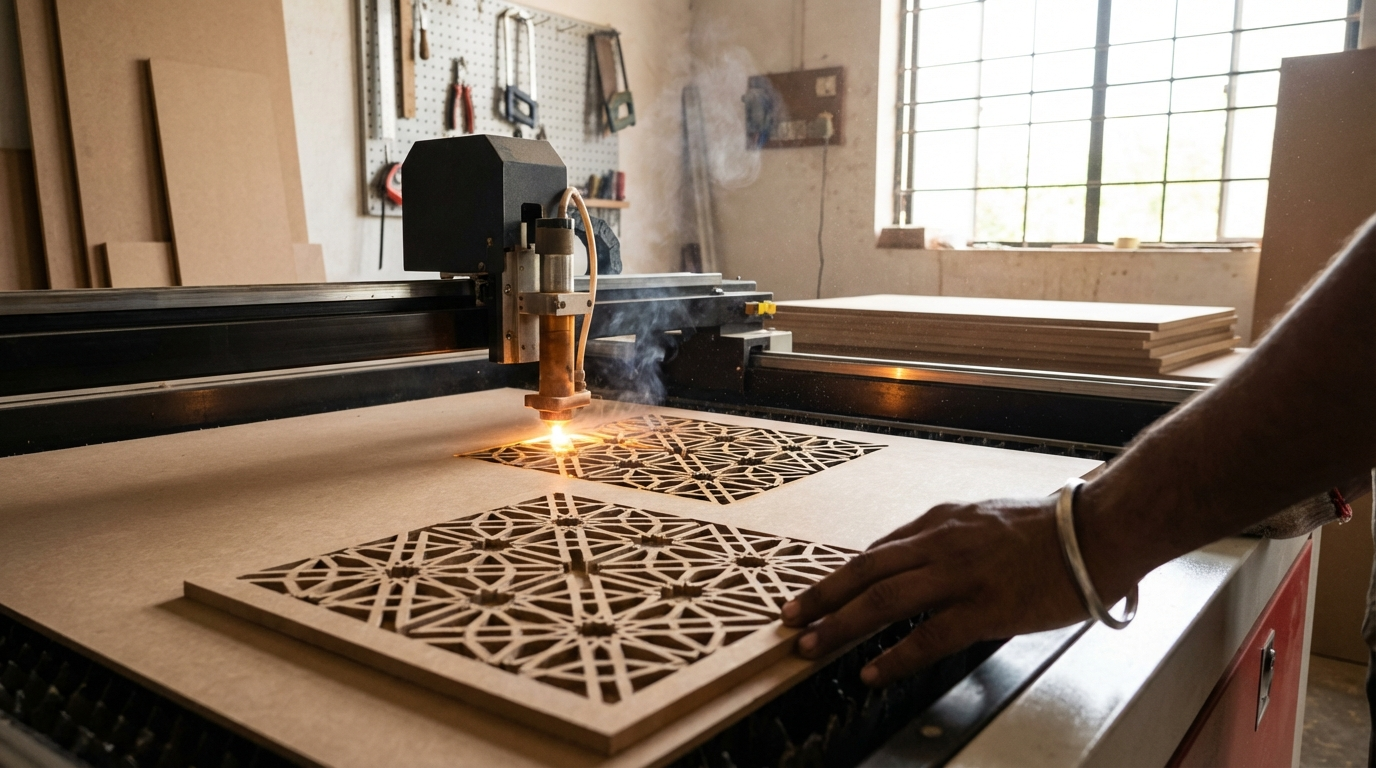
- You prefer intricate CNC-routed patterns on shutter doors
- Budget is a key consideration without compromising on aesthetics
Avoid MDF wardrobes if:
- The wardrobe location faces direct moisture exposure (attached bathrooms, coastal areas without AC)
- You need extremely heavy load-bearing shelves without support brackets
- The installation area experiences flooding or water seepage
- You cannot ensure proper edge sealing during fabrication
What MDF Wardrobe Design Actually Means
MDF wardrobe design refers to wardrobes constructed using Medium Density Fibreboard as the primary structural and finishing material. MDF is an engineered wood panel made by breaking down hardwood or softwood residuals into wood fibres, combining them with wax and resin binder, and forming panels under high temperature and pressure.
In the furniture hierarchy, MDF sits between particleboard (lower density, less durable) and plywood (layered veneers, higher screw-holding strength). MDF offers a completely smooth, grain-free surface that makes it superior for painted finishes and intricate machining work like CNC routing.
Common Confusions Clarified
- MDF vs Pre-laminated MDF: Plain MDF requires finishing; pre-laminated MDF comes with factory-applied melamine paper on both faces
- MDF vs HDF: HDF (High Density Fibreboard) is denser, thinner, and typically used for wardrobe backing panels, not structural components
- MDF vs MR-MDF: Standard MDF swells with moisture; MR-MDF (Moisture Resistant) contains melamine resin for better humidity resistance
- MDF wardrobe vs Modular wardrobe: MDF is a material; modular is a construction method—modular wardrobes can be made from MDF, plywood, or particleboard
Why MDF Wardrobes Matter for Indian Homes
Indian homes face unique challenges that directly impact wardrobe material selection. Understanding these factors helps you make design decisions that last beyond the first monsoon season.
Monsoon and Humidity Impact
During June-September, relative humidity in cities like Mumbai, Chennai, and Kolkata can exceed 85-95%. Standard MDF absorbs this moisture, causing:
- Edge swelling—doors start rubbing against frames
- Surface bubbling—laminate or paint lifts from substrate
- Internal warping—shelves develop visible bows
- Hardware loosening—screw holes expand and lose grip
Real Consequences of Wrong Material Choice
Homeowners who install standard MDF wardrobes in high-humidity zones typically report problems within 18-24 months. The most common failures include:
- Shutter edges swelling 2-4mm, preventing proper closure
- Bottom panels absorbing floor-cleaning moisture and delaminating
- Hinge screws pulling out from softened MDF near hinges
- Musty odour developing from trapped moisture inside panels
Site Handling Realities
In India, wardrobe materials often sit at construction sites for weeks before installation. MDF sheets stored without proper covering absorb ambient moisture even before fabrication begins. This pre-installation damage manifests later as unexplained warping or edge problems that carpenters often cannot diagnose.
Types of MDF for Wardrobe Construction
Selecting the right MDF variant is the foundation of a durable wardrobe. Each type serves specific conditions and applications.
| MDF Type | Density Range | Best Application | Price Range (18mm) | Moisture Resistance |
|---|---|---|---|---|
| Standard MDF | 650-750 kg/m³ | AC rooms, dry climates | ₹45-55 per sq ft | Low |
| MR-MDF (Moisture Resistant) | 700-800 kg/m³ | Most Indian bedrooms | ₹55-70 per sq ft | Medium |
| HDFWR (High Density Fire/Water Resistant) | 850-950 kg/m³ | Coastal areas, premium projects | ₹75-95 per sq ft | High |
| Pre-laminated MDF | 680-750 kg/m³ | Quick installations, rentals | ₹65-85 per sq ft | Medium (surface only) |
| CNC-grade MDF | 750-850 kg/m³ | Routed patterns, detailed work | ₹60-80 per sq ft | Varies by specification |
Thickness Selection Guide:
- 6mm MDF: Back panels, drawer bottoms
- 12mm MDF: Internal shelves (with support), drawer sides
- 18mm MDF: Standard shutters, partitions, load-bearing shelves
- 25mm MDF: Heavy-duty shelves, premium shutters, countertops
Modern MDF Wardrobe Design Ideas for Indian Bedrooms
Contemporary MDF wardrobe designs leverage the material's smooth surface and machining versatility. Here are design concepts organized by room type and style preference.
Sliding Door Wardrobe Designs
Sliding mechanisms work exceptionally well with MDF due to its consistent density and smooth surface. Popular configurations include:
- 2-panel sliding: Ideal for 5-6 feet width, minimal floor clearance needed
- 3-panel sliding: Best for 7-9 feet spans, allows 2/3 access at once
- Soft-close sliding: Premium option with damped closing mechanism
Hinged Door Wardrobe Designs
Traditional swing doors showcase MDF's finishing capabilities best:
- Shaker-style panels: Routed frame patterns, painted white or grey
- Flush doors: Completely flat, modern minimalist aesthetic
- Louvered effect: CNC-routed horizontal lines mimicking ventilation slats
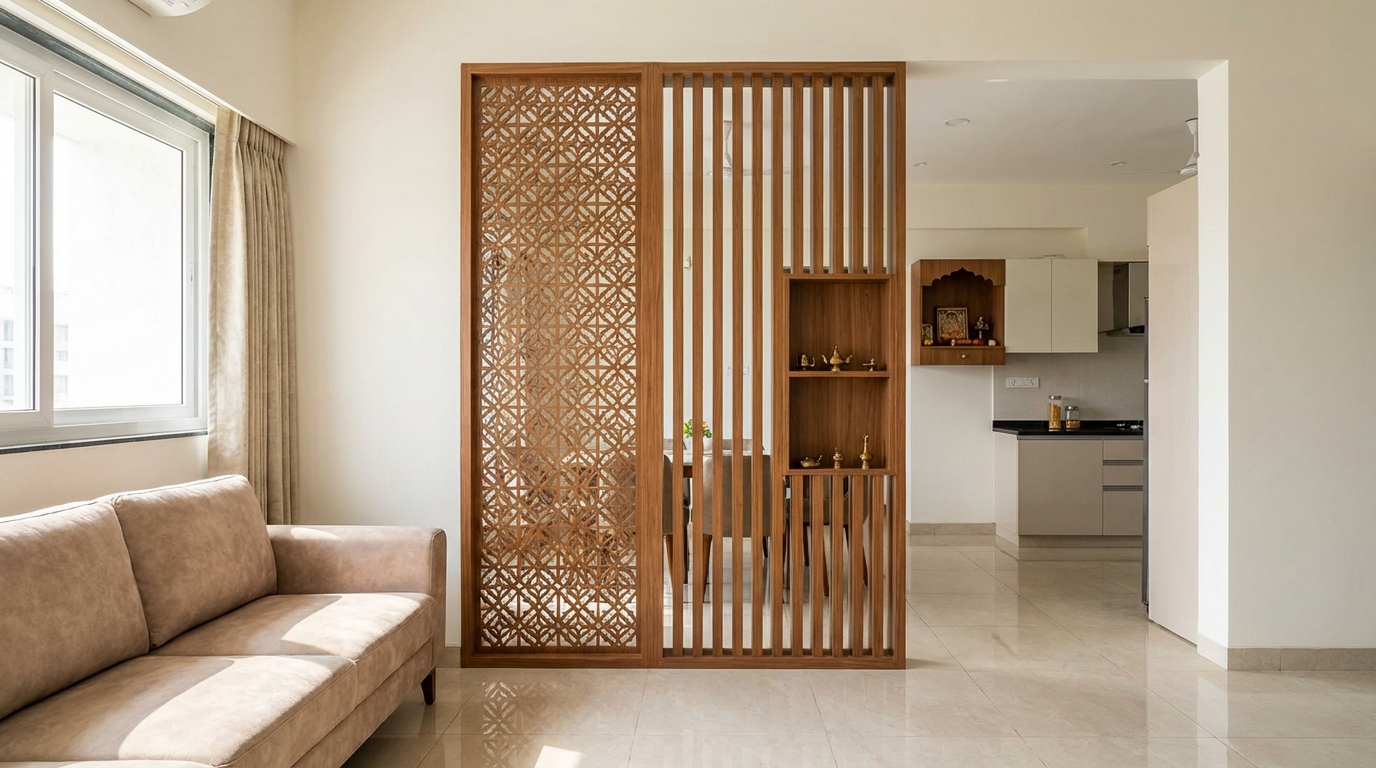
- Geometric patterns: Diamond, hexagonal, or abstract routed designs
Design Ideas by Room Size
Compact Bedrooms (100-150 sq ft)
- Floor-to-ceiling wardrobes to maximize vertical storage
- Mirror-integrated doors to create space illusion
- Light-coloured laminates (whites, creams, light greys)
- Handleless push-to-open mechanisms for streamlined look
Medium Bedrooms (150-250 sq ft)
- L-shaped corner wardrobes utilizing dead space
- Combination of sliding and hinged sections
- Integrated dressing unit with mirror and drawers
- Two-tone colour schemes (dark base, light uppers)
Master Bedrooms (250+ sq ft)
- Walk-in wardrobe configurations with MDF internals
- Island drawer units in centre
- Glass-fronted display sections for accessories
- Integrated lighting with sensor activation
Design Ideas by Style
Contemporary Minimalist
- Handleless J-profile or gola channel doors
- Matte finish laminates in neutral tones
- Concealed hinges for seamless appearance
- LED strip lighting along base and top
Classic Traditional
- Raised panel doors with routed moulding profiles
- Antique brass or bronze handles
- Wood-grain laminate or veneer finish
- Decorative cornice along top edge
Industrial Modern
- Charcoal grey or black MDF with matte finish
- Exposed metal handles and corner brackets
- Glass panel inserts with black aluminium frames
- Raw concrete-textured laminates
Scandinavian
- White or pale wood-effect finishes
- Woven cane or rattan panel inserts
- Natural wood handles
- Open shelving sections mixed with closed storage
Internal Layout and Fitting Guide
The wardrobe interior determines daily usability. Plan compartments based on your actual clothing inventory, not generic templates.
Standard Internal Dimensions
| Storage Type | Recommended Height | Recommended Depth | Notes |
|---|---|---|---|
| Long hanging (sarees, dresses) | 1400-1500mm | 550-600mm | Rod at 1600mm from floor |
| Short hanging (shirts, kurtas) | 900-1000mm | 550-600mm | Double-stack possible |
| Trouser hanging | 700-800mm | 550-600mm | Pull-out trouser rack preferred |
| Shelves for folded items | 300-350mm gaps | 450-500mm | 350mm max for easy reach |
| Shoe shelves | 150-200mm gaps | 300-350mm | Angled shelves save space |
| Drawer height | 150-200mm internal | 450-500mm | Use 12mm MDF for sides |
Essential Internal Fittings
- Hanging rods: Chrome-plated steel, 25mm diameter, with end supports every 900mm
- Pull-out drawers: Soft-close telescopic channels (45kg capacity minimum)
- Trouser racks: Pull-out type with 8-10 rod capacity
- Tie/belt organizers: Rotating or pull-out mechanisms
- Jewellery trays: Velvet-lined, shallow drawers with compartments
- Shoe racks: Adjustable angled shelves or pull-out wire baskets
- Laundry baskets: Pull-out wicker or fabric options
Lighting Integration
Internal lighting transforms wardrobe usability:
- LED strip lights: Install along top shelf underside, 6500K (cool white) recommended
- Motion sensors: Auto-activate when doors open
- Wardrobe light bars: Hanging rod with integrated LED tube
- Spot lights: Recessed downlights in loft sections
MDF Wardrobe Construction Process
Understanding the construction sequence helps you monitor quality and identify potential issues early.
Step 1: Site Measurement and Planning
Accurate measurements form the foundation. Key checks include:
- Floor-to-ceiling height at multiple points (walls are rarely perfectly plumb)
- Wall-to-wall width at top, middle, and bottom
- Floor level verification using spirit level
- Identification of electrical points, AC pipes, or plumbing behind walls
Step 2: Material Selection and Cutting
MDF cutting requirements:
- Use CNC or beam saw for precision cuts (avoid hand circular saws for visible edges)
- Cut all panels in single session to ensure batch consistency
- Label each piece immediately after cutting
- Keep cut panels stacked flat, not leaning against walls
Step 3: Edge Banding
Critical step often rushed by carpenters:
- All exposed MDF edges must receive edge banding (PVC, ABS, or veneer)
- Use 1mm or 2mm thick bands for durability
- Hot-melt adhesive application with edge banding machine
- Trim excess with flush-trim cutter, not razor blade
- End-cap corners should be rounded, not sharp 90-degree cuts
Step 4: Carcass Assembly
Frame construction sequence:
- Assemble side panels to top and bottom using confirmat screws
- Pre-drill all screw holes to prevent MDF splitting
- Use wood glue along joints for added strength
- Check squareness before attaching back panel
- Install 6mm back panel with staples or thin screws at 150mm intervals
Step 5: Internal Fitting Installation
Install components in this order:
- Fixed partitions and vertical dividers
- Adjustable shelf support rails or pins
- Drawer channel mounts
- Hanging rod brackets
- Pull-out accessory brackets
Step 6: Door Installation
Door fitting considerations:
- Hinged doors: Use 35mm cup hinges, three hinges for doors over 1200mm height
- Sliding doors: Install top track first, then bottom guide
- Allow 2-3mm clearance gap between adjacent doors
- Install soft-close dampers for premium finish
Step 7: Handle and Hardware
Final hardware installation:
- Mark handle positions using template for consistency
- Pre-drill handle holes from front face to prevent tear-out
- Install handles with screws from inside
- Adjust door alignment using hinge adjusters
Decision Framework: Which MDF Specification for Which Condition
| Condition | Recommended MDF Type | What to Verify |
|---|---|---|
| Air-conditioned bedroom, metro city | Standard MDF or MR-MDF | AC runs minimum 8 hours daily |
| Non-AC bedroom, humid climate | MR-MDF mandatory | Check edge banding quality closely |
| Coastal area (within 5km of sea) | HDFWR or BWR plywood alternative | Salt air accelerates degradation |
| Ground floor, water seepage risk | Avoid MDF for bottom sections | Consider marine plywood for base |
| Heavy clothing load (sarees, blankets) | 18mm minimum, 25mm for spans over 600mm | Add centre support for long shelves |
| CNC-routed decorative doors | CNC-grade MDF (higher density) | Pattern depth not exceeding 50% thickness |
| Budget-conscious project | Pre-laminated MDF | Laminate adhesion quality at edges |
| Rental property (temporary) | Standard MDF with laminate | Easy disassembly design |
Common Buyer Mistakes (And How to Avoid Them)
Learning from others' errors saves money and frustration. These are the most frequent mistakes observed in MDF wardrobe projects across India.
Mistake 1: Choosing Standard MDF in Humid Conditions
Consequence: Edge swelling within first monsoon, doors refusing to close properly
Prevention: Always specify MR-MDF for Indian conditions unless room is fully climate-controlled year-round
Mistake 2: Skipping Edge Banding on Hidden Edges
Consequence: Moisture enters through unsealed edges inside wardrobe, causing internal swelling
Prevention: Insist on all six edges of every panel being sealed, including back panels and internal partitions
Mistake 3: Undersized Shelf Thickness for Span
Consequence: Shelves sag under weight of folded clothes within 6-12 months
Prevention: Use 18mm MDF for shelves up to 600mm span; add centre support or use 25mm for longer spans
Mistake 4: Ignoring Site Storage Conditions
Consequence: MDF sheets absorb moisture during construction phase, leading to unexplained warping post-installation
Prevention: Store MDF flat on elevated surface, covered with plastic sheets, in enclosed room
Mistake 5: Using Wrong Screw Type
Consequence: Screws pull out from MDF under load, especially near hinges
Prevention: Use confirmat screws or specialized MDF screws with coarse threads; always pre-drill
Mistake 6: Placing Wardrobe Directly Against Wet Wall
Consequence: Back panel absorbs wall moisture, entire wardrobe develops musty smell and mould
Prevention: Maintain 25-50mm gap from wall, or apply waterproof membrane on wall before installation
Mistake 7: Selecting Hardware Based on Price Alone
Consequence: Cheap drawer channels fail within 2 years; soft-close mechanisms stop working
Prevention: Allocate 15-20% of wardrobe budget specifically for quality hardware from known brands
Mistake 8: Not Accounting for Loft Space
Consequence: Difficult access, wasted vertical space, or afterthought loft that looks disconnected
Prevention: Plan floor-to-ceiling design from start; include dedicated loft section in initial drawings
Failure Modes and How to Prevent Them
Understanding how MDF wardrobes fail helps you implement preventive measures during design and installation.
Failure 1: Edge Swelling
Symptom: Visible expansion at panel edges, especially bottom of doors
Root Cause: Moisture penetration through inadequate edge banding or unsealed cuts
Prevention: 100% edge coverage with PVC/ABS bands; apply edge sealer to all cuts before banding
Fix if Already Happening: Sand swollen area, apply wood hardener, re-edge band; may require panel replacement if severe
Failure 2: Shelf Sagging
Symptom: Visible bow in horizontal shelves under load
Root Cause: Undersized thickness for span, or MDF softening from humidity absorption
Prevention: Use 18-25mm MDF; add centre support bracket for spans over 600mm
Fix if Already Happening: Add metal L-bracket support underneath; replace with thicker shelf if deflection exceeds 5mm
Failure 3: Hinge Screw Pull-Out
Symptom: Doors becoming loose; screws no longer gripping in MDF
Root Cause: Repeated stress on hinges, especially with heavy doors or frequent use
Prevention: Use three hinges for doors over 1200mm; specify mounting plates for heavy doors
Fix if Already Happening: Fill holes with wood filler mixed with sawdust, re-drill; or install larger diameter screw anchors
Failure 4: Laminate Delamination
Symptom: Laminate surface bubbling or peeling away from MDF substrate
Root Cause: Moisture ingress beneath laminate; poor initial adhesion; heat exposure
Prevention: Use quality adhesive; avoid direct sunlight on laminate surfaces; ensure sealed edges
Fix if Already Happening: Inject adhesive under bubble with syringe, clamp flat; replace panel if extensive
Failure 5: Back Panel Buckling
Symptom: 6mm back panel bulging inward or outward
Root Cause: Moisture absorption causing expansion; inadequate fixing points
Prevention: Fix back panel at 150mm intervals; maintain gap from wet walls; use HDF instead of standard MDF for backs
Fix if Already Happening: Add additional fixing screws; insert vertical MDF stiffener strips if buckling severe
Failure 6: Sliding Door Track Failure
Symptom: Doors jumping off track; difficult to slide; grinding noise
Root Cause: Cheap aluminium tracks; MDF door weight exceeding track capacity; debris in track
Prevention: Specify heavy-duty tracks rated for actual door weight; install dust guards; regular cleaning
Fix if Already Happening: Replace track system with higher-rated option; adjust roller height
Quality Checks Without Lab Tests
You can verify MDF quality and fabrication standards without specialized equipment using these practical checks.
Before Buying MDF Sheets
- Visual inspection: Surface should be uniformly smooth with no rough patches or visible fibre bundles
- Edge examination: Cut edge should show consistent density throughout thickness; no voids or loose layers
- Smell test: Strong chemical odour indicates high formaldehyde content; quality MDF has minimal smell
- Weight comparison: Heavier sheets of same size indicate higher density (better quality)
- Flex test: 18mm sheet shouldn't flex noticeably when held at one end in horizontal position
- Surface scratch: Run fingernail across surface—shouldn't leave visible mark on quality MDF
Questions to Ask Supplier
- What is the density rating of this MDF? (Should be 700+ kg/m³ for furniture grade)
- Is this MR-MDF or standard? (Ask for written specification)
- What is the formaldehyde emission class? (E1 or E0 preferred)
- Can you provide batch consistency guarantee?
- What is your replacement policy for defective sheets?
Red Flags to Watch For
- Sheets stored outdoors or in open godowns (moisture absorption risk)
- Visible water stains or warping on stock
- Price significantly below market rate (may be lower grade or reject material)
- Supplier cannot provide material specification sheet
- Inconsistent colour between sheets (indicates different batches or grades)
After Cutting: Quality Verification
- Edge quality: Cut edge should be clean without fraying or chipping
- Core consistency: Cross-section should show uniform colour and density
- No delamination: Surfaces shouldn't separate from core when cutting
- Screw test: Insert and remove screw—hole should maintain integrity
After Installation: Ongoing Checks
- Door alignment: Check monthly during first monsoon—gaps should remain consistent
- Drawer operation: Soft-close should engage smoothly every time
- Shelf deflection: Place straightedge across shelf to detect early sagging
- Edge condition: Inspect bottom door edges for swelling signs after floor mopping
Tips by User Type
For Homeowners
Durability Expectations: Quality MR-MDF wardrobe in climate-controlled environment should last 10-15 years without major issues. Expect minor adjustments (hinge tightening, handle replacement) every 3-5 years.
Cleaning Guidelines:
- Wipe with slightly damp (not wet) microfibre cloth
- Never use abrasive cleaners or scrub pads
- Dry immediately after damp cleaning
- Apply furniture polish spray monthly on laminate surfaces
- Avoid placing wet items directly on MDF surfaces
When to Worry:
- Any visible swelling at edges—address immediately before it spreads
- Musty smell from inside wardrobe—indicates moisture problem
- Doors increasingly difficult to close—check for swelling or hinge issues
- Visible mould anywhere—requires professional assessment
For Carpenters and Fabricators
Cutting Best Practices:
- Use TCT (Tungsten Carbide Tipped) blades with 60+ teeth for clean cuts
- Support panels fully during cutting to prevent tear-out
- Score cut line first if using circular saw
- Cut face-down when using table saw to prevent surface chipping
Edge Preparation:
- Apply edge sealer to all cuts before edge banding
- Use proper edge banding machine; avoid manual iron methods for visible edges
- Allow hot-melt adhesive to cool completely before trimming
Screw Zones and Hinge Areas:
- Always pre-drill pilot holes (70% of screw diameter)
- Keep screws minimum 20mm from MDF edges
- Use mounting plates for heavy hinges in soft MDF
- Apply wood glue in hinge cup area for added grip
Handling and Storage:
- Transport MDF flat, never on edge
- Stack horizontally on level surface
- Cover with plastic if storing more than 48 hours
- Acclimatize panels at installation site for 48 hours before fabrication
For Architects and Interior Designers
Specification Language:
- "MR-MDF conforming to IS 12406, minimum density 720 kg/m³, E1 emission class"
- "All exposed edges to receive 1mm PVC edge banding with hot-melt adhesive"
- "Hardware: Soft-close hinges rated minimum 40,000 cycles; drawer channels minimum 45kg capacity"
Wet-Zone Detailing:
- Specify 100mm plinth height with aluminium or PVC base profile
- Require waterproof membrane on wall behind wardrobe if bathroom-adjacent
- Avoid MDF for bottom panels in flood-prone areas—specify marine plywood
Finish Selection Criteria:
- High-pressure laminate for heavy-use residential
- Acrylic or PU paint for premium seamless finish
- Pre-laminated MDF only for cost-constrained projects with shorter lifecycle expectations
For Modular and OEM Manufacturers
QC Checkpoints:
- Incoming material: Density spot-check on random sheets
- Post-cutting: Edge quality inspection, dimensional accuracy within ±0.5mm
- Post-edge banding: Adhesion pull test on samples
- Assembly: Squareness check, hinge alignment verification
- Pre-dispatch: Full function test of all moving components
Reducing Customer Complaints:
- Include moisture care instructions with every wardrobe
- Use regional-specific MDF grade (MR for humid zones, standard acceptable for dry regions)
- Offer monsoon care kit with first service visit
- Train installation teams on site assessment before unloading materials
Batch Consistency:
- Source from single manufacturer for project batches
- Verify lot numbers match across sheets
- Maintain sample panels from each batch for warranty claims reference
Price Ranges and Cost Factors
MDF wardrobe costs vary significantly based on material grade, finish type, internal fittings, and installation complexity. Use these ranges for budget planning only—actual costs depend on local market conditions.
Material Cost Breakdown (Per Square Foot of Wardrobe)
| Component | Economy Range | Mid-Range | Premium Range |
|---|---|---|---|
| MDF carcass (18mm) | ₹350-450 | ₹450-600 | ₹600-800 |
| Laminate finish | ₹150-250 | ₹250-400 | ₹400-600 |
| Hardware (hinges, channels) | ₹100-150 | ₹150-300 | ₹300-500 |
| Internal fittings | ₹50-100 | ₹100-200 | ₹200-400 |
| Labour and installation | ₹150-200 | ₹200-300 | ₹300-450 |
Sample Budget Estimation
6x7 feet (42 sq ft) Sliding Wardrobe:
- Economy (pre-laminated MDF, basic hardware): ₹35,000-45,000
- Mid-range (MR-MDF, laminate, soft-close): ₹55,000-75,000
- Premium (HDFWR, acrylic/PU finish, premium hardware): ₹85,000-1,20,000
Cost Drivers to Consider
- Door type: Sliding adds 15-25% over hinged due to track mechanism
- Finish choice: PU paint costs 40-60% more than laminate
- Internal accessories: Each pull-out fitting adds ₹2,000-5,000
- Loft section: Adds ₹8,000-15,000 for standard 2-feet height
- Mirror integration: Adds ₹3,000-8,000 depending on size
- LED lighting: Adds ₹3,000-10,000 for full internal lighting
Frequently Asked Questions
Is MDF good for wardrobe construction in India?
MDF is excellent for wardrobe construction in Indian bedrooms when you select the appropriate variant for your conditions. Moisture-resistant MDF (MR-MDF) works well in most air-conditioned or low-humidity environments. The material's smooth surface makes it ideal for painted finishes and CNC-routed decorative patterns that solid wood cannot achieve at similar price points. However, standard MDF should be avoided in coastal areas, non-AC rooms in humid cities, or any location with direct moisture exposure. The key to MDF wardrobe success in India lies in proper edge sealing, quality hardware selection, and matching the MDF grade to your specific climate conditions.
What thickness of MDF should I use for wardrobe shelves?
For standard wardrobe shelves holding folded clothes and accessories, 18mm MDF is the minimum recommended thickness for spans up to 600mm (approximately 2 feet). For longer shelves or those intended to hold heavier items like blankets and bedding stacks, use 25mm MDF or add a centre support bracket beneath 18mm shelves. Internal partitions and vertical dividers can use 18mm MDF, while back panels typically use 6mm MDF or HDF. Drawer bottoms work well with 6mm thickness, and drawer sides function best with 12mm MDF. Never use 12mm or thinner MDF for horizontal shelves without support—sagging will occur within months under normal clothing load.
How long does an MDF wardrobe last in Indian conditions?
A well-constructed MR-MDF wardrobe in a climate-controlled Indian bedroom typically lasts 10-15 years with normal use and basic maintenance. The lifespan depends heavily on humidity control, edge sealing quality during fabrication, and hardware grade. In non-AC rooms in cities like Mumbai, Chennai, or Kolkata, expect shorter lifespans of 7-10 years even with MR-MDF, primarily due to monsoon humidity effects on edges and joints. Coastal installations face accelerated degradation from salt-laden air. The weakest points in any MDF wardrobe are the edge bands and screw joints—if these are properly executed and maintained, the wardrobe structure itself remains stable for many years.
Can MDF wardrobes be repaired if damaged?
Minor MDF wardrobe damage can be repaired, but the success depends on damage type and extent. Edge swelling, if caught early, can be addressed by sanding the affected area, applying wood hardener, and re-applying edge band—though the repair may be visible. Screw holes that have lost grip can be filled with wood filler mixed with sawdust, allowed to cure, and re-drilled. Laminate bubbles can sometimes be fixed by injecting adhesive beneath and clamping flat. However, extensive water damage where MDF has turned soft and crumbly requires panel replacement—MDF cannot be restored once the fibre structure has broken down. Surface scratches on laminate can be minimized with colour-matched touch-up pens but cannot be fully eliminated.
What is the difference between MDF wardrobe and plywood wardrobe?
MDF and plywood wardrobes differ in construction, appearance, durability, and cost. MDF offers a completely smooth, grain-free surface ideal for painted finishes and CNC routing, while plywood shows wood grain patterns that some find aesthetically desirable. Plywood has superior screw-holding strength—screws grip the layered veneers better than MDF's homogeneous fibre structure. Plywood handles moisture better than standard MDF, though MR-MDF closes this gap. For the same thickness, plywood is typically 20-30% more expensive than MDF. Choose MDF when you want seamless painted finishes, intricate routed patterns, or have budget constraints. Choose plywood when moisture resistance is critical, heavy loads are expected, or you prefer visible wood grain texture.
How do I maintain an MDF wardrobe during monsoon season?
Monsoon maintenance for MDF wardrobes requires proactive humidity control. Keep bedroom windows closed during heavy rains and run air conditioning or dehumidifier to maintain relative humidity below 60%. Avoid mopping bedroom floors excessively—use damp mop rather than wet, and ensure floor dries quickly. Check wardrobe base and bottom door edges monthly for any swelling signs. Keep silica gel packets or moisture absorbers inside the wardrobe, especially in lower compartments. Ensure no water bottles or damp clothes are stored inside. If you notice doors becoming difficult to close, investigate immediately rather than forcing them—early intervention prevents permanent damage. Keep a 25-50mm gap between wardrobe back and wall to allow air circulation.
Which finish is best for MDF wardrobe doors?
The best finish depends on your priorities. High-pressure laminate (HPL) offers excellent durability, scratch resistance, and wide design options at moderate cost—ideal for most Indian homes. Acrylic finish provides a high-gloss, mirror-like appearance but shows fingerprints and scratches more readily. PU (Polyurethane) paint creates seamless matte or semi-gloss finishes that feel premium but costs significantly more and requires professional application. Pre-laminated MDF is most economical but limited in design options and has lower edge durability. For high-traffic family wardrobes, HPL laminate is typically the best balance. For master bedrooms where aesthetics matter most, PU paint or acrylic deliver superior visual impact. Membrane (PVC foil) finishes work well for routed door profiles but are less durable than laminate.
Can I install an MDF wardrobe myself as a DIY project?
DIY MDF wardrobe installation is possible but challenging without proper tools and experience. The main requirements include precision cutting equipment (table saw or CNC access), edge banding machine, drill with proper bits, and accurate measuring tools. Assembly itself is manageable if panels come pre-cut and pre-edge-banded. However, achieving proper alignment, especially for sliding doors, requires experience. The bigger challenge in India is that most raw MDF suppliers don't offer precision cutting services—you'll need to find a fabricator for panel preparation. Many homeowners opt for a middle path: have a professional fabricator prepare all panels and do the final assembly themselves. This approach captures most savings while avoiding precision-critical operations. Complete DIY from raw MDF sheets requires significant workshop setup investment.
What hardware brands are reliable for MDF wardrobes in India?
For MDF wardrobes, hardware quality directly impacts longevity since the material's screw-holding capacity is limited. Hettich and Hafele are premium options offering excellent soft-close mechanisms and warranty support in India. Ebco and Godrej provide reliable mid-range alternatives with good availability. For hinges, look for cup hinges rated for minimum 40,000 cycles with three-way adjustment capability. Drawer channels should be full-extension telescopic type with soft-close, rated minimum 35-45kg capacity. Avoid unbranded or generic hardware from local markets—the cost savings of ₹2,000-3,000 often results in failures requiring complete hardware replacement within 2-3 years. Budget 15-20% of total wardrobe cost specifically for quality hardware as a thumb rule.
Is pre-laminated MDF better than laminating after fabrication?
Pre-laminated MDF and post-fabrication laminating serve different purposes. Pre-laminated MDF comes with factory-applied melamine paper on both faces, offering consistent finish, faster fabrication, and lower cost—ideal for internal carcass components and budget projects. However, it limits design flexibility (no custom colours) and shows visible seams where panels join. Post-fabrication laminating with HPL (High-Pressure Laminate) offers vastly more design options, better edge finishing, and seamless corners but costs more and requires skilled application. For visible external surfaces like doors and exposed sides, post-fabrication HPL laminating delivers superior results. For internal shelves, partitions, and hidden components, pre-laminated MDF works perfectly well and reduces project cost significantly.
How do I choose between sliding and hinged doors for MDF wardrobe?
The choice between sliding and hinged doors depends on room layout, access requirements, and budget. Sliding doors require less clearance space—ideal when the wardrobe faces a bed or wall within 2 feet. They also look more contemporary and handle larger spans elegantly. However, sliding doors only expose half the wardrobe at a time, making full access inconvenient. Hinged doors provide complete access when opened but require 450-500mm clearance in front. They're easier to align and maintain, and hardware costs are lower. For MDF specifically, hinged doors place more stress on hinge mounting points—use three hinges for doors over 1200mm and consider mounting plates for heavy doors. Sliding door tracks handle MDF door weight well but require quality tracks rated for actual door weight.
What should I check when receiving MDF sheets at site?
When MDF sheets arrive at your construction site, conduct thorough inspection before accepting delivery. Check for visible damage: dents, scratches, corner damage from rough handling. Verify sheet dimensions match order—measure at least three sheets. Examine edges for any signs of moisture exposure: discolouration, swelling, or softness. Confirm the MDF grade matches specification (look for manufacturer stamps or labels indicating MR-MDF if specified). Count sheets to ensure complete delivery. Reject any sheets showing visible defects—replacement after cutting is impossible. Photograph sheets and delivery documentation for records. Most importantly, arrange covered storage immediately; MDF left exposed even for one day in monsoon can absorb enough moisture to cause problems later. Store flat on elevated platform, not leaning against walls.
Note: This is independent informational content and is not affiliated with any manufacturer. Price ranges and specifications mentioned are indicative based on market conditions in January 2026 and may vary by location, supplier, and project requirements. Always verify specific product specifications with your supplier before purchase.
Disclaimer: This content is provided for general informational purposes based on industry practices and publicly available information. Product specifications, standards, prices, and availability may vary by manufacturer, region, and time. Readers should independently verify details with manufacturers, dealers, or qualified professionals before making purchase or construction decisions.Want Plywood Suggestions?
Share a few details and a VIR MDF specialist will suggest suitable brands and connect you to responsive dealers.