MDF Weight Calculator: Estimate Sheet Weight by Thickness (with Examples)
Estimate MDF sheet weight by thickness to plan transport, labour, and hinges. Includes examples and a downloadable calculator template.
Quick Decision Summary
Estimate 8x4 ft MDF sheet weight using: thickness (mm) × 2.2–2.8 kg/mm factor (for typical 700–850 kg/m³ density range).
If you’re in a hurry, use this rule for standard Indian 2440×1220 mm sheets: 3 mm ≈ 7–9 kg, 6 mm ≈ 14–18 kg, 12 mm ≈ 27–35 kg, 18 mm ≈ 40–52 kg, 25 mm ≈ 56–72 kg. Always add 10–20% buffer for moisture pickup in humid storage. Verify by weighing a sample or asking supplier for batch density. This prevents truck overloads, labor injuries, and weak shelf sags in monsoon-prone sites.
- Choose detailed formula if planning large modular kitchens (accurate for hinge loads).
- Avoid rough guesses if coastal (humidity swells weight by 5–15%).
What MDF Sheet Weight Estimation Actually Is
MDF, or medium-density fibreboard, is an engineered panel made from wood fibres bonded with resins under heat and pressure. Its weight depends directly on density (mass per cubic volume), typically 700–800 kg/m³ for standard grades, higher for moisture-resistant (MR) or high-density (HDF) variants at 800–900 kg/m³.
Weight estimation calculates total mass for a sheet or cut piece: volume (length × width × thickness) × density. Standard Indian size is 2440 × 1220 mm (8×4 ft), but custom cuts change this. Unlike plywood, MDF's uniform density makes prediction reliable, but Indian batches vary by fibre source, resin, and pressing.
Why It Matters in Indian Homes and Sites
In monsoon-heavy regions like Mumbai or Kerala, unestimated weights lead to soggy storage swells, adding 10–15% mass and risking delamination during transport on narrow roads. Coastal humidity demands buffers; a 18 mm sheet jumps from 45 kg dry to 50+ kg wet.
Site realities hit hard: carpenters strain backs lifting 60 kg+ 25 mm sheets up stairs without trolleys. Wrong estimates overload tempos (max 1 tonne), hike labour quotes 20–30%, or underspec hinges causing wardrobe droops. Accurate calcs ensure safe handling, balanced modular units, and no sagging TV walls in humid bedrooms.
Standard MDF Sheet Sizes and Thicknesses in India
Most suppliers stock 2440 × 1220 mm (8×4 ft) sheets, with thicknesses from 3 mm (backs) to 25–32 mm (carcasses). Smaller 6×3 ft or 6×4 ft for doors. Volume = area × thickness dictates weight; larger sheets amplify errors in multi-sheet orders.
Table for quick reference:
| Thickness (mm) | Common Use | Typical Sheet Size |
|---|---|---|
| 3–6 | Drawer bottoms, backs | 8×4 ft |
| 8–12 | Shelves, partitions | 8×4 ft |
| 16–18 | Shutter frames, carcasses | 8×4 ft |
| 25+ | Heavy cabinets | 8×4 ft |
How much does a standard 8x4 ft MDF sheet weigh?
A standard 8×4 ft (2440×1220 mm) MDF sheet at 12 mm thickness weighs 27–35 kg typically, based on 700–850 kg/m³ density. Thinner 6 mm drops to 14–18 kg, while 18 mm rises to 40–52 kg. Always check batch density, as Indian mills vary by eucalyptus/poplar mix. For planning, add 10% for site moisture. Next step: measure your cut size and scale proportionally—weigh one corner sample on a bathroom scale for accuracy.
Core Formula for Accurate MDF Weight Calculation
Weight (kg) = Length (m) × Width (m) × Thickness (m) × Density (kg/m³).
Simplify for 8×4 ft: Thickness (mm) × 0.0029768 m² × Density / 1000 × 1000 mm/m ≈ Thickness (mm) × (Density × 0.00298). At 750 kg/m³: ×2.23 kg/mm. Use Excel: Column A thicknesses, B =A/1000 *2.9768 *750.
How to Calculate MDF Weight in 5 Steps
- Measure dimensions: Confirm 2440×1220 mm or custom; convert to meters.
- Pick density: Standard MDF 700–800; MR/HMR 800–850; ask supplier.
- Compute volume: L×W×T (m); e.g., 2.44×1.22×0.018=0.0535 m³.
- Multiply by density: 0.0535×800=42.8 kg for 18 mm MR.
- Add buffer: +10–15% for humidity; total project × sheets.
Failure point: Skipping density check causes 20% errors.
What density should I use for Indian MDF?
Use 700–800 kg/m³ for plain MDF, 800–900 for HDFWR/MR grades common in humid India. Varies by mill—thinner sheets often denser (800+), thicker lighter (700–). Tap supplier for spec sheet. Check: Weigh a known 300×300×12 mm scrap (volume 0.000108 m³); divide weight by volume. Practical next: Build Excel with range sliders for min/max.
MDF Weight Table by Thickness (with Examples)
Typical ranges for 8×4 ft sheets. Varies by grade/batch.
| Thickness (mm) | Weight Range (kg) | Example Project Total |
|---|---|---|
| 3 | 7–10 | 10 drawer backs: 80–100 kg |
| 6 | 14–19 | 20 partitions: 280–380 kg |
| 9 | 21–28 | 15 shelves: 315–420 kg |
| 12 | 27–36 | 12 wardrobe sides: 324–432 kg |
| 18 | 41–54 | 8 cabinets: 328–432 kg |
| 25 | 57–75 | 4 TV units: 228–300 kg |
Example: Kitchen with 20×12 mm + 10×18 mm = (20×32) + (10×48 avg) = 640+480=1120 kg; needs 1.5 tonne truck.
How do I make a downloadable MDF weight calculator template?
Create Excel: Sheet1 Column A1="Thickness mm", B1=Density; A2-A10=3,6,...,25; B2=750; C2=($A$2/1000)*2.9768*$B$2; drag down. Add total rows for project quantities. Save as .xlsx. Print for sites. Handles customs: Input L/W cells. Pro tip: Column D= C*1.1 for monsoon buffer. Test with supplier sample weights.
MR, HMR, HDF Weight Variations
Does moisture-resistant MDF weigh more?
Yes, MR/HMR/HDFWR grades weigh 10–20% more due to denser resins/fibres (800–900 kg/m³ vs 700 standard). 18 mm MR: 45–55 kg vs 40–45 kg plain. Ideal for coastal kitchens but hikes transport. Check: Heavier feel, less flex. Switch for wet zones; verify by tap test (duller thud).
Decision Framework: Choose Thickness/Grade by Conditions
| Site Condition | Recommended Thickness/Grade | Verify/Notes |
|---|---|---|
| Monsoon humidity >80% | 16–18 mm HMR, density >800 | Weight buffer +15%; edge seal all cuts |
| Coastal salt air | 18–25 mm HDFWR | Test screw hold; ventilation gaps |
| Heavy use (kids/TV unit) | 18+ mm standard | Total load < sheet weight ×0.5 |
| Tight budget/fast delivery | 12 mm standard | Local stock; lighter transport |
| CNC modular/high scratch | 12–18 mm prelam | Density uniform; no chip edges |
| Stair carry (2 men max 50 kg) | <12 mm or pre-cut | Trolley use; split sheets |
Common Buyer Mistakes and How to Avoid Them
- Mistake 1: Assuming all MDF same density—avoid by asking batch kg/m³.
- Mistake 2: Ignoring moisture gain in godown storage—cover stacks, calc +10%.
- Mistake 3: Scaling project without totals—list sheets × weight first.
- Mistake 4: Forgetting cut waste weight—add 15% for offcuts disposal.
- Mistake 5: Underplanning hinges/labour—divide total kg by 20 kg/man-shift.
- Mistake 6: Using plywood weights (lighter)—MDF 20–30% heavier.
- Mistake 7: No truck capacity check—1 tonne max common tempo.
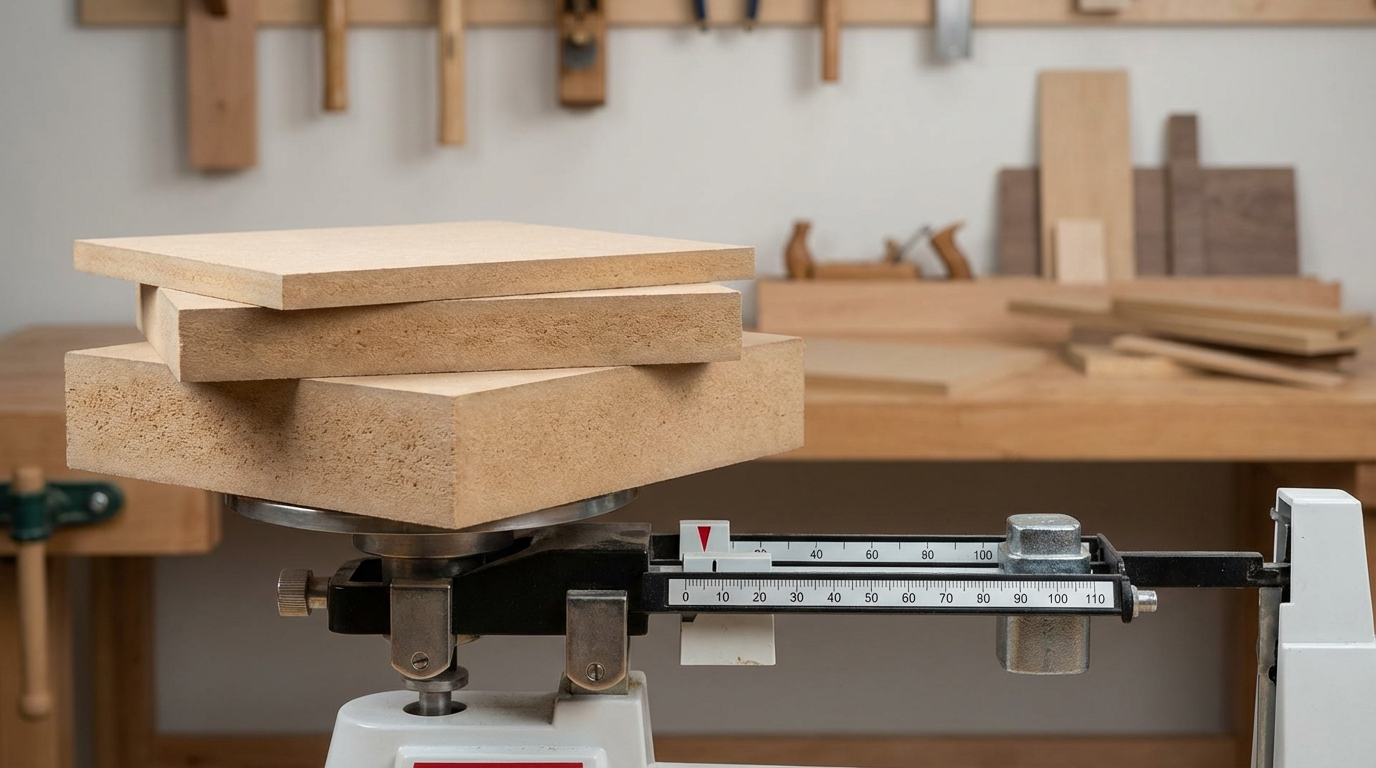
- Mistake 8: Skipping sample weigh—buy 1 sheet, scale it.
- Mistake 9: Coastal no MR upgrade—weight stable but prevents swell failures.
Failure Modes and Fixes
- Symptom: Back strains/labour delays. Root: Underestimated lift weights. Prevention: Calc per man 30–40 kg max. Fix: Hire extra or trolley.
- Symptom: Truck rejection/overcharge. Root: No total kg. Prevention: Sum sheets + buffer. Fix: Split deliveries.
- Symptom: Shelf sag/hinge fail. Root: Wrong density/load. Prevention: Factor live load <1/3 sheet weight. Fix: Reinforce or replace.
- Symptom: Wet swell in transit. Root: Monsoon exposure. Prevention: Tarpaulin cover. Fix: Dry 48 hrs before cut.
- Symptom: Uneven modular balance. Root: Density variation. Prevention: Same batch. Fix: Shim levels.
- Symptom: High disposal cost. Root: Waste weight ignored. Prevention: Optimize cuts. Fix: Sell scraps locally.
What if my MDF sheet feels heavier than calculated?
Humidity absorption or higher density batch—common in Indian summers. Direct: Weigh precisely, adjust density in formula (e.g., 850 kg/m³). Nuance: MR grades intentional heavy. Check: Tap edges (dense=sharp); dry in ventilated godown 2 days. Next: Recalc project with new factor, inform carpenter for load planning.
Quality Checks You Can Do Without Lab Tests
Before buying: Weigh sample on hanging scale; ask density spec; tap for uniform thud; check warp-free stack.
After cutting: Edges uniform density (no light spots); scraps weigh consistent.
After install: No uneven sag under hand pressure; hinges align without tilt.
Red flags: Feather-light feel (low density, poor screw hold); wet spots (swell risk).
Practical Tips by Buyer Persona
Homeowners
Do: Calc total for wardrobe move-in ease; choose lighter 12 mm for upstairs. Don’t: Ignore humidity—MR for bathrooms prevents weight swells and stains.
Carpenters
Cut with sharp 60-tooth blade; pre-weigh stacks for shift planning; edge-band heavy lifts to avoid drops. Fasten in density-matched zones.
Architects/Designers
Spec density >750 kg/m³ + thickness table; detail ventilation for coastal; balance panel weights in elevations.
OEM/Modular Makers
QC batch weights ±5%; Excel template for quotes; reduce returns by pre-labelling kg per part.
How heavy is 18 mm MDF for kitchen cabinets?
Typically 41–54 kg per 8×4 ft sheet; for 10 shutters (say 2×1 m cuts): ~100–130 kg total. Use HMR in humid kitchens. Conditions: Add struts if span >60 cm. Check: Load test sample shelf with 20 kg bags. Next: Quote labour as kg/20 per man.
FAQs
How accurate is the thickness × 2.5 kg rule for MDF?
This rough factor works for 750 kg/m³ average on 8×4 ft sheets but varies 10–20% by grade—use for quick bids, full formula for contracts. Indian eucalyptus MDF trends higher end; test one sheet. Buffer for logistics keeps it safe in variable humidity.
Does HDF weigh more than standard MDF?
Yes, HDF at 800–1000 kg/m³ adds 15–25% weight over MDF's 700–800; 12 mm HDF ~32–40 kg vs 27–35 kg MDF. Better screw hold but costlier transport. Opt for HDF in high-abuse like office partitions.
Why add moisture buffer to weight calcs?
Indian monsoons/coastals cause 5–15% water gain, swelling edges and hiking mass—critical for tempo loads and handling. Store vertical, covered; recalc post-arrival if damp. Prevents 20% of site delays.
Can I calculate weight for cut pieces?
Yes, proportional: (Cut L×W / full area) × full sheet weight. Excel scales easily. For CNC, input exact dims pre-job to avoid surprises in multi-part runs.
How does weight affect hinge choice?
Heavier panels (18+ mm) need heavy-duty hinges (rated 50+ kg/leaf); mismatch causes droop. Calc door weight first, divide by hinges. Common fail in wardrobes.
Is there a weight difference between laminated and plain MDF?
Laminate adds negligible 1–2 kg/sheet (0.1–0.3 mm thick); core density dominates. Prelam saves site weight from separate apps.
What truck for 50 MDF sheets (12 mm)?
Total ~1500–1750 kg; needs 2–3 tonne lorry, not tempo. Split if narrow access. Factor ramps/stairs.
How to reduce total project weight?
Optimize cuts (nesting software); thinner where possible (12 mm shelves); lighter HDF alternatives? No—MDF standard. Pre-cut deliveries help.
Does temperature affect MDF weight calcs?
Minimal direct, but heat drives off moisture (–2–5%), cold holds it. Consistent room temp for accuracy; site-dry before final weigh.
Disclaimer: This content is provided for general informational purposes based on industry practices and publicly available information. Product specifications, standards, prices, and availability may vary by manufacturer, region, and time. Readers should independently verify details with manufacturers, dealers, or qualified professionals before making purchase or construction decisions.Want Plywood Suggestions?
Share a few details and a VIR MDF specialist will suggest suitable brands and connect you to responsive dealers.