Medium Density Fibreboard: Complete Technical Guide 2026
Medium density fibreboard explained: composition, density grades, manufacturing & applications. Technical specifications from VIR MDF experts.
Quick Decision Summary
Quick Answer: Medium density fibreboard (MDF) is an engineered wood panel made from wood fibres bonded with synthetic resin under heat and pressure, featuring a density range of 600-800 kg/m³ that makes it ideal for furniture, cabinetry, and interior applications where smooth surfaces and precise machining matter.
If you're in a hurry: MDF offers exceptional surface smoothness, consistent strength in all directions, and superior machinability compared to solid wood or plywood. Standard MDF works for most interior furniture applications. Choose moisture-resistant (MR) grade for kitchens and bathrooms. Always seal edges properly in humid Indian conditions, and avoid using standard MDF in direct water contact or outdoor applications regardless of grade.
Choose medium density fibreboard if:
- You need a smooth, paint-ready surface without natural wood defects
- Your project requires intricate CNC routing, profiling, or moulding
- Dimensional stability matters more than raw structural strength
- Budget constraints make solid hardwood impractical
Avoid medium density fibreboard if:
- The application involves direct water exposure or outdoor installation
- Structural load-bearing capacity is the primary requirement
- Weight is a critical constraint (MDF is heavier than plywood of equal thickness)
- Edge screw-holding strength is essential without reinforcement
What Medium Density Fibreboard Actually Means
Medium density fibreboard is an engineered wood panel product manufactured by breaking down hardwood or softwood residuals into fine wood fibres, combining them with wax and resin binders, and forming panels under high temperature and pressure. The term "medium density" specifically refers to its density range of 600-800 kg/m³, positioning it between low-density fibreboard (particle board) and high-density fibreboard (HDF).
In the engineered wood hierarchy, MDF sits as follows:
| Panel Type | Density Range (kg/m³) | Primary Characteristic |
|---|---|---|
| Particle Board (LDF) | 450-650 | Lower cost, reduced strength |
| Medium Density Fibreboard | 600-800 | Balanced performance, smooth surface |
| High Density Fibreboard (HDF) | 800-1040+ | Superior hardness, laminate flooring substrate |
Common confusions clarified:
- MDF vs HDF: HDF is not a different material—it's the same manufacturing process pressed to higher density, resulting in harder, thinner panels typically used as laminate flooring core
- MDF vs Plywood: Plywood uses cross-laminated wood veneers; MDF uses reconstituted wood fibres—fundamentally different structures with different performance characteristics
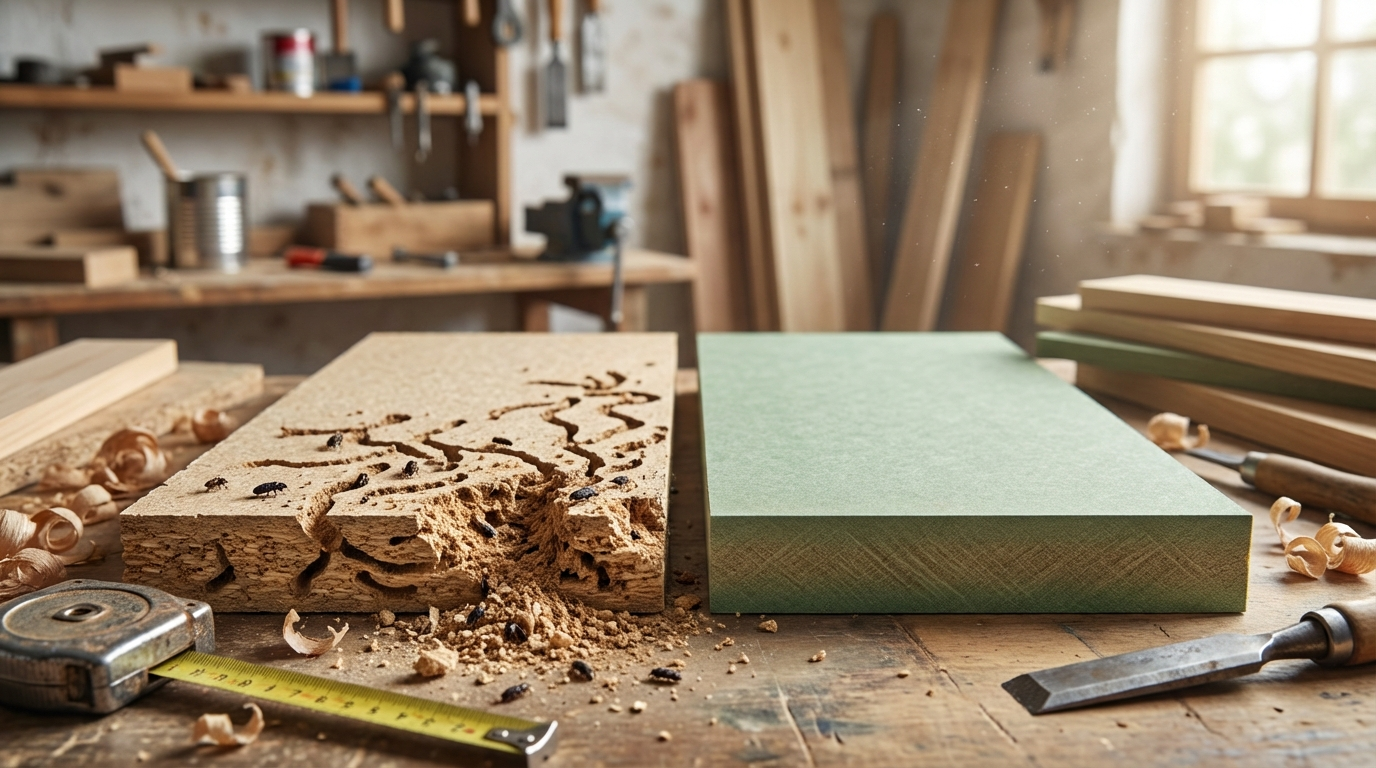
- MR MDF vs Waterproof MDF: No MDF variant is truly waterproof; moisture-resistant grades resist humidity better but still fail under direct water contact
Why This Matters for Indian Homes
Understanding medium density fibreboard specifications becomes critical in India due to the unique environmental challenges that affect material performance differently than in temperate climates where MDF standards originated.
Monsoon and Humidity Impact
During June-September monsoon months, relative humidity in many Indian cities exceeds 80-90%. Standard MDF absorbs this atmospheric moisture, causing thickness swelling of 10-15% in severe cases. This manifests as:
- Wardrobe doors that stick or won't close properly
- Drawer fronts that become misaligned
- Edge swelling visible as a "puffy" appearance at joints
- Laminate or veneer delamination starting from edges
Coastal Conditions
Cities like Mumbai, Chennai, Kochi, and Visakhapatnam experience salt-air exposure combined with high humidity. This accelerates edge deterioration even in MR-grade MDF if edges remain unsealed. Coastal installations typically require:
- Premium MR-grade or HDHMR (High Density High Moisture Resistant) variants
- Complete edge sealing with PU or epoxy-based sealers
- Additional ventilation gaps in closed cabinetry
Site Handling Realities
Indian construction sites present challenges rarely discussed in international MDF literature:
- Storage during construction: MDF sheets often remain at sites for weeks, exposed to cement dust and moisture before installation
- Transport damage: Rough handling during delivery causes edge chips and corner damage
- Carpenter skill variation: Edge-banding quality varies significantly, leaving moisture entry points
- AC cycling: Homes with split AC units create repeated humidity cycles that stress MDF joints
Medium Density Fibreboard Composition Explained
Understanding what goes into MDF helps predict how it will perform in specific applications. The composition of standard medium density fibreboard typically follows this breakdown:
| Component | Percentage by Mass | Function |
|---|---|---|
| Wood Fibres | 80-85% | Primary structural material |
| Resin Binder | 9-12% | Bonds fibres together under heat |
| Moisture Content | 5-8% | Residual water post-manufacturing |
| Paraffin Wax | 0.5-2% | Improves moisture resistance |
| Additives | 0-3% | Fire retardants, fungicides (in specialty grades) |
Wood Fibre Sources
Most MDF manufactured in India uses plantation softwoods (eucalyptus, poplar, pine) or agricultural residues like bagasse. The fibre quality affects final panel properties—longer, thinner fibres generally yield stronger boards. Imported MDF often uses European softwood species with different fibre characteristics.
Resin Binder Types
Urea-Formaldehyde (UF): Most common in standard MDF; lowest cost but higher formaldehyde emissions and poor moisture resistance
Melamine-Urea-Formaldehyde (MUF): Used in MR-grade MDF; improved moisture performance with moderate cost increase
Phenol-Formaldehyde (PF): Used in exterior-grade and BWR MDF; dark colour, excellent moisture resistance, higher cost
Polymeric MDI (PMDI): Used in zero-added-formaldehyde grades; superior moisture performance, no formaldehyde emissions, highest cost
Why Composition Matters for Buyers
The resin type directly determines:
- How the panel behaves in humid conditions
- Whether formaldehyde off-gassing occurs (relevant for bedrooms, children's furniture)
- Long-term structural integrity in kitchens/bathrooms
- Price point and availability
Manufacturing Process: From Wood to Board
Understanding how medium density fibreboard is made explains its unique properties and helps identify quality variations between manufacturers.
Stage 1: Fibre Preparation
Raw wood (logs, chips, or residues) is debarked and reduced to small chips. These chips are washed to remove contaminants, then thermally softened using steam. The softened chips enter a defibrator—a mechanical refiner that separates wood into individual fibres without cutting them. This "defibration" process is what distinguishes MDF from particle board, which uses larger wood particles.
Stage 2: Resin Application
Separated fibres enter a "blowline" where resin binder and wax are sprayed onto the fibres in a controlled environment. The resinated fibres are then dried in heated chambers, reducing moisture content while keeping the resin uncured.
Stage 3: Mat Formation
Dried, resinated fibres are evenly distributed onto a moving belt, creating a continuous "mat" of loose fibres. This random fibre distribution is key—it creates MDF's isotropic properties (equal strength in all directions), unlike solid wood's directional grain.
Stage 4: Hot Pressing
The fibre mat enters a hot press where temperatures of 150-200°C and pressures of 2-4 MPa compress the mat to final thickness. During pressing:
- Resin cures and bonds fibres permanently
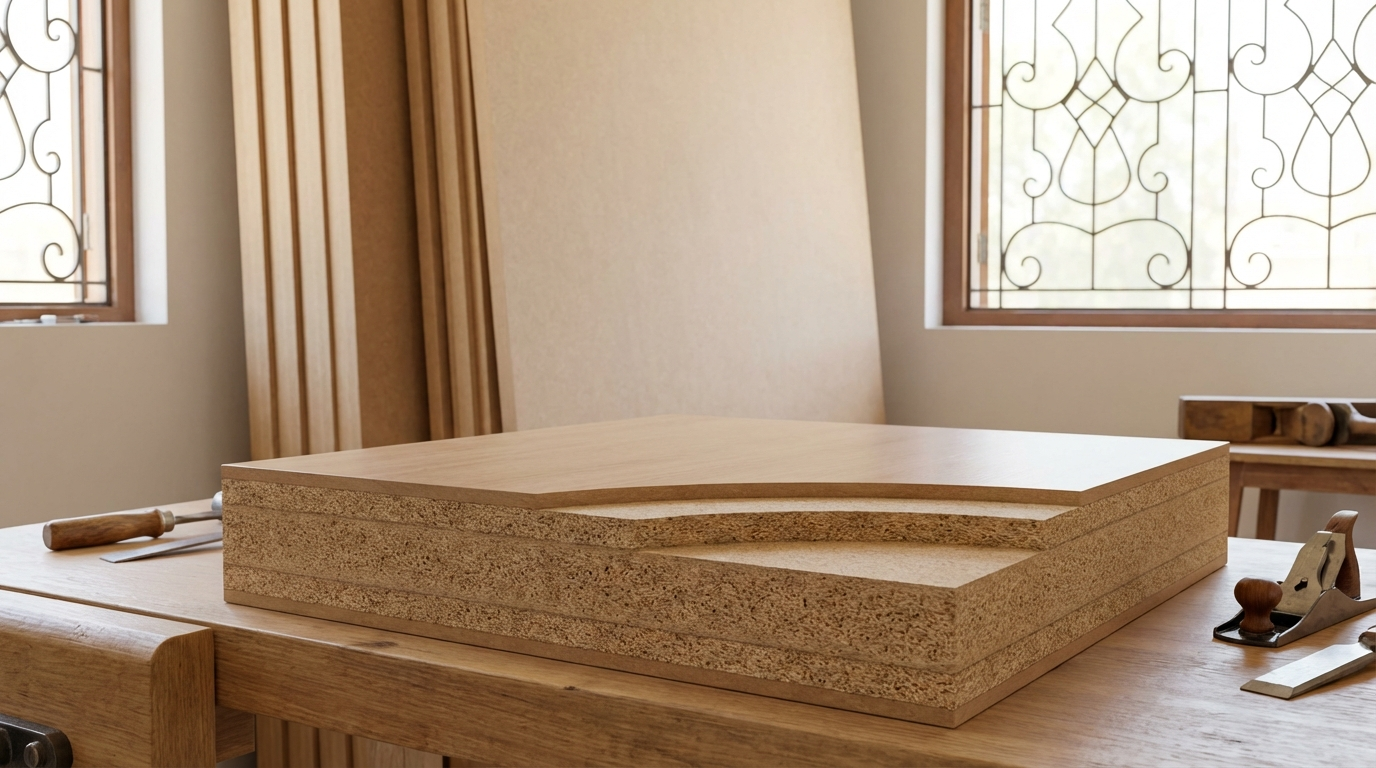
- A density gradient forms—higher density near surfaces, lower in the core
- Surface layers achieve 1000-1100 kg/m³ while core reaches 600-700 kg/m³
This density gradient explains why MDF machines so well—the denser faces hold sharp edges while the softer core reduces overall weight.
Stage 5: Finishing
Pressed panels are cooled, sanded to final smoothness, and cut to standard sizes. In India, common sheet sizes are 8x4 feet (2440x1220mm) and 8x6 feet (2440x1830mm).
Density Grades and Technical Specifications
Medium density fibreboard specifications vary by grade, and understanding these numbers helps match products to applications.
Standard MDF Specifications (Typical Indian Market)
| Property | Test Standard | Typical Value | What It Means |
|---|---|---|---|
| Density | IS 12406 | 700-800 kg/m³ | Weight per unit volume |
| Moisture Content | IS 12406 | 5-8% | Water content at delivery |
| Bending Strength (MOR) | IS 12406 | 28-35 N/mm² | Resistance to breaking under load |
| Modulus of Elasticity (MOE) | IS 12406 | 2500-3500 N/mm² | Stiffness/resistance to bending |
| Internal Bond Strength | IS 12406 | 0.55-0.80 N/mm² | Resistance to delamination |
| Thickness Swelling (24hr) | IS 12406 | ≤12% (standard), ≤8% (MR) | Moisture absorption behaviour |
| Surface Soundness | EN 311 | ≥1.0 N/mm² | Surface layer bond strength |
Thickness Options Available in India
Indian market commonly stocks these thicknesses:
- 2.5-3mm: Backing panels, drawer bottoms
- 6mm: Cabinet backs, partitions
- 8-9mm: Shelving, light-duty applications
- 12mm: Standard cabinet carcasses
- 16-18mm: Wardrobe shutters, table tops, heavy shelving
- 25mm: Premium furniture, thick mouldings
MDF Grade Variations
| Grade | Identifier | Key Property | Typical Application |
|---|---|---|---|
| Standard MDF | Plain/unmarked | General purpose | Dry interior furniture |
| MR MDF | Green core/marking | Enhanced moisture resistance | Kitchens, bathrooms (indirect moisture) |
| HMR/HDHMR | Green core, higher density | High moisture + high density | Modular kitchen carcasses |
| FR MDF | Red core/marking | Fire retardant additives | Public buildings, commercial spaces |
| Exterior MDF | Varies by manufacturer | Phenolic resin, weather resistant | Signage, protected outdoor use |
| E0/E1 MDF | Certification marking | Low formaldehyde emission | Hospitals, schools, bedrooms |
Decision Framework: Which Grade for Which Condition
| Condition/Application | Recommended Grade | Minimum Thickness | What to Verify |
|---|---|---|---|
| Bedroom wardrobe (AC room) | Standard MDF | 18mm shutters, 12mm carcass | Sealed edges, proper ventilation |
| Bedroom wardrobe (non-AC) | MR MDF preferred | 18mm shutters, 12mm carcass | Green core visible, edge banding quality |
| Kitchen cabinets (not near sink) | MR MDF minimum | 18mm shutters, 16mm carcass | MR certification, marine ply alternative for base |
| Kitchen base units near sink | HDHMR or BWR Plywood | 18mm minimum | Edge sealing critical, drainage provisions |
| Bathroom vanity (indirect moisture) | HDHMR or BWR Plywood | 18mm | Avoid MDF for base; okay for mirror frames |
| Coastal city installation | HDHMR minimum | 18mm | All edges sealed, anti-fungal treatment |
| TV unit/entertainment centre | Standard or MR MDF | 18mm main, 6mm backing | Heat dissipation provisions |
| Children's room furniture | E1/E0 certified MDF | Per application | Emission test certificate, rounded edges |
| Office partitions | Standard MDF | 12-18mm | Fire rating if required by code |
| Commercial retail fixtures | FR MDF (if required) | 18mm | Fire test certificate, building compliance |
Common Buyer Mistakes (And How to Avoid Them)
Mistake 1: Using Standard MDF in Kitchen Base Units
Consequence: Swelling at base within 6-18 months from floor cleaning water and sink splashes
Prevention: Use HDHMR or marine plywood for any cabinet within 2 feet of water sources; elevate base units on aluminium legs
Mistake 2: Accepting Pre-Laminated MDF Without Edge Sealing
Consequence: Moisture enters through exposed edges, causing core swelling that pushes laminate off
Prevention: Insist on edge banding on all exposed edges; check that edge band adhesion is complete without gaps
Mistake 3: Believing "Waterproof MDF" Marketing Claims
Consequence: Severe damage when the "waterproof" product fails under actual water exposure
Prevention: Understand that even BWR (Boiling Water Resistant) MDF only resists humidity and splash—no MDF survives submersion or prolonged direct water contact
Mistake 4: Ignoring Density When Comparing Prices
Consequence: Cheaper, lower-density MDF sags, dents easily, and holds screws poorly
Prevention: Compare prices per square foot at the same thickness AND density; ask for density specifications
Mistake 5: Skipping Acclimatisation Before Installation
Consequence: Boards cut to size expand or contract after installation, causing gaps or buckling
Prevention: Store MDF sheets at the installation site for 48-72 hours before cutting, especially during monsoon or extreme dry seasons
Mistake 6: Using Incorrect Hardware
Consequence: Screws strip out of MDF, especially on edges; hinges loosen over time
Prevention: Use coarse-threaded screws designed for MDF; pre-drill pilot holes; use cam locks and dowels for carcass assembly; consider hinge mounting plates on door edges
Mistake 7: Installing MDF Without Adequate Ventilation Provisions
Consequence: Moisture accumulates inside closed cabinets, causing mould and panel deterioration
Prevention: Include ventilation grilles or gaps in cabinet designs; avoid fully sealing wardrobe backs against walls
Mistake 8: Trusting Colour Alone for Grade Identification
Consequence: Green or red dye doesn't guarantee MR or FR properties—it's just a marking convention
Prevention: Request test certificates or manufacturer documentation; buy from authorised dealers of reputed brands
Failure Modes and How to Prevent Them
Failure Mode 1: Edge Swelling
Symptom: Visible puffiness along panel edges, especially near kitchens, bathrooms, or during monsoon
Root Cause: Unsealed edges absorbing atmospheric moisture or water splashes
Prevention: Complete edge banding or sealing on all exposed edges; PVC edge band minimum 0.8mm thickness; PU-based edge adhesion for wet zones
Fix if already happening: Cannot be reversed; affected panels must be replaced; salvage usable portions for dry-zone applications
Failure Mode 2: Surface Delamination
Symptom: Laminate, veneer, or paint film peeling away from MDF surface
Root Cause: Moisture penetration from edges causing core expansion that stresses surface bond; or poor surface preparation before finishing
Prevention: Seal edges before finishing; ensure surface is clean and dust-free; use appropriate primers for MDF
Fix if already happening: Remove loose material, sand smooth, re-seal edges, apply fresh finish with proper primers
Failure Mode 3: Sagging Shelves
Symptom: Horizontal MDF panels developing visible curve under load over time
Root Cause: Span too long for thickness; sustained heavy loads; lower-density MDF used
Prevention: Use 18mm minimum for shelves over 600mm span; add centre supports for spans over 800mm; use higher-density grades for heavy loads
Fix if already happening: Add support brackets; replace with thicker panel or add aluminium channel reinforcement underneath
Failure Mode 4: Screw Pull-Out
Symptom: Hardware (hinges, handles) loosening; screws no longer holding
Root Cause: Screws driven into MDF edge grain; wrong screw type; repeated stress on fastenings
Prevention: Use coarse-threaded screws; pre-drill pilot holes; use cam-lock or confirmat screws for structural joints; consider threaded inserts for repeatedly removed hardware
Fix if already happening: Plug holes with wooden dowels and wood glue, re-drill; or install larger-diameter screws; use threaded metal inserts for critical connections
Failure Mode 5: Formaldehyde Off-Gassing
Symptom: Persistent chemical smell from new furniture; eye/throat irritation in enclosed rooms
Root Cause: High formaldehyde emission from UF-bonded MDF, especially in poorly ventilated spaces
Prevention: Specify E1 or E0 grade MDF; ensure adequate room ventilation; seal all MDF surfaces including backs and undersides
Fix if already happening: Increase ventilation; seal exposed MDF surfaces with primer/sealer; allow 2-4 weeks of airing out with windows open
Failure Mode 6: Core Degradation in Humid Storage
Symptom: MDF feels soft or punky when cut; internal bond failure
Root Cause: Prolonged storage in damp conditions before installation; site storage during monsoon without protection
Prevention: Store MDF flat on dry bearers, covered with polythene; elevate above concrete floors; use within reasonable time of delivery
Fix if already happening: Damaged boards cannot be salvaged; reject for structural use; possibly usable for non-critical applications if only surface affected
Quality Checks Without Lab Tests
Before Buying: Visual and Physical Checks
Surface inspection:
- Run your hand across the surface—it should feel uniformly smooth without rough patches or undulations
- Look along the surface at an angle under good lighting—no visible dips, high spots, or sanding marks
- Check for any visible contamination, oil spots, or discolouration
Edge inspection:
- Examine the cut edge for uniform colour and density throughout thickness
- Look for the density gradient—slightly darker/denser at faces, lighter in core (normal and desirable)
- No visible voids, gaps, or foreign material in the core
- For MR grade: green tint should be consistent throughout the board, not just surface
Dimensional checks:
- Measure thickness at multiple points—variation should be within ±0.2mm
- Check sheet for flatness by placing on a flat surface—no rocking or visible bow
- Verify sheet dimensions match stated size
Questions to ask the dealer:
- Which manufacturer? (Avoid generic or unbranded sheets)
- What is the density specification?
- Is this E1/E2 grade for emissions?
- What is the moisture resistance rating?
- Can you provide a test certificate or technical data sheet?
After Cutting: Quality Verification
Edge quality after sawing:
- Clean cut without excessive chipping or tear-out
- Core colour uniform across the cut
- No burning marks (indicates appropriate blade and feed speed)
Routing/profiling check:
- Sharp, crisp profile edges without fuzz or crumbling
- Smooth profile surface suitable for direct painting
- No core separation at profiled areas
After Installation: Ongoing Assessment
- Check door/drawer alignment after 2-4 weeks—seasonal adjustment may be needed
- Inspect edges for any early signs of swelling during first monsoon
- Verify hardware remains tight after initial settling period
- Monitor for any odour persistence beyond 2-3 weeks (indicates emission issues)
Practical Applications of Medium Density Fibreboard
Furniture Manufacturing
MDF dominates the modular furniture industry due to its combination of smooth surfaces, consistent properties, and cost-effectiveness. Typical applications include:
- Wardrobe shutters: 18mm MDF with laminate or veneer finish; MR grade for non-AC bedrooms
- Cabinet carcasses: 16-18mm for load-bearing components; 12mm for internal partitions
- Drawer fronts: 18mm for durability; painted or laminated finish
- Table tops: 25mm for dining tables with proper edge treatment; 18mm for study tables
- Bed headboards: 18mm with fabric or leather upholstery; CNC-routed decorative patterns
Architectural Millwork
MDF's machinability makes it ideal for interior trim and moulding applications:
- Skirting boards: 12-18mm, profile-routed to match architectural style
- Door frames: 18-25mm with appropriate profile routing
- Wall panelling: 9-12mm with decorative grooves or patterns
- Ceiling coffers: 12mm for decorative ceiling treatments
- Column cladding: 12-18mm wrapped around structural columns
Specialty Applications
Acoustic panels: Perforated MDF with absorptive backing for sound control in offices, auditoriums, and home theatres
Display and retail: Point-of-sale displays, exhibition stands, shop fixtures—easy to shape, finish, and assemble
Speaker enclosures: Dense, non-resonant MDF is preferred by audio manufacturers for speaker boxes
Tips by User Type
For Homeowners
Durability expectations: Well-made MDF furniture in appropriate conditions (sealed edges, controlled humidity) should last 10-15 years with normal use. Kitchen cabinets using proper grades typically last 8-12 years before significant wear becomes apparent.
Cleaning guidelines:
- Use slightly damp cloth—never wet
- Wipe up spills immediately, especially near edges
- Avoid ammonia-based cleaners on laminated surfaces
- Never use abrasive scrubbers
When to worry:
- Visible edge swelling—address moisture source immediately
- Hardware loosening repeatedly—may indicate internal degradation
- Persistent musty smell—check for moisture behind/beneath furniture
For Carpenters and Fabricators
Cutting recommendations:
- Use TCT (tungsten carbide tipped) blades—MDF is highly abrasive
- 60-80 teeth for 250-300mm diameter blades gives clean cuts
- Support sheets fully to prevent binding and chipping
- Effective dust extraction is essential—MDF dust is finer and more hazardous than wood dust
Edge preparation:
- Sand edges to 180-220 grit before edge banding
- Apply edge band with hot-melt adhesive at correct temperature (180-200°C typically)
- Trim and buff edge band within appropriate time window
Screw zones:
- Always pre-drill pilot holes—diameter approximately 70% of screw shank
- Keep screws minimum 25mm from edges to prevent splitting
- For edge fastening, use confirmat screws or cam-lock systems
Hinge mounting:
- Cup hinges require accurate 35mm boring—use quality Forstner bits
- Consider hinge mounting plates for edge-mounted applications
- Soft-close hinges reduce stress on MDF door edges
For Architects and Interior Designers
Specification language: When specifying MDF in project documents, include:
- Density requirement (minimum 700 kg/m³ for furniture grade)
- Moisture resistance grade (MR/HMR/HDHMR as applicable)
- Emission class (E1 minimum, E0 for sensitive occupancies)
- Thickness tolerance requirements
- Surface quality grade (furniture grade for visible surfaces)
Wet-zone detailing:
- Specify HDHMR or marine plywood for any cabinet within splash zone
- Call out edge sealing requirements explicitly
- Include ventilation provisions in cabinet designs
- Consider aluminium legs/bases to isolate MDF from floor moisture
For Modular Kitchen and Furniture Manufacturers
Incoming QC checkpoints:
- Density verification on sample basis
- Thickness consistency across sheet
- Surface quality for lamination/painting
- Moisture content (should be 5-8%)
- Batch consistency for large orders
Reducing customer complaints:
- Complete edge sealing on all panels, not just visible edges
- Use appropriate grades for specific zones—don't compromise on sink bases
- Include usage guidelines in customer handover documentation
- Conduct pre-monsoon check-in calls for first-year installations
Medium Density Fibreboard vs Alternatives: Comparison Guide
| Parameter | MDF | Particle Board | Plywood | Solid Wood |
|---|---|---|---|---|
| Surface Smoothness | Excellent (paint-ready) | Poor (requires facing) | Fair (veneer-dependent) | Variable (grain-dependent) |
| Edge Machining | Excellent | Poor | Fair (may splinter) | Excellent |
| Screw Holding (Face) | Good | Fair | Excellent | Excellent |
| Screw Holding (Edge) | Poor | Very Poor | Good | Excellent |
| Moisture Resistance | Poor (standard), Fair (MR) | Very Poor | Fair (commercial), Good (marine) | Variable by species |
| Weight (18mm) | Heavy (~13-14 kg/m²) | Medium (~10-12 kg/m²) | Medium (~10-12 kg/m²) | Variable by species |
| Cost (relative) | Medium | Low | Medium-High | High-Very High |
| Availability in India | Excellent | Excellent | Good | Limited for quality |
Choose MDF when: Smooth painted finish is the priority; intricate profiling or CNC work required; consistent properties matter more than structural strength
Choose Plywood when: Structural strength is primary concern; moisture exposure likely; edge screw-holding required; weight is a constraint
Choose Particle Board when: Budget is extremely tight; application is non-visible substrate; minimal moisture exposure guaranteed
Frequently Asked Questions
What is medium density fibreboard made of?
Medium density fibreboard is made from approximately 80-85% wood fibres (from softwood or hardwood sources), 9-12% synthetic resin binder (typically urea-formaldehyde for standard grades or melamine-urea-formaldehyde for moisture-resistant grades), and small amounts of paraffin wax and moisture. The wood is broken down into individual fibres through a mechanical refining process, then combined with resin and pressed under high temperature and pressure to form dense, smooth panels. The manufacturing process creates a homogeneous material with consistent properties throughout, unlike natural wood which has variable grain and potential defects.
Is MDF safe to use in homes, especially children's rooms?
Standard MDF releases formaldehyde over time, which can cause respiratory irritation. However, modern MDF manufactured to E1 emission standards (mandatory in many countries) releases formaldehyde at levels considered safe for indoor use. For children's rooms, hospitals, and sensitive individuals, specify E0 or zero-added-formaldehyde (NAF) grades that use alternative binders. Regardless of grade, sealing all MDF surfaces with paint, laminate, or sealer significantly reduces any emissions. Ensuring adequate room ventilation during the first few weeks after installation further minimises exposure.
Can medium density fibreboard get wet?
Standard MDF should never get wet—even brief water exposure causes swelling and permanent damage. Moisture-resistant (MR) MDF handles humidity and occasional splash better but is still not waterproof. Even so-called "waterproof" or BWR MDF only resists short-term water contact and high humidity—prolonged soaking or submersion will damage any MDF product. For areas with regular water exposure like kitchen sink bases or bathroom vanities, marine plywood or HDHMR with complete edge sealing provides better performance. Always wipe spills immediately and ensure good ventilation in humid spaces.
How do I identify MR MDF from standard MDF?
Moisture-resistant MDF is typically identified by a green dye applied throughout the board (visible when you look at a cut edge), though this colouring convention varies by manufacturer and is not a guarantee of performance. The reliable way to confirm MR grade is to request technical documentation or test certificates from the manufacturer. When purchasing, ask specifically for MR grade and verify through authorised dealer channels. Some premium brands use different colour codes, so always confirm the grade specification rather than relying solely on colour identification.
What thickness of MDF should I use for wardrobe shutters?
For wardrobe shutters, 18mm is the standard and recommended thickness in India. This provides adequate rigidity to prevent warping, sufficient material for hinge boring, and a substantial feel that customers expect. Thinner 16mm shutters may work for very small doors (under 400mm width) but tend to feel flimsy. For exceptionally tall shutters (over 2100mm), consider 19mm or 25mm to prevent bowing. Always use MR grade in non-AC bedrooms or humid climates, and ensure all edges are properly sealed with edge banding to prevent moisture infiltration.
Why does MDF furniture swell during monsoon season?
MDF swelling during monsoon occurs because the material absorbs moisture from humid air, particularly through unsealed edges. The wood fibres in MDF naturally attract and hold water vapour, causing the board to expand in thickness. This swelling is most visible at edges because cut edges expose the porous core directly to moisture. Prevention requires complete edge sealing (edge banding on all exposed edges), using MR-grade MDF in humid areas, ensuring furniture has ventilation provisions, and controlling room humidity with air conditioning or dehumidifiers during peak monsoon periods.
Can I use MDF for kitchen cabinets?
MDF can be used for kitchen cabinets with appropriate grade selection and installation practices. Use HDHMR (High Density High Moisture Resistant) grade minimum for all kitchen applications. For base units near sinks, marine plywood is preferable for the carcass, while MDF can be used for shutter faces. All edges must be completely sealed with PVC edge banding. Install base cabinets on aluminium legs to isolate them from floor moisture during cleaning. Even with these precautions, expect shorter lifespan (8-12 years) compared to plywood construction in kitchen environments.
How do I properly paint medium density fibreboard?
Painting MDF requires proper preparation due to its porous nature. Start by sanding surfaces with 180-220 grit sandpaper. Edges are significantly more absorbent than faces and require special attention—apply a skim coat of wood filler or multiple primer coats specifically to edges. Use an MDF-specific primer or shellac-based primer that seals the surface effectively; standard wood primers often allow blotchy absorption. Sand lightly with 220-320 grit between primer coats. Apply thin topcoats of quality acrylic or enamel paint, allowing proper drying time between coats. Satin or semi-gloss finishes hide imperfections better than high-gloss.
What is the difference between MDF and HDF?
MDF (Medium Density Fibreboard) and HDF (High Density Fibreboard) are made through the same manufacturing process but pressed to different densities. MDF typically ranges from 600-800 kg/m³, while HDF exceeds 800 kg/m³, often reaching 1000+ kg/m³. HDF's higher density makes it harder, more resistant to denting, and better at holding fine details. However, HDF is typically available only in thinner sheets (3-8mm) and is primarily used as laminate flooring substrate. MDF's broader thickness range (2.5-25mm+) and easier machinability make it more versatile for furniture and millwork applications.
Is medium density fibreboard environmentally friendly?
MDF has both environmental advantages and concerns. On the positive side, it efficiently utilises wood resources—including sawmill residues, plantation thinnings, and agricultural waste—that might otherwise be discarded. Wood products also store carbon sequestered during tree growth. However, MDF manufacturing is energy-intensive, and conventional urea-formaldehyde resins raise emission concerns. Look for FSC or PEFC certification indicating sustainable wood sourcing, and E1/E0 or NAF grades for reduced formaldehyde. End-of-life recycling of MDF is limited in India, though technology exists to recover fibres for reuse. Overall, responsibly sourced MDF can be a reasonable environmental choice compared to harvesting solid hardwood.
How long does MDF furniture typically last in Indian conditions?
MDF furniture lifespan in India varies significantly based on grade selection, installation quality, and environmental conditions. In air-conditioned bedrooms with properly sealed edges, well-made MDF wardrobes typically last 10-15 years with normal use. Kitchen cabinets using appropriate HDHMR grades last 8-12 years. Non-AC bedrooms in humid climates may see reduced lifespan (6-10 years) unless MR grade is used throughout. Coastal city installations face accelerated deterioration. Key factors affecting longevity include edge sealing quality, hardware quality, humidity management, and usage intensity. Proper maintenance (prompt spill cleanup, avoiding overloading shelves) extends useful life.
What screws should I use for MDF?
Use coarse-threaded screws specifically designed for engineered wood when fastening MDF. These have wider thread spacing that grips the fibre structure better than fine-threaded wood screws. For face fastening, standard coarse-thread screws work well with pre-drilled pilot holes (diameter approximately 70% of screw shank). For edge fastening where MDF is weakest, use confirmat screws (furniture connector screws) or cam-lock fittings designed for panel furniture assembly. Avoid driving screws too close to edges (minimum 25mm clearance) to prevent splitting. For hardware that will be repeatedly removed (access panels, etc.), consider threaded metal inserts.
Disclaimer: This content is provided for general informational purposes based on industry practices and publicly available information. Product specifications, standards, prices, and availability may vary by manufacturer, region, and time. Readers should independently verify details with manufacturers, dealers, or qualified professionals before making purchase or construction decisions.Want Plywood Suggestions?
Share a few details and a VIR MDF specialist will suggest suitable brands and connect you to responsive dealers.