What is MDF Material? Properties, Grades & Applications
What is MDF material? Learn MDF properties, density grades, moisture resistance & applications. Technical specifications from VIR MDF experts.
Quick Decision Summary
Quick Answer: MDF material (Medium Density Fibreboard) is an engineered wood product made from wood fibres bonded with resin under high pressure and temperature, offering uniform density, smooth surfaces, and excellent machinability for furniture, cabinetry, and interior applications across Indian homes and commercial spaces.
If you're in a hurry: MDF is your go-to material when you need smooth, paintable surfaces without wood grain interference, consistent thickness across large panels, and cost-effective alternatives to solid wood. It machines beautifully for CNC work, accepts paint and laminate finishes perfectly, and comes in multiple grades for different moisture and fire resistance requirements. For Indian conditions, choose HDFWR grade for kitchens and bathrooms, standard MDF for bedrooms and living areas.
Choose MDF material if:
- You need perfectly smooth, paintable surfaces for modern furniture
- Your project requires intricate CNC routing or detailed moulding work
- Budget constraints rule out solid wood but quality cannot be compromised
- Dimensional consistency across multiple panels is critical
Avoid MDF material if:
- The application involves direct, prolonged water contact (use marine ply instead)
- Structural load-bearing is the primary requirement
- Outdoor exposure without proper sealing and protection is unavoidable
- You require the natural grain aesthetics of real wood
What MDF Material Actually Means
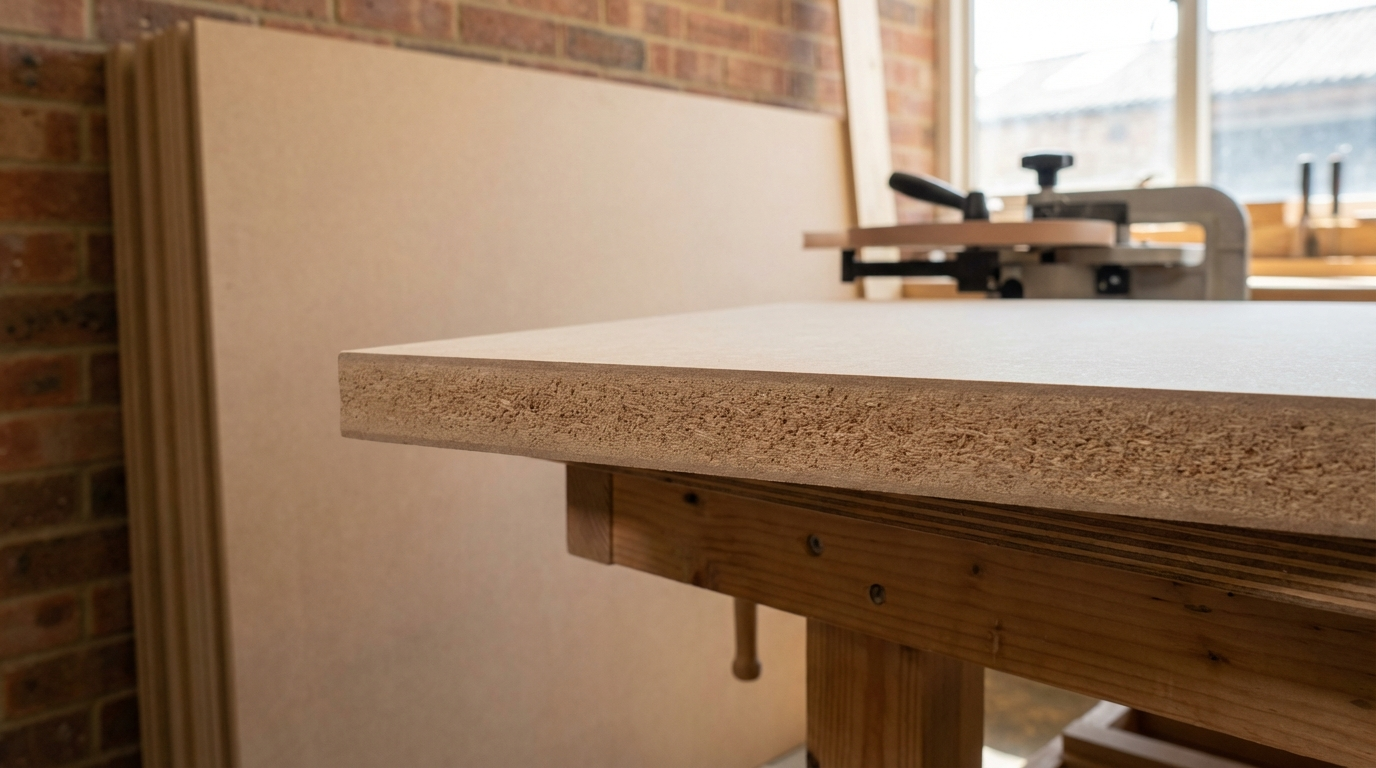
MDF stands for Medium Density Fibreboard, an engineered wood panel manufactured by breaking down hardwood or softwood residuals into fine wood fibres, combining them with wax and thermosetting resin binders, and forming panels under high pressure (typically 150-200 kg/cm²) and temperature (150-200°C). The resulting product has a density range of 600-800 kg/m³, placing it between low-density fibreboard and high-density fibreboard in the engineered wood hierarchy.
Unlike plywood which uses layered wood veneers, or particle board which uses larger wood particles, MDF uses refined wood fibres that create a homogeneous, grain-free structure. This fundamental difference explains why MDF machines so cleanly—there's no grain direction to cause tear-out, no voids between layers, and no density variations across the panel face.
Where MDF Fits in the Material Hierarchy
In the engineered wood spectrum, MDF occupies the middle ground between particle board (lower cost, lower performance) and plywood (higher cost, better structural properties). Understanding this positioning helps you make informed material choices:
- Below MDF: Particle board—cheaper but weaker, less machinable, poor edge quality
- At MDF level: Standard MDF, HDF (High Density Fibreboard), various moisture-resistant grades
- Above MDF: Plywood—better structural strength, moisture resistance, but visible layers and higher cost
Common Confusions Clarified
MDF vs HDF: HDF (High Density Fibreboard) has density above 800 kg/m³ compared to MDF's 600-800 kg/m³. HDF offers better surface hardness and is commonly used for laminate flooring underlayment.
MDF vs Particle Board: While both are engineered wood products, MDF uses fine fibres while particle board uses larger wood chips. MDF has superior edge quality, better screw-holding in edges, and smoother surfaces.
MDF vs Plywood: Plywood has cross-laminated wood veneers providing structural strength and better moisture handling. MDF offers superior surface smoothness and machinability but lacks plywood's structural capabilities.
Why MDF Material Matters for Indian Homes
India's diverse climate zones—from humid coastal regions to dry northern plains—create unique challenges for interior materials. MDF's engineered composition offers specific advantages and requires specific precautions in Indian conditions.
Monsoon and Humidity Impact
During June-September, relative humidity in coastal cities like Mumbai, Chennai, and Kolkata regularly exceeds 80-90%. Standard MDF absorbs moisture from air, leading to:
- Thickness swelling: 8-15% increase in thickness when moisture content rises significantly
- Edge swelling: Exposed edges swell faster than faces, causing warping
- Surface waviness: Uneven moisture absorption creates visible undulations
- Reduced screw-holding: Moisture weakens the fibre-resin bond
Prevention strategy: Use HDFWR (High Density Fibreboard Water Resistant) grade for all furniture in humid zones. Ensure complete edge banding on all exposed edges. Apply primer on all surfaces before final finishing.
Coastal Conditions Considerations
Salt air in coastal areas accelerates material degradation. For MDF in coastal Indian cities:
- Specify moisture-resistant grades even for bedroom furniture
- Ensure complete surface sealing with polyurethane or melamine finishes
- Avoid placing MDF furniture against exterior walls where condensation occurs
- Maintain AC operation to control indoor humidity levels
Site Storage Realities
On Indian construction sites, materials often sit exposed for days or weeks. MDF requires:
- Storage off ground on wooden battens (minimum 100mm clearance)
- Plastic sheet covering during monsoon months
- Immediate edge sealing upon delivery
- Installation only after site is weatherproofed
MDF Composition and Manufacturing Process
Understanding how MDF is made helps you evaluate quality and predict performance. The manufacturing process directly influences the material's properties.
Raw Material Composition
| Component | Percentage by Weight | Function |
|---|---|---|
| Wood Fibres | 82-88% | Primary structural material |
| Urea-Formaldehyde Resin | 9-14% | Binding agent |
| Wax Emulsion | 0.5-1% | Internal moisture resistance |
| Hardeners/Catalysts | 0.5-1% | Accelerate resin curing |
| Additives (if any) | Variable | Fire retardant, extra moisture resistance |
Manufacturing Steps
Step 1: Debarking and Chipping
Logs (typically softwood like pine or hardwood residuals) are debarked and chipped into small pieces approximately 25mm in size.
Step 2: Defibration
Chips are softened with steam and mechanically broken down into fine fibres in a defibrator. This creates the homogeneous fibre structure that gives MDF its characteristic smoothness.
Step 3: Resin Blending
Wood fibres are mixed with urea-formaldehyde resin, wax emulsion, and any additives. The resin content and type determine the board's moisture resistance and strength.
Step 4: Mat Formation
The fibre-resin mixture is spread onto a forming belt to create a uniform mat of controlled thickness.
Step 5: Hot Pressing
The mat is compressed under high pressure (150-200 kg/cm²) and temperature (150-200°C). This activates the resin, bonding fibres together and creating the final density profile.
Step 6: Cooling and Conditioning
Boards are cooled slowly to prevent internal stress, then conditioned to stabilize moisture content at 5-8%.
Step 7: Sanding and Sizing
Final sanding creates the smooth surface, and boards are cut to standard sizes.
MDF Properties and Technical Specifications
MDF's performance characteristics make it suitable for specific applications. These properties vary by grade and manufacturer, so always verify specifications for your specific project.
Physical Properties
| Property | Standard MDF | HDF | HDFWR | Test Method |
|---|---|---|---|---|
| Density | 600-800 kg/m³ | 800-1000 kg/m³ | 850-950 kg/m³ | IS 12406 |
| Moisture Content | 5-8% | 5-8% | 5-8% | IS 12406 |
| Thickness Swelling (24hr) | 10-15% | 8-12% | 5-8% | IS 12406 |
| Water Absorption (24hr) | 25-35% | 20-30% | 12-18% | IS 12406 |
| Internal Bond Strength | 0.55-0.70 N/mm² | 0.70-0.90 N/mm² | 0.80-1.0 N/mm² | IS 12406 |
Mechanical Properties
| Property | Typical Range | Significance |
|---|---|---|
| Modulus of Rupture (MOR) | 25-35 N/mm² | Bending strength—higher is better for shelving |
| Modulus of Elasticity (MOE) | 2500-3500 N/mm² | Stiffness—higher means less deflection |
| Screw Holding - Face | 1000-1400 N | Hinge mounting strength |
| Screw Holding - Edge | 700-1000 N | Edge-mounted hardware retention |
| Surface Hardness | 2-4 N/mm² (Brinell) | Scratch and dent resistance |
Working Properties
Machinability: MDF machines exceptionally well with standard woodworking tools. No grain direction means routing, drilling, and cutting produce clean edges regardless of direction. CNC routing achieves crisp, detailed profiles impossible with natural wood.
Finishing: The smooth, pore-free surface accepts paint directly without grain filler. Primer coat adhesion is excellent. Laminate and veneer bonding is superior due to consistent surface density.
Fastening: Screws hold well in face applications but require pilot holes in edges. Use coarse-thread screws for better grip. Edge screw-holding improves with higher density grades.
MDF Grades and Types Explained
Different MDF grades address specific performance requirements. Choosing the correct grade prevents premature failure and unnecessary cost.
Standard/Interior Grade MDF
What it is: Basic MDF suitable for dry interior applications. The most economical option for general furniture and millwork.
Best for: Bedroom wardrobes, living room furniture, office furniture, decorative mouldings, picture frames, display units in air-conditioned spaces.
Avoid for: Kitchens, bathrooms, laundry areas, basement furniture, any area with humidity fluctuations.
Indian market availability: Most widely available. Thickness range typically 2mm to 25mm. Standard sizes 8ft x 4ft and 8ft x 6ft.
Moisture Resistant MDF (MR-MDF/HDFWR)
What it is: MDF manufactured with moisture-resistant resin systems and higher wax content. Often identified by green or blue core colour.
Best for: Kitchen cabinets, bathroom vanities, laundry room furniture, coastal area installations, areas with high humidity but no direct water contact.
Technical difference: Thickness swelling reduced to 5-8% versus 10-15% for standard grade. Water absorption reduced by 40-50%.
Important clarification: Moisture resistant does not mean waterproof. Prolonged water contact will still cause damage. It handles humidity and occasional splashes, not submersion.
Fire Retardant MDF (FR-MDF)
What it is: MDF treated with fire-retardant chemicals during manufacturing. Slows flame spread and reduces smoke generation.
Best for: Commercial buildings, schools, hospitals, hotels, cinema halls, public assembly areas where fire safety codes apply.
Compliance: Should meet Class 1 or Class 2 surface spread of flame ratings as per IS 1734. Verify certifications for specific projects.
Availability: Usually requires advance ordering in India. Higher cost than standard grades.
Exterior Grade MDF
What it is: MDF engineered for semi-exposed outdoor applications. Uses phenolic or melamine-urea-formaldehyde resins for better weather resistance.
Best for: Covered outdoor furniture, signage, soffits, architectural elements with some weather protection.
Limitations: Not suitable for direct rain exposure or ground contact. Requires proper finishing and maintenance.
Pre-laminated/Melamine MDF
What it is: MDF panels factory-finished with decorative melamine paper surfaces. Available in woodgrain patterns, solid colours, and textured finishes.
Best for: Ready-to-use furniture components, modular furniture, retail fixtures, office workstations where painting is impractical.
Advantages: No finishing required, consistent colour, scratch-resistant surface, available in hundreds of designs.
Decision Framework: Which MDF Grade for Which Condition
| Condition/Application | Recommended MDF Grade | What to Verify Before Purchase |
|---|---|---|
| Bedroom wardrobe (AC room) | Standard/Interior Grade | Density 700+ kg/m³, smooth surface |
| Bedroom wardrobe (non-AC, coastal) | HDFWR/Moisture Resistant | Green/blue core, thickness swelling test results |
| Kitchen cabinets | HDFWR Grade | Moisture resistance certification, edge quality |
| Bathroom vanity | HDFWR with full edge sealing | Complete laminate coverage, no exposed edges |
| TV unit (dry area) | Standard Grade or Prelam | Surface smoothness, uniform thickness |
| Commercial office furniture | Standard Grade or FR-MDF | Fire rating if required, internal bond strength |
| Hospital/School furniture | FR-MDF | Fire certification, formaldehyde emission class |
| Outdoor signage (covered) | Exterior Grade | Phenolic resin content, proper finishing required |
| CNC detailed work | HDF or high-density MDF | Density above 800 kg/m³ for crisp edges |
| Budget furniture (dry area) | Standard Grade 650-700 density | Minimum acceptable density, surface defects |
MDF Applications Across Indian Interiors
MDF's versatility makes it suitable for diverse applications. The key is matching the grade and thickness to the specific use case.
Furniture Applications
- Wardrobes and closets: 18mm for carcass, 16-18mm for shutters, 8-12mm for back panels
- Kitchen cabinets: HDFWR 18mm for carcass, 16-18mm for doors, must have complete edge sealing
- TV units: 18mm for main structure, 12mm for shelves with spans under 600mm
- Study tables: 25mm for tops, 18mm for structure, consider laminate top for durability
- Shoe racks: 18mm for structure, 12mm for shelves, good ventilation important
- Beds: 18-25mm for headboard, 18mm for side rails, structural support from solid wood
Architectural Applications
- Wall panelling: 8-12mm thickness, requires proper fixing framework
- False ceiling panels: 6-8mm thickness, lightweight grades preferred
- Decorative screens: 12-18mm for CNC cut patterns
- Door skins: 3-4mm HDF for flush door facing
- Mouldings and architraves: CNC machined from 18-25mm blocks
- Wainscoting: 8-12mm panels with frame moulding details
Commercial Applications
- Retail display units: Prelam MDF for quick installation
- Office workstations: 25mm tops, 18mm partitions
- Reception counters: 25mm with laminate or paint finish
- Acoustic panels: Perforated MDF with sound-absorbing backing
- Exhibition stands: Lightweight MDF grades for portability
Application-Specific Thickness Guide
| Application | Recommended Thickness | Key Consideration |
|---|---|---|
| Door skins | 3-4mm | Use HDF for better dent resistance |
| Back panels | 4-6mm | Groove into carcass sides |
| Drawer bottoms | 6-8mm | Groove into drawer sides |
| Shelves (under 600mm span) | 12mm | Add lipping for heavy loads |
| Shelves (600-900mm span) | 18mm | Central support for heavy loads |
| Wardrobe carcass | 18mm | Use 25mm for tall units |
| Table tops | 25mm | Consider laminate or postforming |
| Counter tops | 25-30mm | Use solid wood edging |
Common Buyer Mistakes (And How to Avoid Them)
Years of industry experience reveal predictable errors that cost buyers money and cause premature failures.
Mistake 1: Using standard MDF in kitchens
Consequence: Swelling, delamination, and warping within 1-2 monsoon seasons.
Prevention: Always specify HDFWR grade for any kitchen application. Budget the premium upfront rather than replacement costs later.
Mistake 2: Leaving edges unfinished
Consequence: Moisture enters through exposed fibre ends, causing localized swelling even in moisture-resistant grades.
Prevention: Specify edge banding on all exposed edges. Include this in carpenter's scope explicitly.
Mistake 3: Specifying insufficient thickness for shelves
Consequence: Permanent sagging under load over time.
Prevention: Follow span-to-thickness guidelines. Add support rails for spans over 600mm. Consider 25mm for book shelves.
Mistake 4: Storing MDF flat on floor during construction
Consequence: Bottom sheets absorb moisture from concrete, swelling and becoming unusable.
Prevention: Store on battens, minimum 100mm off floor, covered with plastic during monsoon.
Mistake 5: Painting directly without primer
Consequence: Paint peeling, uneven absorption, poor finish quality.
Prevention: Always apply MDF-specific primer coat. Sand lightly between coats.
Mistake 6: Using ordinary wood screws
Consequence: Stripped screw holes, loose hardware over time.
Prevention: Use coarse-thread screws designed for particleboard/MDF. Pilot holes mandatory for edge screwing.
Mistake 7: Accepting visibly damaged sheets
Consequence: Surface defects show through finish, structural weak points.
Prevention: Inspect each sheet before accepting delivery. Reject sheets with corner damage, delamination, or surface marks.
Mistake 8: Ignoring formaldehyde emission class
Consequence: Indoor air quality issues, especially in poorly ventilated spaces.
Prevention: Specify E1 or E0 emission class MDF. Important for children's rooms and healthcare applications.
Failure Modes and How to Prevent Them
Understanding how MDF fails helps you prevent problems before they occur.
Failure Mode 1: Edge Swelling
Symptom: Edges become soft, expand, and show visible fibre separation.
Root Cause: Exposed edges absorbing atmospheric moisture or water splashes.
Prevention: Complete edge banding using PVC, ABS, or melamine tape. Seal all edges before finishing.
Fix if already happening: Cut back swollen area, apply wood hardener, re-edge band after drying.
Failure Mode 2: Surface Delamination
Symptom: Surface layer separates from core, creating bubbles or peeling.
Root Cause: Moisture penetration through damaged finish, manufacturing defect, or excessive humidity cycling.
Prevention: Maintain intact paint/laminate layer. Use moisture-resistant grades in humid areas.
Fix if already happening: Remove loose material, fill with wood filler, re-finish. If extensive, replace panel.
Failure Mode 3: Screw Pullout
Symptom: Screws become loose, hardware falls off, joints separate.
Root Cause: Wrong screw type, no pilot holes, moisture-weakened fibre, repeated loading/unloading.
Prevention: Use correct screws with pilot holes. Reinforce hinge areas with hardwood inserts for heavy doors.
Fix if already happening: Drill out, plug with dowel and glue, re-drill pilot hole. Consider metal inserts for critical joints.
Failure Mode 4: Warping/Bowing
Symptom: Panel develops curve, doors don't close properly, shelves tilt.
Root Cause: Uneven moisture absorption (finished one side only), improper storage, inadequate support.
Prevention: Finish both faces equally. Store flat with support. Design adequate structural framework.
Fix if already happening: Mild warp may correct with moisture balancing. Severe warp requires panel replacement.
Failure Mode 5: Shelf Sagging
Symptom: Permanent deflection in middle of shelf span.
Root Cause: Insufficient thickness for span, excessive load, no edge support.
Prevention: Follow thickness guidelines strictly. Add solid wood lipping for stiffness. Include central support for long spans.
Fix if already happening: Add support bracket. For severe sag, replace with thicker or reinforced shelf.
Failure Mode 6: Surface Scratching
Symptom: Visible scratches that penetrate finish and show raw MDF.
Root Cause: Soft surface compared to laminates, inadequate protective finish, abrasive cleaning.
Prevention: Apply durable finish coat (polyurethane preferred). Consider laminate for high-wear surfaces.
Fix if already happening: Sand, fill, and re-finish affected area. Match original finish carefully.
Quality Checks Without Lab Tests
You can assess MDF quality through practical observations without sending samples to a laboratory.
Before Buying: Visual and Physical Checks
Density check: Lift a sheet—18mm standard 8x4 sheet should weigh approximately 35-42 kg. Significantly lighter indicates low density.
Surface inspection: Look for surface smoothness under angled light. Reject sheets with visible fibre patterns, dents, or scratches.
Edge examination: Check edges for consistent colour and density. Look for delamination signs at corners.
Thickness consistency: Measure at multiple points. Variation should not exceed 0.3mm.
Moisture indicator: Surface should feel dry, not clammy. Press firmly—no indentation should remain.
Questions to ask dealer:
- What is the density rating (kg/m³)?
- What emission class (E0, E1, E2)?
- Is it standard or moisture-resistant grade?
- How long has this batch been in storage?
- Can you provide test certificates?
After Cutting: Core Quality Assessment
Cross-section examination: Cut edge should show uniform fibre distribution without visible layers or voids.
Edge quality: Clean cut should not crumble or show loose fibres. Indicates good resin bonding.
Core colour: Should be consistent throughout. Darker core may indicate moisture damage or old stock.
Smell test: Strong, pungent odour indicates high formaldehyde content. Quality MDF has minimal odour.
After Installation: Performance Monitoring
First monsoon check: Inspect all edges for swelling, doors for warping, surfaces for waviness.
Hardware tightness: Check screw-mounted hardware after 3-6 months. Tighten if needed.
Surface finish: Look for paint lifting, laminate bubbling, or finish failure.
Alignment verification: Doors and drawers should operate smoothly without binding.
Tips by User Type
For Homeowners
Durability expectations: Well-made MDF furniture with proper finishing should last 10-15 years in appropriate conditions. Kitchen cabinets with HDFWR grade typically perform well for 8-12 years.
Cleaning do's: Wipe with slightly damp cloth followed by dry cloth. Use mild soap solution for stubborn marks. Dust regularly to prevent surface abrasion.
Cleaning don'ts: Never use excess water, abrasive cleaners, or steam cleaners on MDF surfaces. Avoid placing hot items directly on painted MDF.
When to worry: Edge swelling, surface bubbling, persistent musty smell, or hardware loosening are warning signs requiring immediate attention.
For Carpenters
Cutting tips: Use sharp, fine-toothed blades (60+ teeth for circular saw). Score cut line first to prevent tear-out on back side. Support large sheets adequately during cutting.
Edge preparation: Sand cut edges lightly (150 grit) before edge banding. Remove all dust with tack cloth. Apply edge band adhesive evenly.
Screw zones: Pre-drill all edge screws. Use 3mm pilot for typical cabinet screws. Apply small amount of PVA glue in pilot hole for better grip.
Hinge areas: Reinforce hinge mounting zones in heavy doors with solid wood inserts or use cup hinges rated for MDF/particleboard.
Handling: Always carry sheets vertically with two people. Prevent corner damage during transport. Stack flat on battens during storage.
For Architects and Designers
Specification language: Include density requirement (minimum kg/m³), grade (standard/MR/FR), emission class (E1 minimum), and specific brand approvals in specifications.
Wet-zone detailing: Specify HDFWR grade with complete laminate encapsulation for bathroom furniture. Include waterproof membrane behind any MDF touching wet walls. Provide ventilation gaps at floor level.
Finish selection: For high-wear surfaces, specify HPL (High Pressure Laminate) rather than paint. For budget applications, prelam MDF eliminates site finishing variables.
Structural considerations: Do not specify MDF for load-bearing applications. Use plywood or solid wood for structural elements. MDF is for faces, panels, and non-structural components only.
For Modular/OEM Manufacturers
QC checkpoints: Implement incoming inspection for density, thickness, and surface quality. Reject sheets not meeting specifications before processing.
Reducing complaints: Most customer complaints trace to moisture damage. Use HDFWR for all kitchen/bathroom product lines. Complete edge sealing eliminates majority of field failures.
Batch consistency: Source from single manufacturer for consistent machining parameters. Different manufacturers' MDF machines differently despite similar specifications.
Storage management: Implement FIFO (First In First Out) for MDF stock. Climate-control storage during monsoon. Date-stamp incoming batches.
MDF Price Factors and Cost Considerations
MDF pricing in India varies significantly based on multiple factors. Understanding these helps budget accurately and avoid surprises.
Price Variables
| Factor | Impact on Price | What to Know |
|---|---|---|
| Thickness | Major (proportional) | Price increases roughly linearly with thickness |
| Density | Moderate (15-25%) | Higher density costs more but performs better |
| Grade (MR/FR) | Significant (20-40%) | HDFWR costs more than standard grade |
| Prelamination | Major (30-50%) | Factory finish adds cost but saves site time |
| Brand | Variable (10-30%) | Established brands command premium |
| Location | Moderate (5-15%) | Transport costs affect delivered price |
Budget Estimation Example
For a 10x10 ft bedroom wardrobe (typical 3-door unit):
- MDF requirement: Approximately 4-5 sheets of 8x4 ft, 18mm
- Standard grade range: ₹2,500-3,500 per sheet (varies by region and brand)
- HDFWR grade range: ₹3,500-4,500 per sheet
- Prelam grade range: ₹4,000-6,000 per sheet (finish dependent)
Note: Prices are indicative ranges as of January 2026 and vary by location, brand, and market conditions. Always get current quotes from local dealers.
Frequently Asked Questions
What is MDF material made of and how is it different from wood?
MDF material is made from wood fibres extracted from hardwood or softwood residuals, combined with urea-formaldehyde resin binder and wax emulsion, then compressed under high temperature and pressure to form uniform panels. Unlike natural wood which has grain direction, knots, and variable density, MDF has homogeneous composition throughout its thickness. This makes MDF dimensionally stable, free from natural wood defects, and easier to machine in any direction. However, MDF lacks the structural strength of solid wood and is more susceptible to moisture damage than many hardwoods.
Is MDF safe for home furniture in terms of formaldehyde emissions?
Modern MDF manufactured by reputable brands meets E1 emission standards (formaldehyde emission below 0.124 mg/m³), which is considered safe for indoor residential use. Some premium brands offer E0 grade with even lower emissions. The key safety factors are: choosing certified brands, ensuring proper ventilation during and after installation, and applying complete surface finishing which seals emissions. For children's rooms or spaces with sensitive occupants, specify E0 or E1 certified MDF and allow new furniture to off-gas for 2-3 days in well-ventilated conditions before regular use.
Can MDF be used in bathrooms and kitchens in Indian conditions?
Yes, but only if you use HDFWR (High Density Fibreboard Water Resistant) grade, not standard MDF. For kitchen cabinets, HDFWR with proper laminate finish and complete edge banding performs well for 8-12 years typically. For bathroom vanities, use HDFWR with full laminate encapsulation, waterproof adhesive edge banding, and ensure the unit doesn't touch wet walls directly. Standard MDF will fail within 1-2 monsoon seasons in these environments. Even with HDFWR, avoid direct water contact—wipe up spills promptly and maintain adequate ventilation.
What thickness of MDF should I use for wardrobe and kitchen cabinets?
For wardrobe and kitchen cabinet construction, use 18mm MDF for all carcass components (sides, top, bottom, fixed shelves). Adjustable shelves work well at 18mm for spans up to 900mm. Back panels can be 6-8mm, grooved into the carcass. Doors and drawer fronts typically use 18mm for durability. For tall wardrobes (over 2400mm height), consider 25mm for vertical panels to prevent bowing. Drawer bottoms work at 6mm when grooved into sides. These recommendations assume standard density (700+ kg/m³) MDF.
How do I prevent MDF furniture from getting damaged during monsoon?
Monsoon protection for MDF furniture requires a multi-pronged approach. First, ensure all edges are properly sealed with edge banding—exposed edges are the primary moisture entry points. Second, apply complete finish coating on all surfaces including backs and undersides that are often missed. Third, maintain room humidity below 60-65% using dehumidifiers or AC during peak monsoon months. Fourth, ensure furniture doesn't touch exterior walls where condensation occurs. Fifth, provide adequate ventilation around furniture—avoid pushing wardrobes flush against walls. For coastal areas, these precautions become mandatory even for HDFWR grade.
What is the difference between MDF and HDF boards?
MDF (Medium Density Fibreboard) has a density range of 600-800 kg/m³, while HDF (High Density Fibreboard) exceeds 800 kg/m³ and typically reaches 850-1000 kg/m³. This density difference translates to practical performance variations: HDF has better surface hardness, making it more resistant to dents and scratches; HDF machines even more cleanly for detailed CNC work; HDF has better screw-holding capacity, especially in edges. HDF is commonly used for laminate flooring underlayment, door skins, and applications requiring high wear resistance. MDF is more economical for general furniture applications where extreme hardness isn't required.
Can MDF be painted, and what preparation is needed?
MDF accepts paint exceptionally well due to its smooth, pore-free surface, but proper preparation is essential. Start by sanding lightly with 180-220 grit sandpaper to remove any surface inconsistencies. Seal all edges with edge sanding sealer or PVA glue diluted 50:50 with water—edges absorb paint unevenly without sealing. Apply MDF-specific primer coat and allow to dry completely. Sand lightly with 320 grit between coats. Apply two coats of your chosen finish paint. For best results, spray application produces smoother finish than brush or roller. Use acrylic or polyurethane paints for durability.
How long does MDF furniture typically last in Indian conditions?
MDF furniture lifespan depends heavily on grade selection, finishing quality, and usage conditions. In air-conditioned, humidity-controlled environments with proper finishing, standard MDF furniture can last 12-15 years. In non-AC rooms in humid regions, expect 6-10 years. Kitchen cabinets with HDFWR grade and proper finishing typically perform 8-12 years. Bathroom furniture, even with HDFWR, may show wear in 5-8 years due to higher moisture exposure. Coastal locations generally reduce these lifespans by 20-30%. Proper maintenance—prompt spill cleanup, avoiding excessive humidity, maintaining finishes—significantly extends these durations.
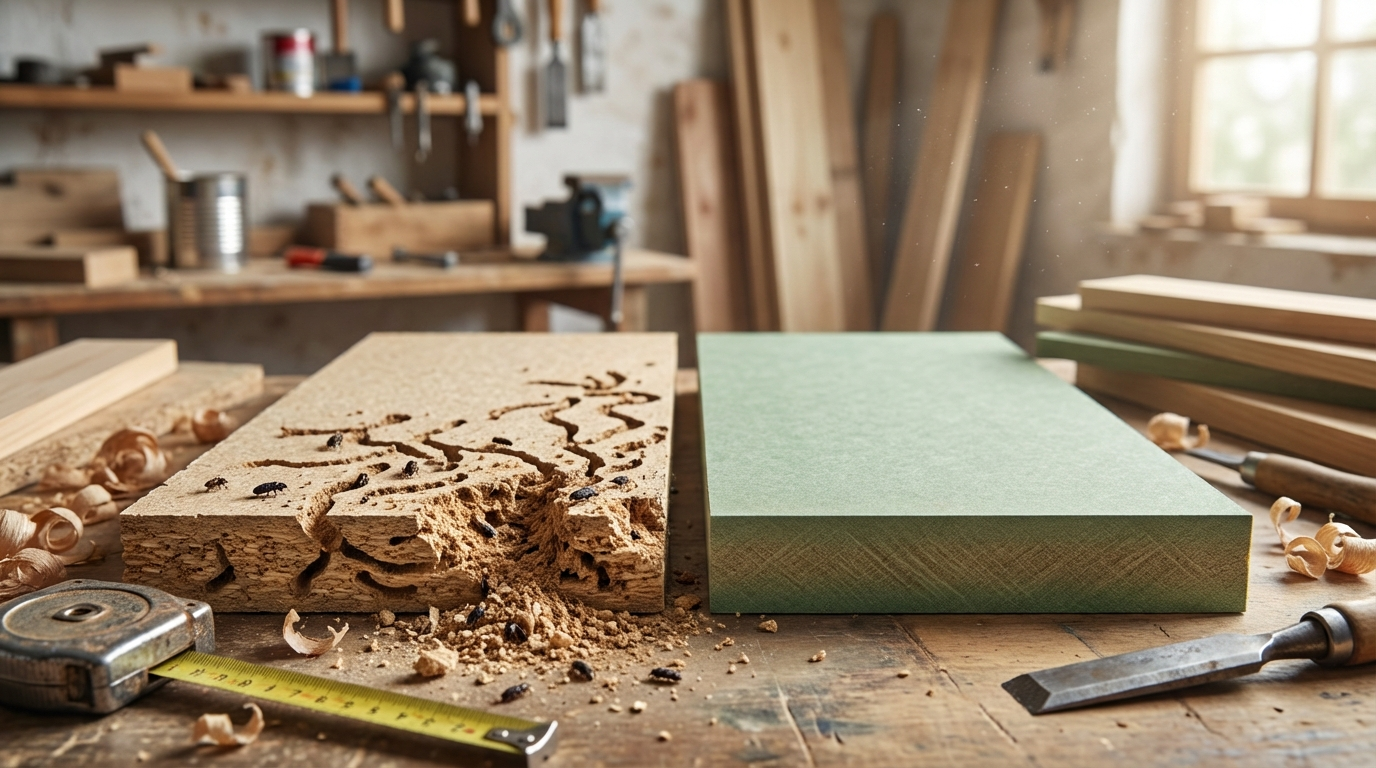
Is MDF termite-proof and resistant to fungus?
MDF is inherently resistant to termites and fungal attack due to the resin and wax content that creates an unfavourable environment for these organisms. The dense, compressed structure leaves no natural voids where termites typically nest. However, this resistance is not absolute—severely damaged MDF with exposed, moisture-compromised core can eventually attract fungus. The key protection factor is maintaining the integrity of surface finishes and preventing prolonged moisture exposure. Unlike natural wood, MDF doesn't require separate termite treatment, but routine inspection during monsoon is still advisable for early problem detection.
What are the standard MDF sheet sizes available in India?
In the Indian market, MDF is primarily available in three standard sheet sizes: 8ft x 4ft (2440mm x 1220mm) which is the most common and economical; 8ft x 6ft (2440mm x 1830mm) which is larger and suitable for tall wardrobes with fewer joints; and 6ft x 4ft (1830mm x 1220mm) which is easier to handle for small projects. Thickness options typically range from 2.5mm to 25mm, with 6mm, 8mm, 12mm, 17mm, and 18mm being most commonly stocked. Pre-laminated MDF is predominantly available in 8ft x 4ft size. Always confirm availability of specific sizes and thicknesses with your local dealer before finalizing designs.
How does MDF compare to plywood in terms of cost and performance?
MDF typically costs 20-40% less than equivalent quality plywood, making it attractive for budget-conscious projects. However, the cost comparison isn't straightforward because their performance profiles differ significantly. MDF excels in: surface smoothness for painting, dimensional consistency, machinability for CNC work, and absence of surface defects. Plywood excels in: structural strength, moisture resistance, screw-holding in edges, and impact resistance. For painted furniture faces, MDF is often the better value. For structural elements, load-bearing shelves, and areas with moisture exposure, plywood's premium is typically justified. Many quality furniture pieces combine both—plywood for carcass, MDF for doors and drawer fronts.
What should I look for when buying MDF to ensure good quality?
Quality MDF assessment involves several checks. First, verify weight—an 8ft x 4ft sheet of 18mm standard MDF should weigh approximately 35-42 kg; significantly lighter indicates low density and inferior quality. Second, examine surface smoothness under angled light—quality MDF has mirror-smooth faces with no visible fibre patterns. Third, check edge consistency—uniform colour and density without visible layers or gaps. Fourth, measure thickness at multiple points—variation should not exceed 0.3mm. Fifth, ask for density specification (aim for minimum 700 kg/m³ for standard applications) and emission class certification (E1 or better). Finally, inspect for storage damage—reject sheets with corner damage, surface marks, or musty smell indicating moisture exposure.
Disclaimer: This content is provided for general informational purposes based on industry practices and publicly available information. Product specifications, standards, prices, and availability may vary by manufacturer, region, and time. Readers should independently verify details with manufacturers, dealers, or qualified professionals before making purchase or construction decisions.Want Plywood Suggestions?
Share a few details and a VIR MDF specialist will suggest suitable brands and connect you to responsive dealers.