Why Does MDF Swell? 9 Causes + Prevention (Edges, Water, Storage)
MDF swelling is usually predictable. Learn the top causes—water, edges, storage—and simple prevention steps that save your project.
Quick Decision Summary
MDF swells mainly from moisture absorption via unsealed edges, direct water, or humid storage—prevent by sealing edges immediately and using moisture-resistant grades in risky spots.
If you’re in a hurry: Pick HDFWR or moisture-resistant MDF for humid Indian sites. Seal all cut edges with primer or banding before exposure. Store sheets flat, off-ground, under cover. During monsoon, cover installed work and avoid wet zones without extra lamination. Test a sample edge with water—if it darkens or puffs in 30 minutes, reject the batch. This cuts swelling risk by over 80% in typical projects.
- Choose this if… your site has controlled humidity (<60%), dry storage, and full edge sealing planned.
- Avoid this if… coastal/monsoon exposure without HDFWR upgrade or proper workflow timing.
What This Material/Option Actually Is
MDF, or Medium Density Fiberboard, is an engineered wood panel made by compressing wood fibers with resins under heat and pressure. It creates a smooth, uniform sheet ideal for furniture, cabinets, and interiors. Standard MDF has a density of 650–800 kg/m³, comes in thicknesses from 3–25 mm, and often gets laminated or veneered for surfaces.
Unlike plywood, MDF has no voids or grain direction, so it cuts cleanly for CNC work. But its fiber structure soaks up water easily if unprotected, leading to swelling. Moisture-resistant variants add hydrophobic resins or waxes, raising density slightly. In India, plain MDF suits dry interiors; upgrades handle humid conditions better.
Key specs to note: core density affects water resistance; edge sealing is non-negotiable post-cutting. It’s cheaper than solid wood but needs finishing to last.
Why It Matters in Indian Homes and Sites
In Indian homes, MDF swelling hits hard during monsoons when humidity spikes above 80%, turning wardrobes, kitchen shutters, and wall panels into warped messes. Coastal areas like Mumbai or Chennai face constant salt-laden moisture, accelerating edge puffing. Sites often lack covered storage, so sheets stacked on bare floors absorb ground dampness overnight.
Consequences show fast: edges swell 2–5 mm in days, ruining screw holds for hinges and weakening modular fits. In kitchens, steam from cooking swells laminates, causing bubbles. Poor workmanship—like delayed edge banding—doubles failures in humid Pune or Bangalore builds. Prevention saves rework costs, which can hit 20–30% of material budget.
Practical upside: Sealed properly, MDF lasts 10+ years in bedrooms. But ignore site realities, and it fails prematurely, frustrating carpenters and homeowners alike.
The 9 Main Causes of MDF Swelling
MDF swelling stems from its porous fiber matrix trapping water molecules, expanding volume by 10–30% in severe cases. Here are the top 9 causes, ranked by frequency in Indian projects.
- Direct water exposure: Spills, leaks, or rain hits unprotected surfaces, soaking in seconds.
- Unsealed cut edges: Fresh CNC cuts expose raw fibers, absorbing humidity 10x faster than faces.
- High ambient humidity: Monsoons over 70% RH cause slow, uniform swelling over weeks.
- Poor storage conditions: Sheets on damp floors or uncovered piles wick moisture from below.
- Inadequate edge banding: Thin or gapped PVC/ABS strips let water seep underneath.
- Low core density: Under 650 kg/m³ boards swell quicker under same moisture load.
- Installation delays: Cut pieces left unsealed overnight in humid sites puff by morning.
- Steam/vapor in kitchens: Cooking fumes condense on cool surfaces, drilling into laminates.
- Rough handling damage: Dents or micro-cracks create weak spots for faster ingress.
Each cause ties to workflow gaps—fix them sequentially for near-zero swelling.
Why Do MDF Edges Swell First and Fastest?
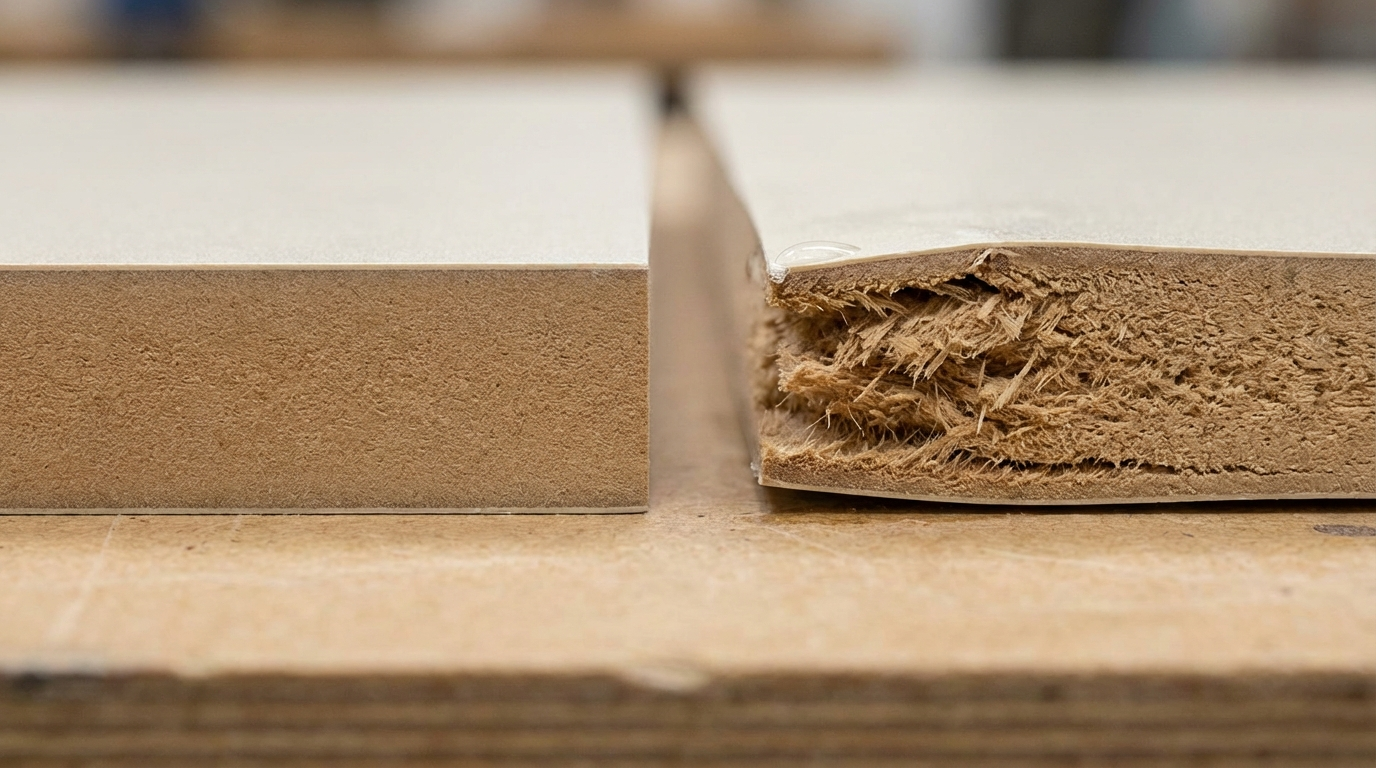
MDF edges swell first because cut fibers stand exposed like a sponge end-grain, with 5–10x higher absorption than sealed faces. In India’s humid air, they pull moisture radially, puffing 2–4 mm outward in hours. Prevention starts here: Apply edge primer within 30 minutes of cutting, then band immediately. Check by dripping water on a test edge—if it darkens without beading, seal better. For coastal sites, double-prime edges. This simple step blocks 70% of failures, keeping wardrobe doors flat and screw holds strong. Next, inspect storage to avoid compounding risks.
Does Humidity Alone Make MDF Swell Without Water?
Yes, prolonged humidity above 65% RH causes gradual swelling as fibers equilibrate to ambient moisture—expect 1–2% thickness gain over months in monsoon-prone areas. Laminates slow it but don’t stop core uptake. Use dehumidifiers in godowns or switch to HDFWR grades with wax additives. Test: Weigh a sample sheet before/after 48 hours at 80% RH—if over 3% gain, it’s low-grade. In practice, combine with ventilation and sealed edges for dry interiors. Homeowners in Delhi summers see less issue, but Mumbai monsoons demand upgrades.
How to Prevent MDF Swelling: Step-by-Step Guide
Follow these 5 steps to cut swelling risk to under 5% in typical workflows.
- Assess site risks: Map humidity, wet zones, storage—upgrade to HDFWR if >60% RH average.
- Buy smart: Tap sheet faces; no telegraphing. Ask for density cert (650+ kg/m³).
- Store right: Flat stacks, 150 mm off ground, covered, ventilated—rotate stock FIFO.
- Cut and seal fast: CNC cut → prime edges → band within 1 hour. Use PU glue for bands.
- Install protected: Acclimatize 48 hours, silicone seal joints, avoid floor contact.
Failure point: Skipping step 4 causes 60% of issues. Track with a checklist per job.
Failure Modes and Fixes
| Symptom | Root Cause | Prevention | Fix If Happening |
|---|---|---|---|
| Edge puffing (2–5 mm) | Unsealed cuts | Prime + band immediately | Sand lightly, re-band, or replace panel |
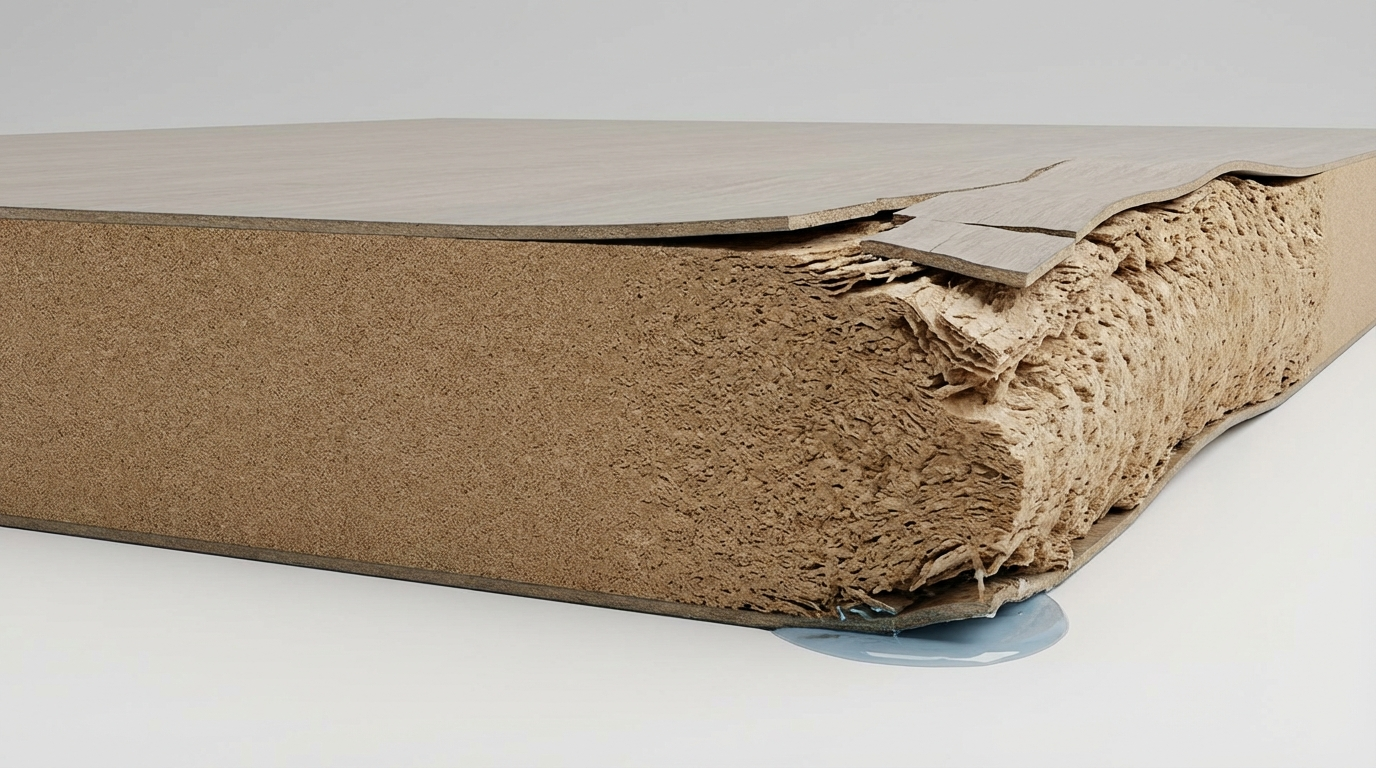
| Surface bubbling | Steam on laminate | Extra lamination + ventilation | Peel/re-laminate affected area |
| Core warping | Uneven humidity | Acclimatize + cover stacks | Discard if >3 mm bow |
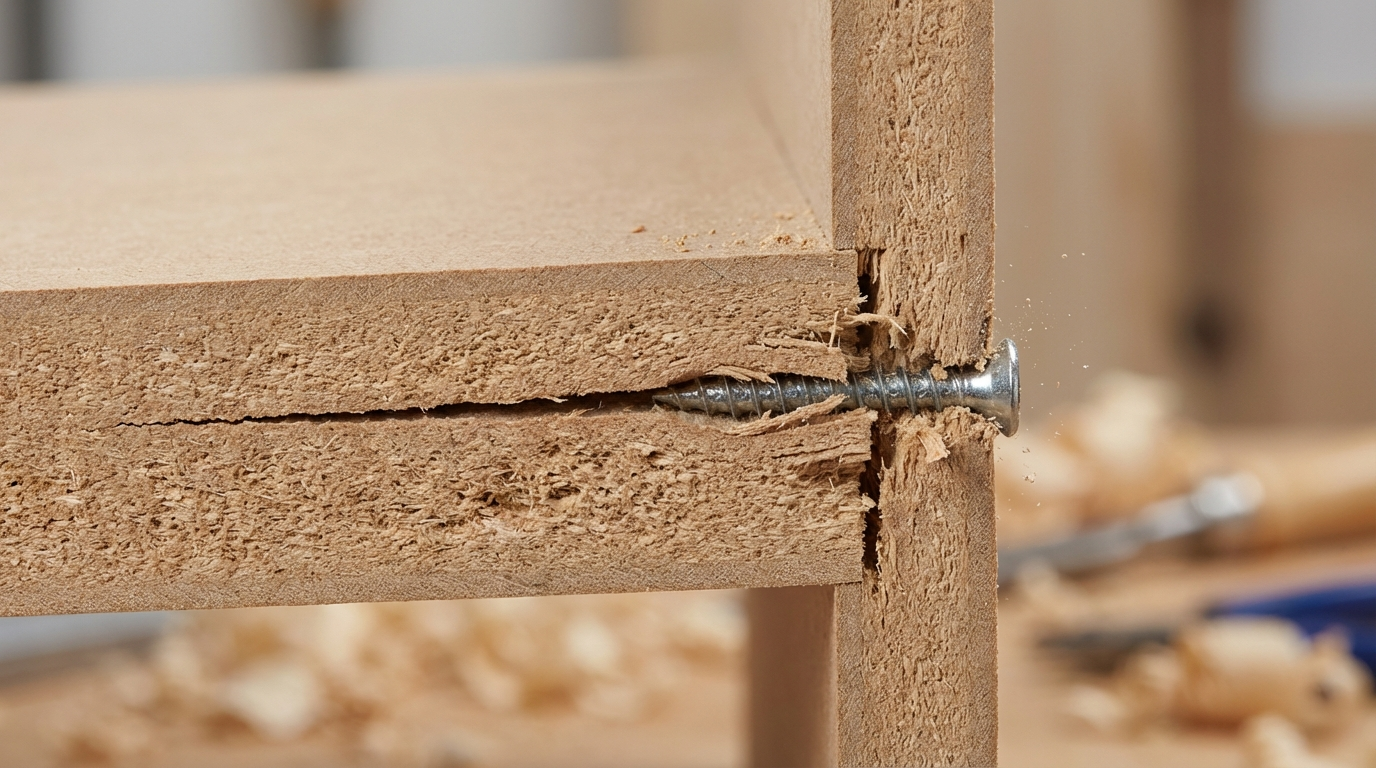
| Screw hold failure | Swollen edges | Seal before drilling | Re-drill wider, use inserts |
| Delamination | Water under bands | Full-glue bands, no gaps | Replace section |
| Slow uniform swell | Chronic humidity | HDFWR + dehumidify | Upgrade material in wet zones |
Spot early: Measure thickness daily on test pieces. In Indian sites, monsoon failures spike—cover work overnight.
Common Mistakes Homeowners and Carpenters Make
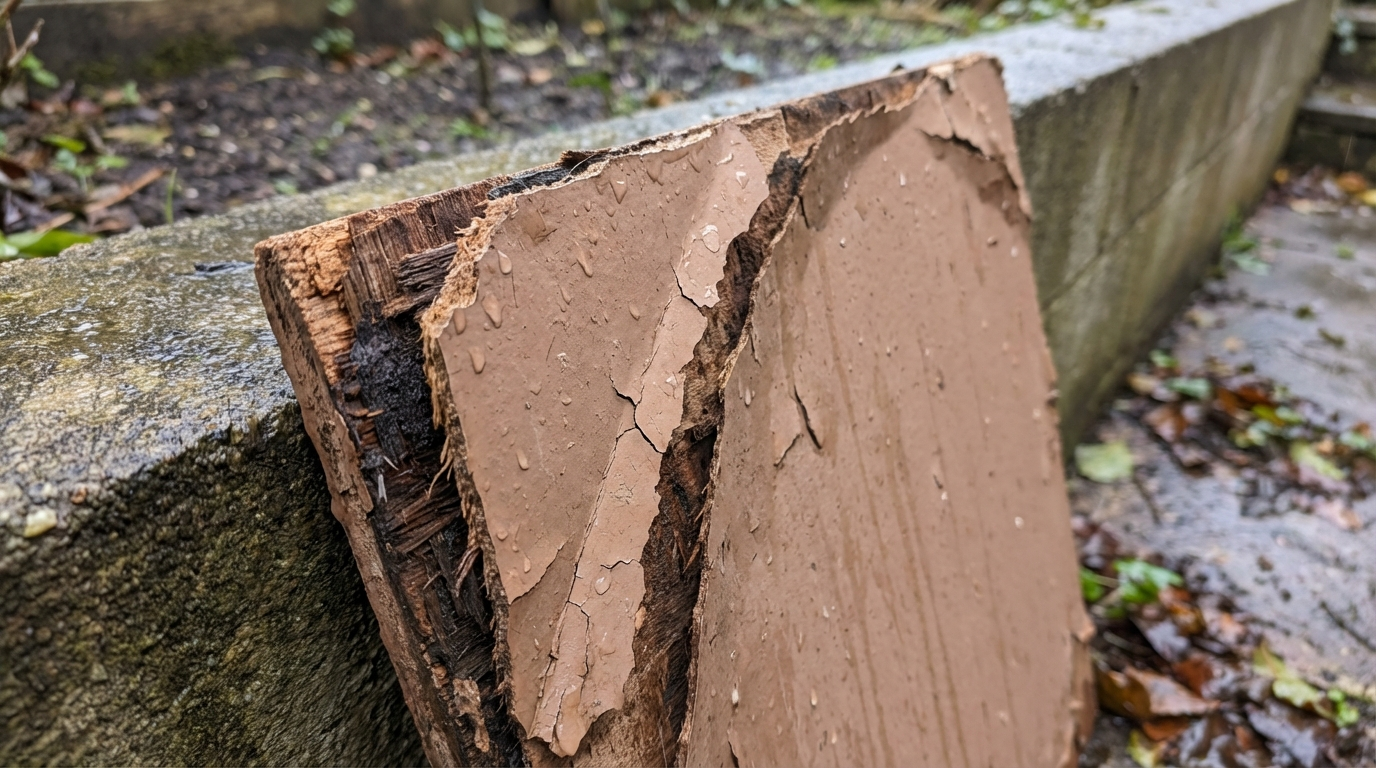
- Storing on-site uncovered: Rain soaks stacks—cover with tarps, elevate 6 inches.
- Delaying edge work: Cut today, band tomorrow—seal same day to beat humidity.
- Ignoring density: Cheap thin-core swells fast—tap for solid thud, not hollow.
- No acclimatization: AC godown to humid site shocks boards—48 hours mandatory.
- Using in kitchens raw: Steam kills laminates—add PVC wrap or avoid.
- Poor banding glue: PVA fails in damp—switch to PU for monsoon grip.
- Overloading shelves: Heavy loads crush moist cores—limit to 20 kg/sq m initially.
- Forgetting joints: Gaps let vapor in—silicone all seams post-install.
- Coastal salt ignore: Salt accelerates—rinse storage area, use WR grades.
Decision Framework for Swelling-Prone Conditions
| Condition | Recommended Approach | What to Verify |
|---|---|---|
| Monsoon humidity >70% | HDFWR + double edge seal | Density >750 kg/m³, wax content |
| Coastal salt air | Moisture-resistant + PVC bands | No surface corrosion on sample |
| Wet kitchen/ laundry | Avoid MDF; use WPC | Steam test on sample laminate |
| Tight budget | Standard MDF + strict sealing | Prime penetration on edge test |
| Fast CNC project | Pre-laminated + quick PU band | Cut edge absorption time <5 min |
| Heavy use wardrobe | 18 mm HDF + metal inserts | Screw pull-out after 24h damp |
Quality Checks You Can Do Without Lab Tests
Before buying:
- Tap faces—uniform solid sound, no soft spots.
- Check edges for fuzz—smooth indicates good compression.
- Weigh sample: 720 kg/m³ avg for 18 mm feels hefty.
- Water bead test on face: Repels 10 seconds = decent resin.
After cutting:
- Drip water on edge— no darkening in 2 minutes.
- Feel for heat telegraphing from friction.
- Inspect dust: Fine powder = clean cut, chunks = dull tool.
After install:
- Press edges—no give or moisture feel.
- Check alignment gaps <1 mm.
- Clean with dry cloth only first week.
In humid godowns, do these weekly on stock.
Tips for Homeowners, Carpenters, Architects, and OEMs
Homeowners: Wipe spills instantly with dry cloth; ventilate kitchens; avoid direct AC drip on panels. Use coasters under vases. Expect 5–7 year life in bedrooms if sealed.
Carpenters: Cut in dry shop, batch-prime edges, use 1.5 mm ABS bands with PU. Pre-drill hinges 2 mm oversize in swollen risks. Handle with gloves to avoid oils.
Architects/Designers: Spec 12–18 mm HDFWR for humid zones, detail 2 mm overhangs for edges, insist on silicone joints. Plan ventilation in drawings.
OEM/Modular Makers: QC every 50th panel with edge soak test; standardize CNC feeds to minimize heat; track return rates by batch for density flags.
Is All MDF the Same for Swelling Risk?
No—standard MDF swells fastest; moisture-resistant types with added paraffin resist 2–3x better in 80% RH. Density matters: 800 kg/m³ holds firmer. In India, check by soaking edge samples 30 minutes—minimal puff means good. Trade-off: WR grades cost 20–40% more but save rework. For dry wardrobes, standard works; kitchens need upgrades. Next step: Ask supplier for a test piece from same batch. This verifies without guesses.
How Long Before Cut MDF Must Be Sealed?
Seal within 1 hour max post-cut, ideally 15 minutes in humid shops. Exposed fibers wick air moisture fast, swelling irreversibly. Use spray primer first, then band. In monsoon workflows, tent the CNC area. Check: Cut a scrap, wait times, measure puff. Prevention beats fixes—unsealed delays cause 40% of site rejects. Architects, spec this in drawings for contractors.
Can You Fix Already Swollen MDF?
Slight edge swelling (<2 mm) can sand flat, re-prime, and band—but core damage weakens holds. Full panels often need replacement as drying warps them. Dry slowly in AC, then assess screw test. In practice, isolate to save time. Prevention via storage covers pays back. For OEMs, cull batches early to cut returns 50%.
FAQs
Why does MDF swell more than plywood?
MDF’s uniform fiber matrix lacks plywood’s cross-grain barriers, so moisture spreads evenly and expands faster—up to 15% vs plywood’s 5–8%. In Indian monsoons, unsealed MDF edges puff visibly in days, while plywood holds shape longer. Choose plywood for steam areas, MDF for smooth finishes if sealed. Verify by comparing soaked samples: MDF darkens quicker. This guides wet-zone picks without lab gear.
Does laminate stop MDF swelling completely?
Laminate protects faces well but edges remain vulnerable—water sneaks under if not banded, swelling from sides. In coastal humidity, combine 0.8 mm melamine with full PVC edges. Expect face protection for 2–3 years spills, but core needs WR MDF base. Test: Spill water on laminated edge—beading means good seal. Homeowners, this duo fits budget wardrobes.
What’s the best storage for MDF sheets in India?
Store flat in ventilated sheds, elevated 150–300 mm on pallets, covered with breathable tarps—avoid plastic sheeting that traps condensation. Rotate stock first-in-first-out. In humid godowns, space stacks 50 mm for air flow. This prevents bottom-sheet wicking, common in rainy seasons. Carpenters, check weekly for soft spots. Proper setup halves swelling complaints.
Can MDF handle kitchen use without swelling?
Standard MDF struggles with cooking steam; use HDFWR 18 mm with heavy-duty lamination and stainless backsplashes. Seal all joints with silicone. In Indian homes, ventilate well—expect edge issues in 6 months otherwise. Avoid open shelves near stoves. Architects, spec exhaust fans. This setup lasts 5+ years with care.
How much does humidity need to be for MDF swelling?
Swelling starts above 65% RH sustained, accelerating over 75%—typical Mumbai monsoon levels cause 1–2 mm gain weekly if unsealed. Dry to 40–50% RH reverses minor cases slowly. Use hygrometers on-site; dehumidify storage. In Bangalore builds, fans suffice; Chennai needs WR grades. Monitor with cheap meters for proactive fixes.
Why do some MDF brands swell less?
Higher resin content, denser fibers (750+ kg/m³), and wax additives slow absorption—varies by batch. Indian mills differ in fiber quality. Test consistently: Edge soak time over 10 minutes signals better grade. No brand is immune unsealed. Focus on specs, not names, for repeatable results across suppliers.
Does painting edges prevent swelling?
PU primer or enamel paints block 60–70% moisture if two coats applied thick post-cut. Better than nothing but inferior to banding for high-wear edges. In dry interiors, it works; humid sites need both. Apply within 30 minutes, sand between coats. Cost-effective for DIY but pros prefer mechanical bands for durability.
What if MDF swells during transport?
Rain exposure or truck condensation soaks sheets—inspect on arrival, reject wet batches. Dry gently in shade, test edges. Prevent with waterproof covers, secure flat loads. Common in long-haul from inland mills to coasts. Insist on covered vehicles; this avoids 20% material loss in rainy seasons.
Is HDF better than MDF for swelling?
HDF (850+ kg/m³) resists better due to tighter fibers, swelling 30–50% less in same conditions. Ideal for edges and humid India. Trade-off: Harder to CNC, 15–25% pricier. Use for shutters, standard MDF for carcasses if sealed. Verify density by weight/feel for fair picks.
Disclaimer: This content is provided for general informational purposes based on industry practices and publicly available information. Product specifications, standards, prices, and availability may vary by manufacturer, region, and time. Readers should independently verify details with manufacturers, dealers, or qualified professionals before making purchase or construction decisions.Want Plywood Suggestions?
Share a few details and a VIR MDF specialist will suggest suitable brands and connect you to responsive dealers.